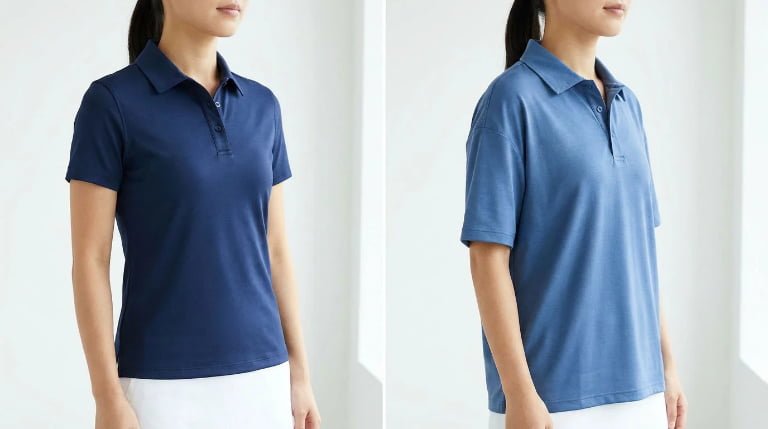
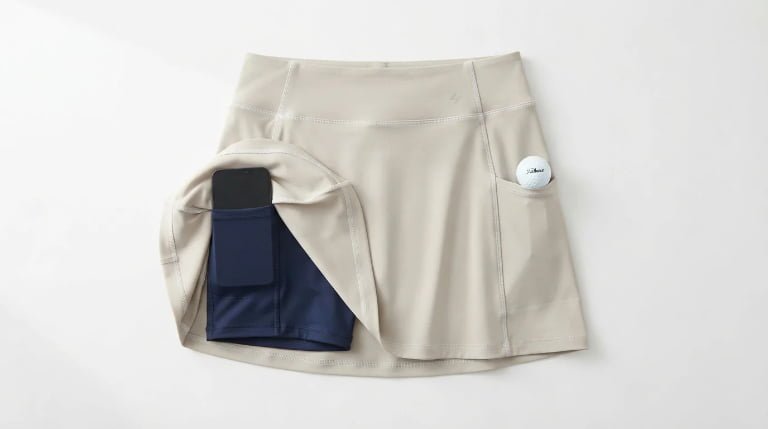
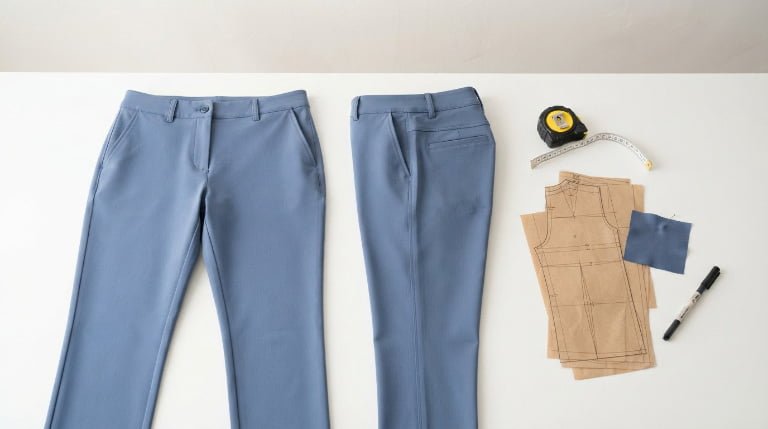
Women’s golf apparel size grading develops an approved base pattern into a defined size range while maintaining the intended fit, proportions, coverage, and movement. It requires separate decisions for bust, waist, hip, shoulder, armhole, and length—not one enlargement percentage applied to the entire garment.
For golf brands, a successful grading system connects four things: target body measurements, finished-garment specifications, pattern grade rules, and physical fit validation.
This guide explains how to review those elements for women’s golf polos, skorts, bottoms, and layers before approving production.
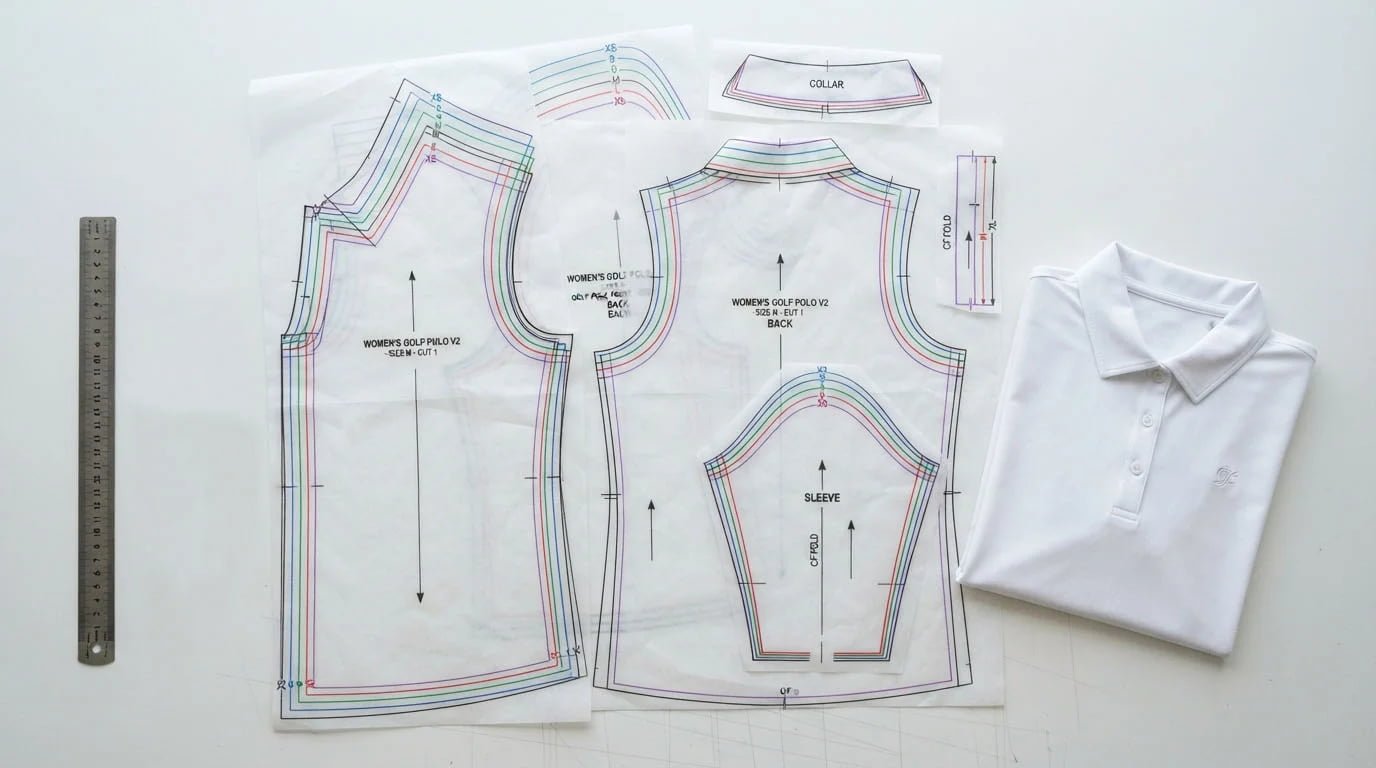
Start With the Target Wearer and an Approved Base Fit
Grading cannot resolve an unfinished base pattern. If the original polo pulls across the bust or the skort liner rides up, extending that pattern into more sizes carries the problem into the size range.
Before grading, confirm:
- Target body profile: Bust, waist, hip, height, and other measurements relevant to the product.
- Fit direction: Close-fitting, regular, or relaxed, with defined coverage and movement expectations.
- Size range: The actual sizes offered, including any separate petite, tall, or extended-size fits.
- Base size: A size supported by an appropriate fit model and approved measurements.
- Fabric and construction: Materials and components representative of the intended product.
A size near the middle of the range can be a practical starting point, but “always use Medium” is not a grading rule. An established brand may already have an approved block in another size.
For women’s polos, resolve bust shaping, shoulder geometry, and front-to-back balance before extending the pattern. Our women’s versus men’s golf polo design guide covers those initial development decisions.
Separate Body Measurements, Garment Specifications, and Grade Rules
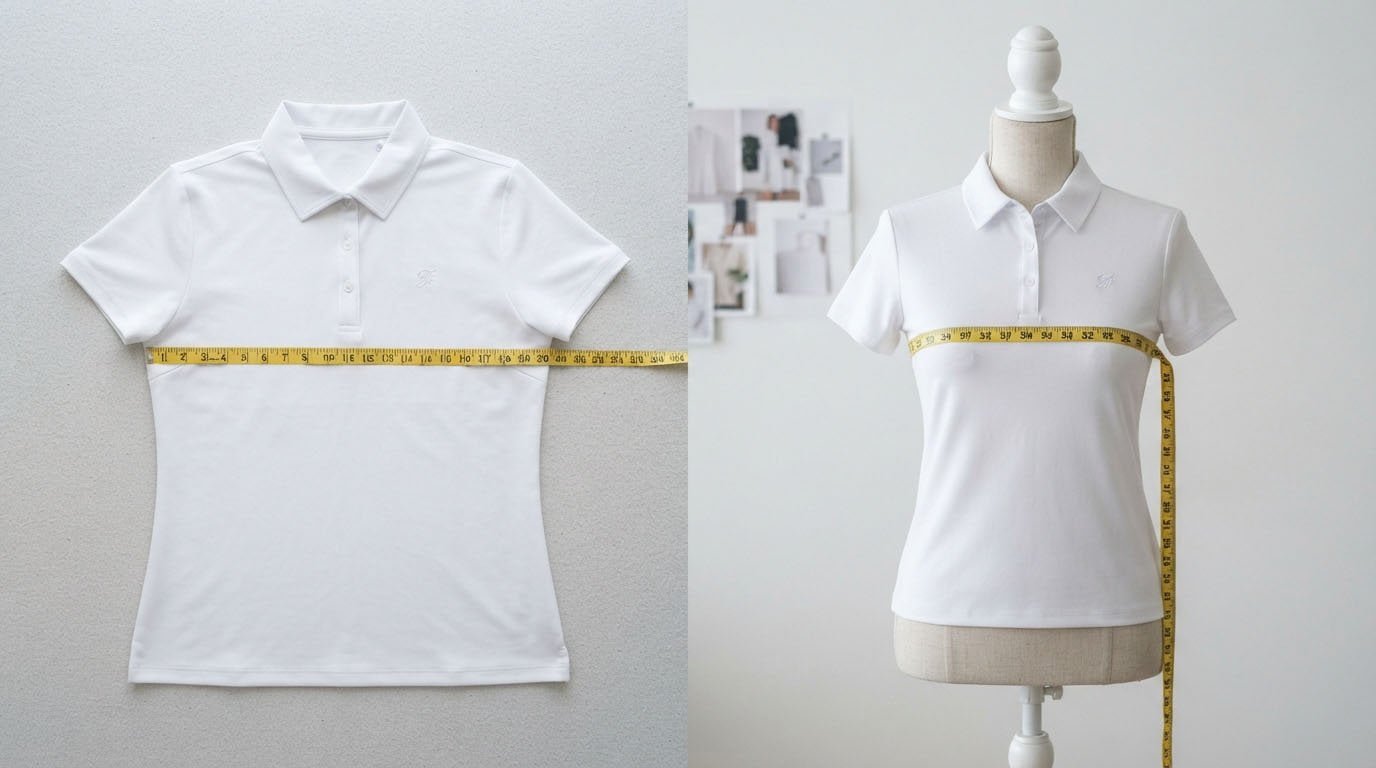
These documents serve different purposes.
| Information | What It Describes | Main Use |
|---|---|---|
| Body size chart | Measurements of the intended wearer | Customer size selection and fit development |
| Finished-garment specification | Target measurements of the completed garment | Sample review and production inspection |
| Grade rule table | Changes assigned to pattern grading points | Developing patterns in additional sizes |
| Measurement tolerance | Permitted deviation from an approved garment target | Production acceptance |
A customer-facing chart may contain body measurements or product measurements. Label it clearly rather than assuming every retail chart follows the same convention.
Compare Like Measurements When Calculating Ease
For corresponding circumference measurements:
Garment circumference − body circumference = nominal ease
For illustration, a 96 cm garment bust circumference compared with a 90 cm body bust gives 6 cm of positive ease.
That calculation is useful only when the measurements refer to corresponding locations. A flat chest width taken below the armhole is not automatically identical to half the wearer’s full-bust measurement.
Negative ease means the garment dimension is smaller than the corresponding body dimension. It may suit selected stretch garments, but it is not a requirement for every performance polo or skort liner.
Define Every Point of Measure
A point of measure, or POM, needs a starting point, endpoint, measurement path, unit, and garment condition.
“Bust: 48 cm” is incomplete if the factory does not know whether it means a flat width, full circumference, relaxed measurement, or stretched measurement.
Women’s Golf Polo Grading Chart: A Worked Example
A finished-garment grading chart makes differences between sizes visible before samples are cut.
The following numbers are invented teaching values. They are not a US body size chart, FUWAY’s standard fit, or validated production specifications. They demonstrate measurement conventions and arithmetic only.
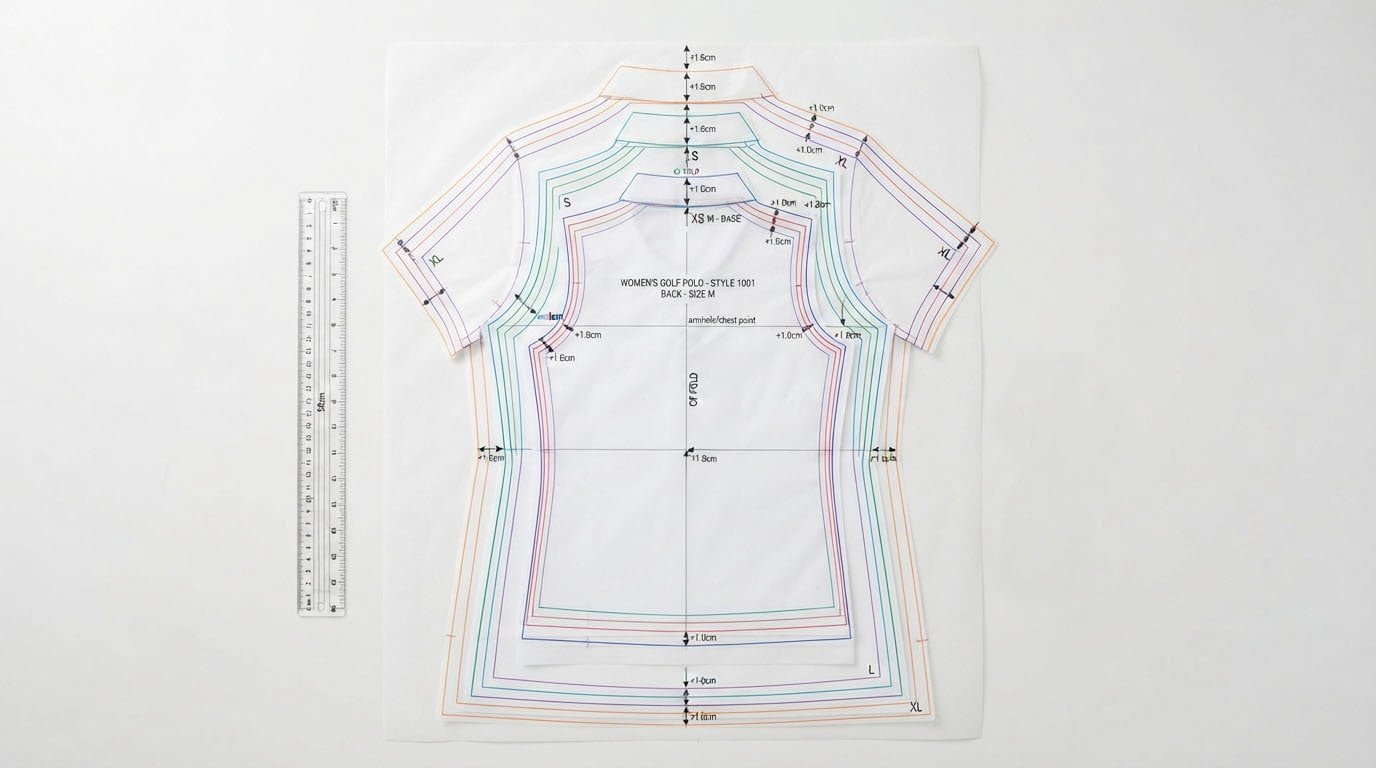
All measurements are in centimeters. Garments are measured relaxed and laid flat.
| Finished-Garment POM | XS | S | M — Base | L | XL |
|---|---|---|---|---|---|
| Chest half-width | 43.0 | 45.5 | 48.0 | 50.5 | 53.0 |
| Waist half-width | 38.0 | 40.5 | 43.0 | 45.5 | 48.0 |
| Hem half-width | 45.0 | 47.5 | 50.0 | 52.5 | 55.0 |
| Across-shoulder width | 35.0 | 36.0 | 37.0 | 38.0 | 39.0 |
| Body length from high shoulder point | 60.0 | 61.0 | 62.0 | 63.0 | 64.0 |
For this example, chest width is measured straight across at the specified level below the armhole. Waist and hem widths require their own illustrated locations. Body length follows a defined path from the high shoulder point beside the neckline to the hem.
Read the Increment Correctly
From M to L:
- Chest half-width increases by 2.5 cm.
- Across-shoulder width increases by 1.0 cm.
- Body length increases by 1.0 cm.
A 2.5 cm increase in chest half-width represents a 5 cm increase in the doubled flat measurement.
The same POM can use a constant increment across a selected size group. Different POMs do not need identical increments, and some ranges may require changes at defined size boundaries.
Do not introduce changing increments simply to make a chart look more sophisticated. Each change should serve the target fit.
A Garment Chart Is Not a Complete Pattern Rule Table
The chart states intended finished dimensions. It does not tell the pattern maker how to distribute growth between front and back pieces or move individual pattern points.
Patterns also need checks for seam compatibility, shaping, notches, and component relationships. A numerically consistent chart can still produce an unbalanced garment.
Review the Measurements That Matter for Each Garment
Women’s polos, skorts, and layers share a need for consistent fit, but their critical grading relationships differ.
| Garment | Priority Measurements | Relationship to Verify Across Sizes |
|---|---|---|
| Polo | Bust, waist, hem, shoulder, armhole, upper arm, body length | Bust accommodation without excessive shoulder or armhole growth |
| Sleeveless polo | Bust, shoulder, neckline, armhole shape and opening | Coverage and edge stability during reaching and rotation |
| Skort | Waistband, hip, front/back length, liner rise, thigh and leg opening | Outer skirt and inner shorts work together without pulling |
| Shorts or pants | Waist, hip, front/back rise, thigh, inseam, leg opening | Seat and crotch balance without unwanted changes in leg proportions |
| Quarter-zip or jacket | Bust, upper back, armhole, upper arm, sleeve and body length | Movement and layering room over the intended underlayer |
Polos: Check Bust Volume and Front-Body Balance
Bust circumference alone does not describe bust shape or how the shirt hangs.
If the shoulders fit but the placket pulls and the front hem lifts, increasing the whole garment may create excess width elsewhere. Review front-body volume, shaping, length balance, and fabric behavior together.
Check the polo with the intended undergarment and button position. For sleeveless styles, review armhole coverage from the front, side, and back during movement.
Skorts: Grade the Outer Skirt and Inner Shorts Together
The outer skirt and liner do not need identical increments. They may use different fabrics and different amounts of ease.
However, they must remain compatible at shared attachment areas.
Across the size range, check whether:
- The waistband stays at its intended position.
- The liner accommodates the seat and thighs.
- Leg openings remain comfortable after walking.
- The liner pulls on the waistband or outer skirt.
- Front and back coverage remain appropriate during bending.
For choosing and defining the starting skirt length, see our golf skort length guide.
For standalone shorts, our golf shorts size grading guide explains waist, rise, thigh, and inseam measurements in more detail.
Layers: Fit Them Over the Intended Outfit
A quarter-zip that fits over a lightweight sleeveless top may feel different over a long-sleeve polo.
Use the intended underlayer during size-set reviews. Check upper-back reach, upper-arm room, sleeve movement, and hem position without assuming that extra chest width solves every layering issue.
Account for Fabric Behavior Without Confusing It With Tolerance
Stretch affects the relationship between body measurements and garment dimensions. It does not remove the need for an appropriate pattern.
Review:
- Stretch direction and extension under an agreed method.
- Resistance to stretch during normal wear.
- Recovery after extension.
- Dimensional change after laundering.
- Compatibility between shell fabric, liner, waistband, seams, and decoration.
Fiber composition alone is insufficient. Two fabrics with the same elastane percentage can behave differently because of construction and finishing.
Test representative sizes in the intended materials. If early prototypes use substitute fabrics, document that limitation and repeat relevant fit checks before final approval.
Measure Wash Changes by POM
Compare the same measurement before and after the agreed care procedure.
For illustration, a 60 cm body length that shortens by 3% loses 1.8 cm. That does not establish a universal “half-size” change: width may behave differently, and size intervals vary between products.
Decide whether each specification applies before washing, after washing, or at both stages. Record care conditions and acceptance limits separately from the grading increments.
Validate Representative Sizes and Any Fit-Block Transitions
Approving the base size confirms that one sample fits its intended wearer. It does not validate the full range.
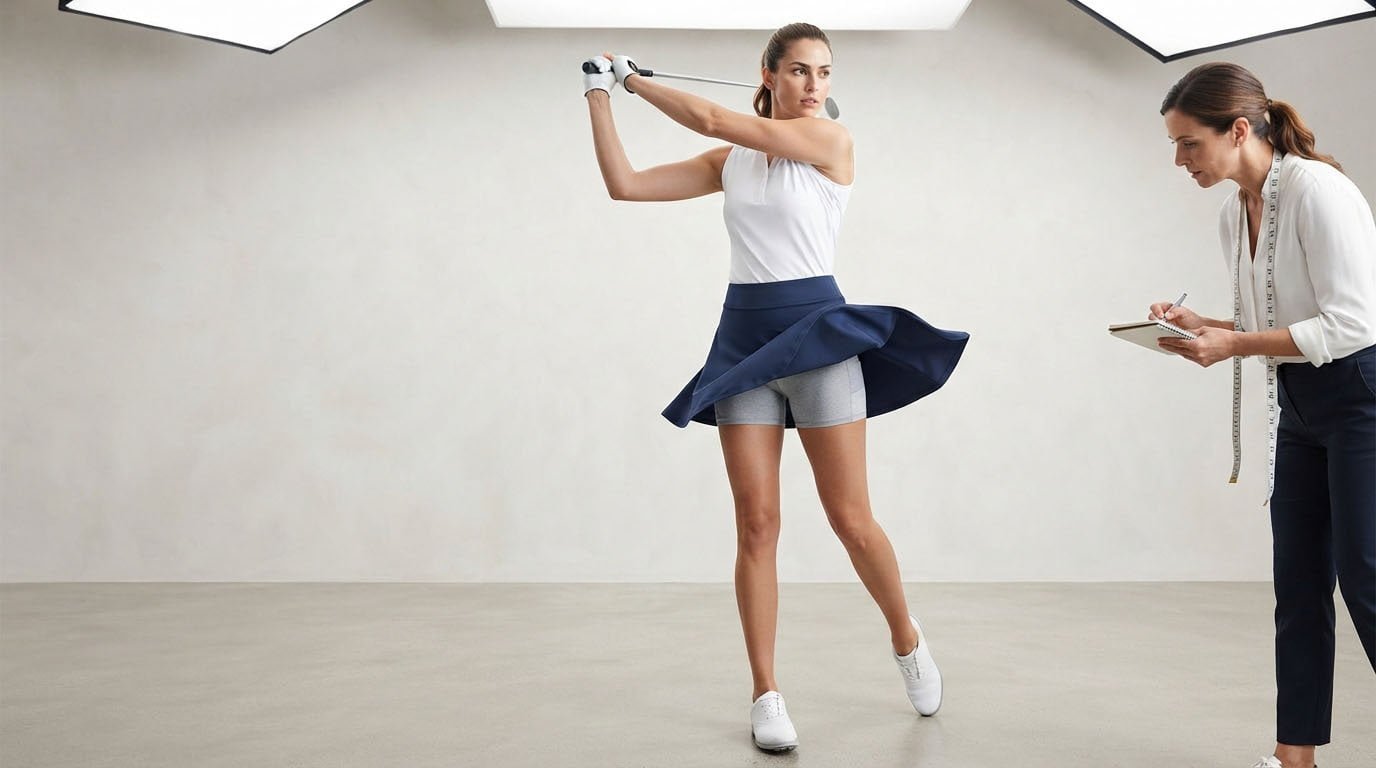
For an XS–XL launch, XS, M, and XL can provide an initial check of the range ends and base size. This is a planning example, not a universal minimum or proof that the other sizes fit.
Add samples where there are:
- Changes in grade increments.
- Separate fit blocks.
- New height or body-shape groups.
- Complex liners, waistbands, or fitted construction.
- Problems found during earlier reviews.
- Buyer requirements for a complete size set.
A dress form can support proportion checks, but movement assessment requires appropriate wearers or fit models.
When Should You Consider Another Base Block?
Consider another block when the intended body proportions cannot be served adequately by the existing pattern and grade rules.
Warning signs include persistent bust or seat imbalance, unsuitable armhole geometry, or excessive shoulder growth when circumference increases.
The decision should follow body data and fit results. There is no single maximum number of sizes that makes one block acceptable or unacceptable.
Petite and tall fits also require attention to vertical placement and proportions. They should not automatically be treated as smaller or larger regular sizes.
Use a Repeatable Golf Movement Review
Use the same review sequence for each selected size so findings can be compared.
- Standing: Check silhouette, seam balance, neckline, waistband, and hem position.
- Address position: Observe upper-back tension, bust pulling, and rear coverage.
- Backswing and follow-through: Check shoulder movement, armholes, torso rotation, and garment displacement.
- Bending and sitting: Review waistband pressure, front/back rise, and coverage.
- Walking and pocket access: Check liner movement and whether pocket use distorts the garment.
- After movement: Observe whether the garment settles back or requires repeated adjustment.
Record the size, fit model measurements, sample version, affected area, and required correction.
“XL feels tight” is difficult to act on. “XL restricts forward reach across the upper back while the standing chest measurement meets specification” gives the technical team a clearer problem to investigate.
For the broader production approval process, use our garment fit approval checklist.
Separate Grade Increments From Production Tolerances
A grade increment is the intended difference between sizes. A tolerance is the permitted difference between an actual garment and its approved target.
For example:
- M chest half-width target: 48.0 cm
- L chest half-width target: 50.5 cm
- Grade increment: +2.5 cm
- If the approved half-width tolerance is ±1.0 cm, L’s measurement acceptance range is 49.5–51.5 cm.
That acceptance range applies to the stated half-width POM. Doubling the measurement also doubles its numerical deviation; a half-width tolerance must not be copied unchanged onto a circumference specification.
At FUWAY, the standard finished-garment tolerance for specified POMs is ±1.0 cm, with stricter requirements applied where defined in the approved Tech Pack.
Meeting measurement tolerances does not automatically prove that a garment fits correctly. Several measurements near their permitted limits can affect overall balance, and pattern shape may still need review.
See our golf apparel measurement tolerance guide for detailed inspection considerations.
Confirm the Grading Approval Package Before Bulk Cutting
Keep the approved body chart, garment specifications, patterns, and sample comments aligned to the same revision.
The grading package should contain:
- Target body measurements and fit direction.
- Approved base pattern and sample reference.
- Finished-garment measurements for every planned size.
- Illustrated POM methods and units.
- Approved pattern grade rules.
- Tolerances and measurement conditions.
- Size-set findings, movement comments, and required corrections.
- Relevant wash results and final approval records.
Our golf apparel tech pack checklist covers the remaining production documentation.
Use a clear decision for the grading package:
| Decision | Meaning | Next Action |
|---|---|---|
| Approve | Required grading, measurement, fit, and material checks are complete | Record approval and confirm remaining production requirements |
| Hold | Evidence or a required sample is missing | Complete the missing check before releasing the affected work |
| Revise and resample | A grading, proportion, or movement problem remains | Correct the relevant specifications or patterns and verify again |
Approval of grading is one part of production readiness. It does not replace approval of materials, decoration, construction, or other requirements.
Frequently Asked Questions
Can women’s golf apparel be graded from a men’s pattern?
Do not assume a men’s block will serve the intended women’s fit simply by reducing its measurements. The starting pattern needs to accommodate the target bust, shoulder, waist, hip, and length relationships.
A shared or unisex design still needs validation on the intended wearers.
Should garment length increase with every size?
Not necessarily. Some products retain a fixed length across selected sizes; others use length increments or separate height options.
Check the resulting coverage and proportions rather than automatically linking length growth to circumference growth.
Can the same grading chart be reused for a new fabric?
Treat it as a starting reference. Changes in stretch resistance, recovery, drape, shrinkage, or construction can change fit even when the flat dimensions remain the same.
Verify the new material before approving the chart for production.
Should logos and pockets increase in size with every garment size?
Not automatically. Some dimensions can remain fixed, while placement or size may change by size group.
Check appearance and accessibility on representative garments. Document any changes instead of letting them happen through automatic scaling.
What if a sample meets the measurement chart but still fits poorly?
Investigate pattern shape, front/back distribution, fabric behavior, construction, and whether the fit model matches the intended body profile.
Passing flat measurements confirms only part of the approval process.
Conclusion
Reliable women’s golf apparel grading starts with an approved fit and a clear target wearer. Keep body measurements, finished-garment specifications, pattern rules, and production tolerances separate, then verify how they work together across the intended size range.
For polos, protect bust accommodation and upper-body movement. For skorts, coordinate the outer skirt, liner, and waistband. For extended sizes and layers, validate proportions and wearing conditions rather than relying on a larger set of numbers.
For a women’s golfwear project, share your reference garment, target body chart, planned size range, and fabric direction with FUWAY. Our custom golf skort manufacturing page outlines relevant product and customization options for discussing the next development step.