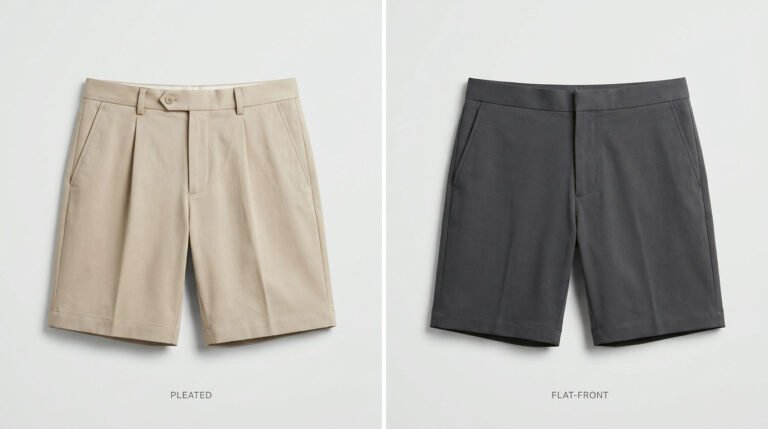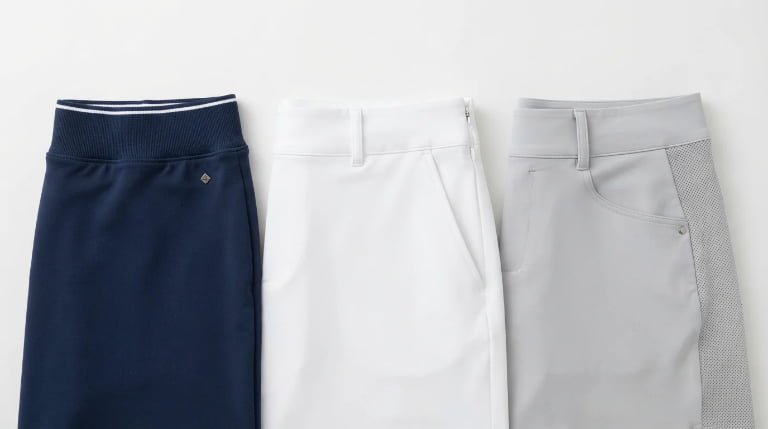
A golf shorts sample may fit perfectly in size 34 but feel too tight through the thighs in size 38. The waistband may fit correctly while the rise or leg opening changes the intended silhouette.
These problems often begin with size grading—not the original design.
Golf shorts size grading develops a full size range from an approved base pattern. It defines how waist, hip, front and back rise, thigh, inseam, and leg opening measurements change between sizes while maintaining the intended fit and proportions.
For golf apparel brands, the goal is not simply to enlarge patterns. It is to establish measurable grade rules that support consistent fit across the intended size range.
This guide explains grading charts, key measurement increments, and how to identify grading problems before production.
What Is Golf Shorts Size Grading?
Size grading starts with an approved base-size pattern and develops additional sizes through defined measurement increments and pattern adjustments.
For example, a brand may approve size 34 before developing sizes 30, 32, 36, and 38.
Not every dimension changes by the same amount.
Body Measurements vs. Finished Garment Measurements
Brands should distinguish three terms:
| Term | Meaning | Example |
|---|---|---|
| Body Measurement | Measurement of the intended wearer | Customer's waist circumference |
| Finished Garment Specification | Target dimensions of completed shorts | Approved waistband circumference |
| Grade Rule | Measurement increments between sizes or pattern-point movements | Waist increases 5 cm between adjacent sizes |
Finished-garment measurements differ from body measurements depending on wearing position, ease, fabric behavior, and waistband construction.
A consumer-facing size chart may describe body measurements, while a manufacturing specification must define actual garment dimensions.
Never use a retail size chart as a complete manufacturing grading specification.
Why Grading Matters
Incorrect grading can cause:
- Waistbands that fit while thighs remain too tight.
- Unbalanced rise proportions across sizes.
- Leg openings that become excessively narrow or wide.
- Inconsistent hem positions.
- Additional pattern revisions and size-related returns.
Good grading begins with an approved base fit and a defined target customer.
If you are still selecting the overall silhouette and inseam, see How to Choose Golf Shorts for Your Brand.
Golf Shorts Size Grading Chart: Sizes 30–38
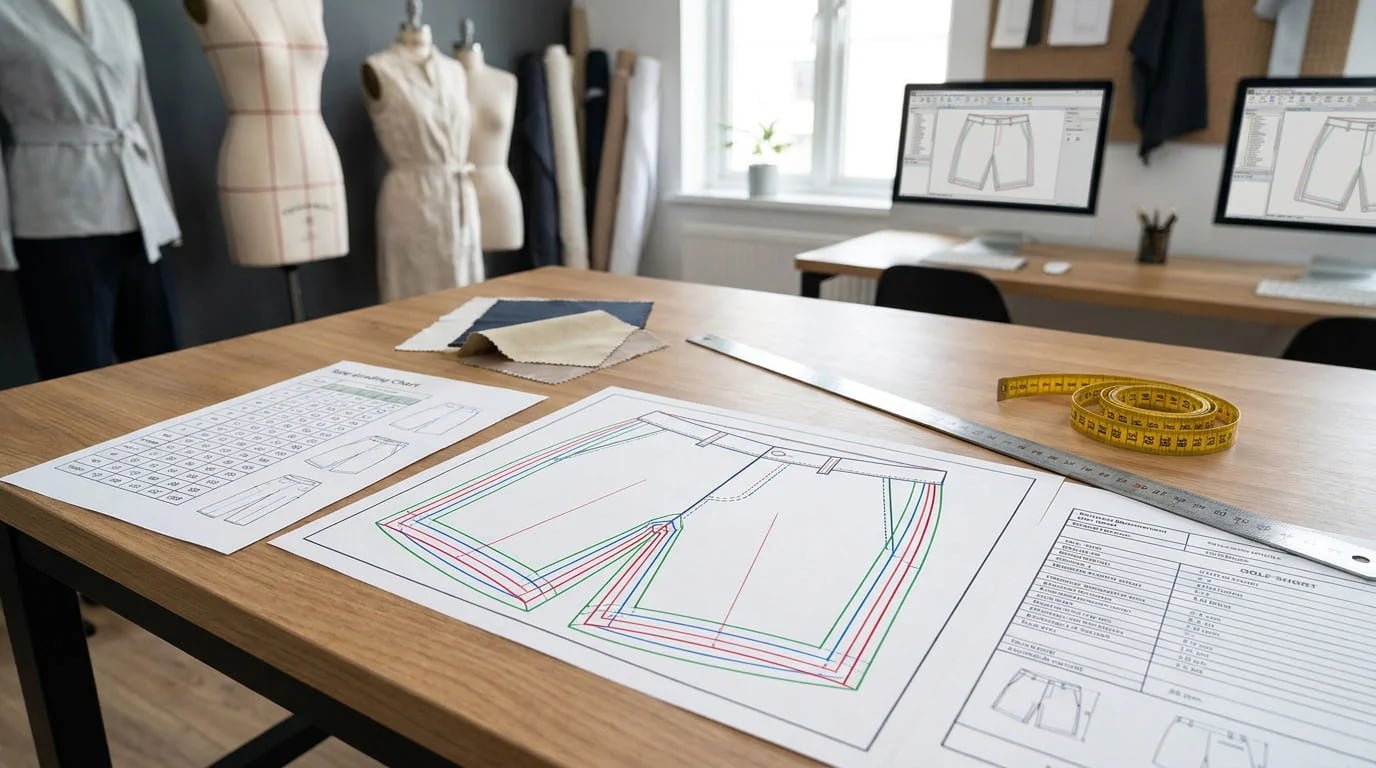
A grading chart shows how approved finished-garment measurements change across sizes.
The following example uses a men's golf shorts range with size 34 as the base.
Important: These are illustrative measurements, not FUWAY's universal grading standards or validated production specifications. Actual measurements depend on the target customer, fit, fabric, and waistband construction.
Example Finished-Garment Grading Chart
All measurements are in centimeters.
| Measurement Point | Size 30 | Size 32 | Size 34 (Base) | Size 36 | Size 38 |
|---|---|---|---|---|---|
| Waist Circumference | 80 | 85 | 90 | 95 | 100 |
| Hip Circumference | 98 | 103 | 108 | 113 | 118 |
| Front Rise | 25 | 25.5 | 26 | 26.5 | 27 |
| Back Rise | 36 | 36.5 | 37 | 37.5 | 38 |
| Thigh Circumference | 60 | 62 | 64 | 66 | 68 |
| Inseam Length | 23 | 23 | 23 | 23 | 23 |
| Leg Opening Circumference | 48 | 49 | 50 | 51 | 52 |
This example assumes a fixed-waistband construction and consistent measurement procedures.
How to Read the Grade Increments
Using sizes 34 and 36:
| Measurement | Size 34 | Size 36 | Grade Increment |
|---|---|---|---|
| Waist | 90 cm | 95 cm | +5 cm |
| Hip | 108 cm | 113 cm | +5 cm |
| Front Rise | 26 cm | 26.5 cm | +0.5 cm |
| Back Rise | 37 cm | 37.5 cm | +0.5 cm |
| Thigh | 64 cm | 66 cm | +2 cm |
| Inseam | 23 cm | 23 cm | 0 cm |
| Leg Opening | 50 cm | 51 cm | +1 cm |
Grade Increment = Next Size Measurement − Previous Size Measurement
For the waist:
95 cm − 90 cm = +5 cm
For the front rise:
26.5 cm − 26 cm = +0.5 cm
Horizontal and vertical measurements do not require identical increments.
However, a finished-garment grading chart is not a CAD pattern grading rule table. Pattern makers must distribute dimensional changes across the appropriate pattern pieces and grading points.
The resulting patterns must also be checked for shape, seam compatibility, and fit—not numerical consistency alone.
How to Grade Waist, Rise, Thigh, and Inseam
Each measurement contributes differently to golf shorts fit and appearance.
Before establishing increments, define exactly how every point of measurement (POM) will be measured.
1. Waist and Hip Grading
Waist grading determines how the waistband changes between sizes. Hip grading controls room through the seat and upper shorts.
These measurements must be evaluated together because customers with similar waist measurements may have different hip proportions.
For fixed waistbands, finished circumference should reflect the intended wearing position and fit.
For elastic or expandable waistbands, specifications should define the measuring condition, such as relaxed or extended.
Key grading checks:
- Does the waist match the approved size specification?
- Does the hip provide the intended seat allowance?
- Is the waist-to-hip relationship appropriate for the target customer?
- Does the waistband behave consistently across sizes?
Increments may remain constant through core sizes or change across size groups when supported by body measurements and fit testing.
Do not assume a competitor's size chart is suitable for your product.
2. Front Rise and Back Rise Grading
Rise affects the relationship between the waistband, crotch, and upper body of the shorts.
Front and back rise should be specified separately.
Front rise influences the front waistband position and crotch balance.
Back rise contributes to seat coverage and comfort when sitting or bending.
Larger sizes may require additional rise, but increments should not be determined by waist growth alone.
Review:
- Front-to-back rise balance.
- Waistband stability during movement.
- Seat coverage when sitting or bending.
- Crotch comfort and pattern shape.
Increasing rise does not automatically improve fit. Excessive changes can create unwanted crotch depth or distort the silhouette.
3. Thigh and Leg Opening Grading
Thigh grading is especially important because golf shorts must allow walking, bending, and rotational movement.
A correctly graded waistband does not guarantee sufficient thigh room.
The leg opening must also preserve the intended silhouette.
| Measurement | Primary Function | Possible Grading Problem |
|---|---|---|
| Thigh | Upper-leg room and movement | Tightness or excess fabric |
| Leg Opening | Hem width and silhouette | Excessive taper or flare |
| Hip/Seat | Upper-shorts fit | Pulling across pockets or seat |
Thigh and leg opening require separate grade rules rather than automatically sharing the same increment.
A slim design may need different proportions from a relaxed style.
The objective is consistent intended fit—not identical proportions at every size.
4. Inseam and Outseam Grading
Inseam measures the inside leg from the crotch reference to the hem.
Outseam measures the outside length using the reference points defined in the specification.
They are not interchangeable.
Does inseam always increase between sizes?
No.
Some brands maintain the same inseam across core waist sizes to offer a consistent nominal length, such as 9 inches.
Others adjust length for specific sizes or offer short, regular, and long options.
The correct approach depends on target body proportions and desired hem position.
Rise and pattern geometry also influence how shorts sit on the wearer.
Do not assume outseam equals front rise plus inseam unless the defined measurement method supports that calculation.
Verify the final hem position on representative fit models.
How to Define Golf Shorts Measurement Points
A grading chart is only useful when buyers and manufacturers measure garments consistently.
Terms such as "thigh width" or "waist measurement" can be interpreted differently without defined reference points.
Essential Points of Measurement
| POM | Measurement Definition |
|---|---|
| Waist | Measure the approved waistband reference under defined closure and tension conditions |
| Hip | Measure horizontally at the specified distance below the waistband |
| Front Rise | Measure from the front waistband reference to the crotch seam intersection |
| Back Rise | Measure from the back waistband reference to the crotch seam intersection |
| Thigh | Measure across the leg at the specified distance below the crotch |
| Inseam | Measure along the inside seam from crotch to hem |
| Leg Opening | Measure the hem according to the specified flat-width or circumference method |
Specifications must state whether dimensions represent flat widths or full circumferences.
For example:
Thigh width: 32 cm measured flat corresponds to an approximate 64 cm circumference under the specified flat-measurement convention.
Do not compare flat-width numbers with circumferences without conversion.
Also define whether rise measurements include the waistband and how curved seams are measured.
Can One Increment Apply to Every POM?
No.
Waist, rise, thigh, inseam, and leg opening serve different fit functions.
Their increments should reflect the approved size range, pattern geometry, fabric, and intended silhouette.
Consistent grading does not mean every measurement increases equally.
How Fabric and Waistband Construction Affect Grading
Significant fabric or construction changes may require grading review.
For example, replacing a low-stretch woven fabric with a more elastic material can change the ease needed for the intended fit.
However, elastane percentage alone does not determine grading rules. Actual stretch, recovery, construction, and fit behavior matter.
| Construction | Grading Consideration |
|---|---|
| Fixed Waistband | Finished waist dimensions need careful control |
| Partial Elastic Waistband | Relaxed and extended measurements may require separate specifications |
| Stretch Woven Fabric | Review ease against actual stretch and recovery |
| Structured Low-Stretch Fabric | Check pattern allowance and movement comfort |
When changing materials, confirm that the approved base pattern and grading remain suitable.
For more detail, see Best Fabric for Golf Shorts and Golf Shorts Waistband Types.
How to Check Golf Shorts Grading Before Production
A completed grading spreadsheet does not automatically prove that every size fits correctly.
Brands should review grade increments, pattern shapes, and representative size-set samples.

Step 1: Approve the Base Size
Confirm the base-size fit, measurements, fabric, and construction before grading additional sizes.
Do not grade an unresolved pattern.
Step 2: Review the Grading Chart
Check increments between adjacent sizes for unexplained jumps or inconsistencies.
Review both finished-garment specifications and relevant CAD pattern grading rules.
Step 3: Check Boundary Sizes
Review the smallest and largest planned sizes, along with intermediate sizes required by the approval plan.
Look for waist curvature, thigh allowance, rise balance, and leg-opening problems.
Step 4: Validate Fit
Use representative fit models to assess standing, sitting, bending, walking, and golf movements.
Record problems by size and POM, then update grading specifications when required.
Step 5: Separate Grade Rules From Production Tolerances
Grade increments describe intended differences between sizes.
Production tolerances describe permitted deviations from each size's approved target.
For example:
- Size 34 approved waist: 90 cm
- Size 36 approved waist: 95 cm
- Grade increment: +5 cm
- Finished-garment tolerance: ±1.0 cm
Under this example, size 36 would have an acceptance range of 94–96 cm, using the same circumference-based measurement method.
FUWAY's finished-garment measurement standard is a maximum tolerance of ±1.0 cm for specified POMs unless the approved tech pack requires stricter limits.
A tolerance applied to a flat width must not automatically be interpreted as the same numerical tolerance for its doubled circumference.
For detailed QC requirements, see our Golf Apparel Measurement Tolerance Guide.
Once grading is approved, use our Golf Shorts Sample Checklist for the broader production approval process.
Common Golf Shorts Grading Mistakes
| Mistake | Why It Causes Problems | Better Approach |
|---|---|---|
| Copying Retail Size Charts | May not show garment specifications | Develop approved garment measurements |
| Applying One Increment to Every POM | Measurements serve different functions | Define individual grade rules |
| Ignoring Rise Balance | Affects crot |