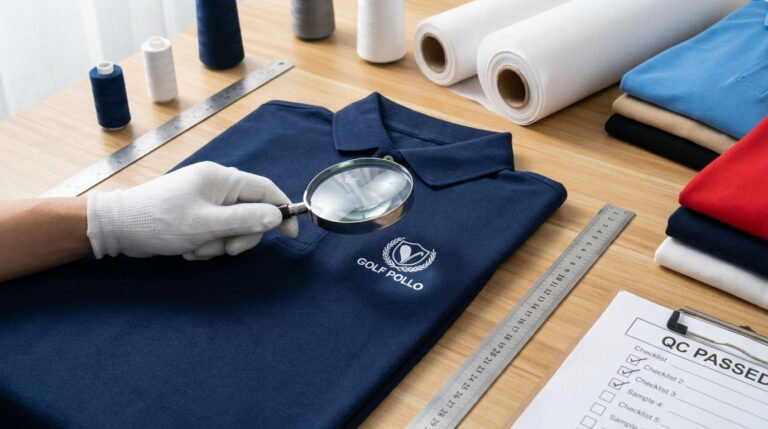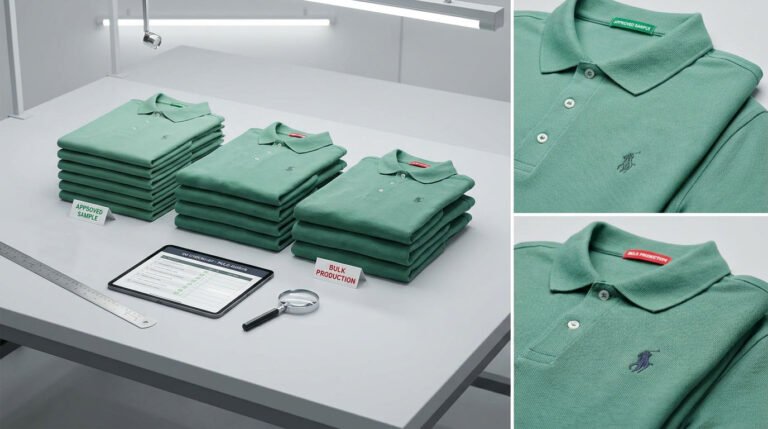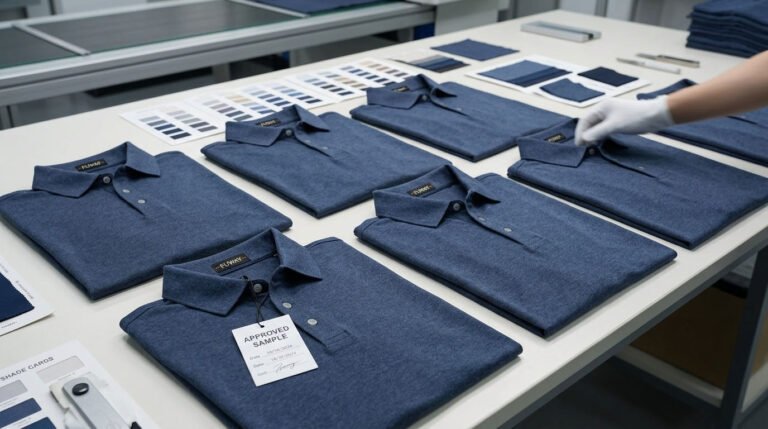
You order 500 golf polos. When the shipment arrives, some shirts measure slightly larger than the approved specifications, while others are smaller.
Should you reject the entire order?
Golf apparel measurement tolerance is the acceptable difference between approved garment specifications and actual finished measurements. At FUWAY, finished-garment measurement deviations must remain within ±1.0 cm of the approved target. Critical fit points may require tighter limits agreed upon before production.
The goal is not zero variation. It is consistent sizing, reliable fit, and clear acceptance criteria.
This guide explains how brands should set measurement tolerances, inspect finished garments, and manage out-of-tolerance production.
Quick Answer: What Measurement Tolerance Should Golf Brands Accept?
Acceptable measurement tolerance depends on the garment style, point of measurement (POM), fabric behavior, and approved buyer specifications.
For FUWAY production, the maximum permitted deviation is ±1.0 cm, with tighter limits where required.
| Question | Recommended Approach |
|---|---|
| What is FUWAY's tolerance? | Within ±1.0 cm |
| Can critical points require tighter limits? | Yes, if agreed in the tech pack |
| Which measurements matter most? | Chest, shoulder, waist, rise, and other fit-sensitive areas |
| Does stretch fabric affect measurements? | Yes, particularly during handling and relaxation |
| When should tolerance be confirmed? | Before pre-production sample approval |
| How should batches be accepted? | Against the agreed specifications and inspection plan |
Key principle: Tolerance should be specified for each relevant POM before bulk production—not negotiated after defects appear.
Key 1: What Is Measurement Tolerance in Golf Apparel?
Measurement tolerance is the allowed difference between a target dimension and the actual measurement of a finished garment.
For example, consider a golf polo with an approved 1/2 chest width of 54.0 cm.
| Measurement Detail | Example |
|---|---|
| Approved chest width | 54.0 cm |
| Approved tolerance | ±1.0 cm |
| Acceptable range | 53.0–55.0 cm |
| Actual measurement A | 54.7 cm — Pass |
| Actual measurement B | 55.3 cm — Fail |
These values illustrate how tolerance works; they are not a universal size chart.
A 1 cm difference in flat 1/2 chest width also represents approximately 2 cm in full chest circumference.
Why Measurement Tolerance Matters
Golf clothing must accommodate movement without losing its intended fit.
Small dimensional differences can affect:
- Chest and shoulder mobility during the swing
- Waistband comfort when walking or bending
- Sleeve and trouser length
- Consistency between repeat orders
Fabric stretching, sewing tension, pressing, and finishing can introduce minor variations.
A realistic tolerance accounts for normal production variation while protecting the approved fit.
Key 2: Which Golf Apparel Measurements Need the Tightest Control?
Not every measurement has the same impact on comfort or appearance.
At FUWAY, all specified garment measurements must meet their approved tolerances within the ±1.0 cm maximum. However, fit-sensitive points may require stricter control.
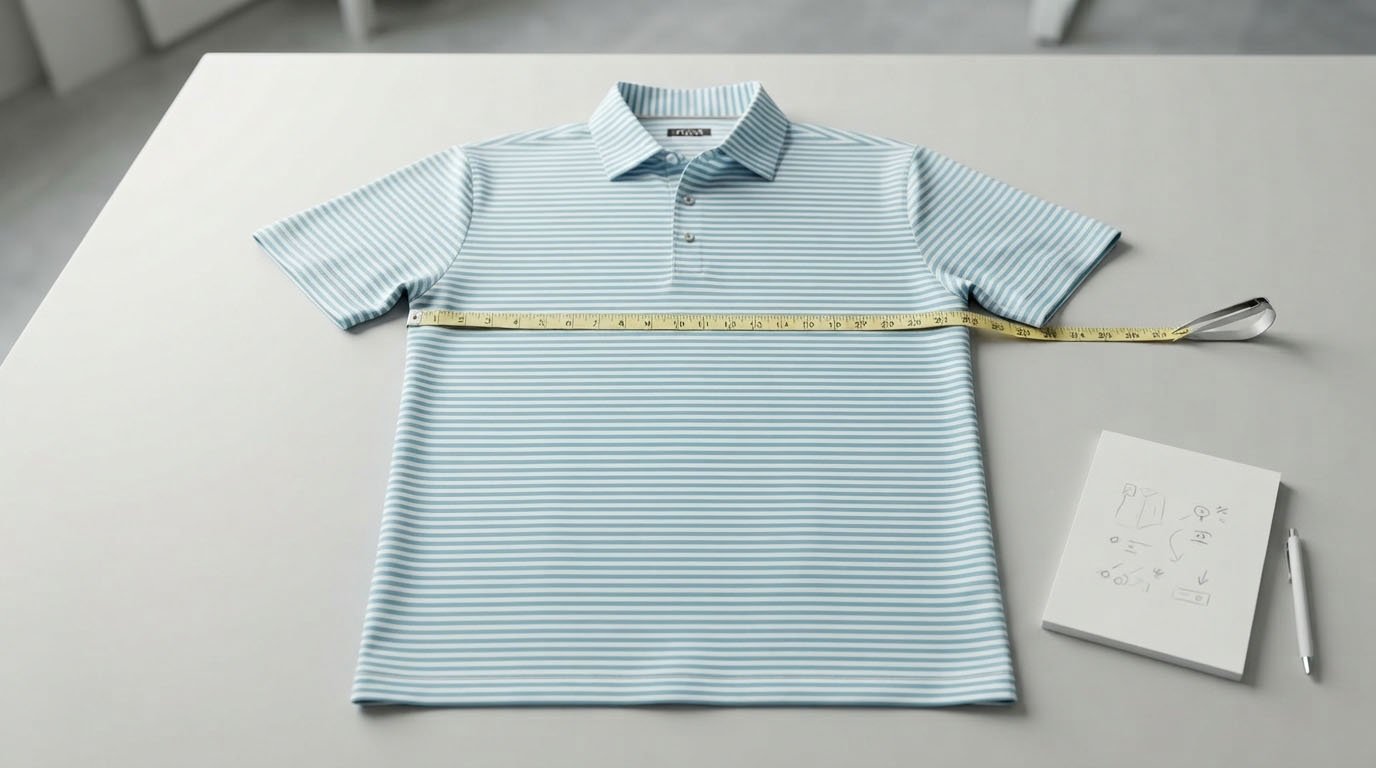
High-Impact Measurement Points
| Garment | Important POMs | Main Concern |
|---|---|---|
| Golf polo | Chest, shoulder, armhole | Swing mobility |
| Golf trousers | Waist, hip, rise, thigh | Fit and movement |
| Golf shorts | Waist, hip, leg opening | Walking comfort |
| Golf skort | Waist, hip, skirt length, liner fit | Coverage and mobility |
| Quarter-zip | Chest, shoulder, sleeve opening | Layering and movement |
Secondary Measurement Points
Other dimensions may be less sensitive depending on the design:
- Total body length
- Sleeve length
- Trouser inseam
- Bottom hem width
- Pocket depth
However, these classifications are style-specific.
For example, outer-skirt length is particularly important for golf skorts, while body length affects the appearance of untucked polos.
Brands should prioritize measurements according to garment function, not one universal tolerance chart.
Key 3: How Does Fabric Affect Measurement Tolerance?
Different fabric constructions respond differently to handling, cutting, sewing, and finishing.
This is particularly relevant for performance golf apparel containing polyester, nylon, cotton, or elastane.
| Fabric Type | Typical Behavior | Inspection Focus |
|---|---|---|
| Polyester piqué | May relax after handling | Chest and body length |
| Polyester-spandex jersey | Elastic stretch and recovery | Consistent relaxed dimensions |
| Nylon-spandex blend | Stretch varies by construction | Recovery and fit |
| Woven stretch twill | Generally more structured | Waist, rise, and inseam |
| Technical midlayer knit | Thickness can affect measurement | Chest, sleeve, and hem |
Does Stretch Fabric Need Wider Tolerance?
Not automatically.
Stretch fabrics can be more sensitive to measurement tension, but this does not justify accepting dimensions outside the approved limits.
FUWAY's maximum ±1.0 cm standard still applies.
The solution is to control fabric relaxation, sewing consistency, and measuring procedures.
Measurement Tolerance vs. Fabric Shrinkage
These are separate quality requirements.
Measurement tolerance checks whether the finished garment matches its approved dimensions.
Fabric shrinkage measures dimensional changes after washing and drying under specified conditions.
A garment may pass its initial measurement inspection but shrink excessively after laundering.
For detailed testing methods, see our Golf Apparel Fabric Shrinkage Testing Guide.
Key 4: How Should Brands Set Tolerances in a Tech Pack?
The best way to prevent measurement disputes is to define tolerances before approving production samples.
A complete tech pack should include:
- Point of measurement (POM)
- Target measurement for each size
- Approved tolerance
- Measurement method
- Size grading
- Revision and approval records
Step 1: Define Every Measurement Point
Avoid vague instructions such as "measure chest" or "check waist."
Instead, define the exact method:
- 1/2 chest width measured flat
- Body length measured from high point shoulder (HPS)
- Shoulder width between specified seam points
- Waistband width measured in the required condition
- Inseam measured from crotch seam to hem
Step 2: Assign Approved Tolerances
For FUWAY production, every specified tolerance must remain within ±1.0 cm.
The following table is an illustrative tech pack example, not a universal tolerance schedule for all styles.
| Style / POM | Target | Approved Tolerance | Acceptable Range |
|---|---|---|---|
| Polo — 1/2 chest | 54.0 cm | ±1.0 cm | 53.0–55.0 cm |
| Polo — collar height | 4.0 cm | ±0.5 cm | 3.5–4.5 cm |
| Trouser — 1/2 waist | 40.0 cm | ±1.0 cm | 39.0–41.0 cm |
| Skort — outer-skirt length | 42.0 cm | ±1.0 cm | 41.0–43.0 cm |
The tighter collar tolerance is an example of a POM-specific requirement that must be confirmed during development.
If a buyer approves a tighter tolerance, that requirement takes precedence over the general maximum.
Step 3: Approve the Pre-Production Sample
Before bulk manufacturing:
- Confirm the sample matches approved specifications.
- Check fit-sensitive points and garment movement.
- Verify grading across the required sizes.
- Approve the final tech pack version.
For a complete list of technical specifications, see our Golf Apparel Tech Pack Checklist.
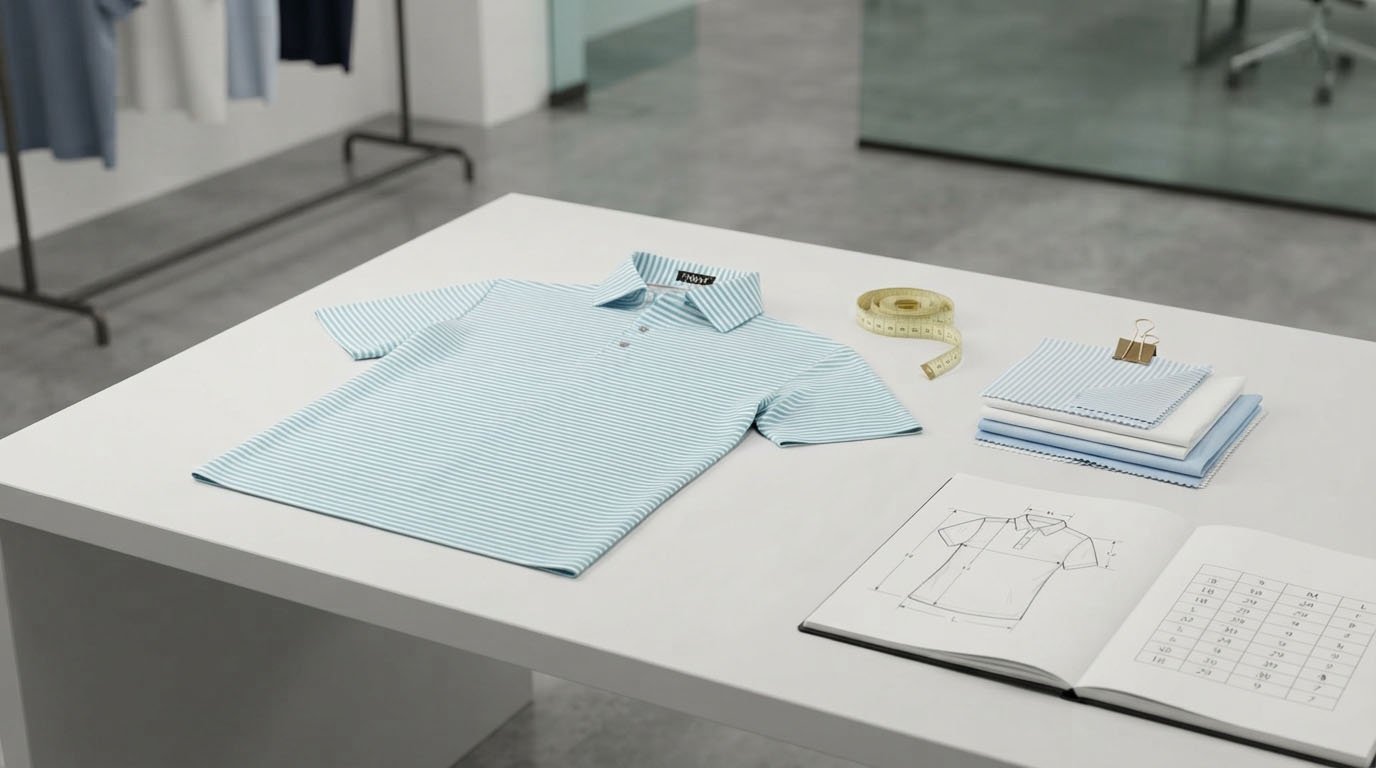
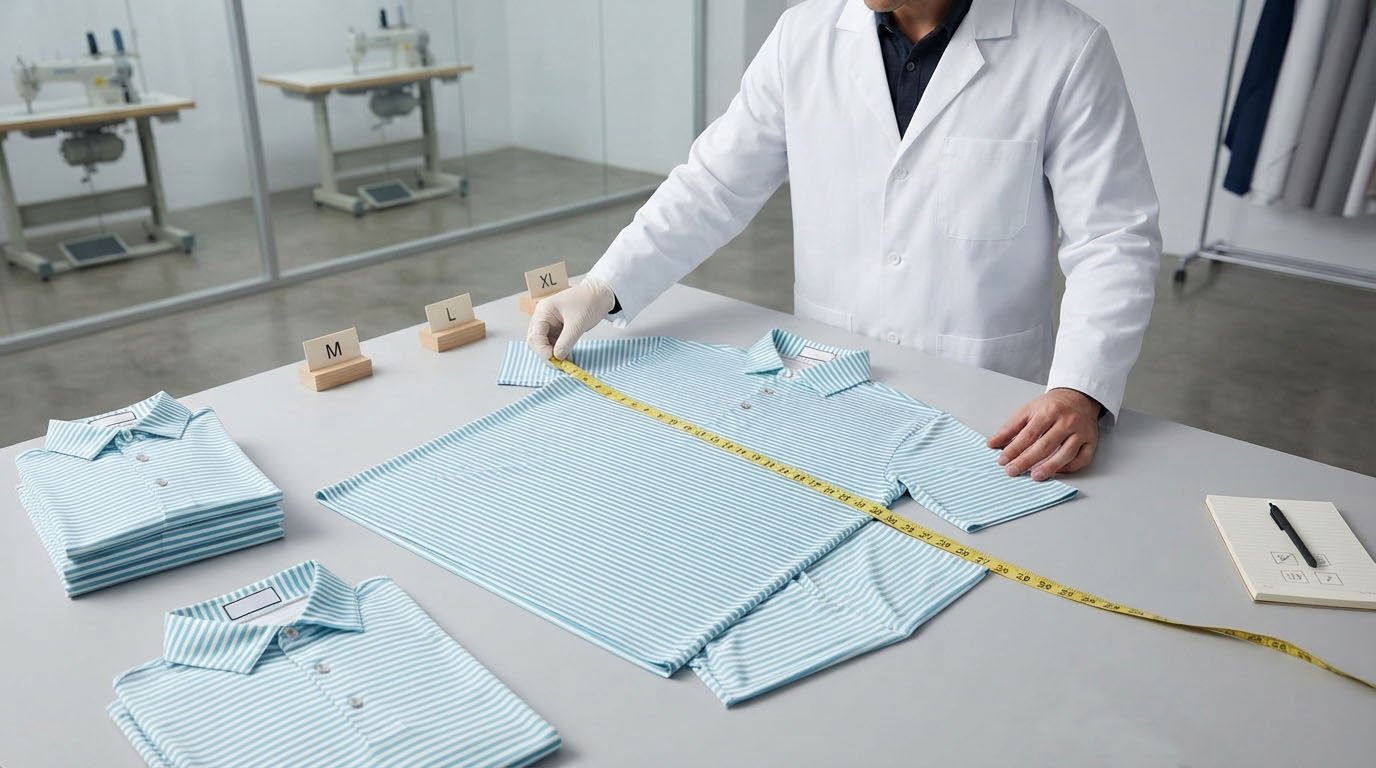
Key 5: How Should Factories Measure Finished Golf Apparel?
Even accurate specifications can produce inconsistent inspection results when operators use different measuring methods.
A standardized procedure helps avoid false defects and unnecessary disputes.
Step 1: Prepare the Garment
Place the garment on a clean, flat inspection table.
Allow it to relax according to the agreed procedure, especially after packing or compression.
Fasten buttons and zippers when required.
Step 2: Follow the Approved POM Diagram
Use the exact measuring points defined in the tech pack.
For example, 1/2 chest width and full chest circumference are different measurements.
Elastic waistbands must specify whether they are measured relaxed or stretched.
Step 3: Measure Without Stretching
Smooth wrinkles gently without pulling the fabric.
Use a suitable, verified measuring tape and maintain the correct measurement direction.
Step 4: Record Results
A basic inspection record should include:
| Field | Example |
|---|---|
| Style / Size | Golf Polo / M |
| POM | 1/2 Chest |
| Target | 54.0 cm |
| Tolerance | ±1.0 cm |
| Actual | 54.6 cm |
| Result | Pass |
If a result appears inconsistent, verify the measuring method before recording a defect.
Key 6: How Should Brands Accept or Reject a Production Batch?
One garment measuring outside tolerance does not automatically mean the entire order must be rejected.
However, that garment is still nonconforming and requires appropriate action.
Brands should distinguish between isolated defects and systematic measurement drift.

Isolated Measurement Deviations
Suppose one polo exceeds its approved chest-width limit while other inspected garments comply.
The factory should:
- Recheck the measurement.
- Investigate whether more garments are affected.
- Segregate or correct nonconforming units.
- Apply the agreed inspection criteria.
An individual defect should not be ignored simply because most garments passed.
Systematic Measurement Drift
Now suppose most inspected Medium polos measure consistently larger than the target.
Possible causes include:
- Incorrect pattern dimensions
- Cutting inaccuracies
- Fabric relaxation problems
- Sewing tension
- Finishing or pressing changes
This suggests a process problem rather than an isolated defect.
The factory should investigate the cause and implement corrective action before shipment approval.
Measurement Tolerance vs. AQL
These concepts serve different purposes.
| QC Element | Purpose |
|---|---|
| Measurement tolerance | Determines whether a specific dimension meets its approved limits |
| AQL sampling plan | Supports lot-level acceptance decisions using agreed sampling and defect criteria |
| Drift analysis | Identifies repeated measurement deviations |
For example, a polo measuring 55.3 cm against a 54.0 ±1.0 cm chest specification is outside tolerance.
Whether the entire lot fails depends on the agreed defect classification, sampling plan, and inspection findings.
AQL does not increase FUWAY's ±1.0 cm measurement limit or override stricter approved specifications.
For the broader inspection process, see our Golf Apparel Quality Control Guide.
Key 7: How Can Brands Prevent Measurement Problems Before Production?
Most measurement disputes can be reduced through clear specifications and early inspection.
Use this practical checklist:
- [ ] Define all relevant POMs.
- [ ] Keep approved tolerances within ±1.0 cm.
- [ ] Identify points requiring tighter control.
- [ ] Confirm measuring methods and size grading.
- [ ] Approve pre-production samples and specifications.
- [ ] Monitor measurements during bulk production.
- [ ] Inspect relevant sizes and production groups.
- [ ] Record deviations and corrective actions.
- [ ] Confirm acceptance criteria before shipment.
The objective is to detect measurement drift early rather than discover widespread sizing problems during final inspection.
This is particularly important when developing a custom golf shirt collection, where consistent fit supports customer confidence and repeat orders.
FAQ: Golf Apparel Measurement Tolerance
What is the acceptable measurement tolerance for golf polo shirts?
At FUWAY, finished-garment measurement deviations must remain within ±1.0 cm of the approved target. Critical points may require tighter agreed tolerances.
This is FUWAY's company standard, not a universal requirement for every garment manufacturer.
Is ±1.0 cm acceptable for every measurement point?
Not necessarily. It is FUWAY's maximum limit.
Certain measurements, such as fit-sensitive collar or waistband details, may require stricter tolerances depending on the approved design.
Does stretch fabric require larger measurement tolerance?
Not automatically. Stretch fabrics require controlled measuring conditions, but they must still meet their approved tolerances.
Should brands reject an entire shipment if one garment is outside tolerance?
Not automatically. The defective garment requires attention, but lot acceptance depends on the agreed inspection plan and findings from further checks.
Should measurements be checked before or after washing?
Both checks may be relevant.
Initial measurements are evaluated against finished-garment specifications, while post-wash dimensions are assessed separately under agreed testing conditions.
Conclusion: Define Tolerances Before Bulk Production
Measurement tolerance directly affects garment fit, production consistency, and customer satisfaction.
For golf apparel brands, the most reliable approach is to:
- Define clear points of measurement.
- Confirm POM-specific tolerances before production.
- Maintain FUWAY's ±1.0 cm maximum deviation.
- Standardize measurement methods.
- Investigate isolated defects and systematic drift.
The objective is repeatable, consistent fit—not unrealistic zero manufacturing variation.
FUWAY supports golf apparel brands with fabric sourcing, sampling, product development, measurement control, and OEM/ODM manufacturing.
If you are developing golf polos, trousers, shorts, skorts, or performance layers, contact FUWAY to discuss your specifications and production requirements.