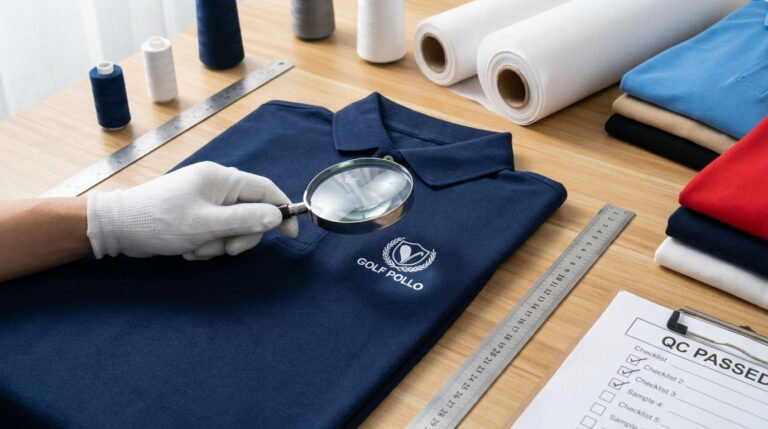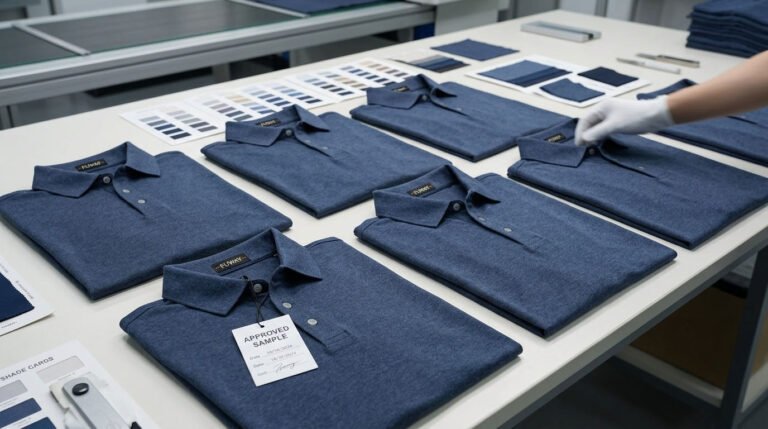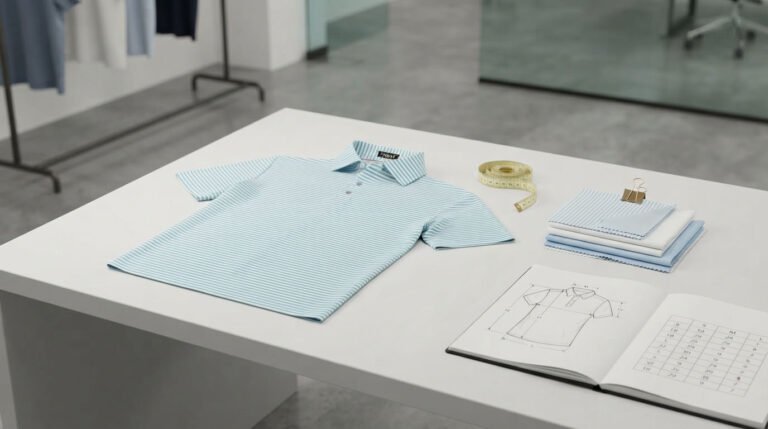
You approved a custom golf polo sample with the right fit, fabric, and embroidery. But when the bulk order arrives, the collar looks different, the fabric feels stiffer, or the sizing no longer matches.
For golf apparel brands, these differences can lead to delayed launches, customer returns, and costly supplier disputes.
Bulk production often doesn't match the approved sample because materials, cutting, size grading, sewing conditions, or specifications change between sampling and manufacturing. Preventing these problems requires an approved production baseline, controlled materials, written tolerances, and inspection against the correct reference.
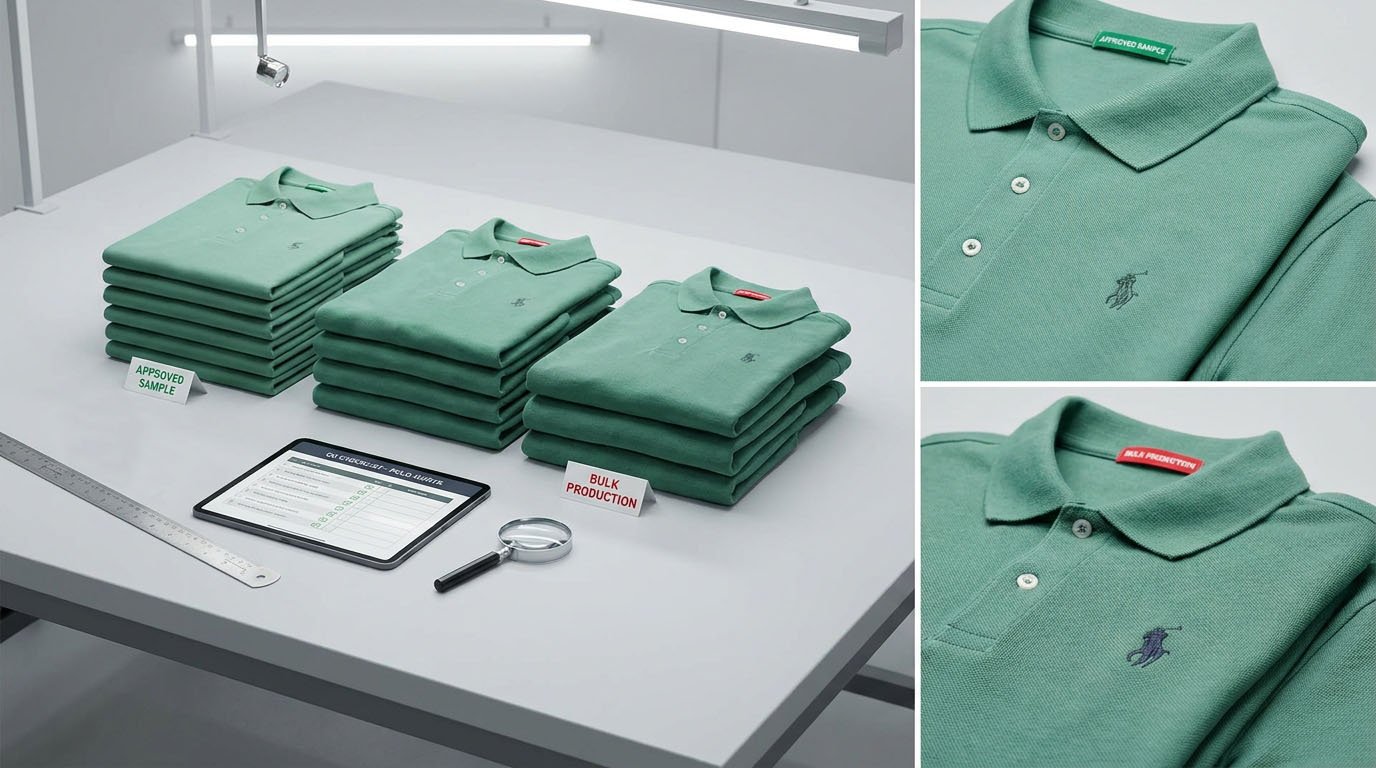
Quick Answer: Why Does Bulk Production Differ From the Approved Sample?
An approved sample demonstrates how a garment should look, fit, and perform. However, producing one sample and manufacturing hundreds of garments involve different production conditions.
The most common causes are:
| Cause | Potential Bulk Production Problem |
|---|---|
| Different fabric lots | Color, texture, stretch, or weight changes |
| Cutting and grading variation | Inconsistent sizing and fit |
| Different sewing conditions | Uneven seams, collars, or plackets |
| Decoration setup changes | Incorrect logo placement or puckering |
| Unrecorded revisions | Bulk follows an outdated specification |
| Incomplete approval standards | Buyer and factory judge quality differently |
Not every small difference is a defect. The important question is whether the delivered garments meet the approved specifications, materials, workmanship requirements, and agreed tolerances.
Step 1: Why Can an Approved Sample Look Different From Bulk Production?
Sample Production vs. Bulk Manufacturing
Samples are generally produced in small quantities, often with close attention from experienced technicians.
Bulk production introduces larger fabric lots, multiple sizes, cutting equipment, sewing operators, and repeated decoration processes.
| Production Factor | Approved Sample | Bulk Production |
|---|---|---|
| Fabric | Sample yardage or selected rolls | Production fabric lots |
| Cutting | Individual pattern cutting | Multi-layer cutting and size markers |
| Sewing | Sample technician | Production sewing line |
| Sizing | Usually one or selected sizes | Complete approved size range |
| Embroidery | Small-scale setup | Repeated machine production |
| Inspection | Individual sample review | Production and lot inspection |
These differences do not automatically indicate poor manufacturing.
Problems arise when the factory cannot consistently transfer the approved construction, materials, measurements, and decoration requirements into production.
The Approved Sample Alone Is Not Enough
A physical sample shows the desired product, but it cannot communicate every technical requirement.
For example, a golf polo sample may show a correctly positioned chest logo without defining its exact placement measurements.
The complete approval baseline should therefore include:
- Approved physical reference sample
- Final measurement specifications and tolerances
- Fabric and trim references
- Approved artwork and logo placement
- Construction requirements
- Latest approved revision records
For the documentation required before production, refer to our Golf Apparel Tech Pack Checklist.
Step 2: What Causes Sample-to-Bulk Differences in Golf Apparel?
Golf apparel introduces additional fit and construction challenges because products must maintain appearance and comfort during movement.
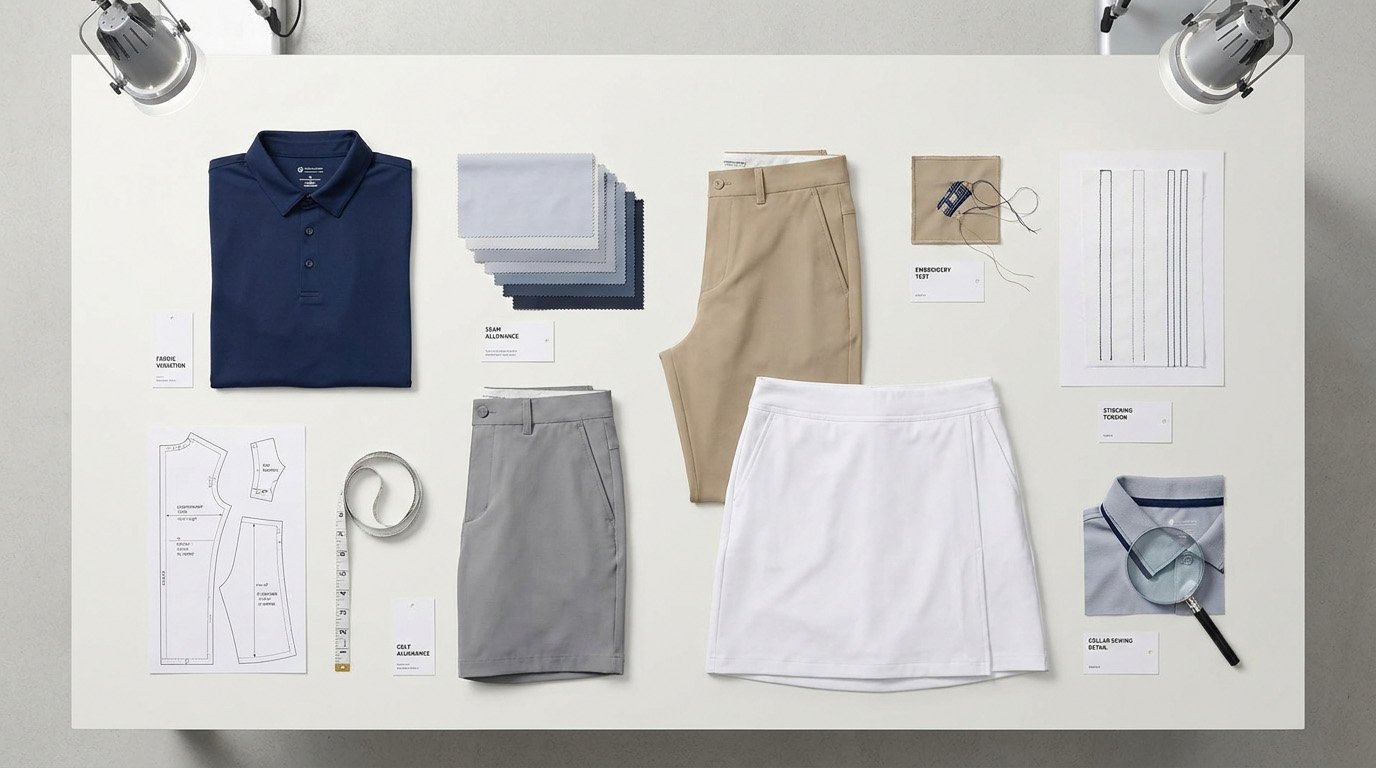
1. Fabric Lots and Finishing Conditions Change
The development sample may use available fabric, while bulk production uses newly sourced or dyed material.
Even when the fiber composition remains unchanged, fabric lots may behave differently due to knitting, dyeing, finishing, or relaxation conditions.
For performance golfwear, differences in stretch recovery, fabric weight, and hand feel can affect the finished garment.
A polo developed with one stretch fabric may feel restrictive when manufactured using a material with different recovery properties.
What to check: Approved fabric specification, production lot identification, weight, stretch behavior, color reference, and relevant test results.
2. Cutting, Grading, and Fabric Relaxation Affect Fit
An approved medium-size sample does not automatically prove that every size will fit correctly.
During bulk production, inaccurate grading, incorrect pattern revisions, fabric tension, or cutting inconsistencies may affect finished measurements.
For example, golf shorts may fit correctly in the approved sample but feel tighter in larger sizes because the waistband grading or elastic specifications were not transferred correctly.
What to check: Final pattern version, size-set approval, measurement records, and fabric relaxation requirements.
3. Sewing and Decoration Settings Are Different
Bulk production may use different operators or equipment setups from those used during sampling.
Changes in sewing tension, pressing conditions, embroidery backing, or heat application can alter the finished appearance.
Common examples include:
- Golf polo collars losing their intended shape
- Plackets becoming uneven after pressing
- Embroidered logos causing fabric puckering
- Golf skort liners becoming distorted during assembly
What to check: Approved workmanship reference, production setup, decoration sample, and early production garments.
4. Post-Approval Changes Were Not Transferred
A brand may approve a sample and later request a minor adjustment.
If the factory updates the sample but continues production using an older pattern, artwork file, or material specification, the delivered garments may not reflect the final approval.
Every approved change should be reflected in the relevant production documents before the affected operation begins.
Common Problems by Golf Apparel Product
| Product | Typical Sample-to-Bulk Difference | Main Area to Investigate |
|---|---|---|
| Golf Polo | Collar curling, placket distortion, logo puckering | Collar construction, finishing, embroidery setup |
| Golf Shorts | Tight waistband, inconsistent fit, pocket distortion | Elastic tension, grading, cutting |
| Golf Pants | Different stretch recovery or leg fit | Fabric behavior, pattern, finishing |
| Golf Skorts | Tight liner, uneven skirt length | Liner construction, grading, elastic attachment |
These are possible diagnostic causes rather than proof of a particular manufacturing fault.
Step 3: How Can You Tell Normal Variation From a Manufacturing Defect?
Some variation is unavoidable in textile manufacturing. However, normal variation must not become an excuse for unauthorized changes or unacceptable workmanship.
Check Measurements Against Approved Tolerances
At FUWAY, finished garment measurements are controlled within ±1.0 cm of the approved target measurements at all designated points of measurement (POMs).
Some measurements may require stricter tolerances when specified in the approved tech pack.
For example:
| Golf Polo Measurement | Approved Target | Tolerance | Acceptable Range |
|---|---|---|---|
| 1/2 Chest Width | 52.0 cm | ±1.0 cm | 51.0–53.0 cm |
| Body Length | 72.0 cm | ±1.0 cm | 71.0–73.0 cm |
| Sleeve Length | 23.0 cm | ±1.0 cm | 22.0–24.0 cm |
| Shoulder Width | 45.0 cm | ±0.5 cm | 44.5–45.5 cm |
Illustrative measurements only; actual targets and any stricter tolerances depend on the approved project specifications.
If the approved chest width is 52.0 cm and a bulk garment measures 53.2 cm, that measurement exceeds the ±1.0 cm limit.
A garment within dimensional tolerance must still satisfy its other approved requirements.
What About Color, Fabric, and Workmanship?
These characteristics require their own acceptance criteria.
- Color: Compare bulk materials with the approved physical color reference under consistent lighting and the agreed evaluation method.
- Fabric: Verify composition, weight, stretch, finish, and other specified properties.
- Construction: Compare seams, collars, waistbands, and trims with the approved standard.
- Branding: Confirm logo design, placement, dimensions, and application quality.
There is no universal Delta E or fabric-weight tolerance appropriate for every project.
Unauthorized fabric substitutions, incorrect artwork, and missing construction components may constitute nonconformities even when garment measurements pass.
For detailed inspection methodology and defect evaluation, see our Golf Apparel Quality Control Guide.
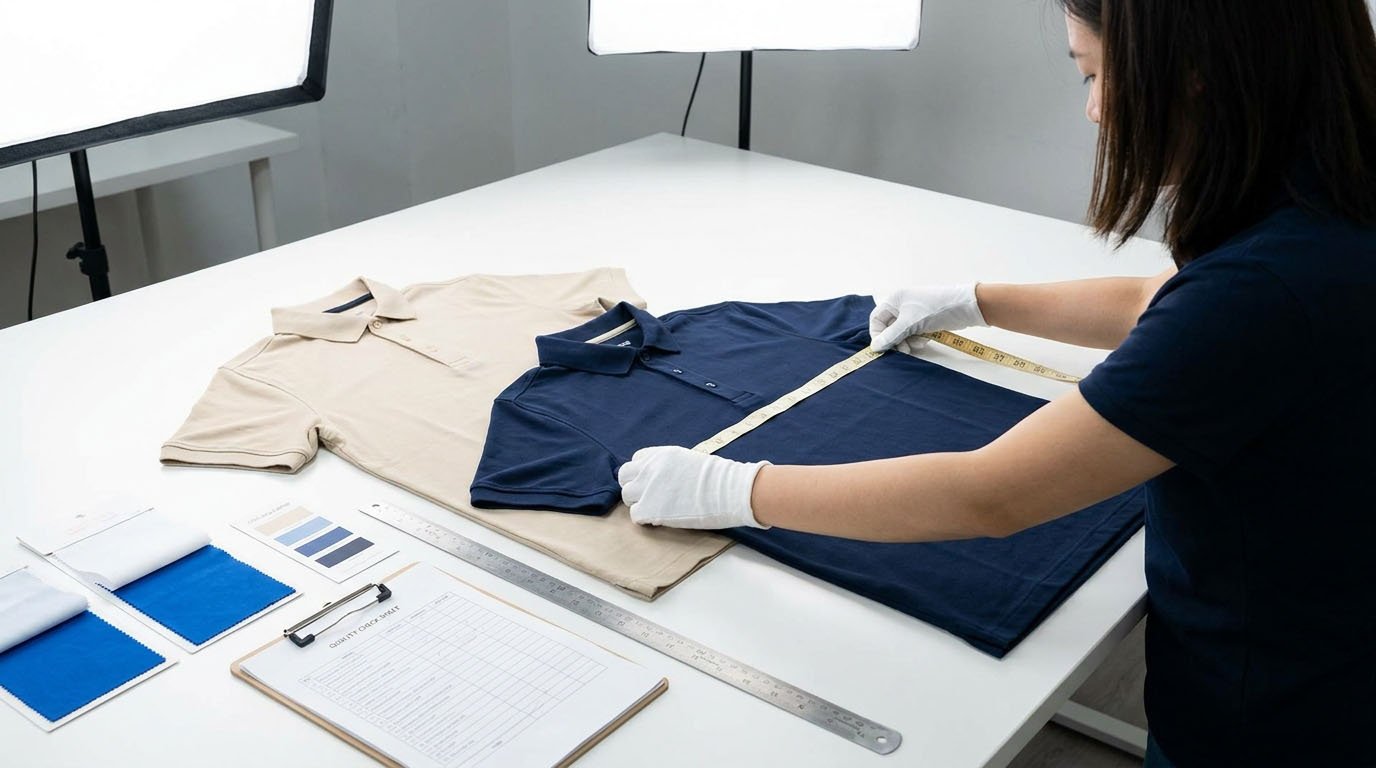
Step 4: How Do You Confirm the Correct Production Reference?
A frequent source of confusion is approving the wrong sample stage.
A fit sample may confirm the pattern while still using substitute materials. A pre-production (PP) sample should represent the approved product much more closely.
What Should the Final Approval Baseline Include?
Before bulk cutting, the brand and factory should confirm:
- Approved PP sample: Represents the intended production materials, measurements, construction, and decoration.
- Current tech pack: Contains the latest approved specifications and size grading.
- Material references: Identifies approved fabric, colors, trims, and relevant lots.
- Revision history: Records any changes made after earlier sample approvals.
- Inspection criteria: Defines how the finished garments will be evaluated.
Where practical, the PP sample should use actual bulk materials and production-representative methods.
An approved reference or golden sample should be identified clearly and retained for comparison.
For higher-risk orders, a Top-of-Production (TOP) sample can provide an additional check using garments taken from the running production line.
These steps do not replace final bulk inspection.
To understand how prototype, fit, size-set, and PP approvals work, read our Golf Polo Shirt Sampling Process Guide.
Step 5: What Should You Do If Bulk Production Already Doesn't Match?
When a bulk order differs from the approved sample, the first priority is to identify the problem objectively before deciding on corrective action.
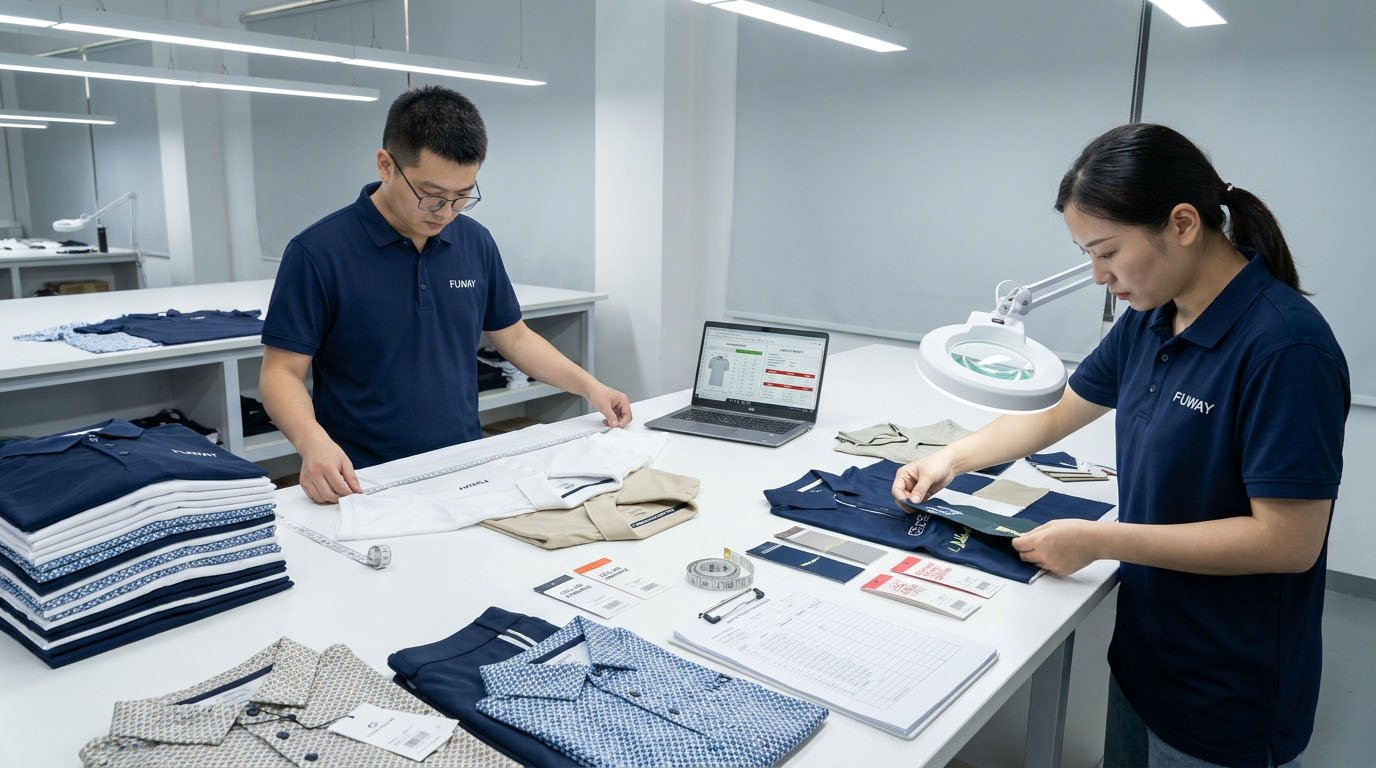
Diagnose the Problem Before Negotiating
Use the following matrix to organize the investigation.
| Observed Problem | Possible Root Cause | Evidence to Review | Possible Action |
|---|---|---|---|
| Golf polo is too small | Wrong grading, shrinkage, or cutting | Approved size chart and measurement records | Verify affected sizes and correct the cause |
| Fabric shade differs | Different dye lot or finishing | Approved swatch and fabric lot records | Segregate affected lots for evaluation |
| Logo causes puckering | Embroidery tension or backing | Approved decoration sample | Evaluate adjustment or feasible rework |
| Golf skort liner is tight | Elastic or grading difference | Liner specifications and sample | Check affected sizes and construction |
| Collar looks different | Material or finishing change | Approved sample and component records | Identify material or process deviation |
Follow a Practical Corrective-Action Sequence
1. Hold affected goods where possible.
If the order has not shipped, request that the manufacturer hold the potentially affected products while the issue is investigated.
2. Compare against the complete approval baseline.
Use the retained sample, latest tech pack, material approvals, and agreed tolerances. Photographs are useful evidence but may not accurately represent color or fabric properties.
3. Record the scope of the problem.
Document affected styles, sizes, quantities, lot numbers, actual measurements, and inspection findings.
4. Agree on the appropriate disposition.
Depending on the defect, contractual requirements, and technical feasibility, options may include sorting, rework, replacement, or another mutually agreed commercial resolution.
Not every defect can be repaired without affecting garment appearance or performance.
5. Confirm corrective action before further production or shipment.
The manufacturer should identify the cause, implement the necessary correction, and verify the result against the approved standard.
For a buyer-side review before shipment, use our Golf Apparel Factory QC Checklist.
Step 6: How Can Golf Apparel Brands Prevent Future Sample-to-Bulk Problems?
The most effective approach is to control the transition from product approval to actual manufacturing.
Five Production Consistency Controls
| Control | What the Brand Should Confirm |
|---|---|
| Material approval | Production fabric and trims match approved requirements |
| Specification freeze | Pattern, grading, artwork, and BOM are current |
| PP sample approval | Final product reference is production-representative |
| Early production verification | Initial bulk garments meet approved standards |
| Final inspection | Completed order meets agreed quality and acceptance requirements |
Changes after approval should be documented and authorized before implementation.
A defined sampling inspection plan, such as AQL General Inspection Level II where agreed, can support finished-lot decisions. However, AQL does not replace individual measurement tolerances, material specifications, or workmanship requirements.
What If You Need to Change Golf Apparel Manufacturers?
If your current supplier repeatedly fails to reproduce approved samples, transferring production to another manufacturer may be worth evaluating.
Before approaching a new factory, prepare the latest tech pack, approved sample, size chart, fabric specifications, artwork, and records of previous production problems.
This allows the new manufacturer to assess whether it can reproduce the product or whether redevelopment is necessary.
For brands planning a new collection or evaluating a different OEM partner, FUWAY provides custom golf shirt manufacturing with fabric sourcing, sample development, branding, and bulk production support.
A successful supplier transition should begin with verified specifications and a new production approval process—not an assumption that another factory can automatically duplicate the original sample.
FAQ: Bulk Production vs. Approved Samples
Can Bulk Production Be 100% Identical to an Approved Sample?
Exact zero-variation replication is not realistic for every garment characteristic. However, bulk products should conform to approved materials, specifications, construction standards, and agreed tolerances. Some design and branding requirements may require an exact match.
Is a Different Fabric Feel Always a Quality Defect?
Not necessarily. Fabric hand feel can vary because of finishing or material conditions. Compare the actual fabric against the approved specification and reference to determine whether the difference is acceptable.
Can a PP Sample Prevent Every Bulk Production Problem?
No. A PP sample helps establish the production reference, but cutting, sewing, decoration, and finishing must still be controlled during manufacturing.
Early production verification and final inspection remain important.
Should Brands Change Manufacturers After One Failed Bulk Order?
Not automatically. First investigate the cause, the supplier's response, and whether corrective actions are effective.
However, repeated unexplained differences, unauthorized substitutions, or poor production records are reasonable grounds to reassess the manufacturing partnership.
Conclusion: Consistency Matters More Than a Perfect Sample
An approved sample is an important development milestone, but reliable bulk production requires more than producing one excellent garment.
Golf apparel brands should focus on controlling materials, specifications, sizing, decoration, and production changes—then verifying finished goods against the same approved standard.
Concerned About Sample-to-Bulk Consistency in Your Golf Apparel Orders?
FUWAY supports golf apparel brands developing custom polos, shorts, pants, skorts, and other performance golfwear through OEM/ODM manufacturing.
Whether you're preparing your first collection or evaluating a new production partner, share your product specifications, reference samples, customization requirements, and expected order quantity.