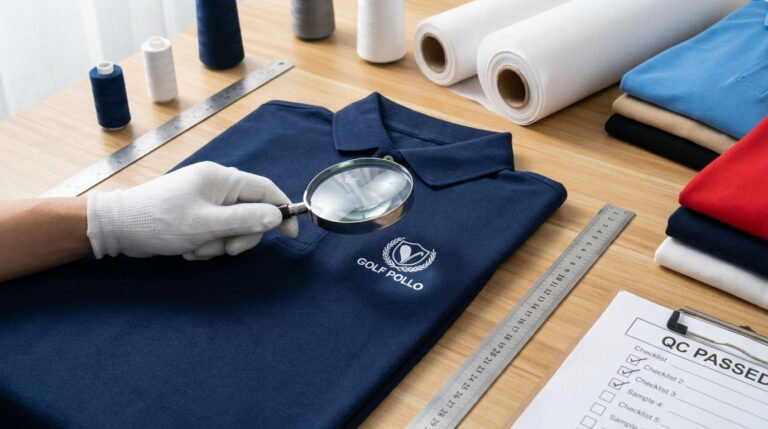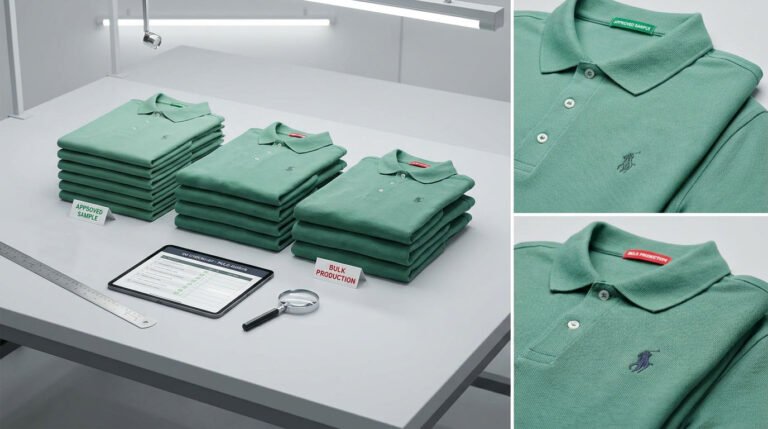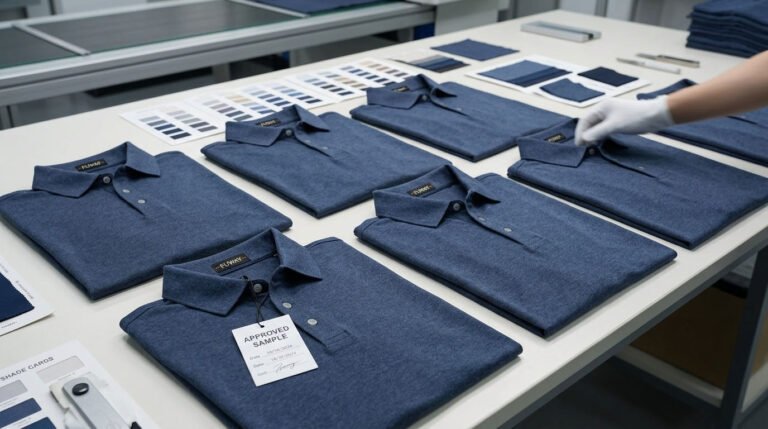
Before approving a golf apparel shipment, buyers need more than a factory statement saying "QC Passed."
A reliable golf apparel factory QC checklist helps brands and importers verify that bulk production meets the approved specifications, quality requirements, and order details.
Whether you are sourcing golf polos, shorts, trousers, skorts, or performance layers, the final review should answer four questions:
- What was inspected?
- Which approved standard was used?
- What evidence supports the result?
- Were failed items corrected and reinspected?
This guide focuses on buyer-side verification and pre-shipment decisions—not the factory's internal inspection procedures.

Quick Answer: What Should Buyers Check Before Shipment?
Before approving shipment, review these essential QC areas.
| QC Area | What Buyers Should Verify | Evidence to Request |
|---|---|---|
| Approved Specifications | Production matches approved requirements | Tech pack and approved sample |
| Fabric and Trims | Correct materials and colors were used | Material inspection and approval records |
| Production QC | Major production issues were controlled | In-line QC and corrective-action records |
| Measurements | Finished sizes meet agreed tolerances | Actual measurement sheets |
| Branding and Labels | Logos and labels match approved artwork | Photos and inspection records |
| Performance | Required tests have acceptable results | Applicable test reports |
| Packaging | Quantities, SKUs, and cartons are correct | Packing records and carton photos |
| Final Inspection | Outstanding issues have been resolved | Final report and reinspection evidence |
The key principle is:
Do not approve shipment solely because the factory says the goods passed. Verify the supporting evidence against the agreed requirements.
Step 1: Verify Approved Production Specifications
The first step is confirming that the shipment was produced according to the latest approved specifications.
Documents Buyers Should Review
Request:
- Final approved tech pack
- Approved measurement chart
- Golden sample or pre-production sample reference
- Fabric and color specifications
- Trim and artwork approvals
- Label and packaging instructions
- Purchase order details
For custom golf shirts, pay particular attention to collar construction, placket appearance, garment measurements, fabric quality, and logo placement.
What Could Go Wrong?
A factory may use an outdated measurement chart, an incorrect artwork version, or a substituted trim.
Before shipment, confirm that any approved changes were documented and reflected in the final production standard.
Buyer decision: If the approved production reference is unclear or an unauthorized change is discovered, hold the affected goods until the issue is resolved.
Step 2: Review Factory QC Records
Buyers do not need to repeat every factory production inspection. However, they should verify that critical manufacturing stages were inspected and that problems were addressed.

Evidence to Request
| Production Stage | Evidence Buyers Should Check | Warning Sign |
|---|---|---|
| Incoming Materials | Fabric and trim inspection records | No material approval evidence |
| Shade Control | Lot identification and shade records | Unexplained color variation |
| Cutting | Cutting or bundle inspection records | Repeated size or panel errors |
| In-Line Sewing | Defect and workmanship reports | Recurring issues without correction |
| Initial Production | First production inspection or approval | Bulk sewing began without verification |
Focus on whether the records identify the defect, affected quantity, corrective action, and reinspection result.
How to Review the Records
Check that:
- Records match the actual style, color, and production batch.
- Failed materials or products were isolated.
- Repeated defects were investigated.
- Corrected products were reinspected.
- Relevant supporting photos or measurements are available.
For a detailed explanation of how factory QC personnel conduct these checks, see our Golf Apparel QC Checklist for Factories.
Buyer decision: Missing records do not automatically prove that products are defective, but they limit the evidence available for approving shipment.
Step 3: Verify Measurements and Golf-Specific Quality Risks
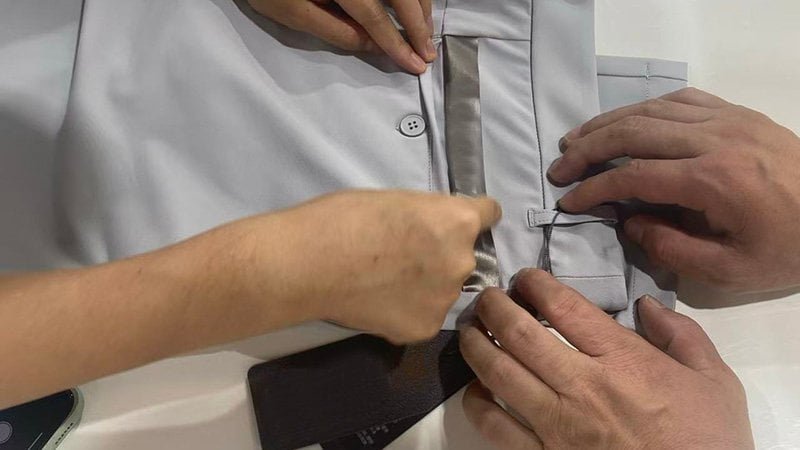
Measurements are among the most important checks before approving bulk golf apparel.
A garment may look acceptable while failing the approved size specification.
Review the Measurement Report
Request actual measurements for relevant sizes and key points of measure.
| Product | Critical Measurement Points |
|---|---|
| Golf Polo | Half chest, body length, shoulder, sleeve, collar |
| Golf Shorts | Waist, hip, rise, inseam, leg opening |
| Golf Trousers | Waist, thigh, rise, inseam, leg opening |
| Golf Skorts | Waist, hip, skirt length, liner dimensions |
| Golf Jackets | Chest, shoulder, sleeve, body length |
The report should show the approved measurement, actual result, deviation, and inspection status.
FUWAY Measurement Tolerance Standard
At FUWAY, all specified garment measurement points must remain within ±1.0 cm of the approved target measurements. Tighter tolerances may apply when defined in the approved tech pack. Measurements exceeding ±1.0 cm are not acceptable under FUWAY's standard.
For example, if the approved target measurement is 54.0 cm, a measured value of 55.2 cm exceeds the permitted tolerance and must be treated as nonconforming.
The affected goods should be held for correction and reinspection.
Golf-Specific Checks Buyers Should Not Miss
| Golf Apparel Type | Additional Quality Risk |
|---|---|
| Golf Polo | Collar curling, uneven placket, poor shape retention |
| Stretch Polo | Insufficient stretch recovery or seam distortion |
| Golf Shorts | Waistband distortion and pocket alignment |
| Light-Colored Bottoms | Poor opacity and visible pocket bags |
| Golf Skorts | Liner coverage, fit, and movement |
| Mid-Layers | Restricted shoulder rotation |
| Golf Jackets | Zipper, panel alignment, and specified technical features |
Buyers should compare these features against the approved sample and agreed product requirements.
Buyer decision: Do not approve affected garments with unresolved measurement or construction failures.
Step 4: Verify Branding, Labels, and Performance Requirements
Branding errors can make otherwise acceptable garments commercially unsuitable.
Logo and Decoration
Review:
- Logo position and size
- Artwork orientation
- Embroidery appearance
- Print color and clarity
- Adhesion or durability where required
- Visible puckering or distortion
Request close-up photos and inspection records showing comparison with the approved artwork.
Labels and Product Information
Confirm:
- Brand and size labels
- Care instructions
- Fiber-content information
- Country-of-origin information where required
- Hangtags
- Barcodes and product codes
Check the requirements applicable to the intended destination market.
Performance-Test Evidence
Depending on the agreed specifications, buyers may need to review test results for:
- Dimensional stability
- Colorfastness
- Stretch and recovery
- Pilling
- Seam performance
- UV protection or other stated performance claims
Not every golf apparel order requires the same tests.
Verify that required tests were completed using the agreed methods and acceptance criteria. Where relevant, buyers can review FUWAY's Test Reports.
Buyer decision: If a required test result is missing or fails the agreed acceptance criteria, resolve the issue before shipment approval.
Step 5: Confirm Packaging and Order Accuracy
Even well-made garments can create delivery problems when quantities, labels, or packing instructions are incorrect.

Packaging Evidence to Review
Request:
- Packed garment photos
- Polybag and size-sticker photos
- Barcode close-ups
- Carton-label photos
- Carton assortment records
- Final packing list
Verify Against the Purchase Order
Check that:
- Style, color, and size assortments match the order.
- Carton quantities are correct.
- Barcodes and product codes are accurate.
- Hangtags and packaging follow approved instructions.
- Shipping marks identify the correct order.
Particular attention should be paid to orders containing multiple sizes, colors, or customized team designs.
Buyer decision: Incorrect packing configurations or carton quantities should be corrected and verified before the affected cartons are approved.
Step 6: Review Defects, Rework, and Reinspection Evidence
Discovering defects during production is not automatically evidence of poor quality control.
The important question is whether the factory identified, corrected, and verified the affected goods.
What Buyers Should Request
Ask for:
- Defect summary
- Affected quantity
- Corrective-action report
- Rework completion record
- Reinspection results
- Final status of unresolved items
Example Corrective-Action Review
| Defect | Evidence Required | Buyer Review |
|---|---|---|
| Uneven collar | Rework and inspection photos | Confirm corrected appearance |
| Incorrect logo placement | Corrected placement photos | Compare with approved artwork |
| Wrong size label | Relabeling and verification record | Confirm affected units corrected |
| Fabric shade mismatch | Lot review and disposition record | Verify affected goods were controlled |
| Out-of-tolerance measurement | New measurement results | Confirm compliance with approved tolerance |
A statement that garments were repaired is not enough.
Reworked garments must be reinspected before they can be accepted.
Buyer Warning Signs
Be cautious when the factory:
- Cannot identify the affected quantity
- Has no clear reinspection result
- Provides conflicting inspection records
- Cannot explain recurring defects
- Requests shipment approval while significant issues remain unresolved
Buyer decision: Keep affected goods on hold until corrective actions and reinspection evidence are satisfactory.
Step 7: Make the Final Shipment Approval Decision
The final decision should be based on the agreed inspection requirements and available evidence—not on a general assurance that production is complete.

Final Buyer QC Evidence Pack
Before authorizing shipment, request a consolidated package containing:
- Approved tech pack and sample reference
- Relevant material and in-line inspection records
- Final measurement report
- Branding and label verification
- Required performance-test results
- Defect and corrective-action records
- Reinspection evidence
- Packaging and carton records
- Final inspection report
- Shipment-release status
These records should correspond to the same order, style, and production batch.
Shipment Decision Matrix
| Inspection Result | Buyer Decision | Required Action |
|---|---|---|
| Agreed requirements met and records complete | Approve | Document shipment authorization |
| Required evidence missing | Hold | Request and verify missing records |
| Measurements outside tolerance | Hold affected goods | Correct and remeasure |
| Reworked products not reinspected | Hold affected goods | Complete reinspection |
| Packaging or quantities incorrect | Hold affected cartons | Correct and verify |
| Serious unresolved nonconformity | Reject affected goods or require correction | Apply agreed acceptance terms |
| Required final inspection not completed | Hold | Complete the agreed inspection |
A shipment should only be approved when the applicable acceptance criteria are satisfied and outstanding issues have been resolved.
When Is Third-Party Inspection Appropriate?
Independent inspection can be valuable for:
- First orders with a new factory
- High-value shipments
- Orders with previous quality problems
- Time-sensitive product launches
- Retailer-required inspection programs
Third-party inspection can provide independent verification, but it does not replace factory quality control.
For an explanation of inspection stages, defect classification, AQL, and final random inspection, refer to our Golf Apparel Quality Control Guide.
Final 20-Point Golf Apparel Pre-Shipment QC Checklist
Use this checklist before authorizing shipment.
Approved Standards
- [ ] 1. Final tech pack and measurement chart approved
- [ ] 2. Golden sample reference confirmed
- [ ] 3. Fabric, color, and trims match approvals
- [ ] 4. Artwork and packing specifications confirmed
Factory QC Evidence
- [ ] 5. Fabric and shade inspection records reviewed
- [ ] 6. In-line QC records reviewed
- [ ] 7. Measurement reports checked across relevant sizes
- [ ] 8. Required performance-test results available
- [ ] 9. Defect and corrective-action records reviewed
Finished Product Verification
- [ ] 10. Golf-specific construction details checked
- [ ] 11. Logo placement and decoration approved
- [ ] 12. Brand, size, and care labels verified
- [ ] 13. Barcodes and product codes verified
- [ ] 14. Finished garment and packaging photos reviewed
- [ ] 15. Carton quantities and packing list confirmed
Final Shipment Approval
- [ ] 16. Agreed final inspection completed
- [ ] 17. All critical unresolved issues addressed
- [ ] 18. Reworked goods reinspected
- [ ] 19. Agreed acceptance requirements satisfied
- [ ] 20. Written shipment approval recorded
A completed checklist should be supported by the applicable QC evidence.
If important documents are missing or nonconforming goods remain unresolved, shipment approval may be premature.
FAQ: Golf Apparel Factory QC Before Shipment
Is Final Inspection Enough to Guarantee Golf Apparel Quality?
No. Final inspection can identify defects in finished goods, but it cannot replace material inspection, production control, and corrective action during manufacturing.
Buyers should review the relevant factory QC records alongside the final inspection results.
Does an Approved Sample Guarantee Bulk Production Quality?
No. An approved sample establishes the reference standard, but bulk production introduces additional variables such as fabric lots, cutting batches, sewing operations, and finishing conditions.
The final shipment must be verified against the approved standard.
Should Buyers Always Arrange Third-Party Inspection?
Not necessarily.
The need depends on order value, factory history, product complexity, customer requirements, and acceptable risk.
Independent inspection is especially useful when buyers need additional verification of a new supplier or a high-risk order.
Conclusion
A reliable golf apparel factory QC checklist should help buyers make a documented shipment decision.
Before approving delivery, verify:
Approved Specifications → Factory QC Evidence → Measurements → Branding & Testing → Packaging → Corrective Action → Final Approval
For golf apparel, buyers should pay particular attention to collar stability, placket appearance, stretch recovery, waistband construction, skort liner quality, and measurement consistency.
The goal is not simply to collect inspection documents.
It is to confirm that the finished order meets the agreed requirements and that unresolved quality issues have been addressed.
If you are preparing a custom golf apparel order and want to review manufacturing specifications, sampling, or quality-control requirements, contact FUWAY.