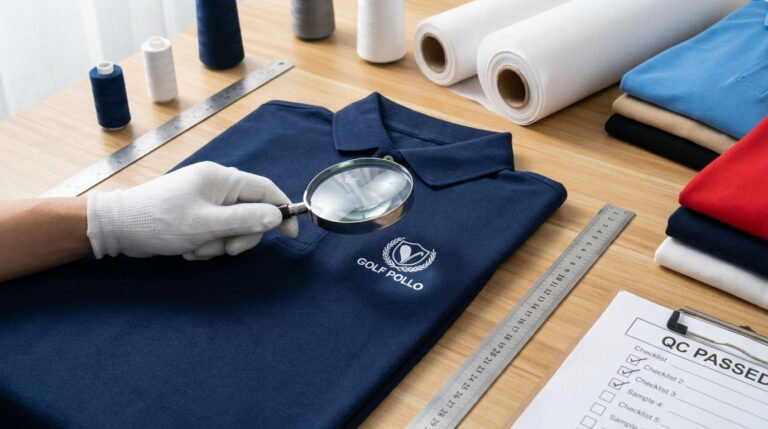
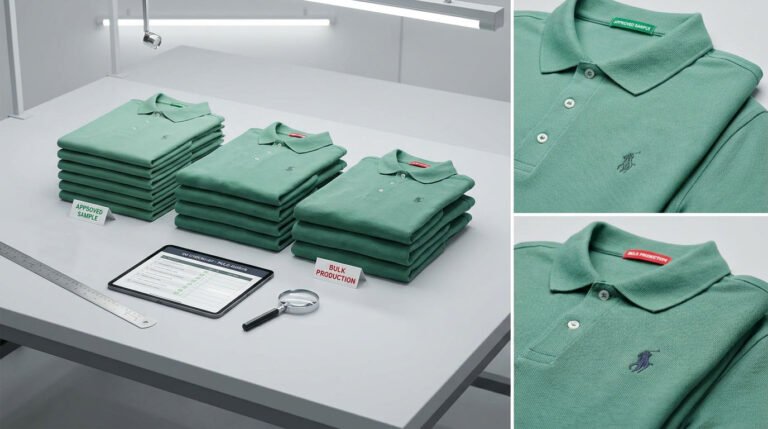
A reliable golf apparel QC checklist helps factories identify defects early, maintain consistent production quality, and document corrective actions before finished garments are released.
For golf polos, shorts, trousers, skorts, jackets, and performance layers, inspection should cover more than appearance. It must verify that materials, measurements, construction, branding, and packaging match the approved specifications.
An effective factory QC process follows one rule:
Inspect → Record → Correct → Reinspect → Document
This guide focuses on how factory QC teams execute inspections and maintain records throughout production. For buyers evaluating whether an order is ready to ship, see our Golf Apparel Pre-Shipment QC Checklist for Buyers.
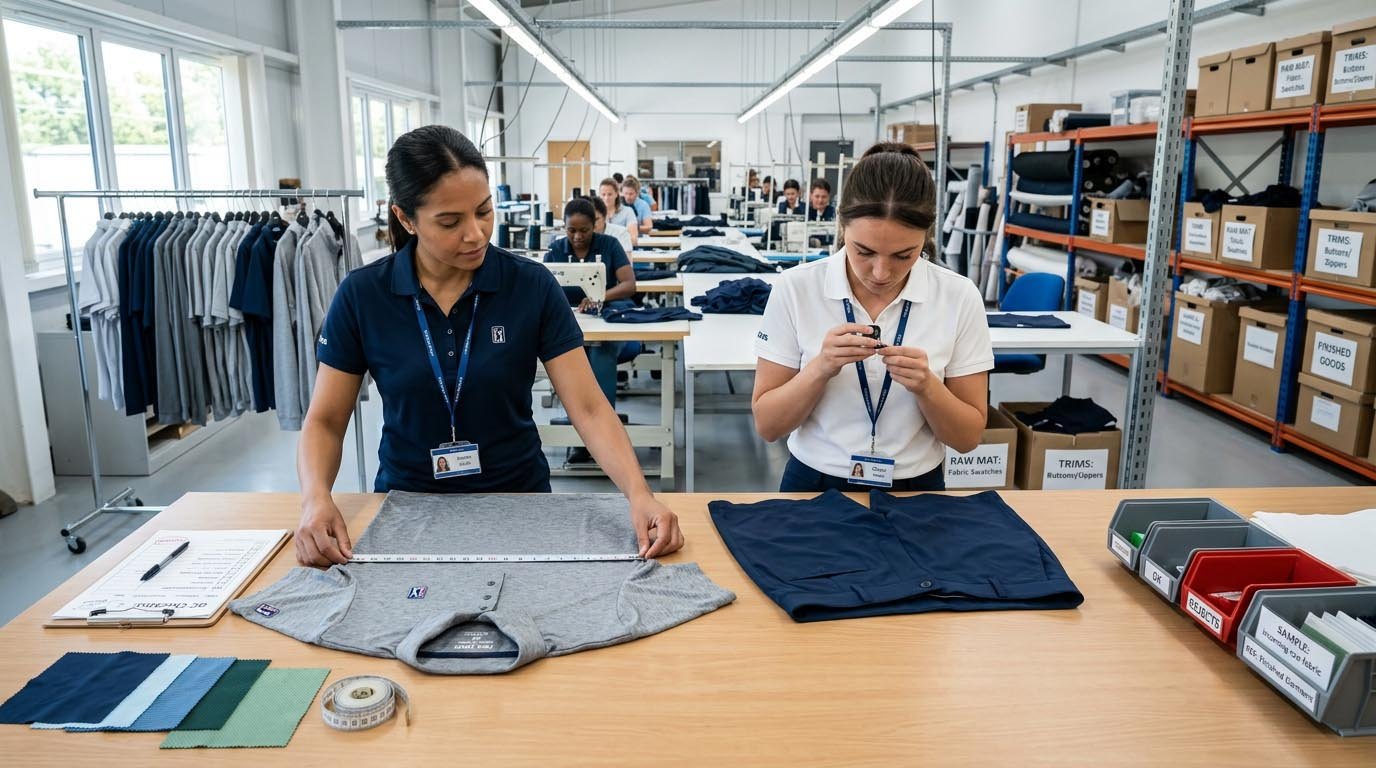
Quick Answer: What Should a Golf Apparel Factory QC Checklist Include?
A complete factory QC checklist should cover three inspection gates.
| QC Gate | Key Inspection Areas | Required Records |
|---|---|---|
| Incoming Materials | Fabric, shade, trims, labels | Material inspection and lot records |
| In-Line Production | Cutting, sewing, measurements, golf-specific construction | In-line QC and corrective-action records |
| Finished Garments | Measurements, appearance, branding, testing, packaging | Final inspection and reinspection records |
Each inspection should identify the approved standard, actual result, responsible QC personnel, and corrective action when necessary.
The purpose is not simply to report that an order passed inspection. It is to maintain traceable evidence that the finished products meet the approved requirements.
Step 1: Confirm the Approved Sample and Tech Pack
Quality control begins before bulk cutting.
The QC team should verify that production departments are using the latest approved:
- Golden sample or pre-production sample
- Tech pack and measurement chart
- Fabric and color references
- Trims and accessories
- Logo artwork and placement specifications
- Labels and packaging instructions
Required QC Records
Record the approved sample reference, tech pack revision, approval date, and any agreed changes.
QC rule: Unapproved substitutions or outdated specifications must be resolved before the affected production process begins.
Step 2: Inspect Incoming Fabric, Shade, and Trims
Incoming-material inspection prevents unsuitable materials from entering production.

Fabric Inspection
Check:
- Fabric type, composition, and weight against specifications
- Visible defects and surface appearance
- Fabric width where relevant
- Stretch and recovery
- Roll-to-roll shade consistency
- Dye-lot identification
For golf polos, pay particular attention to body-to-collar color matching. For golf bottoms, check material consistency where different panels or trims are used.
The inspection method and acceptance criteria should follow the agreed material specification. A structured fabric inspection system may be used where appropriate.
Trim Inspection
Verify buttons, zippers, thread, interlining, elastic, labels, and other approved accessories.
Required QC Records
Maintain the incoming-material inspection sheet, fabric lot identification, rejected-material log, and corrective-action record.
Materials that fail inspection should be isolated and reviewed before use.
For material selection and development requirements, see FUWAY's Fabric Sourcing service.
Step 3: Check Cutting Accuracy Before Sewing
Cutting defects can affect an entire production batch.
The cutting QC team should check:
- Correct pattern and revision
- Fabric direction and panel alignment
- Cut-panel measurements
- Visible defects
- Size identification
- Shade grouping
- Bundle traceability
Required QC Records
Record the style, size, cutting batch, defect type, affected quantity, and corrective action.
Incorrect panels should be separated and replaced before entering sewing.
Step 4: Measure Garments During Production
In-line measurement helps factories identify systematic sizing problems before they affect the full order.
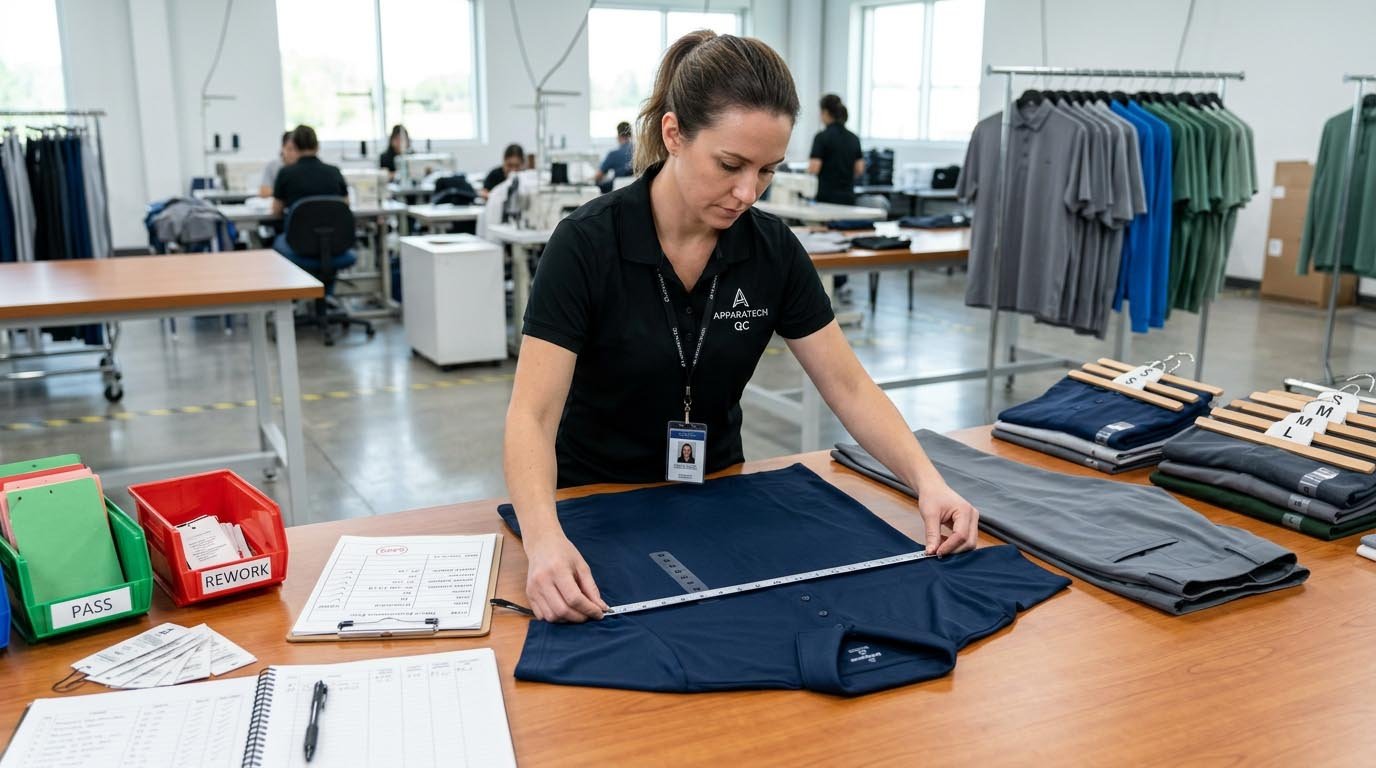
Golf Polo Measurement Points
Typical points include:
- Half chest
- Body length
- Shoulder width
- Sleeve length and opening
- Collar dimensions
- Hem width
Golf Bottom Measurement Points
Typical points include:
- Waist and hip
- Front and back rise
- Thigh
- Inseam
- Leg opening
FUWAY Measurement Tolerance Standard
At FUWAY, all specified garment measurement points must remain within ±1.0 cm of the approved target measurements. Tighter tolerances may apply when defined in the approved tech pack. Measurements exceeding ±1.0 cm are not acceptable under FUWAY's standard.
Inspection records should include the specification, actual measurement, deviation, and pass/fail result.
When a garment exceeds tolerance, isolate the affected pieces, investigate the cause, and remeasure them after correction.
Step 5: Inspect Stitching, Seams, and Workmanship
In-line sewing inspection helps prevent recurring defects.
Common Workmanship Defects
- Skipped or broken stitches
- Open seams
- Seam puckering
- Uneven stitching
- Excessive thread tension
- Needle damage
- Wavy hems
- Exposed unfinished edges where not intended
Pay extra attention to stress areas such as shoulders, armholes, side seams, crotch seams, waistbands, and pocket openings.
Required QC Records
Record the defect type, production operation, affected quantity, correction, and reinspection result.
Recurring defects should trigger process correction, not simply the removal of individual defective pieces.
Step 6: Add Golf-Specific Construction Checks
Golf apparel requires additional checks because garments must maintain their appearance and fit during repeated movement.
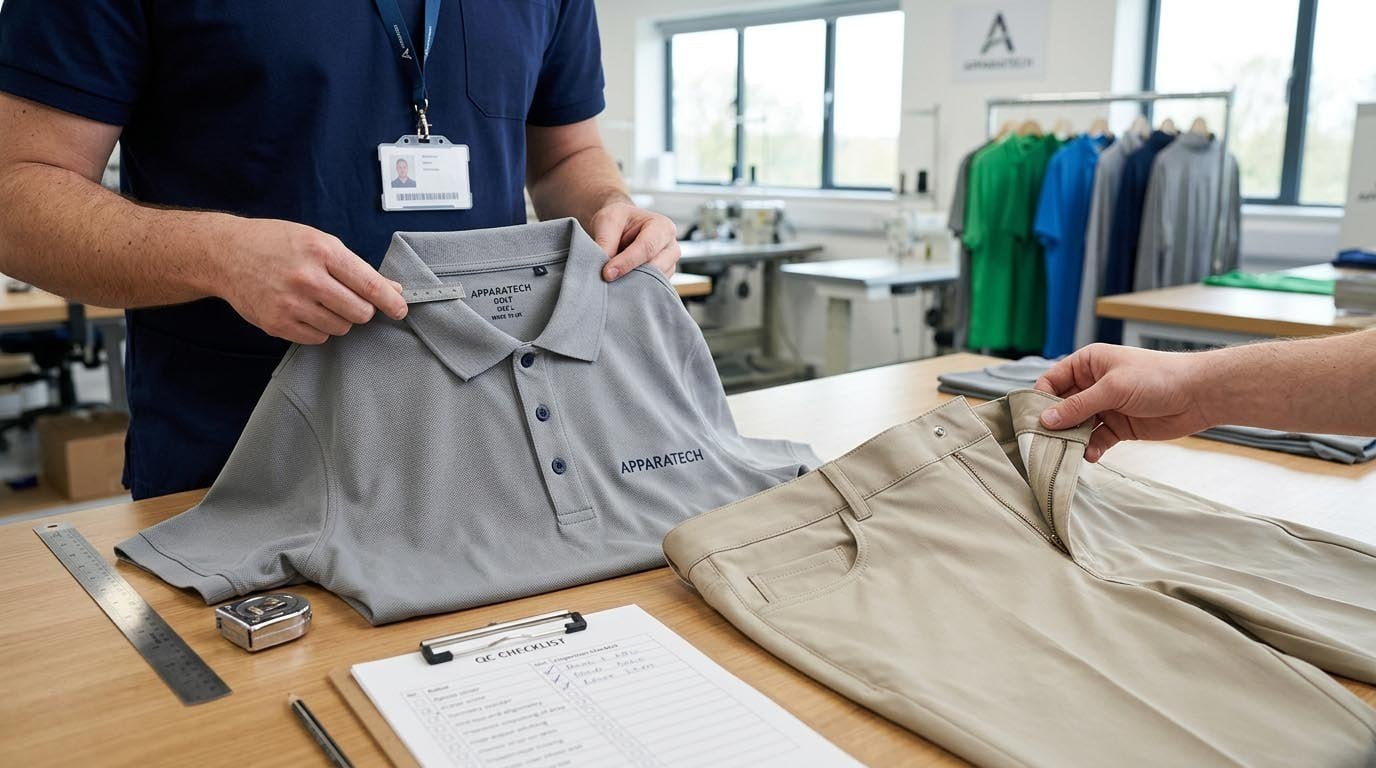
Golf Polo Construction
Inspect:
- Collar symmetry and attachment
- Collar flatness and shape
- Placket alignment
- Button spacing
- Sleeve balance
- Seam puckering
Golf Shorts and Trousers
Inspect:
- Waistband alignment and recovery
- Pocket position
- Zipper operation
- Fly construction
- Belt loops
- Left/right symmetry
Golf Skorts and Jackets
For skorts, check liner attachment, coverage, and movement.
For jackets and mid-layers, check zipper operation, panel alignment, seam construction, and movement in key areas.
Record any product-specific defects against the approved sample and construction specification.
Step 7: Verify Logo Placement and Decoration
Decoration should match the approved artwork and placement requirements.
For golf apparel embroidery, check:
- Logo size and placement
- Thread colors
- Stitch appearance
- Loose threads
- Puckering around the design
For printed branding, verify artwork registration, clarity, color, adhesion, and appearance after applicable testing.
Required QC Records
Keep approved artwork references, inspection photos, defect records, and reinspection results.
Corrections must be verified against the approved design before affected garments are released.
Step 8: Inspect Finished-Garment Measurements and Appearance
Finished-garment inspection verifies that sewing, pressing, finishing, and any agreed washing processes have not changed the product outside its specifications.
Check actual measurements across the applicable size range using FUWAY's ±1.0 cm maximum tolerance, or the tighter limits defined in the approved tech pack.
Also inspect:
- Stains and fabric damage
- Loose threads and visible defects
- Twisted seams
- Uneven hems
- Collar and placket appearance
- Sleeve and panel symmetry
- Correct trims and labels
Required QC Records
Maintain final measurement sheets, appearance inspection results, and any defect or rework records.
A simple statement such as "Measurements Passed" is not a substitute for actual recorded values.
Step 9: Verify Agreed Performance Requirements
Performance checks should follow the approved product specifications and buyer requirements.
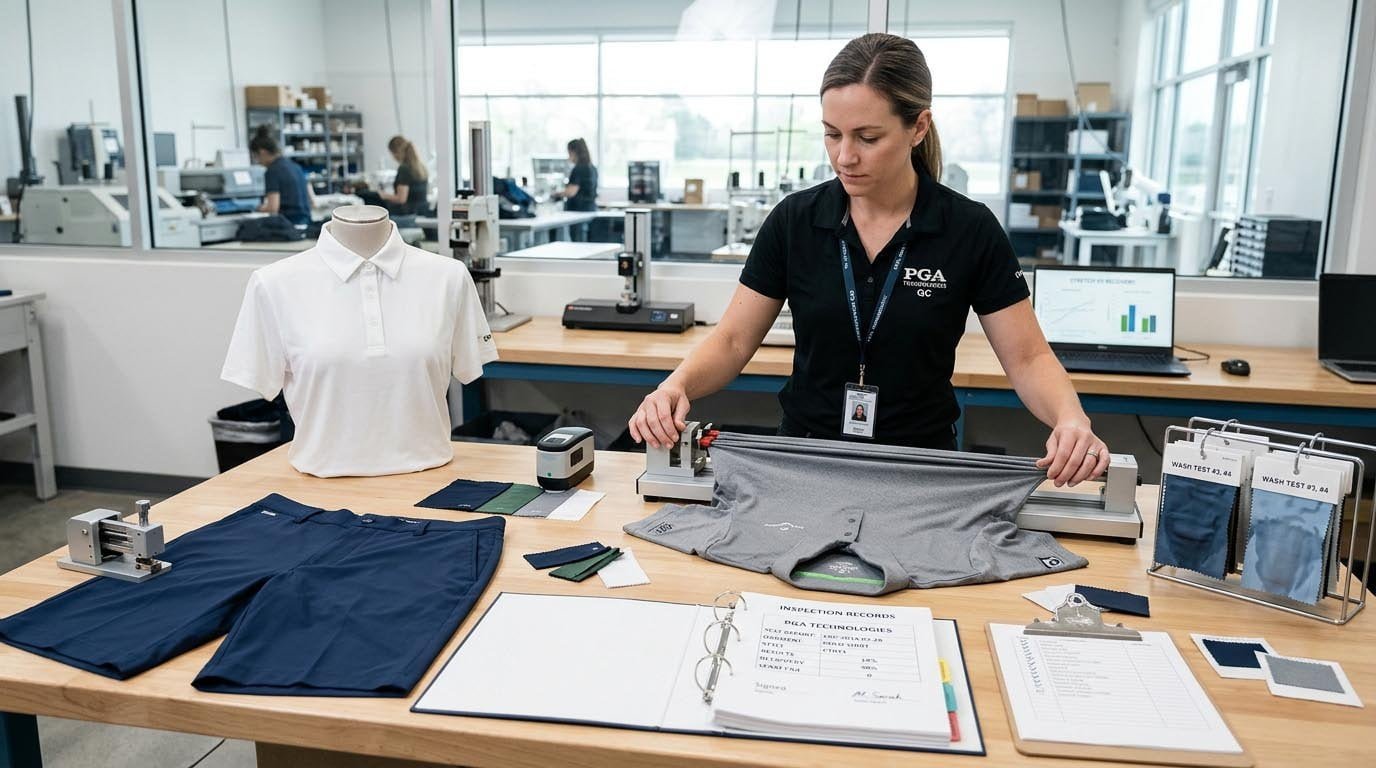
Depending on the project, requirements may include:
- Dimensional stability after washing
- Colorfastness
- Stretch and recovery
- Seam durability
- Logo durability
- Collar stability
- Moisture-management performance
Not every product needs the same test program. Test methods and acceptance criteria should be defined for the specific order.
Required QC Records
Keep relevant test results, test references, and corrective-action records where results fail to meet requirements.
Formal testing evidence may be reviewed through FUWAY's Test Reports resources.
Step 10: Verify Labels and Packaging
Packaging QC should confirm that finished products match the approved packing instructions.
Check:
- Brand, size, and care labels
- Country-of-origin information where required
- Hangtags and barcodes
- SKU, size, and color identification
- Correct folding and polybags
- Carton quantity and assortment
- Shipping marks and carton labels
Required QC Records
Maintain label verification, packing inspection, carton assortment, and packaging correction records.
Incorrect labels or barcode information should be corrected before the affected goods are released.
Step 11: Record Defects, Rework, and Reinspection
A factory QC system is incomplete without documented corrective action.
The required process is:
Defect Found → Affected Goods Isolated → Cause Corrected → Rework Completed → Reinspection → Final Disposition
A defect log should include:
- Style, color, size, and batch
- Defect description
- Affected quantity
- Corrective action
- Responsible person
- Reinspection result
- Final disposition
Reworked products must be reinspected before returning to approved stock.
Repeated defects should also be reviewed to determine whether equipment, materials, work instructions, or production methods need adjustment.
Step 12: Maintain the Final Factory QC Record Package
Before releasing completed goods for the agreed final inspection or shipment approval process, the factory should organize its QC records.
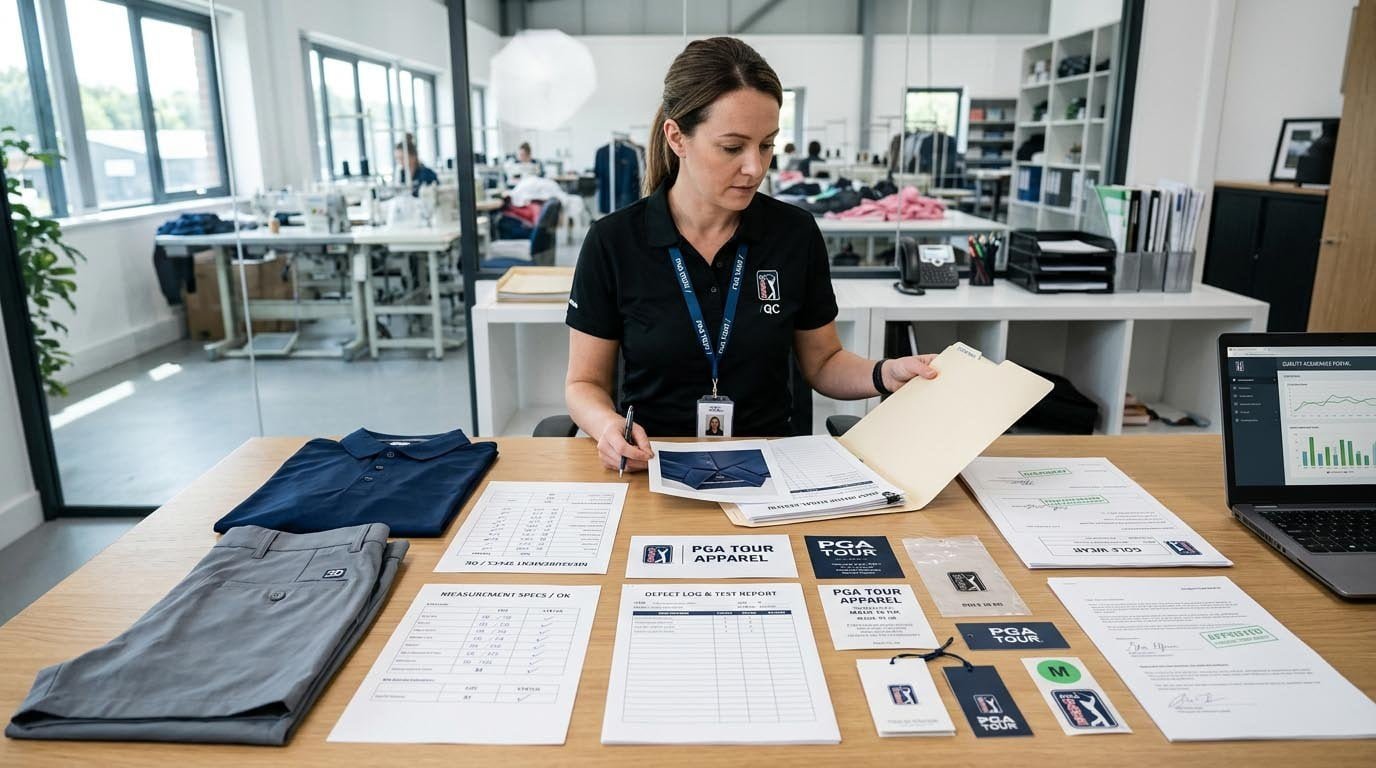
The factory record package should include:
| Record Category | Key Documents |
|---|---|
| Production Approval | Approved sample, tech pack revision, artwork |
| Incoming Materials | Fabric, shade, trim inspection records |
| In-Line Production | Cutting, sewing, and measurement records |
| Finished Garments | Final measurements and appearance inspection |
| Performance | Required test results |
| Corrective Action | Defect logs, rework, reinspection |
| Packaging | Label and carton verification |
| QC Release | Final internal QC status and approval |
This package provides traceability from the approved specifications through production and internal quality release.
The buyer's independent review and shipment authorization are separate steps.
Factory QC Record Template
The following template can be adapted for golf apparel production.
| Inspection Point | Approved Standard | Actual Result | QC Status | Corrective Action / Recheck |
|---|---|---|---|---|
| Fabric shade | Approved swatch | Inspection finding | Pass / Hold | Lot correction |
| Polo chest | Approved size chart | Measured value | Pass / Fail | Remeasure |
| Collar symmetry | Approved sample | Visual finding | Pass / Fail | Rework |
| Sewing quality | Construction standard | Defect finding | Pass / Fail | Repair and reinspect |
| Logo placement | Approved artwork | Placement result | Pass / Fail | Correct placement |
| Packaging | Approved packing specification | Packing result | Pass / Fail | Repack |
Each production record should also identify the style or SKU, batch, inspection date, inspector, and reinspection approval where applicable.
The QC result must be supported by actual measurements, observations, or inspection evidence rather than a generic pass statement.
Complete Golf Apparel Factory QC Checklist
Pre-Production and Materials
- [ ] Approved sample and tech pack confirmed
- [ ] Fabric and trims inspected
- [ ] Shade lots identified
- [ ] Material defects documented
Cutting and In-Line Production
- [ ] Cutting accuracy verified
- [ ] Size identification confirmed
- [ ] In-line measurements recorded
- [ ] Stitching and seam quality inspected
- [ ] Golf-specific construction checked
- [ ] Logo and decoration verified
Finished Garments
- [ ] Final measurements checked
- [ ] Finished appearance inspected
- [ ] Required performance tests reviewed
- [ ] Labels and packaging confirmed
Corrective Action and Records
- [ ] Defects and affected quantities recorded
- [ ] Failed products isolated
- [ ] Corrective actions completed
- [ ] Reworked products reinspected
- [ ] Final internal QC records completed
A completed checklist should be supported by inspection records and evidence appropriate to the order.
Factory QC Checklist vs Buyer Pre-Shipment Checklist
Factory execution and buyer verification have different responsibilities.
This Golf Apparel QC Checklist explains what factory QC personnel should inspect, record, correct, and reinspect during production.
For the overall QC methodology—including inspection stages, defect classification, AQL sampling, and final random inspection—read our Golf Apparel Quality Control Guide.
For brands and importers reviewing QC evidence before authorizing shipment, use our Golf Apparel Factory QC Checklist for Buyers.
Conclusion
An effective golf apparel QC checklist should create a documented chain of quality control:
Approved Specification → Inspection → Record → Correction → Reinspection → Internal QC Release
For golf polos, shorts, trousers, skorts, and performance apparel, this approach helps factories detect manufacturing problems early, control measurement consistency, and maintain traceable inspection records.
The objective is not simply to produce garments that appear acceptable. It is to demonstrate that production followed the agreed quality requirements.
If you are developing custom golf apparel and want to discuss production specifications, manufacturing, or quality-control requirements, contact FUWAY.