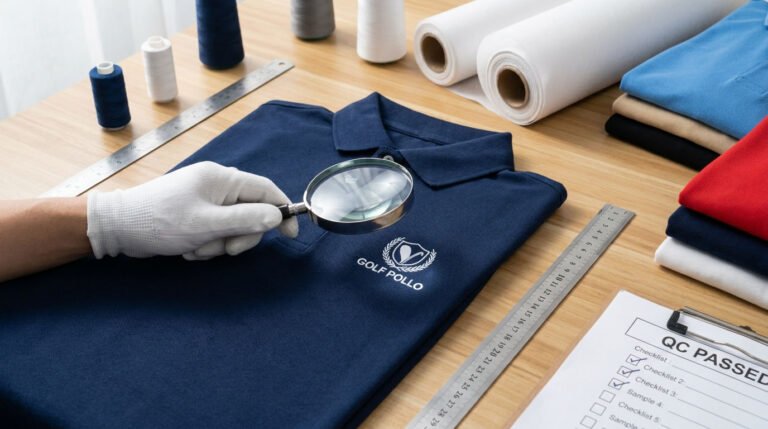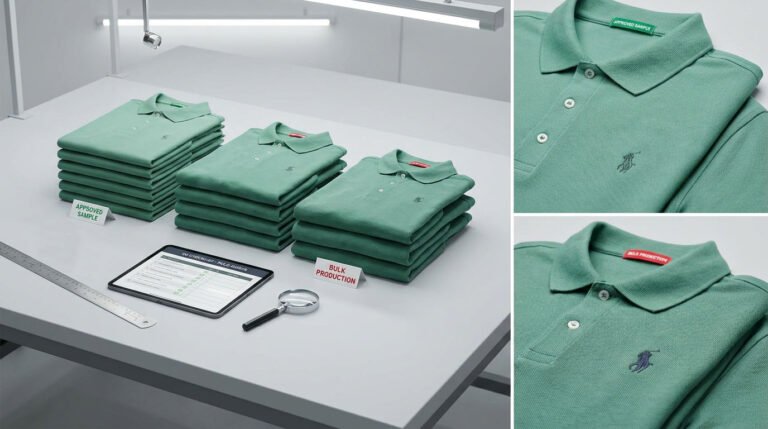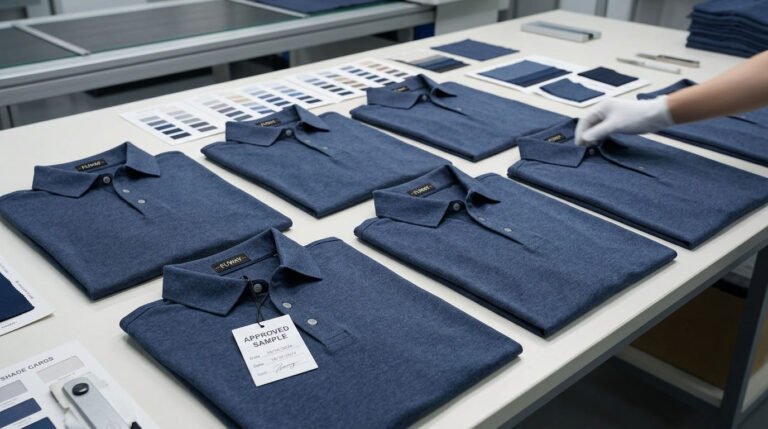
If you are sourcing golf polos, bottoms, outerwear, or performance layers, quality control should not begin at final inspection.
By the time defects are found at the end of production, fabric may already be cut, garments sewn, logos applied, and cartons packed.
A stronger golf apparel quality control system works in stages:
Specification → Sample Approval → Material Inspection → Production QC → Testing → Measurement & Workmanship → AQL → Final Inspection
Each stage catches different problems before correction becomes expensive.

Quick Answer: How Should Golf Apparel Quality Control Be Designed?
A complete golf apparel QC process normally includes:
- Pre-production specification review
- PP sample, TOP sample, and size-set approval
- Incoming fabric and trim inspection
- Laboratory testing where required
- In-line QC during cutting and sewing
- Logo and decoration inspection
- Measurement and workmanship verification
- Defect classification and corrective action
- Final random inspection using an agreed AQL plan
- Packaging and shipment approval
The key principle is:
Quality standards should be defined before production, monitored during production, and verified again before shipment.
At FUWAY, all specified finished-garment measurement points must remain within ±1.0 cm of the approved target dimensions, with tighter tolerances applied where required by the confirmed Tech Pack.
Final inspection should verify that the QC system worked, not serve as the first quality checkpoint.
Quality control is part of the broader brand-manufacturer workflow. For the complete development and production process, see How Golf Apparel Brands Work With Manufacturers From Idea to Delivery.
Why Does Golf Apparel Need a Structured QC System?
Golf apparel combines stretch fabrics, fit-sensitive patterns, visible branding, technical finishes, and retail-ready presentation.
That creates more quality variables than a basic promotional garment.
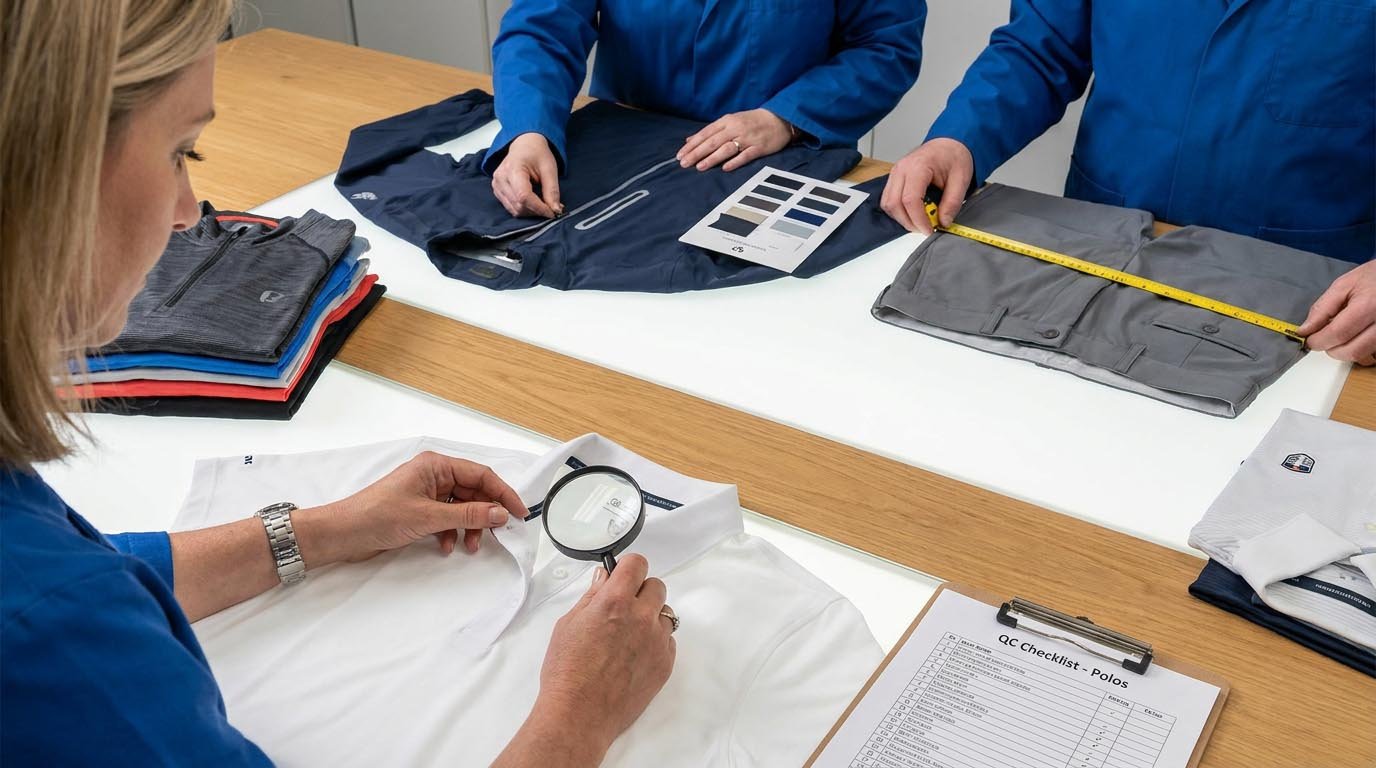
Typical product-specific risks include:
| Product | Common QC Risks |
|---|---|
| Golf Polos | Collar roll, placket alignment, logo placement, sleeve symmetry, side-seam twisting |
| Golf Bottoms | Waistband recovery, rise balance, pockets, zipper operation, inseam consistency |
| Golf Outerwear | Zippers, panel matching, bonded seams, lining, seam sealing, water repellency |
| Performance Layers | Stretch recovery, pilling, seam comfort, moisture management |
For custom polo development, these requirements should be defined during the Custom Golf Shirts development process.
QC should be designed around each product's risks while maintaining consistent approved measurement and workmanship standards.
Stage 1: Define the Quality Standard Before Production
The first QC stage happens before bulk production.
If the buyer and factory do not agree on product standards in advance, inspection becomes subjective.
Review the Tech Pack
A production-ready tech pack should define:
- Garment measurements and points of measurement (POM)
- Approved measurement tolerances
- Construction details
- Fabric and trim specifications
- Logo placement
- Labels and color references
- Artwork and packaging
- Testing requirements
The approved tech pack should remain a primary QC reference throughout production.
Apply FUWAY's Measurement Tolerance Standard
FUWAY controls all specified finished-garment measurement points within ±1.0 cm of the approved target dimensions.
Individual POMs may have tighter tolerances when defined in the approved Tech Pack.
| QC Item | Required Standard |
|---|---|
| Body length, chest width, sleeve length | Within ±1.0 cm of approved target measurements |
| Waist, hip, inseam, garment length | Within ±1.0 cm of approved target measurements |
| Fit-sensitive POMs | Tighter tolerances where specified in the approved Tech Pack |
| Logo and pocket placement | Follow separately approved positioning requirements |
| Color | Match approved swatch, lab dip, or color standard |
| Construction | Match approved sample and workmanship specifications |
For example, if a golf polo's approved body length is 72.0 cm with a ±1.0 cm tolerance, the permitted range is 71.0–73.0 cm.
If the Tech Pack specifies ±0.5 cm for a particular measurement, that tighter limit applies.
Product complexity does not automatically justify a measurement tolerance greater than ±1.0 cm.
Identify High-Risk Areas Early
For a new style, fabric, or supplier, review possible risks such as:
- Shrinkage and dimensional instability
- Shade variation
- Poor stretch recovery
- Collar deformation
- Grading errors
- Trim failure
- Embroidery puckering
- Heat-transfer adhesion problems
This gives the QC team clear priorities before production begins.
Stage 2: Approve PP Samples, TOP Samples, and Size Sets
Different samples serve different quality-control purposes.
PP Sample
A pre-production sample helps confirm:
- Fit and pattern
- Construction
- Fabric and trims
- Logo placement
- Appearance
- Garment measurements
The approved PP sample establishes the intended production standard.
Measurement approval should reference the target dimensions and POM tolerances in the confirmed Tech Pack.
TOP Sample
A top-of-production sample uses actual bulk materials and production processes.
It helps verify that the approved product is reproduced correctly under real production conditions.
Measurements must continue to meet the same approved tolerances.
Size Set
A size set checks grading across the required size range.
A garment may look correct in size M while other sizes reveal:
- Grading errors
- Sleeve proportion problems
- Poor body balance
- Incorrect hem sweep
- Waistband inconsistencies
Every approved size should be checked against its own measurement chart.
| Sample Type | Main QC Purpose |
|---|---|
| PP Sample | Confirm fit, construction, appearance, and approved measurements |
| TOP Sample | Verify production execution against the approved standard |
| Size Set | Confirm grading and POM accuracy across sizes |
Sample approval does not replace bulk-production QC.
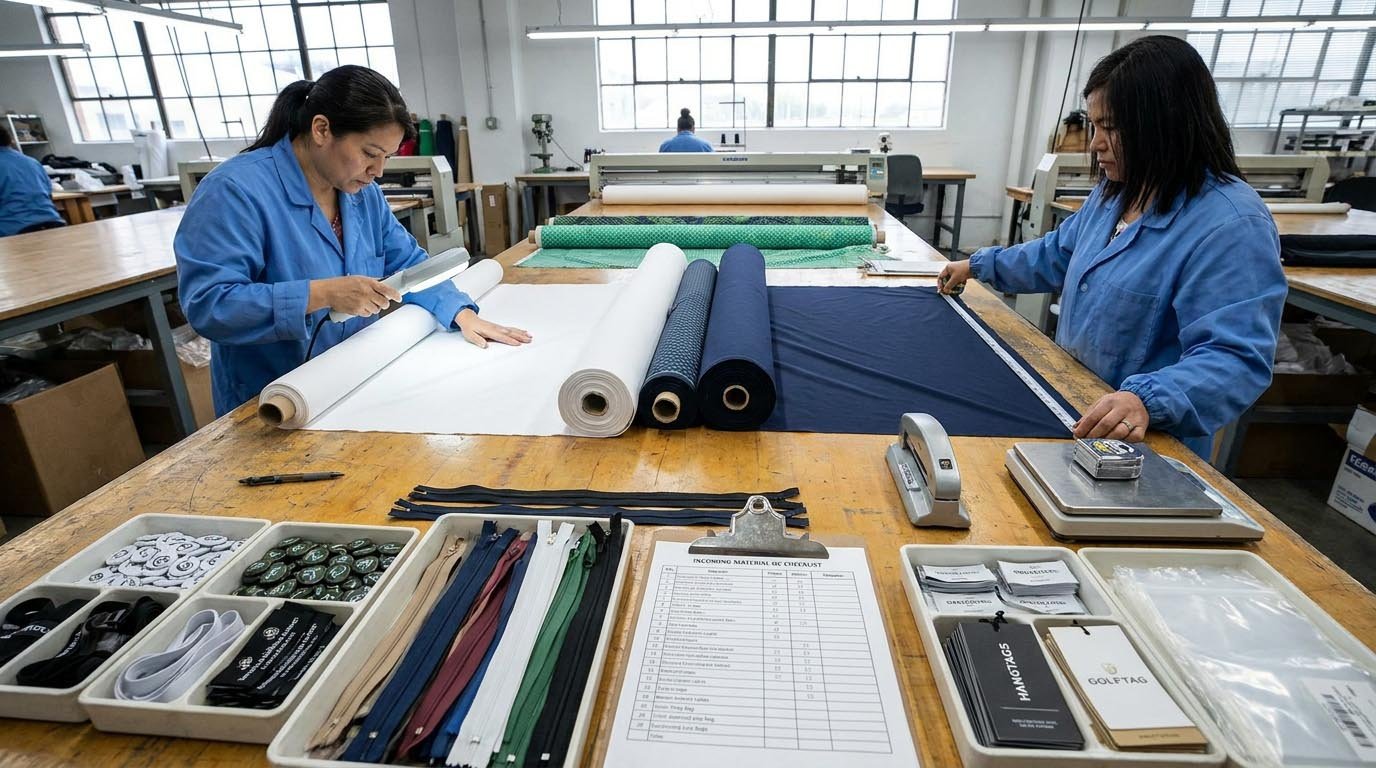
Stage 3: Inspect Fabric and Trims Before Cutting
Incoming-material inspection should happen before cutting.
Material defects become more expensive to correct after fabric has been converted into cut panels or finished garments.
Fabric Inspection
Depending on the project, incoming checks may include:
- Fabric weight and width
- Visible defects
- Shade consistency
- Roll identification
- Stretch and recovery
- Hand feel
- Surface appearance
Where multiple dye lots are used, significant shade differences should be identified before cutting.
For fabric-selection considerations, see our golf pants fabric guide.
Dimensional Stability
Shrinkage or growth can affect:
- Body and sleeve length
- Garment width
- Side-seam alignment
- Collar shape
- Placket appearance
Dimensional stability should be evaluated before bulk production so that cutting and finishing processes can consistently achieve the approved finished-garment measurements.
Fabric shrinkage test results and finished-garment measurement tolerances are separate controls. Both should meet their respective approved specifications.
Trim Inspection
Relevant trims include:
- Buttons and zippers
- Elastic and interlining
- Thread and labels
- Hangtags
- Heat-transfer labels
- Packaging components
A correctly sewn garment can still fail QC if the wrong trim or label is used.
Stage 4: Define the Testing and Compliance Plan
Some quality characteristics cannot be verified through visual inspection alone.
Physical or laboratory testing may be required depending on the product, performance claims, buyer requirements, and destination market.
Common Golf Apparel Tests
| Test | Why It Matters |
|---|---|
| Fiber Composition | Confirms material specification |
| Colorfastness | Checks fading or color transfer |
| Dimensional Stability | Measures shrinkage or growth |
| Pilling Resistance | Evaluates surface durability |
| Stretch and Recovery | Important for performance garments |
| UPF | Relevant where UV protection is claimed |
| Water Repellency | Relevant for applicable outerwear |
Testing should reflect the actual fabric, product construction, and applicable requirements.
Where formal testing has been completed, buyers can review relevant Test Reports.
Compliance Should Be Product-Specific
Depending on the product and destination market, documentation may address:
- Restricted substances
- Formaldehyde
- Azo dyes
- Heavy metals
- Skin-contact requirements
- Fiber-content labeling
Specific test records linked to the relevant material or finished product are more useful than broad compliance claims.
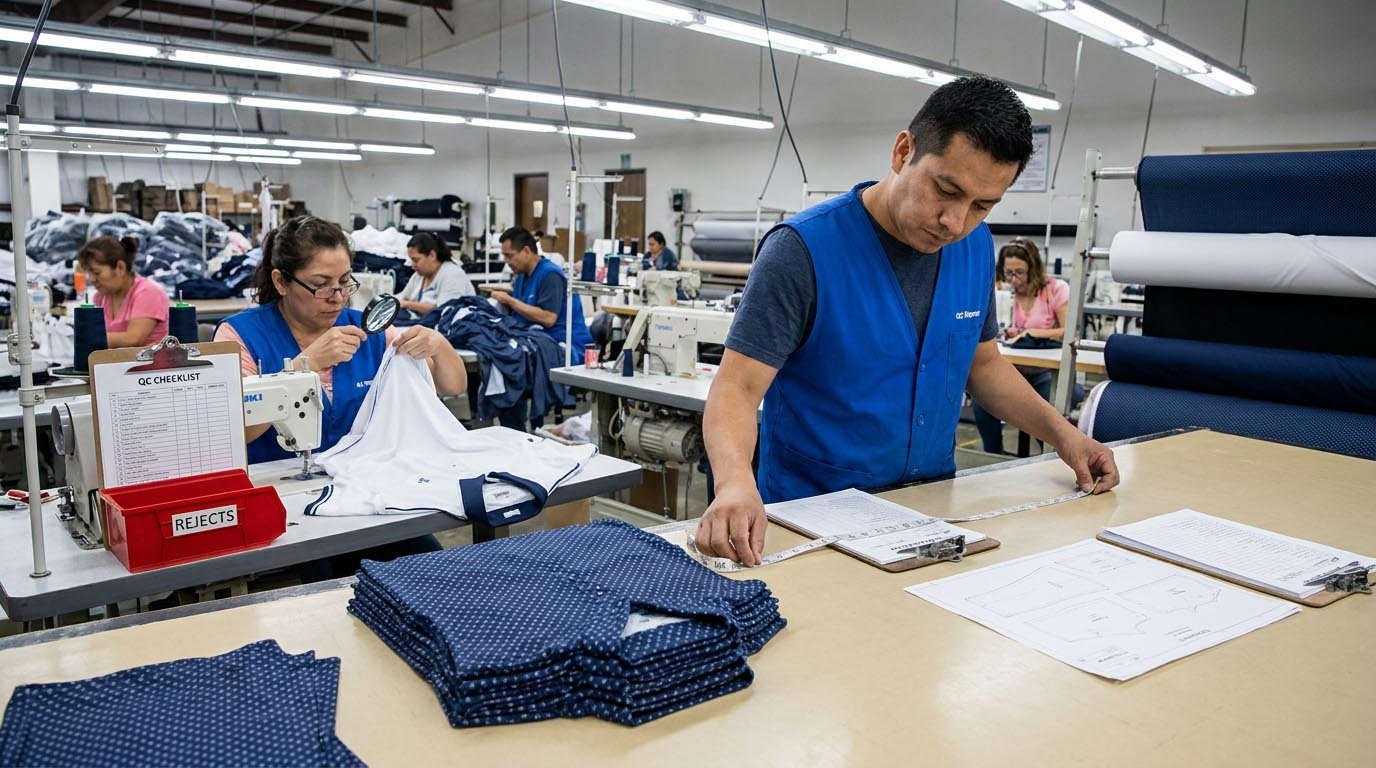
Stage 5: Use In-Line QC to Control Production Drift
In-line QC helps identify recurring problems before they spread through an entire order.
Cutting Control
Check:
- Correct patterns
- Cutting accuracy
- Grain direction
- Shade grouping
- Size separation
- Panel matching
- Visible cut-panel defects
A cutting mistake may be repeated across many garments if not detected early.
Sewing-Line Control
A practical in-line process should:
- Inspect an initial production group.
- Perform periodic line checks.
- Identify recurring defects.
- Correct machines or methods.
- Recheck affected production.
In-line measurement checks should also compare actual garment dimensions with the approved POM specifications.
The inspection frequency should depend on product complexity, order size, risk level, and factory procedures.
Common In-Line Defects
Watch for:
- Skipped stitches
- Open seams
- Seam puckering
- Twisted panels
- Uneven hems
- Collar imbalance
- Placket distortion
- Mismatched components
The goal is not only to remove defective garments but also to correct the process causing the defects.
Stage 6: Inspect Embroidery, Printing, and Other Decoration
Branding is highly visible on golf apparel, so decoration needs dedicated QC checkpoints.
Embroidery QC
For golf apparel embroidery, inspect:
- Logo placement and size
- Thread color
- Orientation
- Stitch appearance
- Thread trimming
- Puckering
- Consistency
Embroidery should be evaluated on the actual production fabric because different materials react differently to stitching.
Printing and Heat Transfer
For screen printing and related decoration methods, inspect:
- Artwork position
- Color and registration
- Edge clarity
- Adhesion
- Cracking
- Distortion
- Wash durability where required
For bonded or technical garments, relevant checks may also include seam tape, bubbling, edge lifting, or bonding appearance.
Bulk decoration should be compared with the approved artwork and production standard.
Stage 7: Control Measurements and Fit
A garment may look acceptable while still falling outside the approved measurement specification.
Measurement inspection therefore requires consistent methods, recorded results, and clear acceptance limits.

Follow the Approved Measurement Method
Inspectors should:
- Use the approved points of measurement (POM).
- Follow the Tech Pack's measurement instructions.
- Measure garments in a consistent condition.
- Use appropriate measuring tools.
- Record actual measurements.
- Compare results with the approved tolerances.
FUWAY's maximum permitted finished-garment dimensional tolerance is ±1.0 cm for every specified POM. A smaller tolerance applies wherever the approved Tech Pack requires it.
Example: Finished-Garment Measurement Verification
The following measurements are illustrative, not a universal size chart.
| POM | Target | Approved Tolerance | Acceptable Range |
|---|---|---|---|
| Body length | 72.0 cm | ±1.0 cm | 71.0–73.0 cm |
| Chest width | 54.0 cm | ±1.0 cm | 53.0–55.0 cm |
| Sleeve length | 23.0 cm | ±1.0 cm | 22.0–24.0 cm |
| Collar-related POM | 40.0 cm | ±0.5 cm | 39.5–40.5 cm |
The tighter collar-related tolerance is an example of a project-specific requirement. It applies only when confirmed in the Tech Pack.
A measurement outside its approved range is a measurement nonconformance, even if the deviation is small.
Record Actual Measurements
Inspection records should include:
- Style and size
- POM identification
- Approved target
- Applicable tolerance
- Actual measurement
- Pass/fail result
- Corrective action where required
Recording actual values makes recurring measurement problems easier to identify than recording only Pass or Fail.
Check the Full Size Range
A size M may pass while XL or XXL reveals:
- Grading errors
- Short sleeves
- Incorrect body balance
- Neckline distortion
- Incorrect hem sweep
- Excessive or insufficient ease
Every inspected size must be assessed against its own approved measurements.
The same maximum ±1.0 cm dimensional standard applies across the specified size range.
Fit evaluation should also consider overall balance, comfort, proportion, and the approved fit sample. Passing individual measurements does not automatically guarantee acceptable fit.
Stage 8: Control Workmanship Against the Approved Construction Standard
There is no universal stitch density or construction specification suitable for every golf garment.
Workmanship requirements depend on fabric type, weight, stretch, thread, seam construction, machinery, durability requirements, and approved samples.
Workmanship Checks
Inspect:
- Seam neatness
- Skipped stitches and open seams
- Thread trimming
- Garment symmetry
- Collar balance
- Placket finishing
- Button security
- Bartacks
- Hem appearance
- Label attachment
- Stains or damage
The benchmark is the approved construction specification, not a generic stitch-density value copied from another product.
Stage 9: Define Defect Classification Before Final Inspection
The buyer, factory, and inspection team should agree on defect definitions before final inspection.
Critical Defects
Critical defects generally involve safety or serious regulatory risks.
Examples include:
- Sharp objects
- Broken needle fragments
- Serious safety-labeling problems
- Prohibited contamination
Major Defects
Major defects significantly affect fit, function, durability, appearance, or saleability.
Examples may include:
- Measurements outside approved POM tolerances
- Incorrect logo placement
- Visible holes
- Major stains
- Broken zippers
- Open seams
- Major color mismatch
FUWAY's ±1.0 cm measurement limit, or any tighter approved POM tolerance, is the acceptance boundary for the corresponding measurement.
Out-of-tolerance measurements must be recorded as nonconformances. Their defect classification and required corrective actions should follow the agreed inspection criteria.
Minor Defects
Minor defects are generally small cosmetic or workmanship issues that do not substantially affect function or saleability.
Defect classifications should be established before inspection rather than negotiated after a failure is found.
Stage 10: Use AQL Correctly in Final Random Inspection
AQL is one of the most misunderstood parts of apparel inspection.
AQL means Acceptable Quality Limit.
It is used with a statistical sampling plan to determine whether a production lot meets the agreed inspection acceptance criteria.
AQL does not mean a fixed percentage of defective garments is automatically acceptable.
Example AQL Settings
Some apparel inspection programs use buyer-defined settings such as:
- AQL 2.5 for major defects
- AQL 4.0 for minor defects
These are examples, not universal requirements.
The inspection plan should define:
- Lot size
- Inspection level
- Sampling plan
- AQL values
- Defect classification
Example: General Inspection Level II + AQL 2.5
| Lot Size | Example Sample Size | Accept Major Defects ≤ | Reject Major Defects ≥ |
|---|---|---|---|
| 151–280 | 32 | 2 | 3 |
| 281–500 | 50 | 3 | 4 |
| 501–1,200 | 80 | 5 | 6 |
| 1,201–3,200 | 125 | 7 | 8 |
This table illustrates a normal single-sampling plan at General Inspection Level II and AQL 2.5 for the indicated lot-size ranges.
Actual sampling should follow the agreed inspection standard, including applicable sample-size and acceptance rules.
AQL Does Not Replace Measurement Tolerances
An AQL sampling plan determines lot-level inspection acceptance. It does not change the approved target dimensions or permitted measurement deviations.
For FUWAY garments:
- Every specified POM has a maximum tolerance of ±1.0 cm.
- Tighter approved POM tolerances take precedence.
- Measurements outside the corresponding limits are nonconformances.
- Detected measurement defects must be recorded and handled under the agreed inspection and corrective-action procedures.
A lot's statistical inspection result must not be interpreted as permission to widen the garment measurement standard.
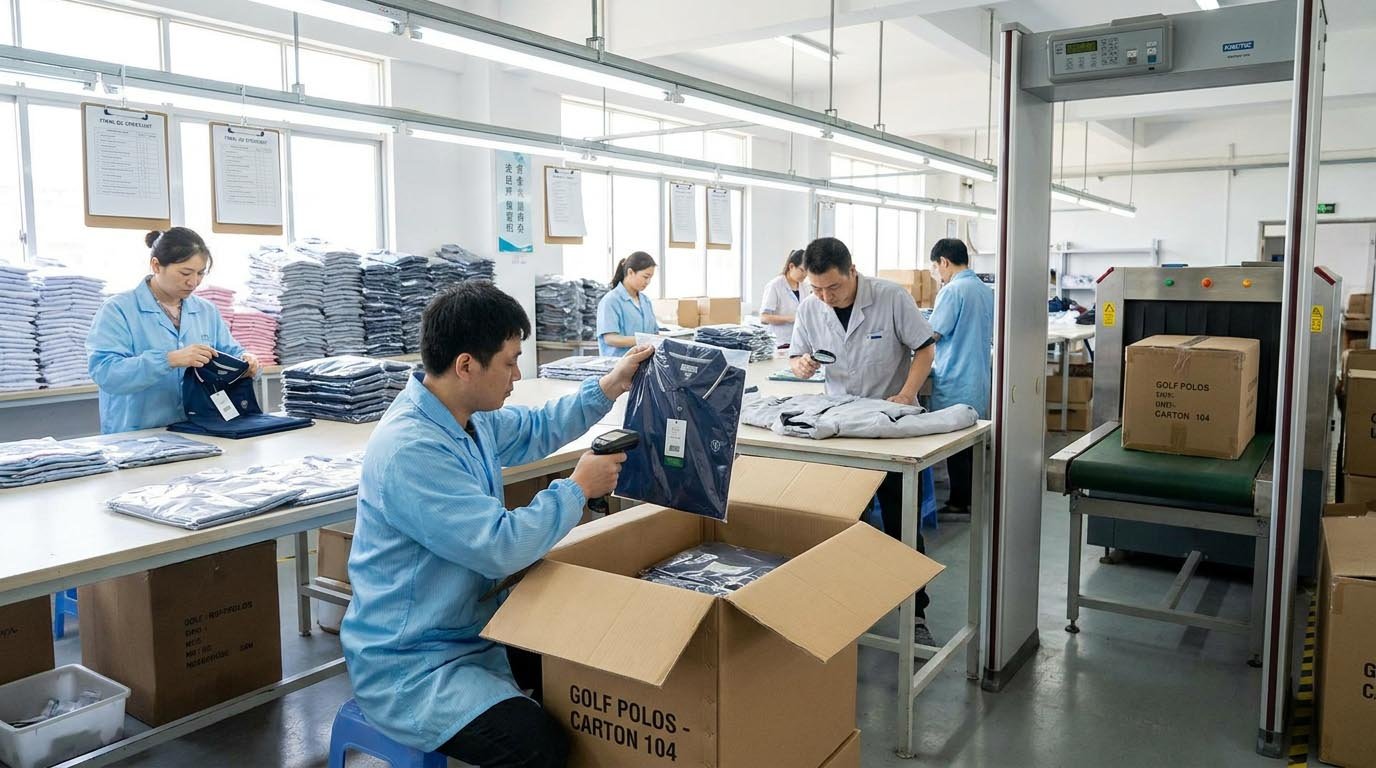
Stage 11: Complete Final Random Inspection Before Shipment
Final inspection should verify the completed order after earlier production controls have taken place.
Final Inspection May Include
- Selecting cartons according to the sampling plan
- Checking garment appearance
- Measuring selected garments against approved POM tolerances
- Reviewing workmanship
- Inspecting branding
- Verifying labels
- Checking packaging
- Recording defects
- Comparing results with the agreed AQL plan
Any measurement outside its approved tolerance should be recorded and evaluated for corrective action.
Packaging Inspection
Check:
- Correct garment and size
- Folding and polybags
- Barcodes and hangtags
- Carton assortment and quantity
- Carton labeling
- Shipping marks
Packaging errors can create problems for distributors, warehouses, retailers, and e-commerce fulfillment.
Needle Control
Where required by the buyer or product program, the factory should follow documented broken-needle and metal-control procedures.
Final inspection should confirm that the QC system has worked, not replace earlier production controls.
What Happens If a Golf Apparel Order Fails Inspection?
A failed inspection should trigger a documented corrective-action process.
Depending on the problem, the factory may need to:
- Isolate defective garments
- Sort affected production
- Repair reworkable pieces
- Replace unacceptable garments
- Correct labels or packaging
- Reinspect repaired goods
- Arrange buyer review
- Reject affected production in serious cases
For measurement-related failures, the factory should identify affected sizes, POMs, and production batches, then evaluate the cause before reinspection.
Any corrected garment must meet its originally approved measurement tolerances before being accepted as conforming.
The later a defect is found, the more expensive correction usually becomes.
That is why staged QC is more effective than relying only on final inspection.
How Should Buyers Use the Golf Apparel QC Checklist?
This guide explains how a golf apparel QC system should be designed and executed.
A factory inspection checklist serves a different purpose.
It tells buyers and factories:
- What should be checked
- What should be recorded
- What evidence should be retained
- What should happen after a failure
For a practical buyer-side tool, use our Golf Apparel QC Checklist to review materials, measurements, workmanship, branding, corrective actions, packaging, and final inspection evidence.
The two articles serve different purposes:
Golf Apparel Quality Control Guide = QC methodology
Golf Apparel QC Checklist = Inspection execution and evidence
FAQ About Golf Apparel Quality Control
What Is the Most Important QC Stage?
No single stage can replace the full process.
Reliable QC combines clear specifications, sample approval, material inspection, in-line production checks, measurement verification, and final inspection.
Preventing defects early is generally more effective than correcting them after production.
What Is FUWAY's Garment Measurement Tolerance?
FUWAY's finished-garment measurement tolerance is ±1.0 cm for all specified points of measurement, measured against the approved target dimensions.
Some POMs may require tighter limits, such as ±0.5 cm, when specified in the approved Tech Pack.
A measurement beyond its applicable tolerance is a nonconformance and requires appropriate inspection follow-up.
When Should Fabric Inspection Happen?
Fabric inspection should take place before cutting and early enough to resolve problems involving shade, weight, width, shrinkage, visible defects, or stretch performance.
What Is AQL in Garment Inspection?
AQL is used with a statistical sampling plan to help determine whether a production lot passes or fails inspection.
The plan depends on lot size, inspection level, sampling rules, and agreed AQL settings.
AQL does not replace FUWAY's garment measurement requirements.
Should Buyers Use Third-Party Inspection?
Third-party inspection can provide useful independent verification, especially for first orders, new suppliers, high-value production, or strict retailer programs.
However, it should complement factory QC rather than replace material inspection, in-line checks, decoration control, and packaging verification.
Final Takeaway
Golf apparel quality control should operate as a staged manufacturing system:
Tech Pack → Sample Approval → Materials → In-Line QC → Testing → Measurement & Workmanship → AQL → Final Inspection
Effective systems share three principles:
- Define standards before production.
- Monitor production while problems can still be corrected.
- Verify finished garments before shipment.
For garment measurements, FUWAY applies a maximum ±1.0 cm tolerance across all specified POMs, with tighter limits where required by the approved Tech Pack.
A good QC system does more than identify defective garments. It controls the manufacturing processes that create them.
FUWAY supports Custom Golf Shirts, Fabric Sourcing, decoration, testing, and production quality control.
If you want to review your specifications, sampling plan, or bulk-production QC requirements before placing an order, contact FUWAY.