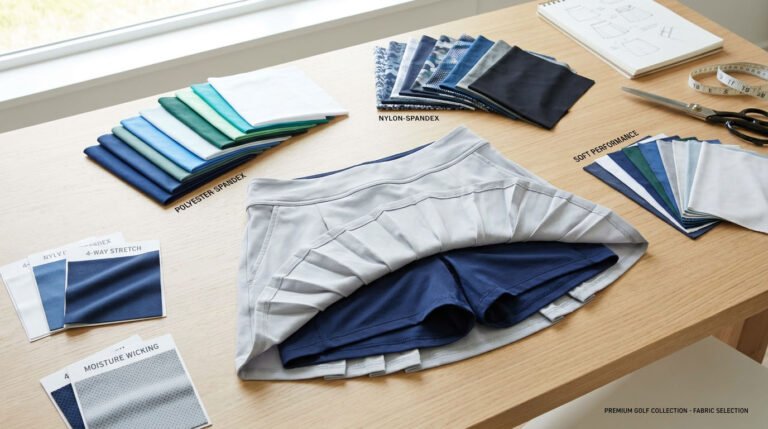
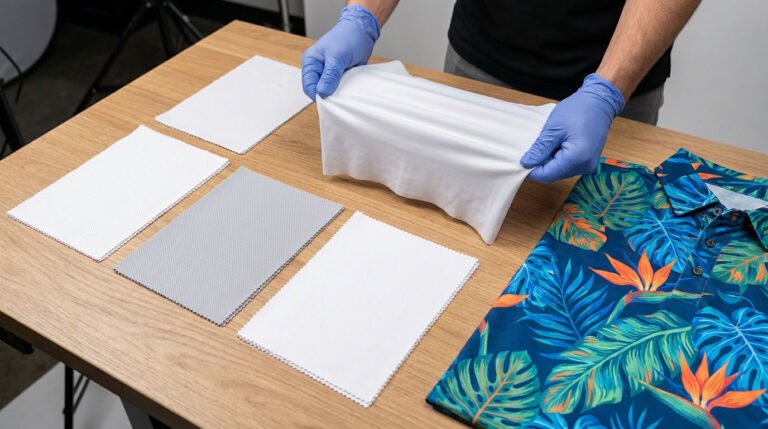
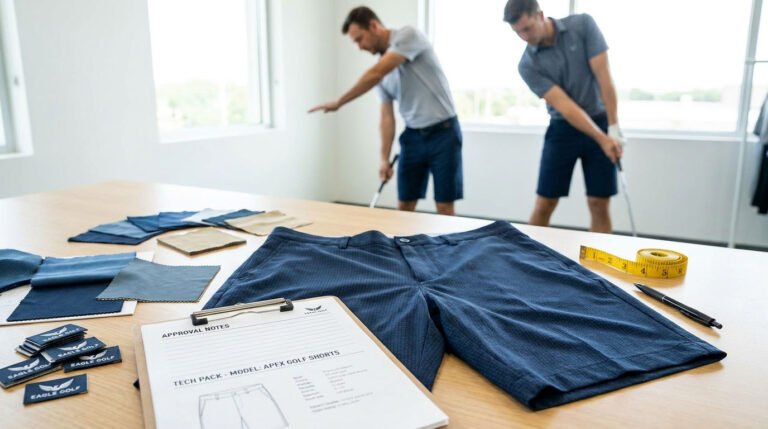
Choosing the wrong golf pants fabric can lead to uncomfortable samples, poor fit recovery, excessive heat, knee bagging, or costly redevelopment.
So, what are golf pants made of?
Most modern golf pants are made from polyester, nylon, cotton, elastane (spandex), or blends of these fibers. But fiber percentages alone do not determine performance.
For brands developing golf bottoms, the complete fabric system matters:
- fiber composition,
- woven or knit construction,
- fabric weight,
- stretch direction,
- stretch recovery,
- breathability,
- moisture management,
- and functional finishes.
A 90% polyester / 10% elastane fabric from one mill can behave very differently from another fabric with the same composition.
That is why brands should evaluate the whole fabric specification, not copy a fiber percentage from an existing retail product.
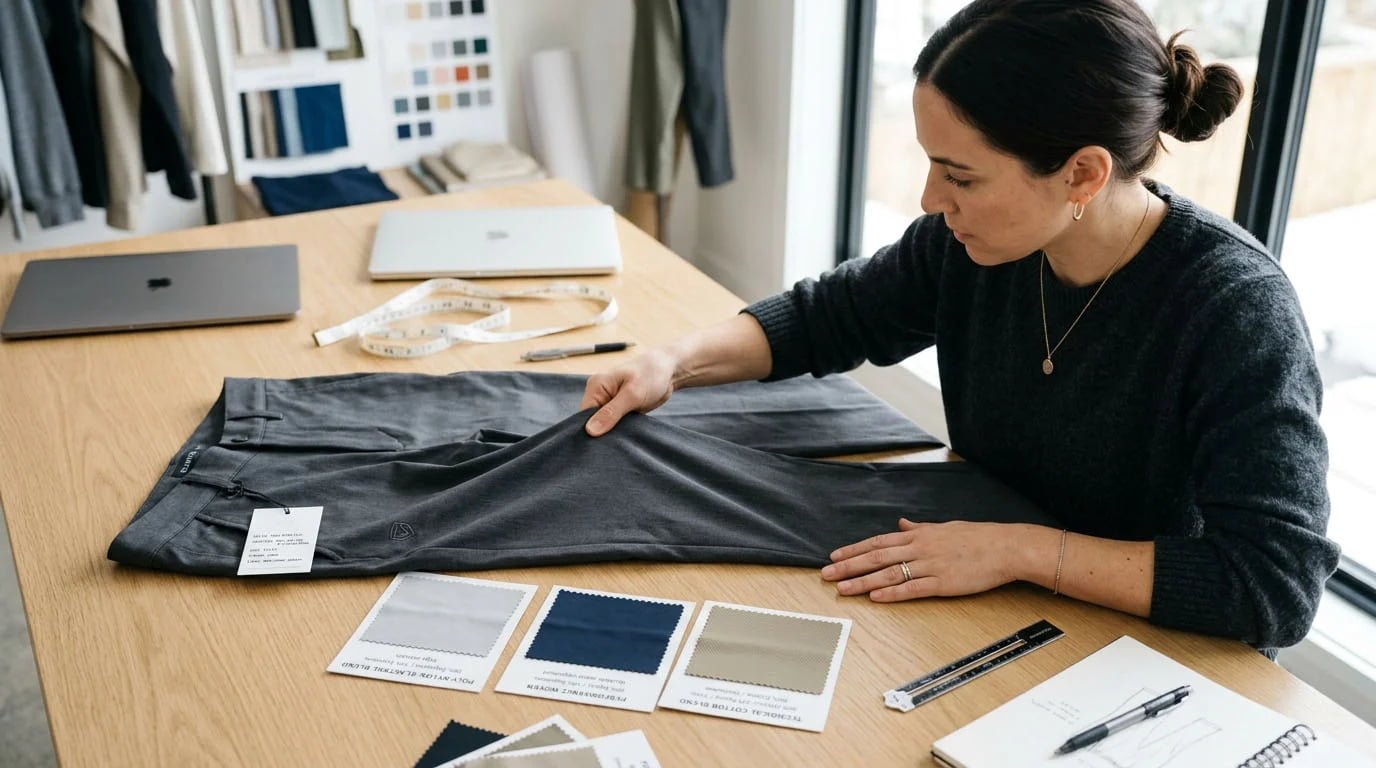
Quick Answer: What Are Golf Pants Made Of?
Golf pants are commonly made from polyester-elastane, nylon-elastane, cotton blends, or other stretch woven fabrics.
For many modern performance golf pants, polyester-elastane or nylon-elastane stretch woven fabrics are the most common starting points, while cotton blends are better suited to lifestyle-oriented styles.
In simple terms:
- Polyester provides durability, stability, and fast drying.
- Nylon offers a smooth hand feel and abrasion resistance.
- Cotton creates a softer, more natural appearance.
- Elastane adds stretch and mobility.
- Stretch woven fabrics suit tailored golf pants.
- Knits suit softer, more casual or jogger-style bottoms.
There is no universal "best golf pants fabric."
The right material depends on climate, fit, target customer, price positioning, and intended use.
For brands developing a new collection:
Define the use case → select fabric construction → build a sample → test fit and performance → revise before bulk production.
Why Does Fabric Choice Matter for Golf Pants?
Golf pants need to look more structured than general activewear while still allowing the golfer to walk, bend, squat, rotate, and swing comfortably.
Poor fabric selection can cause:
- knee bagging,
- seat distortion,
- excessive heat,
- fabric cling,
- pocket pulling,
- wrinkling,
- limited movement,
- or an overly casual appearance.
For a golf apparel brand, these issues affect fit, customer reviews, perceived quality, returns, and repeat orders.
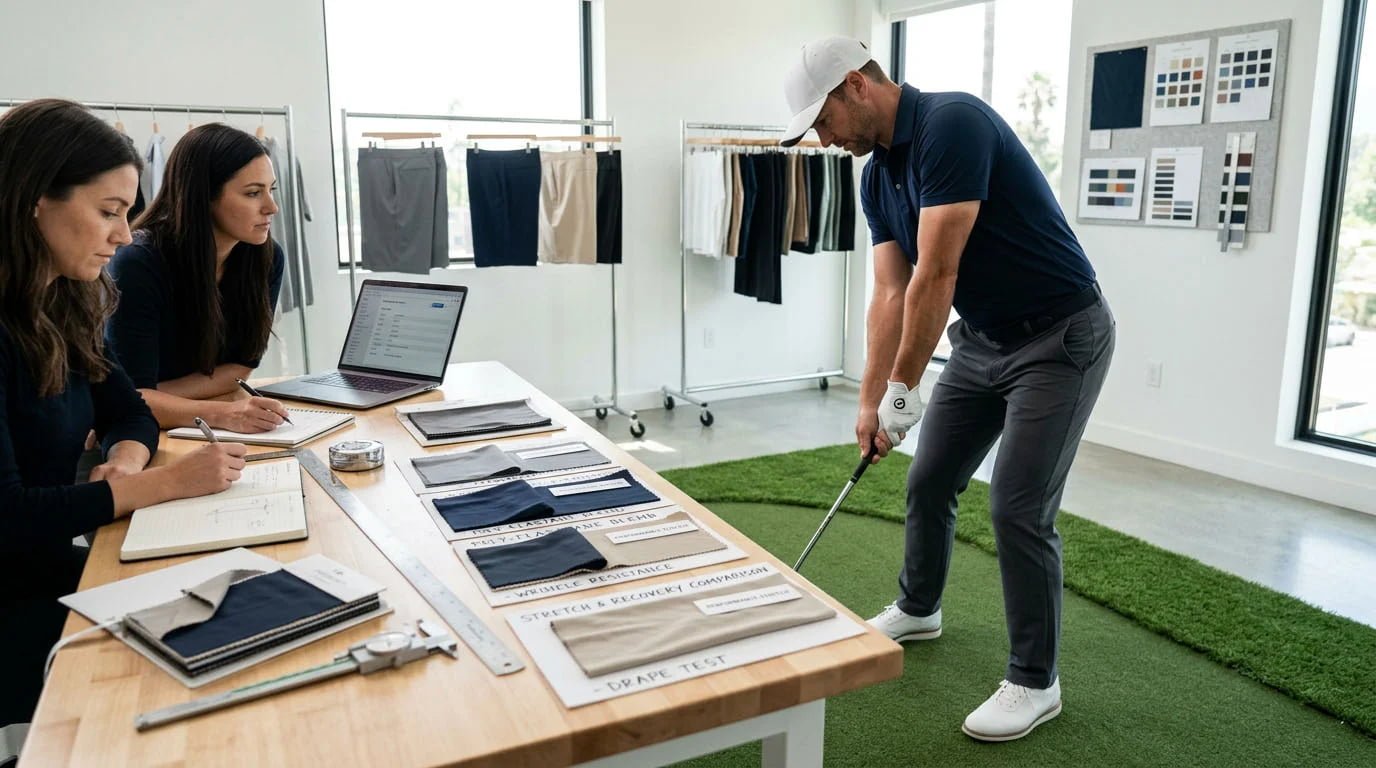
Golf Pants Fabric Is a System, Not Just a Fiber Label
One common product-development mistake is to ask:
"Can you make this in 90% polyester and 10% spandex?"
Composition is only the starting point.
Two fabrics with the same percentages may have very different:
- hand feel,
- thickness,
- stretch,
- recovery,
- air permeability,
- drape,
- surface appearance,
- and durability.
Brands should evaluate at least these factors:
| Fabric Factor | What It Influences |
|---|---|
| Fiber composition | Base feel, durability and moisture behavior |
| Construction | Structure, stretch direction and drape |
| Fabric weight | Warmth, opacity and hand feel |
| Stretch and recovery | Mobility and shape retention |
| Finishing | Wicking, water resistance and surface performance |
When developing custom golf bottoms, fabric selection should be based on the finished product requirement rather than composition alone.
Brands comparing textile options can also review FUWAY's Fabric Sourcing capabilities.
What Materials Are Commonly Used in Golf Pants?
The four most common fibers are polyester, nylon, cotton and elastane.
Polyester: The Common Performance Base
Polyester is widely used because it can provide:
- dimensional stability,
- durability,
- relatively fast drying,
- color retention,
- and compatibility with performance finishes.
However, not every polyester fabric feels premium.
Yarn type, weave and finishing can determine whether the final fabric feels smooth, matte, crisp, soft, technical, or overly synthetic.
Nylon: Smooth and Technical
Nylon, also called polyamide, is often used in technical or premium golf trousers.
It can offer:
- smooth hand feel,
- good abrasion resistance,
- strength,
- flexible drape,
- and a refined technical surface.
Nylon-elastane fabrics are often considered for lightweight or premium performance bottoms.
The final choice should still be based on the intended garment, cost target and finishing requirements.
Cotton: Better for Lifestyle-Oriented Golf Pants
Cotton provides:
- a natural hand feel,
- matte appearance,
- comfort,
- and a classic chino-style look.
However, pure cotton usually dries more slowly and wrinkles more easily than synthetic performance fabrics.
For this reason, many modern golf pants use cotton blends to improve:
- stretch,
- recovery,
- durability,
- wrinkle resistance,
- and comfort.
Cotton-rich fabrics work especially well for brands positioned between traditional golfwear and casual lifestyle apparel.
Elastane: The Stretch Component
Elastane, or spandex, helps improve mobility through:
- hip rotation,
- knee bending,
- squatting,
- walking,
- and the golf swing.
But more elastane does not automatically mean better performance.
What matters is whether the fabric:
stretches comfortably and then recovers its original shape.
Poor recovery can lead to bagging around the knees, seat or waistband.
Golf Pants Fabric Comparison for Brands
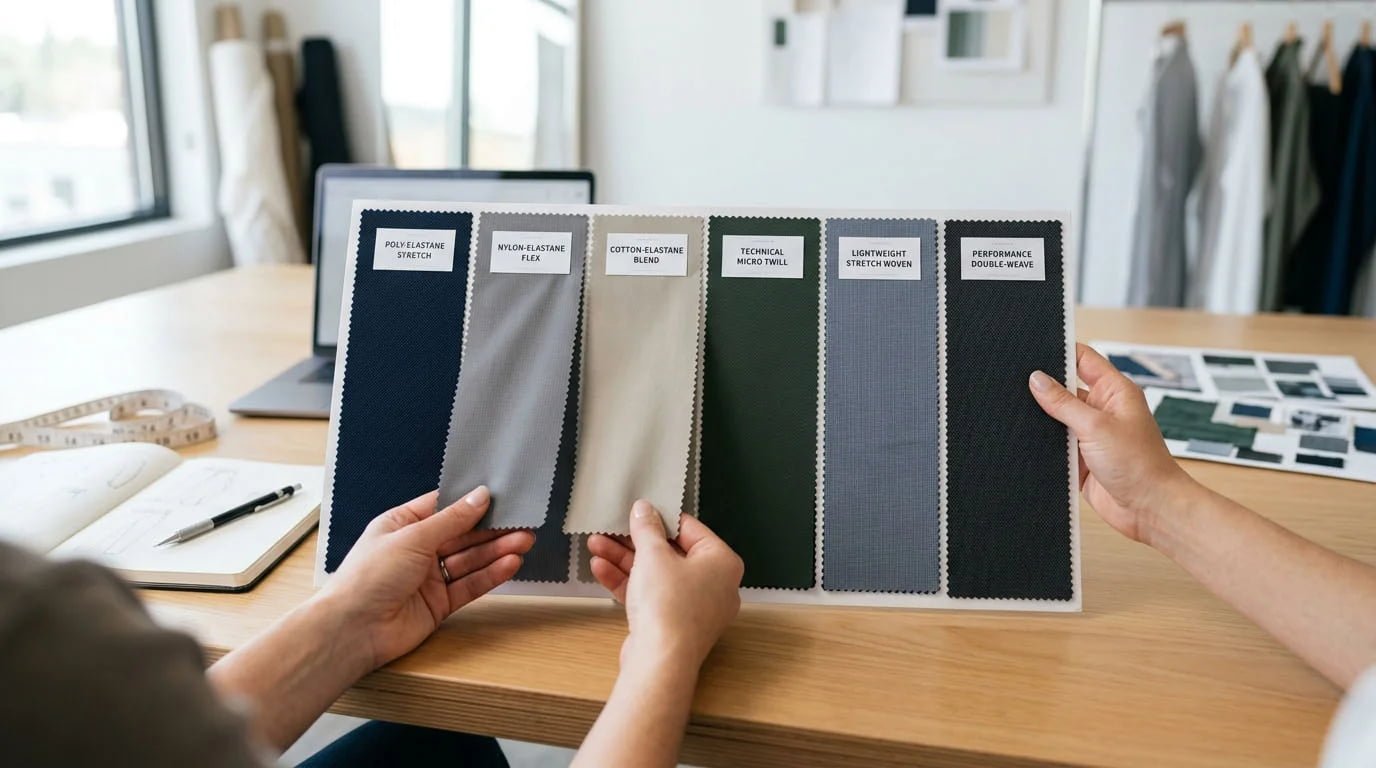
The following table provides a practical starting point.
| Fabric Type | Best For | Main Advantages | Watch-Outs |
|---|---|---|---|
| Polyester + Elastane | Core performance golf pants | Fast drying, stable, versatile | Hand feel depends on yarn and finish |
| Nylon + Elastane | Premium or technical styles | Smooth, durable, flexible | Cost and drying behavior may differ |
| Cotton Blend | Lifestyle / clubhouse styles | Natural appearance and comfort | Usually dries more slowly |
| Stretch Micro-Twill | Tailored golf trousers | Clean drape and structure | Must verify recovery |
| Lightweight Stretch Woven | Hot-weather golf pants | Low bulk and good mobility | Very light fabrics may need opacity checks |
| Double-Weave Stretch | Cooler or windier conditions | More structure and protection | May feel too warm in hot climates |
These are development directions, not fixed formulas.
Best Fabric by Golf Pants Product Type
For a faster starting point:
| Golf Pants Product Type | Practical Fabric Direction |
|---|---|
| Performance golf pants | Polyester-elastane stretch woven |
| Premium technical golf pants | Nylon-elastane stretch woven |
| Lifestyle golf chinos | Cotton-rich stretch blend |
| Hot-weather golf pants | Lightweight breathable stretch woven |
| Cool-weather golf pants | Denser twill or double-weave |
| Golf joggers | Stretch woven or performance knit |
These should be treated as starting directions rather than fixed specifications.
The final fabric should still be confirmed through sampling and wear testing.
Woven vs Knit: Which Is Better for Golf Pants?
For traditional and modern tailored golf trousers, woven fabric is usually the more common starting point.
Woven fabrics can provide:
- cleaner structure,
- better shape definition,
- controlled drape,
- and a sharper trouser appearance.
Knits are usually:
- softer,
- naturally flexible,
- more casual,
- and closer to activewear or golf joggers.
Woven Golf Pants
Stretch woven constructions work well for:
- slim golf trousers,
- classic golf pants,
- tournament apparel,
- performance chinos,
- and men's or women's golf bottoms.
Common constructions include:
- plain weave,
- twill,
- micro-twill,
- dobby,
- and double-weave.
Knit Golf Pants
Knits may suit:
- golf joggers,
- hybrid activewear,
- casual golf bottoms,
- or styles prioritizing softness and flexibility.
A knit is not automatically lower quality, and a woven fabric is not automatically stiff.
The construction should match the intended silhouette.
2-Way vs 4-Way Stretch: Which Does a Golf Brand Need?
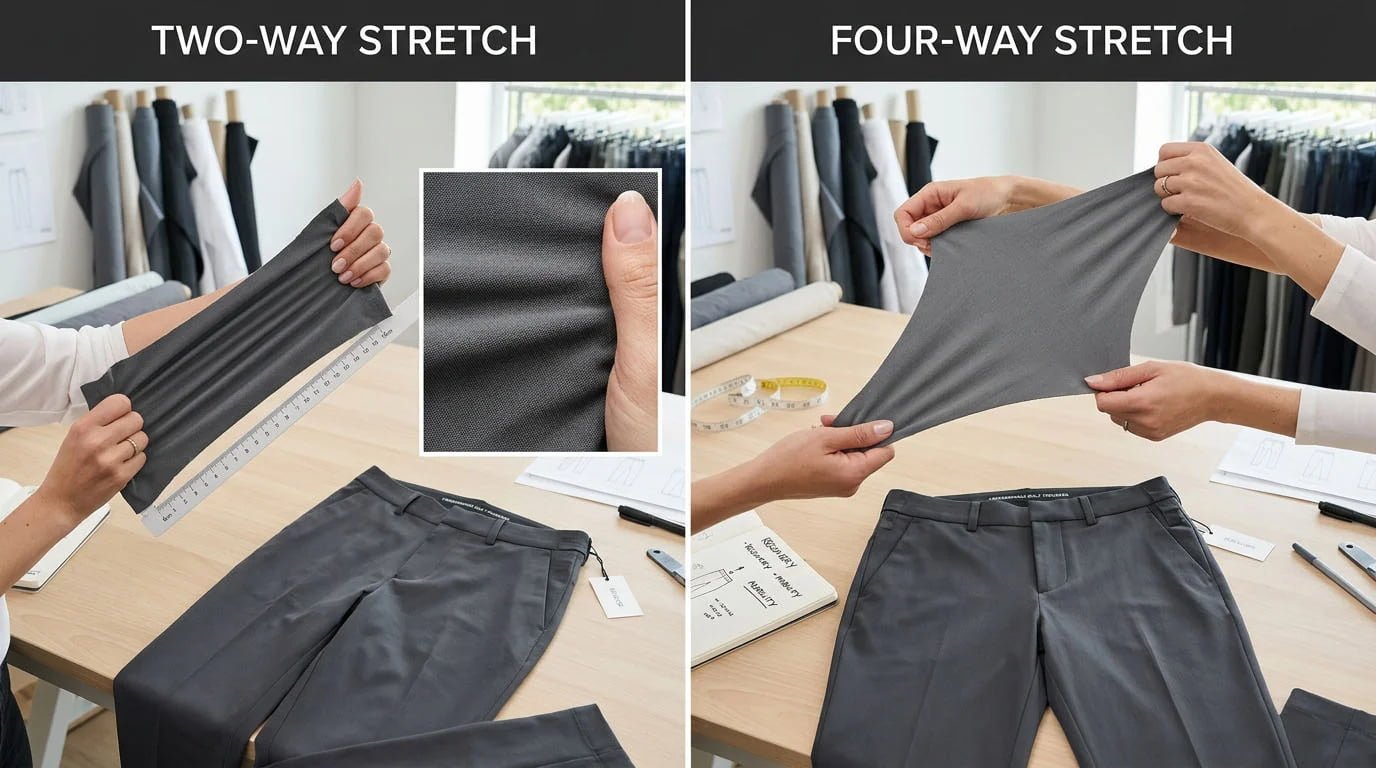
2-Way Stretch
A 2-way stretch fabric usually stretches mainly in one direction.
For many woven trousers, this can provide comfort across the:
- hips,
- thighs,
- and seat,
while helping maintain vertical structure.
It can work well for tailored silhouettes.
4-Way Stretch
A 4-way stretch fabric provides movement in both major fabric directions.
It can suit:
- slim fits,
- technical golf trousers,
- golf joggers,
- and high-mobility styles.
But 4-way stretch does not automatically mean better performance.
Brands should also evaluate:
- recovery,
- weight,
- waistband construction,
- pockets,
- pattern dimensions,
- and final fit.
A fabric that stretches easily but fails to recover can still produce an inferior garment.
What Performance Features Should Golf Pants Have?
Golf brands commonly request:
- moisture management,
- quick drying,
- breathability,
- stretch,
- UV protection,
- water repellency,
- wrinkle resistance,
- and abrasion resistance.
These features depend on more than fiber content.
Moisture Management
Polyester does not automatically mean "moisture-wicking."
Performance can be influenced by:
- yarn structure,
- fabric construction,
- surface treatment,
- and finishing chemistry.
If moisture-wicking is part of the product positioning, brands should verify how the claim is supported.
UPF and Water Resistance
UPF performance may depend on fiber, yarn density, color, construction and finishing.
Likewise, water-repellent finishes can be useful for morning dew or light rain, but performance may change after repeated washing.
Commercial claims should therefore be supported by appropriate testing.
FUWAY buyers can review relevant documentation through the Test Reports page.
How Should Climate Affect Golf Pants Fabric Selection?
Climate matters, but brands should avoid choosing fabrics only by GSM.
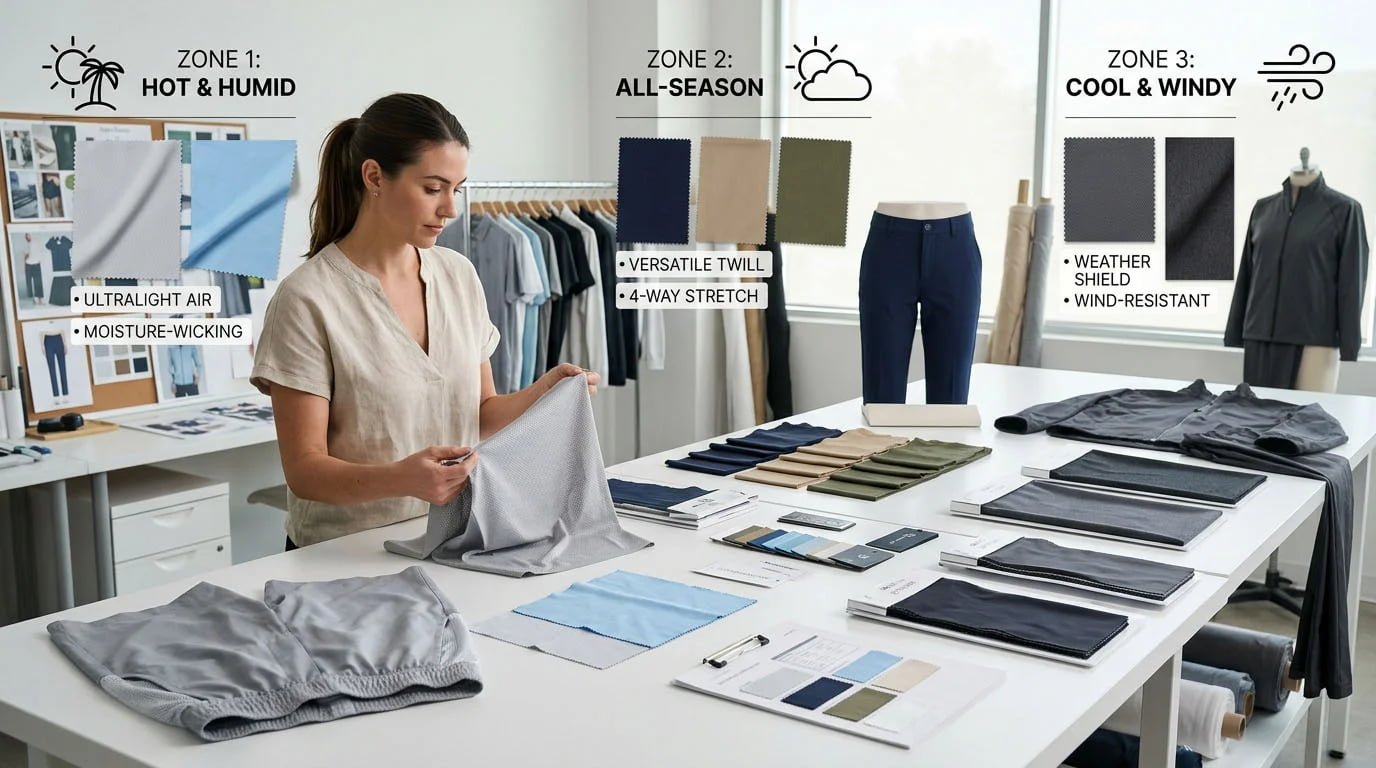
Comfort also depends on:
- weave density,
- air permeability,
- yarn type,
- surface texture,
- stretch construction,
- and finishing.
A lightweight fabric can still feel hot if airflow is poor.
Hot and Humid Markets
Prioritize:
- lightweight construction,
- breathability,
- quick drying,
- low skin cling,
- and comfortable stretch.
Possible starting points include lightweight stretch woven, plain weave and textured technical fabrics.
Mild and All-Season Markets
Aim for a balance between:
- structure,
- stretch,
- comfort,
- opacity,
- durability,
- and moderate weather protection.
Stretch twills and other structured performance wovens are common directions.
Cool, Windy or Damp Conditions
Consider:
- denser constructions,
- double-weave fabrics,
- brushed interiors,
- and weather-resistant finishes.
The fabric should provide protection without restricting the swing.
GSM can be used as a sourcing reference, but final approval should be based on construction, drape, opacity, stretch recovery and wear testing.
How Do You Choose the Right Golf Pants Fabric for Your Brand?
Instead of starting with a percentage formula, brands should start with the finished product.
Step 1: Define the Target Golfer and Use Case
Ask:
- Is the pant for performance golf or lifestyle wear?
- Is the main market hot, mild or cool?
- Is the fit slim, regular, relaxed or jogger-inspired?
- Does the customer prioritize softness or technical performance?
- Does the brand need a tailored appearance?
These questions quickly narrow the fabric options.
Step 2: Define the Fabric Requirements
Translate the product concept into practical specifications.
| Requirement | Question |
|---|---|
| Weight | Lightweight, midweight or cooler-weather? |
| Structure | Tailored, soft, technical or casual? |
| Stretch | 2-way or 4-way? |
| Recovery | Does it retain shape after movement? |
| Surface | Matte, smooth, textured or brushed? |
| Finish | Wicking, water repellency or other feature? |
| Fit | Slim, regular, relaxed or jogger? |
An experienced Fabric Sourcing partner can help narrow mill options into a manageable shortlist.
Step 3: Build the Physical Sample
A swatch does not show how the fabric will behave once combined with:
- the pattern,
- waistband,
- pockets,
- seams,
- zipper,
- and reinforcement.
A fabric that looks excellent on a sample card may behave differently after sewing.
Step 4: Test, Wear and Revise
Before bulk approval, evaluate:
- fit after movement,
- knee and seat recovery,
- waistband stability,
- pocket distortion,
- shrinkage,
- appearance after washing,
- seam performance,
- comfort,
- and drape.
Sampling is one of the most effective ways to reduce bulk-production risk.
How Should Brands Validate Golf Pants Fabric Before Bulk Production?
Fabric validation should answer one question:
Will the fabric continue to perform once it becomes a real garment and is worn repeatedly?
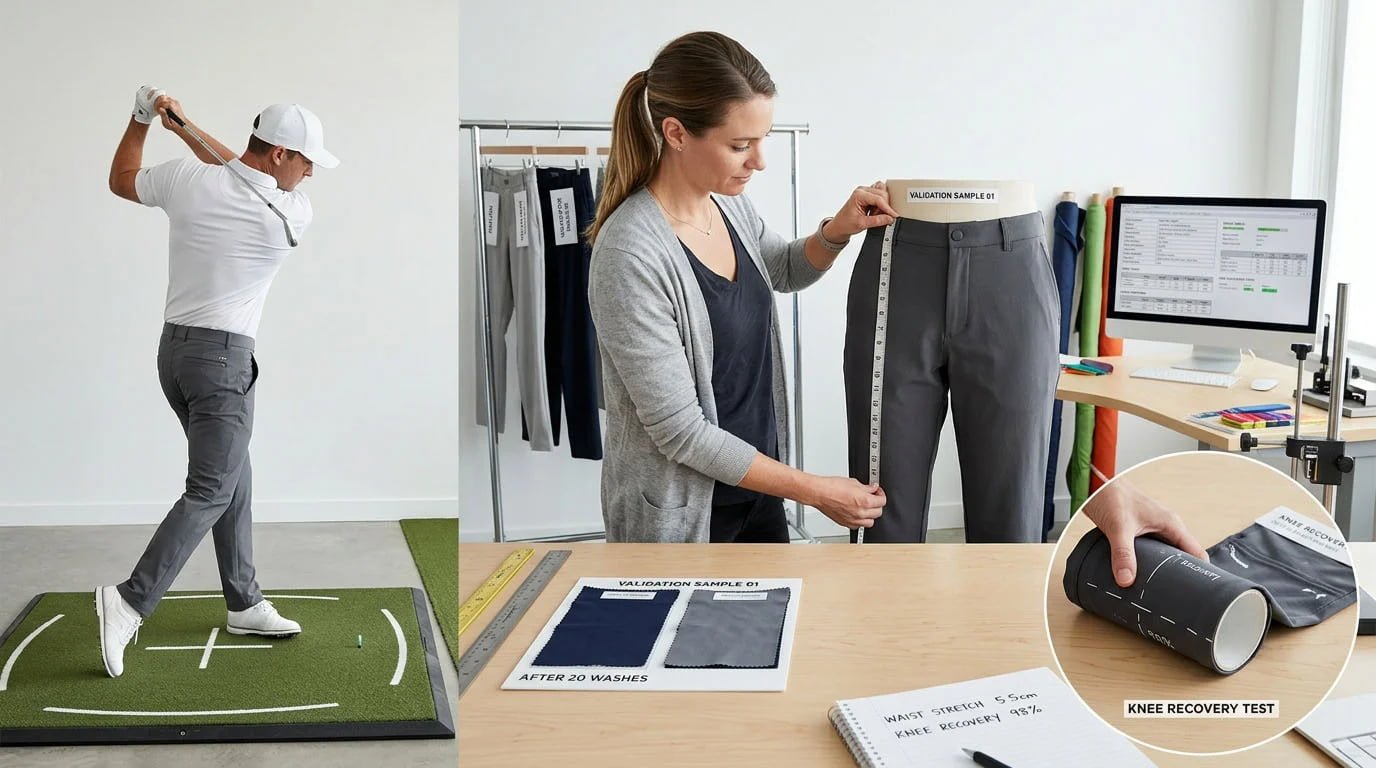
A practical review can include:
Wash and Dimensional Stability
Wash according to the intended care instructions and compare:
- inseam,
- outseam,
- waist,
- rise,
- and overall appearance.
Acceptance tolerances should be defined for the specific project.
For a deeper explanation of test methods, dimensional-change calculations, care-condition setup, and pre-bulk approval, see our Golf Apparel Fabric Shrinkage Testing Guide.
Stretch and Recovery
Check whether:
- knees bag,
- the seat stretches permanently,
- the waistband changes shape,
- or pockets distort.
Movement and Wear Testing
Test realistic movement such as:
- walking,
- sitting,
- bending,
- squatting,
- swinging,
- and carrying golf accessories.
This often reveals issues that a technical data sheet cannot.
Performance Claim Verification
If the product is marketed with moisture-wicking, UPF, water-repellent or other measurable claims, request appropriate supporting documentation.
Fabric validation is only one part of production control. For a broader framework covering material inspection, in-line checks, measurements, workmanship, AQL, and final inspection, see our Golf Apparel Quality Control Guide.
Common Golf Pants Fabric Mistakes Brands Should Avoid
Choosing Fabric Only by Composition
"90% polyester / 10% elastane" is not a complete specification.
Construction and finishing can matter just as much.
Assuming More Spandex Means Better Performance
High stretch is useful only when recovery and structure are also suitable.
Copying a Competitor's Care Label
A fiber label does not reveal:
- yarn specification,
- weave,
- weight,
- finish,
- or density.
Copying the percentage rarely reproduces the original product.
Ignoring Climate
A fabric developed for a cool market may perform poorly in a hot, humid one.
Approving the Swatch Without Testing the Garment
The final decision should be based on how the fabric performs in the actual golf pants.
Frequently Asked Questions About Golf Pants Materials
What is the best material for golf pants?
There is no single best material.
Polyester-elastane and nylon-elastane stretch wovens are common performance choices, while cotton blends work well for lifestyle-oriented trousers.
Are golf pants always made from polyester?
No.
Golf pants may use polyester, nylon, cotton or blended fabrics.
The full fabric system matters more than one fiber name.
Is nylon or polyester better for golf pants?
Neither is universally better.
Polyester is widely used for stability, durability and drying performance, while nylon can offer a smooth hand feel and good abrasion resistance.
How much elastane should golf pants contain?
There is no universal ideal percentage.
Stretch direction, recovery, construction, weight and fit matter as much as the elastane percentage itself.
Is 4-way stretch necessary for golf pants?
No.
4-way stretch can be useful for slim or technical styles, but many good golf trousers also use controlled 2-way stretch.
What fabric is best for golf pants in hot weather?
Brands usually prioritize lightweight, breathable, quick-drying stretch fabrics with good air permeability.
The final choice should be based on construction and wear testing rather than GSM alone.
Final Takeaway
So, what are golf pants made of?
Most modern golf pants use combinations of:
- polyester,
- nylon,
- cotton,
- and elastane.
But the fiber blend is only one part of the answer.
A successful golf pant depends on:
Fiber + Construction + Weight + Stretch + Recovery + Finish + Fit
For brands developing golf apparel:
- define the golfer and climate,
- select a suitable fabric construction,
- build a physical sample,
- test movement, recovery and washing,
- revise the specification,
- then approve the final version for bulk production.
If you are developing custom golf pants, shorts, polos or a wider golf apparel collection, FUWAY can support your project through Fabric Sourcing, OEM/ODM development, sampling and quality verification.
For project-specific fabric recommendations or swatch development, contact FUWAY to discuss your collection.