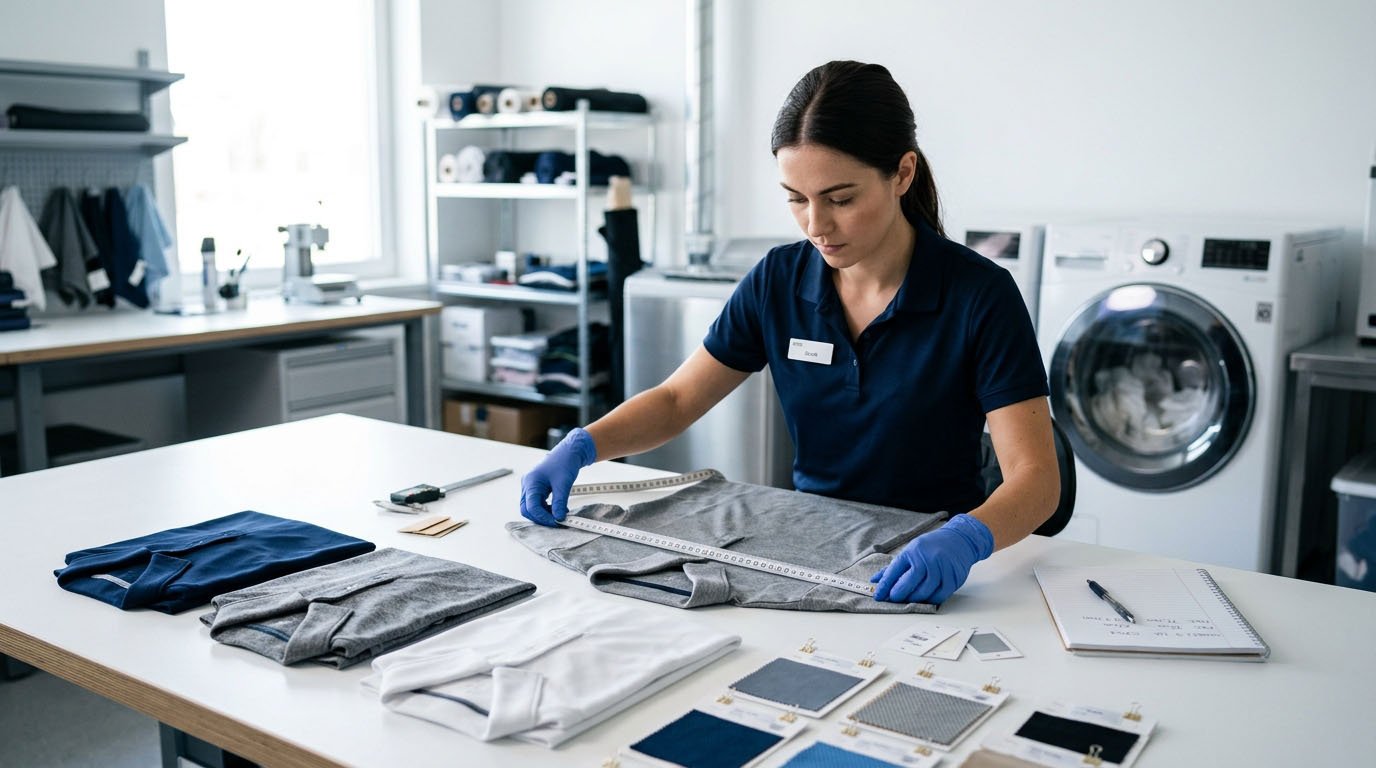

A golf polo can fit perfectly during sampling and still become too short, too tight, or distorted after washing. By the time customers discover the problem, the garments may already be in stores or shipped to hundreds of buyers.
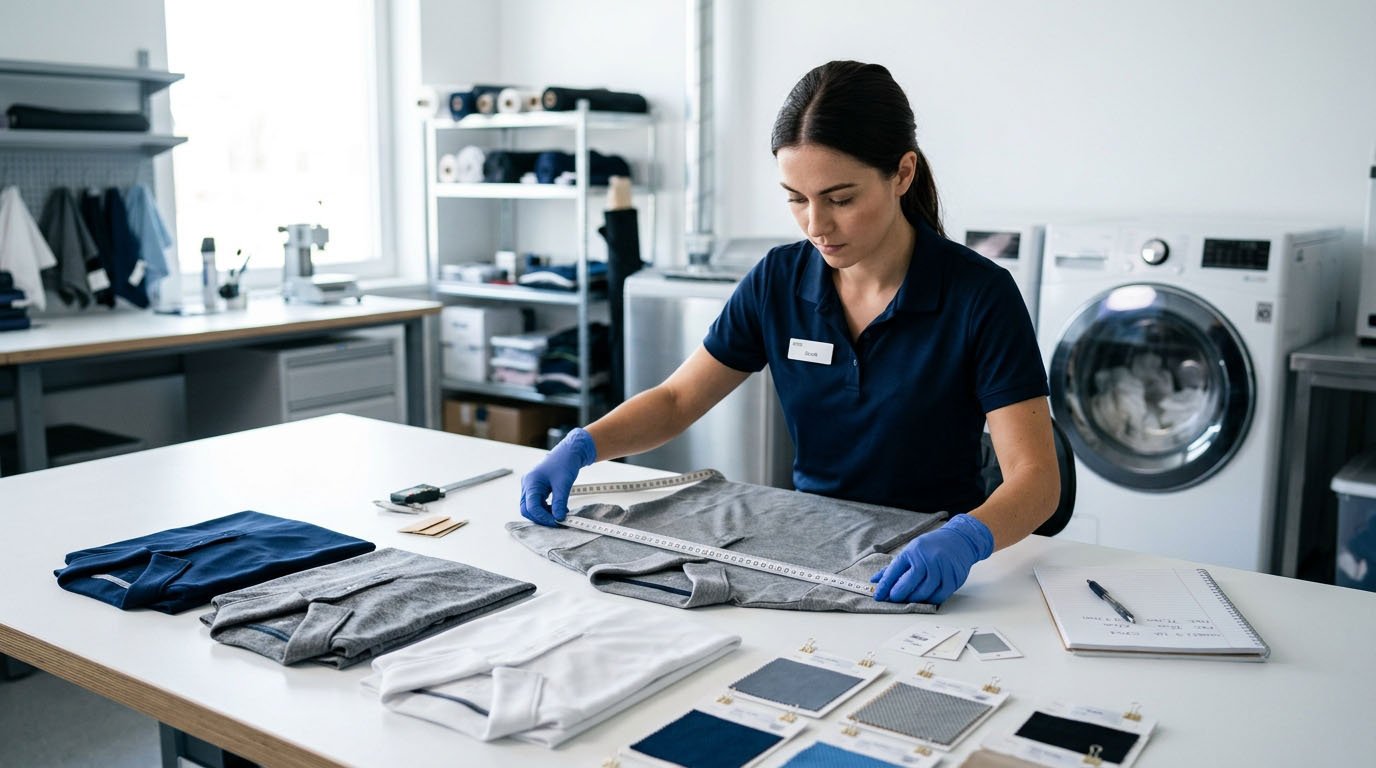
Golf apparel fabric shrinkage testing is a pre-production quality check used to measure how fabric or finished garments change after washing and drying. The goal is not to meet one universal shrinkage percentage. It is to confirm that the actual fabric, garment construction, care instructions, and finished measurements can stay within your brand's agreed post-wash tolerances.
For golf brands, shrinkage testing is not just a laboratory exercise. The result can determine whether a fabric is approved, whether a pattern needs adjustment, whether another sample is required, or whether bulk cutting should be placed on hold.
Quick Answers: Golf Apparel Shrinkage Testing
Is there one acceptable shrinkage percentage?
No.
Different fabrics, constructions, garment styles, care instructions, and buyer specifications require different limits.
The better question is:
Will the garment still meet the agreed finished measurements and fit requirements after washing under its intended care conditions?
Should you test fabric or finished garments?
Ideally, both.
Fabric testing identifies dimensional-stability risks before cutting. Finished-garment testing confirms how the body fabric, collar, placket, waistband, seams, interlining, and other components behave together.
Does pre-shrunk fabric still need testing?
Yes.
A mill's pre-shrunk claim can be useful, but it should not replace testing the actual material used for your order.
Why measure length and width separately?
Because fabrics do not always change equally in both directions.
A fabric may remain stable across the width while becoming noticeably shorter after laundering—or the opposite.
What happens if the fabric fails?
Depending on the issue, the factory and brand may:
- Reject or replace the fabric
- Investigate fabric finishing
- Adjust the pattern for predictable dimensional change
- Produce another sample
- Repeat the wash test
- Check additional fabric lots
- Hold bulk cutting until the issue is resolved
Why Does Fabric Shrinkage Testing Matter for Golf Apparel?
Golf apparel depends heavily on fit.
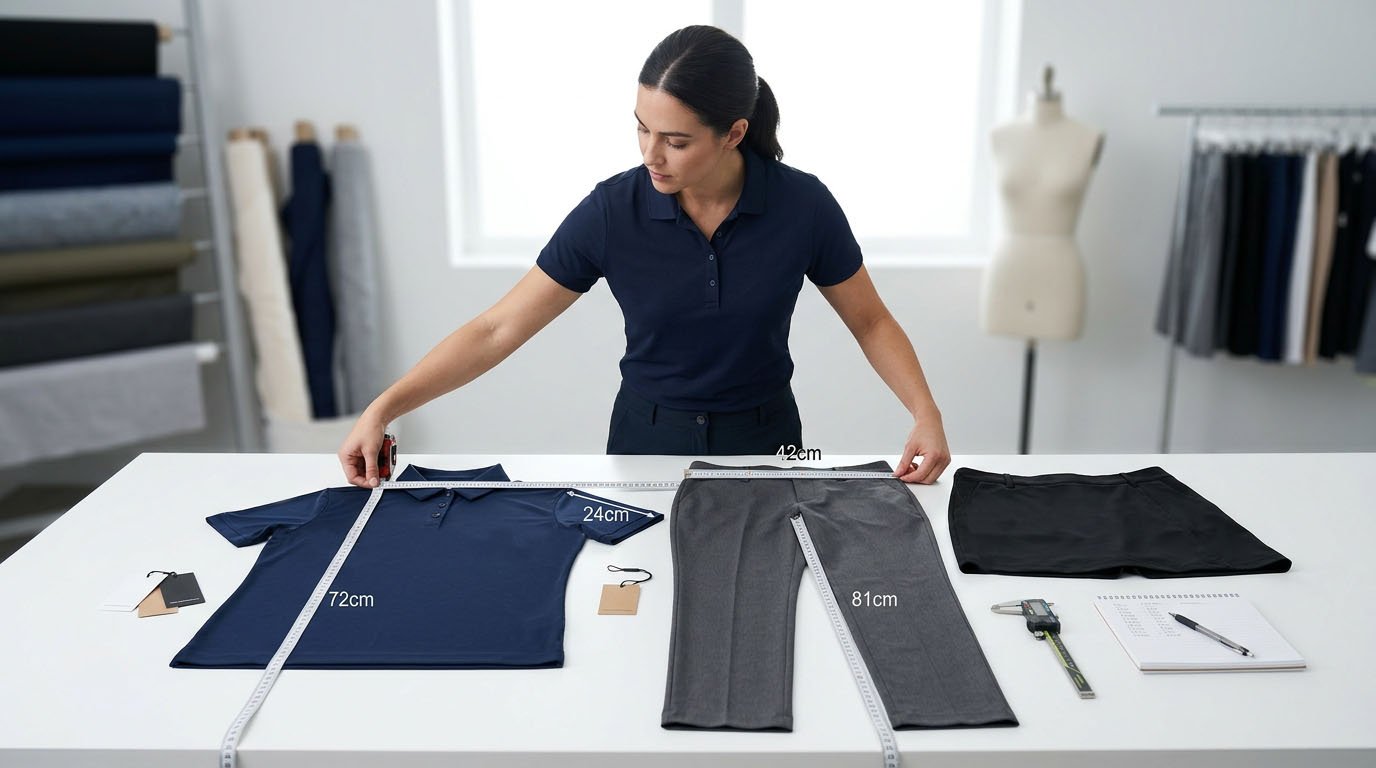
Shrinkage can affect:
- Polo body length
- Chest width
- Sleeve length
- Shoulder position
- Collar balance
- Placket appearance
- Trouser inseam
- Waistband fit
- Skort length
This is why testing should happen before bulk fabric is fully committed to cutting.
A problem discovered during development may require another sample.
The same problem discovered after production can lead to:
- Size inconsistency
- Customer returns
- Refunds
- Poor reviews
- Retailer complaints
- Replacement costs
- Supplier disputes
The purpose of testing is therefore not simply to obtain a number.
It is to answer:
Can this fabric and garment construction consistently deliver the fit that we approved?
What Causes Golf Apparel Fabrics to Shrink?
Shrinkage is influenced by fiber type, fabric construction, finishing, garment construction, and laundering conditions.
Fiber Composition
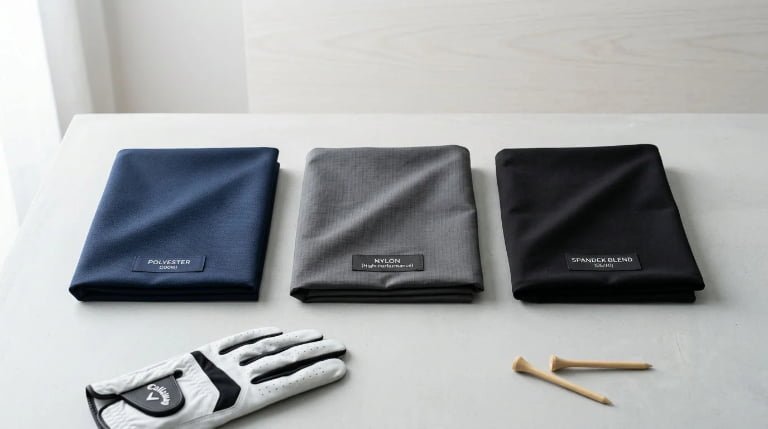
Golf apparel commonly uses:
- Polyester
- Nylon
- Cotton
- Spandex/elastane blends
- Polyester-cotton blends
- Nylon-spandex blends
But fiber composition alone does not predict finished performance.
Two fabrics with similar compositions can behave differently because their yarns, knitting, weaving, dyeing, finishing, and heat-setting processes are different.
That is why actual testing matters.
For brands developing performance golf fabrics, our Fabric Sourcing service can help compare fabric construction, stretch, hand feel, performance requirements, and production suitability.
Knit vs. Woven Construction
Knitted fabrics are made from interconnected loops. When manufacturing tension is released during laundering, those loops may relax and change shape.
Woven fabrics behave differently because their yarns are interlaced rather than looped.
Neither structure is automatically better. Each should be evaluated using the actual production material.
Washing and Drying
Heat, water, agitation, spinning, and drying conditions all affect the result.
That leads to one of the most important rules in shrinkage testing:
Testing conditions should reflect the intended care instructions of the finished garment.
Why Should the Care Label Determine Your Shrinkage Test?
A shrinkage result has limited value if the test conditions do not represent how the garment is intended to be cared for.
If a polo is tested using a very gentle wash-and-air-dry method but its final care instructions allow more demanding laundering, the test may underestimate real-world dimensional change.
For this reason, the brand, factory, and testing team should agree on the intended care method before testing begins.
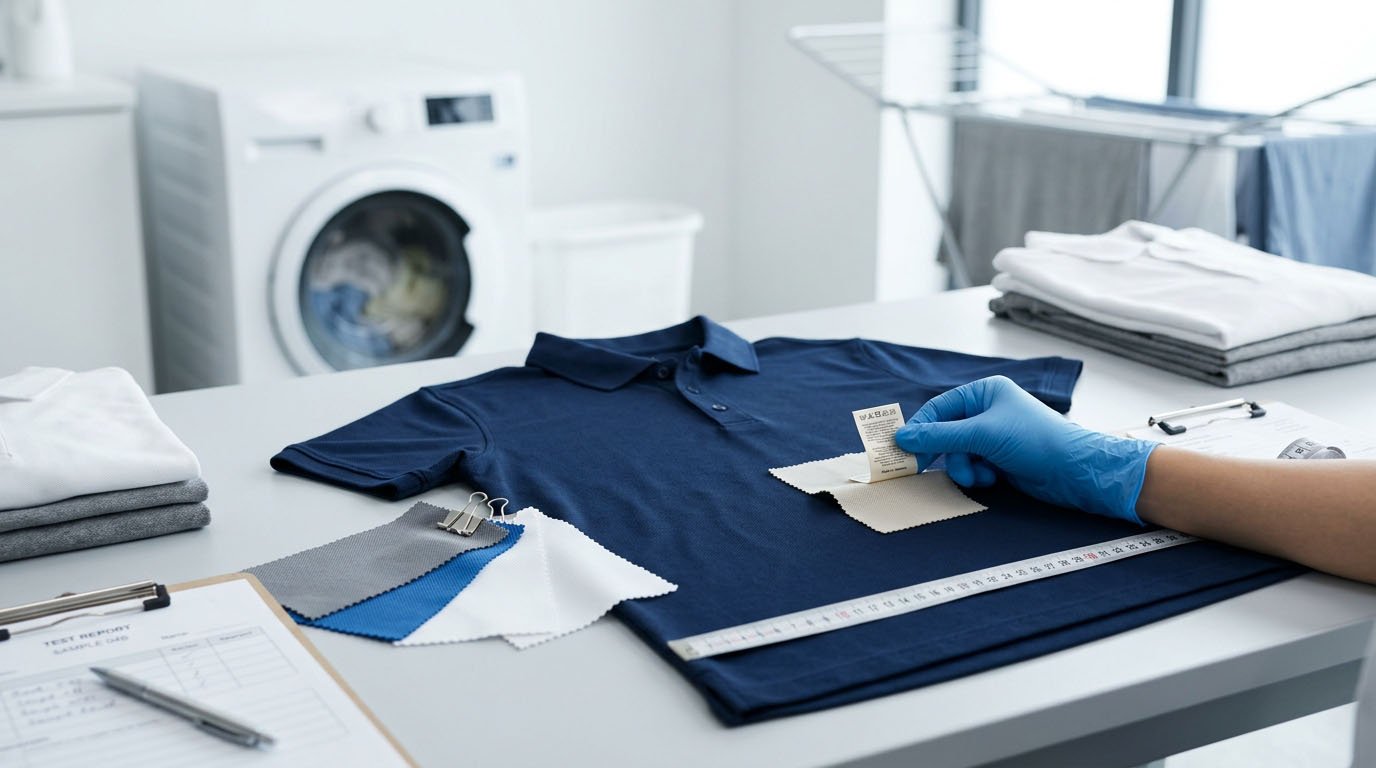
A testing protocol should define:
| Test Variable | What Should Be Defined? |
|---|---|
| Washing method | Agreed laundering method |
| Wash temperature | Based on care instructions |
| Washing cycle | Consistent test conditions |
| Drying method | Flat, hang, tumble, or other agreed method |
| Number of cycles | Defined before testing |
| Measurement points | Same points before and after washing |
| Acceptance criteria | Agreed post-wash tolerances |
The exact method should be selected according to buyer requirements, care instructions, and any applicable testing standard.
A factory should not apply one universal "safe shrinkage percentage" to every garment.
Fabric Test vs. Garment Test: What Is the Difference?
Both are useful, but they answer different questions.
Fabric Shrinkage Test
Fabric testing checks whether the raw material shows unexpected or unacceptable dimensional change before cutting.
It helps determine whether the fabric is stable enough to proceed or whether additional investigation is required.
Finished-Garment Wash Test
A finished garment contains more than one piece of fabric.
A golf polo may include:
- Main body fabric
- Collar
- Placket
- Interlining
- Sewing thread
- Embroidery
- Printed decoration
- Elastic or zippers
These components can react differently after washing.
A fabric may appear stable on its own while the finished garment develops:
- Wavy seams
- Twisted side seams
- Collar distortion
- Placket rippling
- Uneven sleeve lengths
- Waistband puckering
For this reason, FUWAY treats fabric testing and garment testing as complementary checks rather than substitutes.
How Do You Measure Fabric Shrinkage?
The basic process is:
Measure → wash → dry → measure again → compare
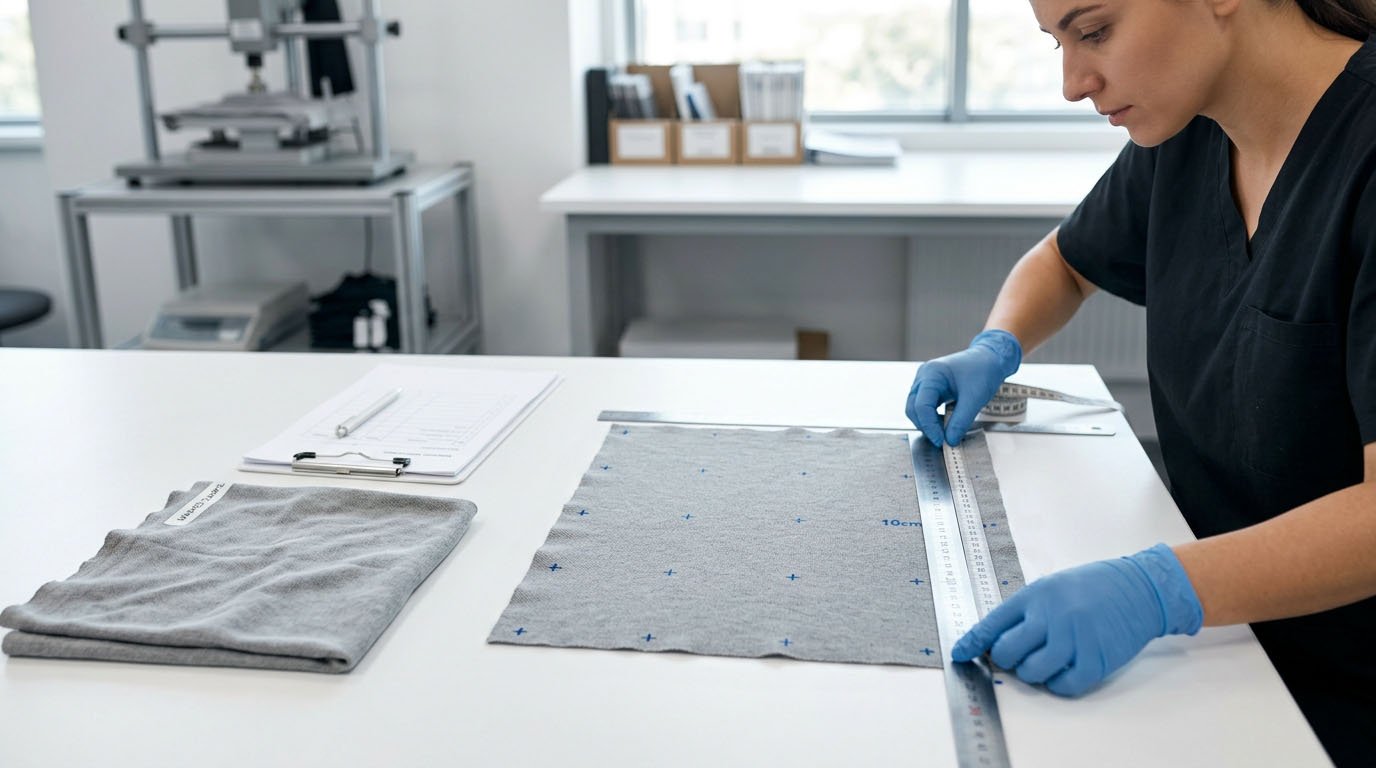
Step 1: Mark Reference Points
Set fixed measuring points before washing.
Measure the main fabric directions separately.
Step 2: Record the Original Measurements
Record the exact distance between the reference points.
Step 3: Wash Under Agreed Conditions
Use the defined washing and drying method.
Changing the test conditions between samples makes comparison unreliable.
Step 4: Re-Measure
After washing and drying, measure the same points again.
Step 5: Compare Each Direction
Review lengthwise and widthwise changes separately.
One average figure can hide a serious problem in a single direction.
How Do You Calculate Fabric Shrinkage?
A commonly used dimensional-change formula is:
Dimensional Change (%) = (Measurement After Washing − Measurement Before Washing) ÷ Measurement Before Washing × 100
For example, if a marked length measures 100 cm before washing and 97 cm afterward:
(97 − 100) ÷ 100 × 100 = −3%
A negative value indicates contraction under this convention, while a positive value indicates growth.
However, some test reports may express shrinkage using a different sign convention. Always confirm:
- How the percentage is calculated
- Whether negative values mean contraction
- Whether positive values mean growth
- Which fabric direction was measured
The number is useful only when linked to the correct test conditions and measurement points.
Why Is Dimensional Stability More Than Shrinkage?
A garment does not only become "smaller."
It may also change shape.
Lengthwise Change
This can affect body length, sleeve length, trouser length, and skort length.
Widthwise Change
This can affect chest, waist, hip, sleeve opening, and leg opening.
Spirality or Torque
Some knitted garments twist after laundering, causing side seams or reference lines to rotate.
Differential Shrinkage
Different garment components may change at different rates.
For example:
Body fabric remains stable
↓
Collar or placket changes differently
↓
Components pull against each other
↓
Garment becomes distorted
This is why finished-garment wash testing is particularly important for technical golf polos.
When Should You Adjust the Pattern for Shrinkage?
Pattern compensation can help when dimensional change is consistent, understood, and repeatable.
It should not be used to hide unstable fabric.
| Test Result | Recommended Production Decision |
|---|---|
| Stable and within tolerance | Approve |
| Stable, predictable change | Review pattern compensation |
| Borderline result | Re-test or re-sample |
| Different behavior between lots | Hold cutting and investigate |
| Uneven shrinkage | Review fabric stability |
| Severe distortion | Investigate material or construction |
| Fabric passes but garment fails | Review components and construction |
| Results remain inconsistent | Do not rely on pattern compensation alone |
The key distinction is simple:
Predictable dimensional change may sometimes be managed. Unpredictable dimensional change is a production risk.
What Is the Shrinkage Testing Decision Tree Before Bulk Production?
A practical workflow looks like this:
1. Select the Actual Production Fabric
↓
2. Confirm Intended Care Conditions
↓
3. Test Lengthwise and Widthwise Dimensional Change
↓
4. Does the Fabric Meet the Agreed Criteria?
Yes → Proceed to garment validation.
No → Investigate fabric finishing, material choice, or supplier process.
↓
5. Wash-Test the Finished Garment
↓
6. Does It Still Meet Measurement and Appearance Requirements?
Yes → Proceed toward bulk approval.
No → Review fabric, pattern, collar, placket, elastic, interlining, construction, or decoration.
↓
7. Adjust, Re-Sample, or Reject
↓
8. Confirm Again Before Bulk Cutting
This is safer than:
receive fabric → cut everything → discover the problem later.
How Do You Control Shrinkage Before Bulk Production?
Shrinkage control should connect directly to product development and bulk approval.
1. Test During Fabric Development
Do not wait until finished garments are ready.
If the material itself is unstable, early testing gives you more options.
You can compare alternative materials through our Fabric Sourcing service.
2. Validate the Finished Sample
Fabric testing alone cannot show exactly how a completed polo, trouser, or skort will behave.
For polo development, see our Custom Golf Shirts process.
3. Compare Results With the Tech Pack
Review critical post-wash measurements such as:
- Body length
- Chest
- Sleeve length
- Collar shape
- Waist
- Inseam
- Skort length
4. Check Additional Lots When Necessary
One acceptable test should not automatically be treated as proof that every future fabric lot will behave identically.
5. Hold Cutting When Results Are Unclear
Once fabric is cut, it becomes committed production inventory.
Unresolved dimensional-stability issues should ideally be investigated before large-scale cutting starts.
Which ISO Standards Are Commonly Used for Shrinkage Testing?
Several ISO standards are commonly referenced when evaluating textile dimensional change.
| Standard | Main Role |
|---|---|
| ISO 3759 | Preparation, marking, and measurement of textile specimens and garments |
| ISO 6330 | Domestic washing and drying procedures used for textile testing |
| ISO 5077 | Determination of dimensional change after washing and drying |
These standards perform different roles rather than acting as interchangeable "shrinkage standards."
Most importantly:
A testing standard defines a repeatable procedure. It does not automatically create one universal acceptable shrinkage limit for every golf garment.
The buyer and supplier should agree on acceptance criteria separately.
What Should a Shrinkage Test Report Show?
A useful test report should clearly identify:
- Fabric or garment style
- Fabric composition or specification
- Fabric lot or batch, when relevant
- Test method or standard
- Washing and drying conditions
- Number of wash cycles
- Measurement direction
- Before-wash measurement
- After-wash measurement
- Calculated dimensional change
- Agreed acceptance criteria
- Pass/fail result
- Test date
- Tester or laboratory identification
A useful report should answer three questions:
What was tested?
How was it tested?
Did it meet the agreed requirement?
A percentage without the test conditions, specimen identity, or acceptance criteria provides much less useful information.
You can also review FUWAY's available Test Reports.
How Can Golf Brands Verify a Factory's Shrinkage-Control Process?
Instead of only asking:
"Do you test shrinkage?"
ask the factory:
- Do you test the actual production fabric?
- Do you measure length and width separately?
- Are test conditions linked to the care instructions?
- Do you keep before-and-after measurement records?
- Do you wash-test finished garments?
- How are failed or borderline results handled?
- Can test results stop bulk cutting?
- Can you provide relevant testing documentation?
A reliable supplier should be able to explain the decision process, not simply say that testing is performed.
Common Shrinkage-Testing Mistakes
Avoid these common mistakes:
- Using one universal safe percentage for every fabric.
- Testing only one direction instead of length and width separately.
- Ignoring the care label when setting test conditions.
- Testing only raw fabric and never validating the finished garment.
- Averaging results in a way that hides directional problems.
- Assuming "pre-shrunk" means zero risk.
- Using pattern compensation to hide unstable fabric.
FAQ: Golf Apparel Fabric Shrinkage Testing
What is fabric shrinkage testing?
It measures dimensional changes after a fabric or garment is washed and dried under defined conditions.
What is an acceptable shrinkage percentage for golf apparel?
There is no universal percentage. Acceptance depends on the fabric, garment type, care instructions, buyer specification, and required post-wash measurements.
Should both fabric and finished garments be tested?
When practical, yes. Fabric testing evaluates the material itself, while garment testing checks how the complete construction behaves after laundering.
Does pre-shrunk fabric still need testing?
Yes. The actual production fabric should still be validated under the intended care conditions.
Can pattern adjustments compensate for shrinkage?
Sometimes. If dimensional change is consistent and predictable, pattern compensation may be appropriate. If shrinkage is irregular or unstable, pattern adjustment alone may not solve the problem.
Final Takeaway
Shrinkage testing is part of a larger production-control process:
Fabric Selection → Care Conditions → Shrinkage Testing → Garment Wash Test → Measurement Review → Pattern Decision → Bulk Approval
The most important question is not:
"Did the fabric shrink?"
It is:
"Will the finished golf garment maintain the fit, measurements, and appearance the brand approved after normal care?"
Test the real fabric. Use realistic care conditions. Measure both directions. Validate the finished garment. Investigate distortion as well as shrinkage. And turn every result into a clear production decision before bulk cutting.
At FUWAY, we support golf brands with fabric sourcing, product development, sampling, customization, and bulk golf apparel manufacturing.
If you are developing a golf polo, trouser, skort, pullover, or other golf apparel style, contact FUWAY to discuss your project.