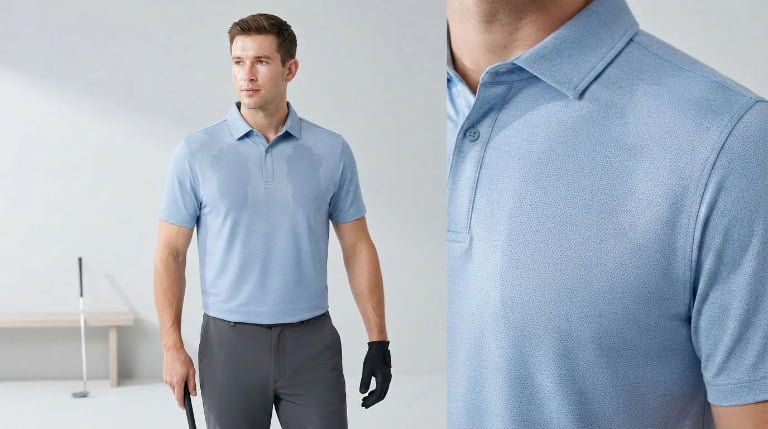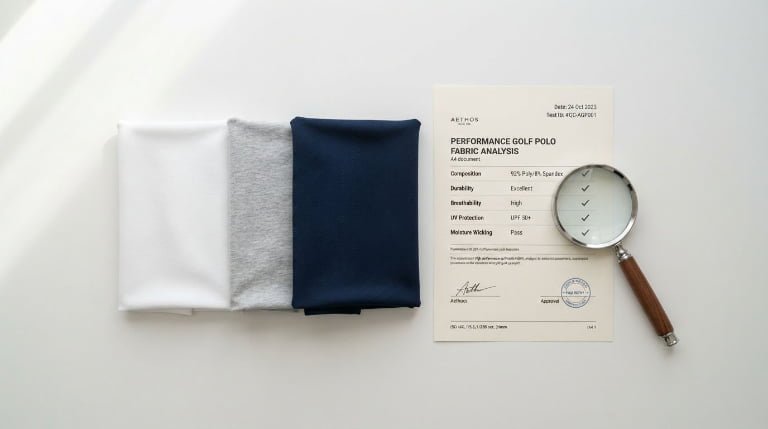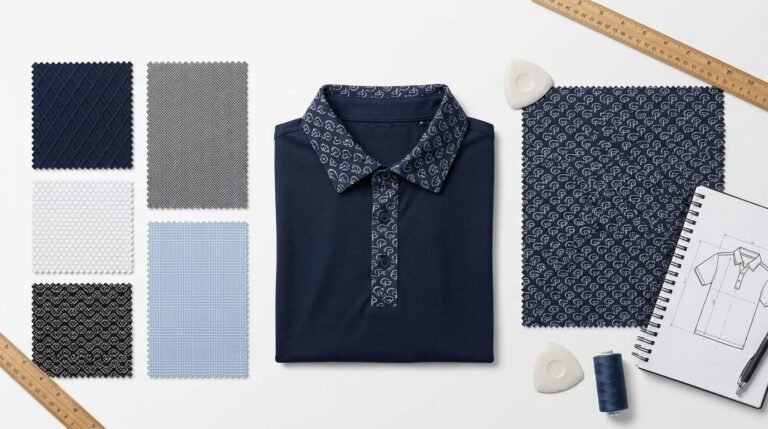
Here's the honest answer: there is no magic number. A fabric with 5%, 10%, or 15% elastane could all work for golf apparel—or all fail—depending entirely on what you're trying to build. Picking a percentage without context is like choosing a club before you've read the lie.
Think of it this way: asking for "10% elastane" is like ordering a meal by specifying the amount of salt. It tells you one ingredient, but nothing about the dish, the chef, or whether it will actually taste good.
For a golf apparel brand, the real question is whether a specific fabric meets the demands of a specific garment, and whether that performance holds up when you're ordering 500 pieces instead of handling a single swatch.
This guide treats 5%, 10%, and 15% as candidates to evaluate, not grades of quality. It walks you through what to ask your supplier, how to compare samples, and which documents to lock down before production starts.
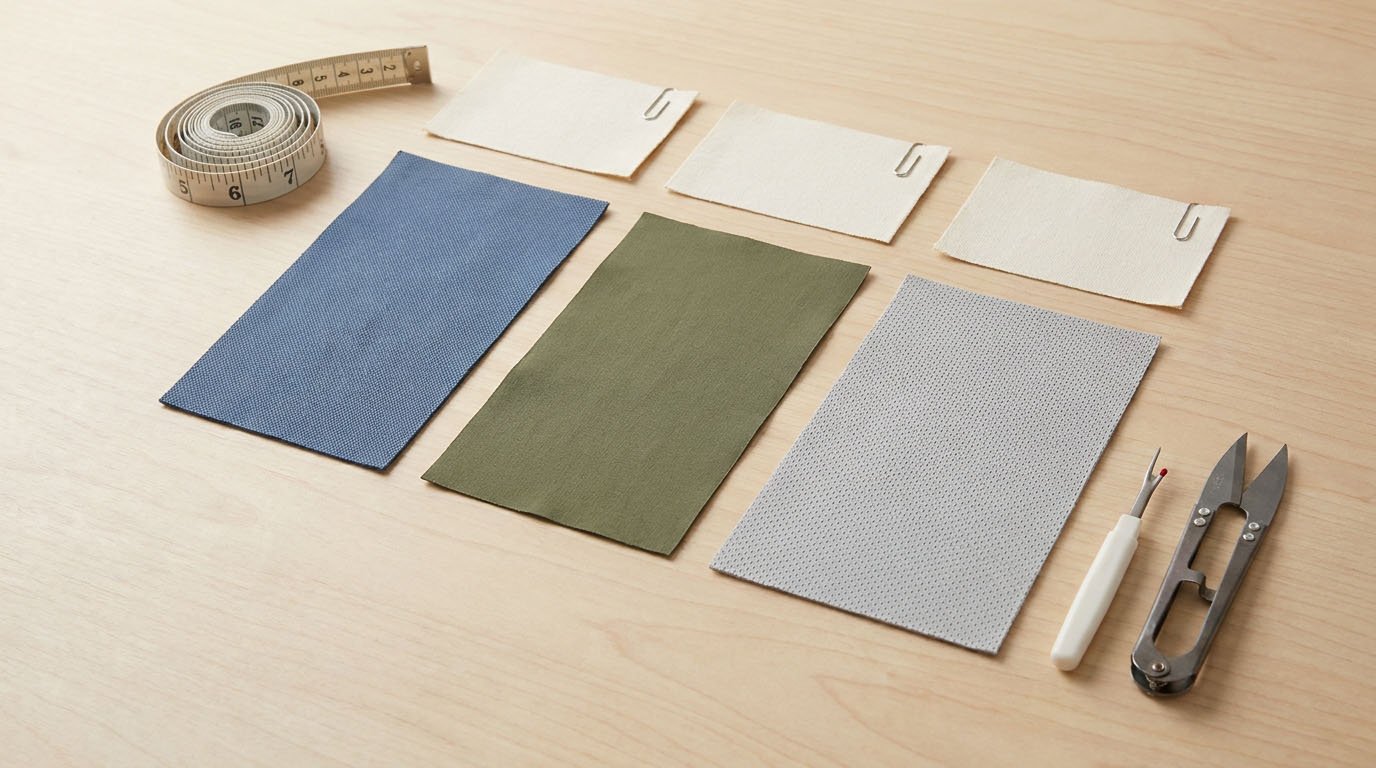
If you need a fast starting point: Shortlist fabrics by fiber composition, knit or weave structure, GSM, intended fit, and verified stretch performance. Don't pick 15% just because it's higher. Don't reject 5% just because it's lower. Request comparable data, then test the actual garment.
Key 1. Why "More Elastane" Doesn't Automatically Mean "Better Pants"
Elastane is the elastic fiber blended into materials like polyester or nylon. Spandex (common in the US) and elastane are generic names for the same fiber category. LYCRA® is a branded fiber, not a different type.
A label reading 90% polyester / 10% elastane tells you the fiber mix. It does not tell you how the fabric moves during a full shoulder turn, whether it bags out after a round, or if the collar will lay flat after washing.
What the percentage alone can't tell you
- Stretch direction: A fabric might stretch more in one direction than another. "4-way stretch" doesn't correspond to a single elastane threshold.
- Recovery – or "snap back": More elastane doesn't automatically mean better recovery. Yarn structure, knit construction, and finishing chemistry all play a role.
- Breathability and drying: Air flow and moisture behavior aren't calculated from fiber content.
- Hand feel and appearance: Two fabrics with identical fiber percentages can feel and drape completely differently if the weight or construction changes.
For a deeper look at stretch direction, see FUWAY's 4-way stretch fabric guide. This article focuses on choosing and approving the blend as part of a buying specification.
Key 2. How to Compare 5%, 10%, and 15% Elastane (Without Fooling Yourself)
Treat these percentages as organizational labels for your sample set. They are not universal performance tiers. A 15% elastane fabric from one mill can behave completely differently than a 15% fabric from another—because dozens of other variables are also changing.
| Candidate composition* | Why you might sample it | What you must check before deciding |
|---|---|---|
| 95% polyester / 5% elastane | You want to see if the lowest elastane option meets your movement brief | Extension in both directions, recovery after stretch, how the garment fits and drapes on body |
| 90% polyester / 10% elastane | You're testing whether adding more elastane actually improves performance | Whether measured stretch, recovery, and appearance meaningfully outperform the 5% candidate |
| 85% polyester / 15% elastane | Your design calls for a closer fit or visibly higher elasticity | Whether opacity, hand feel, sewing behavior, and wash durability still meet your standard |
These three compositions are illustrative comparison options, not FUWAY test results or universal recommendations. Other base fibers and blend percentages are entirely possible.
Compare apples to apples—or at least know when you're comparing oranges
If your 5% candidate is a piqué knit at 170 GSM and your 15% candidate is a jersey knit at 210 GSM, you can't attribute any performance difference to elastane percentage alone. The table below illustrates exactly why two fabrics with different structures can't be compared by fiber content alone:
| Property | Candidate A: Knit Piqué | Candidate B: Woven Twill |
|---|---|---|
| Label composition | 95% Polyester / 5% Elastane | 92% Nylon / 8% Elastane |
| Hand feel & extensibility | Open structure, high mechanical give, low stretch resistance | Tight structure, smooth surface, stretch relies primarily on the elastane fiber |
| Best suited for | Collared polo shirts | Structured trousers that need to hold a crease |
| Why you can't judge by elastane % alone | Its stretch comes mainly from the knit loop architecture, not the 5% elastane. | Despite higher elastane content, it may actually stretch and recover less in certain directions than the knit on the left. |
Document every variable that changes. When a true controlled comparison isn't possible, evaluate each fabric against the same product brief—not against each other. Don't call one "better" just because the composition looks more premium.
And never assume 15% is automatically hotter, tougher, or more "premium." Those aren't deductions from a care label; they are hypotheses that must be proven by physical testing, wear trials, and your cost sheet.
Step-by-Step Decision Flow
Here's the evaluation path this guide follows. If you remember nothing else, use this checklist:
[CHECKLIST: Four-step evaluation process]
[ ] Step 1: Write the Product Brief
What does this garment actually need to do? Define fit, climate, movement requirements, and appearance goals before touching a swatch.
[ ] Step 2: Request Comparable Specs
Get the same data fields from every supplier. Don't let one mill send a hand-stretch video while another sends a lab report.
[ ] Step 3: Review Test Data
Measured stretch, growth, recovery—not marketing claims. Agree on test methods and acceptance criteria before testing begins.
[ ] Step 4: Approve the Finished Garment
A swatch is not a shirt. Test the real thing on body, in motion, after washing. Only then authorize bulk cutting.
Key 3. What Golf Polos, Pants, Shorts, and Mid-Layers Actually Need
Different garments demand different performance briefs—even if they end up using similar-looking fabrics.
| Garment | What to test on body | Decision factors |
|---|---|---|
| Golf polo | Shoulder rotation, full-swing reach, torso twist, hem stability | Can you move freely without the shirt pulling up? Does the collar and placket return to shape? |
| Golf pants | Sitting, crouching (like reading a putt), knee and seat recovery | Stand up after bending: do the knees bag out? Does the seat fabric sag or snap back? |
| Golf shorts | Waist comfort, hip movement, sitting, pocket loading | Same recovery questions as pants, but don't assume shorts need the identical blend. |
| Quarter-zip / mid-layer | Shoulder and elbow movement over a polo | Test layered: does it slide over the base layer or bind? Do cuffs and hem hold shape? |
A real-world cautionary tale
We've seen a brand insist on "15% elastane" fabric for trousers because it sounded premium. The result? Worse knee bagging than their competitor's 5% blend. Why? The mill had used lower-grade elastane yarn and rushed the heat-setting process. The number on the label meant nothing. The finished garment told the real story.
A real FUWAY specification—what it shows and what it doesn't
One FUWAY stock fabric for a men's golf polo is 88% polyester / 12% spandex, 180 GSM. This tells you the composition and weight. It does not, by itself, prove a specific stretch percentage, recovery score, or air-permeability result. Those require the corresponding sample and test records.
If you're considering this fabric, start with your product brief: define the fit, climate, appearance, and movement requirements first, then test whether this material meets them. You don't need to redesign your entire line around 12%.
Key 4. Build a Comparable Fabric Specification Before You Ask for Quotes
"Performance polyester/spandex" can mean a hundred different things to a hundred different suppliers. To make quotes actually comparable, request the same data fields every time.
| RFQ field | What to ask for |
|---|---|
| Fiber composition | Exact percentage of each fiber; must total 100% |
| Fabric construction | Knit or woven; piqué, jersey, interlock, twill, or other specified structure |
| Fabric weight | GSM with agreed tolerance |
| Stretch performance | Test direction, method, conditions, and measured result |
| Growth / recovery | Reported values, conditions, and recovery interval—not just "high recovery" |
| Appearance and comfort | Hand feel, opacity, surface texture, drape, intended fit |
| Laundering performance | Agreed wash/dry conditions, dimensional change, appearance after testing |
| Decoration compatibility | Logo technique tested on the actual fabric |
| Supply and pricing | Stock vs. custom-developed, color availability, lead time, minimums |
| Approval reference | Fabric code, swatch/lot ID, report reference, revision date |
For options beyond stock blends, FUWAY's fabric sourcing service helps brands discuss materials and sample availability. A garment production MOQ is not the same as a mill's custom-development MOQ—confirm both before locking your specification.
Key 5. Verify Stretch, Growth, Recovery, and Wash Performance (Don't Just Believe the Label)
Fabric composition is a lead. Measured performance is the proof.
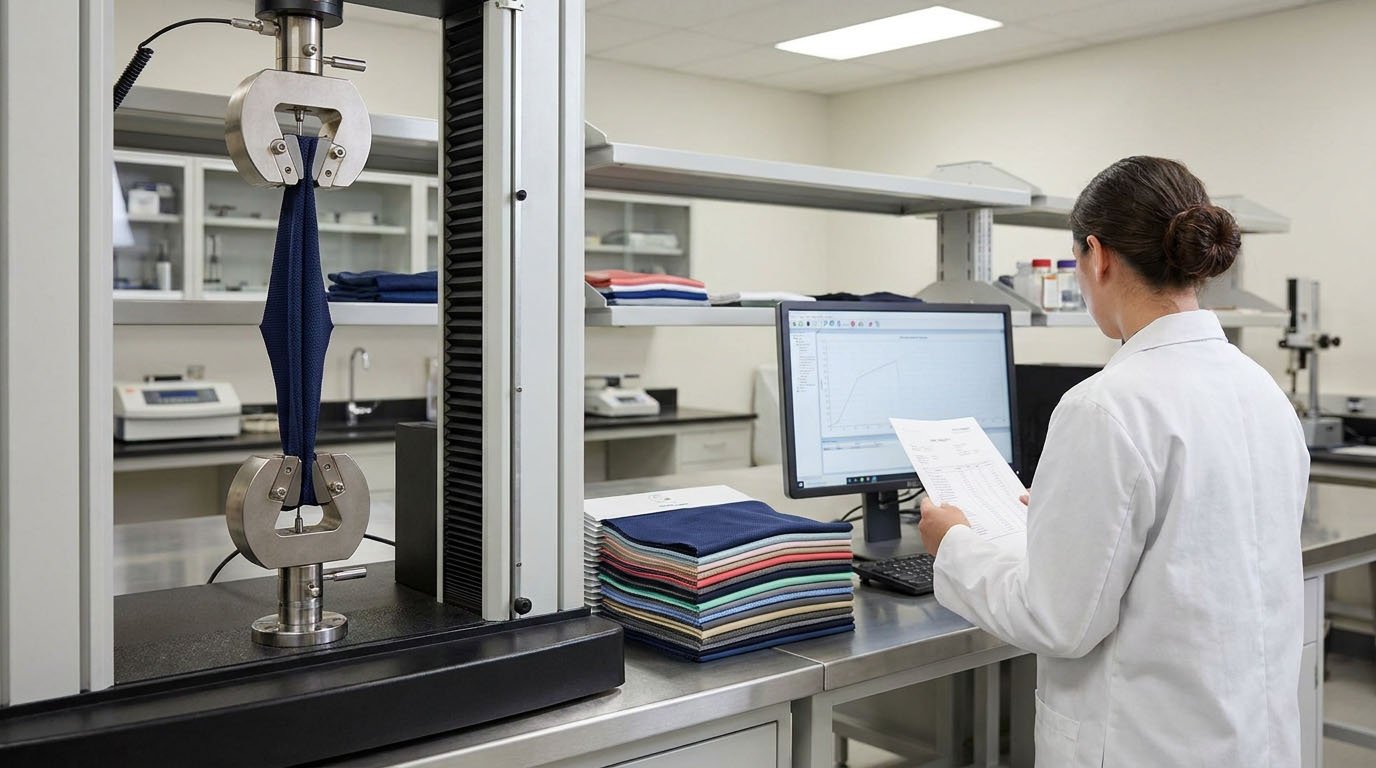
Three measurements you need—and what they actually mean
| Icon | Measurement | What it tells you |
|---|---|---|
| ↔️ | Stretch (extension) | How far the fabric extends under a defined test load |
| 📈 | Fabric growth | How much it remains stretched out after the load is removed—this is permanent or semi-permanent bagginess |
| ✅ | Recovery | How completely the fabric returns to its original dimensions under specified recovery conditions |
These three are related but not interchangeable. Two test reports using different loads, specimen directions, hold times, or recovery intervals may not be comparable—even if both say "pass."
Choose a test method suited to your fabric
| Reference method | What to check with your testing provider |
|---|---|
| ISO 20932-1:2018 | Elasticity and related properties of fabrics using strip or loop specimens; excludes narrow fabrics |
| ASTM D2594/D2594M-21 | Stretch and growth of knitted fabrics having low power under the method's conditions |
| ASTM D3107-26 | Stretch, growth, and recovery of applicable woven fabrics made with stretch yarns |
None of these standards hands you a universal pass/fail number for all golf apparel. Agree on the method, sample direction, conditions, and acceptance criteria before testing. ASTM D3107 carries a specific warning about between-laboratory precision—don't present a single test result as a batch guarantee.
FUWAY publishes genuine test reports, including Fabric Stretch & Recovery under ISO 20932-1. Use any report only for the material, sample, and conditions it actually identifies. A test result for Polo Fabric A is not proof that Pants Fabric B will perform the same way.
Don't stop at fabric testing—test the finished product
Fabric can pass lab tests and still fail in garment form. After the agreed wash/dry procedure, recheck:
- Dimensional stability
- Changes in hand feel or shape
- Seam puckering or distortion
- Effect of heat-transfer or embroidery on the fabric
Don't assume every elastane blend tolerates the same heat-press settings. Don't invent an arbitrary number of wash cycles—agree on a protocol.
A supplier sent me a video of someone stretching fabric by hand. Is that enough?
No. Here's a polite but firm way to respond: "Thanks for the video. For our tech pack, we need quantified data to ensure batch-to-batch consistency. Could you please provide the stretch & recovery test report under ISO 20932-1, specifying the test load and direction? A hand-stretch demo is a helpful first look, but it can't replace proper documentation for our bulk approval process."
This is what separates a reliable mill from a trader who sells samples. Anyone can pull on a swatch. You need to know: under what load? For how long? What's the recovery percentage after 1 minute? After 1 hour?
Key 6. Approve the Finished Garment, Not Just the Swatch
A fabric hanger in a lab tells you nothing about how the garment behaves on a human body during a swing. Approve an actual sample in the intended material before authorizing bulk cutting.
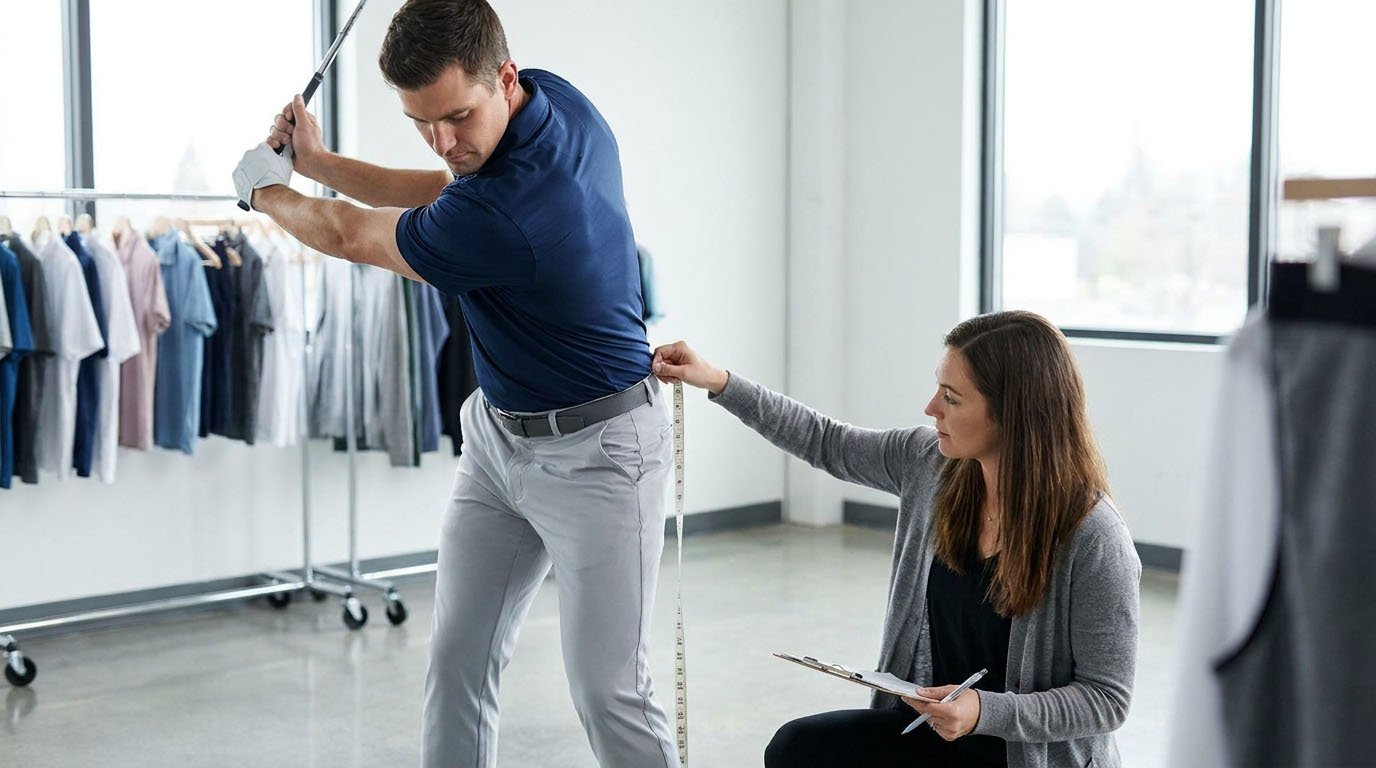
Golf polo sample evaluation checklist
- Fit at rest: Check chest, shoulder, sleeve, body length, collar, and hem against your approved measurements.
- Movement: Have the intended wearer raise both arms, rotate through a full swing, and bend. Watch for pulling, riding up, restriction, and unwanted clinging.
- After movement: Does the garment return to its intended shape? Do seams or hems look distorted?
- After care and decoration: Recheck measurements, appearance, and logo quality using your agreed wash and finishing conditions.
Additional checks for pants and shorts
Test sitting, crouching, walking, and loading pockets with a phone or scorecard. Pay close attention to waist, seat, thigh, and knee or hem areas. If the pants bag out at the knee, jumping from 5% to 15% elastane isn't automatically the fix—your pattern ease and fabric selection need to be assessed together.
For FUWAY finished garments, the general points-of-measure tolerance is ±1.0 cm unless your approved tech pack demands a tighter limit. This is a garment measurement tolerance, not a stretch-recovery performance tolerance.
Key 7. Send a Decision-Ready RFQ—and Keep a Reorder Record
You don't need to decide on a percentage before reaching out to a manufacturer. A stronger RFQ describes the product outcome and asks suppliers to propose materials you can evaluate on equal footing.
Example RFQ brief for a new golf polo brand
| Item | What to send |
|---|---|
| Product | Men's golf polo, performance-oriented everyday fit |
| Initial fabric reference | 88% polyester / 12% spandex, 180 GSM stock fabric example—or your preferred swatch |
| Alternatives to evaluate | Request suitable 5%, 10%, or 15% candidate blends if available, with full specifications |
| Required performance | Comfortable full swing, controlled growth, acceptable wash behavior, intended drape |
| Evidence requested | Swatches, comparable stretch data, sample identification, applicable test documents |
| Product details | Size chart, target fit, color, collar, logo placement, planned quantity |
| Approval rule | Written acceptance of fabric, fit, decoration, measurements, and test criteria before bulk production |
Reorder document checklist—keep this on file
- Approved fabric code and composition
- Construction and GSM
- Color reference
- Swatch or lot identification
- Test-method and report references
- Tech-pack and pattern revision
- Size chart and points of measure
- Logo artwork and application settings
- Approved production sample
- Packaging instructions
Before reordering, confirm the same materials and conditions are still available. Don't assume an identical percentage guarantees an identical garment—mills change, lots change, finishes change.
If you're developing a new golfwear collection, send your requirements through FUWAY's contact page. Include your intended garment, target fit, sample photos or swatches, estimated order size, and what you want the fabric to achieve. FUWAY can then discuss feasible stock and custom material options without treating a higher elastane number as a default upgrade.
Frequently Asked Questions
Is 10% elastane the best choice for a golf polo?
Not for every polo. A 10% blend can work beautifully—or disappoint—depending on construction, GSM, fit, measured stretch and recovery, appearance, and wash performance. Compare it against your brief, not against an abstract ideal.
Does 15% elastane always stretch more than 5%?
Not when comparing different finished fabrics. Construction, yarn type, and finishing can flip the expected result. Test each candidate under comparable conditions rather than guessing from the label.
Can a golf shirt stretch without spandex?
Yes. Knitted structures have inherent mechanical give even without elastane. Whether the recovery and fit hold up over a round is a separate question—test it.
Are spandex, elastane, and LYCRA® the same thing?
Spandex and elastane are interchangeable generic fiber names. LYCRA® is a trademarked brand of spandex/elastane fiber, not a separate fiber category.
Does more elastane make golf clothing less breathable or slower to dry?
You can't conclude that from percentage alone. Air permeability and moisture management depend on construction, weight, finishes, and test conditions. Request evidence for the actual fabric when those properties matter.
Is FUWAY's golf apparel MOQ also the MOQ for a custom elastane fabric?
Not automatically. FUWAY's typical garment production starts around 100 pieces per style, subject to project details. A custom-developed or custom-dyed fabric may have a separate mill minimum—confirm both before finalizing your specification.
Conclusion
Don't let a single number on a label dictate the success of your next season's line. A great pair of golf pants isn't defined by "15% elastane," but by how confidently it moves and recovers over 18 holes.
Stop paying extra for "15% elastane" just because it sounds premium. Start with a clear brief. Treat 5%, 10%, and 15% as possible starting points—not quality grades. Compare full specifications, verify stretch and recovery with proper test methods, test real garments on real bodies in motion, and retain all approval records for bulk production and reorders.
That's how you turn a vague request for "more stretch" into a specification a manufacturing partner can actually develop, verify, and repeat—so your customers feel the difference on the first tee, and your garments still look sharp on the 18th green.
Ready to spec your next golf collection? Take the decision-ready RFQ template from this guide. When you're ready to move from a vague idea to a verified, production-ready specification, send your brief through FUWAY's contact page. Let's build golf apparel your customers will truly feel the difference in—from the first tee to the clubhouse.