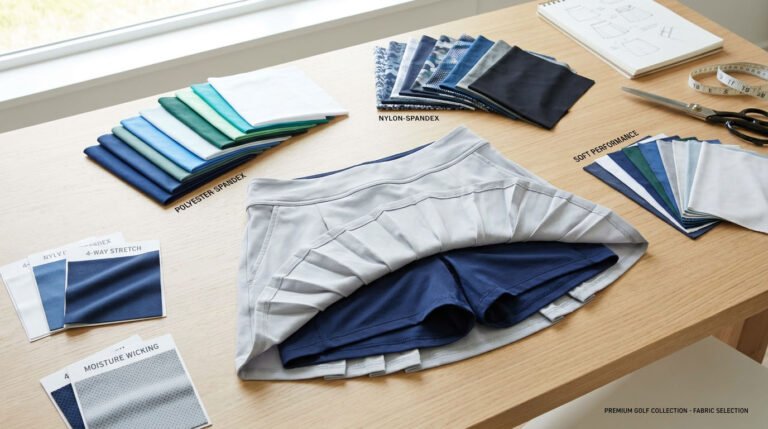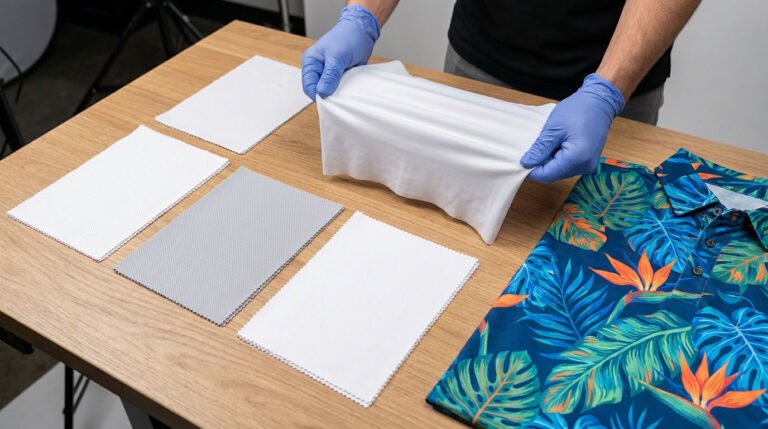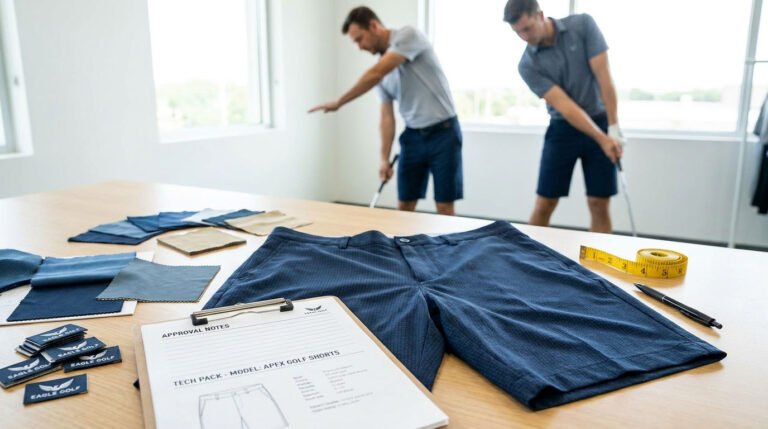
You source a fabric described as “4-way stretch” for a new golf polo.
The sample feels elastic when you pull it sideways—but lengthwise movement is limited. The fabric contains spandex, yet it does not perform as expected during a golf swing.
This is why golf apparel buyers should not approve performance fabric based only on:
- supplier descriptions,
- fiber composition,
- or a quick hand-pull test.
4-way stretch generally describes fabric engineered to stretch in both the lengthwise and crosswise directions. There is no single universal stretch-percentage threshold that automatically defines every fabric as “true 4-way stretch.”
For golf shirts, buyers should define the required:
- stretch,
- growth,
- recovery,
- durability,
- and comfort performance
for the intended product, then verify those requirements using suitable test methods.
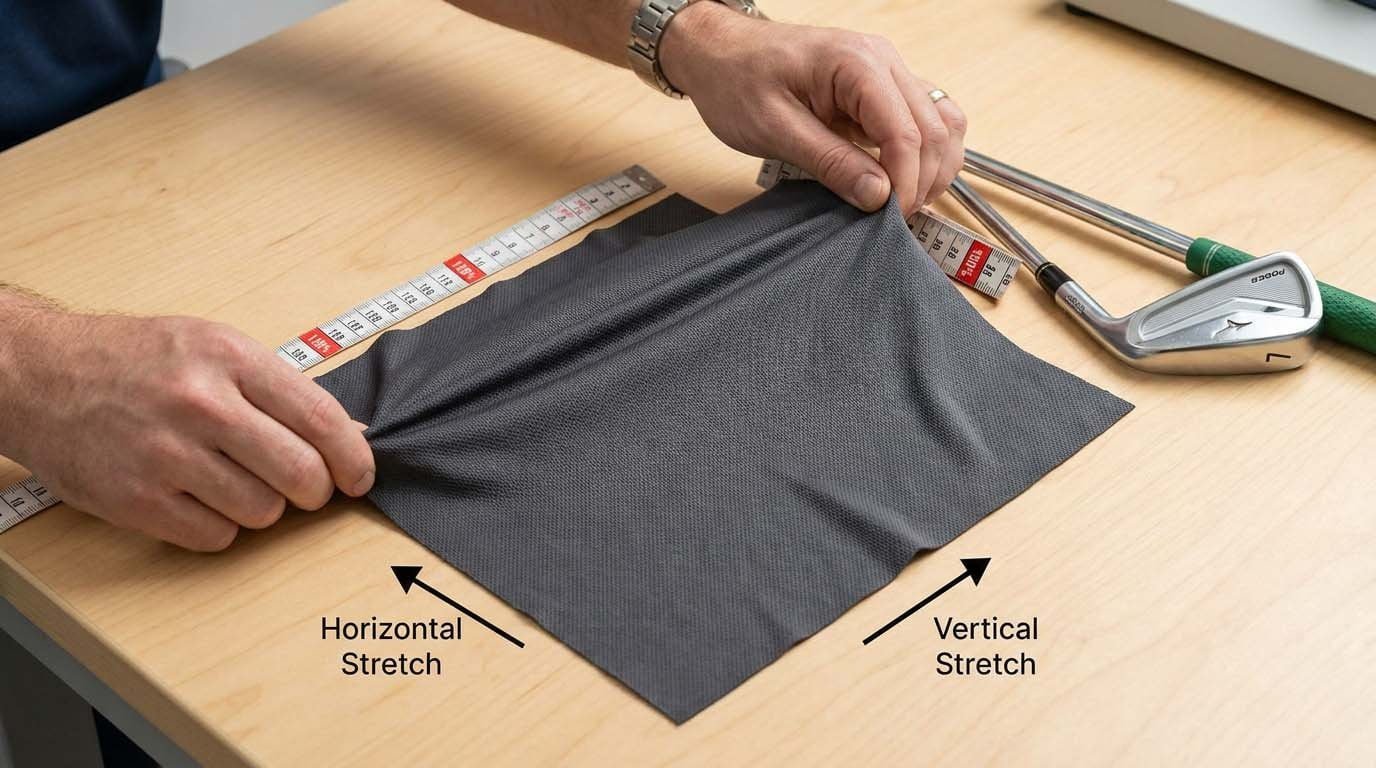
At FUWAY, we recommend treating 4-way stretch as a sourcing specification that must be verified, not simply as a marketing label.
The practical question is not:
“How much spandex is in the fabric?”
It is:
Does the actual fabric stretch appropriately in both directions, recover after movement, retain its shape, and perform consistently after washing?
Quick Answers: 4-Way Stretch Fabric for Golf Shirts
What Does 4-Way Stretch Mean?
4-way stretch generally refers to fabric with useful stretch in both the lengthwise and crosswise directions.
The exact amount of stretch required should be defined by the product specification rather than one universal industry percentage.
Does Spandex Percentage Determine 4-Way Stretch?
No.
Stretch direction depends on more than elastane content. It is also influenced by:
- knit or woven construction,
- yarn arrangement,
- fabric density,
- mechanical stretch,
- finishing.
Two fabrics with the same composition can perform very differently.
How Should Buyers Verify It?
Ask the supplier or testing laboratory to report:
- stretch in both directions,
- growth or dimensional change after extension,
- recovery behavior,
- test method,
- testing conditions.
For applicable stretch fabrics, ASTM D2594/D2594M is one method used to evaluate fabric stretch and growth.
Why Does Recovery Matter?
A fabric may stretch well but still lose shape.
Weak recovery can cause:
- bagging,
- loose elbows,
- distorted hems,
- poor shape retention.
What Is FUWAY's MOQ?
Typical FUWAY custom projects start around 100 pieces per style, depending on fabric, colors, trims, decoration, and construction.
Custom-developed or custom-dyed fabrics may have higher material minimums.
How Long Does Sampling Take?
A typical initial FUWAY sample takes around 7–10 business days.
Multiple revisions, special colors, or custom materials can extend the complete sampling cycle.
What Does 4-Way Stretch Mean for a Golf Shirt?
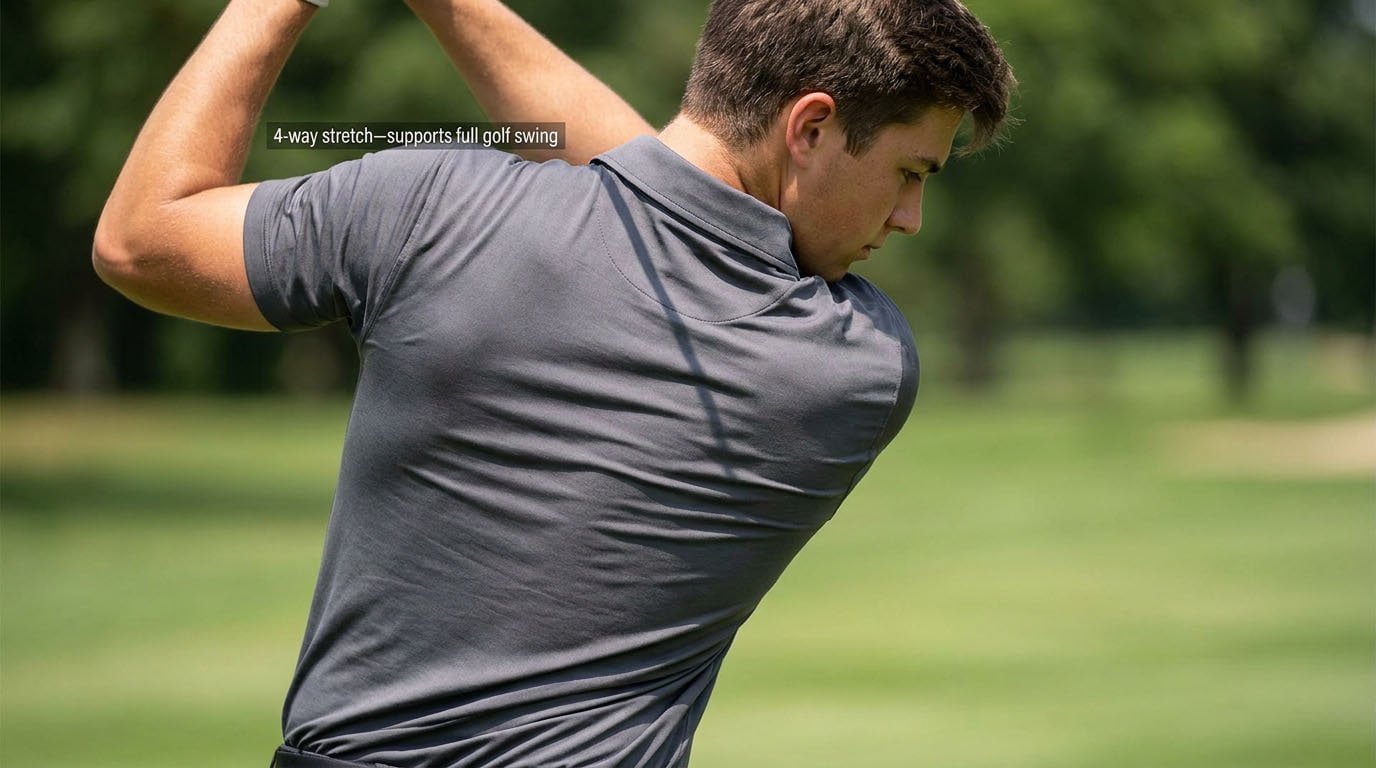
Golf movement is multi-directional.
During a full swing, the garment must accommodate movement through the:
- shoulders,
- upper back,
- chest,
- elbows,
- torso.
2-Way vs 4-Way Stretch
In sourcing discussions, 2-way stretch generally refers to significant stretch mainly along one principal direction.
4-way stretch generally refers to useful stretch along both principal directions.
However, these labels do not tell you:
- how far the fabric stretches,
- how much force is required,
- how much it grows under repeated stress,
- how well it returns afterward.
For golf shirts, multi-directional stretch can help reduce pulling across the shoulders and upper back during the backswing and follow-through.
But stretch alone is not enough.
A good performance fabric also needs suitable:
- recovery,
- stability,
- breathability,
- surface durability.
Spandex Percentage Does Not Determine Stretch Direction
One of the most common sourcing mistakes is using elastane percentage as a shortcut.
For example:
95% Polyester / 5% Spandex
versus:
88% Polyester / 12% Spandex
The second fabric does not automatically provide better 4-way stretch.
What Actually Determines Stretch?
Stretch behavior depends on several factors working together:
- elastane content,
- yarn construction,
- yarn placement,
- knit structure,
- fabric density,
- mechanical stretch,
- finishing.
Therefore, avoid specifications such as:
5% spandex = 2-way
10% spandex = 4-way
A better sourcing instruction is:
Polyester/spandex performance knit with useful stretch in both lengthwise and crosswise directions. Supplier to provide stretch and growth data and confirm recovery performance.
That gives the manufacturer a measurable requirement instead of relying on composition alone.
Polyester/Spandex vs Nylon/Spandex
Both polyester/spandex and nylon/spandex can be engineered for high stretch, but they behave differently.
Polyester/Spandex
Polyester/spandex is widely used for performance golf apparel because it can provide:
- quick drying,
- dimensional stability,
- good color retention,
- lightweight construction,
- compatibility with sublimation on suitable polyester fabrics.
It is commonly used for:
- performance polos,
- warm-weather golf shirts,
- printed golf apparel.
Nylon/Spandex
Nylon/spandex often offers:
- softer hand feel,
- smoother surface,
- refined drape,
- premium tactile feel.
It can work well for:
- fitted polos,
- premium lifestyle-performance products.
However, nylon generally absorbs more moisture than polyester and is not suitable for conventional polyester sublimation.
Do Not Choose Fabric by Fiber or Price Tier Alone
Avoid assuming:
polyester = budget
nylon = premium
Final quality depends on:
- yarn quality,
- knit structure,
- GSM,
- finishing,
- stretch,
- recovery,
- colorfastness,
- surface durability.
Jersey vs Interlock vs Piqué
Fiber composition is only part of the specification.
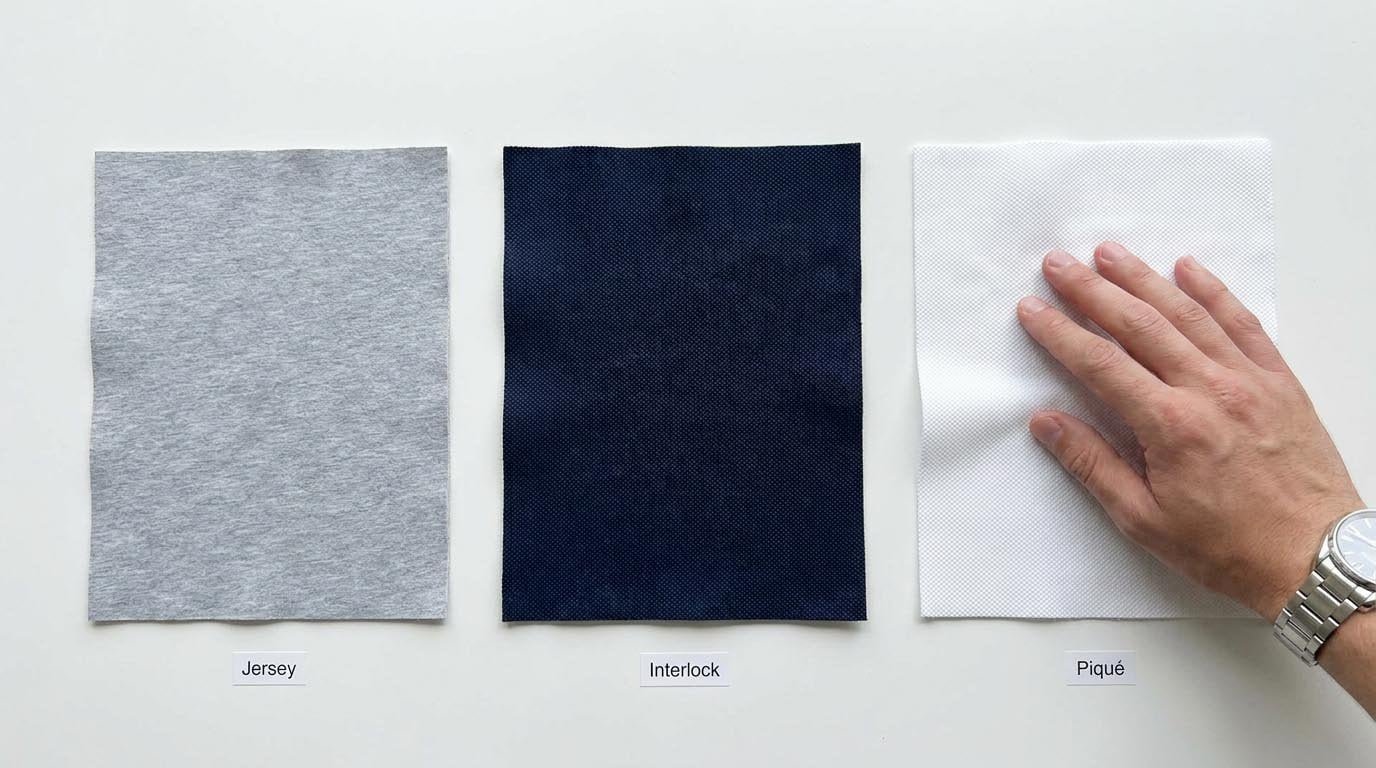
The knit structure also affects:
- texture,
- drape,
- stability,
- opacity,
- breathability.
| Knit Structure | Typical Character | Common Golf Application |
|---|---|---|
| Jersey | Smooth and lightweight | Modern performance polos |
| Interlock | Denser and more stable | Structured performance shirts |
| Piqué | Textured, classic appearance | Traditional golf polos |
Jersey
Jersey is commonly selected for lightweight, athletic products with a smooth surface and flexible drape.
Interlock
Interlock tends to provide greater density and stability, making it useful when opacity and structure are important.
Piqué
Piqué provides the traditional textured polo appearance and can still be engineered with stretch and performance finishes.
Do not assume one knit is always more breathable than another.
Actual airflow depends on:
- yarn,
- density,
- GSM,
- knit geometry,
- finishing.
How to Verify 4-Way Stretch Fabric Before Sampling
Instead of treating stretch, recovery, moisture, UPF, durability, and airflow as separate sourcing decisions, evaluate them together.
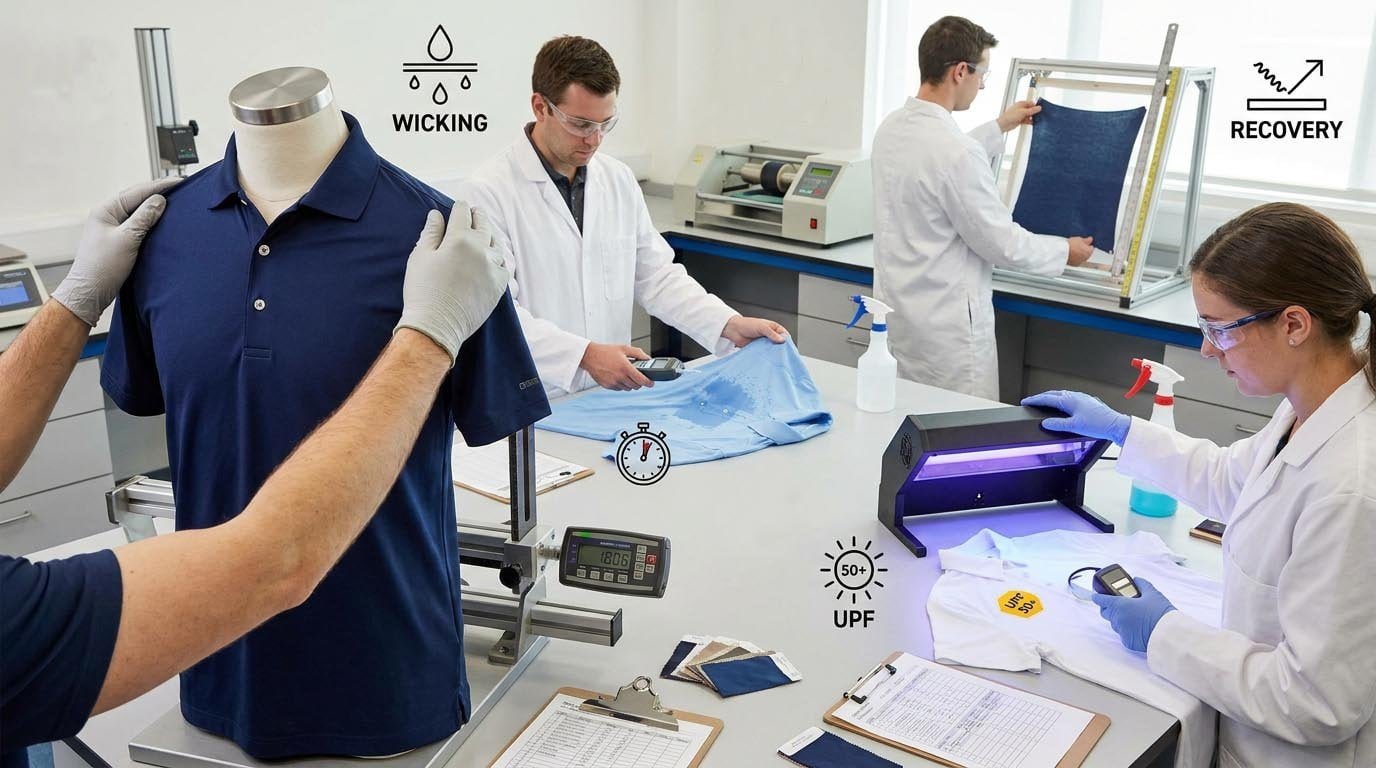
| Property | Why It Matters | What Buyers Should Verify |
|---|---|---|
| Stretch | Swing mobility | Useful movement in both directions |
| Growth / Recovery | Shape retention | Measured result under agreed conditions |
| Moisture Management | Warm-weather comfort | Relevant test data if claimed |
| UPF | Sun-protection claim | Supporting test report if claimed |
| Pilling | Surface appearance | Buyer-defined target |
| Snag Resistance | Golf-bag / Velcro durability | Buyer-defined target |
| Air Permeability | Breathability | Project-specific target |
Stretch and Growth
For suitable stretch fabrics, ASTM D2594/D2594M is one recognized method for evaluating stretch and growth behavior.
The important point is that the method measures performance.
It does not establish one universal golf-shirt rule such as:
30% stretch + 90% recovery = true 4-way stretch.
The buyer should define the required performance based on:
- fit,
- garment ease,
- intended use,
- approved benchmark fabric.
What About ISO 13934-1?
ISO 13934-1 should not be treated as a direct substitute for ASTM D2594/D2594M.
ISO 13934-1 measures maximum force and elongation at maximum force using a strip method. It is fundamentally a tensile-property test rather than a dedicated low-tension stretch/growth test.
The correct method should therefore be selected according to:
- fabric construction,
- property being evaluated,
- end-use requirement,
- laboratory recommendation.
Moisture Management
4-way stretch does not automatically mean moisture-wicking.
Moisture behavior depends on:
- fiber type,
- yarn,
- knit construction,
- finishing.
If your product is marketed as moisture-wicking or quick-dry, ask for supporting performance data.
UPF
Likewise:
4-way stretch ≠ UPF 50+.
If you make a measurable UPF claim, use appropriate supporting test documentation.
Pilling and Snag Resistance
Golf apparel regularly contacts:
- golf bags,
- Velcro,
- cart seats,
- rough surfaces.
Pilling and snag requirements should therefore be defined according to the brand's quality level.
Do not treat one fixed grade as a universal golf-apparel pass/fail standard.
Air Permeability
Air permeability can help assess breathability, but there is no universal CFM value that defines a good golf polo.
The appropriate target depends on:
- GSM,
- knit density,
- opacity,
- climate,
- desired structure.
More airflow is not always automatically better.
Can Buyers Screen Fabric Without a Lab?
Simple checks can help reject obviously unsuitable fabric before garment sampling, although they do not replace controlled laboratory testing.
Directional Stretch Check
Mark and compare the fabric in both:
- lengthwise,
- crosswise
directions.
If it stretches significantly in only one direction, ask the supplier why it is being marketed as 4-way stretch.
Recovery and Wash Check
Stretch the sample repeatedly and observe whether it develops:
- slack,
- distortion,
- permanent growth.
Then wash the actual garment sample according to the intended care instructions and compare:
- dimensions,
- surface appearance,
- twisting,
- recovery.
These checks are useful during development but should not replace formal testing when certified performance claims are required.
4-Way Stretch Golf Shirt RFQ Specification Example
Instead of sending:
“Need premium 4-way stretch golf polo fabric.”
send a more complete sourcing brief.
Example RFQ
Product: Men's Performance Golf Polo
Fabric: Polyester/spandex performance knit
Construction: Jersey or interlock preferred
GSM: Target range based on approved sample
Stretch: Useful movement required in both directions
Growth / Recovery: Must meet agreed buyer specification
Hand Feel: Lightweight and smooth
Moisture Management: Required
UPF: Required only when supported by suitable testing
Pilling / Snag: Buyer-defined targets
Color: Pantone reference or approved lab dip
Decoration: Embroidery or heat transfer
Testing: Supplier or third-party data requested
Sample: Actual fabric and garment sample required before bulk approval
This is much more useful than selecting fabric based only on:
composition + price.
How Does 4-Way Stretch Affect Fit and Pattern Development?
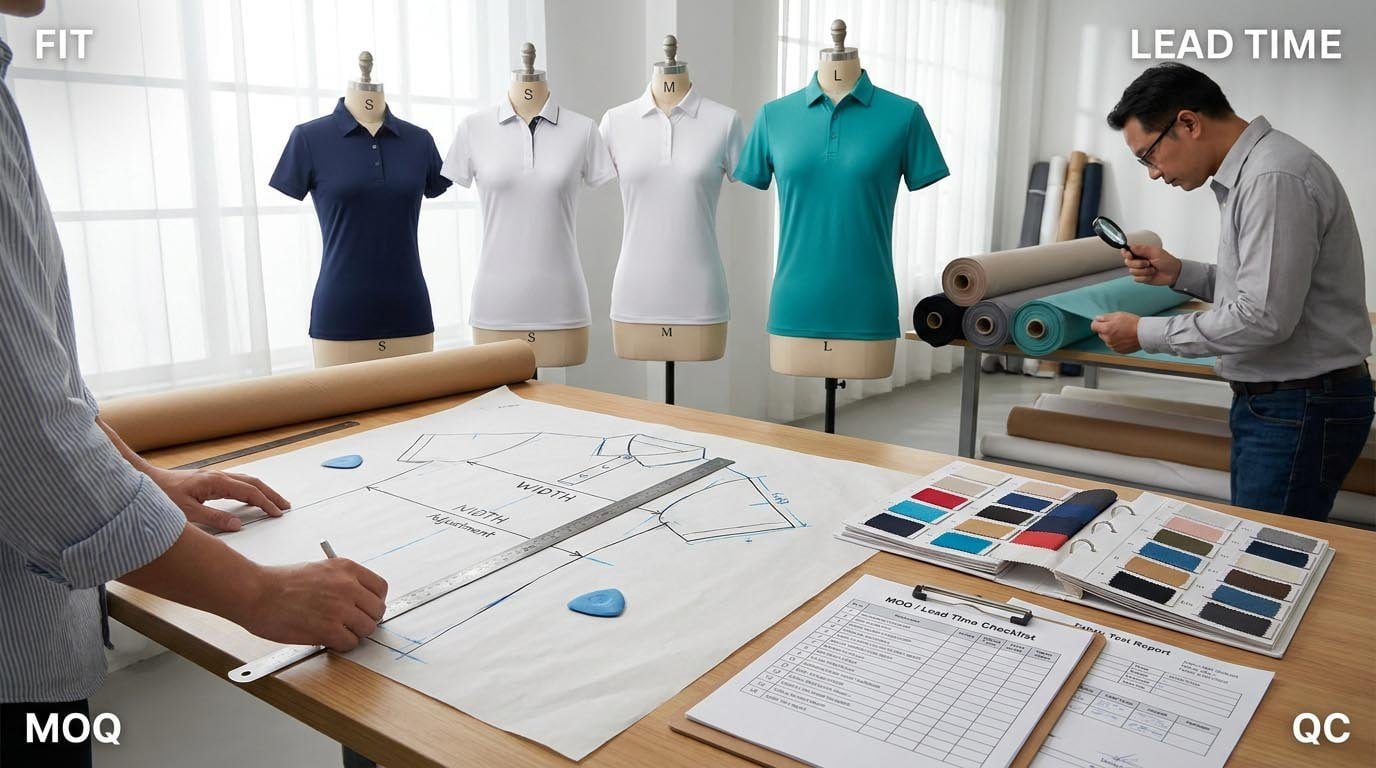
Stretch fabrics should not automatically use the same pattern as non-stretch garments.
Avoid Universal Pattern Reduction Rules
Do not automatically reduce garment width by 5–10%.
The correct pattern adjustment depends on:
- actual stretch,
- recovery,
- target silhouette,
- garment ease,
- body type.
A fitted athletic polo and a relaxed golf polo require different pattern strategies even when both use stretch fabric.
Develop Fit Using the Intended Fabric
A better sequence is:
Select Fabric → Develop Pattern → Make Fit Sample → Movement Test → Revise → Confirm Grading
Changing to a different fabric after fit approval can significantly change the final garment.
For fit-sensitive products, consider checking more than one size to confirm grading consistency.
MOQ for 4-Way Stretch Golf Shirts
MOQ depends heavily on the fabric sourcing route.
Available Fabric
Using available or mill-stock fabric normally provides:
- more flexible order quantities,
- shorter sourcing time,
- lower development risk.
At FUWAY, typical custom projects start around 100 pieces per style, depending on:
- fabric,
- colors,
- trims,
- decoration,
- construction.
Custom Color or Custom Fabric
Custom dyeing may create a separate mill minimum.
Fully custom fabric development may require higher material commitments because of:
- custom knitting,
- yarn requirements,
- new finishes,
- special performance treatments.
This means:
Garment MOQ ≠ Fabric MOQ
Before finalizing the product, confirm:
Garment MOQ + Fabric MOQ + Trim MOQ
FUWAY Sample and Production Timeline
Do not combine sample time, approval time, bulk production, and shipping into one universal lead-time number.
Initial Sample
A typical FUWAY initial sample takes approximately:
7–10 business days
depending on fabric, trims, and construction.
Sampling Cycle
The complete development cycle can take longer when the project requires:
- fit revisions,
- custom colors,
- new materials,
- size-set samples,
- additional approvals.
Bulk Production
After final approval, typical FUWAY bulk production takes approximately:
3–4 weeks
depending on material availability, order quantity, and complexity.
Complex projects or custom-developed materials can require additional time.
Shipping
Shipping is additional and depends on:
- destination,
- air or sea freight,
- customs clearance.
Therefore, avoid using one fixed total timeline for every project.
Quality Control Before Bulk Production
A 4-way stretch project should be controlled before and during production, not only at final inspection.
A practical sequence is:
Fabric Approval → PP Sample → Bulk Fabric Check → In-Line QC → Final Inspection
Fabric Approval
Review:
- composition,
- construction,
- GSM,
- stretch behavior,
- growth / recovery requirements,
- relevant performance data.
Pre-Production Sample
Confirm:
- fit,
- measurements,
- fabric,
- collar,
- construction,
- logo,
- trims.
Bulk Fabric Check
Before cutting, compare bulk material with the approved reference for:
- color,
- hand feel,
- GSM,
- stretch,
- surface appearance.
In-Line and Final QC
Check:
- measurements,
- sewing,
- logo position,
- collar shape,
- panel alignment,
- packaging.
Compare finished garments against the approved specification and golden sample.
For additional verification information, review FUWAY's Test Reports.
4-Way Stretch Fabric Buyer Checklist
Before approving the fabric, confirm:
- [ ] Composition and knit construction
- [ ] GSM
- [ ] Stretch in both directions
- [ ] Growth / recovery requirement
- [ ] Hand feel
- [ ] Wash behavior
- [ ] Moisture / UPF evidence where claims are made
- [ ] Pilling and snag requirements
- [ ] Fit sample using intended fabric
- [ ] Golf movement test
- [ ] Logo compatibility
- [ ] Garment MOQ
- [ ] Fabric and color MOQ
- [ ] Trim MOQ
- [ ] Sample timing
- [ ] Bulk production timing
Frequently Asked Questions
What Is the Difference Between 2-Way and 4-Way Stretch?
2-way stretch generally describes useful stretch mainly along one principal direction.
4-way stretch generally describes useful stretch along both lengthwise and crosswise directions.
The required amount should be defined in the product specification.
Does 10% Spandex Guarantee 4-Way Stretch?
No.
Stretch direction also depends on:
- yarn arrangement,
- knit construction,
- density,
- finishing.
Composition alone cannot confirm 4-way performance.
What Stretch Percentage Should a Golf Polo Have?
There is no single universal requirement.
The appropriate target depends on:
- fit,
- garment ease,
- fabric,
- intended use.
Use an approved benchmark or project-specific performance requirement.
What Is FUWAY's MOQ for 4-Way Stretch Golf Shirts?
Typical FUWAY custom projects start around 100 pieces per style.
Custom colors, proprietary fabrics, or special trims may create higher material minimums.
How Long Does Sampling Take?
A typical initial FUWAY sample takes approximately 7–10 business days.
The complete development cycle can take longer if revisions or custom materials are required.
How Long Does Bulk Production Take?
After final approval, typical bulk production takes approximately 3–4 weeks.
Complex products or custom-developed materials may require additional time.
Conclusion
4-way stretch can improve golf-shirt mobility and comfort, but the phrase itself is not a complete technical specification.
Do not approve fabric based only on:
“4-way stretch” + spandex percentage
Instead evaluate:
Fabric Construction → Stretch in Both Directions → Growth / Recovery → Fit → Durability → Test Evidence
For buyers, the most important steps are:
- define project-specific performance requirements,
- verify stretch in both directions,
- evaluate recovery and durability,
- use the actual fabric for fit development,
- confirm garment, fabric, and trim MOQ separately,
- approve bulk material before cutting.
At FUWAY, typical custom projects start around 100 pieces per style, initial samples commonly take around 7–10 business days, and bulk production typically takes around 3–4 weeks after final approval, depending on materials, quantity, and product complexity.
FUWAY supports golf apparel brands through Custom Golf Shirts, Fabric Sourcing, Embroidery, Screen Printing, Sublimation Printing, sampling, testing, bulk production, and quality control.
If you already have a reference fabric, target GSM, stretch requirement, or golf polo design, you can contact FUWAY to discuss the sourcing and development route.