Cooling fabric for golf shirts can provide a measurable benefit, but “cooling” does not describe one universal property. A fabric may feel cool when first touched, help manage perspiration, or use another heat-management mechanism. Each benefit requires evidence suited to that particular claim.
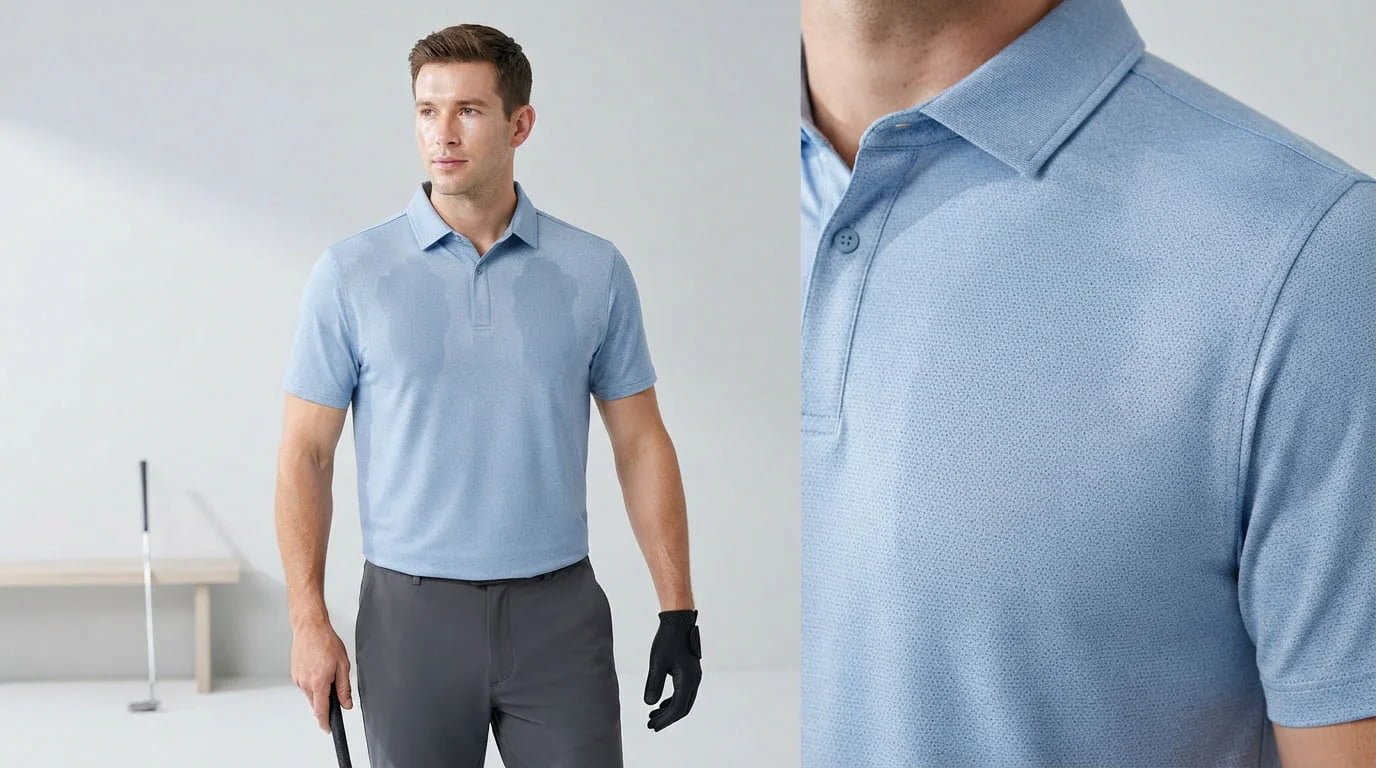
For golf apparel brands, the practical question is what the proposed fabric delivers in the finished polo—and whether the evidence supports the words on its product page or hangtag.
Start by separating three things:
- Contact coolness: the initial sensation when fabric touches skin.
- Moisture and heat management: how the fabric and garment interact with sweat, airflow and the surrounding environment.
- Wearer outcomes: how a finished shirt feels or affects a measured temperature under defined conditions.
A strong result in one category does not establish the others.
What Does “Cooling Fabric” Actually Mean?
Before comparing samples, ask the supplier to define the proposed cooling mechanism.
| Supplier description | What it may mean | What still needs verification |
|---|---|---|
| Cool-touch fabric | Rapid initial heat transfer at contact | The measured contact-cooling result and test conditions |
| Moisture-wicking fabric | Liquid moisture movement and spreading | Drying performance and comfort when damp |
| Quick-dry fabric | Moisture loss under specified conditions | Whether the result translates into the intended garment experience |
| Mineral-containing yarn | An ingredient intended to alter a material property | The actual benefit in the finished fabric |
| Phase-change or radiative technology | A different approach to managing heat | Its operating conditions, duration and application-specific evidence |
A technology name identifies a proposed approach. It does not establish the size, duration or usefulness of the benefit.
For example, a fabric can feel cool on first contact yet become uncomfortable when wet. Another may have an ordinary initial hand feel but perform well during active wear.
Avoid describing a general moisture-management knit as if it has demonstrated a particular reduction in skin or core temperature. Those are separate outcomes requiring appropriate testing.
What Qmax Can—and Cannot—Tell a Golf Brand
Qmax describes the peak transient heat flux during initial contact under specified test conditions. It is commonly used to evaluate contact coolness.
As explained by NC State’s Textile Protection and Comfort Center, a higher Qmax result indicates more rapid initial heat movement from the body toward the fabric surface, producing a cooler sensation.
Qmax is useful for comparing initial touch. It is not an all-day cooling score.
Read the Conditions Alongside the Number
When reviewing a contact-cooling report, request:
- The test method and version.
- The reported result and units.
- The tested fabric article and skin-facing surface.
- Conditioning, temperature difference and contact settings.
- Whether the specimen was dry or wet.
- Whether testing occurred before or after laundering.
Compare results only when the methods and relevant conditions are compatible. A larger number from a different setup may not represent better performance.
Also distinguish Qmax from thermal effusivity. Both relate to contact thermal behavior, but they are different measurements. ASTM D7984, for example, measures thermal effusivity; its result should not be relabeled as Qmax.
Keep the Claim Within the Measurement
A contact-cooling result does not independently establish:
- Faster drying.
- Better airflow.
- Greater comfort throughout a round.
- A specific reduction in skin or core temperature.
- Performance retained after repeated washing.
If initial touch is part of your premium product positioning, test it. If the product promise concerns performance during play, evaluate that separately.
Why the Finished Polo Matters More Than a Cool Swatch
Golfers wear a complete shirt. Fabric construction, fit, trims and decoration can change the experience delivered by the approved swatch.
Evaluate Structure, Weight and Movement Together
Composition and GSM help describe a fabric, but neither is a cooling rating.
A smooth jersey, textured piqué and open mesh can differ in skin contact, airflow, opacity and damp cling. These differences depend on the actual yarns, density and finishing; the construction name alone does not identify a winner.
Similarly, spandex percentage does not establish usable four-way stretch. Check movement and recovery in the finished polo, including the shoulders, armholes and torso.
For broader material comparisons, use our golf polo fabric selection guide.
Match the Evaluation to the Playing Conditions
Humidity, airflow, solar exposure and activity affect the conditions in which a cooling claim must work. Evaporation becomes more limited as environmental conditions become less favorable; a wicking label cannot remove that constraint.
Define whether the target customer walks or rides, plays in humid summer conditions, or prioritizes clubhouse appearance and initial hand feel.
Our hot-weather golf polo fabric guide covers the wider climate-based selection process.
Approve Decoration and Ventilation Together
Review the actual logo size, placement, backing and print coverage. Large coated areas or dense decoration may change local feel and airflow.
Check ventilation panels for transparency, seam comfort and compatibility with any intended UV-protection claim. UPF describes ultraviolet protection; it is not a cooling score.
Which Tests Support Different Cooling-Related Claims?
Choose the intended claim first, then agree the evidence needed to evaluate it.
| Intended claim or requirement | Suitable evaluation discussion | Important limit |
|---|---|---|
| Cool to the touch | Contact-cooling evaluation, such as Qmax using an agreed method | Does not establish sustained comfort |
| Liquid moisture management | AATCC TM195 | Does not independently measure drying rate |
| Quick drying | A suitable drying method, such as AATCC TM201 | Results depend on the method and conditions |
| Air permeability | ISO 9237 or another agreed airflow method | Does not measure the whole garment experience |
| Comfort during golf | Structured finished-garment wear evaluation | Subjective preference is not a temperature measurement |
| Numerical temperature reduction | A protocol matched to the stated temperature outcome and comparator | Fabric-surface, skin and core temperatures are different outcomes |
| Performance after washing | Repeat the relevant evaluation after agreed laundering | Applies to the tested procedure and endpoint |
The AATCC standards directory lists liquid moisture management and drying methods separately. A report for one property should not be presented as proof of another.
Confirm method selection, current versions and acceptance criteria with the laboratory before testing. The methods above are examples for planning; they do not imply that every FUWAY fabric has been tested to them.
For a fuller explanation of moisture testing, see our moisture-wicking test guide.
How to Verify a Cooling Fabric Before Bulk Approval
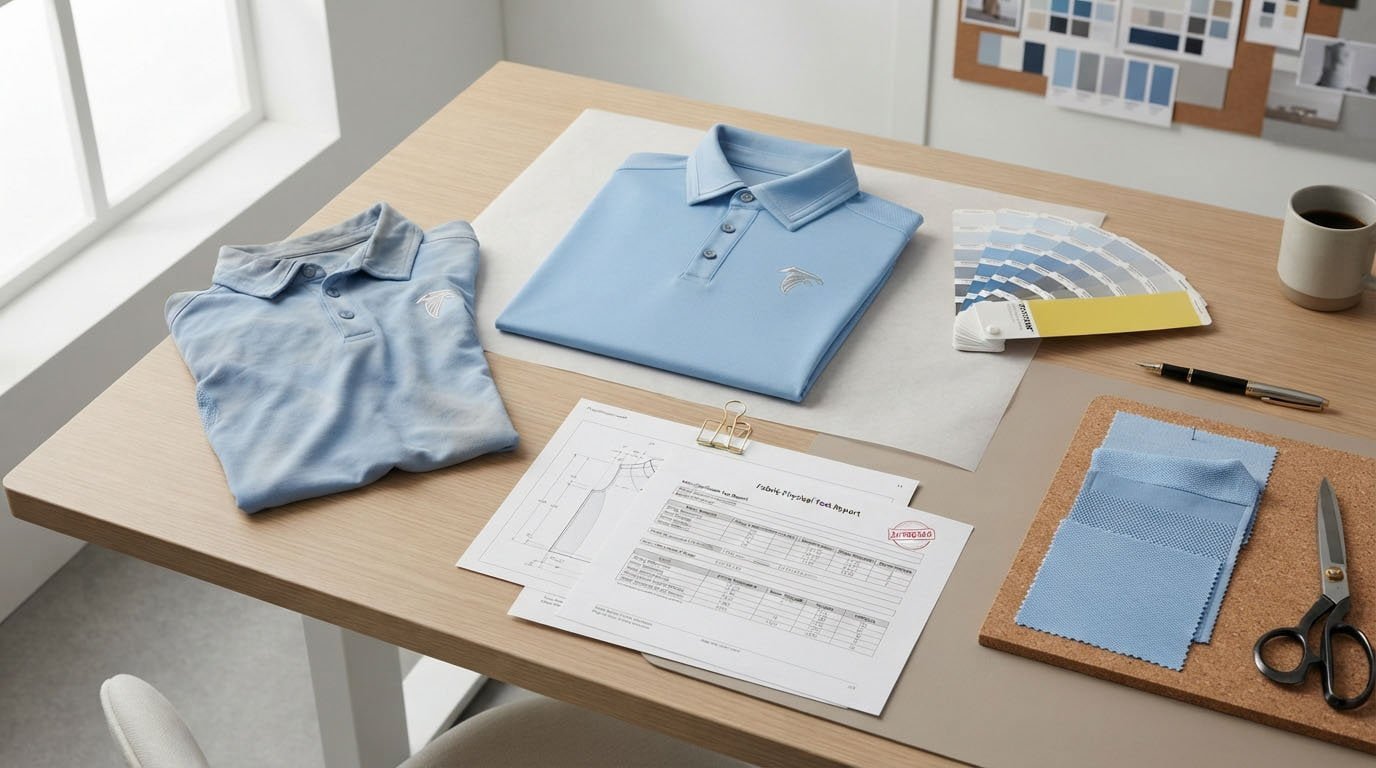
A useful approval process connects the proposed claim to an identifiable material, a finished sample and a repeatable production specification.
1. Write the Requirement Before Reviewing the Report
Replace a vague request such as “premium cooling fabric” with a clear development brief.
Include:
- Target climate and playing conditions.
- Intended fit, colors and decoration.
- The benefit you want to communicate.
- The reference product or material, where comparison is intended.
- Required performance after laundering.
- Budget and order requirements.
This helps the supplier distinguish a hand-feel preference from a measurable performance requirement.
2. Confirm That the Report Covers the Proposed Material
Check the fabric article, composition, construction, finish, color and tested condition against the sample being offered.
Where the report covers a related material rather than the exact specification, ask what supports extending the result. Do not assume one report automatically covers every color, weight or finishing variation.
Ask the laboratory to clarify any unclear result, unit or comparison.
3. Compare Equivalent Finished Samples
For early screening, compare candidate polos with similar fit and decoration.
Record the conditions and care state, then review initial touch, damp cling, wet weight, movement, opacity and drying recovery. Where practical, conceal fabric labels so expectations influence the assessment less.
Wear trials help identify a preferred development direction. They do not automatically substantiate a numerical cooling claim.
4. Repeat the Relevant Checks After Washing
Set the wash procedure, drying procedure, number of cycles and acceptance criteria before approval.
Both yarn-based technologies and applied finishes require evidence appropriate to the durability claim. A finish is not automatically short-lived, and an ingredient incorporated into a yarn does not automatically prove lifetime performance.
If results change, investigate the cause rather than assuming the technology category explains it.
5. Carry the Approval Into Bulk Production
Retain the approved reference and document the material specification, finish, required results and change-control rules.
Agree which checks apply to production lots and which changes trigger further review—for example, a different mill, yarn, construction or finish.
FUWAY’s published test reports provide a starting point for discussing documentation. Request evidence matched to the proposed cooling fabric and claim separately.
How Should Brands Describe Cooling Performance?
Use wording that accurately describes the demonstrated benefit. There is no universal list of “safe cooling claims” independent of the evidence and how customers will understand the message.
| Proposed wording | What the evidence needs to address |
|---|---|
| “Cool to the touch” | Initial contact thermal behavior |
| “Moisture-wicking” | Relevant liquid moisture movement |
| “Quick drying” | Drying performance under an appropriate method |
| “Dries faster than our previous polo” | A relevant comparison using equivalent conditions |
| “Cooling performance retained after washing” | The defined property after the stated laundering endpoint |
| “Lowers skin temperature by X degrees” | Skin-temperature measurements, a defined comparator, conditions and duration |
| “Keeps you cool all day” | The broad duration and wearer benefit communicated by the wording |
A supplier’s technology name should not replace this review. Nor should a measured fabric-surface temperature be rewritten as a body-temperature result.
Before approving hangtags or product copy, keep a record linking:
The exact claim → the tested product or material → the method and conditions → the result and limitations.
For the US market, objective advertising claims need a reasonable basis before they are used. The strength and type of support depend on the claim being made.Federal Trade Commission
Frequently Asked Questions
Is nylon always cooler than polyester for golf polos?
No. Fiber names alone cannot establish contact coolness, drying performance or wearer comfort. Compare the actual constructions, finishes and finished samples against the intended product requirement.
Is a higher Qmax always worth paying more for?
Only when stronger initial contact coolness is a relevant product benefit. Consider it alongside damp comfort, durability, appearance and cost. A higher Qmax alone does not establish a better golf polo.
Can recycled polyester provide cooling-related performance?
It can be developed into performance fabrics, but recycled content does not itself establish cooling. Verify the material’s performance separately from its recycled-content documentation.
How can a small brand control testing costs?
Use a staged process. Screen a small number of clearly identified candidates, compare finished samples and eliminate unsuitable options before commissioning the tests needed for the final product claims. Agree laboratory costs and evidence requirements before committing to the technology.
Conclusion
Cooling fabric becomes a useful product feature when the claimed benefit is clear and the evidence matches it. Separate initial contact coolness from performance during play, evaluate the finished polo and confirm the required result after washing.
For your next collection, share the target climate, intended cooling claim, reference garment, colors and decoration requirements with FUWAY. Our fabric sourcing service and custom golf shirt development can help translate that brief into samples and an agreed approval plan.