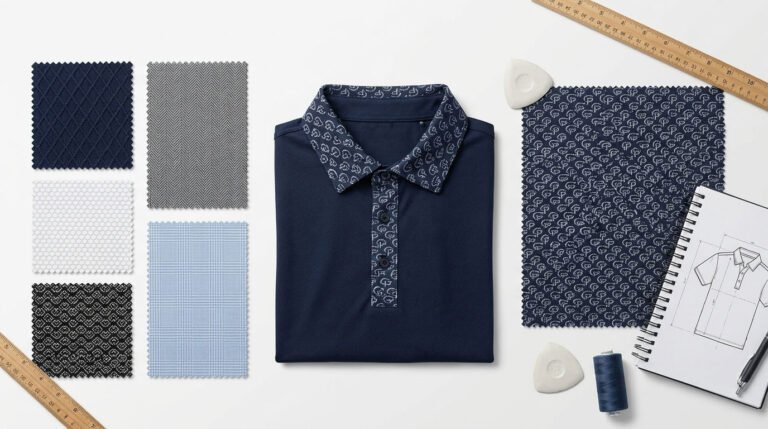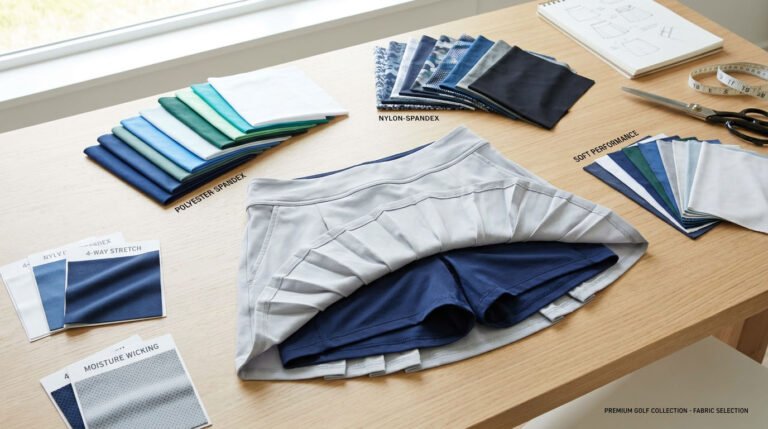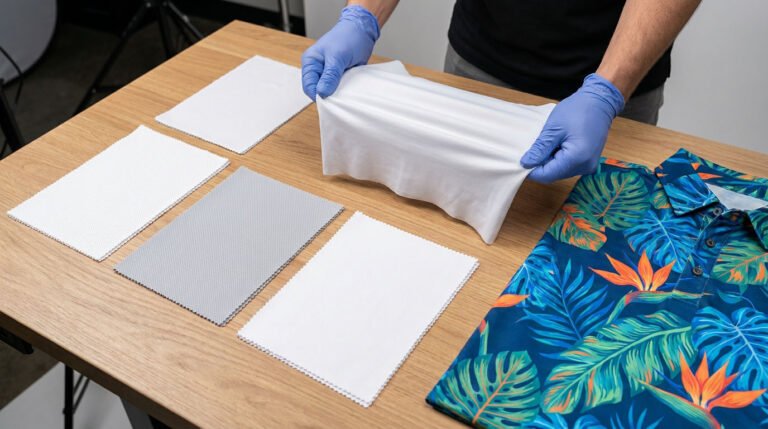
Choosing the best fabric for golf polo shirts is not as simple as picking polyester, cotton, or the fabric with the most performance claims.
Two fabrics can both be described as:
- breathable,
- moisture-wicking,
- stretchy,
- lightweight,
- and premium
yet behave very differently once they are made into a finished polo.
For golf brands, fabric selection affects:
- on-course comfort,
- moisture management,
- stretch and recovery,
- drape,
- opacity,
- collar stability,
- decoration quality,
- wash performance,
- sample-to-bulk consistency,
- and whether the final garment fits the intended price and brand position.
The most useful way to choose a golf polo fabric is to evaluate the full specification:
Fiber + Blend + Knit Structure + GSM + Density + Finish + Garment Construction
There is no single best fabric for every golf polo line.
A lightweight polyester-rich fabric may work well for hot-weather performance. A cotton blend may better suit a lifestyle collection. A nylon-spandex construction may be worth testing when a softer premium hand feel is more important.
This guide explains how to narrow those options before sampling and bulk production.
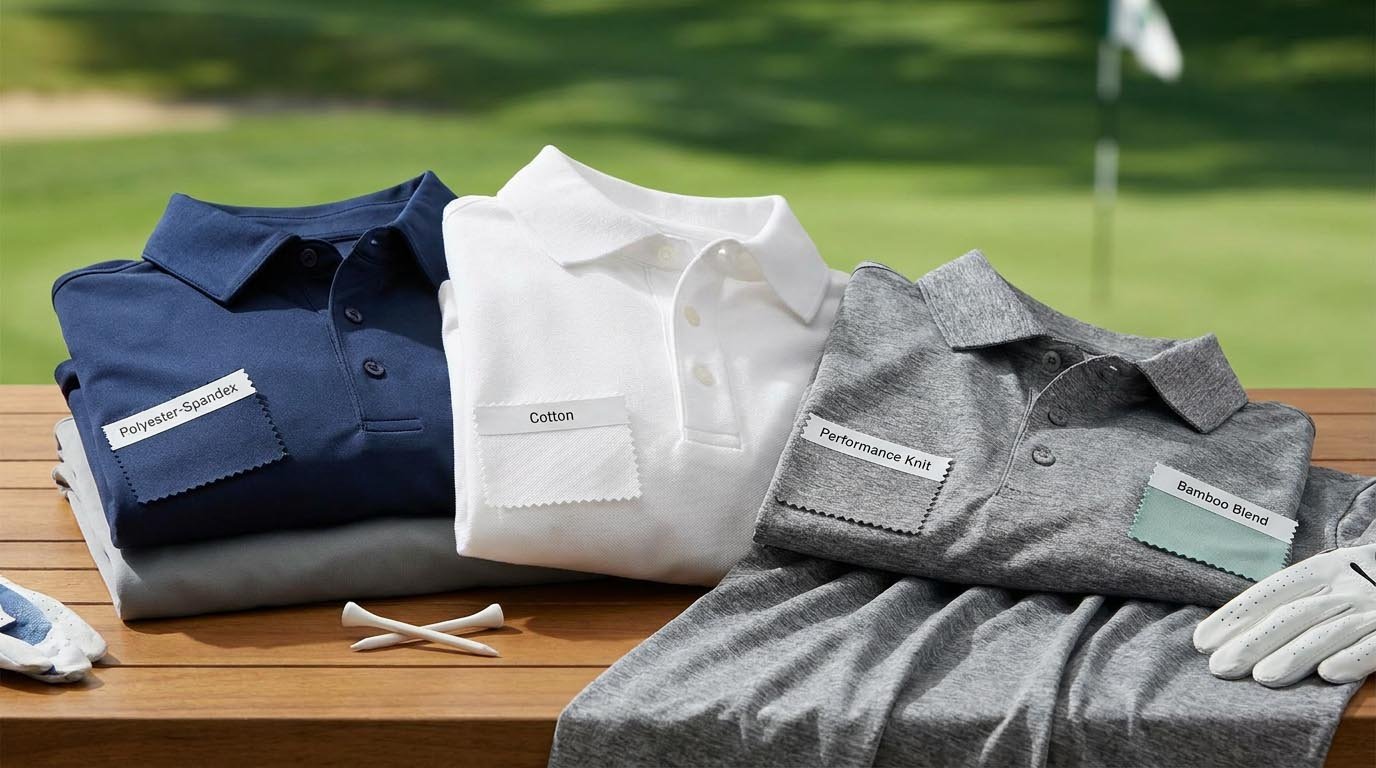
Quick Answer: What Is the Best Fabric for Golf Polo Shirts?
For most modern golf polo programs, these are useful starting directions:
| Product Goal | Fabric Direction to Test First |
|---|---|
| Performance golf polo | Polyester-rich stretch blend |
| Hot-weather golf | Lightweight polyester-rich construction |
| Classic golf polo | Polyester or cotton-blend piqué |
| Premium smooth polo | Nylon/polyester stretch or interlock construction |
| Lifestyle golf polo | Cotton-poly or softer blended fabric |
| Athletic slim fit | Stretch blend with strong recovery |
| Traditional club polo | Structured piqué or similar stable knit |
| Recycled-performance program | Recycled polyester blend with verified sourcing |
These are starting points, not universal specifications.
The correct fabric still depends on:
- target climate,
- fit,
- customer expectations,
- required hand feel,
- decoration,
- sourcing consistency,
- and production requirements.
What Makes a Good Golf Polo Fabric?
A golf polo fabric usually needs to balance five main areas:
- Comfort and moisture management
- Stretch and recovery
- Durability
- Appearance and hand feel
- Production consistency
Problems often happen when a brand optimizes only one of them.
For example:
- a very soft fabric may dry too slowly,
- a very light fabric may become too transparent,
- a very stretchy fabric may lack structure,
- a premium-looking sample may be difficult to reproduce consistently,
- or a fabric with strong technical claims may simply feel wrong for the target customer.
Before selecting fabric, define:
Who will wear the polo, where they will wear it, how it should fit, what it should feel like, and how the brand wants it positioned.
That brief is more useful than starting with a fabric catalog.
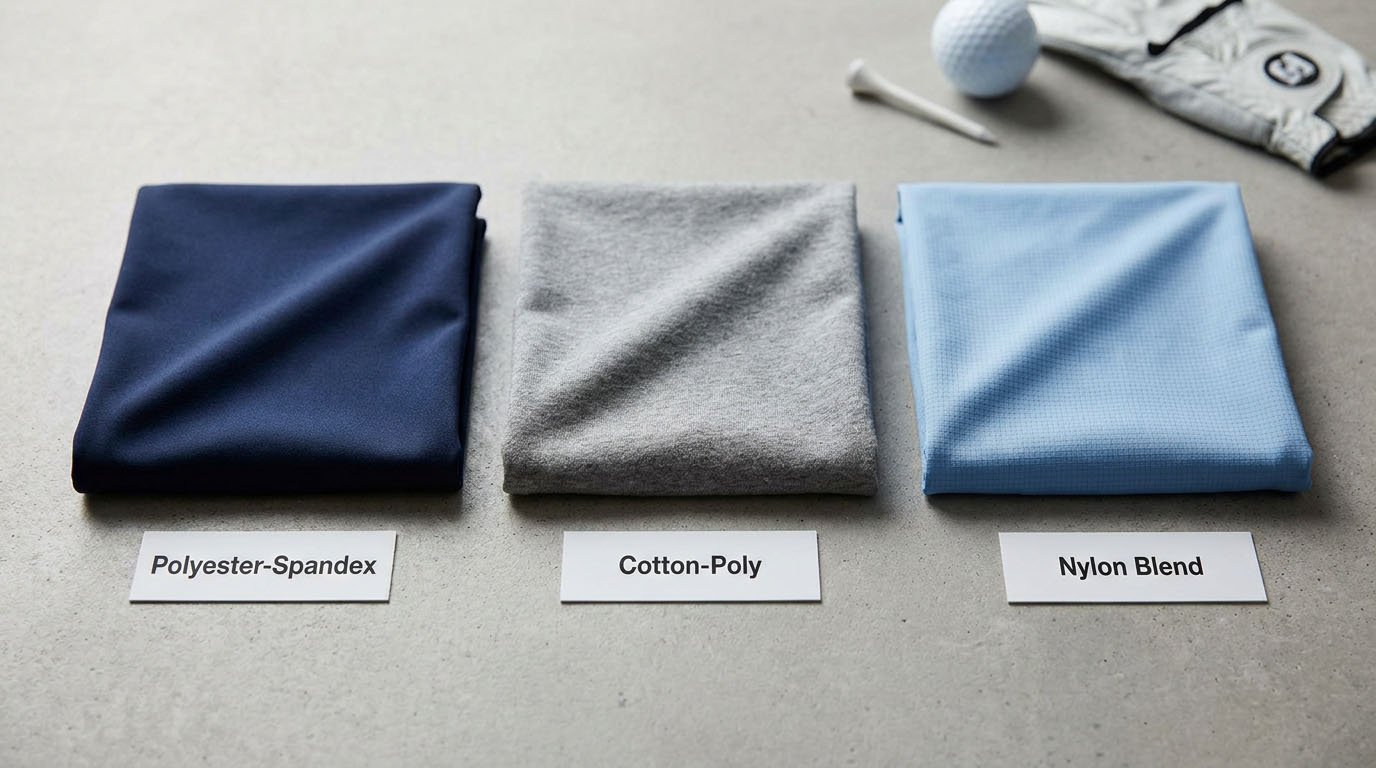
Polyester-Spandex: A Common Starting Point for Performance Golf Polos
Polyester-spandex blends are widely used in modern golf apparel because they can combine:
- quick drying,
- moisture management,
- stretch,
- wrinkle resistance,
- color stability,
- and athletic movement.
Common commercial constructions may use different polyester-to-spandex ratios depending on the required stretch and fit.
The exact percentage is less important than whether the finished fabric delivers the required:
- mobility,
- recovery,
- hand feel,
- stability,
- and wash performance.
Why Brands Choose Polyester-Spandex
It is often a strong fit for:
- athletic golf polos,
- performance collections,
- slim or modern fits,
- hot-weather products,
- and brands that prioritize technical functionality.
What to Watch
Lower-quality polyester can feel overly slick or synthetic.
Too much stretch may also add cost and sewing complexity without producing meaningful benefits in a relaxed-fit polo.
So the question should not be:
“How much spandex can we add?”
It should be:
“How much stretch and recovery does this specific fit actually require?”
Cotton-Poly Blends: Better for Softer Lifestyle Positioning
Cotton-poly blends remain useful when a brand wants to combine:
- softer hand feel,
- familiar comfort,
- casual styling,
- and some of the durability benefits of synthetic fibers.
They can work well for:
- lifestyle golf,
- resort collections,
- casual clubwear,
- traditional buyers,
- and brands that do not need maximum moisture performance.
Why Brands Choose Cotton Blends
Cotton adds:
- a more natural touch,
- softer first impression,
- and a less technical appearance.
Polyester can help improve:
- durability,
- wrinkle resistance,
- drying speed,
- and shape retention.
Main Trade-Off
Cotton-rich fabrics generally hold more moisture than polyester-rich fabrics.
So if the polo is intended for:
- humid conditions,
- walking rounds,
- or performance-first customers,
a cotton-heavy construction should be wear-tested carefully.
Nylon Blends: When a More Premium Hand Feel Matters
Nylon is less common than polyester in golf polos, but it can be useful for more premium programs.
It can provide:
- smooth hand feel,
- good abrasion resistance,
- soft drape,
- and strong stretch performance when blended appropriately.
When Nylon Makes Sense
Nylon blends are worth testing when the brand wants:
- a softer premium surface,
- elevated activewear positioning,
- stronger abrasion performance,
- or a different touch from standard polyester.
What to Watch
Nylon is often more expensive and can require more careful color and process control.
That means it should be selected because it supports a clear product direction—not simply because it sounds more premium.
Recycled Polyester: A Useful Option for Sustainability-Focused Programs
Recycled polyester can be used in many of the same golf polo applications as virgin polyester.
It may be appropriate when a brand wants to build:
- recycled-content collections,
- corporate sustainability programs,
- or sustainability-focused product stories.
What matters is not only the fiber claim but whether the supply chain can support:
- verified recycled content,
- repeat sourcing,
- consistent fabric quality,
- and relevant documentation where required.
If recycled content is part of the product marketing, verify the sourcing and certification requirements before bulk production.
Polyester vs Cotton for Golf Polo Shirts
This is one of the most common fabric decisions.
Polyester-Rich Fabrics
Typically offer stronger:
- drying performance,
- wrinkle resistance,
- color stability,
- moisture management,
- and performance positioning.
Cotton-Rich Fabrics
Typically provide:
- softer natural hand feel,
- more casual appearance,
- familiar comfort,
- and stronger lifestyle positioning.
Cotton-Poly Blends
Sit between the two.
They can help balance:
comfort + durability + cost + appearance
without pushing the polo fully into either technical sportswear or traditional cotton apparel.
Quick Comparison
| Property | Polyester-Rich | Cotton-Poly Blend | Cotton-Rich |
|---|---|---|---|
| Drying | Faster | Moderate | Slower |
| Moisture management | Strong | Moderate | Lower |
| Natural hand feel | Lower | Good | Strong |
| Wrinkle resistance | Strong | Moderate | Lower |
| Performance positioning | Strong | Moderate | Lower |
| Lifestyle positioning | Moderate | Strong | Strong |
| Hot/humid suitability | Usually stronger | Project-dependent | Requires careful testing |
If your main decision is specifically between natural softness and technical performance, see our detailed guide to cotton vs polyester for golf polos, including moisture behavior, shrinkage, care, durability, and blended-fiber options.
How Much Stretch Does a Golf Polo Need?
Stretch supports:
- shoulder rotation,
- backswing mobility,
- comfort,
- and shape recovery.
But more stretch is not always better.
A relaxed-fit golf polo may require much less stretch than a close athletic fit.
Stretch Should Match Fit
Athletic or slim fit
Usually benefits more from stretch and recovery.
Regular fit
May need moderate stretch rather than a highly elastic construction.
Relaxed fit
May gain little from increasing elastane content significantly.
This is why blend ratio should be treated as a development variable, not a universal formula.
How Does Knit Structure Affect Golf Polo Fabric?
Fiber tells you what the yarn is made from.
Knit structure tells you how that yarn is constructed into fabric.
For golf polos, three common structures are:
| Knit | Main Character | Common Direction |
|---|---|---|
| Piqué | Textured and structured | Classic golf |
| Jersey | Smooth and fluid | Athletic / modern |
| Interlock | Smooth and more stable | Refined / structured |
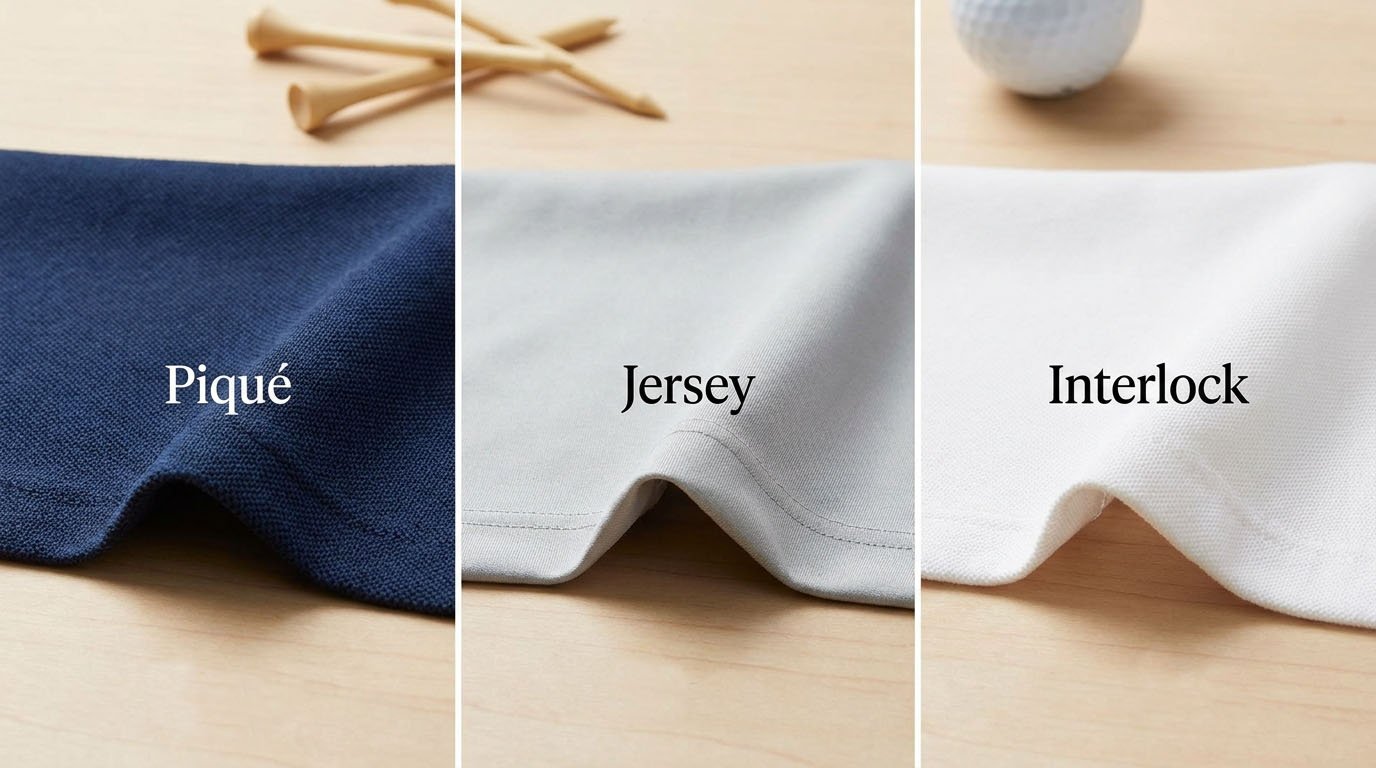
Piqué, jersey, and interlock can all be produced using different fibers and weights, so knit structure should be evaluated separately from fiber composition. For a detailed comparison of texture, drape, collar behavior, decoration, and product positioning, read our Piqué vs Jersey vs Interlock golf polo fabric guide.
Why GSM Matters in Golf Polo Fabric
Fabric weight is usually expressed in GSM — grams per square meter.
It influences:
- fabric body,
- opacity,
- drape,
- heat retention,
- structure,
- and perceived substance.
But heavier does not automatically mean better.
Lighter Fabrics
Can provide:
- lower bulk,
- cooler wear,
- softer movement,
- and performance-oriented positioning.
Potential trade-offs include:
- reduced opacity,
- less collar support,
- and a thinner hand feel.
Midweight Fabrics
Often provide a practical balance of:
- comfort,
- structure,
- opacity,
- and versatility.
Heavier Fabrics
Can provide:
- greater body,
- stronger visual structure,
- and a substantial hand feel.
But they may be less appropriate for hot or humid golf conditions.
Do Not Choose GSM in Isolation
The same GSM can feel different depending on:
- fiber,
- knit structure,
- yarn size,
- density,
- and finishing.
So GSM should be evaluated together with the complete fabric construction.
Which Functional Finishes Matter for Golf Polos?
Functional finishes can improve a fabric, but brands should avoid assuming every polo needs every treatment.
Moisture Management
Useful for:
- performance golf,
- warm-weather collections,
- active customers,
- and polyester-rich fabrics.
UV / UPF Performance
Can matter for products designed around:
- strong sun exposure,
- outdoor tournaments,
- resort markets,
- or specific UV protection claims.
If the brand makes a UPF claim, support it with appropriate testing.
Anti-Odor Treatments
Potentially useful for:
- premium performance collections,
- travel golf apparel,
- and products designed for extended wear.
Anti-Pilling Finishing
Useful where appearance retention is important.
However, pilling resistance also depends strongly on:
- fiber,
- yarn,
- surface construction,
- and fabric quality.
Finishing should support the base material—not compensate for weak fabric construction.
For project-specific testing and verification, see FUWAY's Test Reports.
How Should Climate Influence Golf Polo Fabric Selection?
Climate is one of the most useful ways to narrow fabric choices.
Hot and Humid Markets
Prioritize:
- lower fabric bulk,
- fast moisture movement,
- comfortable skin feel,
- airflow,
- stretch,
- and drying performance.
A lightweight polyester-rich construction is often a useful starting direction.
But the final fabric should still be checked for:
- opacity,
- drape,
- collar stability,
- and actual wear comfort.
Moderate Climates
Brands have more flexibility.
Depending on positioning, suitable options can include:
- polyester blends,
- piqué structures,
- cotton blends,
- and slightly fuller fabrics.
Premium or Lifestyle Positioning
Climate still matters, but hand feel and appearance may have greater influence.
A customer buying a resort lifestyle polo may value:
- softness,
- drape,
- and appearance
more than maximum moisture performance.
Golf Polo Fabric Selection Matrix
This is the simplest way to combine the main variables.
| Product Goal | Fiber Direction | Knit Direction | Weight Direction | Key Priority |
|---|---|---|---|---|
| Hot-weather performance | Polyester-rich stretch | Jersey or lightweight Piqué | Lightweight | Moisture + mobility |
| Classic club polo | Polyester / cotton blend | Piqué | Midweight | Structure + appearance |
| Premium smooth polo | Nylon/poly stretch | Interlock | Midweight | Hand feel + drape |
| Athletic slim fit | Polyester stretch | Jersey / Interlock | Light–mid | Stretch + recovery |
| Lifestyle golf | Cotton-poly / cotton-rich | Piqué or Jersey | Project-dependent | Softness + appearance |
| Corporate golf | Polyester blend | Piqué / Interlock | Midweight | Stability + repeatability |
| Sustainable collection | Verified recycled polyester | Project-dependent | Project-dependent | Documentation + consistency |
Treat the table as a shortlisting tool, not a final specification.
Why Sample-to-Bulk Consistency Matters
A fabric can look excellent during development and still create problems in bulk production.
This is especially important for brands planning:
- repeat orders,
- seasonal reorders,
- multiple colorways,
- or wholesale programs.
Before approving a fabric, ask:
- Is it stock-supported or custom-made?
- Can the mill reproduce the same construction?
- How is color consistency managed?
- Is there a defined GSM tolerance?
- Will repeat orders use the same yarn and finish?
- Does the factory have experience using this fabric in bulk?
This is one of the biggest differences between selecting a nice sample and building a scalable product.
How Should You Test Golf Polo Fabric Before Bulk Production?
Fabric approval should go beyond touching a swatch.
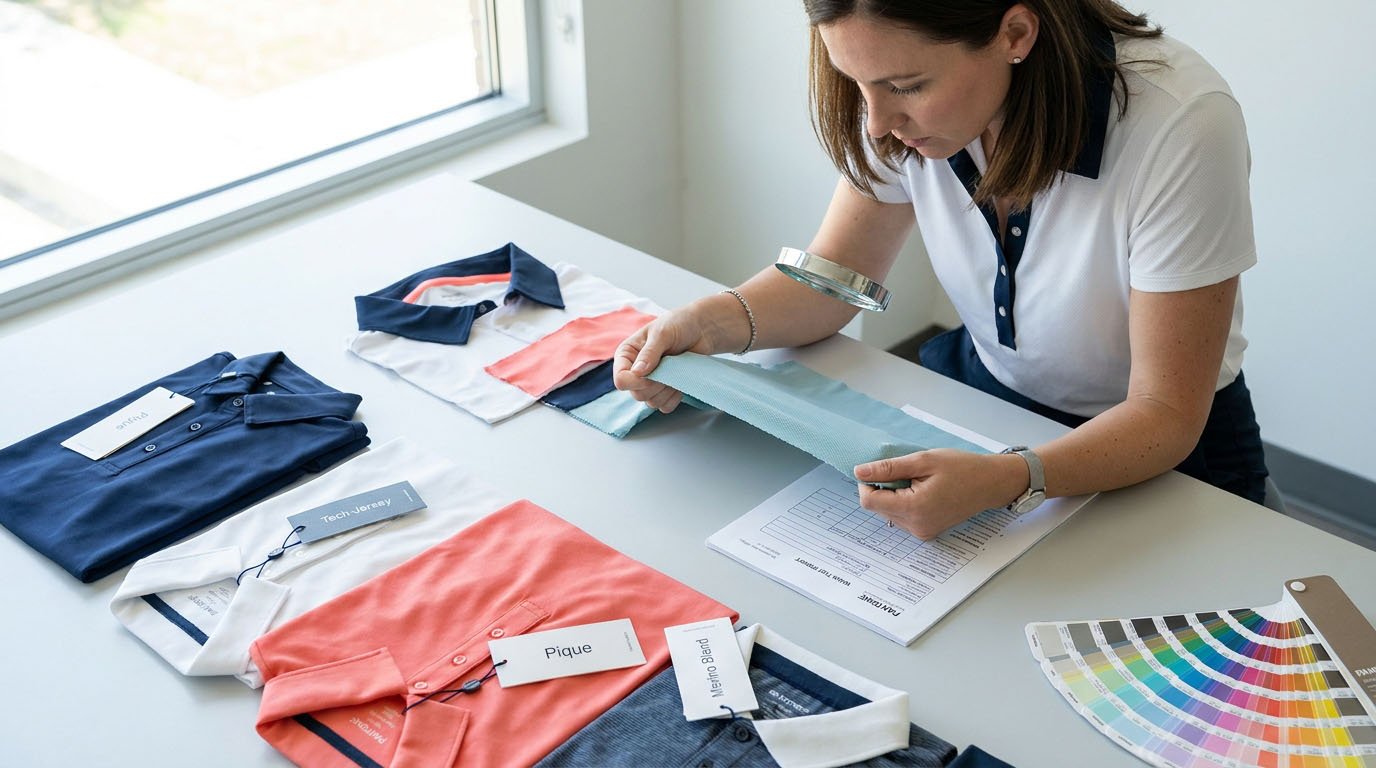
Step 1: Compare Physical Swatches
Check:
- hand feel,
- texture,
- weight,
- stretch,
- recovery,
- opacity,
- and drape.
Step 2: Make a Garment Sample
Evaluate:
- fit,
- collar behavior,
- placket,
- sleeve movement,
- body drape,
- and comfort.
Step 3: Test the Actual Logo
Decoration can change fabric behavior.
For embroidery, check:
- puckering,
- stitch clarity,
- and fabric distortion.
For transfers or printing, check:
- adhesion,
- artwork definition,
- and stretch compatibility.
Step 4: Wash and Wear Test
Recheck:
- shrinkage,
- twisting,
- collar shape,
- surface appearance,
- stretch recovery,
- and logo condition.
Step 5: Approve the Final Reference
The approved sample should align buyer and factory on:
- fabric,
- color,
- measurements,
- workmanship,
- decoration,
- and overall appearance.
What Should You Ask a Fabric Supplier Before Committing?
Before moving forward, ask practical questions such as:
- What is the exact fiber composition?
- What is the knit structure?
- What is the target GSM and tolerance?
- Is the fabric stock-supported or custom?
- What is the MOQ by color?
- What finishing has been applied?
- Can the same construction be repeated later?
- Are there known lot-to-lot differences?
- Has the fabric already been used in golf polos?
- Can the supplier provide relevant test information?
For performance or premium programs, you may also need to ask about:
- pilling,
- colorfastness,
- shrinkage,
- moisture performance,
- UV testing,
- or relevant material certifications.
Not every project needs every test.
The required verification should match the actual product claim and target market.
Common Golf Polo Fabric Selection Mistakes
Mistake 1: Choosing by Blend Ratio Alone
A polyester-spandex ratio does not tell you:
- knit,
- weight,
- density,
- hand feel,
- or finishing.
Always evaluate the complete fabric.
Mistake 2: Assuming Heavier Means Higher Quality
Heavy fabrics may feel substantial but can be uncomfortable in warm climates.
Quality and weight are not the same thing.
Mistake 3: Choosing From Swatches Without Making a Polo
The fabric needs to work with:
- the pattern,
- collar,
- placket,
- logo,
- and final fit.
Approve a garment, not just yardage.
Mistake 4: Ignoring Repeat Availability
A great launch fabric is less useful if it cannot be reproduced for your next order.
Ask about supply continuity early.
FAQ: Best Fabric for Golf Polo Shirts
Is polyester or cotton better for golf shirts?
For performance-focused golf polos, polyester-rich fabrics are usually the stronger starting point because they dry faster and manage moisture better.
Cotton or cotton blends can be better when softness, natural feel and lifestyle positioning are more important.
What is the best fabric for hot-weather golf?
A lightweight polyester-rich construction is often a good place to start.
But final performance depends on GSM, density, knit, finishing and garment fit.
Is piqué the best fabric for golf polos?
Piqué is a knit structure, not a fiber.
It is an excellent option for traditional golf styling, but jersey or interlock may be more appropriate depending on the design and positioning.
For the full knit comparison, see the dedicated Piqué vs Jersey vs Interlock Golf Polo Fabric Guide.
How much spandex should a golf polo have?
There is no universal percentage.
The required stretch should match:
- fit,
- movement,
- recovery,
- and garment design.
A relaxed polo needs less stretch than a close athletic fit.
What should I test before approving fabric?
At minimum, evaluate:
- hand feel,
- fit,
- stretch and recovery,
- wash behavior,
- collar/placket stability,
- opacity,
- logo compatibility,
- and sample-to-bulk repeatability.
Final Recommendation: Build the Fabric Specification From the Product Backward
The best fabric for a golf polo shirt is not the fabric with the longest list of marketing claims.
It is the material that fits:
your customer + climate + fit + brand position + manufacturing requirements
A practical development sequence is:
Define the customer → choose the fiber direction → set stretch requirements → choose knit structure → define GSM → add only necessary finishes → make garment samples → wash and wear test → approve the final standard → confirm bulk repeatability.
For many modern golf brands, polyester-rich stretch fabrics are a practical starting point.
But that does not mean every line should use the same construction.
A classic club polo, lightweight performance polo and premium lifestyle polo can all require different answers.
FUWAY can support this development process through Fabric Sourcing, Custom Golf Shirt Manufacturing, decoration and quality verification.
Contact FUWAY to discuss your golf polo fabric requirements before sampling or bulk production.