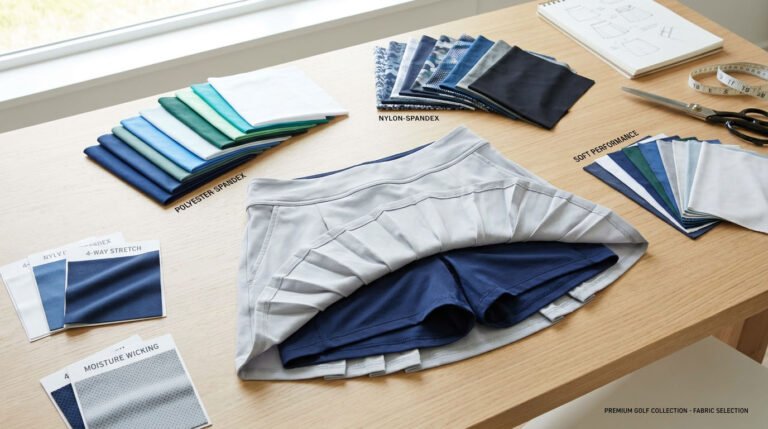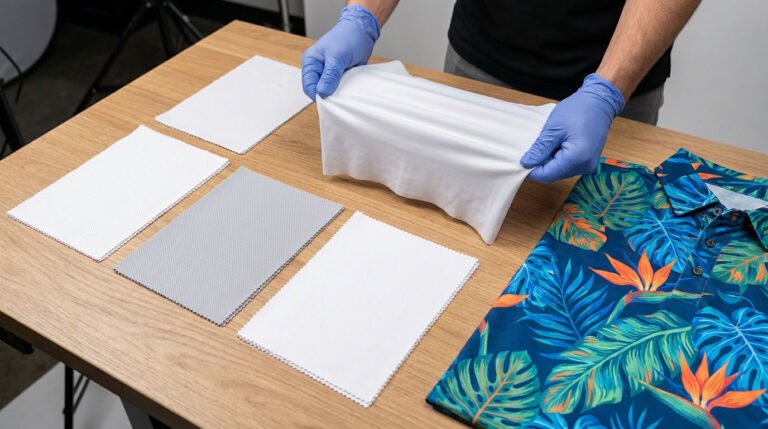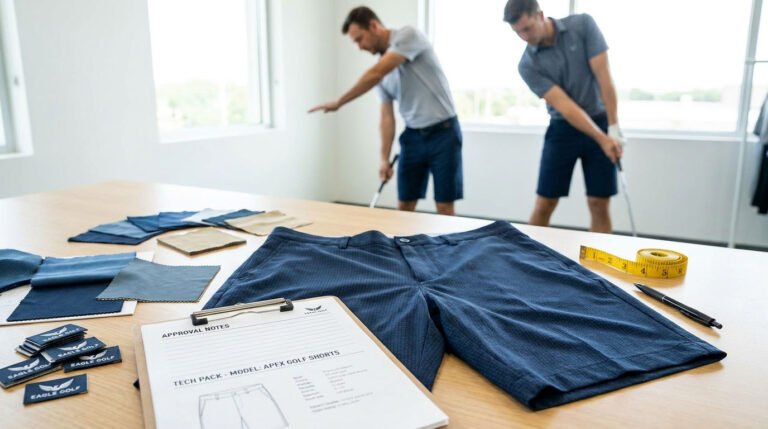
Jacquard golf polo fabric offers private label brands a way to create distinctive textures, subtle geometric patterns, and recognizable designs without relying entirely on prints or oversized logos.
However, a jacquard fabric that looks premium on a small swatch may feel too heavy, restrict movement, snag easily, or display an unbalanced pattern when made into a finished golf polo.
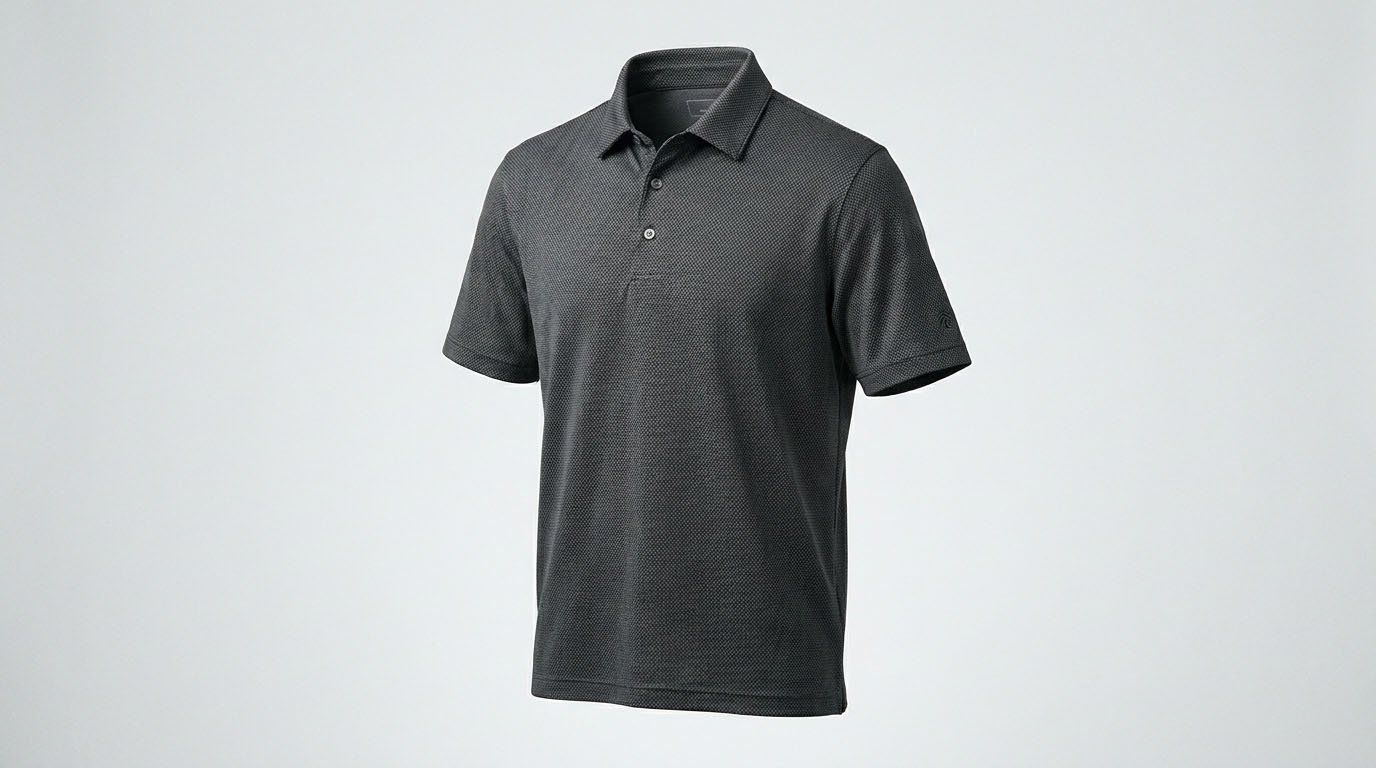
The key is to choose jacquard fabric based on the finished garment—not its appearance alone.
For golf apparel brands, that means selecting a suitable knit construction, evaluating performance and comfort, understanding fabric MOQ requirements, and verifying that bulk production matches the approved sample.
Quick Answer: Is Jacquard Fabric Good for Golf Polos?
Yes. Jacquard can be an excellent choice for premium-looking golf polos, tonal geometric designs, and differentiated private label collections.
However, jacquard is a pattern-forming knitting technique, not a guarantee of breathability, softness, stretch, or durability.
The best option depends on your target golfer, climate, product positioning, and production requirements.
| Brand Requirement | Recommended Starting Direction | Main Risk to Check |
|---|---|---|
| Classic premium golf polo | Fine micro jacquard | Texture and appearance consistency |
| Hot-weather golf collection | Lightweight, open-structure jacquard | Airflow, opacity, and snagging |
| Structured premium polo | Double-knit jacquard | Weight, warmth, and drape |
| Unique brand-specific pattern | Custom jacquard | Fabric MOQ and motif accuracy |
| Detailed multicolor artwork | Printed performance knit | Print compatibility and durability |
These are development directions, not standardized jacquard categories or guaranteed performance outcomes.
For brands considering jacquard, the most important decision is whether its texture and design benefits justify the additional development, sourcing, and quality-control requirements.
Key 1. What Is Jacquard Golf Polo Fabric?
Jacquard is a textile patterning technique that creates designs directly through the knitting structure rather than applying the entire pattern afterward through printing.
In knitted jacquard, controlled yarn selection and loop formation can produce:
- Subtle tone-on-tone textures
- Small geometric or diamond patterns
- Raised or recessed surface effects
- Repeating brand motifs
- Multicolor knitted designs
The resulting appearance depends on yarn composition, machine capabilities, pattern complexity, knit structure, and finishing.
A jacquard polo may also use a different construction for its collar, cuffs, or other components. A jacquard collar does not necessarily mean the entire garment body uses jacquard fabric.
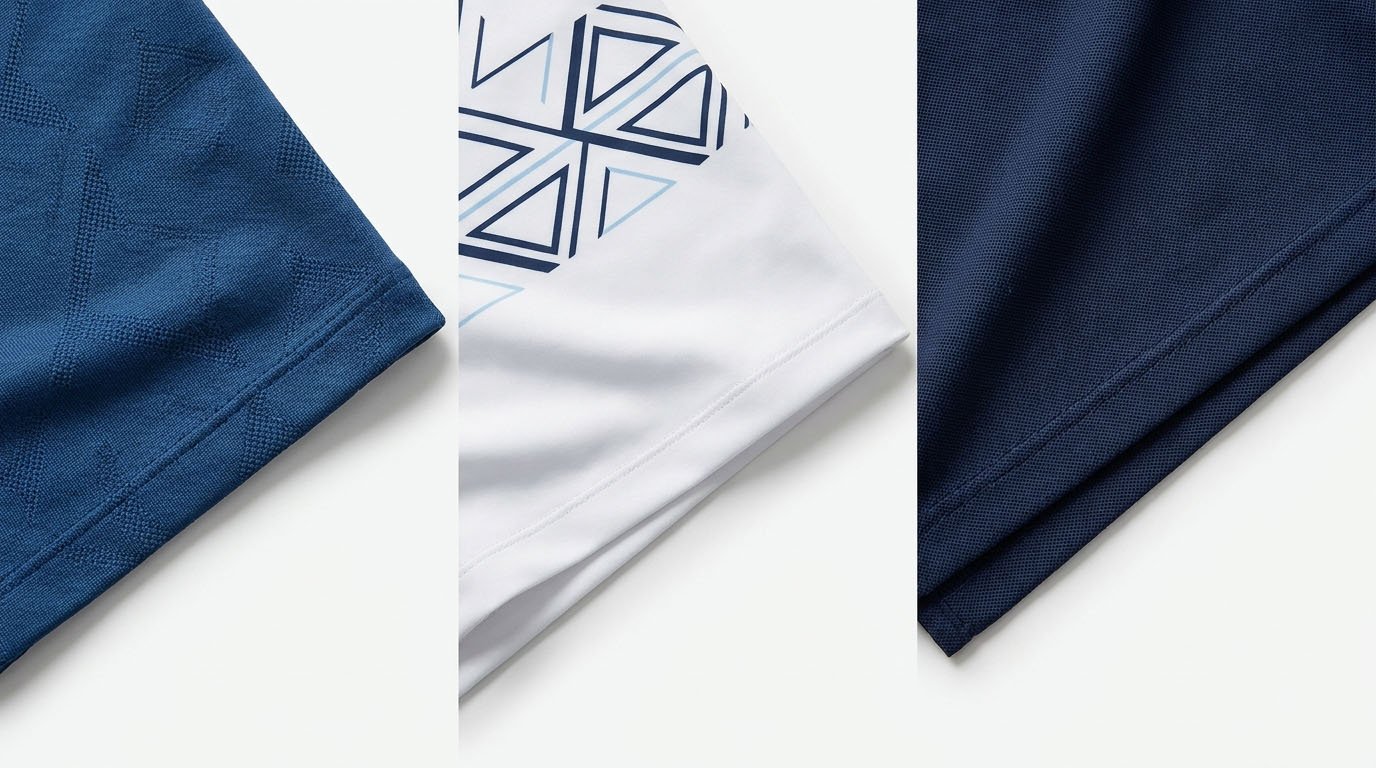
Jacquard vs Printed Fabric vs Piqué
These are not entirely equivalent categories.
Jacquard describes a patterned textile construction, printing adds artwork to a base fabric, and piqué refers to a textured knit structure.
| Feature | Jacquard Knit | Printed Knit | Piqué Knit |
|---|---|---|---|
| Pattern creation | Built into knitting | Applied through printing | Texture formed by knitting |
| Typical appearance | Tonal or repeating motifs | Detailed or multicolor artwork | Classic textured surface |
| Design flexibility | Depends on knit capability | Often high for compatible printing methods | Usually simpler surface designs |
| Main concern | Pattern accuracy and stability | Print durability and compatibility | Comfort and shape retention |
| Performance | Depends on actual fabric | Depends on base fabric and print | Depends on actual fabric |
Jacquard and piqué can overlap in some constructions.
A knitted-in motif will not peel like an applied transfer, but the fabric may still snag, fade, distort, or lose appearance depending on its yarns and finishing.
For a wider comparison of golf polo materials and constructions, see our Best Fabric for Golf Polo Shirts guide.
Key 2. Which Jacquard Fabric Type Should Your Brand Choose?
Jacquard is not a single standardized fabric. Different knitting constructions offer different levels of texture, structure, openness, and stretch.
For private label golf polos, three useful development directions are micro jacquard, open-structure jacquard, and double-knit jacquard.
Micro Jacquard: For Versatile Golf Polo Collections
Micro jacquard uses small-scale patterns to create a subtle textured appearance.
It is suitable for brands that want differentiation without making the polo visually busy.
Potential applications:
- Core premium golf polo collections
- Golf club and pro shop apparel
- Corporate golf uniforms
- Course-to-clubhouse collections
Fine patterns can coordinate well with embroidery and understated branding. However, yarn quality, snagging resistance, and repeat-production consistency still require evaluation.
Airflow Jacquard: For Warm-Weather Golf Apparel
Some jacquard constructions incorporate engineered openings or mesh-like patterns.
These structures may support ventilation, making them worth considering for warm-weather golf apparel.
However, a visibly open knit does not automatically prove better moisture management or overall comfort.
For hot and humid conditions, prioritize:
- Air permeability and wearing comfort
- Opacity, especially in lighter colors
- Moisture-management performance
- Stretch and recovery
- Resistance to snagging
Open structures can introduce transparency or durability trade-offs. Evaluate the actual fabric rather than relying on the supplier's use of the term airflow.
Double-Knit Jacquard: For More Structured Polos
Double-knit jacquard can provide a more substantial fabric body and stable appearance, depending on the construction.
It may suit premium lifestyle collections, cooler conditions, or designs requiring a structured drape.
However, a denser construction may feel warmer or heavier during active summer golf.
Select it for a specific fit and design requirement rather than assuming that greater weight means higher quality.
What GSM Is Suitable for Jacquard Golf Polos?
GSM means grams per square meter. It measures fabric weight, not overall quality.
The following ranges are illustrative starting points for development discussions, not universal industry standards, verified FUWAY stock specifications, or guaranteed performance ranges.
| Jacquard Direction | Illustrative GSM Reference | Development Priority |
|---|---|---|
| Lightweight open-structure jacquard | 150–180 GSM | Comfort, opacity, and durability |
| Fine micro jacquard | 165–205 GSM | Balanced texture and drape |
| Structured double-knit jacquard | 200–240 GSM | Body, shape, and wearing comfort |
Actual specifications must be confirmed against available fabrics.
A 180 GSM open jacquard can feel very different from a dense jacquard of the same weight.
For that reason, evaluate GSM together with knit density, yarn, finishing, skin-side feel, and garment-level comfort.
FUWAY's Fabric Sourcing service can help brands explore available fabric constructions and assess their suitability for specific golf apparel projects.
Key 3. What Fabric Specifications Matter Before Sampling?
A jacquard polo must perform as well as it looks.
Its comfort, movement, and durability depend on the complete material construction—not the pattern alone.
Yarn Composition and Hand Feel
Jacquard golf apparel can use polyester, nylon, elastane, natural fibers, or selected blends.
| Material Direction | Potential Benefit | What to Validate |
|---|---|---|
| Polyester-rich blend | Practical care and shape stability | Hand feel and moisture management |
| Nylon-rich blend | Smooth feel and durability potential | Drying, cost, and color consistency |
| Elastane-containing blend | Stretch and recovery | Stability and shape retention |
| Natural-fiber blend | Different tactile characteristics | Care, drying, and shrinkage |
These benefits are possibilities, not guaranteed properties. Yarn selection, knitting, dyeing, and finishing all influence the result.
Stretch, Recovery, and Golf Movement
Golf polos need comfortable movement through the shoulders, chest, and back.
Evaluate whether the fabric stretches sufficiently during a full swing and returns toward its original dimensions afterward.
A fabric may stretch easily but recover poorly, causing bagging or visible pattern distortion.
Check both material behavior and garment fit before approval.
Breathability and Moisture Management
Jacquard does not automatically provide moisture-wicking, quick-drying, or UV-protective performance.
For performance-oriented collections, request evidence supporting the specific claims you plan to make.
Wear trials help evaluate comfort, but they are not substitutes for laboratory evidence of technical performance.
Snagging and Surface Durability
Raised motifs, open-knit areas, or exposed yarn floats can increase snagging risk in certain constructions.
Relevant contact points include golf bag straps, zippers, hook-and-loop glove closures, and rough surfaces.
Evaluate representative fabric samples after agreed wear, handling, and care procedures.
Also inspect the reverse side: some jacquard structures contain yarn floats that can affect skin comfort.
Key 4. How Should Brands Design Custom Jacquard Patterns?
Custom jacquard allows brands to integrate geometric patterns, tonal branding, or repeating motifs into the fabric itself.
The most common design risk is approving the pattern only from a small swatch or digital rendering.
A motif that looks subtle on a fabric card may appear oversized or unbalanced across a finished polo.
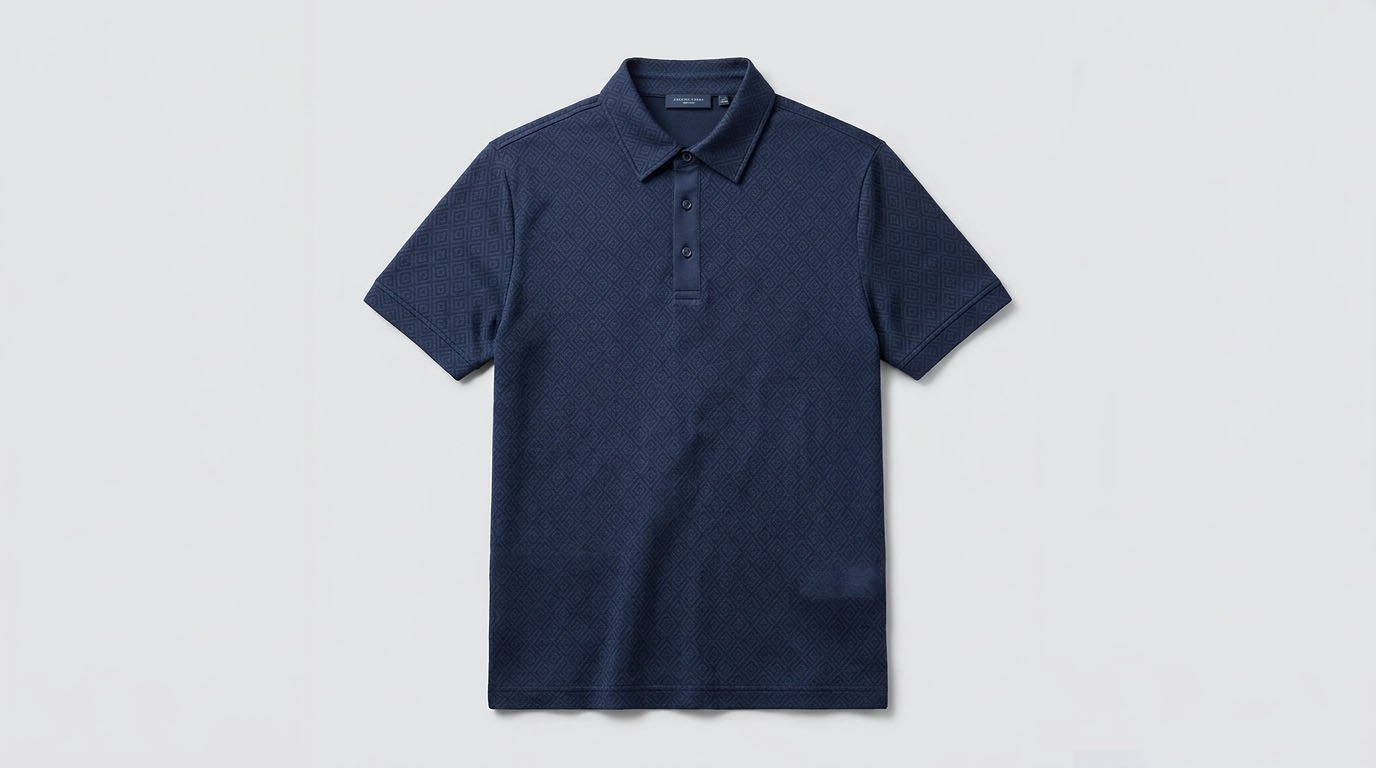
Review Motif Scale on a Full Garment
Check how the pattern appears across:
- Front and back body panels
- Shoulder and side seams
- Sleeves and armholes
- Collar and placket areas
- Different garment sizes
For example, a repeating diamond motif may look understated on a swatch but visually crowded across the chest.
The correct response may be a smaller repeat, different contrast, or revised pattern direction—not necessarily abandoning jacquard altogether.
Control Pattern Alignment and Construction
Repeating patterns may become discontinuous where garment panels meet.
Buyers should define critical matching points and acceptable variation before production.
Perfect matching at every seam is not always necessary or economically practical.
Also review how the jacquard body interacts with the collar and placket.
Differences in stretch or stability may contribute to:
- Wavy placket edges
- Collar imbalance
- Seam puckering
- Distorted motifs around seams
These problems should be evaluated on a sewn sample, not predicted from fabric weight alone.
Check Custom Logos and Knit Resolution
Certain logos or brand motifs can be incorporated into jacquard knitting.
However, very fine lettering and intricate details may lose clarity depending on knitting resolution, yarn selection, and motif dimensions.
Review the design after stretching and washing.
For very small or detailed logos, embroidery or another decoration method may be more suitable.
Record the approved repeat dimensions, orientation, critical matching areas, and garment photographs in the Golf Apparel Tech Pack Checklist.
Key 5. Stock vs Custom Jacquard: How Do MOQ and Cost Differ?
For many private label brands, the most important sourcing decision is whether to use an existing jacquard fabric or develop a new pattern.
Stock jacquard may simplify development because a suitable fabric construction already exists.
Custom jacquard offers greater design flexibility but may require additional knitting development, color approvals, and material minimums.
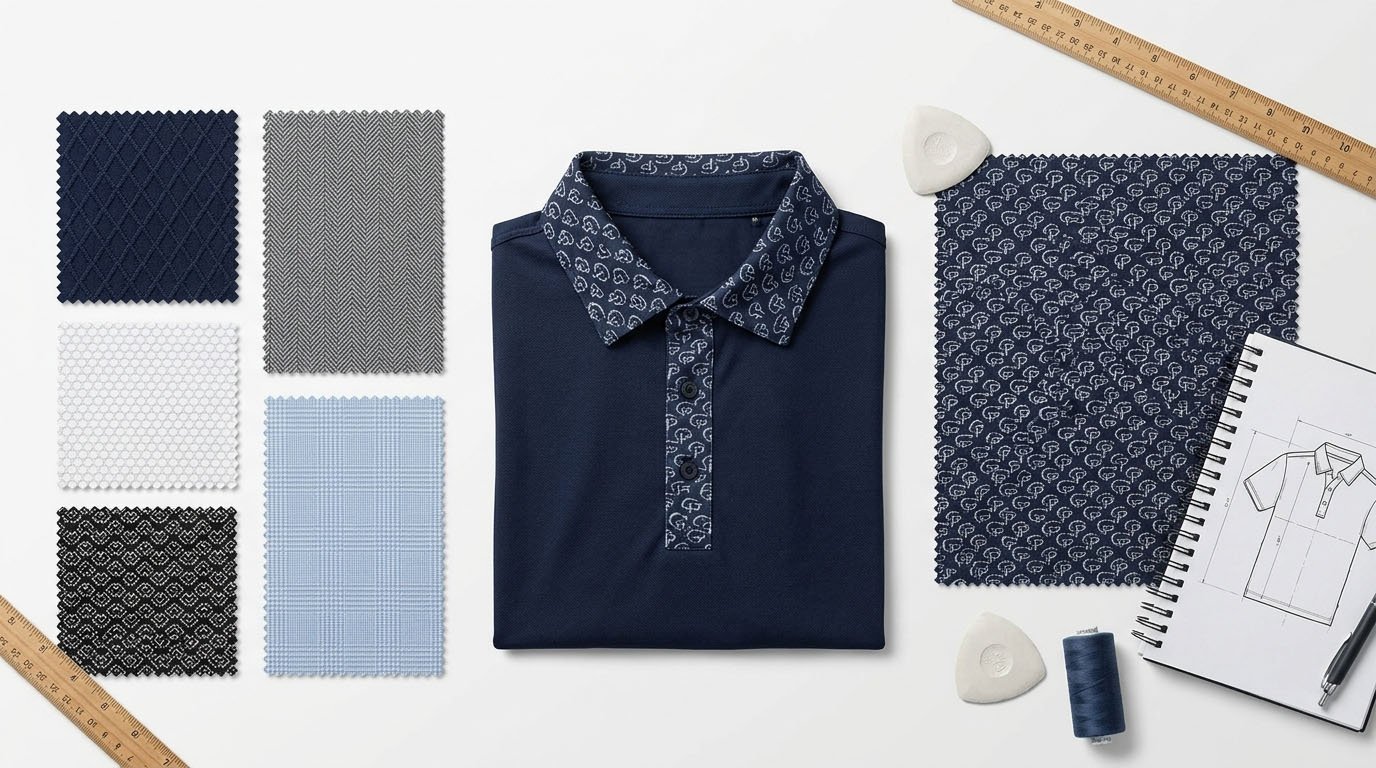
Jacquard Sourcing Decision Matrix
| Fabric Option | Best Starting Point For | Main Advantage | Main Limitation |
|---|---|---|---|
| Stock micro jacquard | Startups and core collections | Simpler fabric sourcing | Limited exclusivity |
| Stock open-structure jacquard | Seasonal collections | Existing fabric options | Limited motif choices |
| Custom jacquard pattern | Distinctive private label designs | More design control | Development and fabric MOQ |
| Printed performance knit | Detailed multicolor artwork | Greater artwork flexibility | Print and base-fabric compatibility |
For smaller launches, an existing jacquard construction can be more practical than developing an exclusive fabric from scratch.
Fabric MOQ Is Not the Same as Garment MOQ
FUWAY's standard custom golf apparel programs commonly start at approximately 100 pieces per style, depending on the design and order requirements.
However, this does not mean that every custom jacquard fabric can be developed economically at the same quantity.
A project may involve separate minimums for:
- Knitting a new pattern
- Dyeing an exclusive color
- Producing finished garments
- Ordering specialized trims
The applicable MOQ may also depend on the color, fabric construction, and order configuration.
Confirm each requirement before finalizing the product range or budget.
What Makes Custom Jacquard More Expensive?
Potential cost drivers include:
- Knit pattern programming and development
- Yarn and color requirements
- Fabric consumption and cutting efficiency
- Sampling revisions
- Additional material inspection and defect control
Custom jacquard is not necessarily more expensive in every comparison.
Actual cost depends on the material, motif, production quantity, and sourcing route.
Use the Cost Breakdown of a Golf Polo to understand how fabric, trims, workmanship, and other quotation components affect the finished product price.
For custom jacquard, request separate confirmation of fabric development charges, garment unit cost, and any additional material minimums.
Key 6. How Should Brands Approve Samples and Bulk Production?
An approved development sample does not guarantee that every bulk fabric roll or finished garment will match it.
Yarn lots, dyeing, knitting conditions, finishing, and sewing can affect the final result.
For jacquard polos, use two separate approval gates.
Gate 1: Development and Garment Sample Approval
The first gate establishes what the finished product should look and feel like.
| Checkpoint | What to Approve |
|---|---|
| Fabric | Composition, construction, weight, and hand feel |
| Pattern | Repeat size, orientation, and appearance |
| Fit | Golf movement and garment balance |
| Construction | Collar, placket, seams, and sleeves |
| Comfort | Skin-side feel and wearing suitability |
| Care evaluation | Agreed dimensional and appearance results |
A small swatch alone is insufficient.
Review a complete sewn garment in the intended fit, with relevant trims and branding.
Where necessary, check additional sizes to identify changes in motif appearance or garment balance.
Retain identifiable approved references, including the fabric sample, garment sample, and current specification revision.
Gate 2: Bulk Fabric and Production Verification
The second gate verifies actual production materials and initial production output against the approved references.
Before bulk cutting, review the production fabric for:
- Material identity and finished GSM
- Color and shade consistency
- Motif dimensions and definition
- Snags, holes, and knitting defects
- Agreed dimensional stability
- Stretch, recovery, and hand feel
Where the production plan allows, review representative first-production garments after the line starts.
Check motif balance, construction, measurements, and appearance against the approved standard.
A few approved pieces do not replace continued production checks and final order inspection.
Control Changes Between Sample and Bulk
Brands should also define which changes require renewed approval.
For example:
- A different yarn or fabric source
- Changes to the knitting pattern
- A new finishing process
- Revised collar or placket construction
- Material substitutions affecting fit or performance
Record the reason for the change, the revised reference, the required rechecks, and the person authorizing production.
Testing methods and acceptance criteria should be agreed for the project. There is no universal jacquard shrinkage, snagging, or recovery limit suitable for every fabric.
For general apparel inspection stages and final order control, see FUWAY's Golf Apparel Quality Control Guide.
Key 7. What Should You Send a Jacquard Golf Polo Manufacturer?
A useful development inquiry should help the manufacturer evaluate material feasibility, design requirements, and production risks before quoting.
Jacquard Golf Polo Development Brief
| Information | What to Include |
|---|---|
| Target customer | Market, climate, golfer type, and retail positioning |
| Product design | Fit, collar, placket, sleeves, and branding |
| Jacquard pattern | Artwork, repeat dimensions, colors, and orientation |
| Fabric direction | Stock or custom, composition, GSM, and hand feel |
| Performance | Required stretch, comfort, durability, and claim evidence |
| Order configuration | Quantities by style, color, and size |
| Approval requirements | Sample stages, production-material checks, and acceptance criteria |
| Repeat orders | Fabric availability, reference retention, and change control |
Ask the manufacturer to identify unresolved specifications, material substitutions, and separate fabric MOQ requirements before confirming the quotation.
This reduces the risk of comparing proposals that appear similar but cover different materials or development services.
For private label projects, FUWAY can help assess suitable customization routes, from existing fabric options to more individualized product development. Learn more about our Private Label Golf Apparel services.
FAQ: Jacquard Golf Polo Fabric
Is jacquard better than printed golf polo fabric?
Not necessarily. Jacquard is useful for integrated textures and repeating motifs, while printing often provides more flexibility for detailed multicolor artwork. Neither method automatically guarantees better comfort or durability.
What is the best GSM for a jacquard golf polo?
There is no single ideal GSM. Lightweight structures may suit warm-weather collections, while denser constructions may suit more structured styles. Evaluate the actual fabric's airflow, opacity, drape, stretch, and comfort before deciding.
Can jacquard golf polo fabric have four-way stretch?
Yes, depending on the yarn and knit construction. Elastane may improve stretch and recovery, but the actual performance must be confirmed through suitable material and garment evaluation.
What is the MOQ for custom jacquard golf polos?
MOQ depends on whether the project uses existing fabric or requires custom knitting. Fabric production minimums can differ from garment manufacturing minimums. Confirm requirements for the specific pattern, color, and quantity.
Does jacquard golf polo fabric snag easily?
Some raised or open jacquard constructions are more susceptible to snagging. Risk depends on yarn selection, motif design, finishing, and intended use. Test representative samples before production.
Can I approve custom jacquard using only a fabric swatch?
No. A swatch can support initial material selection, but it cannot fully demonstrate garment drape, pattern scale, seam behavior, collar balance, or golf movement. Approve a complete sewn sample before committing to bulk production.
Conclusion: Choose Jacquard for the Finished Garment, Not Just the Texture
Jacquard golf polo fabric can help private label brands create distinctive, premium-looking collections.
However, a successful jacquard polo requires more than attractive fabric.
The most effective development process is to:
- Select a construction suited to the target golfer and climate.
- Evaluate fabric weight, comfort, stretch, and durability.
- Review the motif and construction on a complete garment.
- Confirm stock versus custom fabric requirements and MOQ.
- Separate development approval from bulk-production verification.
At FUWAY, we support custom golf apparel brands with fabric sourcing, OEM/ODM product development, private label customization, sampling, and production quality control.
Whether you are considering an existing micro jacquard or developing a custom knitted motif, our team can help review the available manufacturing options for your project.
Contact FUWAY to share your fabric references, design requirements, target quantity, and jacquard golf polo development plans.