You received a quote for a golf polo, but it feels like a black box. You're worried about hidden fees and don't know if you're getting a fair price, making it impossible to budget accurately.
The final FOB cost of a golf polo, typically ranging from $3.25 to $6.95, is a sum of its parts: fabric (40-60%), trims and logos, labor (CMT), factory overhead, and testing. Understanding this breakdown is the key to negotiating effectively and managing your margins.
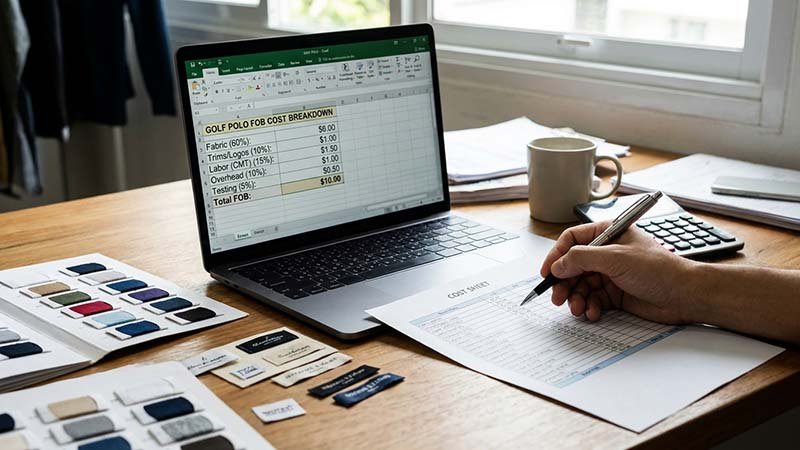
The biggest mistake I see new brand owners make is comparing quotes without understanding what's inside them. A "cheaper" quote might just be hiding costs that will surprise you later. To build a profitable business, you need to speak the same language as your manufacturer. You need to see the polo not as a single item, but as a collection of materials and processes, each with its own cost. Let's open up that black box and look at exactly what you're paying for.
What Are the Different Cost Models and Quote Structures?
You're seeing terms like "FOB," "CMT," and "DDP," but you aren't sure how they impact your final cost. This confusion can lead to unexpected bills and shrink your profit margins.
FOB (Free On Board) is the most common and balanced quoting model. It includes all manufacturing costs plus getting the goods to the port of origin, giving you a clear benchmark for your product cost.
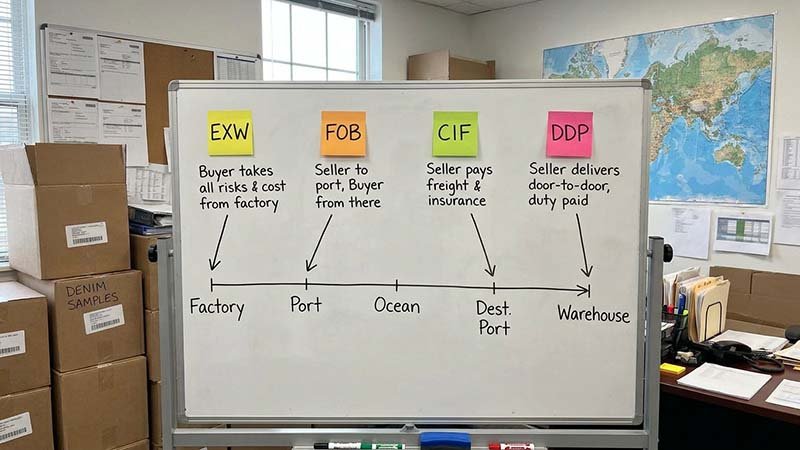
Think of these terms as defining the handover point of cost and responsibility. Choosing the right one is the first step in managing your budget.
Common Quoting Models: EXW, FOB, DDP, and CMT
Your quote will be based on a combination of a trade term (Incoterm) and a service model. The table below breaks down the most common ones. For most new brands, a FOB Full-Package quote is the standard.
| Term | What It Means | Your Responsibility |
|---|---|---|
| EXW (Ex-Works) | The price for the goods at the factory door. | Arrange and pay for all shipping and customs. |
| FOB (Free On Board) | The factory's price to produce and deliver goods to the departure port. | Manage ocean freight, insurance, and duties. |
| DDP (Delivered Duty Paid) | An all-in price to deliver goods to your warehouse, duties paid. | Unpack the boxes. Easiest, but most expensive. |
| CMT (Cut, Make, Trim) | A labor-only price. | Source and provide all fabric and trims. |
Standard Cost Structure
A full-package FOB quote bundles everything: raw materials, labor, factory overhead, compliance testing, standard packaging, and the factory's margin.
Key Calculation Points
When you receive a quote, confirm these three things immediately:
- Currency: Is it in USD, EUR, or another currency?
- Exchange Rate: What rate is the quote based on?
- Price Validity: How long is the quote good for? (Usually 30-60 days).
What Drives the Cost of Your Fabric?
You know fabric is the biggest cost component, but why does one polyester feel cheap while another feels premium and costs twice as much?
Fabric cost is driven by three main factors: the raw material (e.g., recycled vs. virgin polyester), the weight (GSM), and any special functional finishes applied to it (e.g., UPF 50+).
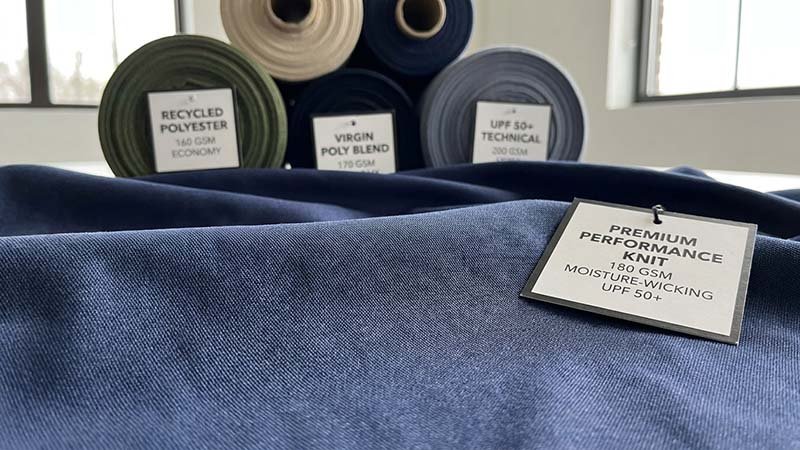
The fabric alone can account for 40-60% of your polo's total cost.
GSM, Yarn, and Construction
The price per kilogram of fabric is set by its composition. Recycled polyester or branded yarns like Lyocell cost more than generic virgin polyester. Heavier fabrics (higher GSM) naturally cost more per meter because they use more raw yarn.
Calculating Consumption and Waste
Your factory calculates the exact fabric needed per garment (the "yield") based on the pattern and fabric width. For a 170gsm polo, this might be 0.85 meters. They then add a waste factor (typically 6-10%) to account for fabric lost during cutting.
Functional Finishes and Added Costs
Each performance feature you add is another process with a cost. A simple moisture-wicking finish is cheap, but adding UPF 50+ protection or PFC-free water repellency will noticeably increase the fabric price.
What About the Small Stuff? Trims and Logos
You've budgeted for fabric and labor, but the small details—buttons, thread, and logos—are adding up faster than you expected.
Every single component on your polo, from the thread to the hangtag, has a cost. A complex embroidered logo can cost more than all the other trims combined.
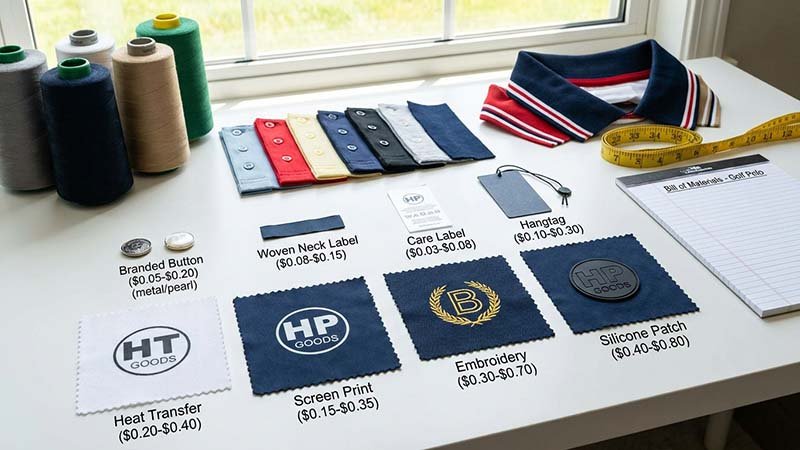
I always tell clients to create a detailed Bill of Materials (BOM) to track these items.
Ribs, Plackets, Buttons, and More
A separate knit rib collar is a classic look but adds $0.25-$0.45 compared to a self-fabric collar. Custom-branded buttons, quality thread, and internal interfacing for the placket all contribute small amounts to the final cost.
Logo and Decoration Pricing
Your branding method is a major cost variable. Here’s a quick comparison:
| Logo Type | Typical Cost Range | Key Considerations |
|---|---|---|
| Heat Transfer | $0.18–$0.35 | Good for fine detail; best on smooth fabrics. |
| Screen Printing | $0.15–$0.50+ | Cost depends on the number of colors. |
| Embroidery | $0.35–$0.65 | Priced by stitch count. A classic, durable look. |
| Silicone Patch | $0.25–$0.45 | Modern 3D look; requires a one-time mold fee. |
Labels and Regulatory Tags
Your branded neck label, care instructions label, and hangtag all contribute to the cost. Ensure they meet all legal requirements for your sales market.
How Is Your Polo's Labor Cost Calculated?
The factory gave you a "CMT" (Cut, Make, Trim) price. How do they determine that number, and what makes it go up or down?
Labor cost is based on the SMV (Standard Minute Value)—the time required to sew one garment. A higher SMV means a more complex product and a higher labor cost.
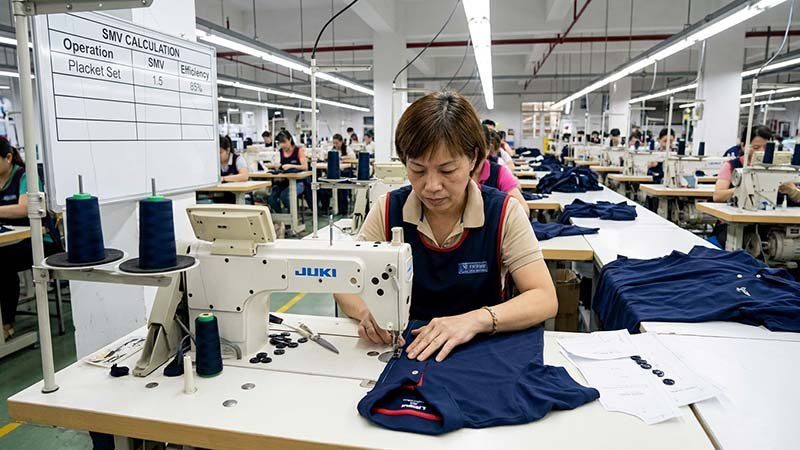
This is where factory efficiency directly impacts your bottom line.
SMV (Standard Minute Value) Estimation
A basic polo has an SMV of around 15-20 minutes. This includes every step from cutting the fabric to the final finishing. A more complex style will have a higher SMV and thus a higher labor cost.
Automation and Efficiency
Factories with automated equipment can reduce the SMV and lower labor costs. The overall "line efficiency"—a measure of a sewing line's productivity—also plays a huge role. Higher efficiency means lower cost.
Order Size and the Learning Curve
For small orders, the cost per piece is higher. Why? Because it takes time for sewers to learn a new style and get up to speed (the "learning curve"). That initial inefficiency is spread over fewer units, driving up the cost of each one.
Let's Build a Real Polo Cost: An Example Breakdown
Theory is great, but let's see how this adds up in a real-world scenario. How do we get from a pile of fabric to a final FOB price?
For a standard 170gsm polyester polo in a 1,000-piece order, the final FOB price will range from $3.25 to $6.45, depending on the logo, collar type, and country of origin.
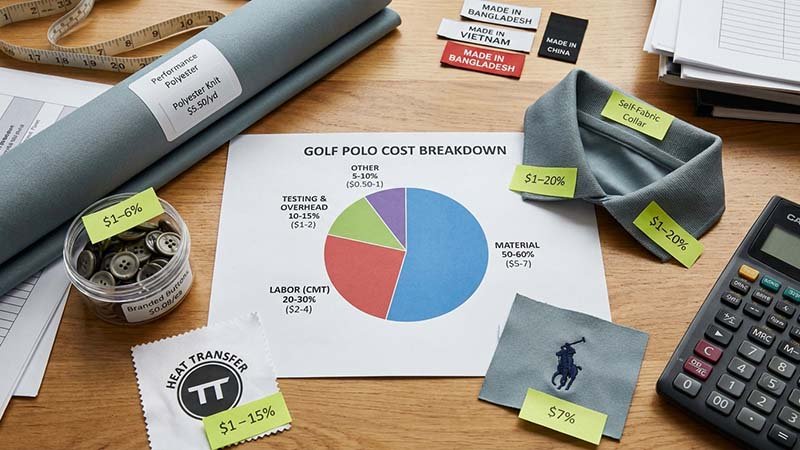
The table below shows how the costs for a basic polo compare to a premium one.
FOB Cost Scenarios: Basic vs. Premium
| Cost Component | Scenario A: Basic Polo (Self-Collar, Heat Transfer) | Scenario B: Premium Polo (Rib Collar, Embroidery) |
|---|---|---|
| Material Cost | $1.70 – $2.60 | $2.15 – $3.35 |
| Labor & Overhead (CMT) | $1.40 – $2.30 | $1.60 – $2.60 |
| Amortized Testing, etc. | $0.15 – $0.40 | $0.20 – $0.50 |
| Total Estimated FOB | $3.25 – $5.30 | $3.95 – $6.45 |
The lower end of these ranges typically comes from regions like Bangladesh, while the higher end is more common in Vietnam or China. Remember to add freight and duties to get your final "landed cost."
How Does Order Quantity (MOQ) Affect Your Price?
You tried to place a small 300-piece order, but the factory quoted you a price 20% higher than their 1,000-piece price. Why?
Small orders are more expensive because you lose bargaining power on materials and the factory loses efficiency in production. Key costs like fabric dyeing and machine setup are spread over fewer units.
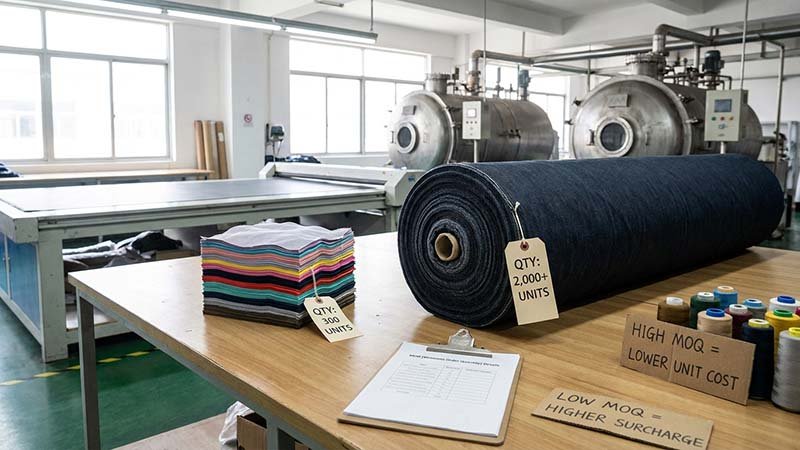
This is driven by the Minimum Order Quantities (MOQs) from the factory's suppliers.
Material and Production MOQs
Fabric mills have dyeing MOQs, often 500-1,000 yards per color. Ordering less incurs a hefty surcharge. On the production floor, setting up a sewing line for a new style is a fixed time cost; spreading that cost over 300 units is far less efficient than spreading it over 3,000.
The Impact of Scale
As your order volume increases, your power increases. You can negotiate better prices on fabric, and the factory's labor efficiency improves, leading to a lower labor cost per unit.
What Are the Smartest Ways to Reduce Costs?
Your quote came in higher than your target cost. How can you work with your factory to lower the price without compromising your brand's quality?
The most effective cost-reduction strategies involve smart material choices, simplifying construction, and optimizing logistics. A good factory partner will act as a consultant to help you find these savings.
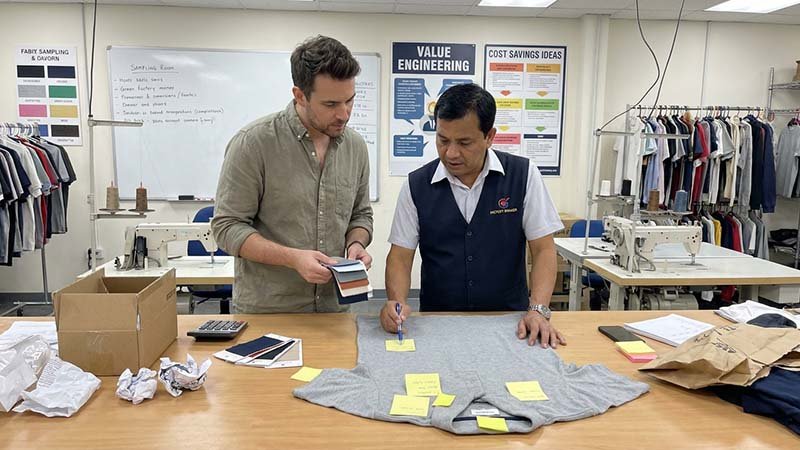
This is about collaborative "value engineering," not just demanding a discount.
Material and Process Optimization
- Material Tweaks: Can you use a slightly lighter fabric? Can you switch from a rib collar to a self-fabric collar (saves ~$0.30)? Can you change from embroidery to a heat transfer (saves ~$0.20)?
- Process Simplification: Can a complex seam be simplified? Can you use a standard button instead of a custom one?
Logistics and Negotiation
- Packaging: Use lightweight packaging and optimize your carton size to reduce freight costs.
- Negotiation: Provide an annual forecast to your factory. Guaranteed volume can lead to better pricing.
FAQ: Your Top Costing Questions Answered
You've got the big picture, but a few specific questions always come up. Here are the quick answers you need.
Why did the price for my re-order go up?
This is common and usually happens for two reasons. First, raw material costs (like polyester yarn) fluctuate. If costs have risen since your last order, the factory will pass that on. Second, if your re-order quantity is smaller than your initial order, the price per unit will be higher due to the loss of scale efficiencies.
What is a "mold fee" and is it negotiable?
A mold fee is a one-time charge (often $150-$300) to create a custom mold for things like silicone logos or unique zipper pullers. The fee itself is rarely negotiable, but you should clarify in writing that you own the mold and can take it with you if you ever switch suppliers.
How much does air freight add to my cost vs. sea freight?
The difference is huge. As a rough rule of thumb, shipping a single polo by sea from Asia to the US might cost $0.30-$1.00. Shipping that same polo by air could cost $1.50-$3.50. Air freight is for urgent samples or top-up orders, not for your main bulk shipment.
Is it always cheaper to source from Vietnam or Bangladesh than China?
Generally, the direct labor cost is lower in Bangladesh and Vietnam. However, China has a highly developed supply chain for trims and complex fabrics. For a basic polo, Bangladesh might be cheapest. For a technical polo with many specialized components, China might be more cost-effective and faster overall.
My factory is asking for a 3% price increase due to exchange rates. Is this normal?
Yes, this can be normal, especially if there has been a significant swing in currency values. Most factories operate on thin margins (5-15%). It's best to discuss and agree on a policy for handling currency fluctuations in your initial contract to avoid surprises.
Conclusion
Understanding your cost breakdown isn't just about saving a few cents. It empowers you to design better products, negotiate smarter deals, and build a resilient, profitable golf apparel brand.