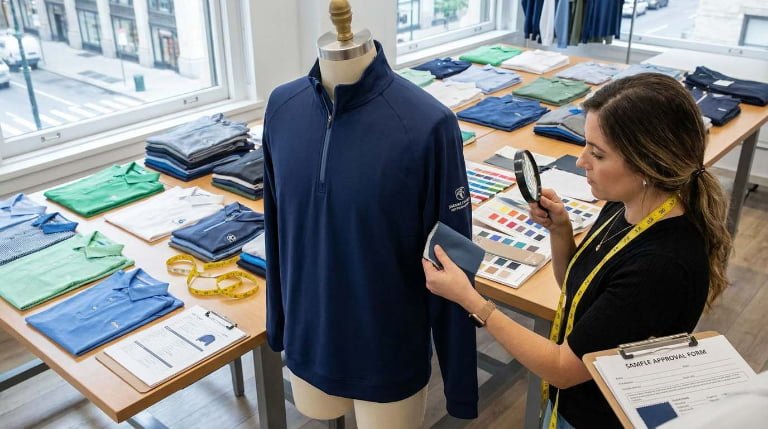
Before sending a golf apparel design to a manufacturer, ask one practical question:
Can the factory develop the sample without guessing important product requirements?
A complete golf apparel tech pack should define design details, fabric specifications, measurements, grading, construction, decoration, testing, and approval requirements.
At FUWAY, finished-garment measurement deviations must stay within ±1.0 cm of the approved target, with tighter tolerances where specified in the tech pack.
This checklist helps golf apparel brands identify missing specifications before sampling and confirm which details must be finalized before bulk production.
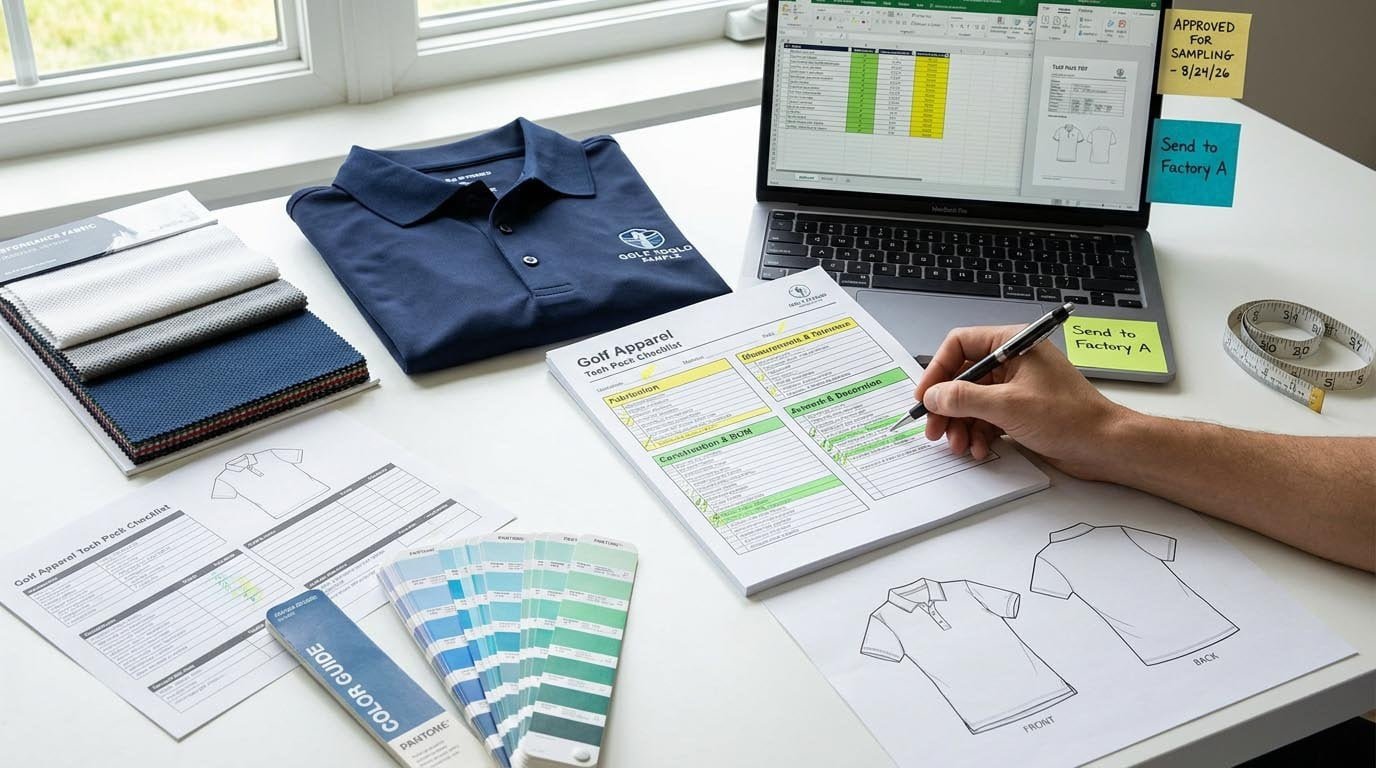
Quick Answer: What Should a Golf Apparel Tech Pack Include?
Before submitting a tech pack, check these 13 essential sections:
- Product and style information
- Technical flat sketches
- Fabric specifications
- Color references and approval methods
- Bill of Materials (BOM)
- POM measurement chart and tolerances
- Size grading rules
- Construction details
- Logo and decoration specifications
- Performance and testing requirements
- Sample stages and approval criteria
- Labels and packaging
- Revision control and approval status
Each section should clearly identify the required specification, supporting reference, and current approval status.
A tech pack is ready for initial sampling when the factory has enough confirmed information to develop the requested sample without making critical assumptions.
Not every detail needs final bulk approval at the prototype stage. However, unresolved requirements must be clearly marked and completed before the relevant production stage.
For instructions on creating these sections, see How to Prepare a Solid Tech Pack for Golf Apparel.
Basic Tech Pack vs. Production-Ready Tech Pack
A basic tech pack communicates the intended design. A production-ready tech pack contains the final approved information needed to manufacture the garment consistently.
| Specification | Initial Sampling | Before Bulk Production |
|---|---|---|
| Design | Technical flats and design direction | Final approved design |
| Fabric | Proposed or approved material specifications | Confirmed production fabric |
| Measurements | Base-size POM chart and required tolerances | Approved measurements and tolerances |
| Grading | Proposed grading rules where applicable | Approved complete size range |
| Decoration | Method and placement requirements | Final artwork and placement |
| Construction | Required construction details | Approved construction |
| Approvals | Open items identified | Required approvals completed |
The objective is not to create a longer document. It is to ensure every critical manufacturing decision is documented at the appropriate stage.
Key 1: Verify Product and Style Information
Every tech pack should clearly identify the product being developed.
Check that it includes:
- [ ] Style name and style number
- [ ] Garment category
- [ ] Target market
- [ ] Intended fit
- [ ] Base sample size
- [ ] Colorway or design reference
- [ ] Document version and date
What to verify: The factory can identify the exact style, requested sample size, and current document revision without asking for clarification.
Key 2: Check Technical Flat Sketches
Technical flats explain garment construction more precisely than lifestyle photos or fashion illustrations.
Confirm that the file includes:
- [ ] Front and back technical views
- [ ] Relevant side or internal views
- [ ] Panel and seam locations
- [ ] Collar, placket, and pocket details
- [ ] Sleeve, hem, and vent construction
- [ ] Decoration placement references
For golf polos, the sketch should clearly show collar shape, placket length, button configuration, sleeve opening, and side vents.
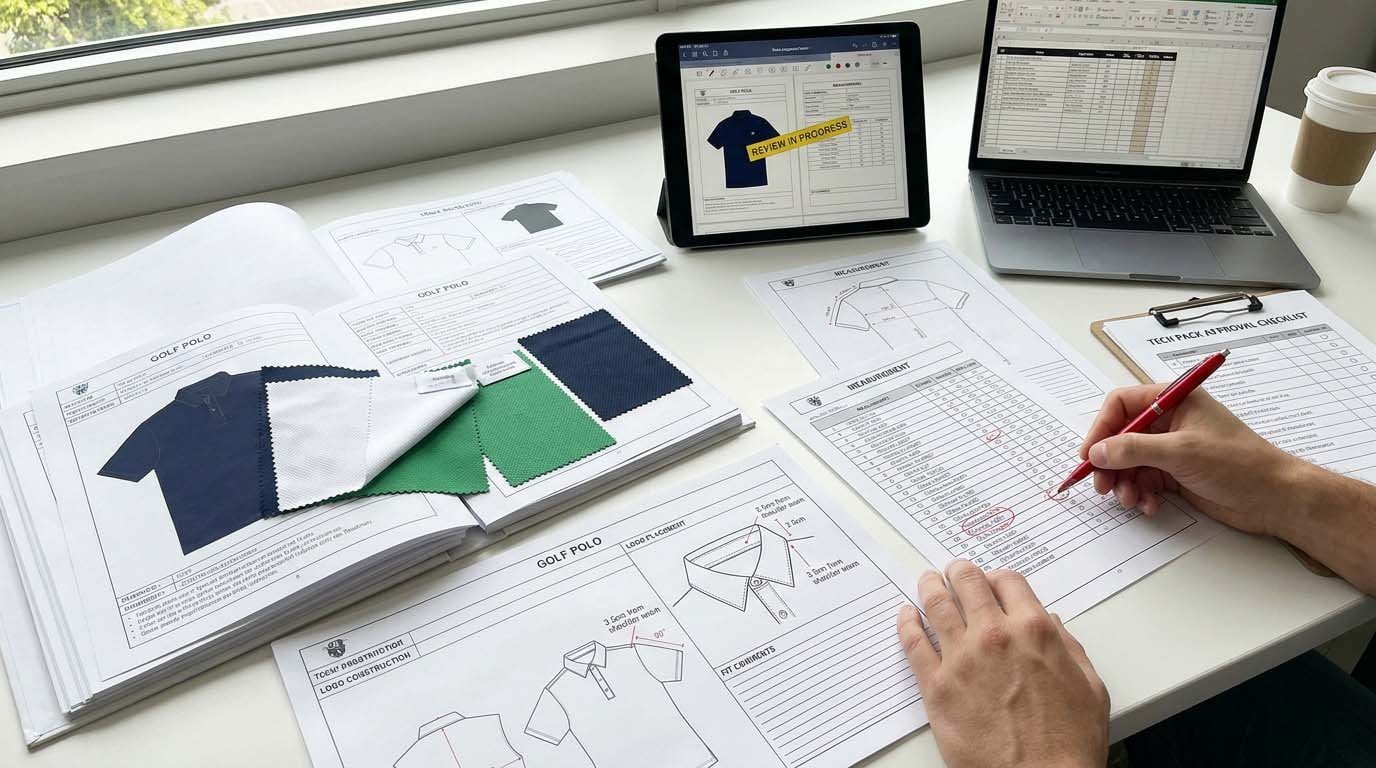
What to verify: Important details can be identified from the drawings and supporting callouts.
A reference image can support the design direction, but it should not replace technical flats.
Key 3: Confirm Fabric Specifications
Descriptions such as "premium performance fabric" or "moisture-wicking polyester" are not sufficient manufacturing specifications.
Check whether the fabric section includes:
- [ ] Fiber composition
- [ ] Knit or woven construction
- [ ] Fabric weight and applicable tolerance
- [ ] Stretch direction and recovery requirements
- [ ] Finishing treatment
- [ ] Color or fabric reference
- [ ] Relevant performance requirements
- [ ] Supplier or material code, where applicable
For example, a polyester-spandex piqué and a polyester-spandex jersey may use similar fibers but have different structures, appearance, and performance.
The tech pack should identify the intended fabric rather than leaving the manufacturer to choose based on a general description.
What to verify: The selected fabric can be sourced and compared against the approved reference.
FUWAY's Fabric Sourcing service can help brands evaluate suitable material options.
Key 4: Verify Color References and Approval Methods
A Pantone reference alone may not fully define the final garment color.
Fabric composition, construction, dyeing method, and surface texture can influence appearance.
Confirm:
- [ ] Colorway name
- [ ] Pantone or agreed color reference
- [ ] Fabric base and material reference
- [ ] Dyeing or printing method, if relevant
- [ ] Required lab dip, knitdown, or strike-off
- [ ] Color approval status
What to verify: The factory knows which color reference or physical sample must be matched and how the result will be approved.
Key 5: Review the Bill of Materials (BOM)
The BOM should identify the components required to manufacture the garment.
Common items include:
- Main and contrast fabrics
- Buttons or zippers
- Elastic and drawcords
- Sewing thread
- Neck tape
- Brand, size, and care labels
- Embroidery backing or transfer materials
- Hangtags and packaging components
For important items, confirm:
| BOM Field | Required Information |
|---|---|
| Item | Component name |
| Material | Composition or material specification |
| Color | Approved color or reference |
| Size | Dimensions, where applicable |
| Source | Supplier or article code, if required |
| Status | Proposed, pending, or approved |
What to verify: Critical components are clearly identified, and substitutions cannot be made without the required approval.
Key 6: Check POM Measurements and FUWAY's ±1.0 cm Tolerance Standard
The Point of Measurement (POM) chart is one of the most important sections of a golf apparel tech pack.
It defines the approved garment dimensions and how they should be measured.
Required POM Information
Confirm that every applicable POM includes:
- [ ] Measurement name
- [ ] Target dimension
- [ ] Measurement method
- [ ] Diagram or reference where needed
- [ ] Approved tolerance
- [ ] Relevant size or size range
Typical golf polo measurements include 1/2 chest width, shoulder width, body length, sleeve length, armhole, collar height, and placket length.
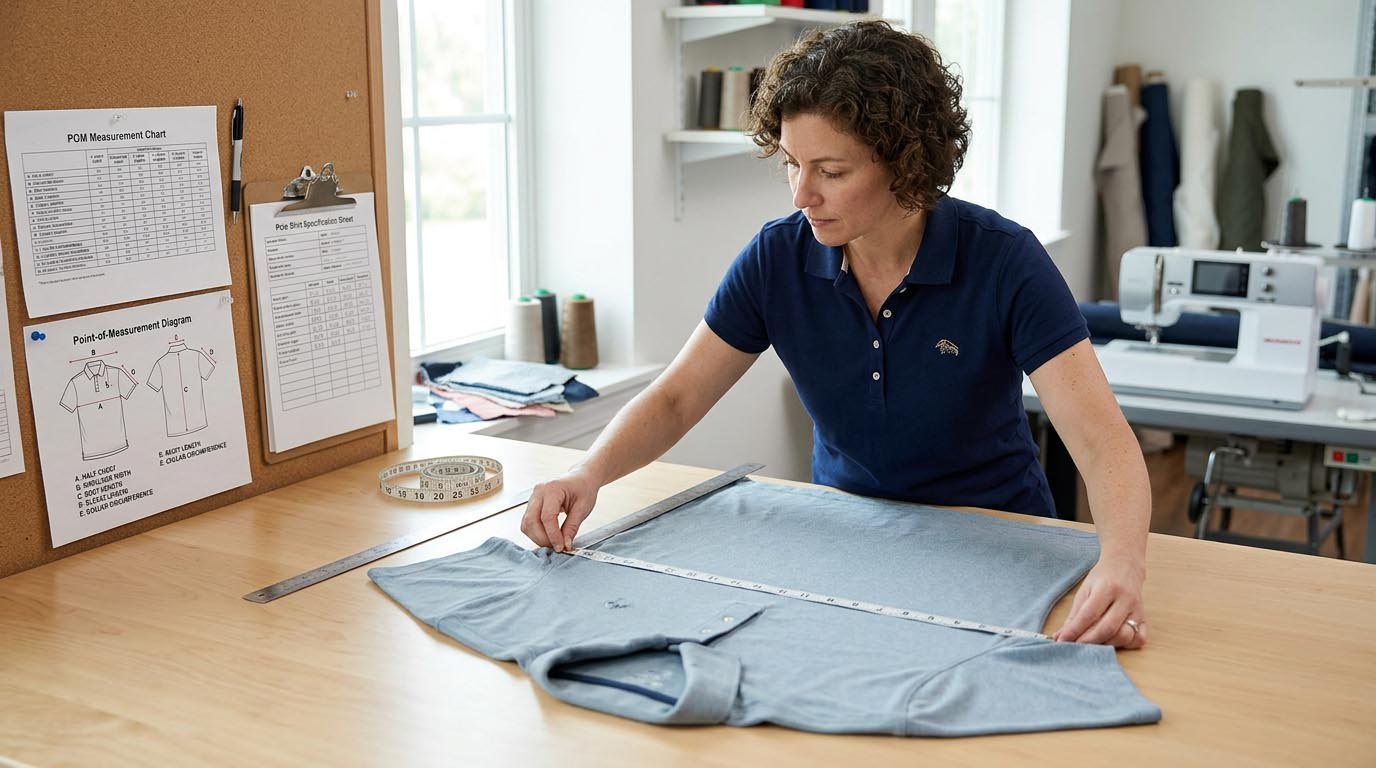
FUWAY's Measurement Tolerance Standard
At FUWAY, finished-garment measurement deviations must remain within ±1.0 cm of the approved target.
This is the maximum permitted deviation under FUWAY's measurement standard. Certain fit-sensitive points may require tighter tolerances.
The following table is an illustrative tech pack example.
| Point of Measurement | Target | Example Tolerance | Acceptable Range |
|---|---|---|---|
| Polo 1/2 chest width | 54.0 cm | ±1.0 cm | 53.0–55.0 cm |
| Polo body length | 72.0 cm | ±1.0 cm | 71.0–73.0 cm |
| Polo collar height | 4.0 cm | ±0.5 cm | 3.5–4.5 cm |
These are example measurements, not fixed specifications for every FUWAY garment.
Actual targets and POM-specific tolerances must be agreed upon during development.
Three Requirements Before Approval
- Use clear POM methods. Define where and how each measurement is taken.
- Apply the approved tolerance. No FUWAY finished-garment dimensional tolerance should exceed ±1.0 cm.
- Do not automatically widen limits for stretch fabrics. Measurement conditions and fabric handling must be controlled.
A separate specification may be required for logo placement, seam alignment, or other construction details. FUWAY's ±1.0 cm garment measurement standard should not automatically be treated as the acceptance limit for every type of workmanship or decoration requirement.
For more detailed dimensional examples and inspection decisions, see our Golf Apparel Measurement Tolerance Guide.
What to verify: Every required measurement has a defined target, method, and approved tolerance.
Key 7: Check Size Grading Rules
A base-size measurement chart does not automatically define the entire selling size range.
The tech pack should include either:
- [ ] Approved measurements for each size, or
- [ ] Clear grading rules used to calculate the remaining sizes
For golf apparel, check whether grading maintains the intended balance of chest width, shoulder proportions, sleeve length, garment length, and waistband fit.
Important: Size grading increments are not measurement tolerances.
For example, a chest width may intentionally increase by several centimeters between Medium and Large. That planned increase is not restricted by FUWAY's ±1.0 cm measurement tolerance standard.
What to verify: Every selling size can be developed from documented grading requirements rather than factory assumptions.
Key 8: Confirm Construction Details
Construction notes tell the factory how to assemble the garment.
Check whether the tech pack specifies:
- [ ] Seam and stitch types
- [ ] Seam allowances
- [ ] Edge finishing
- [ ] Reinforcement points
- [ ] Collar and placket construction
- [ ] Waistband and pocket construction
- [ ] Side vents or special panels
- [ ] Bonding and taping where applicable
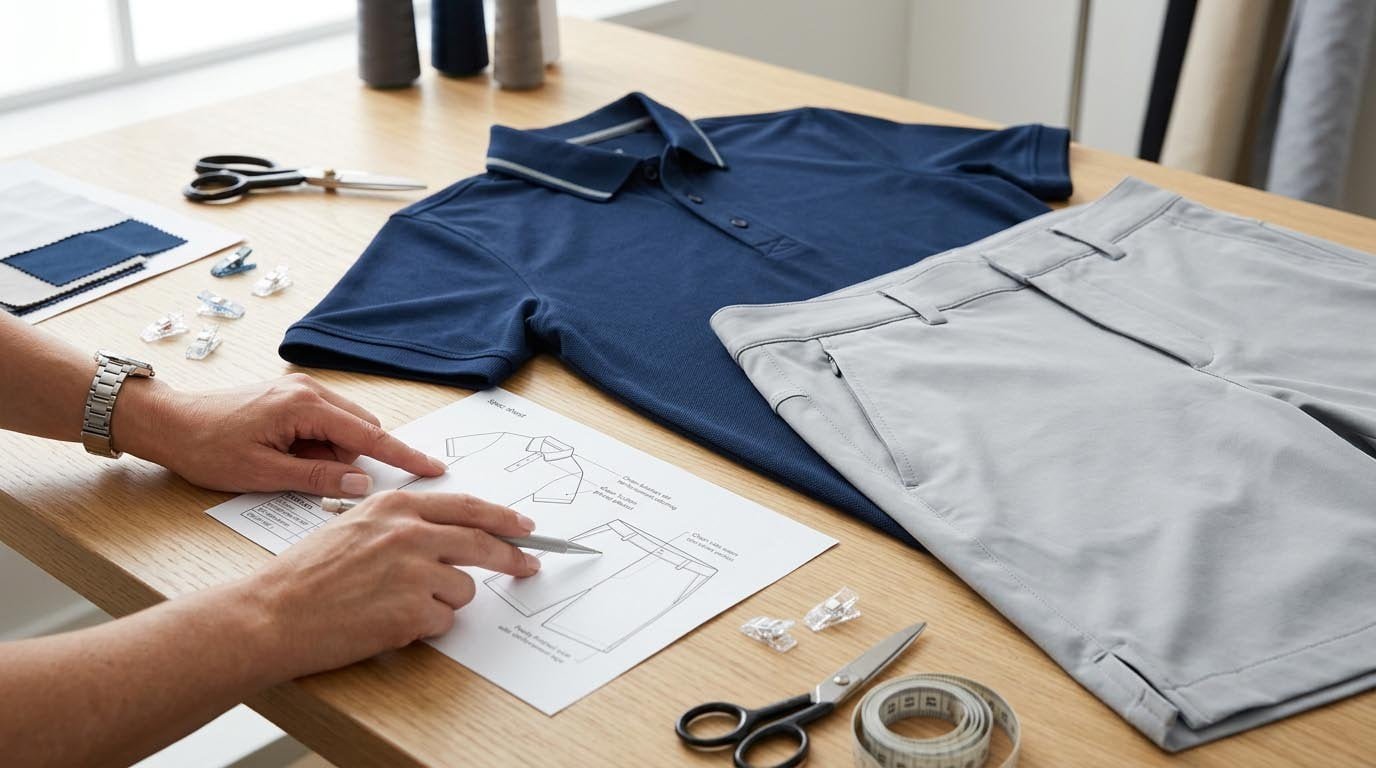
For a golf polo, an instruction such as "reinforced side vent" should be supported by a construction callout or reference.
For trousers and shorts, waistband assembly and pocket construction may require additional detail.
What to verify: Critical construction details can be reproduced without relying on verbal instructions.
Key 9: Check Logo and Decoration Specifications
Instructions such as "left chest logo" are too general for consistent production.
Confirm that the decoration section includes:
- [ ] Approved artwork file and version
- [ ] Decoration method
- [ ] Artwork width and height
- [ ] Placement coordinates and reference points
- [ ] Orientation
- [ ] Color reference
- [ ] Backing, underlay, or other material requirements
- [ ] Method-specific approval criteria
Common methods include embroidery, screen printing, sublimation, and heat transfer.
For embroidery, stitch count and density should be determined by the actual design, dimensions, and material requirements rather than copied from a universal specification.
What to verify: The factory can reproduce the approved logo size, position, appearance, and application method.
Key 10: Confirm Performance and Testing Requirements
If the brand makes a measurable product-performance claim, the tech pack should identify how that requirement will be evaluated.
Relevant checks may include:
- Moisture management
- Quick-drying performance
- UV protection
- Stretch and recovery
- Pilling resistance
- Colorfastness
- Dimensional stability
- Wash durability
Required Testing Information
For applicable tests, specify:
| Item | Requirement |
|---|---|
| Property | What must be tested |
| Method | Agreed test method or standard |
| Target | Required performance level |
| Stage | When testing must be completed |
| Approval | Who reviews the result |
For example, "moisture-wicking" should be supported by an agreed performance target when it is a required product claim.
What to verify: Required testing criteria are documented and assigned to the appropriate development or production stage.
Detailed laboratory procedures do not need to be reproduced in the tech pack checklist itself.
Key 11: Verify Sample Stages and Approval Requirements
The tech pack should identify which sample is requested and what it must demonstrate.
Possible stages include:
- Prototype sample
- Fit or development sample
- Size set
- Sales or showroom sample
- Pre-production (PP) sample
- Top-of-production (TOP) sample
Not every project requires every stage.
Required Sample Instructions
For each requested stage, confirm:
- [ ] Sample purpose
- [ ] Required size and quantity
- [ ] Materials to be used
- [ ] Items requiring review
- [ ] Outstanding specifications
- [ ] Responsible approver
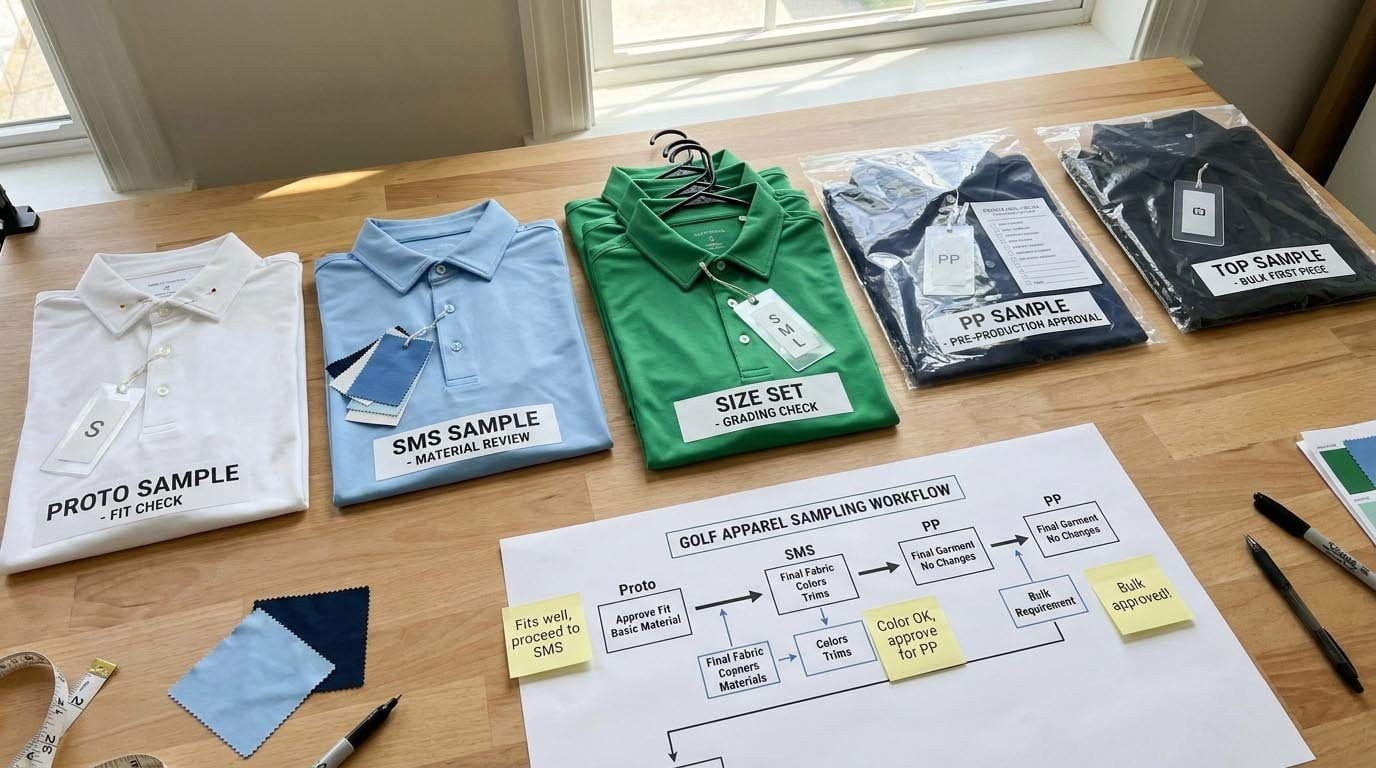
What to verify: Both the brand and manufacturer understand the requested sample and its approval requirements.
The tech pack records these requirements. The actual process of approving fit, grading, movement, and PP samples is covered in our Garment Fit Approval Checklist.
Key 12: Check Labels and Packaging Instructions
Labels and packaging should be documented before the relevant production or purchasing decisions are finalized.
Confirm applicable requirements for:
- [ ] Main brand label
- [ ] Size label
- [ ] Care and fiber-content label
- [ ] Country-of-origin marking
- [ ] Hangtag and barcode
- [ ] Folding instructions
- [ ] Polybag specifications
- [ ] Carton quantity and markings
Exact labeling requirements depend on the destination market and applicable product regulations.
What to verify: The factory has the approved artwork, instructions, and placement details needed to prepare labels and packaging.
Key 13: Verify Revision Control and Approval Status
A technically complete file can still cause manufacturing errors if the factory follows an outdated revision.
Before sending the tech pack, confirm:
- [ ] Current version number
- [ ] Latest revision date
- [ ] Change history
- [ ] Responsible document owner
- [ ] Approved specifications
- [ ] Outstanding approval items
- [ ] Current file shared with the manufacturer
Example Revision Log
| Version | Main Change | Status |
|---|---|---|
| V1.0 | Initial design issue | In Review |
| V1.1 | Updated POM and grading | Revised |
| V1.2 | Fabric and logo confirmed | Approved for Specified Stage |
Approval should clearly identify which stage is authorized. Approval for prototype development does not automatically authorize bulk production.
What to verify: The factory and brand are working from the same current document, and unresolved changes are visible.
Golf Apparel Tech Pack Checklist by Product Type
Different golf garments require additional product-specific information.
| Product | Additional Details to Verify |
|---|---|
| Golf Polo | Collar, placket, sleeve opening, side vents, logo placement |
| Quarter-Zip | Zipper, collar construction, zipper guard, seam alignment |
| Golf Pants | Waistband, rise, pocket construction, inseam |
| Golf Shorts | Waistband construction, pockets, hem opening |
| Golf Skort | Outer-skirt length, liner construction, waistband, coverage |
| Golf Jacket | Zipper, lining, cuffs, hem, bonding or seam finishing |
For women's golf skorts, the tech pack should distinguish outer-skirt length from inner-liner measurements and define the relevant waistband reference points.
Our Golf Skort Length Guide provides a product-specific reference for these measurement requirements.
Final Tech Pack Release Check: Ready or Needs Clarification?
Before submitting the document, review unresolved items and decide whether the file can proceed.
| Finding | Recommended Decision |
|---|---|
| Required specifications are complete for the requested sampling stage | Ready for Sampling |
| A noncritical future-stage item remains pending and is documented | Proceed only if not needed for the current stage |
| A critical POM or measuring method is missing | Clarify Before Sampling |
| Fabric or construction information is insufficient to make the requested sample | Hold for Clarification |
| Final materials, grading, or required approvals remain unresolved | Not Ready for Bulk Production |
| Multiple document versions contain conflicting instructions | Hold Until Corrected |
Final Buyer Checklist
- [ ] Product identity and technical flats are complete.
- [ ] Fabric and color requirements are documented.
- [ ] BOM components and approval statuses are clear.
- [ ] POMs include approved tolerances within ±1.0 cm.
- [ ] Size grading covers the required range.
- [ ] Construction and decoration specifications are defined.
- [ ] Required tests and sample stages are identified.
- [ ] Labeling and packaging requirements are recorded.
- [ ] The latest document version is clearly identified.
- [ ] Critical missing information has been resolved.
The release decision should be based on whether the tech pack contains the information required for the next stage—not simply whether every checklist box has been filled with text.
FAQ: Golf Apparel Tech Pack Checklist
Can I Use a Reference Sample Instead of a Tech Pack?
A reference garment can help explain fit, construction, and fabric appearance.
However, it should not replace written specifications for measurements, materials, grading, decoration, and approval requirements.
Do I Need Every Specification Before the First Prototype?
Not necessarily.
The factory needs enough confirmed information to create the requested prototype. Other details may be identified as pending when they are not required at that stage.
Before bulk production, all applicable production specifications and approvals must be completed.
What Measurement Tolerance Should FUWAY Tech Packs Specify?
FUWAY controls finished-garment dimensional deviations within ±1.0 cm of the approved target.
Certain fit-sensitive POMs may require tighter tolerances. The approved tech pack should identify the actual requirement for each measurement.
Is ±1.0 cm Also the Size Grading or Shrinkage Standard?
No.
Measurement tolerance controls deviations from an approved garment dimension.
Grading determines intended size-to-size measurement changes, while fabric shrinkage is evaluated separately under specified testing conditions.
Should Testing Requirements Be Included?
Yes, when performance, durability, dimensional stability, or compliance testing is required for the product.
The tech pack should identify the relevant method, target, stage, and approval responsibility.
Conclusion: Check the Tech Pack Before Sampling and Production
A golf apparel tech pack checklist helps brands identify missing requirements before they become sample revisions, sizing inconsistencies, decoration errors, or manufacturing disputes.
Before submission, verify that the document clearly defines:
- Design and construction
- Fabric, colors, and BOM
- POM measurements and grading
- Approved dimensional tolerances
- Decoration and testing requirements
- Sampling and approval instructions
- Labels, packaging, and revisions
At FUWAY, finished-garment measurement deviations must remain within ±1.0 cm of approved targets, with tighter limits where required.
The objective is a clear, controlled specification document that supports accurate sampling and repeatable production.
If your brand needs help reviewing a golf apparel tech pack before sampling or production, contact FUWAY.