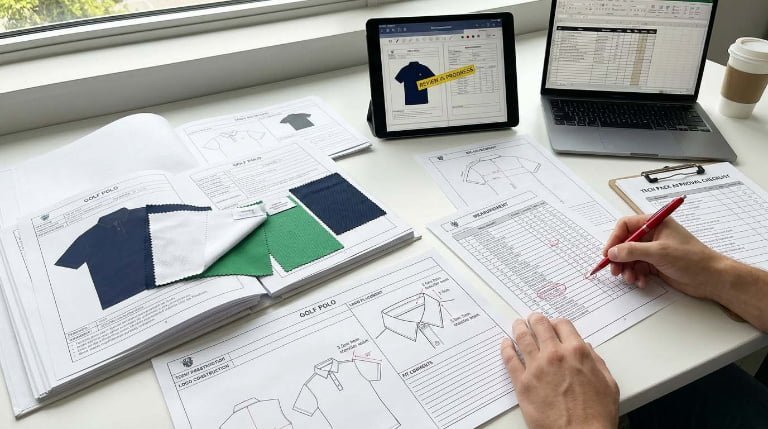
Launching a golf polo, quarter-zip, or performance layer without sampling is one of the fastest ways to lose time and money. A tech pack can define measurements, trims, and construction details, but it cannot fully confirm fit across sizes, fabric behavior after washing, color accuracy, or decoration performance in bulk production.
The golf apparel sampling process protects your launch timeline by validating the product before you commit to bulk inventory. In most cases, brands spend $500–$2,000 on samples to avoid $10,000+ in production mistakes, delivery delays, or unsellable stock.
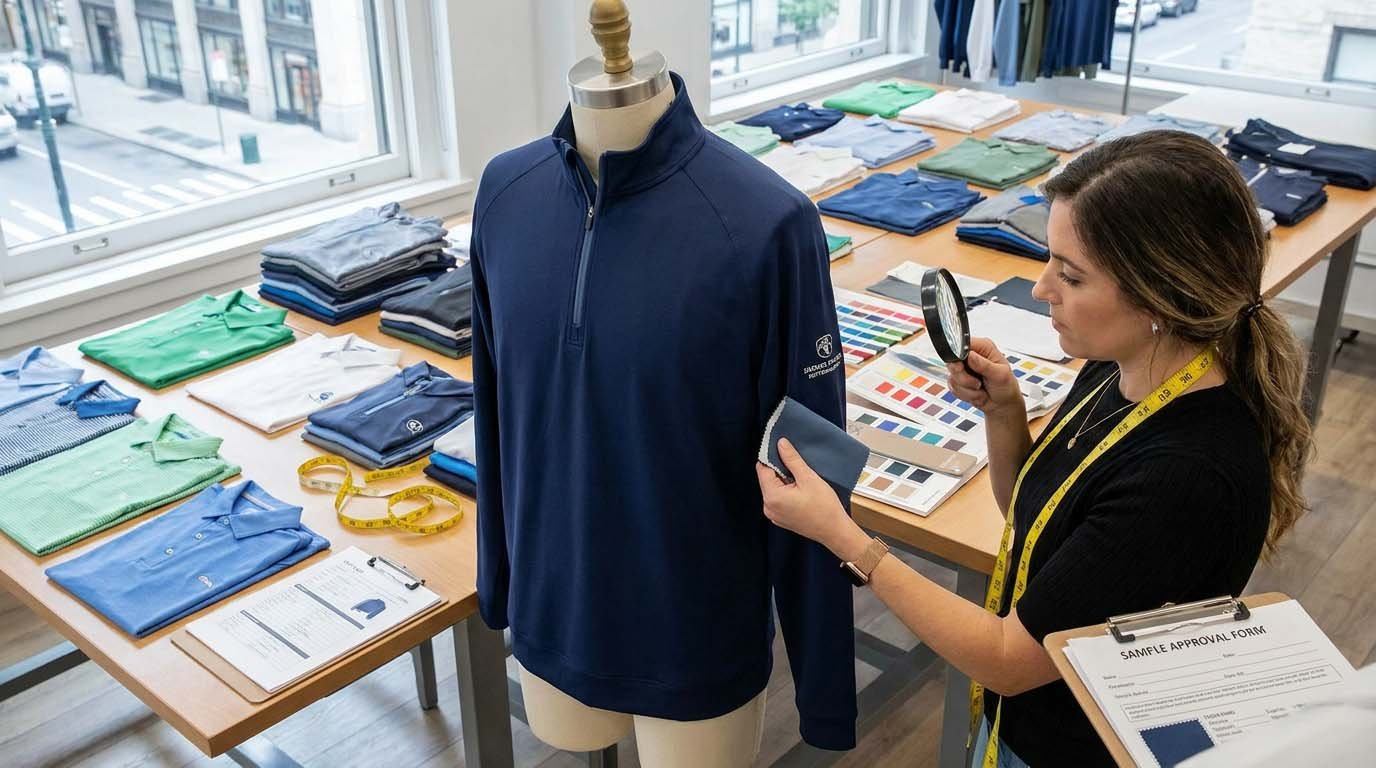
If you are sourcing custom golf shirts, private label golf polos, or a new golf apparel collection, this guide explains:
- what each sample type means
- how much golf apparel sampling costs
- how long sampling takes
- how many rounds you should budget for
- how to approve fit, color, and decoration correctly
- how to avoid delays before bulk production
Quick Answer: What Is the Golf Apparel Sampling Process?
The golf apparel sampling process is the step-by-step approval workflow used to confirm a garment before bulk production begins.
In most projects, the process looks like this:
- Approve the tech pack
- Develop a proto sample
- Review lab dips, knitdowns, or strike-offs if needed
- Check a size set sample for grading and fit consistency
- Approve a pre-production (PP) sample
- Start bulk production
- Review a TOP sample if required
Most golf apparel programs need 2–3 sample rounds, and the full sampling stage usually takes 15–45 days depending on fabric availability, color development, and decoration complexity.
Sampling is one stage in the broader brand-factory workflow. For the complete process from initial concept and product briefing through sampling, bulk production, delivery, and reorder, see our How Golf Apparel Brands Work With Manufacturers From Idea to Delivery.
Why Sampling Matters Before Bulk Production
Sampling is not only about approving how a golf shirt looks. It is about confirming how it performs.
Before you place a bulk order, sampling helps verify:
- fit consistency across sizes
- stretch and recovery during movement
- collar behavior during a golf swing
- fabric shrinkage after washing
- moisture-wicking or performance finish quality
- logo embroidery, print, or heat-transfer durability
- color accuracy under daylight and retail lighting
- construction quality before 500–1,000 pieces are cut
A golf polo may look correct in a flat sketch and still fail in wear. For example:
- the collar may collapse during shoulder rotation
- sleeve openings may ride up during play
- body length may become too short after wash
- chest embroidery may pucker lightweight fabric
- print placement may distort when the shirt stretches
That is why sampling reduces production risk instead of adding unnecessary time.
Golf Apparel Sampling Process in 5 Steps
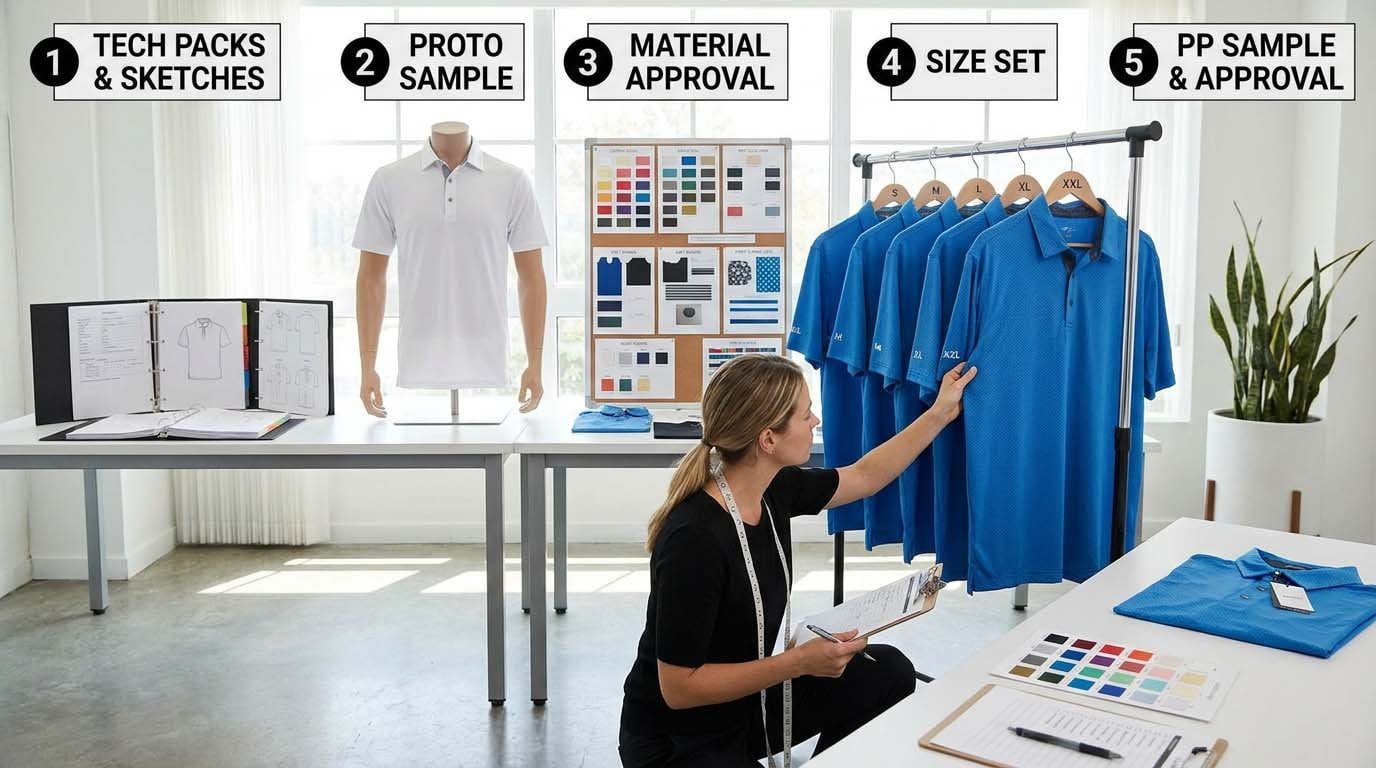
1. Confirm the Tech Pack
The tech pack gives the factory the initial instructions for:
- garment measurements
- construction details
- seam types
- fabric composition
- trim requirements
- artwork placement
- color references
- packaging notes
A strong tech pack speeds up sampling, but it does not replace sampling.
2. Make the Proto Sample
A proto sample checks whether the design works in real form. It is used to review:
- silhouette
- feature placement
- basic fit
- construction direction
- early decoration issues
Proto samples usually use stock or similar fabrics, not always the final bulk material.
3. Approve Material Development
If your style uses custom color, knit structure, or print, the factory may send:
- lab dips for color approval
- knitdowns for fabric structure and hand feel
- strike-offs for print testing
These approvals should happen as early as possible to avoid delays later.
4. Review Size Set Samples
A size set checks whether your grading works across multiple sizes such as S, M, L, XL, and XXL.
This is where brands often catch:
- chest grading issues
- incorrect body length increase between sizes
- sleeve length imbalance
- shoulder width problems
- poor fit in larger sizes even if the medium fits well
5. Approve the PP Sample
The pre-production (PP) sample is the final sample before bulk production. It should use:
- actual bulk fabric
- approved trims
- approved color
- final decoration method
- final construction details
Once the PP sample is approved, it becomes the production reference.
Types of Apparel Samples Explained
Different sample types answer different questions. If you skip the wrong stage, you may not discover problems until bulk production is already underway.
| Sample Type | Main Purpose | Materials Used | Typical Cost | When You Need It |
|---|---|---|---|---|
| Proto Sample | Confirm design concept and basic fit | Stock or similar fabrics | $80–$150 | New styles and first development round |
| SMS Sample | Sales presentation or buyer review | Approved or near-final materials | $150–$250 | Trade shows, pre-orders, retailer meetings |
| Size Set Sample | Validate grading and fit across sizes | Approved fabrics if available | $400–$1,200 | New size charts or multiple size ranges |
| PP Sample | Final approval before bulk production | Actual bulk materials and trims | $200–$300 | Every production order |
| TOP Sample | Check first bulk piece during production | Bulk materials | Usually included | Larger or higher-risk orders |
Proto Sample
A proto sample asks:
Does this design work in three dimensions?
It is the stage to fix:
- collar shape
- placket proportions
- pocket placement
- zipper length
- hem shape
- panel line balance
- construction feasibility
SMS Sample
An SMS sample or salesman sample is mainly for:
- buyer presentations
- line reviews
- trade shows
- wholesale sales meetings
- pre-launch photography
Direct-to-consumer brands sometimes skip SMS and spend that budget on fit or PP sampling instead.
Size Set Sample
A size set asks:
Does the garment fit correctly across the full size range?
A medium sample alone cannot confirm whether your XL or XXL will still fit properly.
PP Sample
A pre-production sample asks:
Can the factory reproduce the approved garment using actual production materials?
This is the most important approval before bulk cutting begins.
TOP Sample
A TOP sample or top-of-production sample confirms the first garments coming off the bulk line match your approved standard.
Proto vs PP Sample: What Is the Difference?
Many buyers confuse the proto sample and the PP sample, but they serve different purposes.
| Item | Proto Sample | PP Sample |
|---|---|---|
| Main Goal | Confirm design and fit concept | Confirm production readiness |
| Fabric | Similar or stock fabric | Actual bulk fabric |
| Trims | Temporary or substitute trims | Final approved trims |
| Decoration | Test version | Final approved execution |
| Timing | Early development | Right before production |
| Risk Controlled | Design errors | Bulk execution errors |
Proto samples prove you are making the right product.
PP samples prove the factory can make it correctly at production standard.
How Much Does Golf Apparel Sampling Cost?
The cost of golf apparel sampling depends on fabric sourcing, complexity, and how many rounds are required.
Typical sample cost ranges
| Sampling Item | Typical Cost |
|---|---|
| Proto sample | $80–$150 |
| SMS sample | $150–$250 |
| PP sample | $200–$300 |
| Size set | $400–$1,200 |
| Lab dip | $30–$50 each |
| Knitdown | $50–$150 each |
| Strike-off | $30–$80 each |
Budget guideline
For most projects:
- simple golf polo: $500–$800
- performance style with custom fabric or multiple decorations: $1,200–$2,000
- material approvals: add $300–$500
These costs may feel high for a first order, but they are usually far lower than the cost of replacing bulk inventory.
How Long Does the Golf Apparel Sampling Process Take?
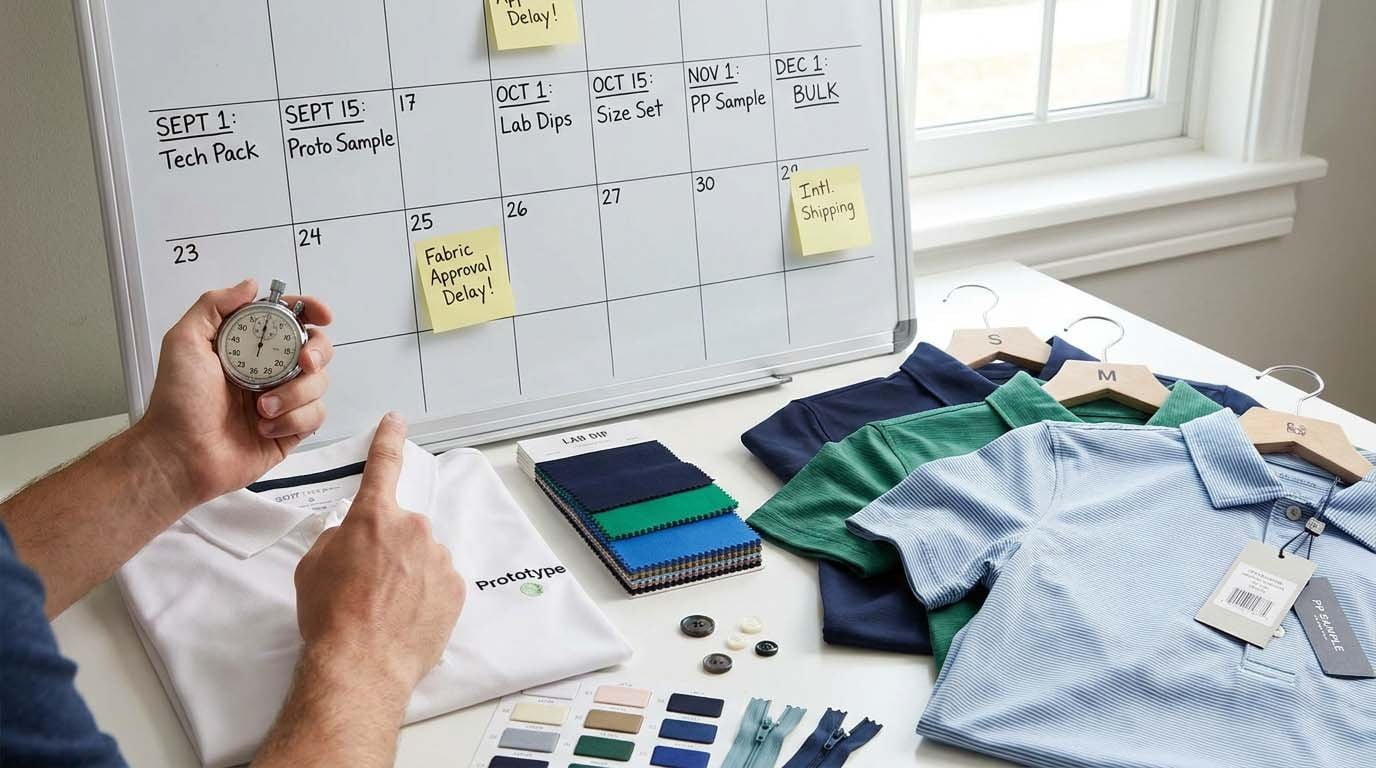
The total sampling timeline is usually 15–45 days.
Typical timeline by stage
| Stage | Typical Time |
|---|---|
| Tech pack review | 2–5 days |
| Proto sample development | 10–15 days |
| Lab dips / knitdowns / strike-offs | 7–10 days per round |
| Size set development | 7–14 days |
| PP sample development | 10–15 days |
| Client review and comments | 2–7 days |
What affects sample lead time?
The biggest factors are:
- fabric availability
- custom dyeing
- decoration complexity
- revision rounds
- delayed client feedback
- trim sourcing
- international shipping time
In most cases, fabric approval causes more delay than sewing the sample itself.
How Lab Dips, Knitdowns, and Strike-Offs Prevent Expensive Mistakes
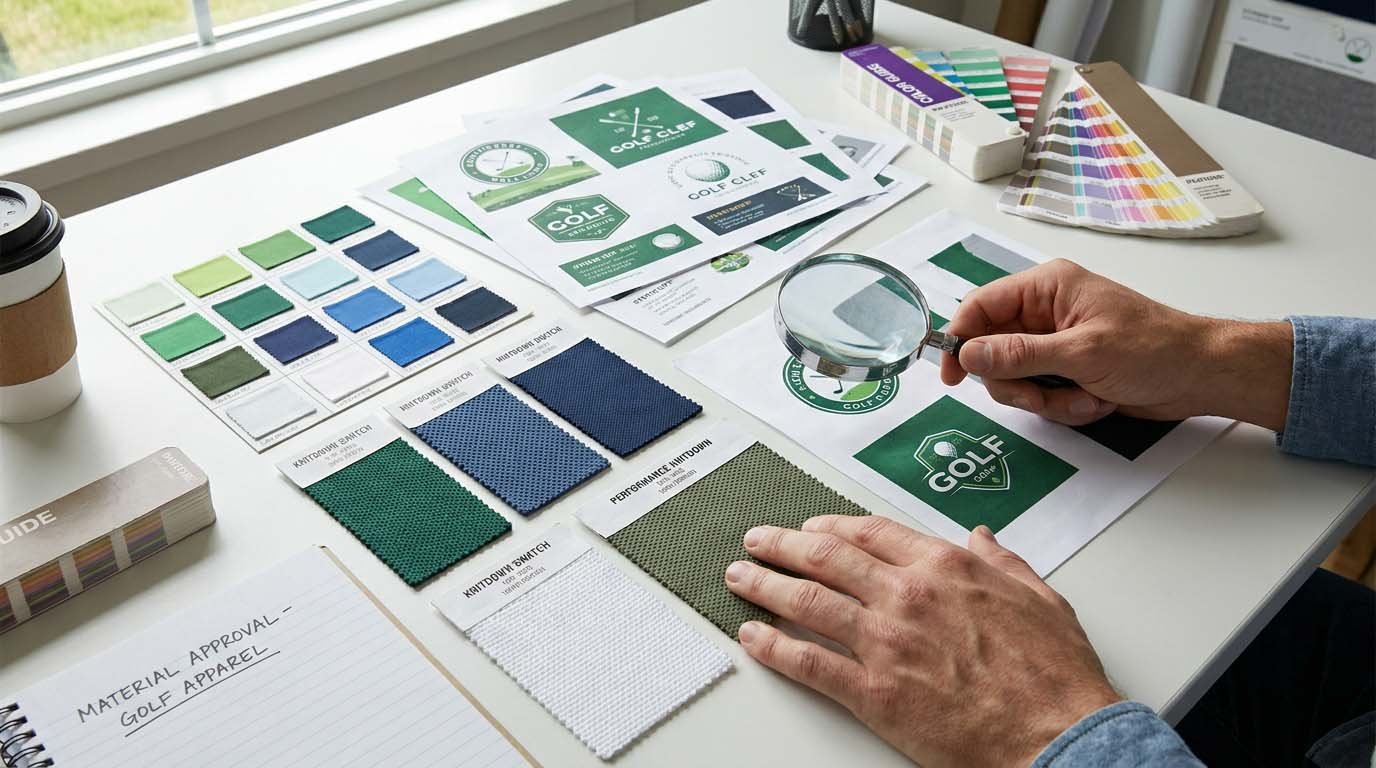
Garment samples are only part of the approval process. Material approvals are equally important.
Lab Dips
A lab dip is a small dyed swatch used to approve color before bulk fabric dyeing.
Lab dips help confirm:
- Pantone matching
- shade accuracy
- color under different lighting
- dye formula on a specific fabric base
Knitdowns
A knitdown is a fabric development swatch used to confirm:
- knit structure
- fabric weight
- stretch level
- hand feel
- surface texture
- performance finish compatibility
This matters for golf polos because pique, jersey, interlock, and performance knit structures all behave differently.
Strike-Offs
A strike-off is a print sample used to check:
- color accuracy
- line sharpness
- graphic detail
- print reaction on actual fabric
- bleed, migration, or texture issues
If you use printed branding, event graphics, or all-over patterns, strike-offs are important before production.
Best practice
Whenever possible, approve these materials before or alongside proto development. This can reduce your total lead time because the factory can move fabric planning forward earlier.
Why Size Set Samples Matter for Golf Apparel Fit
A golf shirt must perform in motion, not only on a hanger.
Size set samples are essential because a good medium does not guarantee a good full size range.
During size set review, check:
- chest width by size
- shoulder grading
- body length changes
- sleeve opening balance
- collar proportion by size
- placket scaling
- hem drop consistency
- movement comfort during swing
If your target customer is an athletic golfer, your grading may need different increments than a relaxed or casual lifestyle fit.
Skipping size set approval can create serious sell-through problems. A style may fit well in M and L but fail in S or XXL, leaving part of your inventory difficult to sell.
For women's golf skorts, size-set testing should also verify outer-skirt length, rear coverage, and liner movement across sizes. Our golf skort length guide for apparel brands explains how to define these measurements and validate fit before bulk production.
Why You Need a POM Sheet for Fit Approval
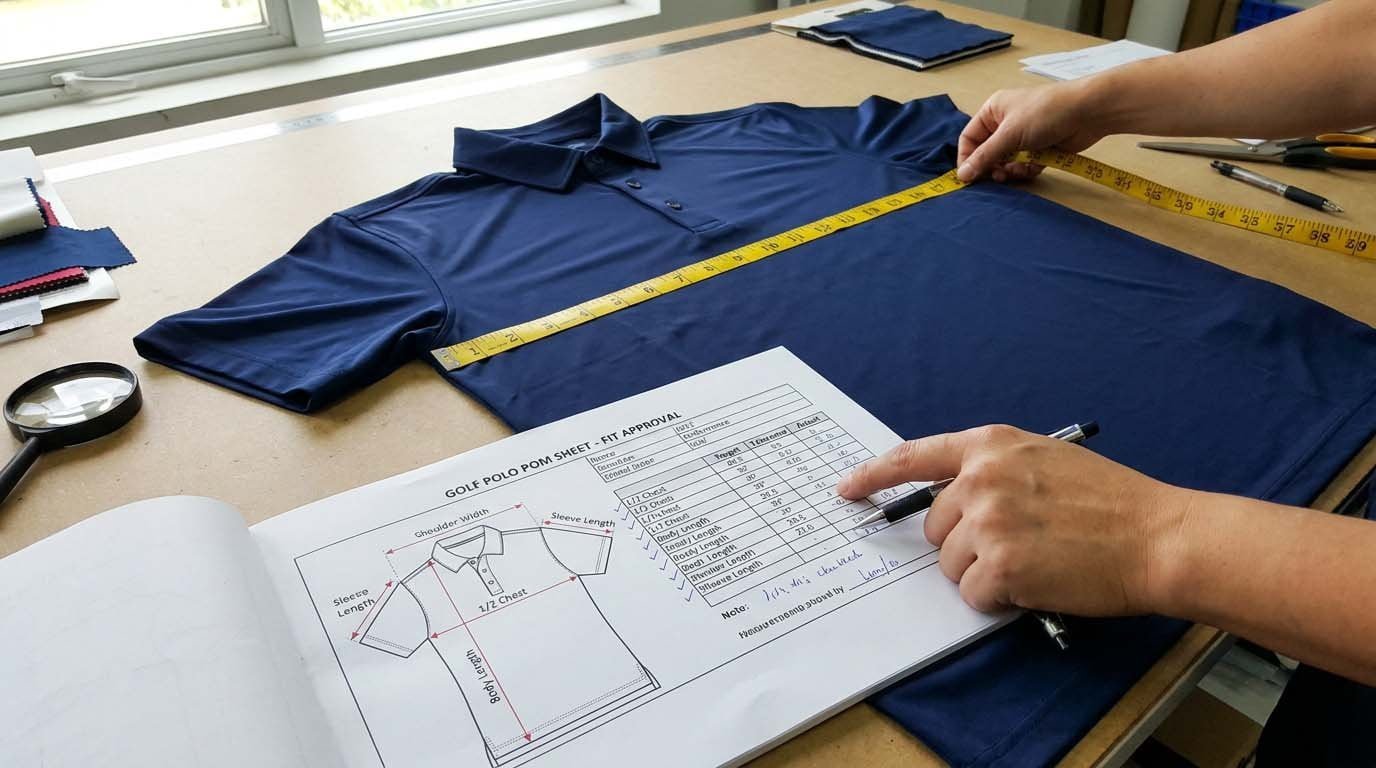
A sample photo shows how a garment looks on one person. A POM sheet shows how the factory must measure every piece.
POM means Point of Measurement. It should define:
- target measurement
- tolerance
- measuring method
- reference sample size
Typical golf polo POMs include:
- 1/2 chest
- shoulder width
- body length
- sleeve length
- sleeve opening
- collar height
- placket length
- bottom opening
Why tolerances matter
No cut-and-sew production run is mathematically identical. Every bulk order needs acceptable tolerance ranges.
Common examples:
- body measurements: ±0.5 inch
- detail placement: ±0.25 inch
Without approved tolerances, bulk quality disputes become much harder to resolve.
Decoration Sampling: Embroidery, Printing, Heat Transfer, and Bonded Details
If your golf apparel includes logos or technical details, decoration should be tested during sampling, not left for bulk production.
Common decoration risks
| Decoration Method | Bulk Risk | What to Test During Sampling |
|---|---|---|
| Embroidery | puckering, distortion, stiffness | stitch density, backing type, logo size |
| Screen Printing | cracking, fading, poor adhesion | wash durability, color sharpness, ink behavior |
| Heat Transfer | peeling, stiffness, reduced breathability | peel strength, stretch recovery, comfort |
| Bonded Seams | delamination, edge visibility, reduced stretch | seam strength, wash performance, mobility |
| Sublimation | color shift, seam mismatch | panel alignment, final color accuracy |
Decoration review checklist
When reviewing decorated samples, ask:
- Does the logo distort the fabric?
- Does the print crack after wash testing?
- Is placement correct on body, not only flat?
- Does the decoration interfere with stretch or breathability?
- Does it remain stable after repeated wear and laundry?
For lightweight performance golf polos, even a chest embroidery that looks correct in a mockup can create visible puckering if stitch density is too high.
How to Review a Golf Apparel Sample Correctly
When a sample arrives, do not just decide whether you “like it.” Review it systematically.
Sample review checklist
Fit
- Is body length correct for tuck-in use?
- Does the hem stay in place during movement?
- Are sleeve openings comfortable during rotation?
- Does the collar stay clean during wear?
Measurements
- Do actual measurements match the POM sheet?
- Are tolerances realistic and approved?
- Are grading increments correct?
Fabric
- Does the fabric weight match expectations?
- Is stretch and recovery acceptable?
- Is moisture management or finish performing as expected?
Color
- Does the color match the approved standard?
- Have you checked it under daylight and indoor lighting?
Decoration
- Is the logo sharp and correctly placed?
- Does embroidery pucker the base fabric?
- Does print remain flexible?
Construction
- Are seams clean?
- Is placket construction balanced?
- Are labels, trims, and finishing details correct?
Wear and Wash
- Has the sample been washed?
- Did shrinkage, twisting, or fading appear?
- Did the decoration degrade?
How Many Sample Rounds Should You Budget For?
Most golf apparel projects need 2–3 sample rounds.
Typical sample round planning
-
Round 1: Proto sample
Confirm design direction and basic fit -
Round 2: Size set or revised proto
Confirm grading and key corrections -
Round 3: PP sample
Confirm final production standard
When 4–5 rounds may be needed
You may need more rounds if the project includes:
- custom-developed fabric
- multiple decoration methods
- revised size chart
- unusual collar or placket construction
- bonded or welded details
- complex printing
- frequent late-stage changes from the buyer
A realistic sample plan prevents last-minute schedule pressure.
Common Golf Apparel Sampling Mistakes
These are the most common mistakes that delay launches or damage margins:
1. Treating sampling as optional
Skipping sampling does not remove risk. It shifts risk from a small development budget to a large inventory commitment.
2. Approving by photos only
Photos do not replace:
- measurements
- wear testing
- wash testing
- decoration review
- fabric hand feel
3. Ignoring size set approvals
A good medium is not enough for a multi-size launch.
4. Approving color under the wrong lighting
Always review color in:
- natural daylight
- retail store lighting
- office lighting if relevant
5. Giving vague comments
Feedback like “looks off” or “please improve” slows development.
Use comments such as:
- increase sleeve length by 1 inch
- reduce embroidery density
- move logo down 0.5 inch
- raise collar stand by 0.25 inch
6. Starting production without a sealed sample
The sealed PP sample is your reference for bulk quality.
How Comments, TNA Plans, and Sealed Samples Keep the Project on Schedule
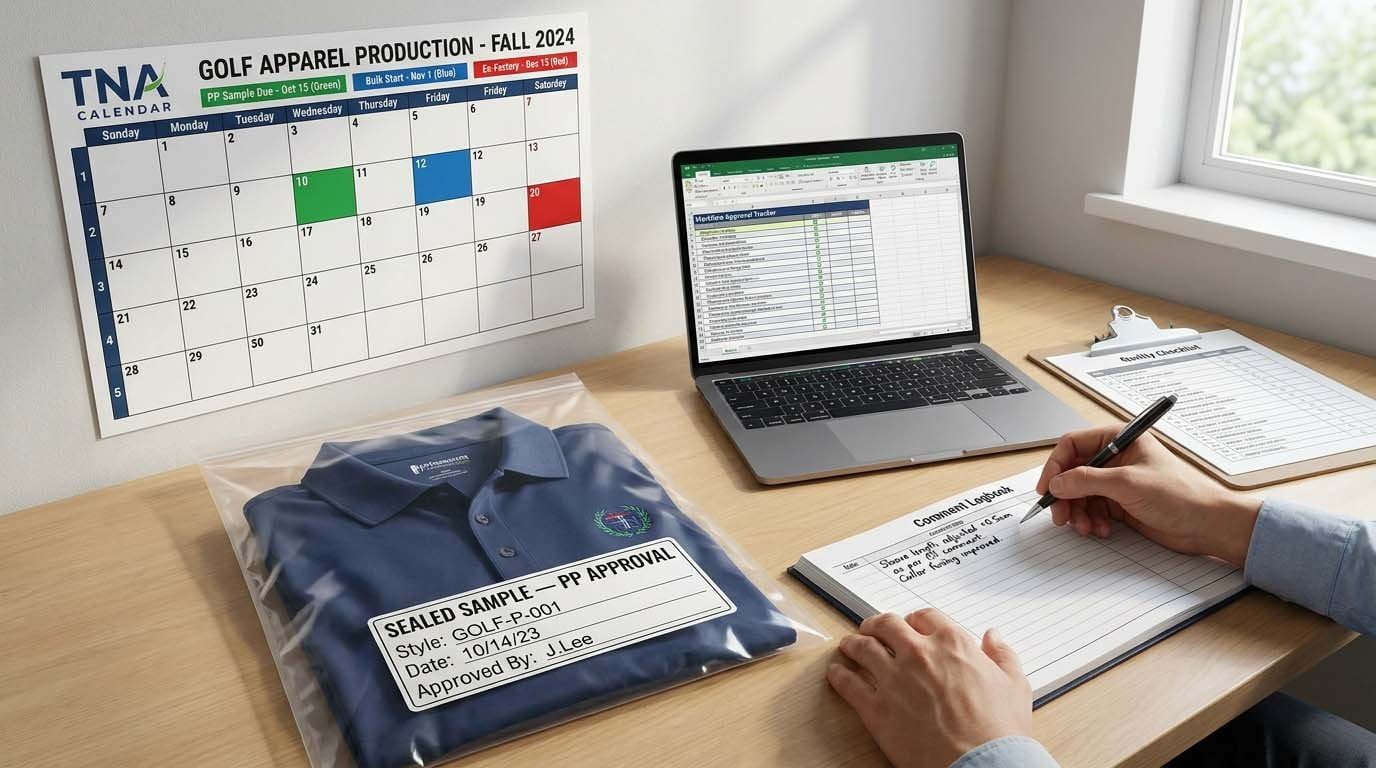
A well-run sample program needs more than a garment. It needs a process.
Comment logs
Each sample round should clearly record:
- what is approved
- what must change
- what still needs confirmation
- when comments were sent
TNA calendar
A TNA (Time and Action) calendar should include:
- sample send date
- sample arrival date
- feedback deadline
- revision due date
- material approval date
- PP approval date
- production start date
- shipment date
Sealed sample
A sealed sample is the final approved PP sample used as the bulk quality standard.
It should be stored carefully and referenced during:
- production setup
- inline inspection
- final QC
- dispute resolution if needed
Do You Need a Pilot Run?
A pilot run is a small production batch, often 50–100 pieces, made using bulk methods before the full order starts.
Pilot runs are worth considering if:
- you are using a new factory
- the style has several decoration methods
- the order value is high
- the construction is technically demanding
- quality failure would be very expensive
For simpler golf polo orders, a strong PP sample and TOP review are often enough.
Golf Apparel Sampling FAQ
Do I have to pay for samples?
Yes. Most factories charge separately for sample development because sampling requires pattern work, sourcing, cutting, sewing, and revision time. Some factories credit part of the cost back if you place a bulk order above MOQ.
Can I skip sampling and use only a tech pack?
Usually no. A tech pack defines the product on paper, but it cannot fully validate fit, fabric behavior, color, decoration, or production execution.
How many sample rounds do I need?
Most styles need 2–3 rounds. Complex styles may need 4–5.
Do I need to sample every colorway?
Not always. You can often approve fit and construction on one color, then approve other colorways through lab dips. But if artwork or decoration changes, each variation may need separate review.
What happens if the bulk order looks different from the approved sample?
This usually happens when fabric lots, trims, or construction methods change between sample stage and production. To reduce this risk, confirm that the PP sample uses the actual approved materials and request a TOP sample when needed.
What is the difference between a proto sample and a PP sample?
A proto sample tests design and fit direction. A PP sample confirms the final production version using bulk materials and trims.
How much should I budget for golf apparel sampling?
For most small launches, budget $500–$800 for basic sampling. For more complex styles, budget $1,200–$2,000, plus material approval costs.
How long does apparel sampling take?
Sampling usually takes 15–45 days, depending on revisions, fabric development, and shipping time.
Final Takeaway
The golf apparel sampling process protects your launch timeline by catching problems before they become bulk production losses.
A solid sample process helps you confirm:
- design feasibility
- fit and grading
- fabric performance
- color approval
- decoration quality
- production readiness
If you are developing a new golf polo, quarter-zip, or private label golf apparel style, sampling is not an avoidable cost. It is part of quality control, timeline protection, and inventory risk management.
In simple terms: spend hundreds on sampling so you do not lose thousands in bulk production mistakes.