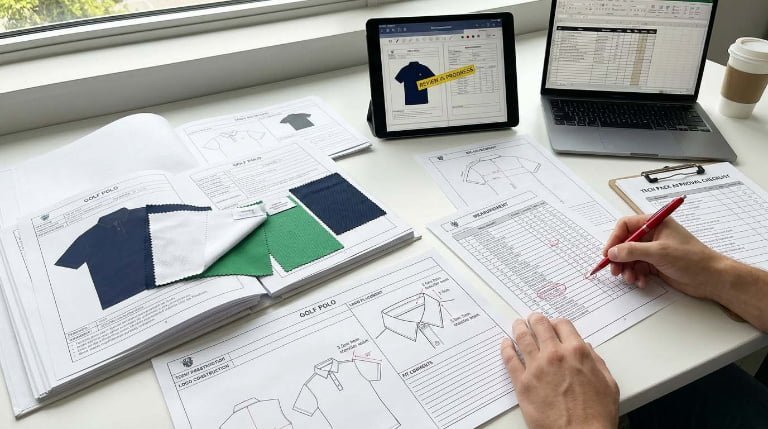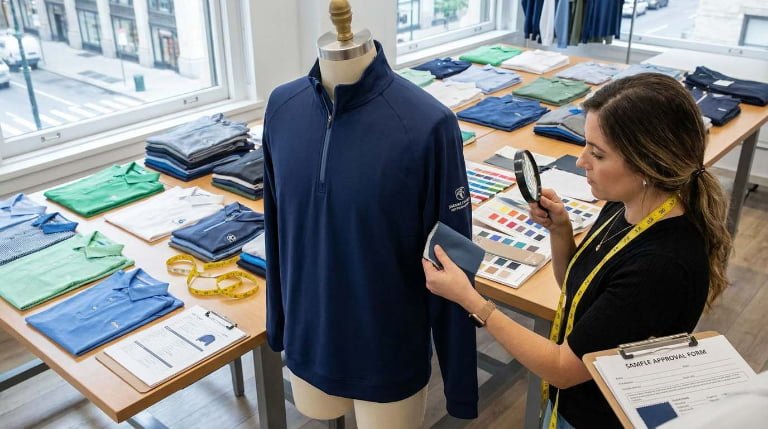
A golf apparel idea may begin with a sketch, mood board, reference garment, or product concept. But a design only becomes manufacturable when the brand and factory turn that idea into clear decisions about fit, fabric, construction, branding, quantity, quality, and delivery.
Golf apparel brands work with manufacturers through shared stages: defining the product, preparing specifications, selecting materials, reviewing samples, approving production standards, managing bulk production, inspecting finished garments, and arranging delivery.
The manufacturer manages execution; the brand manages decisions and approvals. Successful projects depend on keeping those handoffs clear from idea to delivery.
The best projects are not simply handed from the brand to the factory. They are managed as a collaboration with clear responsibilities on both sides.

This guide focuses on how brands and manufacturers work together, rather than explaining every technical operation inside the factory.
Quick Answer: How Does a Golf Apparel Brand Work With a Manufacturer?
A typical project follows this sequence:
Idea → Product Brief → Technical Development → Fabric & Trim Approval → Sampling → Production Approval → Bulk Production → QC → Delivery → Reorder
The brand controls product direction, fit expectations, branding, approvals, quantity, and launch timing.
The manufacturer translates those requirements into fabrics, patterns, samples, production methods, quality controls, and finished garments.
Brand vs Manufacturer Responsibilities at a Glance
| Stage | Brand Responsibility | Manufacturer Responsibility | Main Goal |
|---|---|---|---|
| Product Concept | Define product, customer and positioning | Review feasibility | Turn the idea into a workable project |
| Technical Brief | Confirm fit, features, branding and quantities | Convert requirements into production specifications | Reduce uncertainty |
| Fabric & Trims | Approve feel, performance and appearance | Source suitable materials and components | Match product expectations |
| Sampling | Review fit, appearance and function | Make and revise samples | Establish the approved standard |
| Production Approval | Freeze specifications and quantities | Prepare materials and production planning | Prevent late changes |
| Bulk Production | Respond quickly to questions | Manufacture to approved specifications | Maintain consistency |
| Quality Control | Define acceptance expectations | Inspect production and finished garments | Catch issues before shipment |
| Delivery | Confirm shipping requirements | Pack and prepare shipment | Deliver the approved order |
| Reorder | Provide sales and fit feedback | Reproduce the approved product | Build repeatable production |
The key point is that neither side controls the project alone.
Step 1: How Does a Golf Apparel Idea Become a Factory-Ready Product Brief?
A manufacturer cannot accurately develop a garment from inspiration alone.
A mockup shows appearance, but it may not explain:
- fabric,
- fit,
- measurements,
- construction,
- logo method,
- labels,
- packaging,
- quantity,
- or delivery timing.
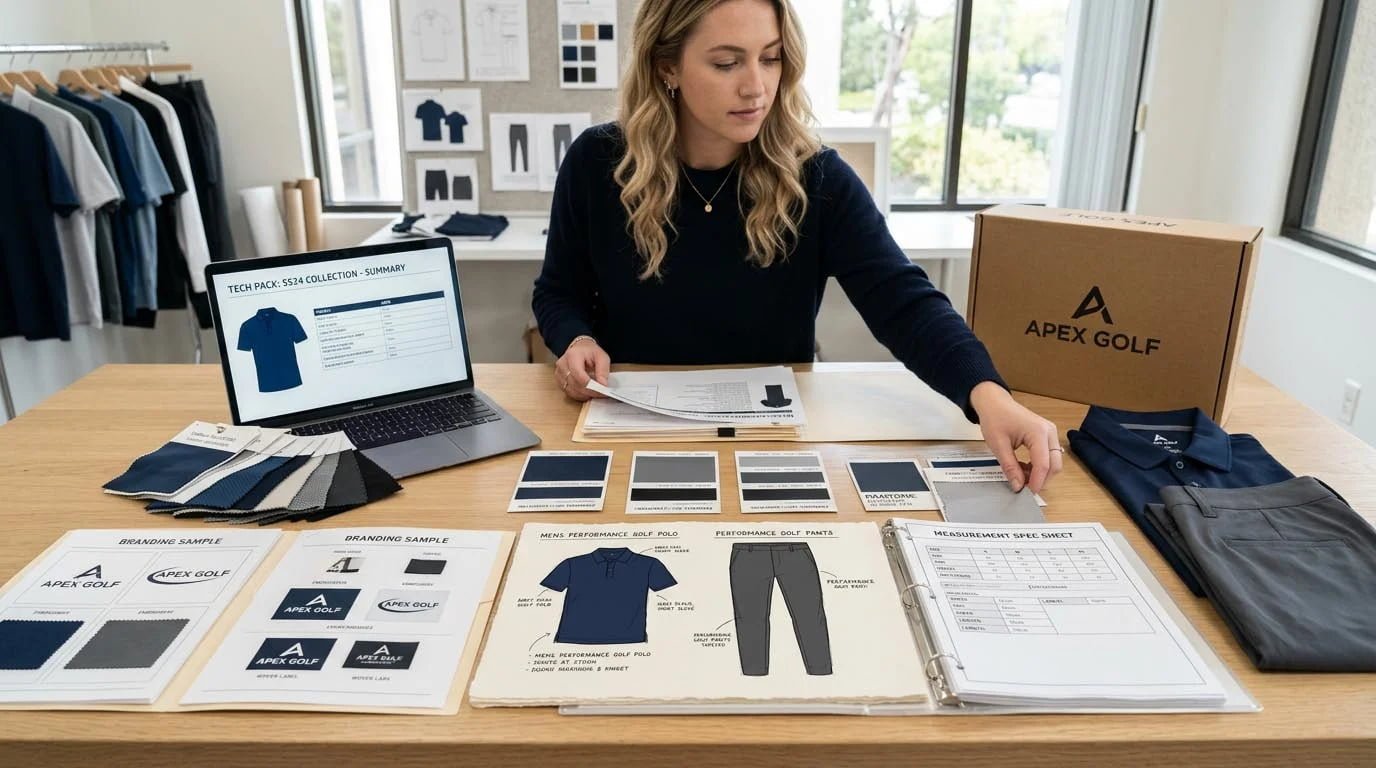
Before requesting a final quotation, the brand should convert the idea into a structured product brief.
What Should the Brand Define First?
| Decision | Example Questions |
|---|---|
| Product | Polo, shorts, pants, skort, quarter-zip or jacket? |
| Customer | Men's, women's, junior or teamwear? |
| Fit | Regular, athletic, relaxed or custom? |
| Fabric | Lightweight, structured, stretch or moisture-management? |
| Branding | Embroidery, print, heat transfer or another method? |
| Quantity | What is the expected first production volume? |
| Packaging | Standard or private-label packaging? |
| Timing | When does the collection need to launch? |
These decisions are usually organized into a golf apparel tech pack, specification sheet, reference sample, or structured development brief.
A complete engineering package helps, but a brand does not need every technical detail finalized before contacting a manufacturer. An experienced OEM or ODM factory can also help convert a clear concept into production-ready specifications.
For deeper customization, FUWAY's Private Label service supports branding and product development for golf apparel projects.
Step 2: How Should a Brand Choose the Right Golf Apparel Manufacturer?
The cheapest factory is not automatically the right factory.
The right manufacturing partner should match your product type, order quantity, customization requirements, quality expectations, and growth plans.
Evaluate Manufacturer Fit Before Price
Brands should compare manufacturers across:
- golf apparel experience,
- product specialization,
- MOQ suitability,
- customization capability,
- fabric sourcing,
- sampling support,
- quality control,
- communication,
- scalability,
- and reorder consistency.
A supplier focused on basic promotional polos may not suit a brand developing custom-fit performance golf clothing. Likewise, a factory designed only for very large programs may not be practical for a startup.
Good Manufacturers Ask Questions
A capable factory may ask:
- What fabric feel are you targeting?
- Is there a reference garment?
- What fit do you want?
- How will the logo be applied?
- How many colors and sizes are planned?
- Is the launch date fixed?
- Do you expect repeat orders?
Good questions reduce assumptions before development starts.
Step 3: How Do Brands and Manufacturers Work Together on Fabric and Trims?
Once the product direction is clear, the next collaboration point is material selection.
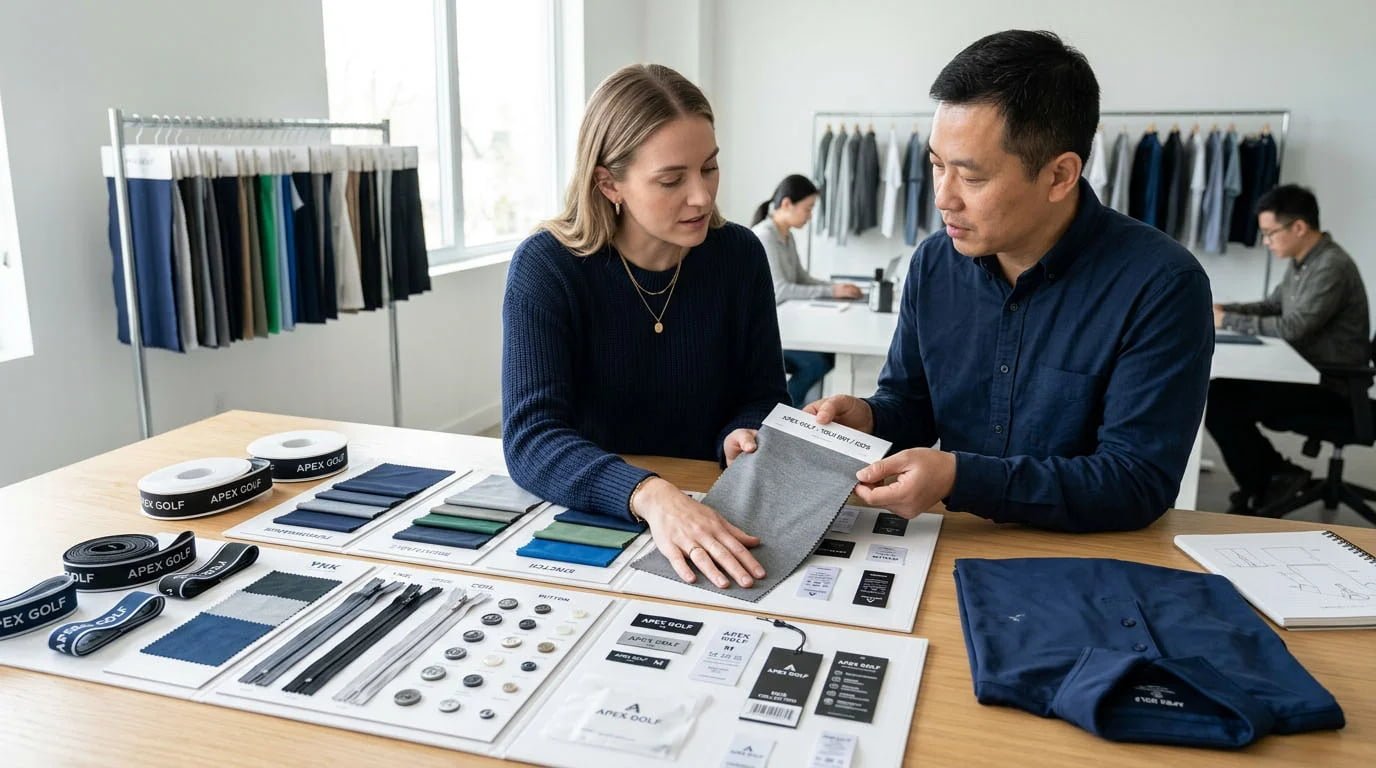
The brand defines the desired performance, appearance, feel, and market positioning. The manufacturer then recommends fabrics and trims that can realistically meet those expectations.
Start With Performance Requirements
Instead of simply asking for "polyester golf fabric," explain what the garment needs to achieve:
- lightweight feel,
- stretch during the swing,
- moisture management,
- soft hand feel,
- structured appearance,
- durability,
- breathability,
- or easy-care performance.
The manufacturer can then recommend suitable constructions and available materials.
Brands developing custom textiles can learn more about FUWAY's Fabric Sourcing capabilities.
Trims Also Matter
Important components may include:
- buttons,
- zippers,
- drawcords,
- elastic waistbands,
- woven labels,
- care labels,
- heat-transfer labels,
- hangtags,
- and packaging.
The goal is to agree on what the finished garment should look and feel like before repeated sampling becomes expensive or slow.
Step 4: How Does Sampling Work Between a Brand and Manufacturer?
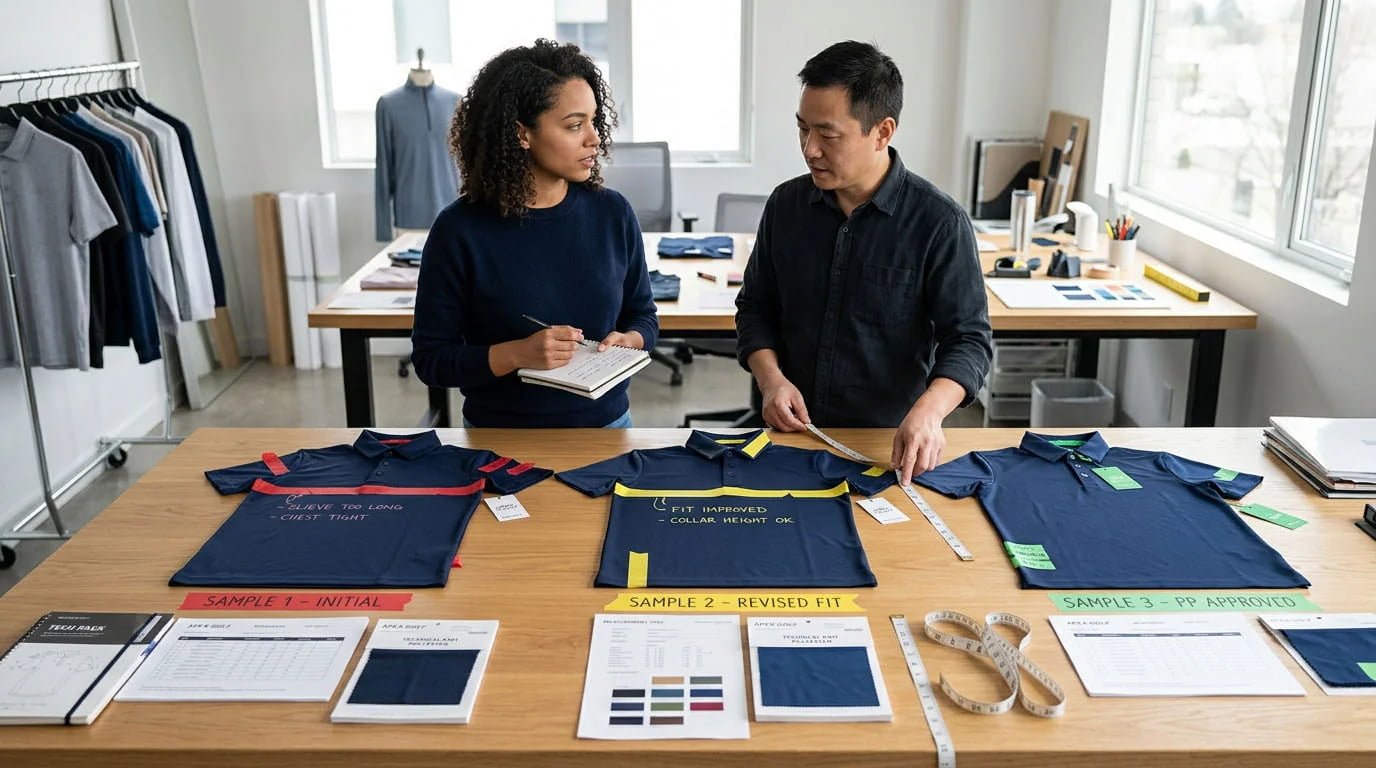
Sampling turns digital decisions into a physical garment.
A simple development flow may look like:
Initial Sample → Fit / Revision Sample → Approved Pre-Production Sample
For a deeper look at sample types, revision stages, and approval points, see our Golf Apparel Sampling Process guide.
Not every project needs the same number of rounds. Complexity depends on the product, material, pattern, decoration, and customization level.
What Should the Brand Review?
The brand should check:
- silhouette,
- garment measurements,
- movement and comfort,
- collar appearance,
- sleeve proportion,
- waistband or bottom fit,
- fabric feel,
- logo position,
- trims,
- workmanship,
- and overall balance.
Feedback should be specific.
Instead of:
The fit feels wrong.
Use:
Increase chest width slightly while keeping shoulder width unchanged.
Clear feedback gives the factory something measurable to correct.
What Should the Manufacturer Do?
The manufacturer should:
- document revisions,
- update specifications,
- explain technical limitations,
- flag changes affecting cost or production,
- and produce the next sample against agreed comments.
Sampling should reduce uncertainty, not become an endless redesign process.
Step 5: When Should the Brand Approve the Product for Bulk Production?
Bulk production should begin only after the major product decisions are frozen.
Before approval, confirm:
- final fabric,
- colors,
- measurements,
- size range,
- artwork,
- logo placement,
- trims,
- labels,
- packaging,
- quantities,
- and quality requirements.
The approved sample becomes an important reference for production.
Why Late Changes Cause Problems
Changes to fabric, color, measurement, logo size, trims, or packaging after production preparation begins can affect both cost and timing.
A useful rule is:
Development is flexible before approval. Production should become controlled after approval.
Step 6: What Happens During Bulk Production?
Once the product is approved, the relationship changes.
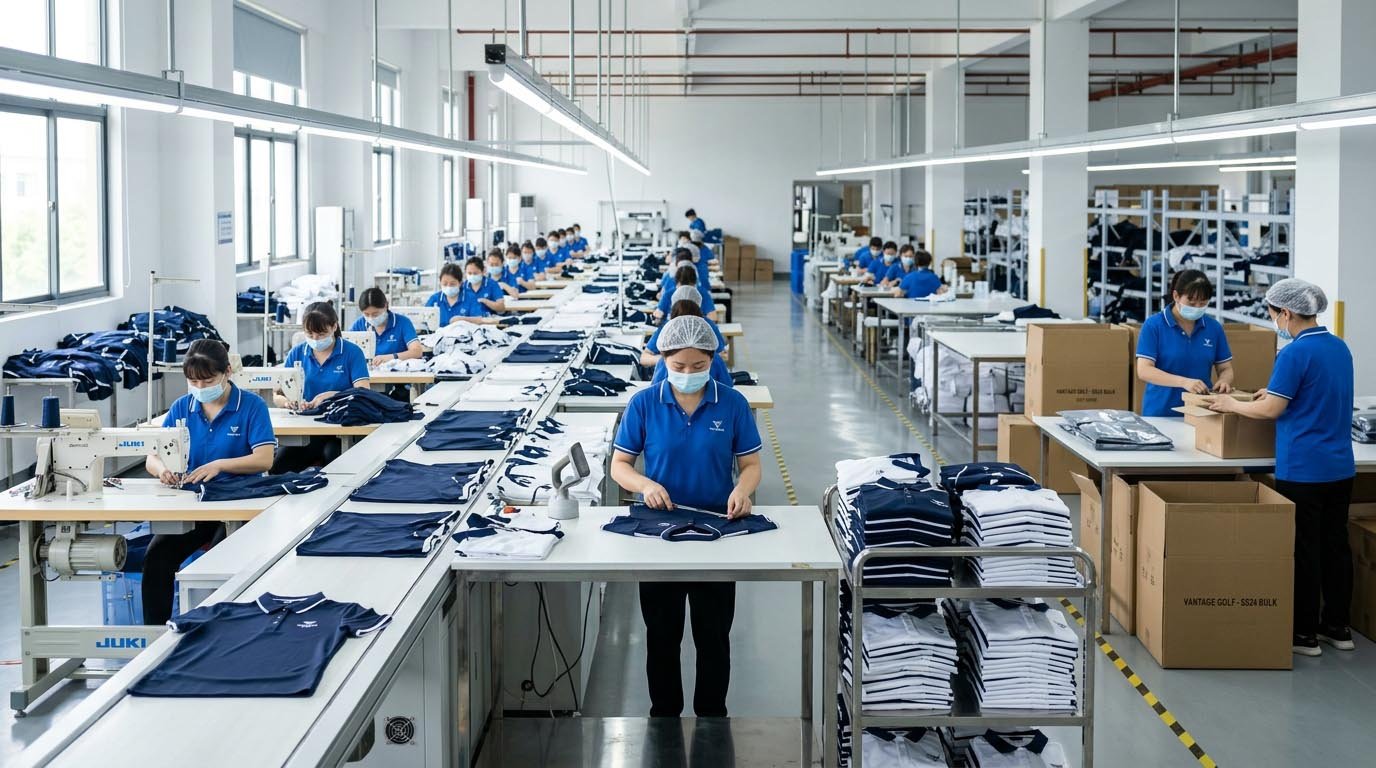
The brand should focus on communication, approvals, and commercial timing. The manufacturer's role is to reproduce the approved standard consistently.
The Brand's Role During Production
The brand should:
- answer questions quickly,
- avoid unnecessary changes,
- monitor key milestones,
- confirm packaging and shipping details,
- and prepare for launch.
The Manufacturer's Role During Production
The factory manages:
- material preparation,
- cutting,
- sewing,
- decoration,
- finishing,
- production checks,
- final inspection,
- and packing.
This article does not go deeply into those factory operations. For a closer look at how approved specifications move through sampling and production, see our OEM Golf Polo Manufacturer: From Tech Pack to Bulk Production guide.
The main handoff is:
The brand manages the approved standard. The manufacturer manages execution against that standard.
Step 7: How Should Brands and Manufacturers Manage Quality Control?
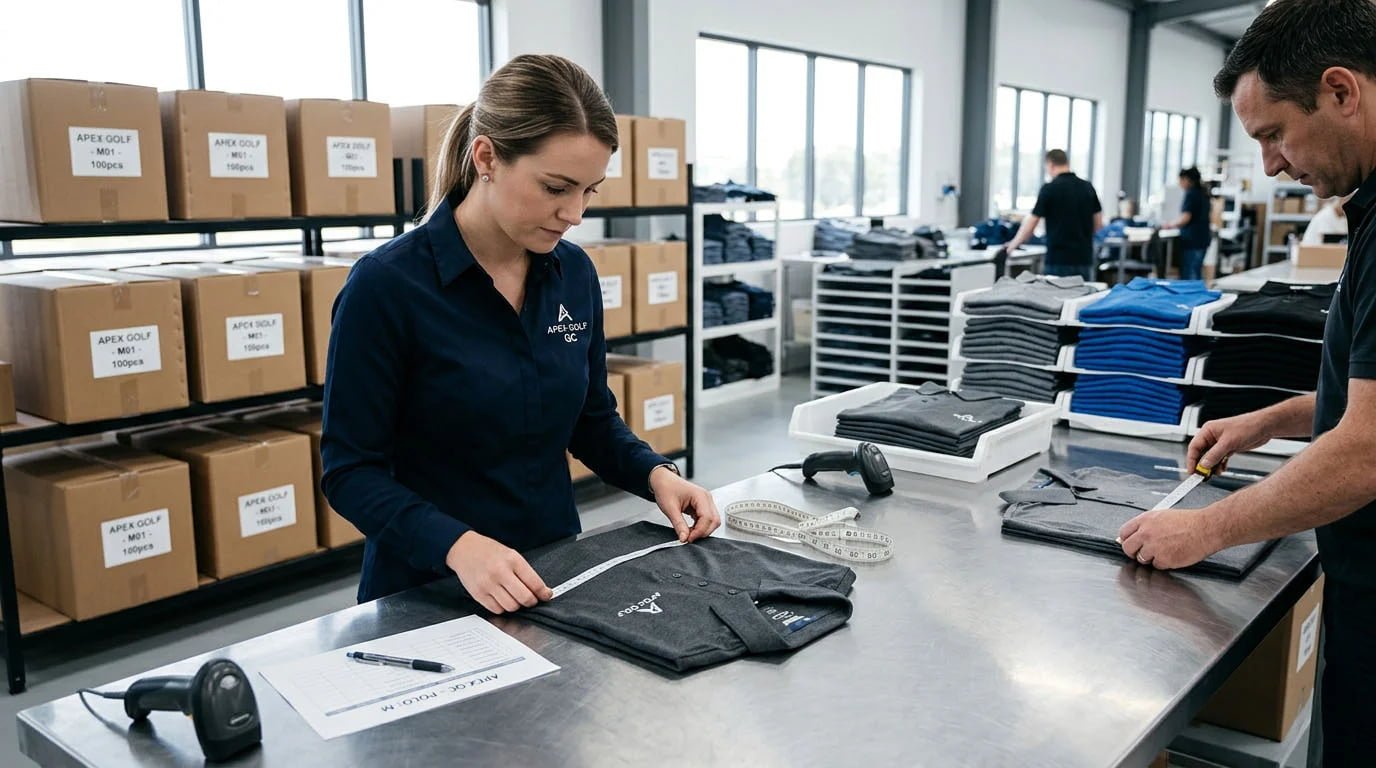
An approved sample does not eliminate the need for inspection.
Bulk production introduces variables such as:
- fabric lot differences,
- measurement variation,
- decoration consistency,
- color variation,
- finishing,
- and packaging errors.
Agree on Quality Expectations Before Production
Both sides should understand:
- approved measurements,
- tolerances,
- workmanship expectations,
- color standards,
- logo appearance,
- packaging standards,
- and defect acceptance criteria.
The exact inspection method may vary by project. For a deeper explanation of inspection stages, defect evaluation, and QC methodology, see our Golf Apparel Quality Control Guide.
For deeper verification, FUWAY also provides Test Reports and applicable quality documentation.
QC Is a Shared Risk-Control Process
The manufacturer performs production and inspection.
The brand must make its expectations clear enough to inspect against.
Documented standards reduce disputes and give both sides the same reference point.
Step 8: How Do Packaging, Shipping, and Delivery Work?
Production is not complete when garments leave the sewing line.
The order still needs to be:
- finished,
- inspected,
- folded,
- labeled,
- packed,
- cartonized,
- and prepared for shipment.
Packaging and shipping requirements should be confirmed early enough to avoid last-minute delays.
Delivery Is a Shared Responsibility
The manufacturer controls factory scheduling, but the brand also affects timing through:
- sample approvals,
- artwork confirmation,
- label approval,
- quantity confirmation,
- packaging decisions,
- and shipping instructions.
Good delivery planning depends on both sides keeping decisions moving.
Step 9: What Happens After the First Delivery?
The first order should not be treated as the end of the manufacturing relationship.
For growing golf brands, the real objective is usually:
repeatable production
After delivery, the brand should review:
- customer feedback,
- fit comments,
- product returns,
- fabric performance,
- sell-through,
- size distribution,
- and reorder demand.
The manufacturer should preserve approved production information so future orders can reproduce the same product consistently.
From Sample Consistency to Reorder Consistency
A strong manufacturing relationship should create continuity across:
Approved Sample → Bulk Production → Repeat Order
The goal is not only to make one good sample. It is to make future orders match the same standard without restarting development.
Where Do Brand-Manufacturer Projects Usually Stall?
Most problems happen at the handoff between stages.
| Handoff | Typical Problem |
|---|---|
| Idea → Brief | Specifications are incomplete |
| Brief → Quote | Requirements are still changing |
| Sample → Approval | Feedback is subjective or unclear |
| Approval → Bulk | Late changes are introduced |
| Bulk → Delivery | Packaging or shipping details arrive too late |
| Delivery → Reorder | Product changes are not documented |
A good workflow is therefore more than a list of production steps.
At every handoff, both sides should know:
- what has been approved,
- what still needs a decision,
- who is responsible,
- and whether changes affect cost or timing.
What Usually Goes Wrong Between Golf Apparel Brands and Manufacturers?
Most problems come from unclear or changing decisions rather than one major production failure.
Incomplete Product Briefs
A rendering without fabric, fit, measurement, branding, or quantity information forces the manufacturer to guess.
Choosing Only by Price
The lowest quote may not come from the factory best suited to your product, quality level, or order size.
Unclear Sample Feedback
Subjective comments make revisions slower. Specific, measurable feedback works better.
Major Changes After Approval
Late changes may affect material orders, production planning, cost, and delivery.
Poor Documentation
Important approvals should be recorded so both sides know which version becomes the production standard.
How Can Emerging Golf Brands Make Manufacturing Easier?
A practical workflow is:
- Define the product and target customer.
- Prepare a structured brief.
- Choose a manufacturer suited to the project.
- Confirm fabric and customization direction.
- Develop and approve samples.
- Freeze production specifications.
- Produce and inspect against the approved standard.
- Review the first delivery before reordering.
Clear decisions at each stage make the entire project easier to manage.
FAQ: Working With a Golf Apparel Manufacturer
Do I Need a Complete Tech Pack Before Contacting a Manufacturer?
Not always.
A tech pack improves quoting and development, but some OEM/ODM manufacturers can also work from reference garments, sketches, measurements, and structured product briefs.
The goal is to reduce ambiguity before production.
Who Is Responsible for Fabric Selection?
Usually both sides.
The brand defines appearance, performance, feel, and positioning. The manufacturer recommends materials that can realistically meet those requirements.
How Many Samples Should a Golf Brand Make?
There is no universal number.
A simple style may need fewer revisions than a highly customized garment. The objective is to reach a clearly approved production standard efficiently.
Does an Approved Sample Guarantee Perfect Bulk Production?
No.
The sample establishes the reference standard, while bulk production should still be monitored and inspected.
Who Controls the Production Timeline?
Both sides.
Factory scheduling and material availability matter, but delayed approvals and late changes from the brand can also affect delivery.
Final Thoughts
Working with a golf apparel manufacturer is not simply sending a design and waiting for finished garments.
It is a sequence of shared decisions.
The brand defines and approves the product standard. The manufacturer turns that standard into materials, samples, production, inspection, and delivery.
The clearest workflow is:
Idea → Specification → Sample → Approval → Bulk Production → QC → Delivery → Reorder
When responsibilities and approvals are clear at every stage, brands reduce development risk and make future production easier to repeat.
For brands developing custom golf polos or broader golf apparel collections, FUWAY supports product development through Custom Golf Shirts, Private Label, Fabric Sourcing, and production support from concept through bulk order.
If you are preparing a new golf apparel project, you can also contact FUWAY to discuss your specifications, quantity, customization requirements, and development plan.