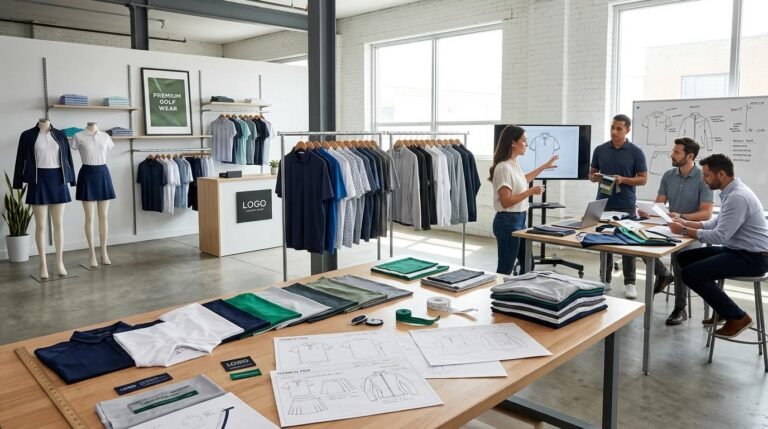
Your golf polo design looks perfect on screen. The colors look right. The pattern looks clean. The logo is exactly where you want it.
Then the factory opens the files.
The artwork does not repeat correctly. The Pantone colors are missing. The fabric specification simply says "performance polyester." The size chart has no tolerances.
Suddenly, a design that looked finished is not ready for production.
An OEM golf polo manufacturer does much more than cut and sew shirts. The factory must turn your creative concept into a production-ready product through tech pack review, artwork validation, fabric and trim sourcing, sampling, approval, bulk production, quality control, and packaging.
At FUWAY, we work with startup and growing golf brands on custom golf polo shirts and other golf apparel projects. One lesson comes up again and again:
Problems caught before sampling are cheap to fix. Problems discovered during bulk production are not.
This guide shows what actually happens after you send your tech pack to an OEM golf polo manufacturer—and how your design moves from a digital file to finished bulk production.
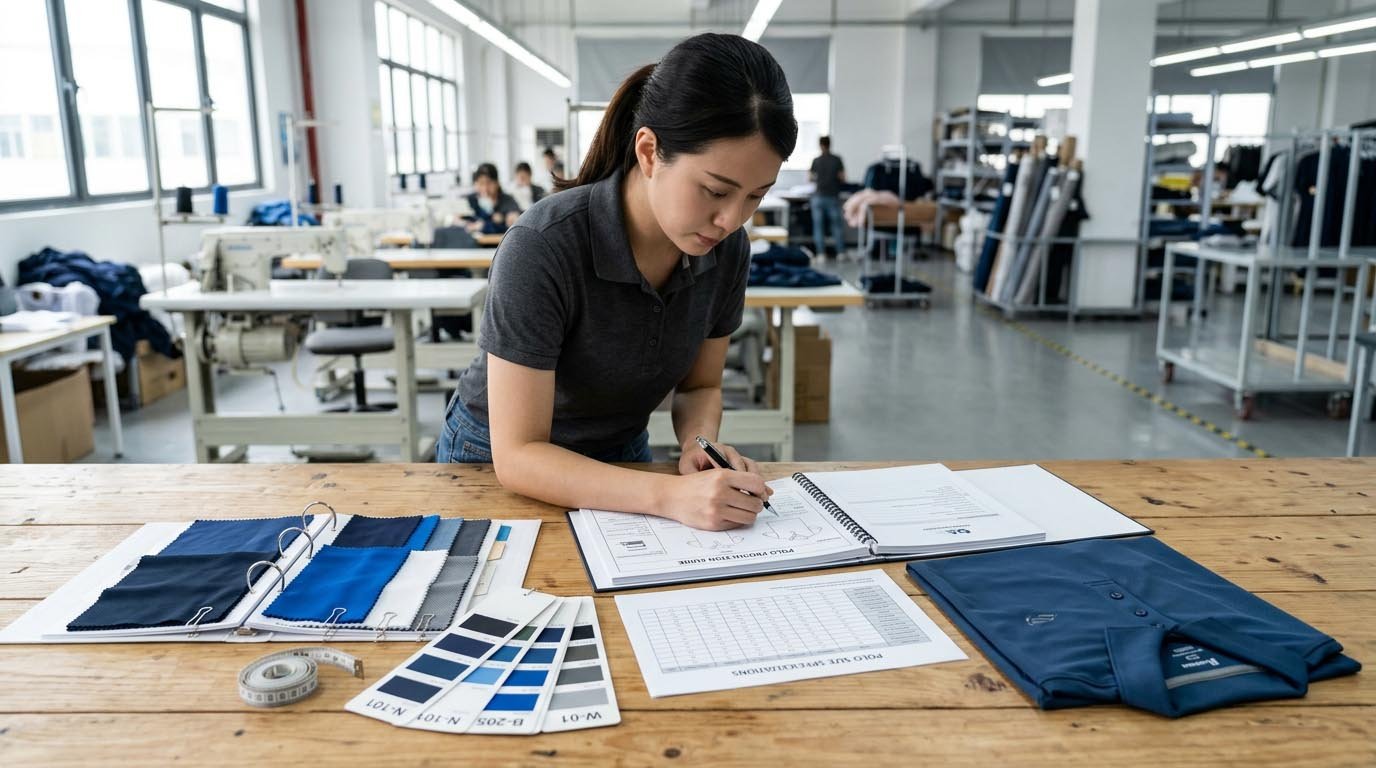
OEM Golf Polo Manufacturing Process: Quick Overview
Before getting into the technical details, here is the complete process:
| Stage | What Happens | Main Goal |
|---|---|---|
| 1. Tech Pack Review | Check measurements, artwork, colors and construction | Remove missing information |
| 2. Artwork Validation | Check logos, AOP files and seamless repeats | Make artwork production-ready |
| 3. Fabric & Trim Selection | Confirm composition, GSM, stretch, collars and trims | Match performance and brand look |
| 4. Sampling | Turn specifications into a physical garment | Test fit, fabric and construction |
| 5. Sample Approval | Record revisions and freeze final specifications | Create the bulk production standard |
| 6. Bulk Production | Cutting, printing, embroidery and sewing | Produce approved design consistently |
| 7. Quality Control | Inspect measurements, workmanship and branding | Catch defects before shipment |
| 8. Packing & Shipping | Final inspection, packing and logistics | Deliver finished inventory |
For a normal FUWAY project, sample development is typically around 7–10 business days, while bulk production is usually around 3–4 weeks after final approval, depending on materials, order quantity and design complexity.
What Does an OEM Golf Polo Manufacturer Actually Do?
OEM stands for Original Equipment Manufacturer.
In simple terms, you bring the product idea, design or specifications, and the manufacturer turns them into physical products under your brand.
But good OEM manufacturing is not simply:
Send Design → Sew Polo → Ship
The real process looks more like:
Design → Technical Review → Material Sourcing → Pattern → Artwork Preparation → Sample → Revision → Approval → Bulk → QC → Packing
For golf apparel, this process can be more technical because the product may include:
- Performance fabrics
- 4-way stretch
- Moisture-wicking finishes
- All-over sublimation prints
- Embroidery
- Heat-transfer logos
- Custom collars
- Custom plackets
- Branded buttons
- Woven labels
- Printed care labels
- Custom packaging
For brands that also need their own labels, hangtags and branded packaging, these elements become part of the broader private label golf apparel manufacturing process.
Every additional component creates another specification that must be confirmed before bulk production.
That is why an experienced OEM golf polo manufacturer should help identify manufacturing problems before they become expensive production problems.
Step 1: Is Your Golf Polo Tech Pack Production-Ready?
A tech pack is the bridge between your design and the factory.
But one of the most common misunderstandings we see is:
A beautiful tech pack is not necessarily a production-ready tech pack.
A presentation can look professional while still leaving important manufacturing questions unanswered.
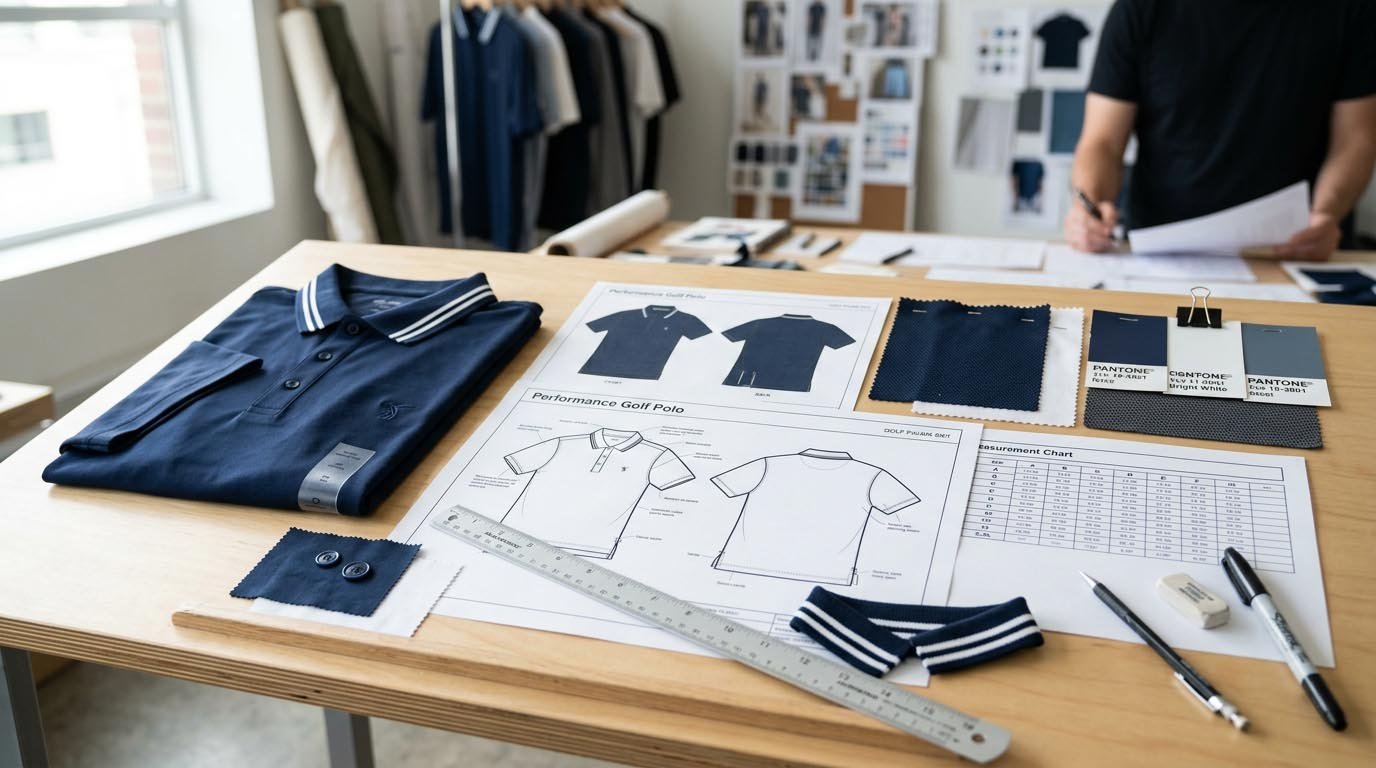
Concept File vs Production File
Imagine you send us a mockup showing:
- Front view
- Back view
- Logo position
- Pattern
- Colors
Visually, we understand your idea.
But our pattern maker still needs to know:
- What is the chest measurement?
- What is the garment length?
- How does the size grade from S to XL?
- What fabric composition do you want?
- What is the fabric weight?
- Which Pantone color should we match?
- What type of collar?
- What button size and color?
- What is the logo dimension?
- Is the artwork repeat-ready?
- What measurement tolerance is acceptable?
Without those details, the factory has to guess.
And guessing is one of the easiest ways to create sample revisions.
What Should a Golf Polo Tech Pack Include?
| Tech Pack Element | What the Factory Needs |
|---|---|
| Measurements | Point-of-measure chart |
| Size grading | Measurements across required sizes |
| Tolerances | Acceptable measurement variation |
| Fabric | Composition, GSM and performance requirements |
| Colors | Pantone references where applicable |
| Artwork | Production-quality logo or print files |
| Logo placement | Exact size and position |
| Collar | Construction and material |
| Placket | Length, construction and button details |
| Trims | Buttons, labels, tapes, zippers if applicable |
| Labels | Main label, size label, care label |
| Packaging | Polybag, hangtag, barcode or other requirements |
Creative Concept vs Factory-Ready Specification
| Element | Creative Concept | Production-Ready Information |
|---|---|---|
| Color | "Dark navy" or screen color | Pantone/textile reference |
| Fabric | "Breathable stretch fabric" | Composition + GSM + construction |
| Sizing | One visual mockup | Complete measurement chart |
| Collar | "Premium polo collar" | Collar type + construction |
| Logo | Visual placement | Dimensions + position |
| JPG/PNG concept | Print-ready artwork | |
| Packaging | "Branded packaging" | Exact packaging requirements |
You do not always need to understand every technical term before contacting a manufacturer.
A good OEM partner should help identify what information is missing.
But the more decisions you can finalize early, the fewer revisions you are likely to need later.
Step 2: How Does an OEM Factory Check Your Artwork Before Sampling?
This has become increasingly important.
Many startup brands now use AI tools, graphic designers or online design software to create golf polo patterns.
The design may look excellent on a screen.
But:
Visual artwork is not automatically textile-production artwork.
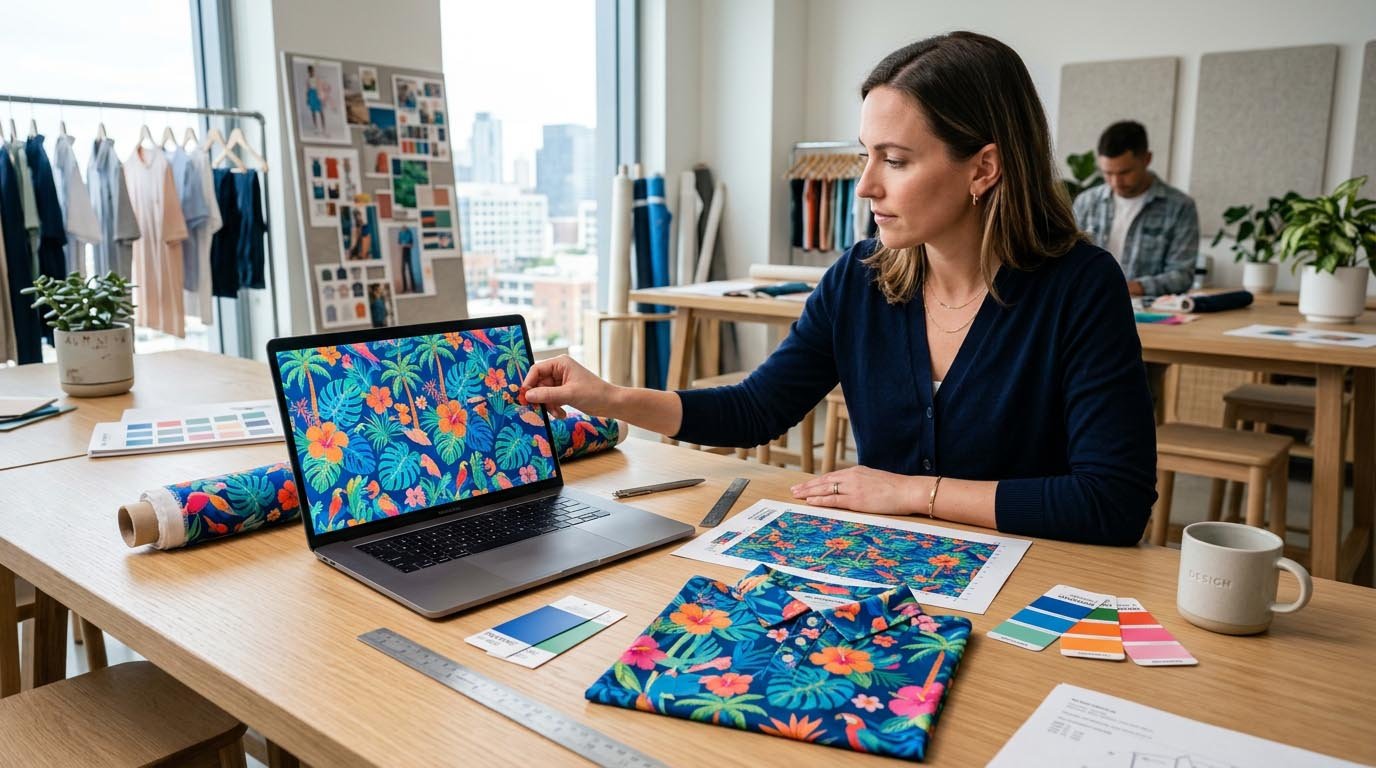
Why AI-Generated Artwork Can Cause Problems
Suppose you generate a tropical golf pattern.
On screen, it looks seamless.
But when we place the image repeatedly across a large fabric area, the left edge may not connect to the right edge.
The top may not connect to the bottom.
The result can be:
- Visible pattern breaks
- Obvious repeat lines
- Cut-off motifs
- Unnatural transitions
- Uneven pattern density
- Color differences between screen and fabric
This is especially important for all-over-print golf polos produced with sublimation printing.
What Is a Seamless Repeat?
For continuous fabric printing, the artwork often needs to repeat across a larger area without creating obvious boundaries.
Think of a tile:
One Tile → Repeat → Repeat → Repeat
The right edge must connect naturally to the left edge.
The top must connect naturally to the bottom.
If they do not match, the repeat becomes visible on the fabric.
Can FUWAY Adjust a Non-Repeating Design?
Depending on the artwork, our design team may be able to help prepare it for production.
But there is an important trade-off.
Turning a static image into a repeatable textile pattern can require:
- Moving design elements
- Adjusting spacing
- Rebuilding edges
- Changing motif scale
- Rebalancing composition
- Adjusting colors for printing
That means the final repeat may not look exactly like the original static image.
This is why we do not recommend quietly changing client artwork.
If adjustments are required, the revised artwork should go back to the brand for approval.
The brand should approve the design change before fabric printing begins.
Step 3: How Do You Choose the Right Golf Polo Fabric and Trims?
A golf polo must look good, but it also needs to perform.
Golf involves walking, bending, rotating and swinging for hours.
The fabric therefore affects:
- Comfort
- Stretch
- Breathability
- Sweat management
- Appearance
- Print quality
- Durability
- Fit
For brands that are not sure which material best fits their product, working through the fabric sourcing process before sampling can help narrow down the right composition, weight, stretch and performance characteristics.
Common Golf Polo Fabric Requirements
| Feature | Why It Matters |
|---|---|
| Moisture-wicking | Helps move sweat away from the body |
| Stretch | Supports the golf swing |
| Breathability | Improves comfort in warm conditions |
| Lightweight construction | Reduces bulk |
| UV protection | Useful for outdoor wear |
| Shape retention | Helps maintain appearance |
| Wrinkle resistance | Keeps polos looking presentable |
Common options can include polyester, polyester-spandex and other performance blends.
But fabric should not be selected only by composition.
Two fabrics with similar fiber content can feel completely different because of:
- GSM
- Knit construction
- Yarn
- Finishing
- Stretch
- Surface texture
That is why physical fabric swatches are useful during product development.
Stock Fabric vs Custom Fabric
This decision also affects your MOQ.
Stock Fabric
Using an available performance fabric can help reduce:
- MOQ
- Development time
- Fabric sourcing time
- Inventory risk
For some FUWAY projects, this can make 50–100 pieces per style workable, depending on the design and trims.
Custom Fabric
If your brand requires:
- Custom Pantone dyeing
- Proprietary composition
- Unique texture
- Special finish
- Custom jacquard
- Custom knit structure
the fabric mill may impose its own minimum.
This can increase the garment MOQ.
Don't Forget the Small Details
The identity of a polo is not created by fabric alone.
You should also confirm:
- Collar construction
- Placket
- Buttons
- Logo method
- Neck tape
- Main label
- Size label
- Care label
- Hangtag
- Packaging
A button may seem unimportant in a digital mockup.
On the physical product, customers touch it every time they wear the shirt.
Step 4: From Fabric Approval to Golf Polo Sample
Once the tech pack, artwork and basic material direction are clear, we can move into physical development.
Sampling is where digital assumptions meet reality.
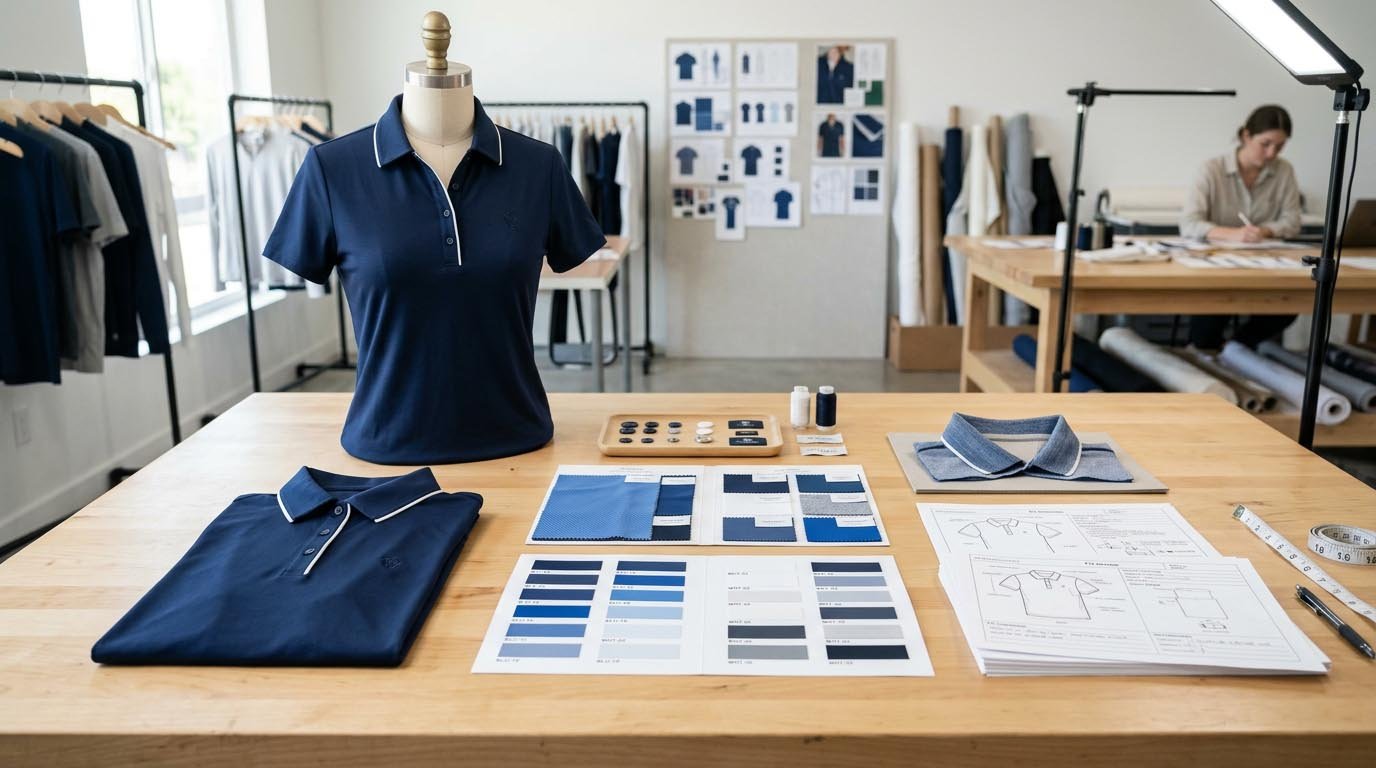
Depending on the project, the approval process can include different checkpoints.
Artwork / Color Check
For printed products, it may be useful to test the artwork on the intended fabric before moving directly into bulk.
Why?
Because a color displayed on a monitor and a color printed on performance fabric will not always look identical.
Fabric texture, fiber composition and the printing process all affect the result.
Fit Sample
The purpose of a fit sample is to answer questions such as:
- Is the chest width correct?
- Is the body too long or short?
- Is the sleeve opening comfortable?
- Does the shoulder allow movement?
- Does the collar sit correctly?
- Does the placket stay flat?
- Does the polo move naturally during a swing?
A golf polo should not only look correct while lying flat on a table.
It must work when worn.
Pre-Production Sample
For more complex projects, a final pre-production sample can become the reference for bulk manufacturing.
Ideally, it should represent the approved:
- Fabric
- Color
- Artwork
- Fit
- Collar
- Buttons
- Labels
- Logo
- Construction
- Packaging details
The goal is simple:
Everyone should know exactly what bulk production is supposed to match.
Step 5: What Must Be Approved Before Bulk Production?
One of the most expensive times to change a design is after bulk production has started.
Before cutting bulk fabric, the important decisions should be frozen.
Bulk Production Approval Checklist
Before production, confirm:
Product
- Final measurements
- Size grading
- Fit
- Fabric
- Color
- Collar
- Placket
- Buttons
Branding
- Logo
- Logo size
- Logo position
- Repeat pattern
- Main label
- Care label
- Hangtag
If your project is being developed as a complete branded collection rather than only a custom garment, this is also the stage to confirm your private label details, including labels, hangtags and packaging.
Production
- Quantity
- Size breakdown
- Color breakdown
- Packaging
- Shipping marks
- Delivery requirements
If something changes after this point, the factory may need to reorder materials, remake artwork, recut fabric or change production instructions.
That costs both time and money.
Our simple rule is:
Approve carefully. Freeze early. Produce consistently.
Step 6: How Does Golf Polo Bulk Production Work?
Once everything is approved, the project moves from development into production.
A typical FUWAY workflow may include:
Fabric Preparation → Cutting → Printing / Embroidery → Sewing → Quality Control → Finishing → Ironing → Thread Cleaning → Packing
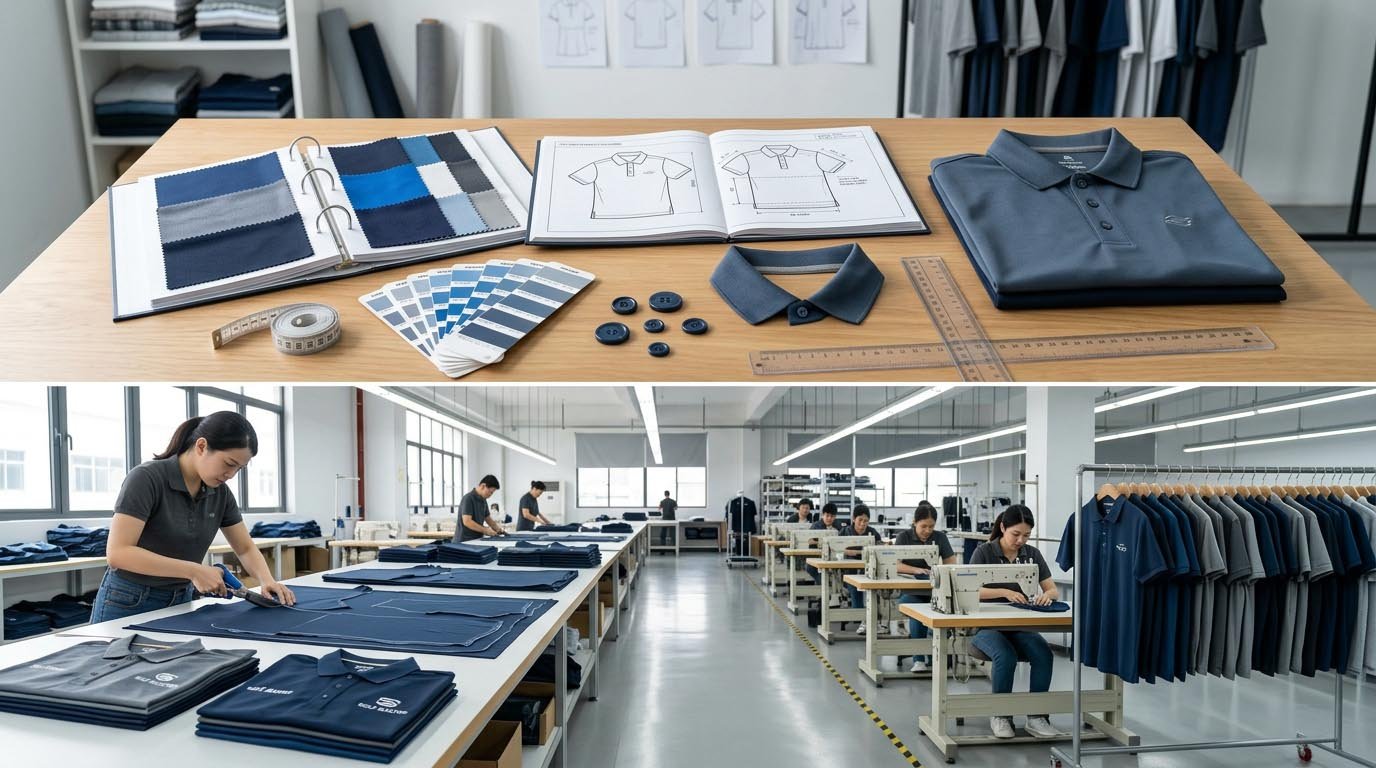
Cutting
Approved patterns are used to cut the fabric according to the required size breakdown.
Accuracy matters because small pattern errors multiply across hundreds of garments.
Printing or Embroidery
Depending on the design, branding can include:
- Sublimation printing for all-over patterns and full-color designs
- Golf polo embroidery for logos and premium branding
- Heat transfer for lightweight graphic applications
- Screen printing for suitable logo and graphic designs
- Other custom logo applications
The right method depends on the fabric, artwork, order quantity and desired appearance.
For all-over-print products, artwork preparation must already be finalized before this stage.
Sewing
The cut panels move through sewing operations.
For golf polos, attention is often required around:
- Collar
- Shoulder
- Sleeve
- Placket
- Side seams
- Hem
- Logo placement
Finishing
After sewing, garments move into finishing and inspection.
Loose threads are removed, garments are pressed where necessary, and final presentation is checked before packing.
Step 7: How Does an OEM Golf Polo Manufacturer Control Quality?
Quality control should not be one final check after every polo is already packed.
It should happen throughout production.
A simplified QC structure looks like this:
| Stage | What We Check |
|---|---|
| Incoming materials | Fabric, colors and trims |
| Pre-production | Approved specifications and artwork |
| Cutting | Pattern and size accuracy |
| Printing / Embroidery | Color, position and appearance |
| Sewing | Stitching and construction |
| In-line inspection | Batch consistency |
| Final inspection | Measurements, workmanship and appearance |
| Packing | Labels, quantities and packaging |
What Do We Check on a Finished Golf Polo?
Typical inspection points include:
- Chest measurement
- Garment length
- Sleeve length
- Collar shape
- Placket alignment
- Stitching
- Loose threads
- Logo placement
- Print quality
- Color consistency
- Labels
- Buttons
- Overall workmanship
- Packaging
The approved sample and technical specifications give the QC team a reference.
Without a clear standard, "good quality" becomes subjective.
Brands that want to review supporting quality documentation can also see our FUWAY test reports.
What MOQ Should You Expect From an OEM Golf Polo Manufacturer?
There is no universal golf polo MOQ.
It depends on the project.
At FUWAY, 100 pieces per style is a common MOQ, while some projects using available fabrics and relatively standard components may be workable around 50–100 pieces per style.
Projects requiring highly customized fabrics or trims may require higher quantities.
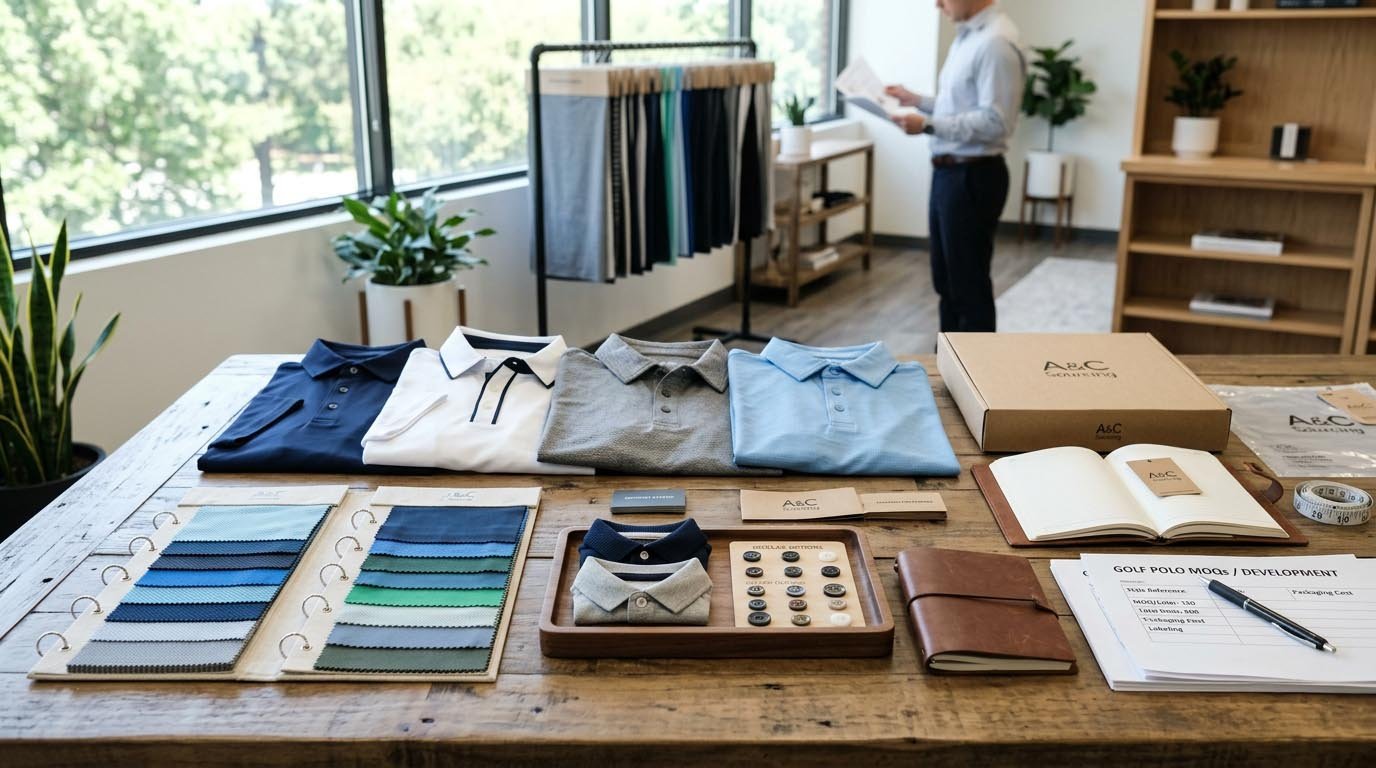
What Changes the MOQ?
- Stock vs custom fabric
- Number of colors
- Custom dyeing
- Print method
- Custom collar
- Custom buttons
- Custom trims
- Size breakdown
- Packaging
- Total quantity
Instead of asking only:
"What is your MOQ?"
ask:
"What is the MOQ for this exact design and fabric?"
That gives you a much more useful answer.
What Determines the Cost of OEM Golf Polo Production?
There is no meaningful universal price for a custom golf polo.
A simple polo and a highly customized performance polo are not the same product.
Your quotation can be affected by:
Fabric
Composition, GSM, finish and custom dyeing.
Construction
A basic polo costs less to produce than a complicated cut-and-sew design.
Printing
All-over sublimation, screen printing and other methods have different production requirements.
Embroidery
Logo size, stitch count and number of locations affect cost.
Trims
Custom collars, buttons, labels and tapes add sourcing and production requirements.
Quantity
Larger quantities generally distribute setup and development costs across more garments.
Packaging
Custom polybags, boxes, barcodes, hangtags and other packaging add cost.
The best way to receive an accurate quotation is to send the manufacturer:
Tech Pack + Artwork + Fabric Requirements + Quantity + Size Breakdown + Packaging Requirements
How Long Does OEM Golf Polo Production Take?
A realistic timeline starts before sewing.
At FUWAY, sample development is typically around 7–10 business days, depending on materials and complexity.
Bulk production is typically around 3–4 weeks after final approval, depending on the project.
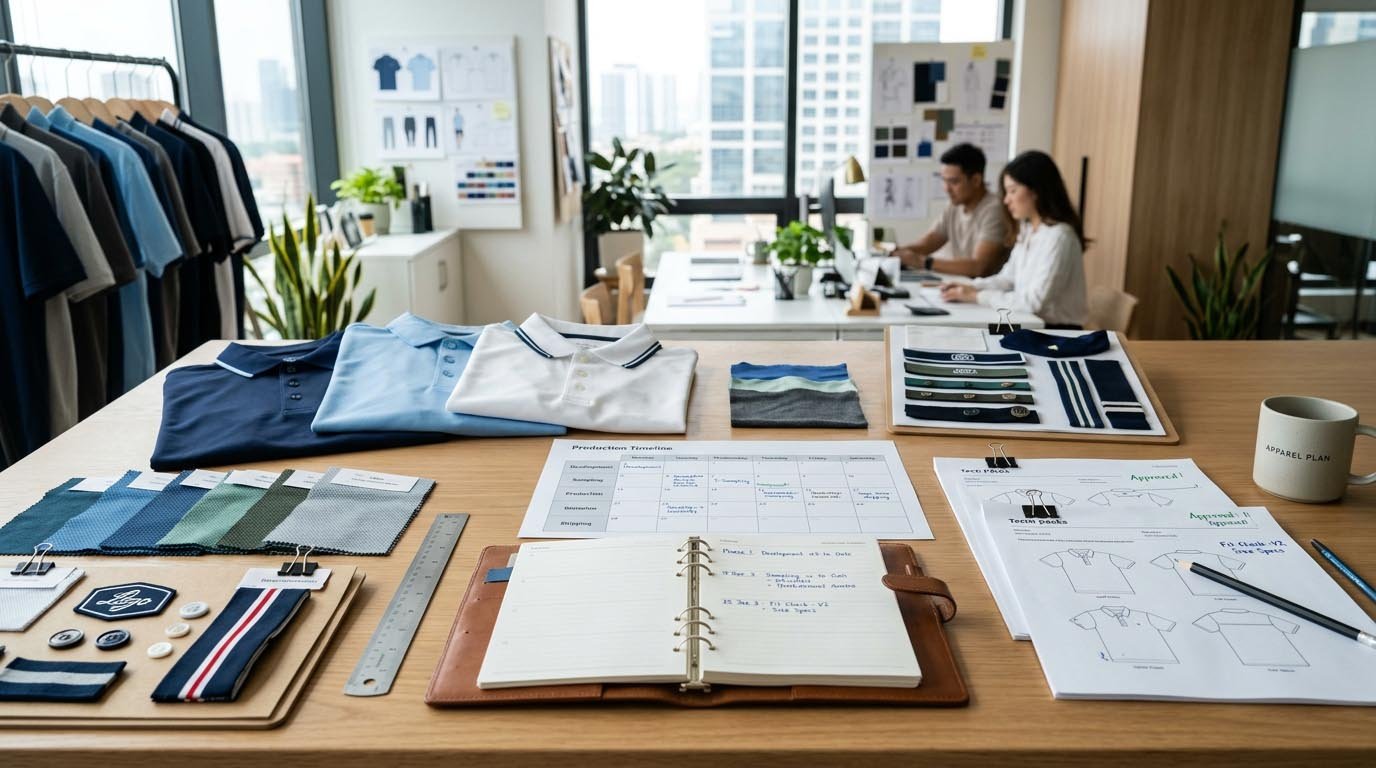
A simplified timeline is:
| Stage | Typical FUWAY Planning Reference |
|---|---|
| Tech pack review | Depends on file completeness |
| Fabric / trim confirmation | Depends on stock or custom materials |
| Sample development | Approx. 7–10 business days |
| Sample review | Client-dependent |
| Revision | Depends on changes |
| Final approval | Client-dependent |
| Bulk production | Approx. 3–4 weeks |
| Shipping | Depends on destination and method |
The biggest hidden variable is often approval time.
If a brand takes two weeks to approve a print, the project has already moved two weeks.
That is why fast communication between the brand and manufacturer matters.
Real-World Example: Why Artwork Validation Matters Before Sampling
Here is a situation we see with startup brands.
A client creates an all-over golf polo print.
The mockup looks excellent.
But when the production file is reviewed, the artwork does not repeat cleanly.
If the factory immediately prints fabric and makes a sample, the client may only discover the problem after spending time and money on that sample.
A better workflow is:
Step 1: Review the original artwork.
Step 2: Identify the repeat problem.
Step 3: Ask the client whether the artwork can be adjusted.
Step 4: Prepare the repeat-ready version.
Step 5: Send the revised artwork back for approval.
Step 6: Produce the physical sample only after approval.
The important lesson is not that every artwork file is wrong.
It is:
Validate digital assumptions before turning them into physical products.
This one habit can reduce unnecessary sample revisions and keep the project moving.
What Should You Send an OEM Golf Polo Manufacturer?
You do not need a perfect technical package before making first contact.
But the more information you provide, the more accurate the factory can be.
Ideal Information Checklist
Send:
- Tech pack
- Front and back design
- Artwork files
- Logo files
- Fabric preference
- Fabric composition if known
- Target GSM if known
- Pantone colors
- Size chart
- Target quantity
- Size breakdown
- Required labels
- Packaging requirements
- Target delivery date
- Destination country
If you do not know everything yet, say so.
An experienced OEM team should help you identify which decisions need to be made before sampling.
If your project is already at this stage, you can also contact FUWAY with your tech pack, artwork or reference product for review.
How Do You Choose the Right OEM Golf Polo Manufacturer?
Do not evaluate a manufacturer only by unit price.
Ask:
- Do they understand golf apparel?
- Can they explain your fabric options?
- Can they identify problems in your tech pack?
- Can they help prepare artwork for production?
- Do they provide sampling?
- Can they handle your required MOQ?
- What customization methods do they offer?
- How do they manage approvals?
- How do they control bulk quality?
- Can you verify the factory?
- Can they show similar products?
- How clearly do they communicate?
A good manufacturer should not simply say:
"Yes, we can do it."
They should be able to explain:
how they will do it.
FAQ: OEM Golf Polo Manufacturing
What does OEM mean for golf polo manufacturing?
OEM means the manufacturer produces golf polos based on your brand's specifications, designs and requirements. The finished garments are produced for your brand rather than the manufacturer's own retail label.
Do I need a tech pack to manufacture custom golf polos?
A detailed tech pack makes development more accurate and efficient. If your tech pack is incomplete, an experienced manufacturer may help identify missing specifications before sampling.
Can I send AI-generated artwork to a golf polo manufacturer?
Yes, but treat it as a design concept until the factory confirms that it is suitable for textile production. All-over-print artwork may need to be converted into a seamless repeat before printing.
What is the MOQ for OEM golf polos?
At FUWAY, 100 pieces per style is a common MOQ. Some projects using available fabrics and relatively standard trims may be workable around 50–100 pieces per style, while highly customized fabrics or trims can require higher quantities.
How long does a golf polo sample take?
FUWAY's typical sample development time is approximately 7–10 business days, depending on the design, fabric and trim requirements.
How long does bulk golf polo production take?
Typical FUWAY bulk production is approximately 3–4 weeks after final approval, depending on order quantity, material availability and product complexity.
Can the factory modify my artwork?
If production preparation requires artwork changes, the factory should explain the changes and obtain approval before proceeding. This is especially important for all-over prints and seamless repeats.
What should I approve before bulk production?
Confirm the final sample, measurements, fabric, colors, artwork, logo placement, labels, trims, quantity, size breakdown and packaging before bulk production begins.
From Tech Pack to Bulk Production: Final Takeaway
Successful OEM golf polo manufacturing is not about moving into bulk production as quickly as possible.
It is about removing uncertainty before bulk production begins.
A reliable workflow looks like this:
Tech Pack Review
→ Artwork Validation
→ Fabric & Trim Selection
→ Sample Development
→ Revision
→ Final Approval
→ Bulk Production
→ Quality Control
→ Packing & Shipping
The earlier you identify a problem, the easier it is to solve.
That is why we spend time reviewing specifications, artwork and materials before bulk cutting.
At FUWAY, we support golf brands with OEM/ODM golf apparel manufacturing, including custom golf polo manufacturing, fabric sourcing, pattern development, sampling, sublimation printing, embroidery, screen printing, private label manufacturing, bulk production, quality control and packaging.
If you are preparing a new golf polo collection, send us your tech pack, artwork, reference sample or design concept.
We can review the project and help you determine:
- Whether the artwork is production-ready
- Suitable fabric options
- MOQ
- Sampling requirements
- Customization methods
- Production timeline