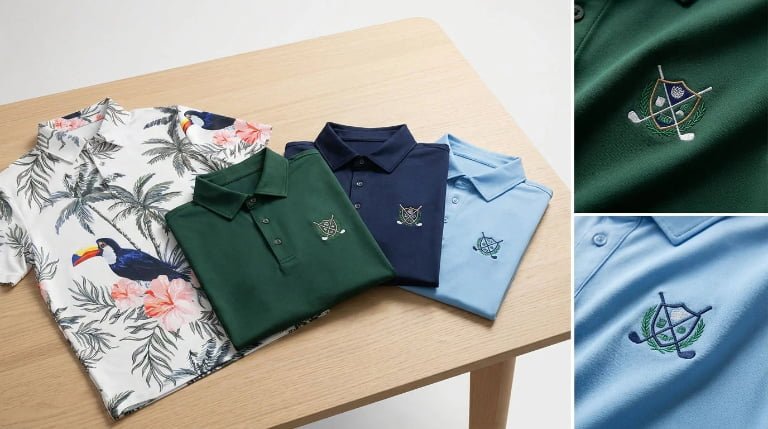
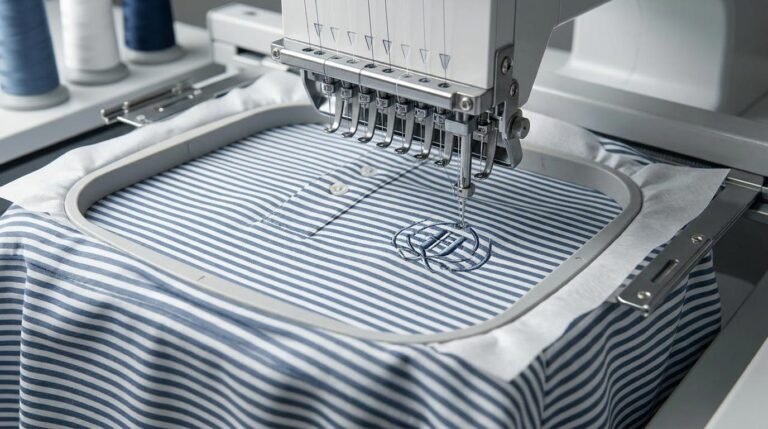
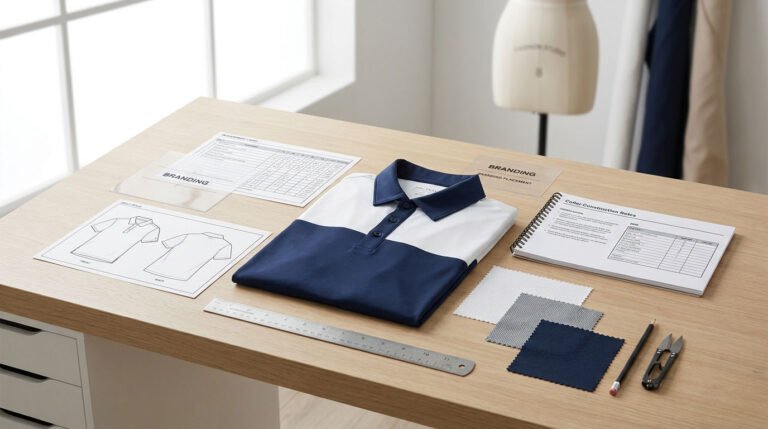
All-over print golf shirts feature graphics across much of the garment rather than a single chest or back logo. For polyester performance polos, dye sublimation is a common production route: the design is transferred onto suitable fabric before the garment is assembled.
For brands developing sublimated golf polos, the key decisions are fabric suitability, repeat or placement artwork, panel layout, size-specific scaling, and physical sample approval. A digital mockup shows the design direction; it does not confirm print color, seam alignment, or finished fit.
This guide focuses on turning an all-over design into a production-ready golf polo.
Is Sublimation Right for Your All-Over Print Golf Shirts?
“All-over print” describes the design coverage, not one exclusive printing method. The appropriate process depends on the fabric and intended result.
For conventional dye sublimation, white polyester is a useful starting point for vibrant graphics. Suitable high-polyester blends can also work, but the actual material should be tested. Cotton-rich fabrics require a different approach if you want a strong, durable full-color print.
| Product Direction | Development Approach |
|---|---|
| Full-color graphics on a white polyester performance polo | Evaluate dye sublimation |
| Stretch golf polo with dark, dense artwork | Test the intended polyester blend under stretch |
| Cotton-rich polo with an all-over pattern | Discuss a printing process suited to that fiber |
| Dark solid polo with a small chest logo | Compare dyed fabric with a separate logo application |
Conventional sublimation does not provide an opaque white ink layer. A navy polo with white motifs can be made by printing the navy areas onto white fabric and leaving the motifs unprinted. Printing the same artwork onto navy-dyed fabric will not produce that result.
Choose the fabric and printing route before paying to finalize production artwork. For a deeper material comparison, see our golf shirt fabric guide for sublimation.
Choose Between a Repeat Pattern and an Engineered Placement Print
This decision affects more than appearance. It changes artwork preparation, cutting flexibility, seam-matching requirements, and how the design behaves across sizes.
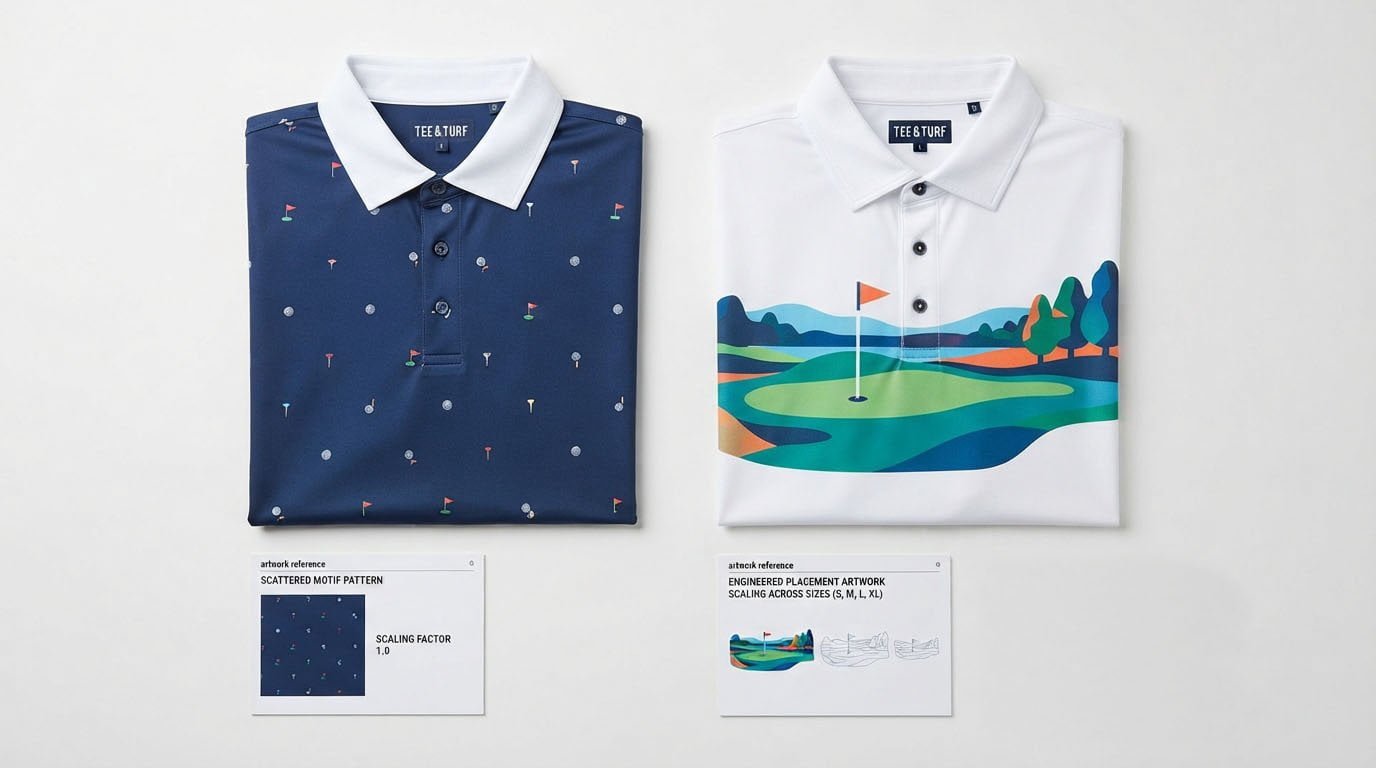
Repeat Patterns
A repeat pattern uses a tile that repeats across the fabric or garment panels. Examples include scattered golf icons, botanical motifs, and small geometric designs.
Confirm:
- The motif dimensions at actual print size.
- The repeat direction and spacing.
- Whether motifs may be cropped at seams and hems.
- Whether the pattern needs matching at particular locations.
A repeat is not automatically easy to produce. Large checks, obvious diagonals, and repeating brand marks may still need careful alignment.
Engineered Placement Prints
An engineered print positions a graphic relative to a particular garment area. Examples include a chest gradient, a large back illustration, or a stripe intended to continue through the front opening.
These designs need approved positions for the relevant panels and sizes.
| Design Feature | Decision to Confirm |
|---|---|
| Small scattered motifs | Keep motif size consistent or scale by garment size? |
| Large back graphic | Fixed dimensions or proportional scaling? |
| Chest stripe | Which seams must align? |
| Pattern across the placket | Continuous matching or a deliberate interruption? |
| Sleeve graphic | Where should it sit on each sleeve size? |
Do not assume that enlarging the complete artwork for every larger size will preserve the intended appearance. A repeated icon may need to stay the same size even as the garment panels become larger.
Map the Artwork to the Actual Polo Pattern
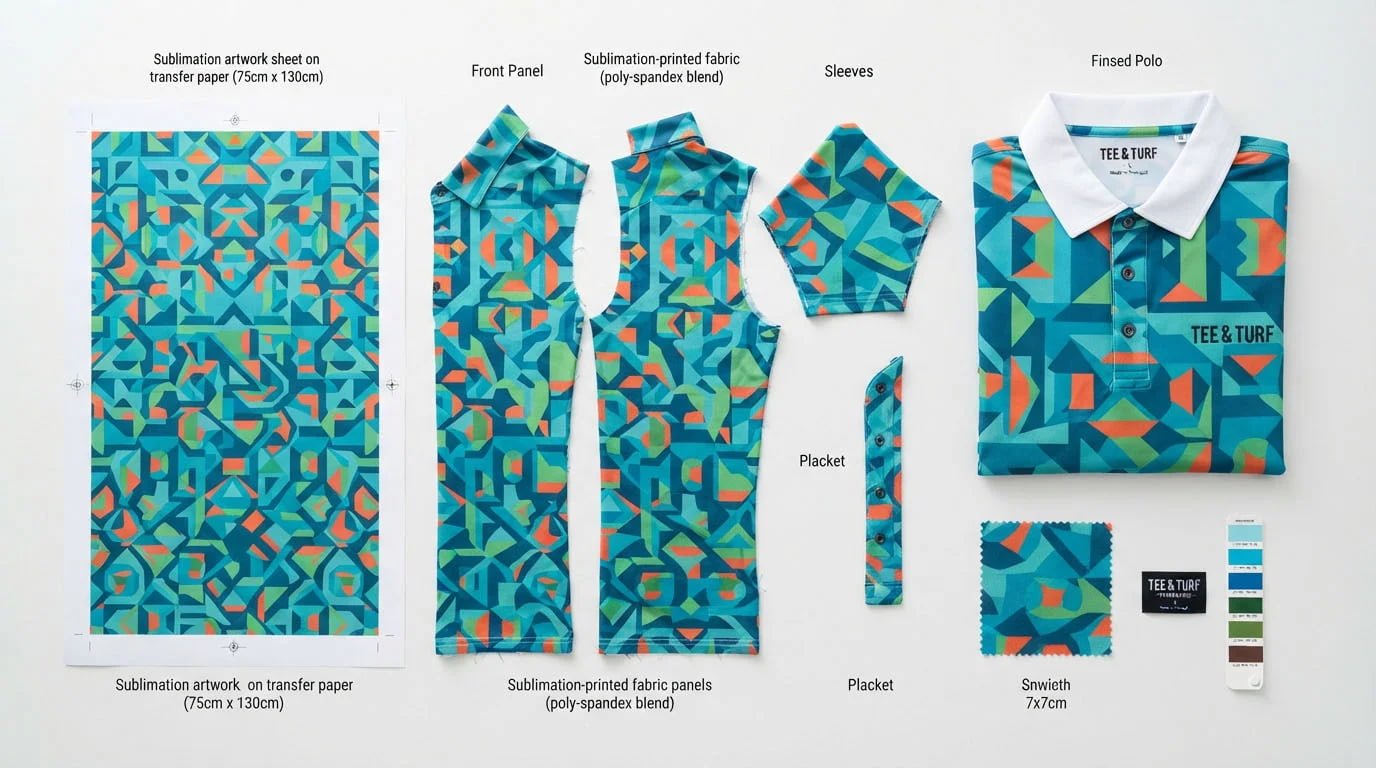
A shirt-shaped mockup communicates the concept. Production requires the design to work with the real front, back, sleeves, collar, and placket components.
For extensive coverage, printing flat fabric or panels before sewing generally offers better access than printing across an assembled shirt. The exact printing and cutting sequence depends on the production workflow.
Pre-sewn shirts can develop unprinted areas where folds or seams prevent uniform transfer. Printing before assembly reduces that particular risk, but it does not guarantee perfect alignment or eliminate every white spot.
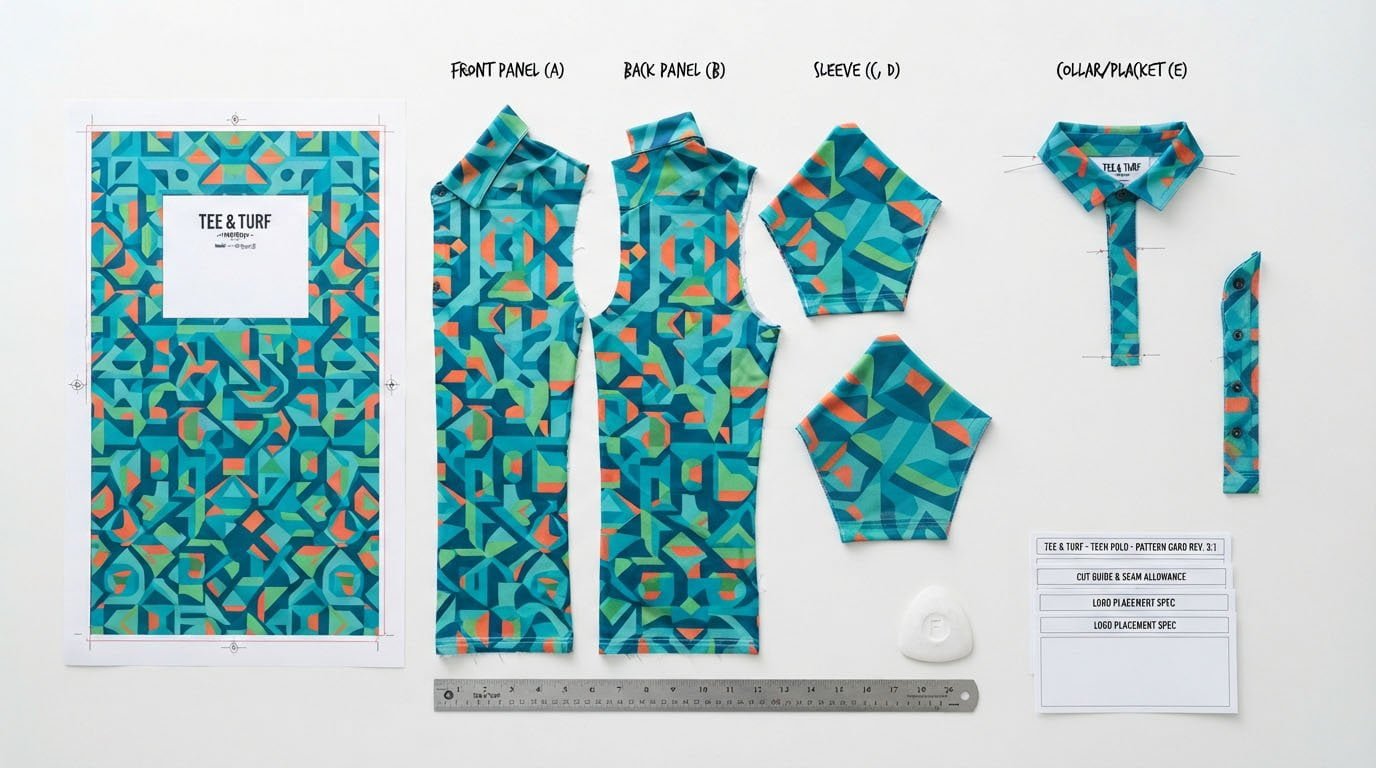
Separate Seam Allowance, Bleed, and Safe Areas
These instructions serve different purposes:
- Seam allowance: Fabric used to join components.
- Print bleed: Artwork extended beyond the intended cut boundary to accommodate production variation.
- Safe area: Space that keeps essential text and logos away from seams, folds, or trimming.
Ask the manufacturer to confirm these boundaries on the production template. There is no single bleed measurement that suits every polo pattern and workflow.
Mark the Areas That Must Match
Not every seam needs continuous pattern matching. Identify the locations that matter most to the design.
| Garment Area | What to Review |
|---|---|
| Front placket | Appearance when buttoned; interruption caused by overlap |
| Collar | Visible face, fold line, and relationship to the body print |
| Side seams | Continuity of prominent lines or shapes |
| Sleeve attachment | Position of stripes or graphics near the armhole |
| Hem and sleeve openings | Cropped motifs and distance from finished edges |
A stripe crossing a curved armhole is more demanding than a scattered micro-print. Where continuous matching is essential, approve an assembled sample and agree on achievable acceptance criteria.
A solid collar or placket can simplify a busy design, provided that it supports the intended look.
Prepare Artwork the Print Team Can Use
Ask for the supplier’s artwork specification before exporting your final files.
For logos and geometric elements, editable vector artwork is useful. Photographs, painted textures, and other raster designs need adequate resolution at their actual output dimensions.
Around 300 pixels per inch at final size is a common preparation target for detailed raster artwork, but the required resolution should follow the supplier’s specification. Changing a low-resolution file’s label to “300 DPI” does not restore missing detail.
A practical artwork handoff includes:
- Editable source artwork in an agreed format.
- Outlined fonts or the required font package.
- Embedded images or all linked image files.
- Actual motif dimensions and repeat instructions.
- Logo dimensions and defined placement references.
- Color references and embedded profiles as requested.
- A PDF preview for visual comparison.
- A clear file version and approval status.
Do not convert every file to CMYK by default. Color handling depends on the printer, RIP software, and production profile. Confirm the required color mode before conversion and retain the editable master file.
For the broader document package, see what files to send a golf apparel manufacturer.
Approve Color on the Intended Production Fabric
Screens emit light; printed textiles reflect it. The same artwork can also appear different on smooth jersey, textured piqué, and different base shades.
Use the digital proof to approve layout. Use a physical printed reference to approve color and surface appearance.
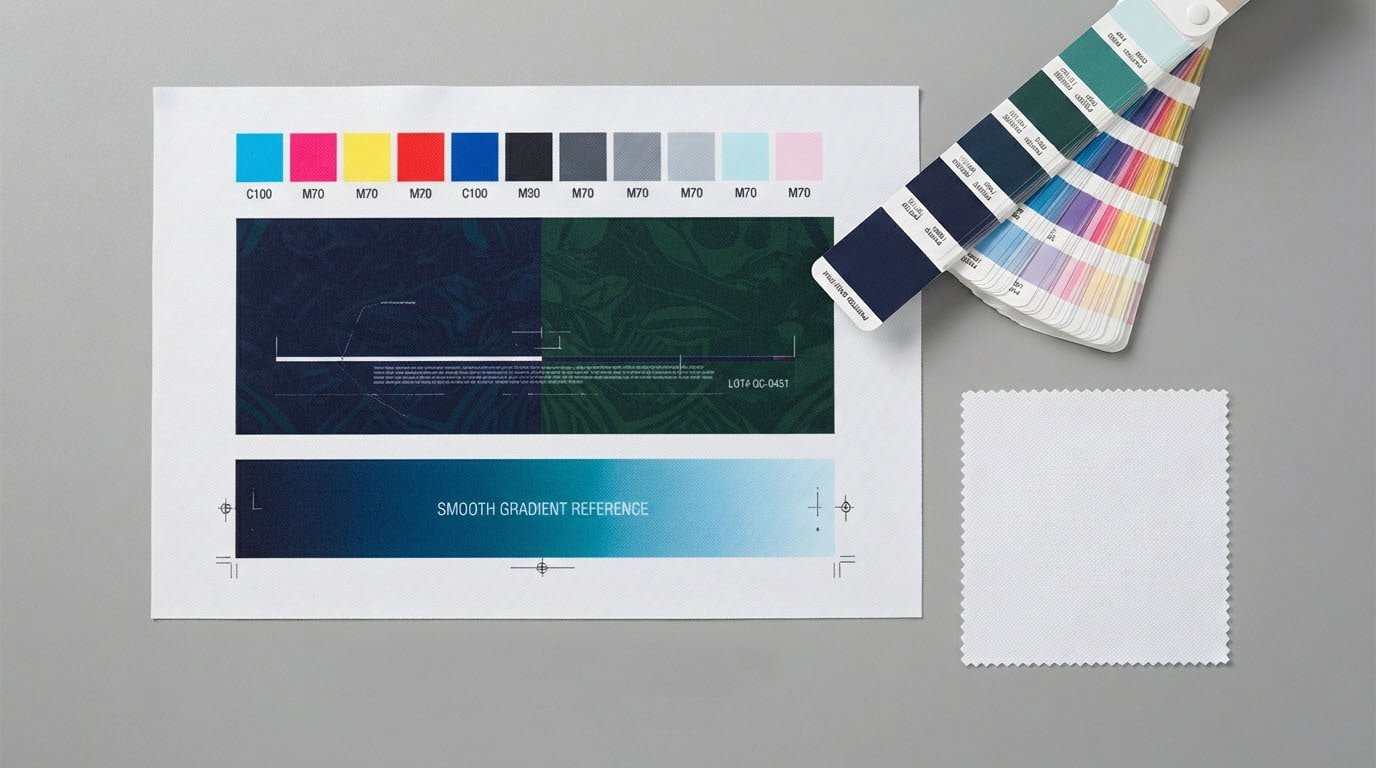
Start With a Fabric Strike-Off
A strike-off is a small printed trial on the intended fabric. It should include representative artwork, especially:
- Important brand colors.
- Large dark areas.
- Fine lines and small text.
- Gradients or closely related shades.
- Any difficult contrast between the background and motifs.
Provide physical color references where available. A Pantone reference or fabric swatch communicates the target; the strike-off establishes what can be reproduced on the selected material.
If a color falls outside the production system’s achievable range, agree on an alternative before approving the garment sample.
Record the Approval Conditions
Identify the approved fabric, artwork version, physical reference, viewing conditions, and acceptable variation. If instrumental color measurements are used, agree on the measurement method and tolerance rather than choosing an arbitrary number.
A sample establishes the production target. It does not make later color differences automatically acceptable. Bulk output must still meet the agreed standard.
Check the Print on an Assembled Golf Polo
A successful strike-off confirms only part of the product. Sewing, fit, and movement can change how the design looks.
Use the garment sample to review the following:
| Check | Approval Question |
|---|---|
| Pattern scale | Are motifs the intended size on the body? |
| Placket and collar | Does the design work when buttoned and worn? |
| Critical seam matching | Does the assembled garment meet the agreed layout? |
| Size variation | Are important graphics balanced in representative sizes? |
| Dark areas under stretch | Do lighter yarn areas become visibly exposed? |
| Post-wash appearance | Are color, dimensions, surface, and shape acceptable? |
Lighter areas appearing through a stretched dark print are often called white grinning. This can relate to knit structure and dye penetration, rather than elastane alone. Check the actual printed fabric under realistic movement.
Sublimation does not create the thick surface film associated with some other print methods. However, printing does not automatically guarantee moisture management, UPF, breathability, or stretch recovery. Approve any required performance claims against suitable evidence for the finished material or garment.
Use Separate Approval Gates
A useful development sequence is:
- Confirm fabric suitability and fit direction.
- Approve artwork layout and size-scaling rules.
- Approve the printed fabric strike-off.
- Approve the assembled pre-production sample.
- Check the first production output before continuing bulk production.
Changing the fabric, fit, or artwork after approval may require another review. For production defect checks and inspection records, use our sublimation quality control checklist.
What Changes the Quote and Sampling Schedule?
An all-over print does not have one standard development cost.
The quote can change with fabric selection, artwork preparation, the number of designs, size-specific layout work, critical seam matching, trims, and order allocation. Unlike conventional screen printing, adding another artwork color does not require another screen, but digital setup and development work can still carry costs.
For an initial inquiry, provide:
| Information | What to Send |
|---|---|
| Product direction | Reference images, intended customer, and golf polo style |
| Artwork | Design preview, source-file availability, repeat or placement instructions |
| Fabric | Preferred composition, texture, weight, and performance needs |
| Fit | Size range, measurement targets, or a reference garment |
| Quantity | Estimated units by design and size |
| Construction | Collar, placket, buttons, labels, and packaging requirements |
| Schedule | Required delivery date and destination |
Ask how the minimum order applies to each style, artwork, and fabric option. A total order quantity does not necessarily mean that every design can be produced in any quantity.
You do not need finished panel artwork to start a conversation. A concept can support an initial feasibility review, provided that missing development work is identified. Production artwork and approvals must be complete before bulk release.
FUWAY’s custom golf shirt development service supports discussions around fabric, fit, printing, and private label requirements. Send your design direction and estimated quantity to review the development scope and sampling plan.
Frequently Asked Questions
Can an all-over print golf shirt have a white logo on a dark background?
Yes. With conventional sublimation, the dark background can be printed onto white fabric while the white logo area remains unprinted. This differs from printing white ink onto dark fabric.
Will sublimation prints crack or peel?
The sublimated dye is within the receptive fibers rather than forming a separate print film, so the design does not crack or peel like a surface layer can. That does not mean the color cannot fade or change. Durability still depends on the material, process, use, and care.
Why is the inside sometimes lighter than the outside?
The print may be concentrated toward the outer face, leaving the reverse lighter. The result depends on fabric construction and dye penetration. Agree on the required inside appearance rather than assuming every sublimated polo will look identical.
Can I reorder the same print later?
Usually, the artwork can be retained for reorders. Keep the approved source files, fabric specification, and physical reference. If the fabric lot or production conditions change, review a new strike-off where color consistency is important.
Conclusion: Approve the Product, Not Just the Artwork
Successful all-over print golf shirts depend on how the artwork, fabric, and garment construction work together. Confirm pattern scale, critical seam matching, and color on the intended fabric, then review an assembled sample before approving bulk production.
Planning a printed golf polo collection? Explore FUWAY’s custom golf shirt development service and share your design concept, fabric preferences, size range, and estimated quantity to discuss feasibility and sampling.