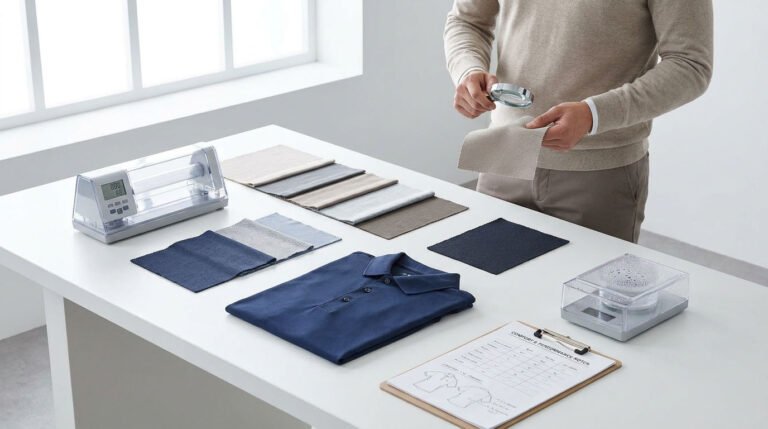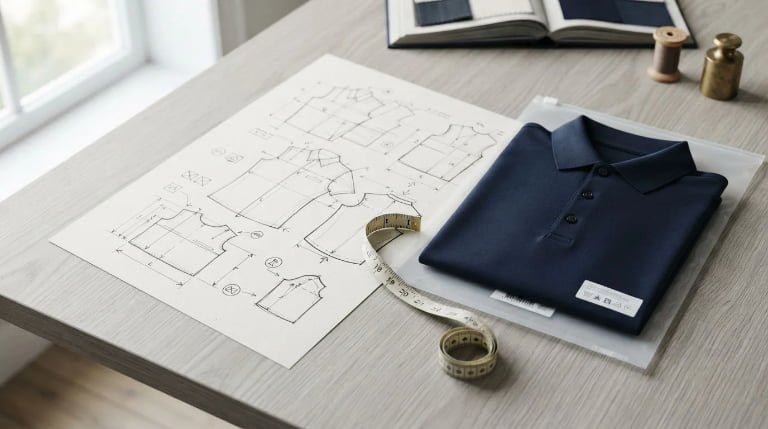
A sublimated golf polo can look perfect during sampling but develop color differences, ghosting, or misaligned patterns during bulk production. When these defects repeat across hundreds of garments, they can cause rejected orders, wasted fabric, and delayed product launches.
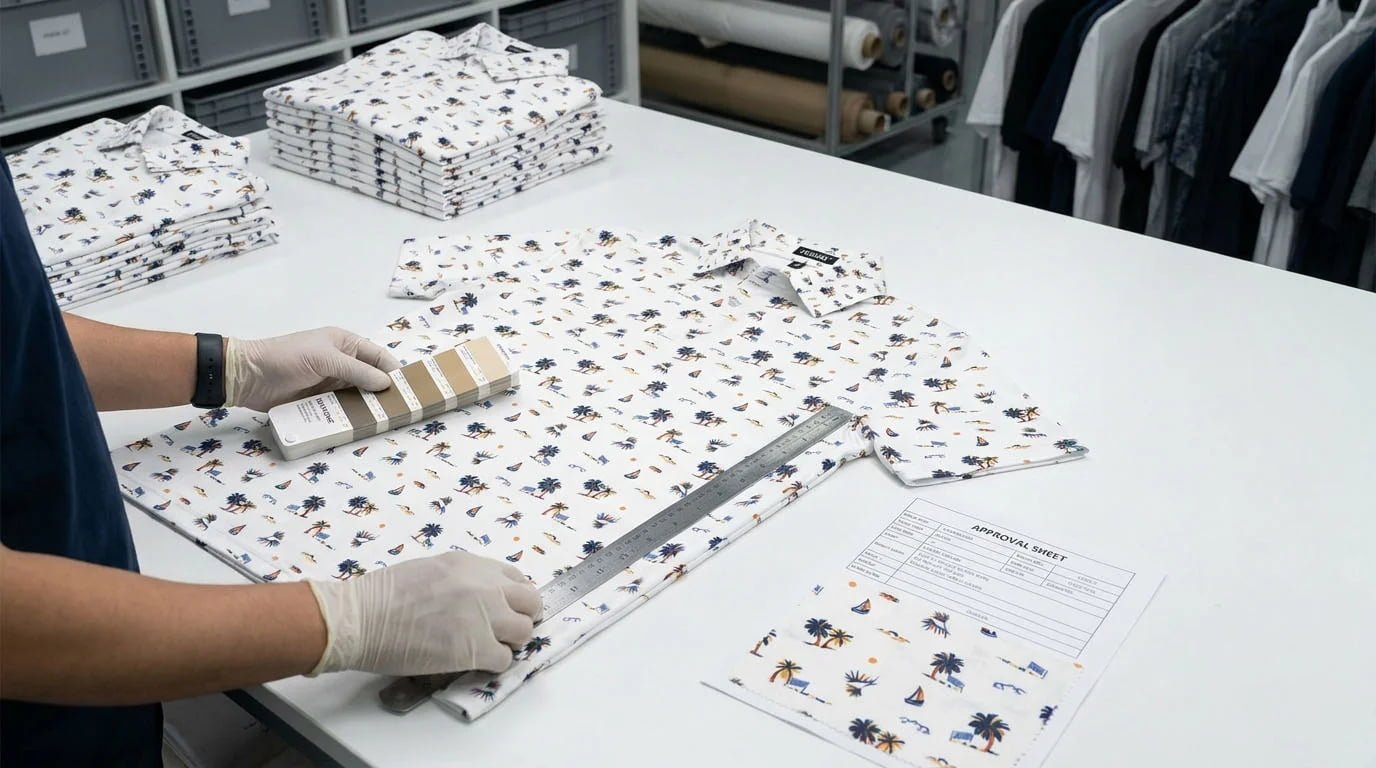
A sublimation quality control checklist helps apparel brands prevent these problems by verifying approved artwork, fabric, color references, first production prints, and bulk consistency before defects spread.
For custom golf apparel, inspection must also cover panel alignment, heat-related distortion, and print appearance after stretching and washing.
This guide provides a practical checklist for brand owners, sourcing managers, and OEM/ODM buyers reviewing sublimated golf polos and other performance apparel.
Quick Answer: What Should a Sublimation Quality Control Checklist Include?
An effective sublimation inspection checklist covers three stages:
- Pre-production: Verify the approved artwork, physical color reference, production fabric, and validated transfer settings.
- First-piece and in-line inspection: Check color accuracy, print clarity, alignment, ghosting, and process consistency.
- Post-print verification: Review dimensional stability, wash performance, defect records, and corrective actions.
The most important rule is simple: Do not approve continuous bulk printing until the first production print matches the approved reference.
Complete Sublimation QC Checklist
Use this table as a starting point when reviewing a factory's production controls.
| QC Checkpoint | What to Verify | Reference / Evidence | Action if Failed |
|---|---|---|---|
| Artwork version | Correct design, scale, and colors | Approved artwork file | Stop and correct file |
| Fabric identification | Correct material and lot | Approved fabric specification | Hold incorrect material |
| Color accuracy | Printed colors match approved target | Physical strike-off / color record | Investigate color difference |
| Print clarity | Fine lines and graphics remain clear | Approved artwork / close-up photos | Check printing and transfer |
| Ghosting and banding | No unacceptable double images or streaks | Printed sample / defect photos | Correct source of defect |
| Heat-related distortion | Fabric remains within specified dimensions | Approved measurement requirements | Revalidate transfer process |
| Panel alignment | Patterns match at specified garment areas | Panel layout / assembled reference | Correct layout or placement |
| First-piece approval | Production print matches approved baseline | Signed first-piece record | Do not release bulk printing |
| In-line consistency | No unacceptable color or print drift | Production inspection log | Hold affected output |
| Wash performance | Meets agreed appearance and colorfastness criteria | Test results | Investigate and retest |
| Final print review | Finished print meets approved requirements | QC record / photos | Reinspect before release |
Acceptance tolerances should be defined for the specific artwork, fabric, and order rather than applying one universal limit to every sublimation project.
Step 1: Verify Approved Artwork, Color References, and Fabric
Many sublimation problems begin before printing. A factory may use an outdated artwork revision, the wrong color profile, or a fabric lot that differs from the approved sample.
Pre-production quality control establishes one reference for everyone involved.
Check Artwork Version and Print Specifications
Before releasing production files, confirm:
- Artwork revision and approval date
- Correct logo, graphics, and color references
- Print scale for each garment size
- Panel layout and orientation
- Bleed allowance where required
- RIP and ICC color profile appropriate to the printing setup
For custom golf polos, verify that repeating patterns and sponsor graphics remain correctly positioned across graded sizes.
The artwork requirements should agree with the approved golf apparel tech pack.
Confirm the Physical Color Standard
Screen previews are not reliable final color references.
Compare the printed strike-off with an approved physical sample under consistent lighting. Where appropriate, use a controlled light booth and color-measuring equipment.
If a numerical color difference tolerance is required, agree on the measurement method and permitted variation before production.
Avoid introducing a new color tolerance after the goods have already been printed.
Verify Production Fabric
Confirm that the production material matches the approved fabric specification, including relevant construction, composition, surface finish, and lot information.
For polyester-spandex golf polos, pay particular attention to:
- Color reproduction
- Heat-related dimensional changes
- Stretch recovery
- Surface appearance after transfer
If your brand is still selecting its material, refer to our best golf shirt fabric for sublimation guide. This checklist focuses on controlling an already approved fabric during production.
Release decision: Artwork, color reference, and production fabric must be confirmed before the first production print.
Step 2: Approve the First Production Print Before Bulk
An approved development sample does not automatically guarantee consistent bulk production.
The production fabric lot, printer, transfer equipment, and operating conditions may differ from those used during sampling.
That is why first-piece approval is a critical quality checkpoint.
What Should the First-Piece Inspection Cover?
The first production print should be made using the intended bulk material, equipment, and validated operating conditions.
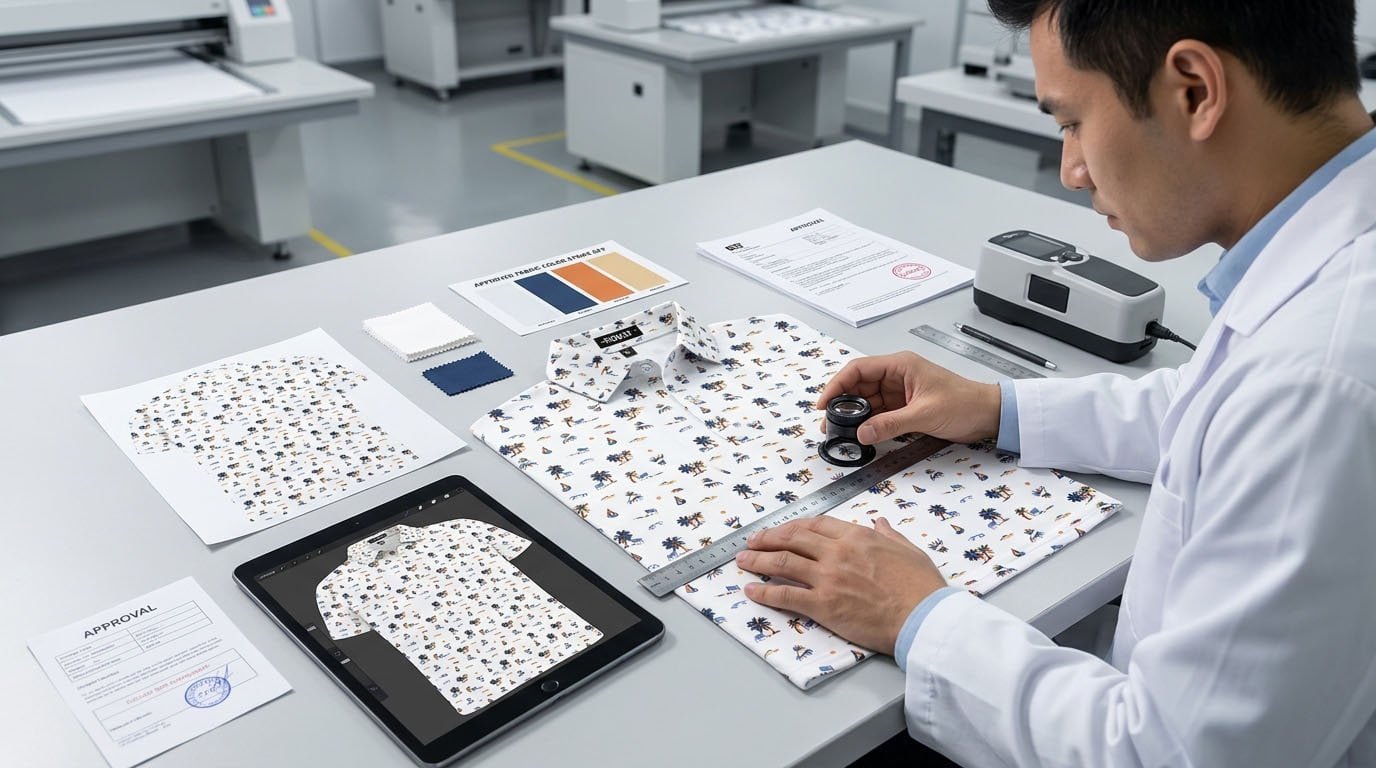
Inspect the following:
| Inspection Item | Acceptance Basis |
|---|---|
| Color accuracy | Approved physical strike-off |
| Logo and graphic clarity | Approved artwork |
| Print position | Approved panel layout |
| Pattern scale | Size-specific artwork specifications |
| Dimensional stability | Agreed panel or fabric requirements |
| Fabric appearance | Approved sample and material specification |
| Ghosting or transfer defects | Agreed defect criteria |
For designs with several colors, inspect representative areas rather than evaluating only one small section of the print.
Record the Approved Transfer Conditions
The production team should document the validated settings appropriate to the specific machine and material, including:
- Transfer temperature or equipment setpoint
- Effective transfer time or line speed
- Pressure or contact conditions where applicable
- Fabric and transfer paper identification
- Relevant environmental conditions
- Operator and approval record
These are control records, not universal printing instructions.
For an overview of the decoration method itself, see FUWAY's sublimation printing service.
Release decision: Keep an approved first-production reference. Bulk printing should proceed only after the required checks pass.
Step 3: Inspect Common Sublimation Printing Defects
Visual inspection should identify both the defect and its possible cause.
A useful QC system does not simply label a garment as defective. It also records where the problem occurred and what must be checked before production resumes.
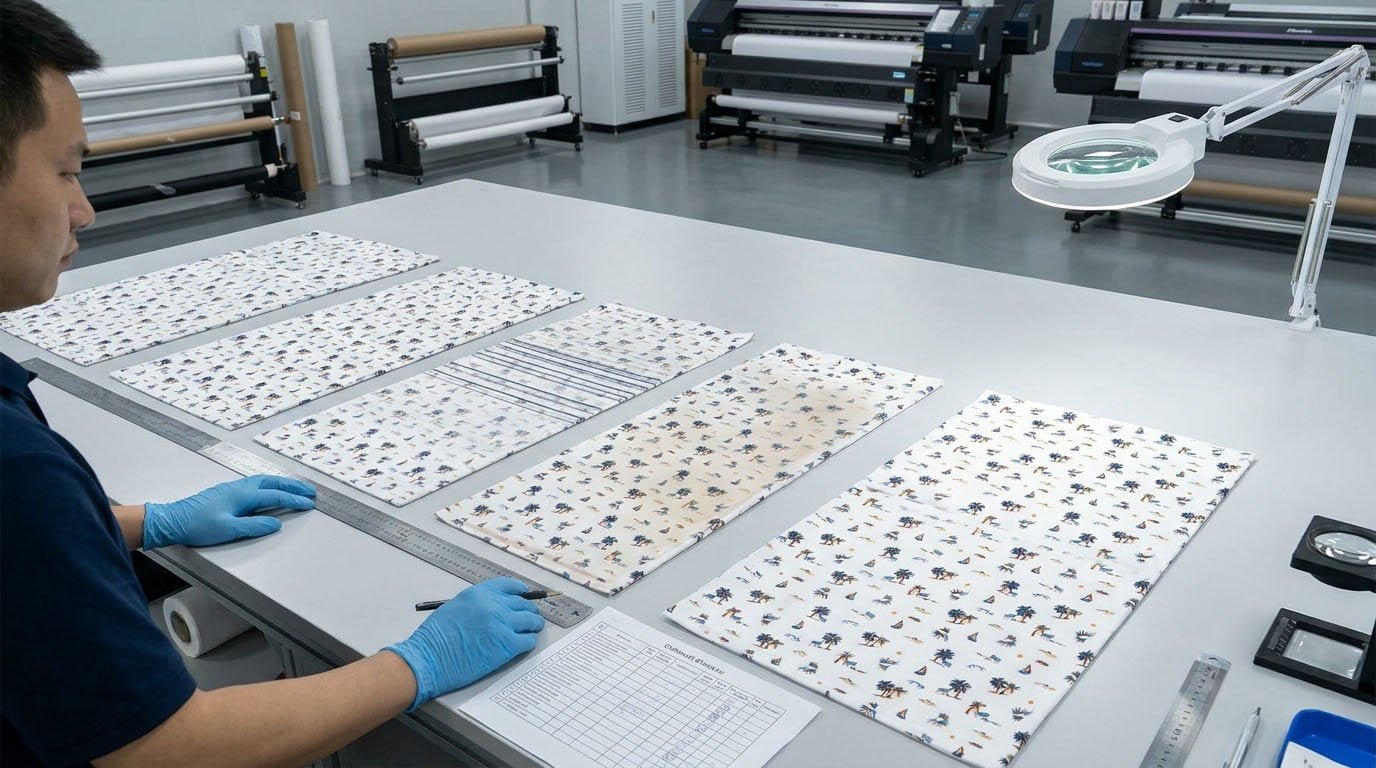
Sublimation Defect Inspection Table
| Defect | What It Looks Like | Possible Cause | QC Response |
|---|---|---|---|
| Ghosting | Faint duplicate or shadow image | Transfer paper or fabric movement | Check positioning and transfer stability |
| Banding | Repeated light or dark streaks | Printhead or media-feed inconsistency | Inspect printer output |
| Blurred edges | Fine lines lack definition | Artwork, paper movement, or transfer conditions | Compare file and transfer result |
| Uneven color | Shade variation across the print | Heat distribution, fabric, or printing variation | Investigate affected areas |
| White spots | Small unprinted or pale areas | Lint, contamination, folds, or incomplete contact | Inspect surface and transfer setup |
| Press marks | Visible shiny or flattened areas | Excessive or uneven heat or pressure | Review contact conditions |
| Color migration | Unwanted color movement or staining | Dye behavior, residual heat, or material interaction | Isolate and investigate |
The possible causes are diagnostic starting points, not definitive conclusions.
How Should a Factory Investigate a Defect?
Use a consistent sequence:
- Confirm that the approved artwork version was used.
- Inspect the printed transfer paper where applicable.
- Check the production fabric and affected lot.
- Compare transfer settings with the approved record.
- Inspect paper movement, contact, and equipment condition.
- Reproduce and verify the corrected result before restarting affected production.
For example, a faint duplicate image near a logo may indicate movement during transfer. Increasing the transfer temperature without confirming the cause could introduce additional defects.
QC rule: Identify the source of the defect before changing several production variables at once.
Step 4: Check Golf Polo Panel Alignment and Print Placement
This is one of the most important checks for sublimated golf apparel.
A printed panel can pass color and clarity inspection but still produce an unacceptable finished polo if patterns do not align at visible garment areas.
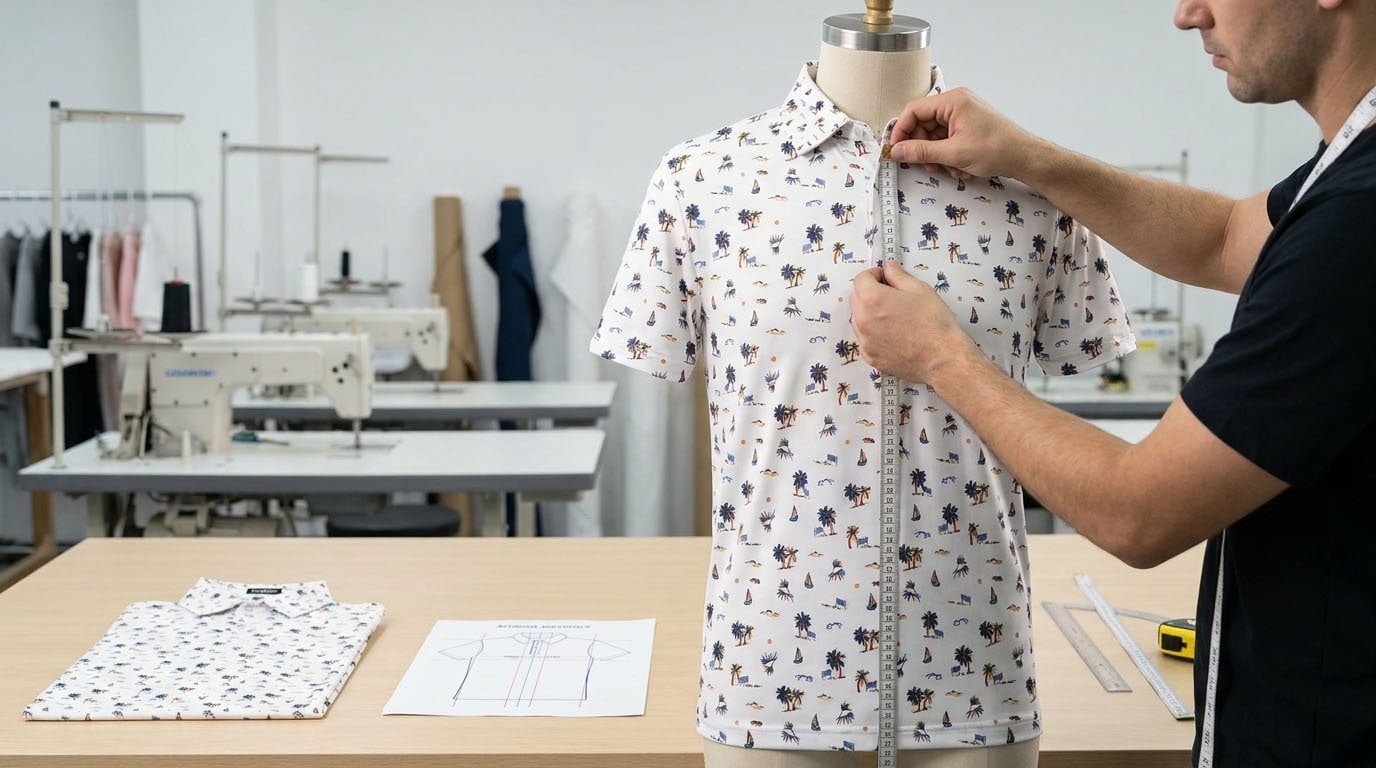
Check Placket and Front-Panel Alignment
For patterned golf polos, inspect:
- Design continuity across the front opening
- Placement around the placket
- Alignment of prominent stripes or geometric elements
- Logo positioning relative to the center front
- Visual balance after sewing
Not every artwork requires continuous matching across the placket. The inspection standard should follow the approved design.
Check Sleeves, Shoulders, and Side Seams
Large or repeating patterns may need additional checks at the sleeve attachment, shoulder, and side seam.
Pay attention to designs containing:
- Horizontal or diagonal stripes
- Large geometric graphics
- Continuous gradients
- Repeating branded motifs
- Sponsor artwork crossing panel boundaries
Where the design requires matching, evaluate the assembled garment rather than relying only on flat printed panels.
Check Pattern Scale Across Sizes
A design approved in size M may not look proportionally balanced in XL or 2XL.
Confirm that the size-specific artwork follows the approved grading or scaling instructions.
For stretch performance polos, also inspect the appearance of dark printed areas during controlled stretching. Lighter areas becoming visible within the knit structure, sometimes called white grinning, may affect the intended appearance.
Release decision: Check critical alignment areas on the assembled reference garment and representative sizes before approving the relevant bulk output.
Step 5: Monitor Bulk Printing and Verify Wash Performance
Passing the first-piece inspection is not the end of quality control.
Long production runs can introduce variations through material changes, equipment adjustments, and operating conditions.
Monitor Critical Production Variables
During bulk printing, maintain records for:
- Production fabric and transfer paper lots
- Approved equipment settings
- Changes in operating conditions
- Color consistency against the first-piece reference
- Print clarity and visible defects
- Any maintenance or adjustments made during the run
Set inspection frequency according to the production risk, equipment, order requirements, and any agreed control plan.
Additional checks may be necessary after a fabric lot change, significant machine adjustment, or production restart.
What Should Be Checked After Washing?
For sublimated golf apparel, wash evaluation should focus on the actual fabric and print system.
Review:
- Color change compared with the approved reference
- Staining or unwanted dye transfer
- Dimensional stability
- Fabric surface appearance
- Stretch and recovery, where required
For formal colorfastness evaluation, an agreed test method such as ISO 105-C06 may be appropriate. The specific test conditions and acceptance criteria should be defined for the project.
Unlike surface-applied prints, conventional dye sublimation generally does not form a separate raised ink layer. Cracking and peeling are therefore not the primary inspection criteria for the sublimated design itself.
Testing should use representative material and production-equivalent conditions. Any required approvals must be completed at the agreed production release stage.
For broader garment inspections, including construction, measurements, and final shipment checks, refer to our golf apparel QC checklist.
QC rule: When bulk results differ from the approved reference, identify and isolate potentially affected production rather than waiting for final shipment inspection.
Step 6: Record Failures, Corrective Actions, and Reinspection
A defect report is useful only when it helps the factory decide what to do next.
Each nonconformity should connect the affected production to an approved reference, investigation, corrective action, and documented disposition.
Example Sublimation QC Record
| Record Field | What to Document |
|---|---|
| Style / Order | Golf polo style and order reference |
| Print / Fabric Lot | Traceable production identification |
| Inspection Stage | First-piece, in-line, or post-print |
| Defect Description | Type, location, and affected quantity |
| Approved Reference | Artwork, sample, or agreed specification |
| Corrective Action | Adjustment, replacement, or other action |
| Reinspection Result | Pass / Fail with supporting evidence |
| Release Status | Approved / Hold / Rejected |
What Happens When an Inspection Fails?
Follow a controlled response:
Hold → Investigate → Correct → Reinspect → Release or Reject
- Hold: Stop or isolate the affected production according to the severity and scope of the defect.
- Investigate: Identify the probable cause using production and inspection records.
- Correct: Fix the verified cause and determine the disposition of affected material.
- Reinspect: Compare corrected output with the original approved reference.
- Release or reject: Document the decision before affected goods proceed.
For example, if color drift is discovered during a long printing run, the factory should trace the affected production back to the last accepted inspection and determine which output requires additional review.
Changing machine settings alone does not resolve the status of garments printed before the correction.

Step 7: What Should Buyers Request Before Approving Bulk Sublimation?
Brand owners do not need to operate the printing equipment themselves. However, they should understand which records support the factory's quality decisions.
Before approving the relevant production stage, request a concise evidence package.
Buyer Approval Checklist
- [ ] Final approved artwork and revision confirmed
- [ ] Physical color reference or approved strike-off available
- [ ] Production fabric specification and lot recorded
- [ ] First production print approved
- [ ] Critical transfer settings documented
- [ ] Representative print and defect inspection photos available
- [ ] Golf polo panel alignment reviewed where applicable
- [ ] Required wash and dimensional tests completed
- [ ] Significant defects and corrective actions documented
- [ ] Reinspection and release status confirmed
Not every order requires the same volume of documentation. A simple repeating pattern may need fewer approval records than a complex all-over design with multiple panel-matching requirements.
The objective is to obtain enough evidence to verify that the approved design can be reproduced consistently.
Three Questions to Ask Your Manufacturer
Before confirming the order, ask:
1. How do you ensure bulk colors match the approved sample?
The manufacturer should explain its physical reference, color-control method, and first-piece approval process.
2. How do you prevent alignment problems on finished golf polos?
Ask how artwork placement, graded panel layouts, and critical garment seams are checked.
3. What happens if defects appear halfway through production?
A reliable process should include traceability, affected-lot isolation, corrective action, and reinspection.
These questions are especially important when developing premium custom golf shirts with all-over graphics, brand colors, and repeating designs.
Frequently Asked Questions About Sublimation Quality Control
What Is the Most Important Sublimation QC Check?
First-piece approval is one of the most important production controls. It confirms that the actual production setup can reproduce the approved artwork, color, and appearance before continuous printing proceeds. In-line checks are still necessary to detect later drift.
Why Does Sublimation Color Differ Between Samples and Bulk Production?
Differences may result from fabric lots, ICC profiles, ink and paper combinations, transfer equipment, operating conditions, or inconsistent color evaluation. The correct response is to compare the production result with the approved physical reference and investigate changed variables.
How Do You Check Ghosting in Sublimation Printing?
Inspect printed logos, fine text, and high-contrast edges for faint duplicate images. Compare the result with approved artwork and check whether transfer paper or fabric movement occurred during pressing.
Can Defective Sublimation Prints Be Repaired?
Many significant sublimation defects cannot be reliably corrected to the approved standard because the dye has penetrated the synthetic fibers. Reprinting or further heating may create additional color or fabric damage. The affected material should be evaluated for rejection or an explicitly approved alternative disposition.
How Often Should Sublimation Prints Be Inspected During Bulk Production?
The inspection frequency should be defined in the production control plan. It depends on process stability, equipment, order size, artwork complexity, and buyer requirements. Recheck after meaningful changes to materials or transfer conditions.
Conclusion: Control Sublimation Quality Before Defects Multiply
A practical sublimation quality control checklist should do more than identify printing defects.
It should connect approved artwork, physical color standards, production materials, first-piece verification, in-line monitoring, and corrective action into one traceable process.
For custom golf polos, panel alignment and appearance after assembly are just as important as print clarity and color consistency.
At FUWAY, we support golf apparel brands with OEM/ODM development, customization, sampling, and production coordination.
If you are planning a sublimated golf polo collection, share your artwork, fabric requirements, intended fit, size range, and estimated order quantity with our team.
Contact FUWAY to discuss your custom golf apparel project and the quality requirements to confirm before bulk production.