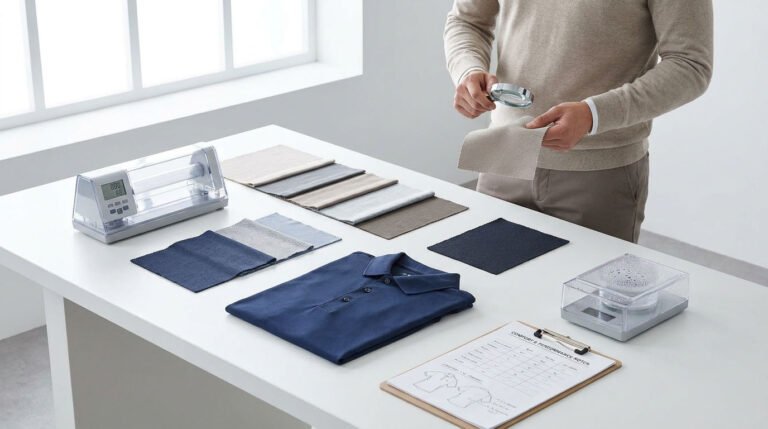
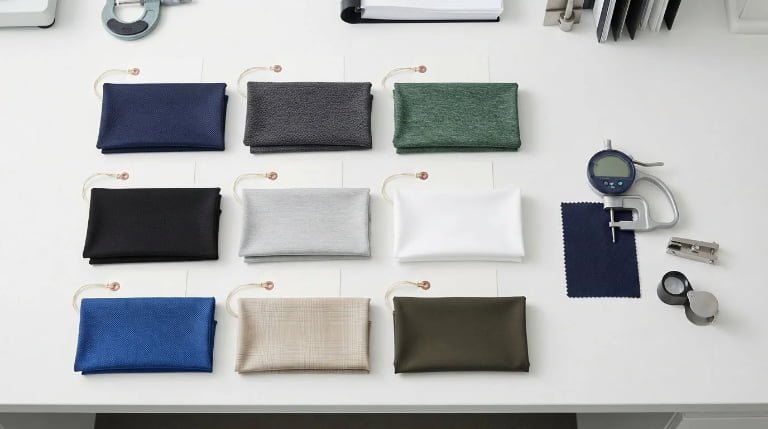
Golf pants and shorts face repeated friction during walking, sitting in golf carts, and carrying accessories. Even when the fabric looks durable during sampling, surface fuzzing, pilling, and premature wear can become problems after repeated use.
For golf apparel brands, selecting a fabric that feels comfortable is only part of the process. You also need evidence that its durability matches the intended product.
Abrasion resistance testing evaluates how fabric withstands controlled rubbing under specified laboratory conditions. For golf pants and shorts, brands should use it to compare materials, understand potential wear risks, and agree on measurable acceptance criteria with their manufacturer before bulk production.
However, a high abrasion cycle count does not automatically mean a garment will last longer. The test method, applied conditions, failure endpoint, and finished garment construction all affect how results should be interpreted.
This guide explains how golf apparel buyers can use abrasion testing to make better material and production decisions.
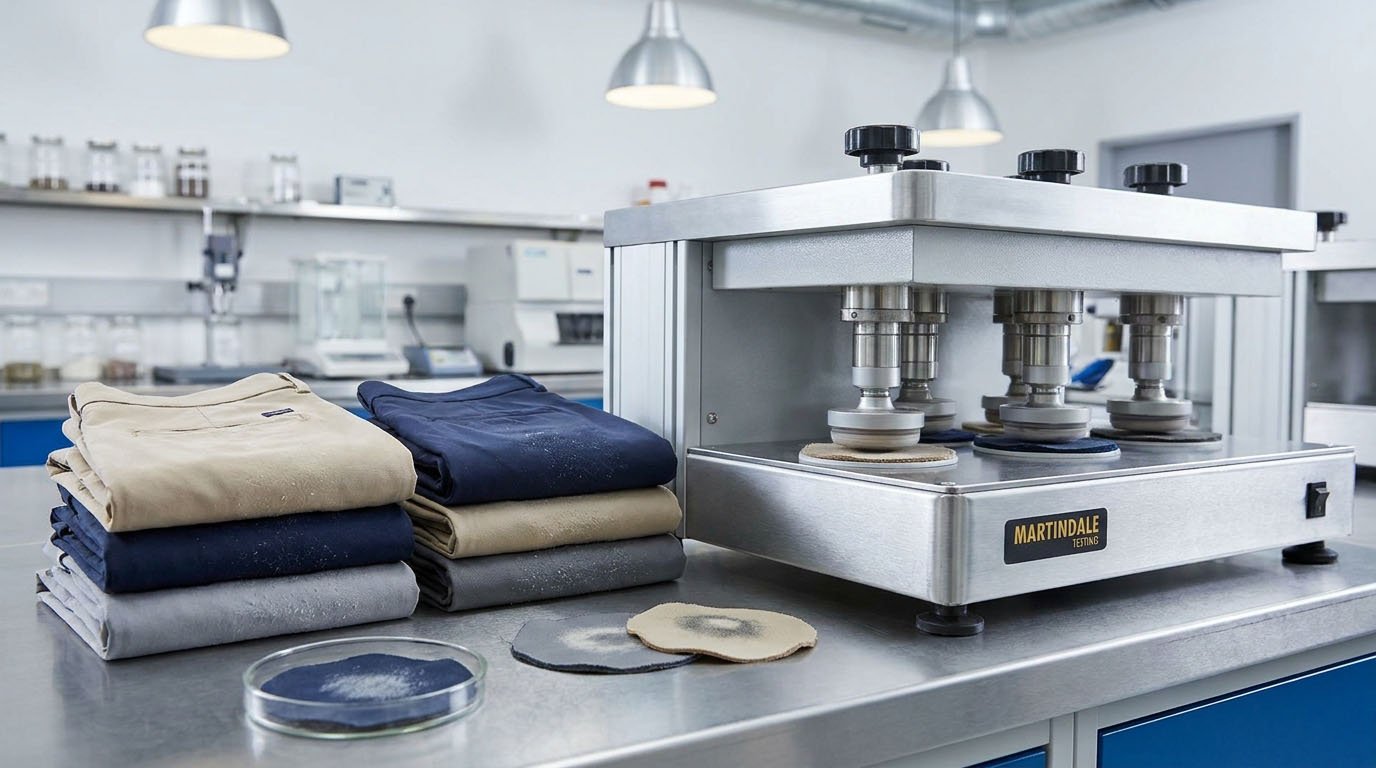
Quick Answers: Abrasion Resistance Testing for Golf Apparel
| Question | Practical Answer |
|---|---|
| What is abrasion resistance testing? | A laboratory evaluation of how fabric responds to repeated friction. |
| Which test is commonly used? | Martindale testing, including ISO 12947-2 and ASTM D4966. |
| Is abrasion resistance the same as pilling resistance? | No. Abrasion, surface appearance, and pilling require different evaluations. |
| Is a higher cycle count always better? | Not necessarily. Results must be compared under equivalent test conditions and endpoints. |
| Is there one minimum cycle count for all golf pants? | No universal threshold applies to every fabric, product, and test method. |
| Does a passing fabric test guarantee durable golf pants? | No. Garment construction and actual use also influence durability. |
| When should brands confirm testing requirements? | During fabric development and before bulk material approval. |
Key 1. What Does Abrasion Resistance Testing Measure?
Abrasion resistance testing measures how a textile performs when its surface is subjected to repeated mechanical rubbing.
Depending on the selected standard, the evaluation may focus on specimen breakdown, visible surface changes, or other defined outcomes.
For golf pants and shorts, abrasion testing is especially relevant because these garments experience repeated contact with seats, equipment, accessories, and other parts of the garment.
Abrasion Resistance vs. Pilling Resistance
These two properties are related but should not be treated as interchangeable.
| Property | What It Evaluates | Potential Customer Complaint |
|---|---|---|
| Abrasion resistance | Resistance to damage or breakdown caused by repeated friction | Fabric thinning, broken yarns, or holes |
| Pilling resistance | Resistance to the formation of small fiber balls on the surface | Visible pills on the inner thigh or seat |
| Surface appearance change | Visible changes after controlled rubbing | Fuzzing, surface deterioration, or altered appearance |
| Color fastness to rubbing | Resistance to color transfer caused by rubbing | Dye transfer onto another surface |
A fabric may resist structural breakdown while developing visible pilling. Another material may maintain an attractive surface but perform less well under prolonged abrasion.
This is why brands should define the actual quality concern before selecting a test.
Buyer takeaway: Do not use an abrasion-resistance result as a substitute for pilling or color-fastness testing. These properties require their own evaluation.
Key 2. Which Abrasion Test Methods Should Golf Brands Use?
Martindale is a widely used method for evaluating textile abrasion resistance. However, different standards and endpoints must be distinguished when comparing laboratory reports.
The correct method should reflect the fabric type, intended evaluation, and any requirements imposed by the brand or retailer.
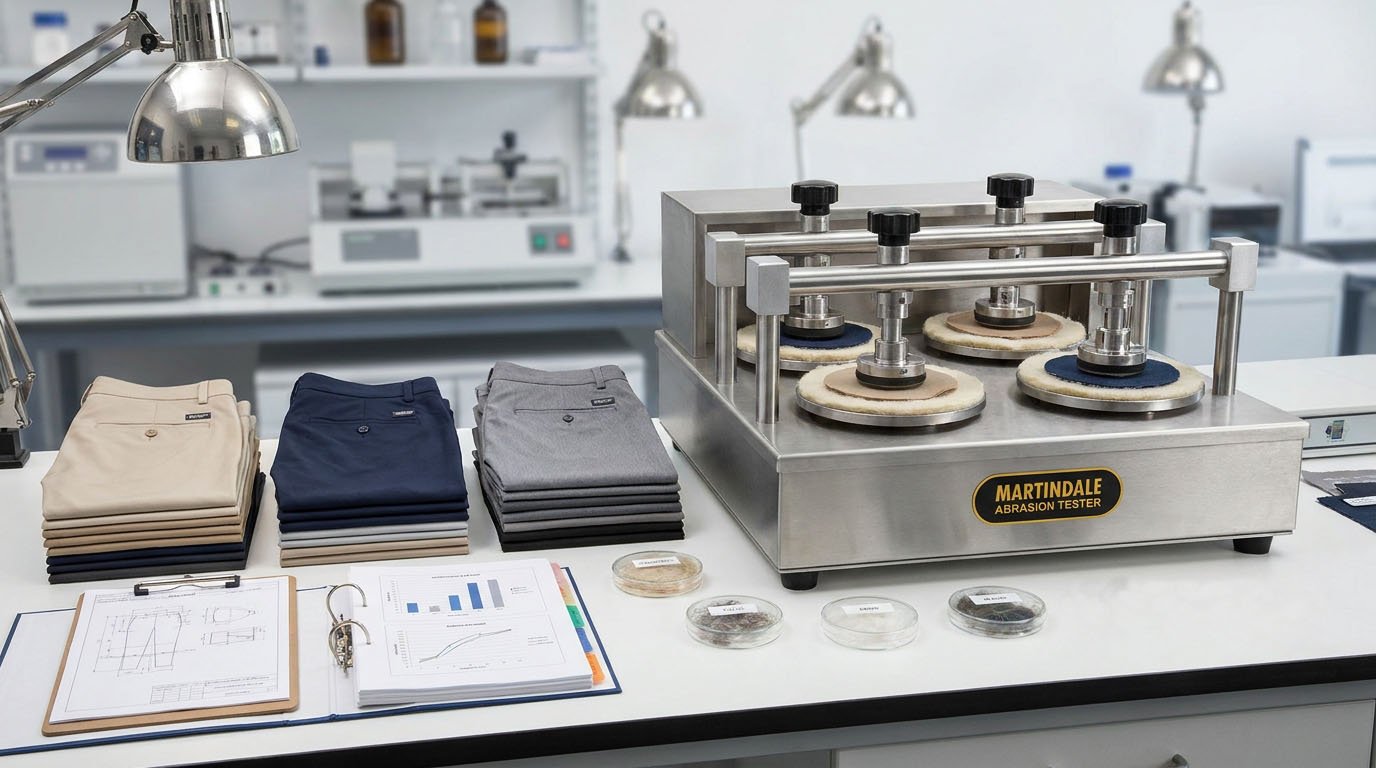
Martindale Abrasion Testing
The Martindale apparatus subjects fabric specimens to controlled rubbing using a prescribed movement pattern and test setup.
Relevant standards include:
| Standard | Main Purpose | What Buyers Should Know |
|---|---|---|
| ISO 12947-2 | Determination of specimen breakdown | Evaluates when a specimen reaches the defined breakdown endpoint |
| ISO 12947-4 | Assessment of appearance change | Focuses on changes in fabric appearance following abrasion |
| ASTM D4966 | Abrasion resistance using a Martindale tester | Results must be interpreted with attention to test variability and limitations |
| ASTM D4970/D4970M | Pilling and related surface changes using a Martindale tester | Evaluates pilling rather than using specimen breakdown as the primary outcome |
ISO 12947-2 is particularly relevant when brands want to evaluate how a fabric withstands abrasion before reaching its specified breakdown condition.
However, it does not provide a universal pass/fail threshold for every golf apparel product.
The ISO 12947-2 standard specifically addresses specimen breakdown under defined test procedures.
What About Wyzenbeek Testing?
Wyzenbeek testing, associated with ASTM D4157, uses an oscillatory cylinder to evaluate abrasion resistance in woven fabrics.
It is also widely associated with upholstery applications.
Some buyers may encounter Wyzenbeek reports when reviewing fabric suppliers, but it should not automatically replace Martindale testing for golf apparel.
Martindale cycle counts and Wyzenbeek double-rub counts are not directly interchangeable.
The machines, rubbing actions, specimen arrangements, and evaluation conditions differ.
Why the Test Conditions Matter
A reported cycle count is only meaningful when accompanied by the conditions that produced it.
Before comparing two reports, verify:
- The complete test standard and edition.
- The fabric identification and specimen condition.
- The abradant and applied load.
- The inspection intervals and failure endpoint.
- The actual reported results and any agreed acceptance criteria.
Two fabrics reporting different abrasion cycles under different conditions cannot be ranked reliably using those numbers alone.
ASTM also cautions that its Martindale abrasion method can show substantial variability between laboratories and is not recommended as the sole basis for commercial shipment acceptance.
For further technical context, consult ASTM D4966.
Buyer takeaway: Choose the test for the quality question being investigated, then compare results only when the testing conditions and endpoints are appropriately aligned.
Key 3. How to Read an Abrasion Test Report Before Approving Fabric
An abrasion test report should help the buyer establish what material was tested, how the test was performed, and whether the reported outcome meets the project's agreed requirements.
A document showing only a PASS statement or an isolated cycle count does not provide enough information for every purchasing decision.
What a Real FUWAY Test Report Shows
FUWAY publicly shares third-party laboratory reports on its Test Reports page.
One published abrasion resistance report was issued by STC (Guangdong) Company Limited on May 8, 2026.
The report identifies:
- Applicant: Guangzhou Fuway Sports Goods Co., Ltd.
- Sample description: Golf Polo Shirts.
- Test: Abrasion resistance of fabric by the Martindale method, specimen breakdown.
- Published reference standard: ISO 12947-2.
- Result summary: PASS.
This is a real, publicly available FUWAY test report, rather than a hypothetical testing example.
Important distinction: The submitted sample is identified as Golf Polo Shirts. Its result must not be presented as proof that a particular golf pants or shorts fabric has passed the same test.
For a golf bottoms project, buyers should confirm the report covers the actual fabric under consideration, or arrange relevant testing using the approved test plan.

Seven Details to Check in a Laboratory Report
| Report Field | Why It Matters |
|---|---|
| 1. Laboratory and report identification | Identifies who performed the testing and which document is being reviewed |
| 2. Sample description | Confirms the garment or textile submitted for testing |
| 3. Fabric composition or reference code | Helps link the test specimen to the intended bulk material |
| 4. Standard and edition | Identifies the procedure used |
| 5. Test conditions | Establishes the applied load, abradant, and other relevant parameters |
| 6. Results and endpoint | Shows what was measured and when the test concluded |
| 7. Acceptance criteria | Determines whether the result meets requirements agreed for the project |
Not every report contains all purchasing information in one place. If a requirement is missing, the buyer should clarify it with the laboratory or manufacturer rather than assume the result is sufficient.
Does PASS Mean the Fabric Is Approved for Bulk Production?
Not automatically.
A PASS result establishes that the laboratory considered the sample to have met the applicable criteria stated in the report or its testing instructions.
It does not necessarily establish that:
- Every subsequent fabric batch will produce the same result.
- Every color or finish has been tested.
- The completed garment will have the same durability as the tested fabric.
- The product will meet every retailer's requirements.
- The garment will withstand a specific number of rounds of golf.
For procurement approval, the report must also be relevant to the intended material and product specification.
Practical rule: Match the laboratory report to the approved fabric identification, testing requirements, and production lot before using it as evidence in a bulk-production decision.
Key 4. Where Do Golf Pants and Shorts Experience the Most Abrasion?
Fabric testing provides useful material-level evidence, but finished golf garments experience friction differently from flat laboratory specimens.
The most important locations to inspect depend on the garment design, fit, fabric, and actual use.
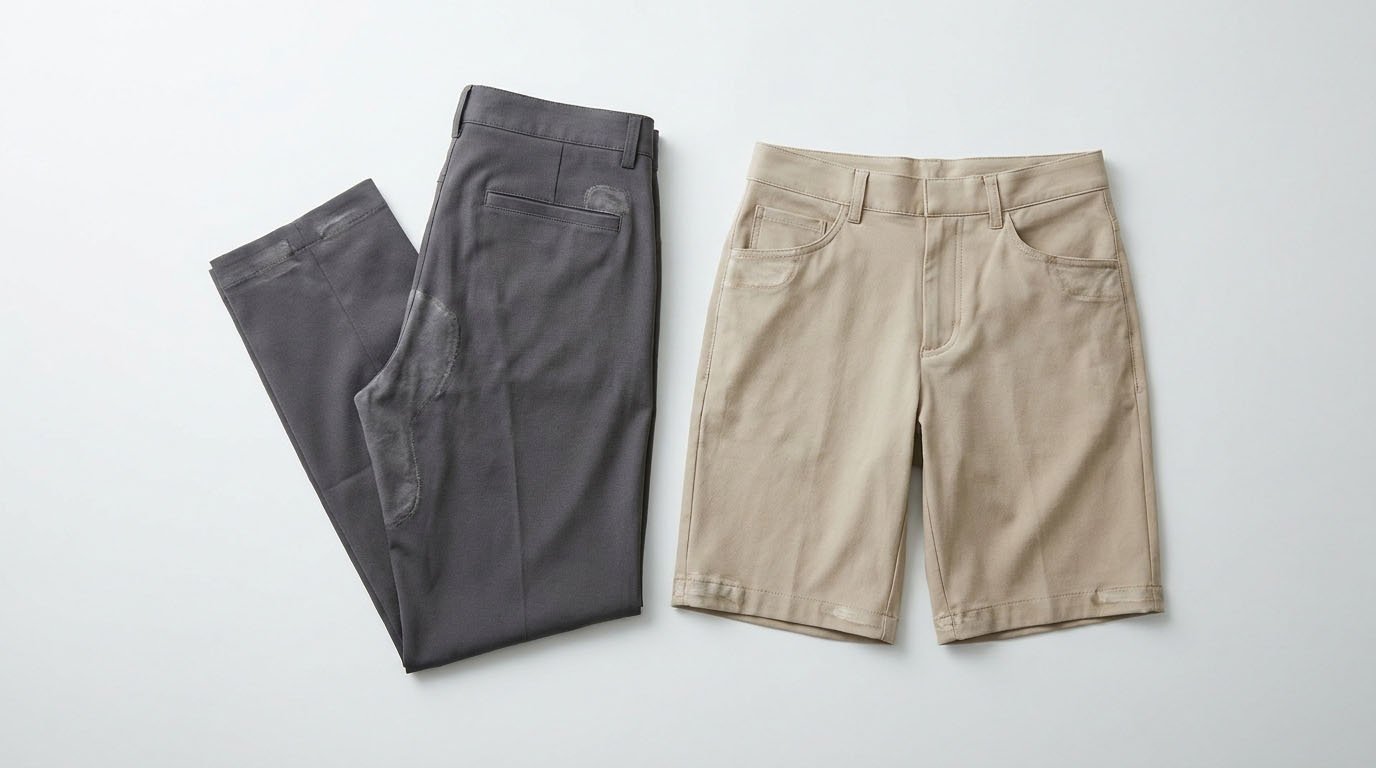
High-Friction Areas to Evaluate
| Garment Area | Potential Abrasion Exposure | Recommended Inspection |
|---|---|---|
| Inner thigh | Fabric-on-fabric rubbing during walking | Surface fuzzing, pilling, seam condition |
| Seat | Repeated contact with golf cart seats and other surfaces | Surface wear, fabric thinning, appearance changes |
| Pocket openings | Repeated insertion and removal of accessories | Edge wear, stitching, reinforcement |
| Pocket bags | Contact with tees, ball markers, and other stored objects | Pocket fabric wear and seam integrity |
| Waistband and belt loops | Contact with belts and equipment | Localized edge wear and stitching |
| Trouser hems | Contact with footwear and nearby surfaces | Edge abrasion and hem condition |
These locations are inspection priorities, not proof that every golf garment will fail in the same way.
Why Fabric Tests Cannot Replace Garment Evaluation
A laboratory specimen does not fully reproduce the shape and construction of a finished garment.
Factors such as seam allowances, pocket reinforcement, interlining, folded fabric edges, and garment fit can change how friction occurs.
A golf short made with a well-performing outer fabric may still experience pocket-bag wear if the pocket material is unsuitable for its intended use.
Similarly, a trouser with an abrasion-resistant shell can develop localized problems around raised seams or poorly constructed edges.
For this reason, brands should combine laboratory results with finished-garment inspection and practical wear trials where appropriate.
Buyer takeaway: Test the relevant fabric, but inspect the actual garment's high-friction construction points before approving production.
Key 5. How Do Fabric Composition, GSM and Finishes Affect Abrasion Resistance?
A common sourcing mistake is assuming that heavier or more expensive fabric will always have better abrasion resistance.
In reality, abrasion performance depends on several interacting characteristics, including fiber properties, yarn construction, fabric density, finishing treatments, and the selected testing method.
Fiber Composition Is Only the Starting Point
Polyester, nylon, cotton, and elastane blends can behave differently under friction.
However, knowing the fiber composition alone is not enough to predict the final test result.
For example, two polyester-elastane woven fabrics with the same nominal composition may have different yarn structures, surface finishes, or fabric constructions.
Those differences can influence their tested abrasion performance.
Common Fabric Types and Observed Performance Patterns
While test results always depend on the specific material and conditions, the following examples illustrate typical performance patterns buyers encounter during golf apparel sourcing:
| Fabric Type | Typical GSM Range | Observed Abrasion Behavior (Martindale, ISO 12947-2) |
|---|---|---|
| Nylon-spandex woven | 130–180 gsm | Often records higher cycle counts before breakdown; suitable for styles prioritizing durability |
| Polyester-elastane woven | 120–170 gsm | Performance varies with yarn quality and density; widely used with appropriate testing |
| Polyester-cotton blend woven | 140–200 gsm | Abrasion behavior depends on blend ratio and finishing; surface appearance changes may differ from 100% synthetic fabrics |
| Brushed or peached polyester-elastane | 140–180 gsm | Surface finishing can influence fuzzing and pilling behavior under abrasion |
These ranges are provided as sourcing reference points, not as performance guarantees. Always confirm actual test data for the specific fabric under consideration.
Does Higher GSM Mean Better Abrasion Resistance?
Not necessarily.
GSM measures fabric mass per unit area. It does not independently measure yarn strength, resistance to rubbing, or expected product lifespan.
A higher-GSM fabric may offer greater material substance, but this does not establish superior abrasion performance.
Brands should compare actual test data rather than use fabric weight as a substitute for durability testing.
Fabric Construction and Surface Finishing
The following properties deserve attention during fabric evaluation:
| Factor | Potential Influence | Procurement Consideration |
|---|---|---|
| Yarn structure | Influences how fibers respond to repeated rubbing | Compare finished fabrics using relevant test conditions |
| Woven or knit construction | Affects specimen behavior and material movement | Confirm that the testing procedure suits the material |
| Fabric density | Can influence surface stability and wear | Avoid evaluating density independently from other properties |
| Brushing or peaching | Changes surface texture and may affect fuzzing or pilling | Evaluate the finished surface |
| Elastane integration | Influences stretch behavior and fabric recovery | Assess abrasion alongside stretch and recovery |
| Coatings or special finishes | Can change surface behavior and test-method suitability | Verify that the selected standard applies to the finished material |
Notably, ISO 12947-2 does not cover every type of coated or laminated fabric. Specialized materials may require a different applicable test method.
Balance Durability with Golf Performance
Selecting a fabric solely because it achieves a high abrasion test result can create other product-development problems.
Golf pants and shorts also require suitable comfort, stretch, recovery, breathability, and appearance.
A material that performs well in laboratory abrasion testing may still be unsuitable for a lightweight summer golf short if it does not meet the brand's comfort requirements.
For a broader explanation of fiber blends, woven structures, and fabric selection, see FUWAY's What Are Golf Pants Made Of? guide.
Buyer takeaway: Evaluate abrasion performance as part of the complete product specification, not as a stand-alone indicator of fabric quality.
Key 6. How Should Brands Set Abrasion Acceptance Criteria Before Bulk Production?
The most useful abrasion test requirement is one that both the brand and manufacturer understand and agree to before bulk materials are approved.
There is no universal abrasion cycle threshold that automatically applies to every golf pants or shorts project.
An appropriate requirement depends on the selected method, fabric construction, product expectations, and available validation evidence.
Step 1 — Define the Product's Intended Use
Before requesting testing, identify the garment's intended application. For example:
- A lightweight summer golf short prioritizing breathability and comfort.
- A tailored performance golf trouser intended for repeated regular use.
- A casual golf lifestyle garment emphasizing appearance and softness.
These examples describe different product priorities. They are not standardized abrasion-performance categories.
Step 2 — Agree on a Test Plan
The test plan should identify:
- The applicable test method and edition.
- The specimen condition and fabric identification.
- The relevant testing setup.
- The required result or evaluation endpoint.
- Any appearance or pilling requirements.
- The party responsible for reviewing the results.
If a numerical threshold is required, it should be established using the relevant specification, customer requirement, or validated development evidence.
Do not copy an arbitrary cycle count from an unrelated fabric report.
Step 3 — Confirm the Bulk Material Matches the Approved Material
Testing a development sample is useful, but the buyer must also ensure that bulk production uses the agreed fabric.
Where relevant, verify the material reference, composition, construction, finish, and batch documentation.
If the project requires testing of production fabric, define how samples will be selected and when testing must be completed.
The inspection and test plan should reflect the project's actual risks rather than assume every fabric lot needs identical testing.
Step 4 — Combine Laboratory Evidence with Garment Checks
Laboratory testing evaluates selected material properties. Finished-garment inspection evaluates construction and manufacturing conditions.
For golf pants and shorts, check relevant high-wear areas, compare approved samples, and consider practical wear or washing evaluations where appropriate.
These evaluations are complementary rather than interchangeable.
Step 5 — Record the Approval Decision
Once results have been reviewed, retain the supporting documentation and record the decision.
The approval should identify the tested fabric, the relevant results, outstanding concerns, and any agreed follow-up actions.
A laboratory test should inform the purchasing decision, but a single abrasion result should not automatically serve as the only basis for accepting an entire commercial shipment.
Key 7. Abrasion Test Approval and Reorder Checklist for Golf Brands
A documented approval checklist helps purchasing, product development, and manufacturing teams work from the same requirements.
It also reduces the risk of using an outdated sample report or approving a different fabric during a later reorder.

Pre-Production Approval Checklist
| Checkpoint | Document or Evidence Required | Approval Question |
|---|---|---|
| Product requirements | Tech Pack or product specification | Is the intended use clearly defined? |
| Fabric identification | Fabric code and approved sample | Does the report refer to the intended material? |
| Test method | Named standard and edition | Is the method suitable for the fabric and objective? |
| Testing conditions | Laboratory test details | Are the conditions sufficiently documented? |
| Acceptance criteria | Approved test requirements | Were the criteria agreed before evaluation? |
| Test results | Relevant laboratory report | Do the results meet the agreed requirements? |
| Garment construction | Approved sample and inspection findings | Have relevant high-wear areas been checked? |
| Bulk material confirmation | Supplier material and batch records | Does the production fabric match the approved specification? |
| Final decision | Written approval record | Are unresolved issues documented and addressed? |
A brand does not need to make every possible test mandatory for every order. The required testing should be proportionate to the garment's design, material risks, and commercial requirements.
Documents to Keep for Future Reorders
For repeat production, retain a practical set of records:
- Approved Tech Pack and revision number.
- Fabric supplier, reference code, composition, and construction details.
- Approved fabric swatch or relevant reference sample.
- Laboratory reports linked to the tested material.
- Agreed test requirements and acceptance decisions.
- Bulk material or lot references where applicable.
- Approved production sample and relevant inspection records.
- Records of material substitutions, changes, or corrective actions.
If the fabric, construction, or finishing process changes, review whether the existing laboratory evidence still applies.
This documentation provides a useful reference for future production decisions without assuming that a previous PASS result automatically covers every new material lot.
Frequently Asked Questions
1. Is there a standard number of abrasion cycles that all golf pants must pass?
No. There is no single cycle count that universally applies to all golf pants and shorts regardless of fabric, testing conditions, and intended use.
Brands should establish requirements for the selected method and product instead of treating an isolated number as an industry-wide guarantee.
2. Can abrasion resistance testing predict how many rounds of golf pants will last?
No. Laboratory abrasion testing does not directly predict the number of rounds, washes, or years a garment will last.
Actual service life also depends on use conditions, garment construction, care, and other material properties.
3. Is Martindale testing better than Wyzenbeek testing for golf apparel?
Neither method should be described as universally superior.
Martindale methods are commonly relevant to textile apparel evaluation. ASTM D4157 uses an oscillatory cylinder method for woven fabrics and is frequently encountered in other textile applications.
Brands should select an applicable method based on the material and required evaluation. Results from different methods should not be treated as directly equivalent.
4. Should every color of the same golf pants fabric be tested?
Not necessarily.
The required testing scope depends on buyer specifications, material consistency, finishing differences, and identified quality risks.
If different colorways involve materially different finishing processes or show different surface behavior, additional evaluation may be appropriate.
5. Can an existing fabric mill report be used for bulk approval?
It can provide useful evidence if the sample identification, test procedure, conditions, and results are relevant to the intended material.
However, buyers should not assume that a report for one sample automatically covers a different material, finish, or future production batch.
6. Does washing affect abrasion resistance?
Washing can change some fabrics' surface appearance, finishes, and wear behavior.
If performance after laundering is important, brands can define a suitable washing pre-treatment and subsequent abrasion or appearance evaluation.
The testing protocol should be agreed in advance so that results can be interpreted consistently.
Conclusion
Abrasion resistance testing helps golf apparel brands make more informed fabric sourcing and bulk-production decisions.
However, the value of a test depends on more than the reported cycle count.
Brands should use appropriate standards, check the complete laboratory report, distinguish abrasion from pilling and appearance changes, and evaluate high-friction areas of the finished garment.
Most importantly, testing requirements and acceptance criteria should be agreed before bulk production decisions are made.
At FUWAY, we support custom golf apparel development through fabric sourcing, sampling, and production coordination. Our publicly available third-party test reports also provide examples of documented textile testing. We can assist with arranging abrasion testing for your golf pants and shorts fabrics, ensuring your materials meet agreed specifications before production begins.
If you are developing a private-label golf pants or shorts collection, explore our Custom Golf Bottoms manufacturing services or contact FUWAY to discuss your fabric specifications and production requirements.