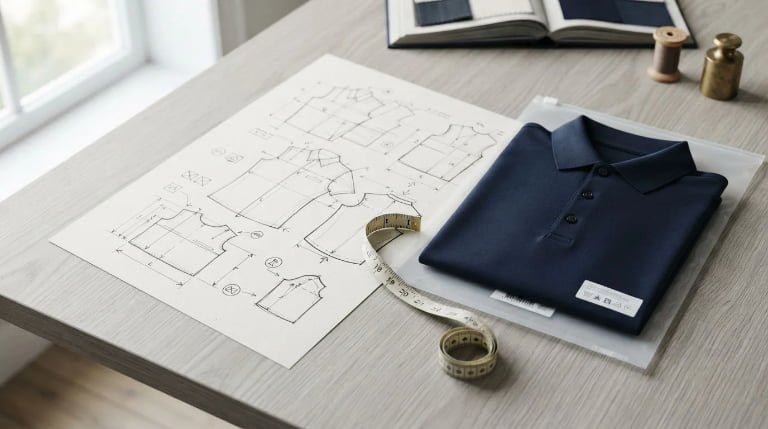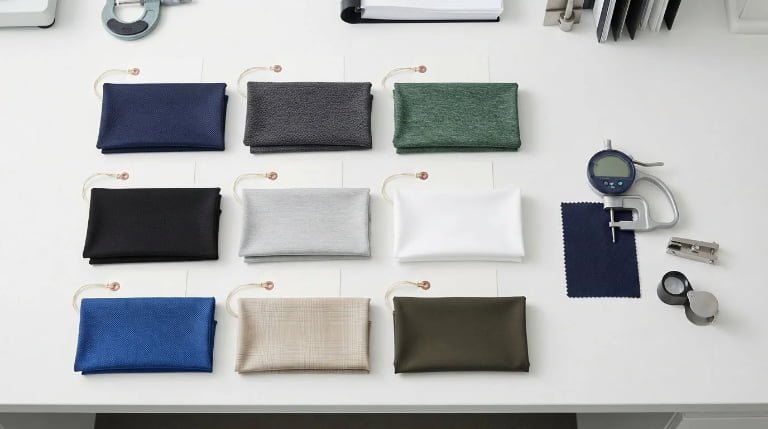
A golf polo can feel lightweight in your hand but become uncomfortable after an hour on the course. For apparel brands, the challenge is identifying this problem before approving hundreds of garments for production.
Fabric weight, fiber composition, and moisture-wicking claims cannot confirm breathability on their own. Buyers need to examine how air and moisture move through the fabric, how the garment is constructed, and whether the finished sample performs as expected.
To evaluate golf apparel breathability before bulk production, check air permeability, liquid moisture management, drying performance, garment ventilation, and prototype wear results. Compare candidate fabrics using consistent test conditions, then document the approved specifications before production.
This guide focuses on the practical verification process for golf apparel brands, product developers, and sourcing teams. The evaluation follows seven practical steps, from defining product requirements to documenting approved specifications.
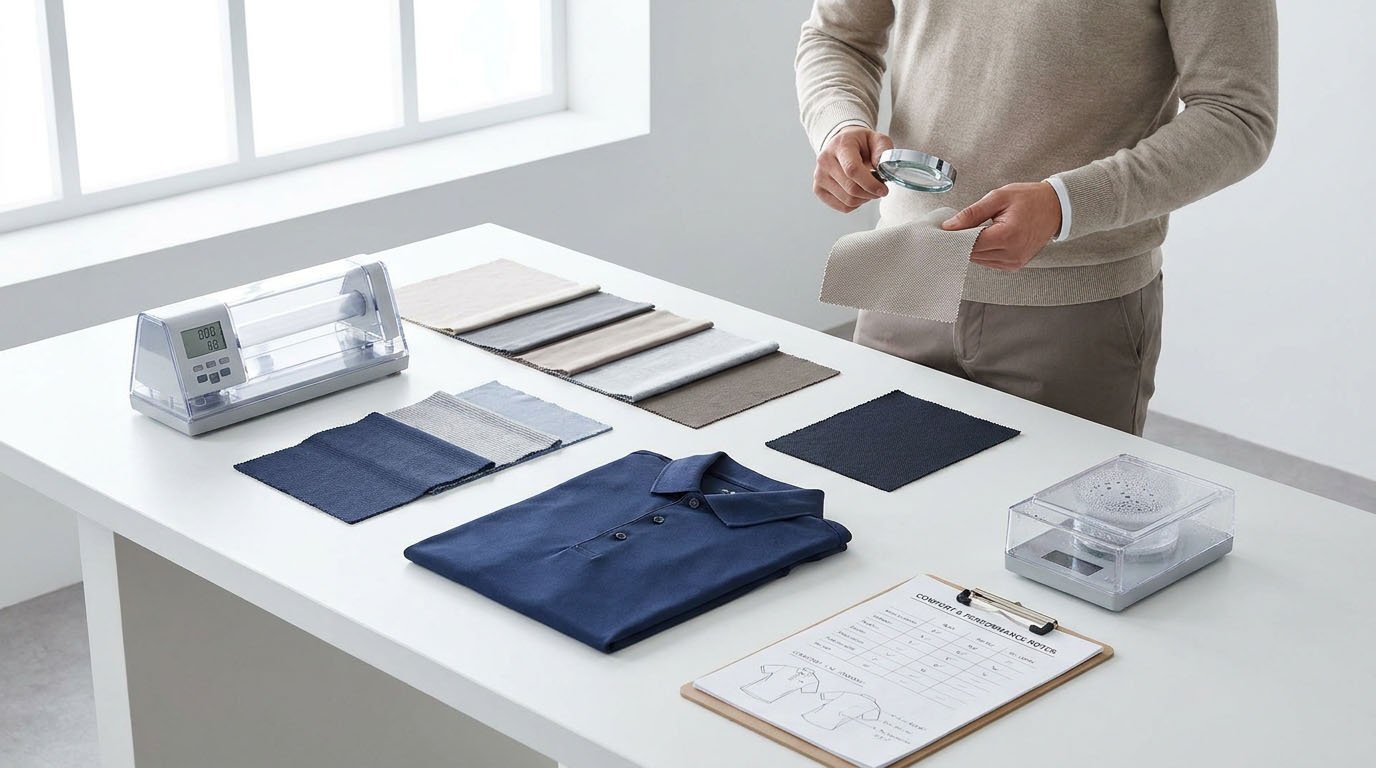
Quick Answer: How Do You Check Golf Apparel Breathability?
Breathability is not adequately described by one fabric measurement. A comfortable golf garment must manage heat and moisture under its intended playing conditions.
Before approving a fabric or garment sample, review these five areas:
| Evaluation Area | What to Check | Why It Matters |
|---|---|---|
| Air permeability | Airflow through the fabric under specified test conditions | Indicates how easily air can pass through the material |
| Liquid moisture management | Wetting, spreading, and movement of liquid moisture | Helps assess sweat management |
| Drying performance | How the fabric releases retained moisture | Helps assess dampness after perspiration |
| Garment construction | Fit, ventilation panels, linings, and branding | Influences airflow around the body |
| Wear validation | Comfort, wet cling, and mobility during activity | Identifies issues that laboratory fabric tests may not capture |
The key purchasing rule: Do not approve a fabric simply because its supplier calls it breathable. Ask which property was measured, which test method was used, and whether the results relate to the fabric you intend to purchase.
Step 1. Define the Climate, Garment Type, and Breathability Requirements
Before requesting laboratory results, establish where and how the garment will be worn.
A summer golf polo designed for Florida may require different performance priorities from a golf quarter-zip intended for cooler, windy conditions.
Match Testing Priorities to the Playing Environment
| Playing Conditions | Main Evaluation Priorities | Garment Considerations |
|---|---|---|
| Hot and humid | Airflow, moisture management, wet cling, drying | Ventilation panels, fit, low moisture retention |
| Hot and dry | Airflow, sun protection, moisture management | Coverage, fabric structure, ventilation |
| Mild and variable | Balance of ventilation and thermal comfort | Layering compatibility, ease of movement |
| Cool and windy | Wind resistance and water-vapor management | Layer construction, controlled ventilation |
These are development priorities, not universal performance specifications.
For example, increasing airflow may improve ventilation in some warm-weather garments but reduce wind protection in a cooler-weather layer.
Define the Product Before Selecting Tests
Your initial development brief should identify:
- Garment type: polo, shorts, trousers, quarter-zip, or jacket
- Target market and expected weather
- Intended fit and activity level
- Required moisture-management properties
- Whether testing is needed before and after laundering
You can then select relevant tests instead of requesting every available performance report.
For help narrowing down fabrics for your intended market, see FUWAY's Golf Apparel Fabric Sourcing service.
Step 2. Separate Air Permeability, Wicking, Drying, and Vapor Resistance
These properties contribute to garment comfort in different ways. They should not be treated as interchangeable performance claims.
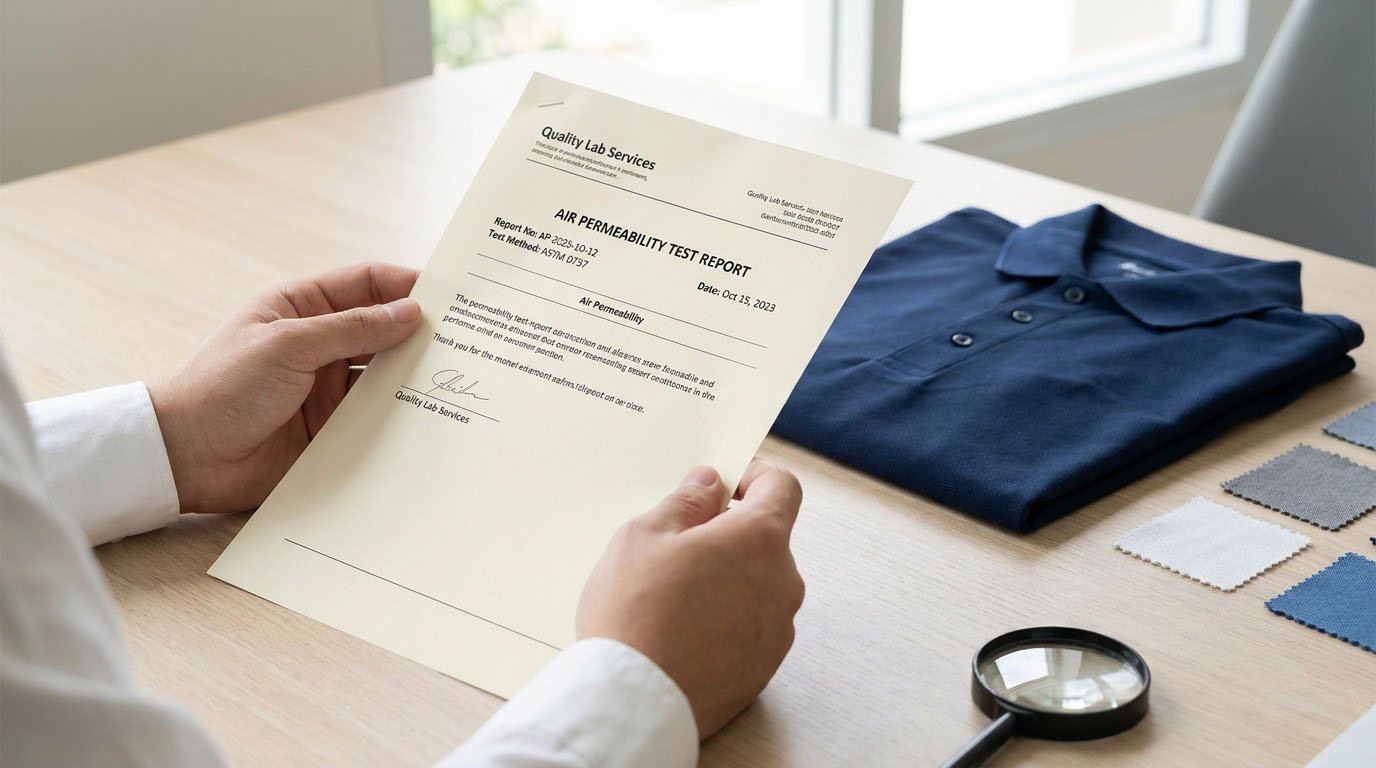
Air Permeability
Air permeability measures the rate at which air passes through a fabric under a specified pressure difference.
It is influenced by fabric construction, porosity, finishing, and other structural factors.
Two fabrics with similar GSM values can have different air permeability results. Higher air permeability can support ventilation, but it does not automatically mean better overall comfort in every condition.
Liquid Moisture Management
Moisture-wicking performance concerns how liquid moisture moves through or across a textile.
A fabric may spread sweat effectively while still having relatively low air permeability.
This distinction matters when developing performance polos that must manage perspiration without feeling excessively damp against the skin.
Drying Performance
Drying tests evaluate how moisture leaves a fabric under defined conditions.
A fabric that absorbs or spreads water rapidly does not necessarily dry rapidly. These properties should be assessed separately when they are important to the product.
Water-Vapor Resistance
Water-vapor resistance describes resistance to moisture vapor transfer through a textile or assembly under specified conditions.
It can be especially relevant when evaluating layered garments, wind-resistant fabrics, and outerwear.
What buyers should remember: Air permeability, liquid moisture transport, drying, and water-vapor resistance describe different mechanisms. No single result fully predicts the comfort of a finished golf garment.
For a detailed explanation of moisture transport and laboratory methods, read FUWAY's Moisture-Wicking Golf Apparel Testing Guide.
Step 3. Review Fabric Test Methods and Supplier Reports
A test report is useful only when the method, sample, conditions, and results can be checked.
Which Testing Standards Should Buyers Recognize?
| Standard | Property Measured | Main Use |
|---|---|---|
| ASTM D737 | Fabric air permeability | Comparing airflow under defined test conditions |
| ISO 9237 | Fabric air permeability | Evaluating fabric permeability to air |
| AATCC TM195 | Liquid moisture management | Assessing wetting, absorption, spreading, and moisture transport |
| AATCC TM199 | Drying time using a moisture analyzer | Evaluating textile drying under the specified method |
| AATCC TM201 | Drying rate using a heated plate | Comparing drying behavior under controlled conditions |
| ISO 11092:2026 | Thermal and water-vapor resistance | Evaluating thermal and vapor resistance of textiles and assemblies |
These methods measure different properties and should not be used as substitutes for one another.
For authoritative definitions, consult the ASTM D737 standard, the AATCC testing standards directory, and ISO 11092:2026.
What Should You Check on a Test Report?
Before comparing results, confirm the following:
- Sample identification: Does the report identify the correct fabric or garment?
- Test method: Is the standard and its applicable version specified?
- Testing conditions: Are the pressure difference, temperature, or other relevant conditions recorded?
- Results and units: Are the values clearly expressed using the method's reporting units?
- Report traceability: Can you identify the testing organization, report number, and test date?
- Acceptance criteria: Does the report show whether the result satisfies an agreed requirement?
For air permeability, verify the test pressure difference and units before comparing results from different reports.
A higher airflow result is not automatically better. The selected performance target must fit the garment's intended use.
Real FUWAY Testing Evidence: Air Permeability Report
FUWAY makes its third-party testing documentation publicly available through its Golf Shirts Test Reports page.
One published Air Permeability Test Report provides a practical example of traceable documentation:
| Report Detail | Published Information |
|---|---|
| Testing organization | STC (Guangdong) Company Limited |
| Report number | DT26042419 |
| Report date | May 8, 2026 |
| Submitted sample description | Golf Polo Shirts |
| Test category | Determination of fabric permeability to air |
| Standard listed on FUWAY's report page | ISO 9237 |
| Report summary | PASS |
This is a real, published report associated with the submitted sample.
However, the summary alone should not be interpreted as proof that every FUWAY fabric has the same air permeability or that every product meets a universal comfort threshold.
For an individual order, buyers should verify that the test data corresponds to the selected fabric specification and the requirements agreed for that project.
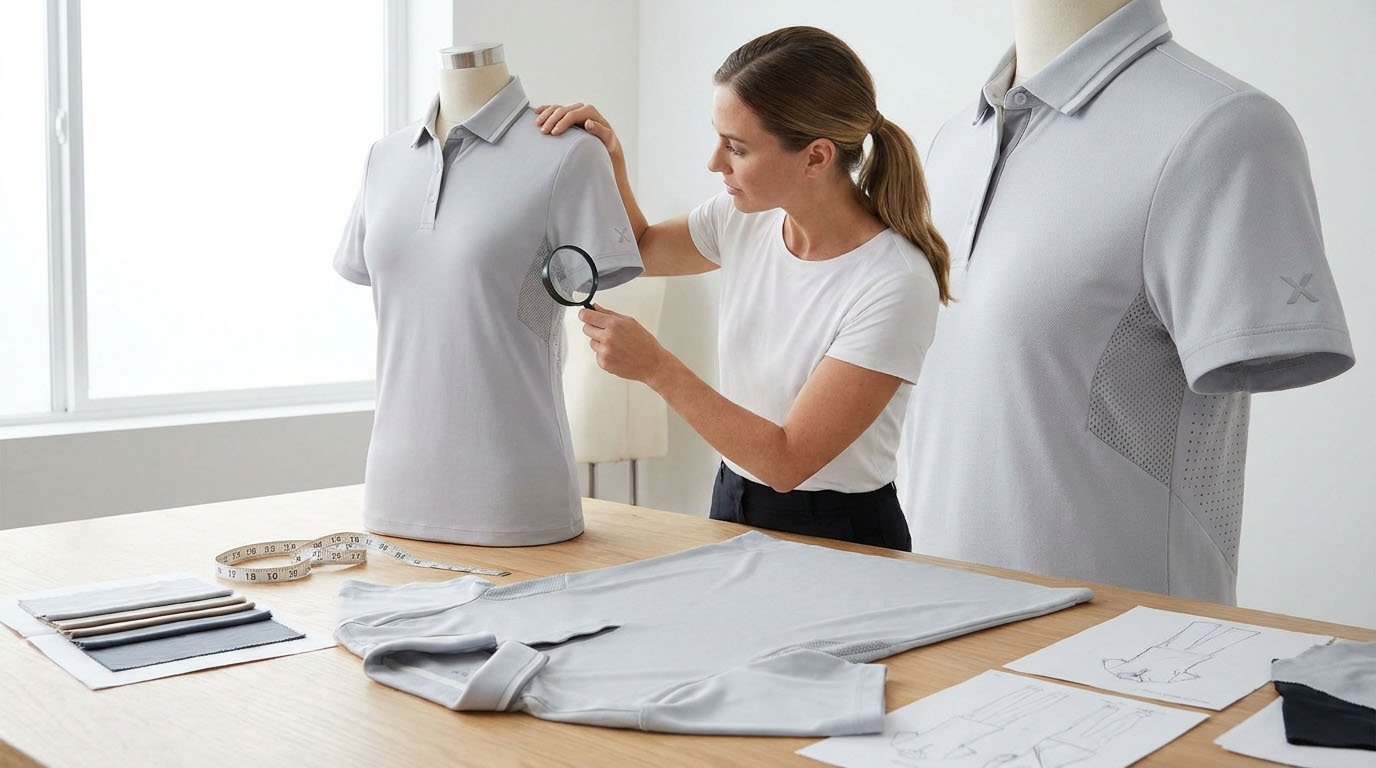
Step 4. Check Fit, Ventilation Zones, and Garment Construction
A breathable fabric can still produce an uncomfortable garment if construction restricts ventilation or movement.
Laboratory tests on fabric samples cannot fully reproduce the interaction between the garment, the body, and the surrounding environment.
Key Construction Areas to Evaluate
| Garment Area | Potential Problem | Recommended Check |
|---|---|---|
| Collar and placket | Heavy interlining or multiple layers can restrict local ventilation | Assess thickness, stiffness, and comfort |
| Underarms | Tight fit or poorly positioned panels can increase discomfort | Check movement and ventilation during swinging |
| Upper back | Excess fabric layers or restrictive construction | Observe heat buildup and wet cling |
| Logo placement | Large transfers or dense decoration can reduce local fabric permeability | Review decoration coverage and backing materials |
| Pants and shorts pockets | Dense pocket bags add layers over the body | Evaluate pocketing fabric and ventilation |
| Waist and seat | Tight fit can restrict movement and air circulation | Check fit during walking and bending |
Construction Features That Support Ventilation
Well-designed golf apparel often incorporates specific construction techniques to improve airflow without compromising durability or appearance. Common examples include:
| Ventilation Feature | Typical Application | What to Verify Before Approval |
|---|---|---|
| Laser-cut underarm panels | Polo shirts | Check panel durability after washing |
| Mesh-lined collar construction | Polo shirts | Confirm opacity and color matching |
| Perforated back yoke | Lightweight tops | Evaluate seam stability around perforations |
| Lightweight pocket bags | Golf shorts and trousers | Confirm resistance to abrasion from accessories |
Each solution must be evaluated for durability, opacity, and post-wash stability before production approval.
Evaluate the Finished Garment, Not Just the Fabric
For example, a large, low-permeability heat-transfer graphic may reduce airflow through the decorated area even when the base fabric is relatively air-permeable.
Similarly, a ventilation panel must be evaluated for more than airflow. Buyers should also consider appearance, opacity, seam durability, and how the panel behaves after washing.
For slim-fit golf shirts, check comfort during a complete golf swing, including when the garment is damp.
These checks help identify construction problems before production approval.
Step 5. Compare Prototype Garments Under Controlled Conditions
Laboratory data helps narrow down candidate fabrics. Prototype wear evaluation helps determine whether the resulting garment performs as intended.
The comparison should be structured rather than based on a single person's general impression.
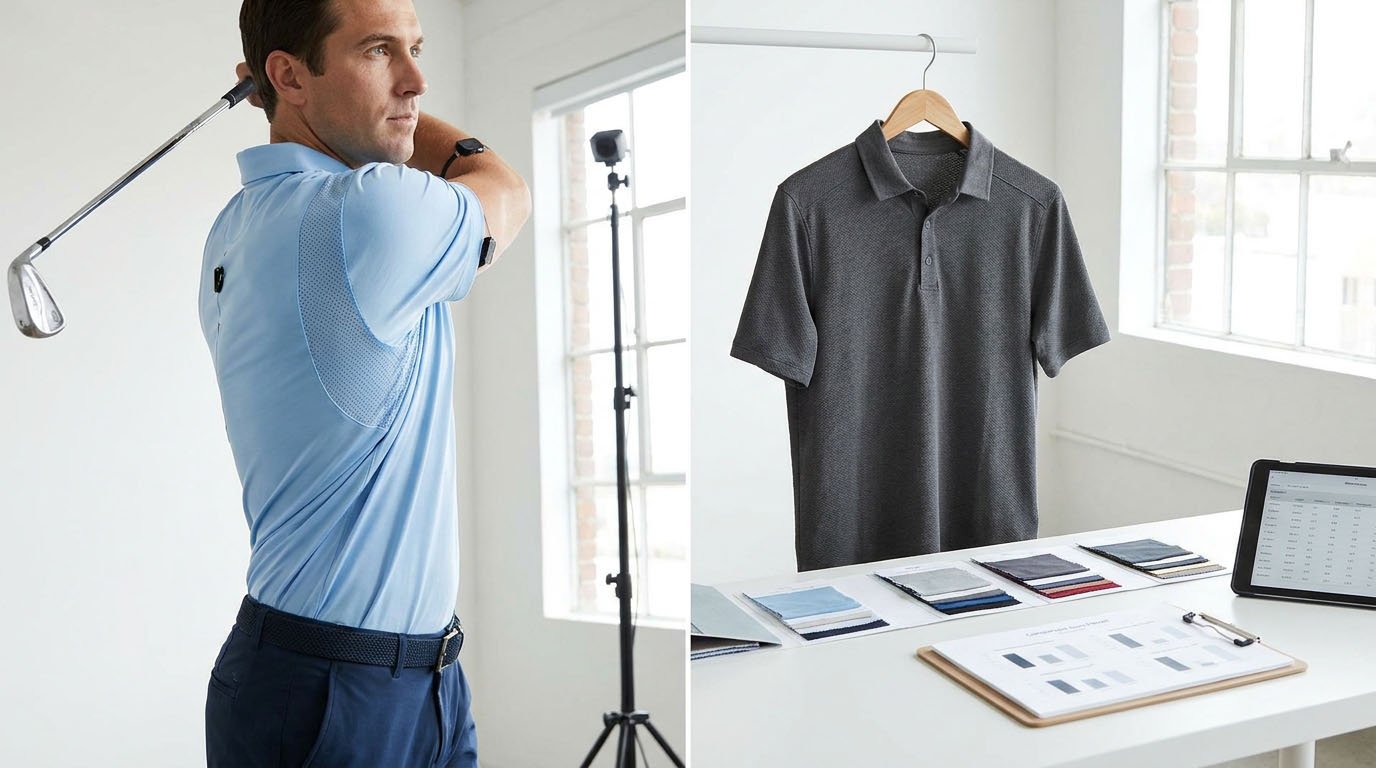
Use a Four-Stage Wear Evaluation
1. Prepare Comparable Prototypes
Develop candidate garments using the same pattern, size, and construction details wherever possible.
If Fabric A and Fabric B are being compared, changing the fit or ventilation design at the same time makes it harder to identify which factor caused a difference.
Record the fabric code, composition, GSM, knit or weave structure, and any relevant finish.
2. Standardize the Testing Conditions
Choose conditions that reasonably represent the intended market.
Record:
- Ambient temperature and relative humidity
- Activity type and approximate duration
- Garment size and fit
- Tester's observations
- Whether garments have been laundered
Where practical, use multiple testers and repeat comparisons with the wearing order changed. For brands requiring structured data, consider standardizing the trial using a simple numerical rating scale (e.g., 1–5 comfort score at each activity stage) and testing with at least three wearers.
Wear trials can provide useful product-development evidence, but they are not substitutes for standardized laboratory measurements.
3. Observe Comfort During Activity
Evaluate the garments during walking, swinging, and rest periods.
Use a simple observation sheet:
| Evaluation Point | What to Record |
|---|---|
| Initial wear | Fit, skin contact, and immediate comfort |
| During activity | Perceived heat buildup and ventilation |
| After perspiration | Wet cling, damp areas, and movement restriction |
| During rest | Whether the garment remains uncomfortable or damp |
| After movement | Any change in collar, hem, or overall fit |
A buyer may choose a numerical comfort rating to make observations easier to compare. Such a rating should be identified as an internal evaluation tool, not a standardized breathability measurement.
4. Check Performance After Laundering
Wash the sample according to the intended care instructions and an agreed test plan.
Then repeat the relevant observations or laboratory tests.
Look for changes in:
- Garment dimensions and fit
- Fabric handle and surface condition
- Moisture-management performance
- Ventilation panel stability
- Comfort during movement
The number of laundry cycles and pass criteria should be established according to the product requirements. There is no single wash-cycle count that automatically proves breathability durability for every golf garment.
Step 6. Decide Whether to Approve, Revise, or Reject a Sample
Testing is valuable only when the results lead to a documented purchasing decision.
A fabric can perform well in one area and poorly in another. For example, Candidate A might offer better airflow, while Candidate B provides better appearance or stretch recovery.
Rather than choosing from one metric, compare the results against the agreed product requirements.
Sample Approval Decision Matrix
| Evaluation Item | Expected Target | Candidate A | Candidate B | Required Decision |
|---|---|---|---|---|
| Fabric specification | Record agreed specification | Record actual specification | Record actual specification | Confirm identity and requirements |
| Air permeability | Enter agreed target | Enter measured result | Enter measured result | Compare with agreed target |
| Moisture management | Enter agreed target | Enter test findings | Enter test findings | Confirm intended performance |
| Drying performance | Enter agreed target | Enter test findings | Enter test findings | Check agreed requirement |
| Wear comfort | Record expected comfort level | Record observations | Record observations | Review comfort and movement |
| Post-wash performance | Enter agreed post-wash criteria | Record results | Record results | Confirm acceptable changes |
| Overall status | — | Pass / Revise / Reject | Pass / Revise / Reject | Document final decision |
This is a purchasing template, not a record of completed FUWAY laboratory tests.
Three Possible Approval Outcomes
Approve: The sample meets the agreed performance, construction, fit, and appearance requirements. Record the approved specification and reference sample.
Revise and retest: A correctable issue remains, such as poor ventilation placement, unacceptable wet cling, or a garment fit problem. Define the change and repeat the affected checks.
Reject: The candidate cannot meet a mandatory requirement within the agreed development constraints.
A buyer should avoid approving a sample with an unresolved critical issue simply because its other test results are satisfactory.
Step 7. Document the Approved Specification Before Bulk Production
A successful prototype does not automatically guarantee consistent bulk production.
Performance can change if the supplier substitutes a different fabric construction, changes a finishing process, or uses materials that differ from the approved sample.
The approved requirements must therefore be communicated clearly to the production team.
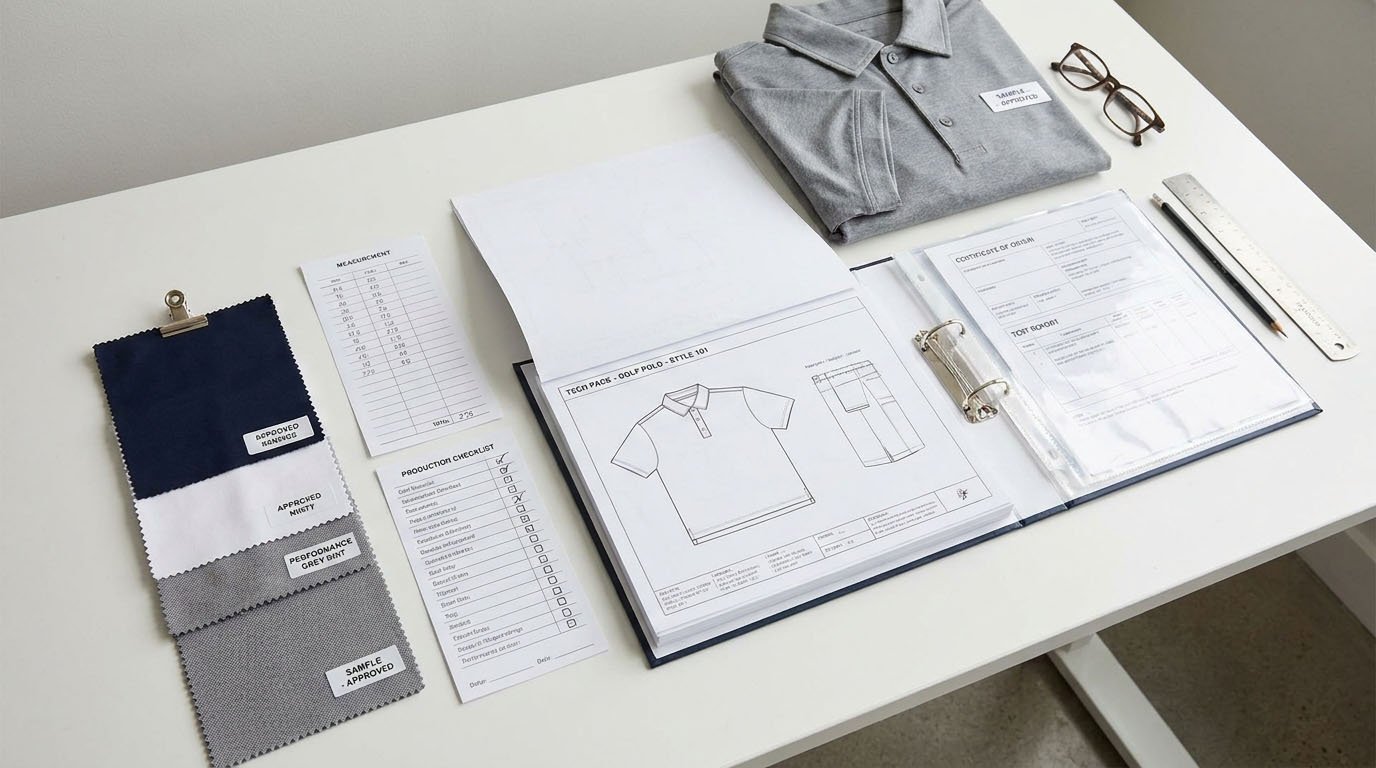
Practical Pre-Production Approval Checklist
| Document or Record | What It Should Include |
|---|---|
| Fabric specification | Supplier, material code, composition, GSM, structure, and agreed finish |
| Test documentation | Relevant reports, sample identity, methods, results, and acceptance criteria |
| Approved garment sample | Confirmed fit, construction, decoration, and ventilation details |
| Tech Pack | Patterns, measurements, tolerances, panels, and trim instructions |
| Wash verification | Agreed laundering conditions and required post-wash performance |
| Material traceability | Fabric batch or lot identification where applicable |
| Approval record | Final decisions, revision status, and responsible approvers |
| Bulk verification plan | Which characteristics require checking during or before production acceptance |
Do Not Forget Repeat Orders
When reordering an approved style, confirm that the new production uses the intended fabric and construction specifications.
A practical reorder document package should include the previous approved Tech Pack, sample reference, fabric identification, relevant performance reports, recorded changes, and any agreed verification requirements for the new batch.
A previously approved report should not automatically be treated as evidence for a different fabric batch or a modified garment.
For brands developing private-label performance polos, FUWAY's Custom Golf Shirts Manufacturing service covers custom fabric selection, fit development, branding, sampling, and bulk production coordination.
Frequently Asked Questions
Does a Higher GSM Mean Golf Apparel Is Less Breathable?
No. GSM measures fabric mass per unit area, not air permeability. Construction, yarn characteristics, fabric density, and finishing also influence airflow. Compare relevant test results instead of relying on GSM alone.
Is ASTM D737 Enough to Verify Golf Polo Breathability?
No. ASTM D737 evaluates air permeability under specified conditions. It does not independently measure liquid moisture management, drying performance, or the comfort of a finished garment.
Can Two Fabrics With the Same Composition Have Different Breathability?
Yes. Fabrics with identical fiber percentages may differ in yarn construction, knitting or weaving, density, and finishing. These differences can affect air permeability and moisture behavior.
How Many Prototype Fabrics Should a Brand Compare?
There is no universal required number. Comparing two or three suitable candidates can be a practical starting point when the budget allows. The more important requirement is using consistent evaluation criteria and documenting the results.
Does a PASS Result Mean the Fabric Will Be Comfortable in Every Climate?
No. A PASS conclusion refers to the particular tested sample and the criteria applied to that test. It does not establish that a garment will provide equal comfort across all climates, fits, and activity levels.
Should Golf Apparel Be Retested Before Repeat Production?
Retesting may be appropriate when the material supplier, fabric construction, finishing, or other critical conditions change. The necessary checks should follow the agreed quality and production verification plan.
Conclusion
Golf apparel breathability should be verified through a combination of relevant fabric testing, garment construction review, controlled wear evaluation, and documented sample approval.
Air permeability, wicking, drying, and water-vapor resistance each explain a different aspect of material performance. None should be used alone as proof of overall garment comfort.
For apparel brands, the most reliable development approach is to define the required performance, compare candidate materials under consistent conditions, approve the finished sample, and preserve the relevant specifications for bulk production and future reorders.
At FUWAY, we support golf apparel brands with fabric sourcing, OEM/ODM development, sampling, and production coordination. Our public testing documentation provides examples of independently tested golf apparel materials, while project-specific requirements should be confirmed against the selected fabric and approved sample.
Developing a breathable golf polo or performance apparel collection? Explore our Custom Golf Shirts manufacturing services or contact FUWAY to discuss your fabric specifications, performance requirements, and sample development before committing to bulk production.