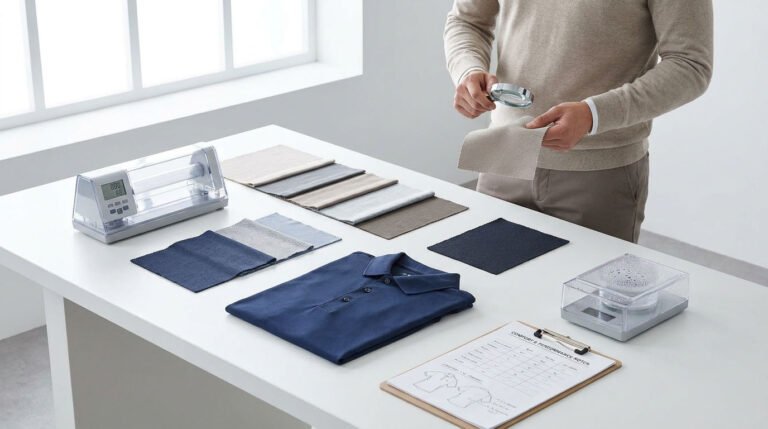
Pilling testing measures how a fabric develops pills and related surface changes under a defined laboratory procedure. For golf apparel brands, it helps compare materials and establish documented quality requirements. A passing result does not guarantee that a finished garment will never pill.
The useful question is therefore more specific than “Did this fabric pass?” Buyers need to know which material was tested, which method was used, what condition the specimen was in, and whether the result applies to the bulk fabric being purchased.
This guide explains how to turn a pilling grade into a practical material decision for golf polos, trousers, skorts and performance layers.
What Does a Pilling Test Actually Prove?
A laboratory result describes the submitted specimens under the reported conditions. It can support material screening, development comparisons and an agreed approval process.
Its usefulness depends on the connection between the report and the product:
- Material: Is it the exact fabric code, construction and finish you intend to use?
- Procedure: Was the agreed method and edition followed?
- Condition: Was the fabric tested as received, after laundering, or both?
- Evaluation: At which exposure stage was the grade assigned?
- Production: Does the evidence cover a development swatch or an identified bulk lot?
A result from a sample swatch does not automatically cover every later delivery. Likewise, a pilling result does not establish snag resistance, abrasion life, moisture management or overall garment quality.
Use each result to answer the question it was designed to address.
Which Pilling Test Methods Should Buyers Recognize?
Common approaches include modified Martindale, pilling box and random tumble methods. Their mechanical actions differ, so their grades should not be treated as interchangeable.
| Method family | Relevant standard examples | Basic approach | Information buyers should check |
|---|---|---|---|
| Modified Martindale | ISO 12945-2 | Controlled rubbing using a modified Martindale procedure | Assessment stages, specimen preparation and prescribed test setup |
| Martindale pilling | ASTM D4970/D4970M | Pilling evaluation using a Martindale tester | Exact edition, exposure stages and reported conditions |
| Pilling box | ISO 12945-1 | Specimens tumble in a rotating pilling box | Preparation, test exposure and evaluation procedure |
| Random tumble | ASTM D3512/D3512M | Specimens undergo random tumbling | Test duration, specimen condition and method suitability |
The official description of ISO 12945-2:2020 identifies it as the modified Martindale method for evaluating pilling, fuzzing and matting. Other methods require their own procedures; sharing a method family does not make ISO and ASTM results equivalent.
Do not confuse Martindale pilling with Martindale abrasion testing. A report expressed as cycles to an abrasion endpoint answers a different question from a visual pilling grade.
Ask the laboratory to confirm the appropriate method for the actual fabric and buyer requirement.
How Should You Read a Pilling Grade?
Pilling is commonly assessed visually on a scale from 5, indicating no pilling, to 1, indicating very severe pilling. The grade belongs to the specified test and evaluation stage. It is not a predicted number of rounds, washes or months of acceptable appearance.
A statement such as “Grade 4” remains incomplete without its supporting conditions.
For example, a result on unwashed fabric cannot establish what that fabric will achieve after a specified laundering treatment. A result from one test method also cannot establish the grade under another.

Is Grade 4 Always the Correct Requirement?
There is no single pilling requirement suitable for every golf garment.
A smooth tournament polo, a brushed quarter-zip and a lifestyle hoodie have different surface characteristics and customer expectations. Define an acceptable appearance for the intended product, then agree a measurable requirement with the supplier and laboratory.
A higher target does not automatically require a rougher fabric. Compare actual material options before deciding that a performance trade-off is unavoidable.
Can Two Laboratories Produce Different Results?
Yes. Matching method names alone does not remove every source of variation.
The public guidance for ASTM D4970/D4970M cautions against using the method for acceptance testing because interlaboratory data are unavailable. Where it is used, the parties should understand the limitation and establish how disputed results will be investigated.
For development and bulk comparisons, consider using the same competent laboratory and keeping reference specimens. Agree on the retest process before a borderline result delays production.
What Causes Pilling in Golf Apparel Fabrics?
Pills develop when surface fibers become entangled and remain attached to the fabric. Fiber characteristics, yarn construction, fabric structure and finishing all affect the outcome.
Fiber strength alone does not determine pilling resistance. Strong fibers can help keep an existing pill attached, while the likelihood of forming that pill also depends on how the yarn and fabric expose and retain surface fibers.
Avoid selecting materials from composition, price or GSM alone.
| Material detail | What to investigate during development |
|---|---|
| Fiber and yarn type | Whether the exact yarn system produces an acceptable tested surface |
| Yarn construction | Surface hairiness and how securely fibers are held |
| Knit or woven structure | Exposed yarn areas, surface movement and suitability for the garment |
| Brushing or peaching | Appearance and durability of the finished raised surface |
| Finishing treatment | Whether the tested finish matches the intended bulk process |
When a candidate fails, ask the mill to propose specific yarn, construction or finishing adjustments. Test the revised material and review its comfort, stretch and appearance alongside pilling performance.
FUWAY’s golf apparel fabric sourcing service provides a starting point for discussing material options against a defined product brief.
Should Pilling Be Tested Before or After Washing?
The test plan should state the specimen condition explicitly.
An as-received test helps assess the supplied material in its initial state. A separately defined post-laundering evaluation can address concerns about appearance after care.
Where both conditions matter, request both. Record the laundering procedure, number of cycles and drying method rather than writing only “after washing.”
Do not assume that washing will always make the result worse, or that every finish disappears after a fixed number of washes. The effect depends on the material and treatment. ASTM D4970/D4970M specifically calls for the parties to agree and report the state of the fabric being tested.
Also distinguish two observations:
- A post-laundering pilling test applies the specified laboratory procedure to pretreated material.
- A garment wash review records appearance changes caused by the laundering sequence itself.
Both may contribute to development, but they provide different evidence.
Which Golf-Specific Friction Zones Should You Review?

Use finished-garment trials to investigate contact that matters to the intended player.
| Garment area | Contact to include in the review |
|---|---|
| Polo shoulders and upper back | Golf bag straps and repeated carrying |
| Underarms and side body | Arm movement and fabric-to-fabric rubbing |
| Tucked polo hem and waist | Contact with the waistband during movement |
| Trouser or short inner thigh and seat | Walking, sitting and repeated local contact |
| Midlayer inner surface | Rubbing against the polo or other intended underlayer |
For a useful trial, identify the garment version, wearer, equipment, care conditions and observation points. Take consistent photographs and record where surface changes appear.
Classify what you see. Small attached fiber balls suggest pilling; pulled loops suggest snagging; thinning or holes indicate other wear damage. More than one problem can occur in the same area.
A wear trial supplements controlled testing. It should not be presented as a standardized laboratory result.
What Should Buyers Check on a Pilling Test Report?
Request the complete report rather than a cropped “PASS” screenshot.
| Check | Evidence to request |
|---|---|
| Fabric identity | Supplier or mill code, composition, construction and finish |
| Color and production relationship | Submitted color, development or bulk status, and relevant lot reference |
| Test basis | Standard designation, edition and declared deviations |
| Specimen condition | As received or pretreated, including laundering details where applicable |
| Test exposure | Assessment stages, rubbing exposure or tumbling duration, as applicable |
| Tested surface | Face, reverse or other surface covered by the evaluation |
| Results | Grades and relevant observations reported under the method |
| Acceptance basis | The buyer’s agreed requirement |
| Document traceability | Laboratory, report number, issue date and revision |
If a report identifies a different finish or material code, resolve that mismatch before relying on it. A traceability gap does not prove poor performance, but it leaves the purchasing question unanswered.
FUWAY’s Test Reports page lists available testing categories, including pilling resistance. For an order decision, request the complete report relevant to the proposed fabric and confirm its scope.
How Do You Turn the Result Into a Bulk Approval Requirement?
A useful specification connects the required appearance with an identified material and an agreed evaluation process.

Write a Complete Requirement
Use the following as a specification worksheet:
Material: fabric code, color, construction, finish and relevant lot.
Test: standard and edition, specimen preparation, tested surface and exposure stages.
Condition: as received and/or after the agreed laundering procedure.
Requirement: minimum grade and the agreed rule for evaluating specimen results.
Evidence: complete report and retained references where required.
Decision process: approval owner, retest procedure and handling of nonconforming material.
Complete these fields with the supplier and laboratory. The worksheet does not prescribe a universal grade or test duration.
Follow the Approved Material Into Production
Before release, confirm that the bulk fabric matches the approved material definition. Agree on representative sampling and testing coverage according to the order’s requirements and risk.
Reopen the review when relevant changes occur, such as a yarn substitution, revised construction, different surface finish or unexplained change in appearance.
If a required result fails, identify and hold the affected material while the parties investigate. Any reprocessing should be followed by the agreed verification, including checks for other properties that the treatment may affect.
For the wider shipment decision, use the golf apparel pre-shipment QC checklist alongside the order’s material-test requirements.
Frequently Asked Questions
Does an Anti-Pilling Finish Replace Testing?
No. The finish description identifies an intended treatment, not the measured performance of the purchased material. Request evidence for the finished fabric and the relevant care condition.
Does Recycled Polyester Automatically Pill More Than Virgin Polyester?
Recycled content alone is insufficient to predict the result. Compare the actual yarn, fabric construction, finish and test evidence for the candidate materials.
Can a Polo Body Fabric Report Also Approve the Collar?
Only if the collar material is included in the report’s identified scope. A separate rib collar or contrasting panel should not automatically inherit the body fabric’s result.
Can a Development Report Be Used for a Repeat Order?
Review whether the material, finish and production relationship remain applicable. Define when repeat orders require fresh testing, particularly after substitutions, process changes or complaints.
Conclusion
Pilling testing becomes useful when the grade stays connected to the fabric, method, test condition and purchasing requirement. Combine that evidence with a golf-specific garment review and documented control of the material used in bulk production.
Before approving a fabric, establish what was tested, what the result covers and how changes will be handled.
If you are developing golf polos, bottoms or performance layers, contact FUWAY with your fabric references, intended use, care requirements and existing buyer specifications to discuss material selection and sample development.