You have a golf apparel design ready, but your manufacturer asks for product files, measurements, and artwork. What should you send first? And do you really need a complete tech pack just to request a quote?
The files you send depend on your production stage. For an initial inquiry, reference images, product descriptions, estimated quantities, fabric preferences, and branding requirements are usually enough to begin. Before sampling, your manufacturer needs clearer technical specifications. Before bulk production, all critical files and approvals must be finalized.
This guide explains exactly which documents to send, how to organize them, and how to prevent missing or outdated files from delaying your golf apparel order.
Quick Checklist: What Files Should You Send at Each Stage?
You do not need every production document before contacting a manufacturer. Start with the information needed for your current stage, then develop the remaining files as your project progresses.
| File or Document | Initial Inquiry | Before Sampling | Before Bulk Production |
|---|---|---|---|
| Product brief | Required | Updated | Final reference |
| Reference photos or sketches | Recommended | Required design direction | Approved reference |
| Estimated quantities | Required | Updated | Final size/color breakdown |
| Fabric preferences | Basic requirements | Detailed specifications | Approved fabric |
| Technical drawings | If available | Required or developed with factory | Approved version |
| Measurement specifications | If available | Base-size targets | Final graded size chart |
| Bill of Materials (BOM) | Optional | Development version | Approved version |
| Logo artwork | Preview acceptable | Production-source files | Approved artwork |
| Color references | Preliminary | Development standards | Approved colors |
| Labels and packaging | Basic requirements | As needed | Final specifications |
| Sample approval record | Not required | Created during development | Required before production release |
Key takeaway: Send enough information for the manufacturer to complete the next task. Do not delay your first inquiry because your tech pack is unfinished, but do not release bulk production with unresolved specifications.
For a quotation-specific email and pricing information, see FUWAY's Golf Apparel RFQ Template.
Key 1. What Files Do You Need for an Initial Inquiry?
An initial inquiry helps a manufacturer understand your product, assess production feasibility, and provide preliminary pricing.
At this stage, a concise product brief is more useful than a large collection of unorganized files.
Your Minimum Inquiry Package
Include:
- Product category: Golf polo, quarter-zip, golf pants, skort, or jacket.
- Reference images: Front and back photos, sketches, or design mockups.
- Estimated quantities: Total units and approximate quantities per color.
- Fabric direction: Preferred composition, texture, weight, or performance.
- Branding requirements: Logo location and intended application method.
- Size range: For example, men's S–XXL.
- Target market: United States, Australia, Europe, or another region.
- Target delivery date: Your planned launch or warehouse arrival.
- Undecided details: Clearly identify anything requiring factory recommendations.
A product brief can be prepared in PDF, Word, or a simple spreadsheet.
What If You Do Not Have a Tech Pack?
You can still contact a manufacturer.
For example, a startup golf brand might provide:
Men's performance golf polo, regular fit, polyester-spandex stretch fabric, two colorways, embroidered chest logo, estimated 200 pieces, sizes S–XXL. Fabric weight and collar construction to be recommended by the manufacturer.
This is enough to begin discussing feasibility and indicative pricing.
However, the final price may change when the fabric, construction, quantities, and customization details are confirmed.
Practical tip: Label undecided items as "TBC" (To Be Confirmed). This prevents preliminary assumptions from being mistaken for approved production requirements.
Key 2. What Technical Files Are Needed Before Sampling?
Once you are ready to develop a physical garment, your manufacturer needs a more detailed technical package.
This typically includes:
- Front and back technical drawings.
- Measurement specifications with defined measurement methods.
- Fabric and material requirements.
- Construction details.
- Logo and artwork specifications.
- Preliminary BOM.
- Sample size and development objectives.
These documents may be combined into one tech pack or organized as separate files.
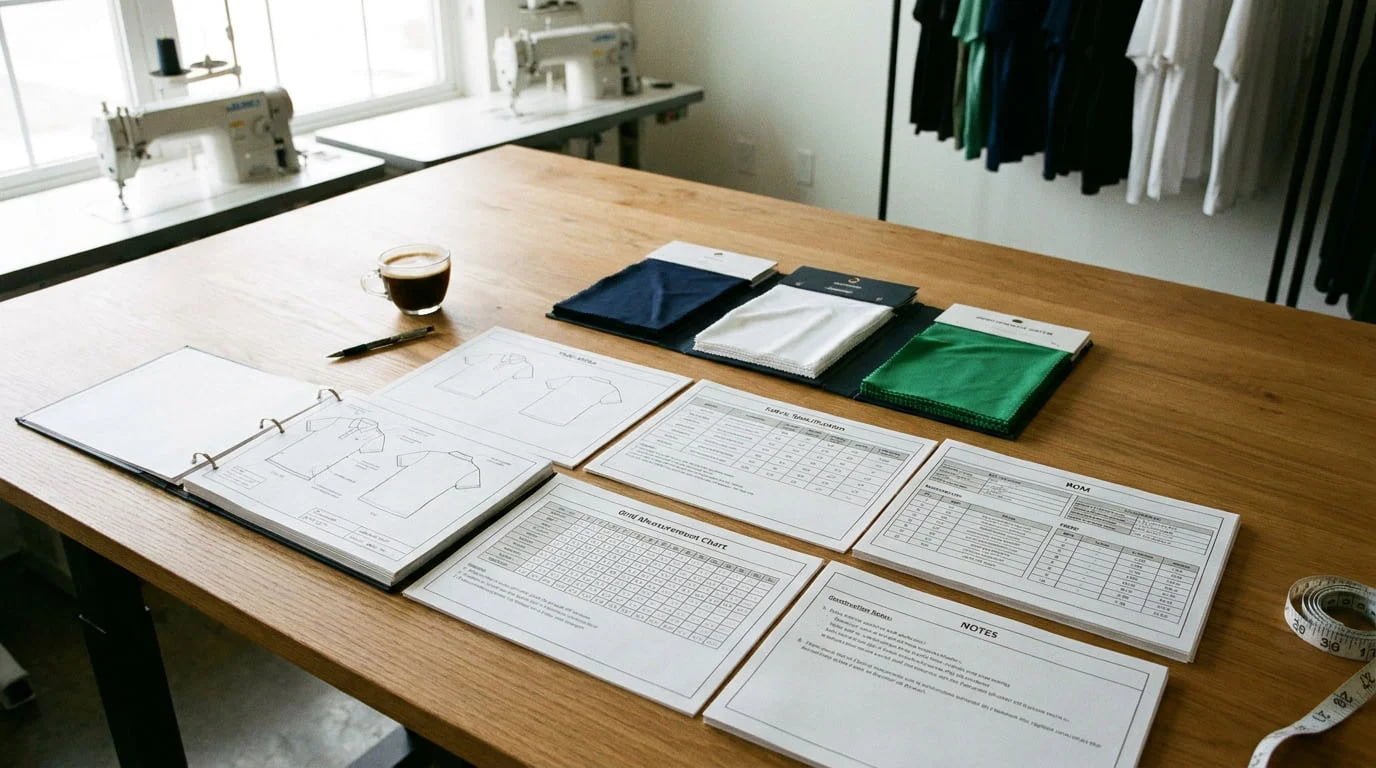
Recommended File Formats
| Document | Preferred Format | Purpose |
|---|---|---|
| Technical drawings | PDF / AI | Communicate garment design |
| Measurement chart | XLSX / PDF | Define sizing and measurement points |
| Fabric specifications | PDF / XLSX | Communicate material requirements |
| BOM | XLSX / PDF | Identify fabrics, trims, and components |
| Construction notes | Describe sewing and assembly details | |
| Reference photographs | JPG / PNG | Show appearance and construction references |
Editable source files are useful when the manufacturer is responsible for technical development. A controlled PDF version helps ensure everyone reviews the same released specifications.
What About Measurement Tolerances?
Each point of measurement (POM) should have a clear definition and tolerance.
At FUWAY, the standard finished-garment measurement tolerance is ±1.0 cm for specified POMs, unless a stricter requirement is agreed upon in the approved tech pack.
The measurement method must also be documented. Terms such as "chest width" or "body length" can otherwise be interpreted differently.
For a complete breakdown of required technical specifications, refer to our Golf Apparel Tech Pack Checklist.
This article focuses on transferring those files correctly, rather than explaining every technical specification in detail.
Key 3. Which Artwork and Logo File Formats Should You Send?
A logo that looks sharp on your website may not be suitable for embroidery, screen printing, or heat transfer production.
Your manufacturer needs both the design artwork and instructions explaining how it should appear on the garment.
Artwork File Requirements
| Application | Recommended Source File | Additional Information |
|---|---|---|
| Embroidery | AI / EPS / vector PDF | Logo dimensions, thread colors, placement |
| Screen printing | AI / EPS / vector PDF | Print dimensions, color references |
| Heat transfer | Vector or suitable high-resolution artwork | Transfer size, material, placement |
| Sublimation | Print-ready artwork to agreed specifications | Panel layout, scaling, color requirements |
| Woven label | Vector artwork | Label size, fold type, colors |
| Hangtag | Print-ready PDF / AI | Dimensions, artwork, finishing details |
Vector artwork is generally preferred because it can be resized without losing image quality.
For embroidery, the artwork must also be converted into a machine-compatible stitch file through embroidery digitizing. A vector logo alone is not the final machine file.
Include a Logo Placement Sheet
For each logo, specify:
- Artwork filename and version.
- Garment style and colorway.
- Decoration method.
- Finished logo width and height.
- Position measured from defined garment reference points.
- Approved colors.
- Any relevant backing, finish, or appearance requirements.
For example, "left chest logo" is not specific enough. A placement sheet should identify the measurement reference points and exact approved coordinates.
These requirements are particularly important for lightweight stretch golf polos, where decoration choices can affect garment appearance and flexibility.
FUWAY also supports Private Label Golf Apparel, including custom branding and labeling options.
Key 4. How Should You Organize Files Before Sending Them?
Even complete technical documents can create confusion when they are scattered across emails, messaging apps, and multiple folders.
A clear file structure helps the manufacturer identify current documents and avoid working from outdated instructions.
Recommended Manufacturer File Folder Structure

Here is an example for a custom golf polo project:
BrandName_GP001_GolfPolo/
│
├── 01_Product_Brief/
│   └── GP001_ProductBrief_v1.0.pdf
│
├── 02_Tech_Pack/
│   └── GP001_TechPack_v1.2.pdf
│
├── 03_Measurements/
│   └── GP001_SizeSpecs_v1.2.xlsx
│
├── 04_Fabric_and_BOM/
│   ├── GP001_FabricSpecs_v1.1.pdf
│   └── GP001_BOM_v1.2.xlsx
│
├── 05_Artwork/
│   ├── GP001_ChestLogo_v1.0.ai
│   └── GP001_LogoPlacement_v1.1.pdf
│
├── 06_Labels_and_Packaging/
│   └── GP001_PackagingSpecs_v1.0.pdf
│
└── 07_Approvals/
    └── GP001_ApprovalRecord.xlsx
This is an organizational example, not a mandatory FUWAY upload format.
Smaller projects may combine several documents into one PDF. More complex collections may require separate folders for each style or colorway.
Use Consistent File Names
A practical naming convention is:
[StyleNumber]_[DocumentType]_[Version].[Extension]
For example:
GP001_TechPack_v1.2.pdf
Avoid ambiguous filenames such as:
final.pdffinal_new.pdflatest_revised_final.pdf
Version numbers make it easier to confirm which document was used for sampling or production.
Key 5. How Do You Control File Versions and Approvals?
A manufacturer may receive several revisions during development.
If an updated measurement chart is approved but an earlier version remains in circulation, different teams may work from conflicting specifications.
The solution is to maintain one clearly identified current version for each document.
Use Three Simple File Statuses
| Status | Meaning | Can It Be Used for Bulk Production? |
|---|---|---|
| Draft | Under development | No |
| Pending Approval | Submitted for review | No |
| Approved | Authorized for its stated production purpose | Yes, when all required approvals are complete |
The approval record should identify who approved the document and when.
Maintain a Change Log
| Version | Document Change | Status |
|---|---|---|
| v1.0 | Initial golf polo specifications | Superseded |
| v1.1 | Collar dimensions revised | Superseded |
| v1.2 | Measurement chart and artwork confirmed | Approved |
When changes are made, update both the relevant source document and the released reference version.
Do not rely only on comments from chat messages or informal phone discussions.
Important: An approved sample does not automatically authorize every subsequent specification change. Any material change affecting fit, construction, color, artwork, or cost should be documented and approved before implementation.
Key 6. Golf Polo Example: A Complete Manufacturer File Handoff
Consider a hypothetical golf brand developing its first private-label performance polo.
The brand plans to produce 200 pieces across two colorways, with an embroidered chest logo.
Here is how its file package might develop.
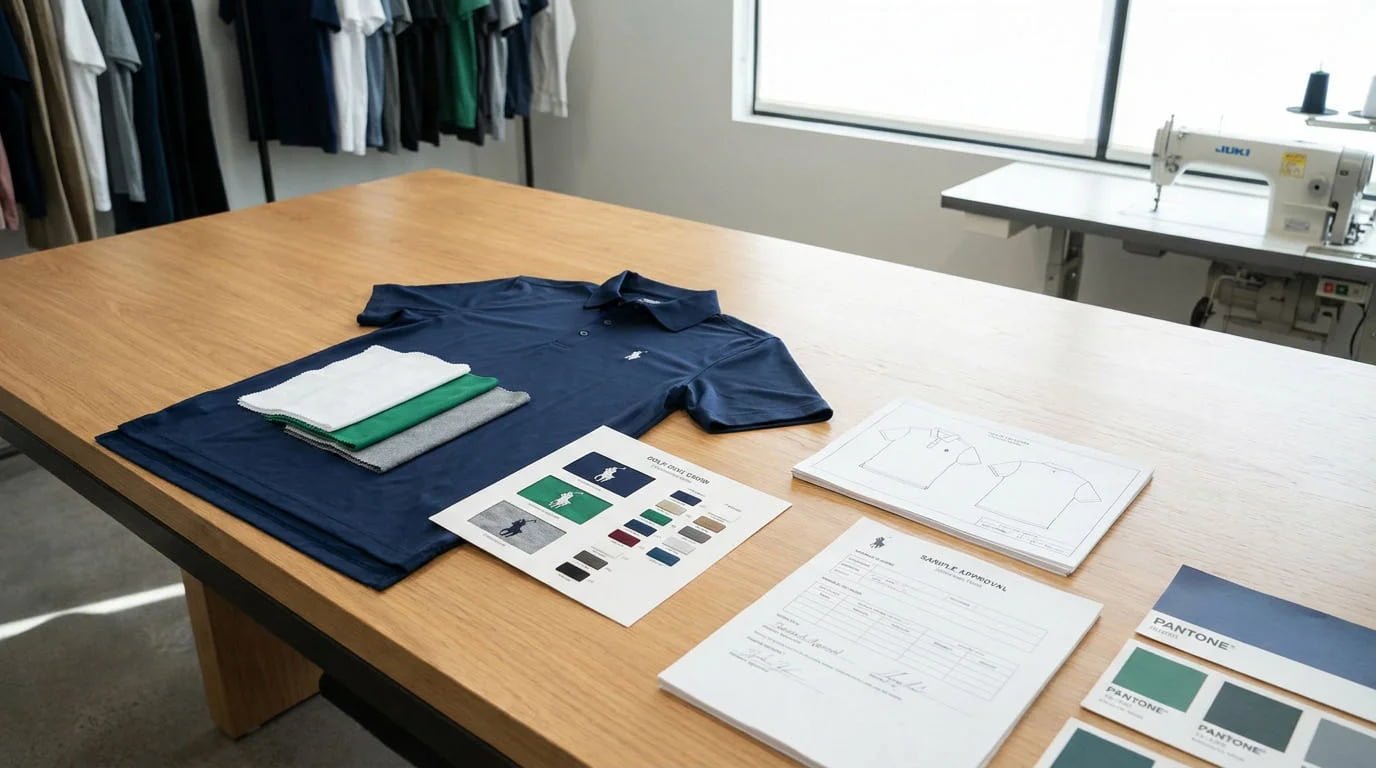
Stage A: Requesting a Quote
The brand sends:
- Product brief and reference images.
- Men's regular-fit golf polo description.
- Estimated quantity: 200 pieces.
- Two proposed colorways.
- Preliminary size range.
- Fabric performance preferences.
- Chest logo preview.
- Target delivery timeline.
The manufacturer reviews the requirements and identifies any assumptions that affect pricing.
The brand does not need to finalize every button, label, or measurement at this point.
Stage B: Preparing for Sampling
Once the project progresses, the file package expands to include:
- Technical flat drawings.
- Base-size measurement specifications.
- Proposed fabric and trim details.
- Logo source artwork.
- Placement instructions.
- Preliminary BOM.
- Sample objectives and review criteria.
The manufacturer and buyer confirm which specifications are fixed and which remain under development.
If the brand has a physical reference polo, it can also provide that garment to communicate fit, construction, and fabric hand feel.
However, the reference garment should be supported by written specifications before production approval.
Stage C: Approving Bulk Production
Before production release, the final package should contain:
- Approved tech pack.
- Final graded size specifications.
- Approved fabric and color references.
- Final BOM.
- Approved logo artwork and placement.
- Label and packaging instructions.
- Final size/color quantity breakdown.
- Documented sample approvals.
- Any agreed testing or inspection requirements.
The manufacturer should confirm that the documents match the approved sample and commercial order.
Why this matters: The goal is not to send the largest possible number of files. It is to make sure every production-critical decision has a clear, current reference.
For projects requiring fabric development, FUWAY's Golf Apparel Fabric Sourcing service can help buyers evaluate suitable materials and sampling options.
Key 7. What Should a Golf Apparel File Handoff Checklist Include?
A file handoff checklist is a document register that helps buyers track what has been submitted, what still needs approval, and which version the factory should use.
A simple Excel spreadsheet is sufficient.
Recommended Checklist Columns
| Field | Example |
|---|---|
| Style Number | GP001 |
| Document Name | Tech Pack |
| File Format | |
| Current Version | v1.2 |
| Production Stage | Pre-Sampling |
| Status | Pending Approval |
| Responsible Person | Brand Product Developer |
| Missing Information | Final collar dimensions |
| Approval Date | TBC |
Use one row for each document.
For a collection containing several styles, filter the spreadsheet by style number, production stage, or approval status.
Five Checks Before Sending Your Package
- Completeness: Are all files required for the next stage included?
- Consistency: Do the drawings, measurements, artwork, and BOM agree?
- Version: Are filenames and revision numbers clear?
- Approval: Are unapproved items clearly marked?
- Next Action: Does the factory know what it should review or produce?
Suggested downloadable resource: A "Golf Apparel Manufacturer File Handoff Checklist" in Excel format with a document register, version tracking, and approval-status fields.
This type of checklist complements a technical pack. It does not replace one.
Key 8. What Should Your Manufacturer Confirm After Receiving the Files?
Sending your documents is only half the process.
The manufacturer should review the package and clarify whether it contains enough information to proceed.
Manufacturer File Receipt Checklist
| Review Item | What the Manufacturer Should Confirm |
|---|---|
| File receipt | All expected attachments were received and opened |
| Version control | Current document versions are identified |
| Missing information | Gaps requiring buyer clarification are listed |
| Technical feasibility | Materials and construction can be evaluated |
| Sampling readiness | Requirements are sufficient for the agreed sample stage |
| Commercial assumptions | Pricing and timeline assumptions are identified |
| Next steps | Responsibilities and outstanding approvals are clear |
When requesting this review, ask the manufacturer to identify missing information rather than silently making assumptions.
For example:
Please confirm receipt of the attached files and advise whether any specifications, artwork, or approvals are missing before sampling. Kindly identify any assumptions that require our confirmation.
This creates a clear handoff between the brand and the factory.
It also reduces the chance of different departments working from incompatible instructions.
Key 9. Common File Handoff Mistakes to Avoid
Even experienced brands can encounter problems when documentation is poorly organized.
| Common Mistake | Better Approach |
|---|---|
| Sending only a product photo | Add product details, quantity, and fabric direction |
| Mixing old and new tech packs | Clearly identify the current version |
| Sending a logo without dimensions | Include artwork size and placement references |
| Leaving fabric details undefined | Mark requirements as preliminary or approved |
| Forgetting size/color quantities | Provide a separate quantity matrix |
| Changing specifications through chat only | Update the controlled document |
| Starting bulk production with pending approvals | Resolve critical items before release |
For manufacturers and buyers, these are not simply administrative issues.
They can affect sampling accuracy, material ordering, production scheduling, and final garment consistency.
Frequently Asked Questions
Do I need a full tech pack before contacting a golf apparel manufacturer?
No. You can begin with a product brief, reference images, estimated quantities, and basic customization requirements. More detailed specifications are needed as the project approaches sampling and production.
Can I send a physical golf shirt instead of technical drawings?
Yes, a physical reference garment can help communicate fit, fabric feel, and construction. However, intended modifications, measurements, branding, and final production requirements should still be documented.
Should I send editable files or PDFs?
Use controlled PDFs for consistent technical review and supply editable source files when the manufacturer needs to develop patterns, measurements, or artwork. The appropriate format depends on the document and development responsibilities.
What if I do not know the exact fabric specifications?
Describe the intended performance, appearance, hand feel, and weight range. A manufacturer can help propose suitable fabrics, but the selected material should be confirmed before final production approval.
How do I prevent the factory from using an outdated file?
Use consistent version numbers, maintain a document register, archive superseded files, and identify the approved version before sampling or bulk production begins.
Conclusion: Send the Right Files at the Right Time
Preparing files for a golf apparel manufacturer does not have to be complicated.
Start with a concise product brief for your inquiry. Add detailed technical specifications when preparing samples. Before bulk production, confirm that all critical documents, materials, artwork, and approvals are complete and current.
A well-organized file package makes communication clearer, reduces avoidable revisions, and gives both the brand and manufacturer a reliable production reference.
Need help preparing your golf apparel project?
FUWAY supports OEM and ODM development for golf polos, pants, skorts, quarter-zips, and other golf apparel. Whether you already have a complete tech pack or are starting with a design concept, our team can review your requirements and discuss the next development steps.
Contact FUWAY to share your product brief and discuss your manufacturing project.