Many founders enter golf apparel with a great idea but the wrong budget. They focus on logo design and samples, then get surprised by production deposits, shipping, duties, photography, returns, and marketing costs. That is usually where the problems begin.
In the USA, starting a golf clothing brand typically costs between $15,000 and $50,000 depending on your product complexity, order volume, manufacturing location, and launch strategy. Most new brands spend the bulk of their budget on sampling, first production, shipping, website setup, and marketing.
At FUWAY, I have worked with many first-time founders who thought the hardest question was how to design the product. In reality, the harder question is how to budget correctly. If you underfund the launch, you end up with too little inventory, delayed deliveries, or no money left to market the brand after production arrives.
This guide focuses only on cost. Not positioning, not branding theory, not trend forecasting. Just the real budget categories you need to understand before launching a golf clothing brand in the U.S.
Quick Answers: Startup Cost for a Golf Apparel Brand
Here are the numbers most founders want first:
- Lean launch budget: $15,000-$20,000
- Typical small-brand launch: $25,000-$40,000
- Better-capitalized launch: $40,000-$50,000+
- Samples per style: usually $100-$300
- MOQ for production: typically 200-300 units per style, sometimes more
- Landed cost for quality polos: often $14-$22 per unit
- Website and brand setup: usually $1,000-$5,000
- Initial marketing: often $1,000-$8,000, depending on channel mix
If you want enough room for mistakes, revisions, and a real launch plan, I usually tell founders to avoid starting with the absolute minimum.
The 7 Main Cost Categories You Need To Budget For
Most startup budgets fall into seven major categories: business setup, branding, product development, sampling, bulk production, shipping and duties, and launch marketing. Missing even one can distort your entire financial plan.
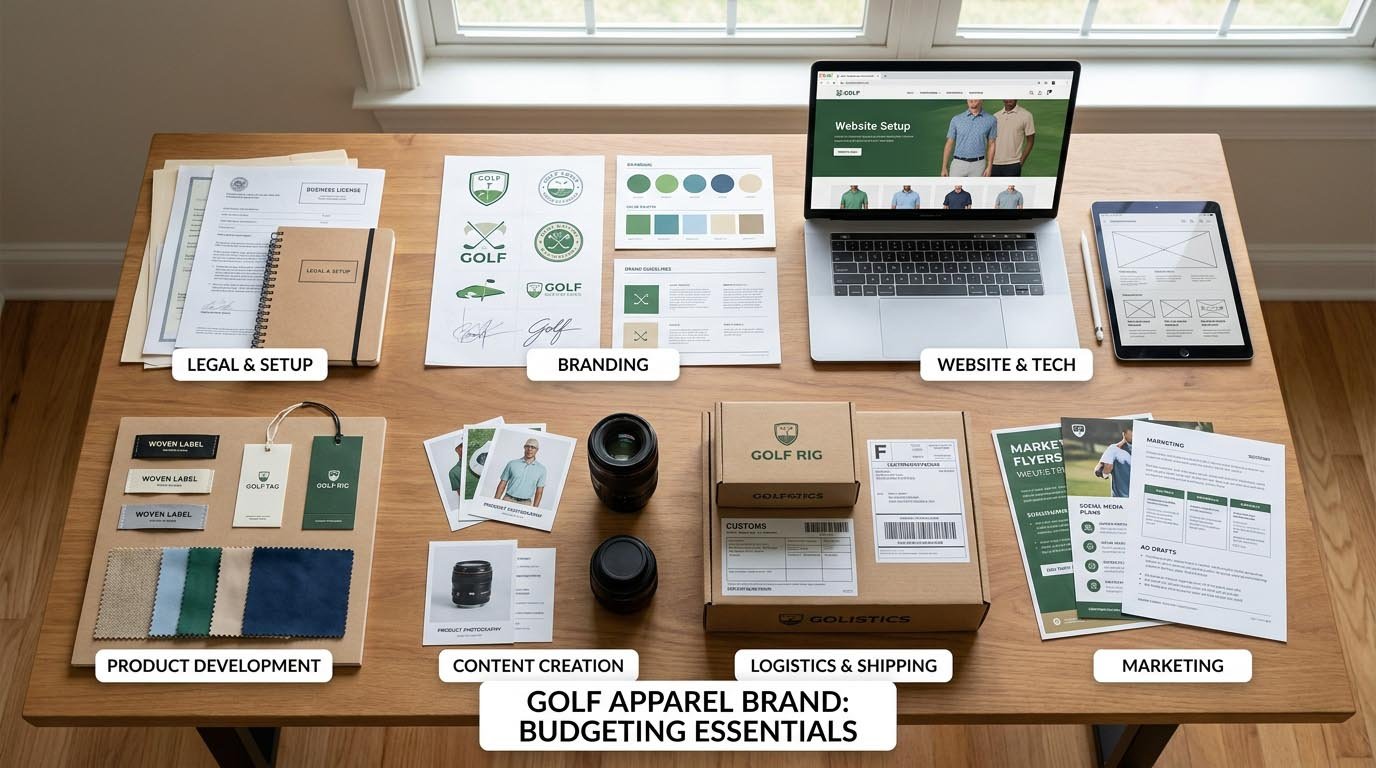
Below is how I would structure a realistic first-year launch budget.
1. Business Formation and Legal Setup
This is not the largest cost, but it is one of the first.
Typical expenses include:
- LLC formation: $100-$500 depending on state
- EIN: free
- Business bank account: usually free or low monthly fee
- Basic legal review or setup help: $300-$1,000
- Trademark filing: roughly $250-$350 per class, often more if using an attorney
- Insurance: often $500-$1,200 per year for basic product liability coverage
Estimated Range:
$500-$2,500
A lot of small brands delay trademark filing to save money. That is understandable, but at minimum you should confirm the brand name is usable before investing heavily in packaging, labels, and marketing assets.
2. Branding, Design and Website Setup
You do not need a huge agency budget to launch, but you do need to look credible.
This category often includes:
- Logo design
- Brand colors and identity system
- Packaging design
- Woven label and hang tag design
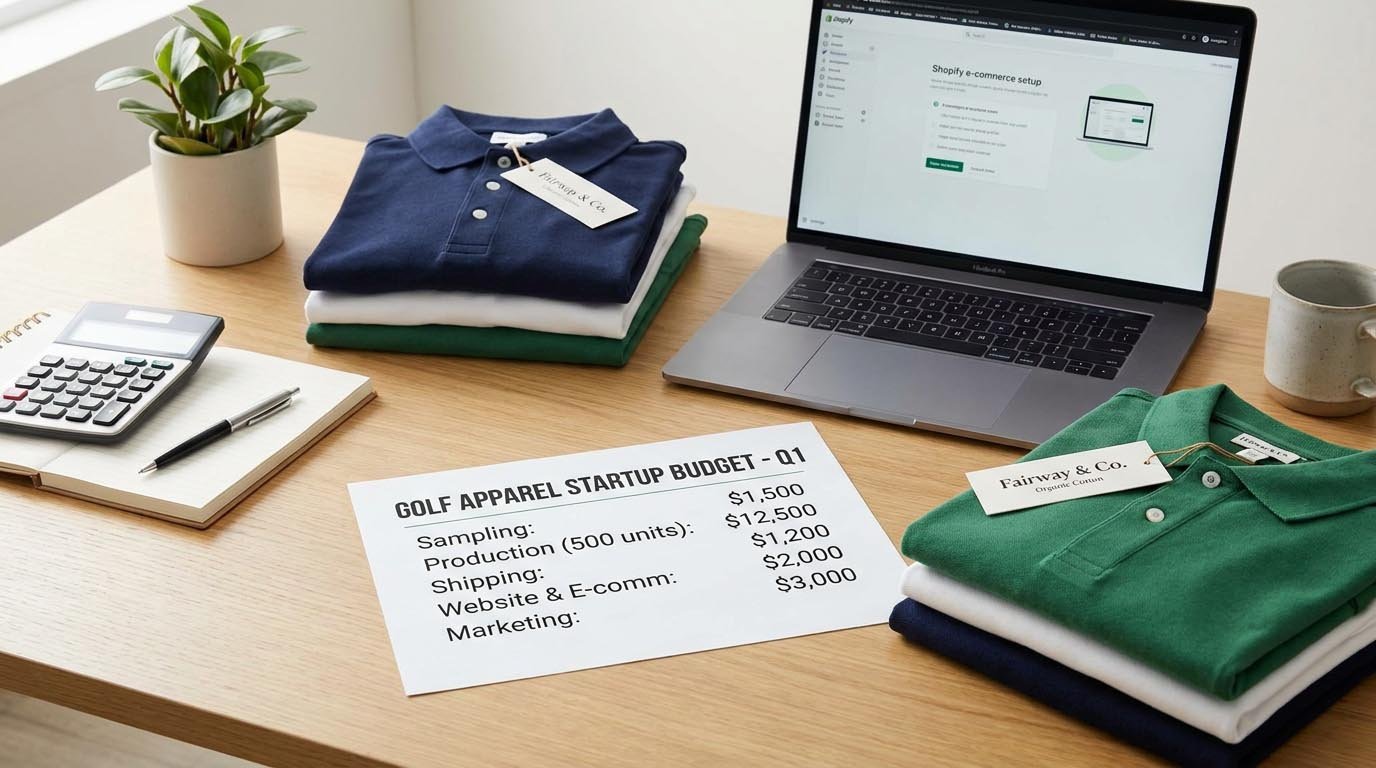
- Shopify setup[^1]
- Theme customization
- Domain and email setup
- Basic copywriting or product page creation
Typical Cost Range:
| Item | Estimated Cost |
|---|---|
| Logo / visual identity | $300-$2,000 |
| Website platform and theme | $300-$1,500 |
| Packaging design | $200-$800 |
| Product photography | $800-$2,500 |
| Email / app setup | $100-$500 |
Estimated Range:
$1,500-$6,000
If you bootstrap, you can stay on the lower end using Shopify templates and freelance help. If you want a polished premium look from day one, costs rise quickly.
Product Development Costs: Where New Brands Often Underestimate
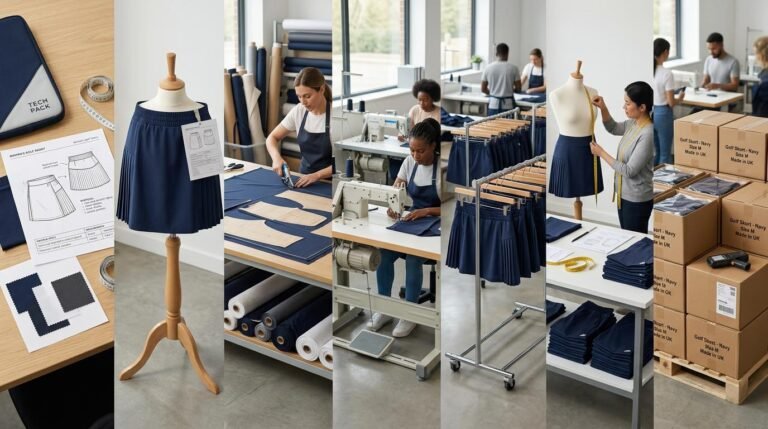
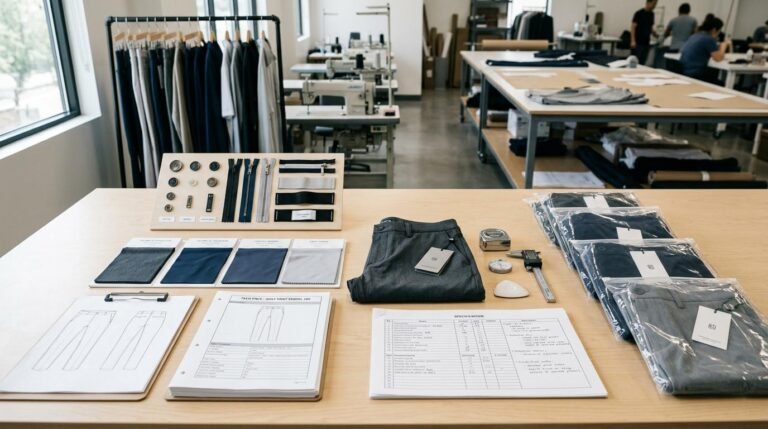
Development costs are not just about making the final garment. They include tech packs, fabric selection, trim decisions, fit revisions, sample corrections, and wear testing. This phase is often more expensive than founders expect.
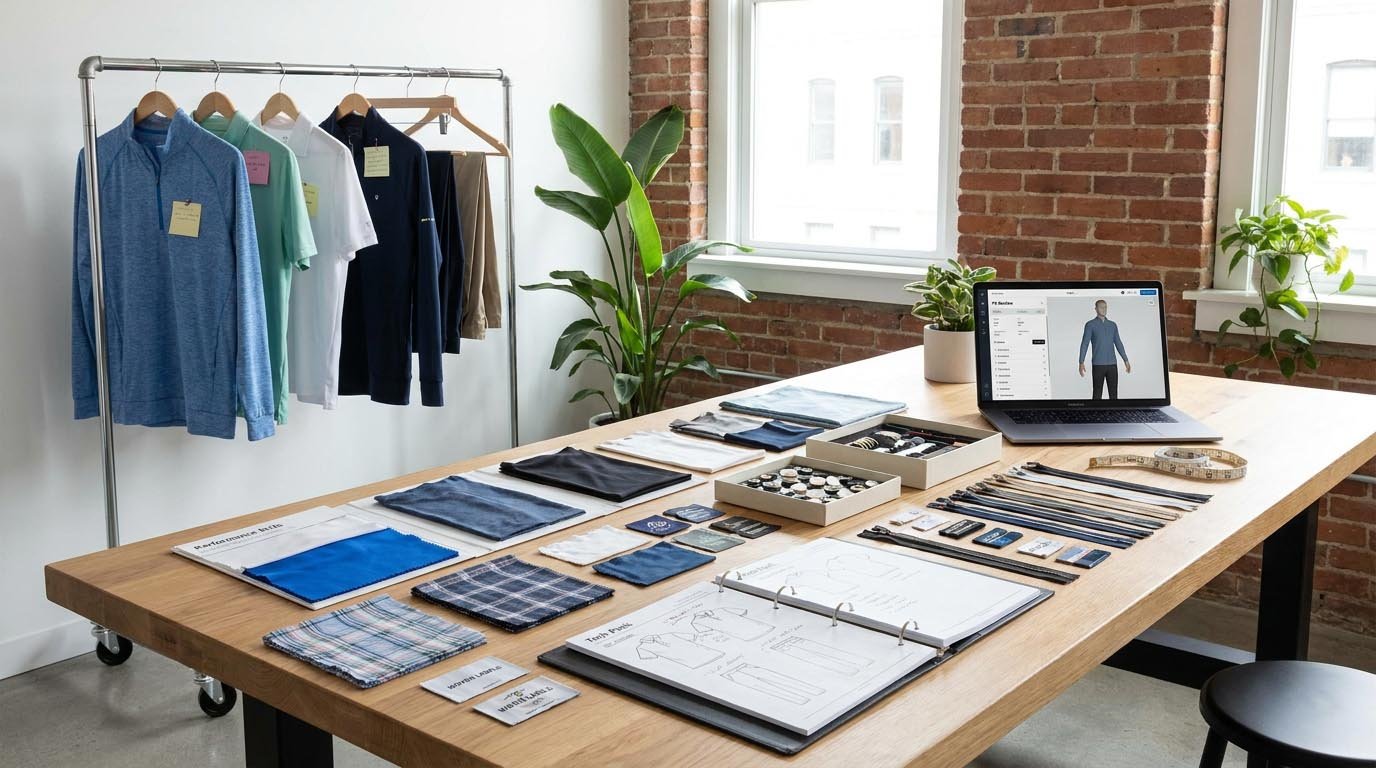
Many new founders assume they can jump directly to production after one sample. That is rarely a good idea.
What Product Development Usually Includes
- Design sketch or concept refinement
- Tech pack creation
- Fabric sourcing
- Trim sourcing
- Label development
- Size spec setup
- Fit sampling
- Salesman or pre-production samples
- Revisions after comments
- Test wearing and wash checks
Sample Cost by Product Type
| Product Type | Typical Sample Cost |
|---|---|
| Performance polo | $100-$200 |
| Golf pants / shorts | $120-$250 |
| Quarter-zip / outerwear | $150-$300 |
| Women’s skort / dress | $120-$250 |
If you launch with 4-6 styles, and each style needs 1-3 rounds of samples, your development budget can grow fast.
Example Development Budget
For a small collection of:
- 2 polos
- 1 pant
- 1 quarter-zip
A realistic sample budget could look like this:
- First proto round: $600-$900
- Revisions / second round: $400-$700
- Shipping samples back and forth: $150-$400
- Fabric swatches and trim development: $100-$300
Estimated Range:
$1,200-$2,300
For more complex collections, expect more.
Bulk Production: The Biggest Cost in Most Launches
Your first production run will usually be the largest line item in the entire startup budget.[^2] Product category, fabric choice, customization, and MOQ all directly affect how much cash you need upfront.
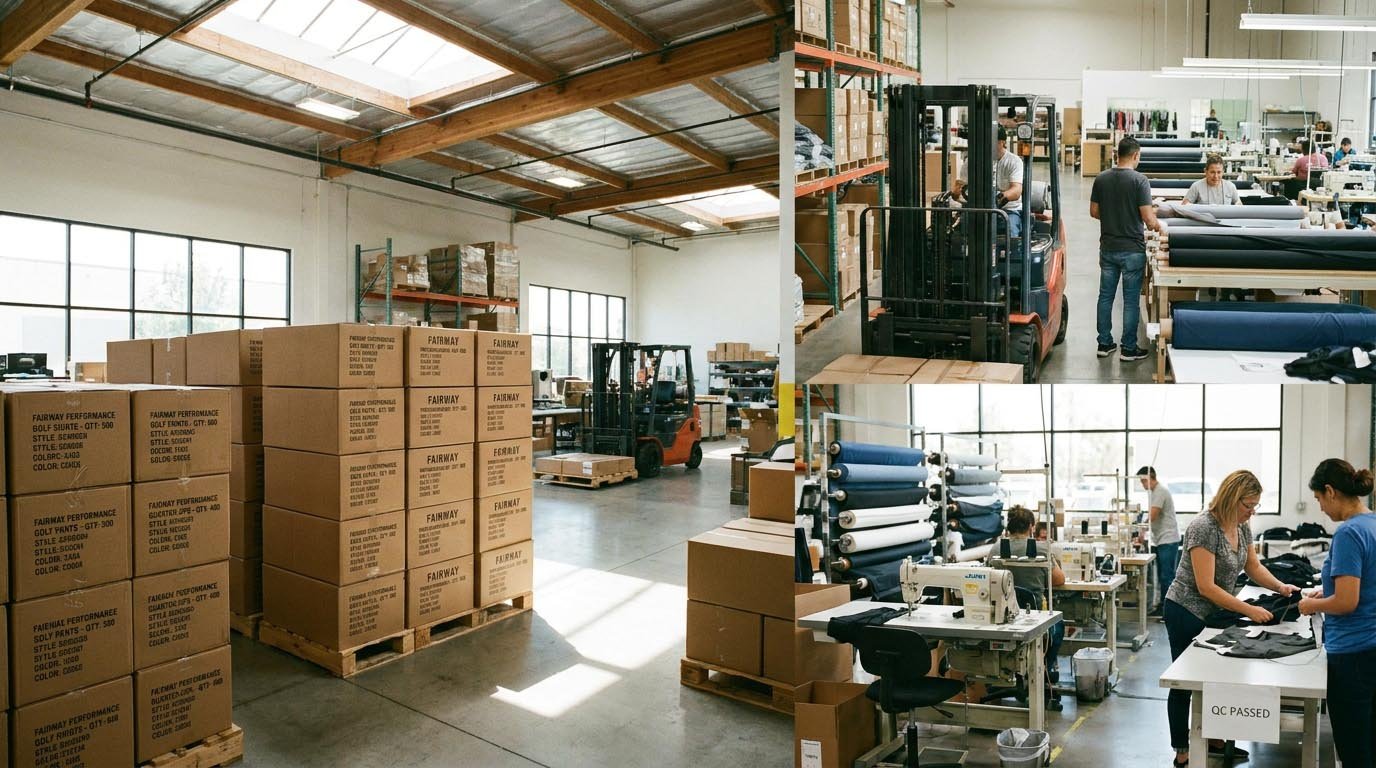
This is where founders often realize their launch plan is too broad.
Typical First-Order Unit Costs
These are broad working ranges for decent-quality golf apparel, not ultra-budget and not luxury European production.
| Product Type | Typical Factory Cost |
|---|---|
| Performance polo | $12-$18 |
| Golf pants / joggers | $16-$24 |
| Shorts | $14-$20 |
| Quarter-zip / lightweight layer | $18-$30 |
| Hat / cap | $5-$12 |
These numbers can rise if you use:
- recycled or specialty fabrics
- premium trims
- all-over prints
- embroidery
- complex panels
- lower-than-standard MOQ
Example First Production Budget
Let us say a founder launches with:
- 300 polos at $14
- 300 pants at $20
- 300 quarter-zips at $24
The factory cost alone would be:
- Polos: $4,200
- Pants: $6,000
- Quarter-zips: $7,200
Total factory cost: $17,400
Then add trims, labels, packaging upgrades, and QC support, and the total may move closer to $18,500-$19,500.
Estimated Production Range:
$8,000-$30,000+
That is why small brands should usually start with fewer styles, not more.
Shipping, Duties and Landed Cost: The Budget Line Founders Forget
Factory price is not your real cost. What matters is landed cost: product cost plus freight, duties, customs fees, local delivery, and sometimes inspection.
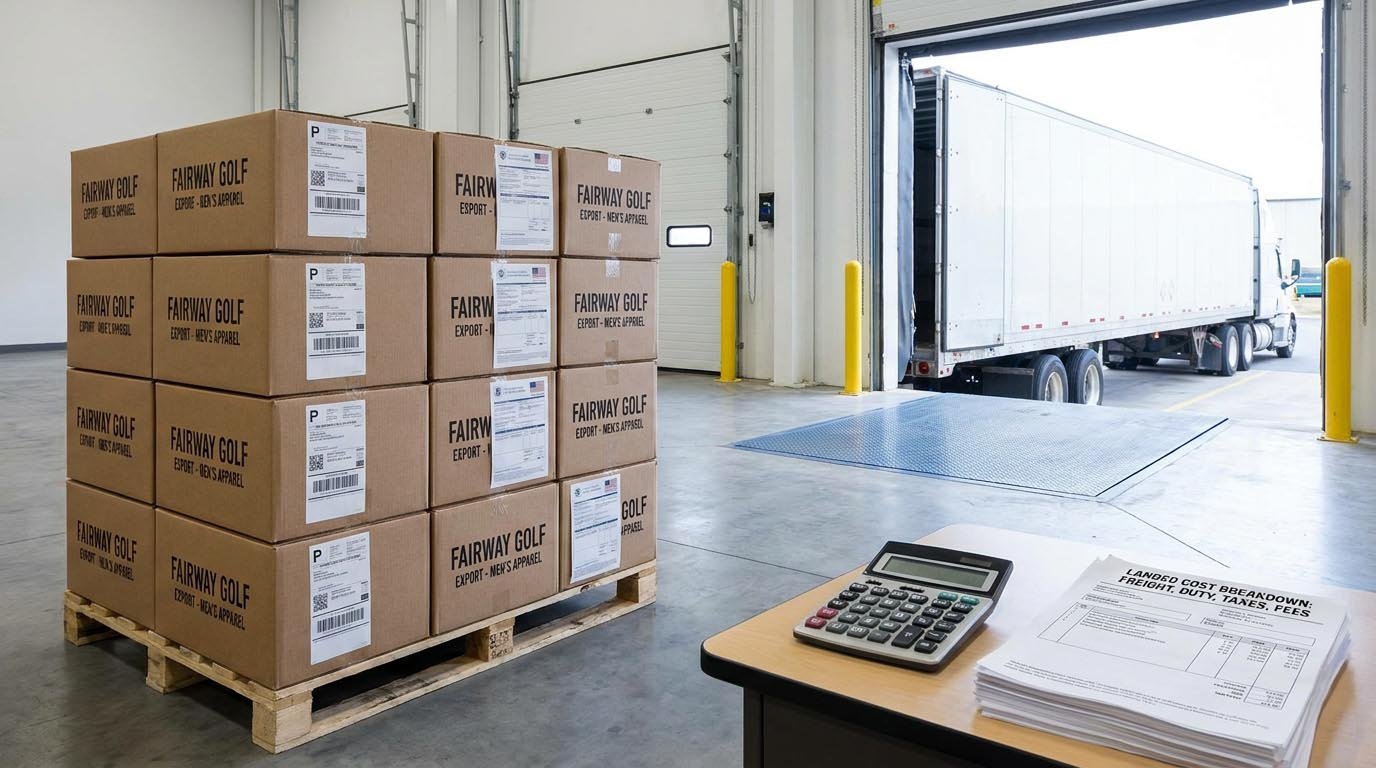
A founder may think a polo costs $14, but after freight and import charges, the true cost may be closer to $17-$20.
Costs That Affect Landed Price
- Ocean or air freight
- Fuel surcharges
- U.S. customs duties
- Customs broker fees
- ISF filing
- Local trucking or warehouse delivery
- Port congestion or exam charges in some cases
Basic Rule of Thumb
For many first orders coming from Asia:
- Add roughly 15-30% above factory cost to estimate landed cost
- Air freight increases cost dramatically but saves time
- Sea freight is cheaper but slower
Example
If your goods cost $12,000 at factory level:
- Freight and duties may add $2,000-$3,500
- Your total landed cost becomes $14,000-$15,500
Estimated Range:
$1,500-$5,000+
This depends heavily on volume, shipping method, and timing.
Marketing and Launch Costs: You Still Need Money After Inventory Arrives
One of the most common startup mistakes is spending the full budget on product and having nothing left to create demand. Inventory alone does not build a brand.
I have seen founders spend everything getting product into the warehouse, then try to launch with no photo assets, no ad budget, and no email strategy. That usually slows sales and hurts cash flow.
Common Launch Marketing Expenses
- Product photography and lifestyle shoot
- Paid social ads
- Influencer seeding
- Email and SMS setup
- Launch discount strategy
- PR outreach
- Event booth or tournament participation
- Packaging inserts and brand collateral
Starter Marketing Budget
| Marketing Activity | Estimated Cost |
|---|---|
| Product / lifestyle photos | $800-$2,500 |
| Paid social ads | $500-$3,000 |
| Micro-influencer seeding | $300-$1,500 |
| Email / SMS software | $50-$300/month |
| Launch event / local activation | $300-$2,000 |
Estimated Range:
$1,500-$8,000
You do not need to overspend. But you do need enough budget to create visibility.
Three Realistic Startup Budget Scenarios
The best budget depends on how lean you want to be, how many products you launch with, and how much risk you can absorb.
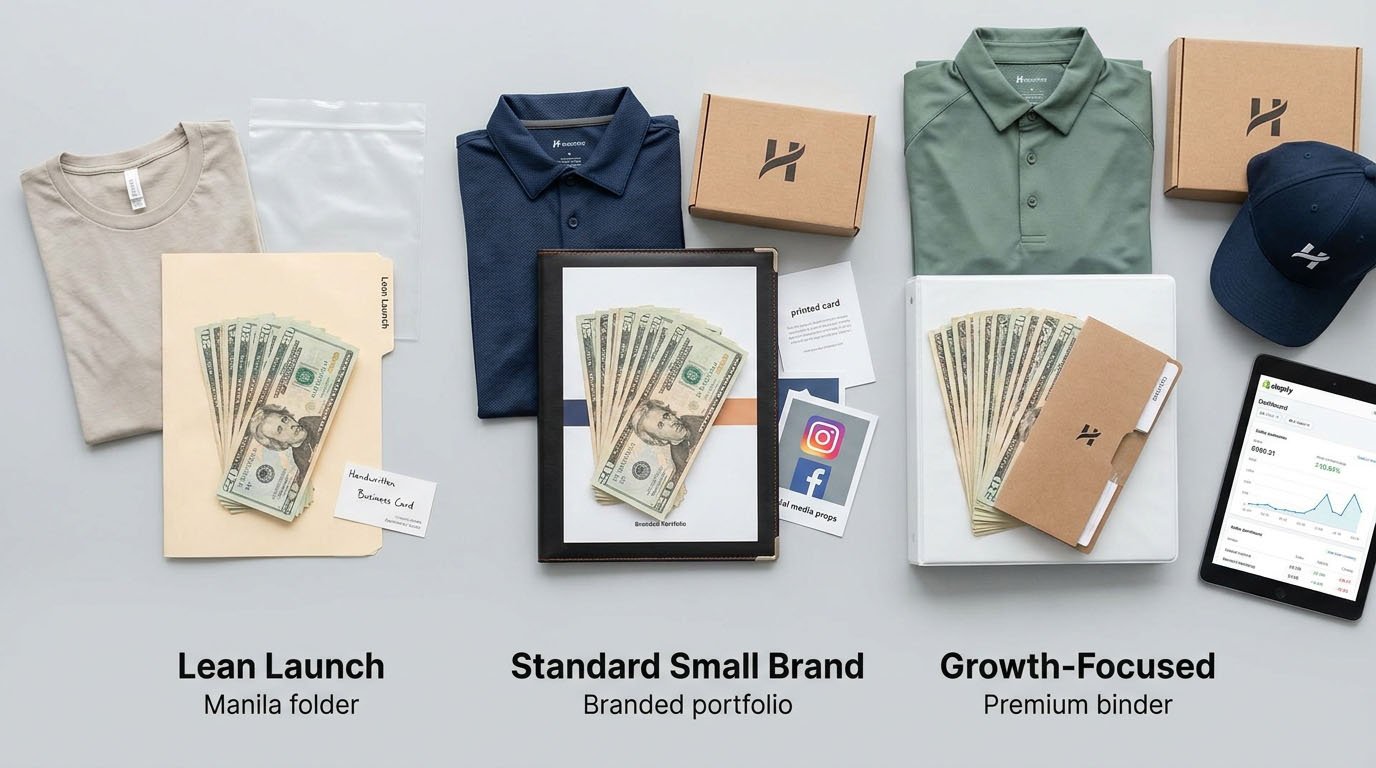
1. Lean Launch: $15,000-$20,000
Best for founders who want to test the market carefully.
Typical setup:
- 2-3 core styles
- minimal packaging
- simple Shopify store
- limited paid ads
- lower initial depth
- mostly DTC launch
Pros:
- Lower risk
- Faster learning
- Easier to manage cash
Cons:
- Less inventory depth
- Fewer size and color options
- Little margin for error
2. Standard Small-Brand Launch: $25,000-$40,000
This is the range I consider most practical for a serious launch.
Typical setup:
- 4-6 styles
- better quality samples and fit work
- professional photography
- stronger inventory position
- real paid marketing budget
- some room for reorders or mistakes
Pros:
- Better brand presentation
- More complete product offer
- Healthier launch support
Cons:
- Larger upfront risk
- More inventory to manage
3. Growth-Focused Launch: $40,000-$50,000+
Best for founders who want stronger marketing and broader assortment from the beginning.
Typical setup:
- more polished branding
- deeper size runs
- premium fabrics
- better content and launch assets
- wholesale readiness
- event and partnership budget
Pros:
- Stronger first impression
- better scaling potential
- more flexibility
Cons:
- More capital at risk
- harder to pivot if product mix is wrong
Cost by Manufacturing Location
Where you manufacture affects not only product cost but also MOQ, communication, lead time, and flexibility.
Here is a simple comparison:
| Location | Relative Cost | Typical Strength |
|---|---|---|
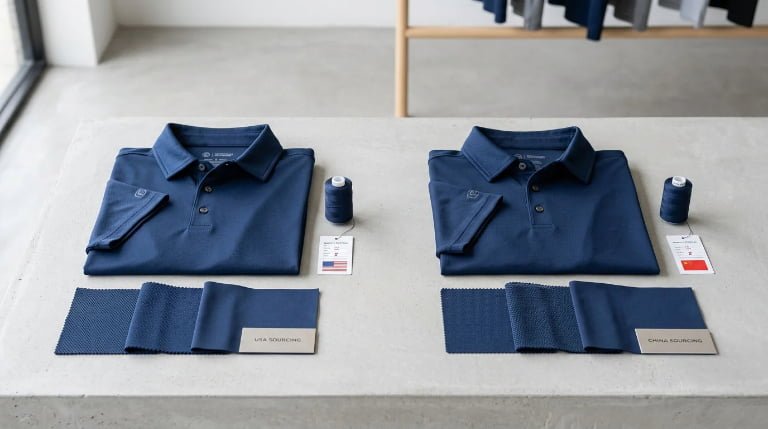
| China | Low to mid | Technical fabrics, scalable production, broad sourcing network |
| Vietnam | Mid | Good quality, growing technical capability |
| USA | High | Faster communication, shorter supply chain, smaller runs in some cases |
| Portugal / Europe | High | Premium positioning, smaller luxury programs |
For most startup golf brands, overseas production offers better cost structure. U.S. manufacturing may be attractive for branding reasons, but the unit cost is often much higher.
Hidden Costs That Catch New Founders Off Guard
The most painful expenses are often the ones founders did not budget for at all.
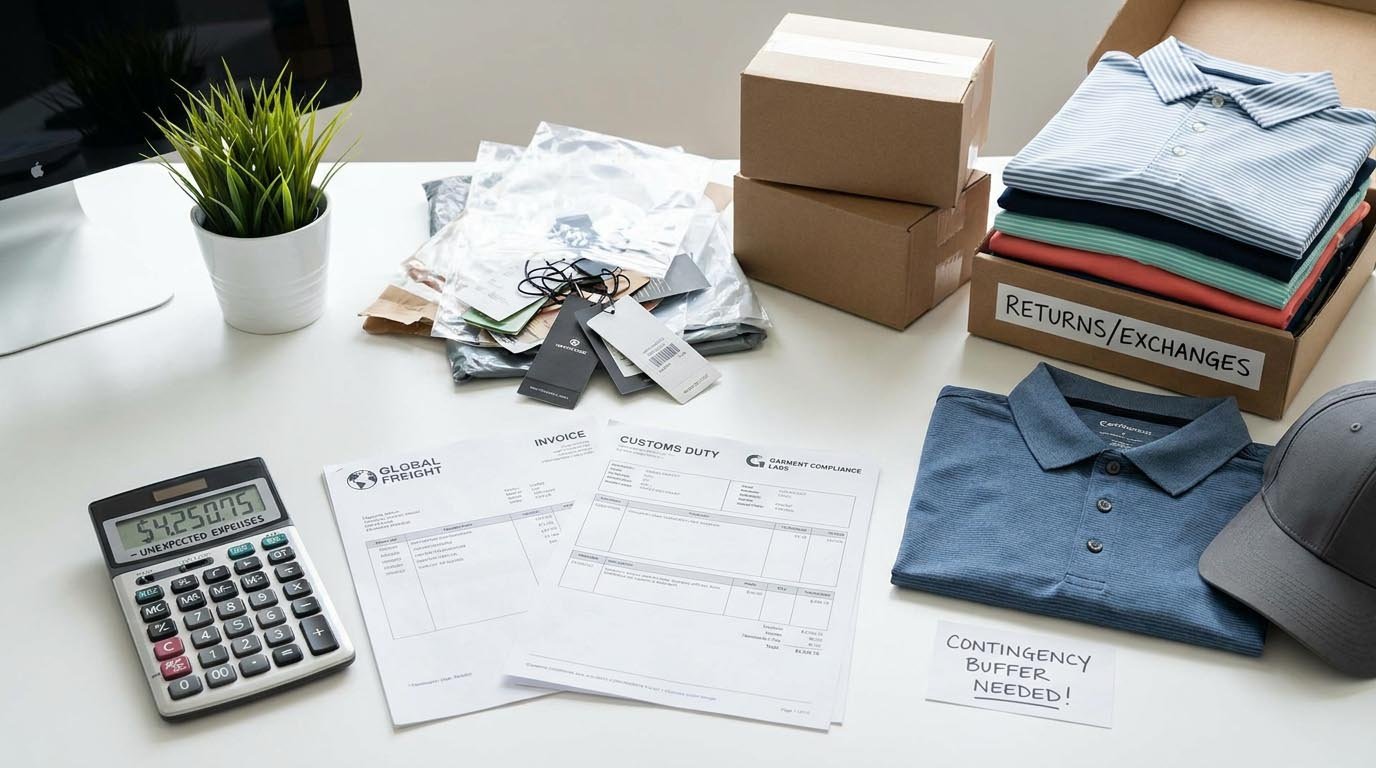
Watch for these:
- sample revisions
- expedited shipping
- customs delays
- storage and fulfillment fees
- return handling
- sizing exchanges
- extra packaging requirements
- re-labeling or compliance corrections
- product testing
- software subscriptions
- merchant processing fees
- discounting to drive first sales
Even a well-planned launch should keep some buffer.
Recommended Buffer
I strongly recommend setting aside 10-20% of your total budget as contingency.
If your planned startup cost is $25,000, try not to spend the full amount on the initial plan. Keep $2,500-$5,000 available for surprises.
How To Reduce Startup Cost Without Damaging Your Brand
You can reduce startup cost intelligently by simplifying the launch, not by cutting the wrong corners.
Here are the smartest ways to reduce cost:
Do This
- Launch with fewer styles
- Reuse one fabric across multiple products where possible
- Limit color count
- Use standard trims instead of fully custom hardware
- Start with DTC before pushing wholesale
- Use a templated Shopify setup
- Focus ad budget on one or two channels only
- Order stronger depth in proven sizes, lighter depth in extreme sizes
Avoid This
- Choosing very cheap fabric that hurts quality
- Skipping fit revisions
- Overdesigning your first collection
- Launching with too many SKUs
- Spending everything on branding and nothing on marketing
- Using a factory with poor communication just to save a few dollars
Low cost is not the same as smart cost.[^3]
FAQ: Cost of Starting a Golf Clothing Brand
What is the minimum budget to start a golf clothing brand?
You can launch very lean around $15,000-$20,000, but that usually means fewer styles, tight inventory, and limited marketing. It is possible, but there is not much room for mistakes.
What is a realistic budget for a serious small launch?
For most founders, $25,000-$40,000 is a more realistic range. That usually allows proper samples, enough inventory, branding, a website, and some marketing support.
What is the most expensive part of starting a golf apparel brand?
Usually bulk production, followed by shipping and marketing. Sampling can also add up if you make too many revisions or launch too many styles.
Can I start with just polos?
Yes, and in many cases that is a smart move. Polos are one of the easiest categories to build a focused launch around. Starting with one strong category reduces complexity and cost.
Is U.S. manufacturing cheaper once shipping is removed?
Usually no. Even after adding freight and duties, overseas production is often still more cost-effective for startup golf brands, especially when using performance fabrics.
How much should I budget for marketing?
At minimum, try to reserve $1,500-$3,000 for launch content and customer acquisition. If you want stronger visibility, the budget may need to be $5,000+.
Should I budget for reorders immediately?
If possible, yes. A launch that sells well creates its own pressure. If you have no cash left for reorders, you risk stocking out right when demand starts building.
Conclusion
Starting a golf clothing brand in the USA can cost as little as the mid-teens or as much as $50,000 and beyond, but the real difference comes down to how focused your launch is and how accurately you budget for production, shipping, and marketing.
The founders who handle cost best are not always the ones who spend the most. They are the ones who understand where the money really goes.
[^1]: "Shopify Dev Docs", https://shopify.dev/docs. Shopify's official documentation and user guides confirm that basic store setup can be accomplished with standard templates and minimal technical expertise. Evidence role: general_support; source type: education. Supports: Shopify setup. Scope note: Customization and advanced features may require additional costs or expertise.
[^2]: "How much does it cost to start a clothing brand in 2026? | Printful", https://www.printful.com/blog/cost-of-starting-clothing-line. Small business and apparel industry reports consistently identify bulk production as the largest single expense for new clothing brands. Evidence role: expert_consensus; source type: institution. Supports: Your first production run will usually be the largest line item in the entire startup budget.. Scope note: Relative costs may differ for non-apparel startups.
[^3]: "7 Smart Pricing Strategies to Attract Customers", https://www.uschamber.com/co/run/finance/pricing-strategies-for-your-business. Entrepreneurship and small business management literature emphasize that minimizing costs without strategic planning can harm product quality and brand reputation, distinguishing 'smart cost' from simply 'low cost.' Evidence role: expert_consensus; source type: education. Supports: Low cost is not the same as smart cost.. Scope note: The concept is widely accepted but not always quantified in research.