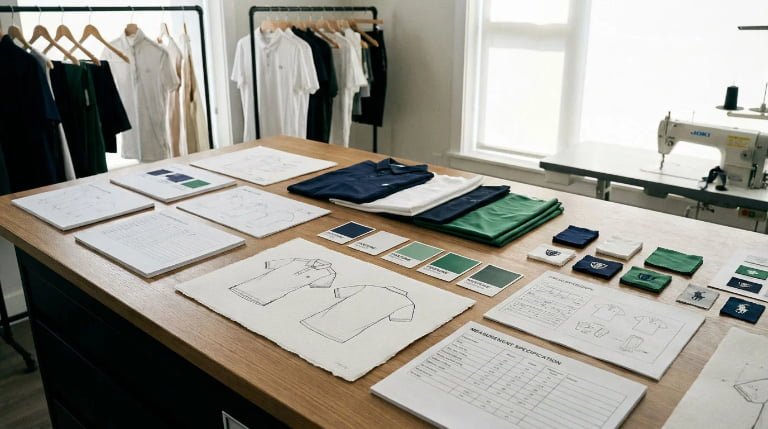
Give two factories the same fabric and the same "Large" label. You'll get two completely different golf polos.
Here's why — and what actually controls the difference.
The difference is not the fabric or a simple increase in size. It comes from how the brand defines its fit specifications and underlying pattern structure.
A golf polo fit block is a foundational pattern that establishes the garment's silhouette and proportional relationships. Regular, Athletic, and Relaxed fits must be defined through coordinated design decisions — not by universal size labels or a single chest measurement.
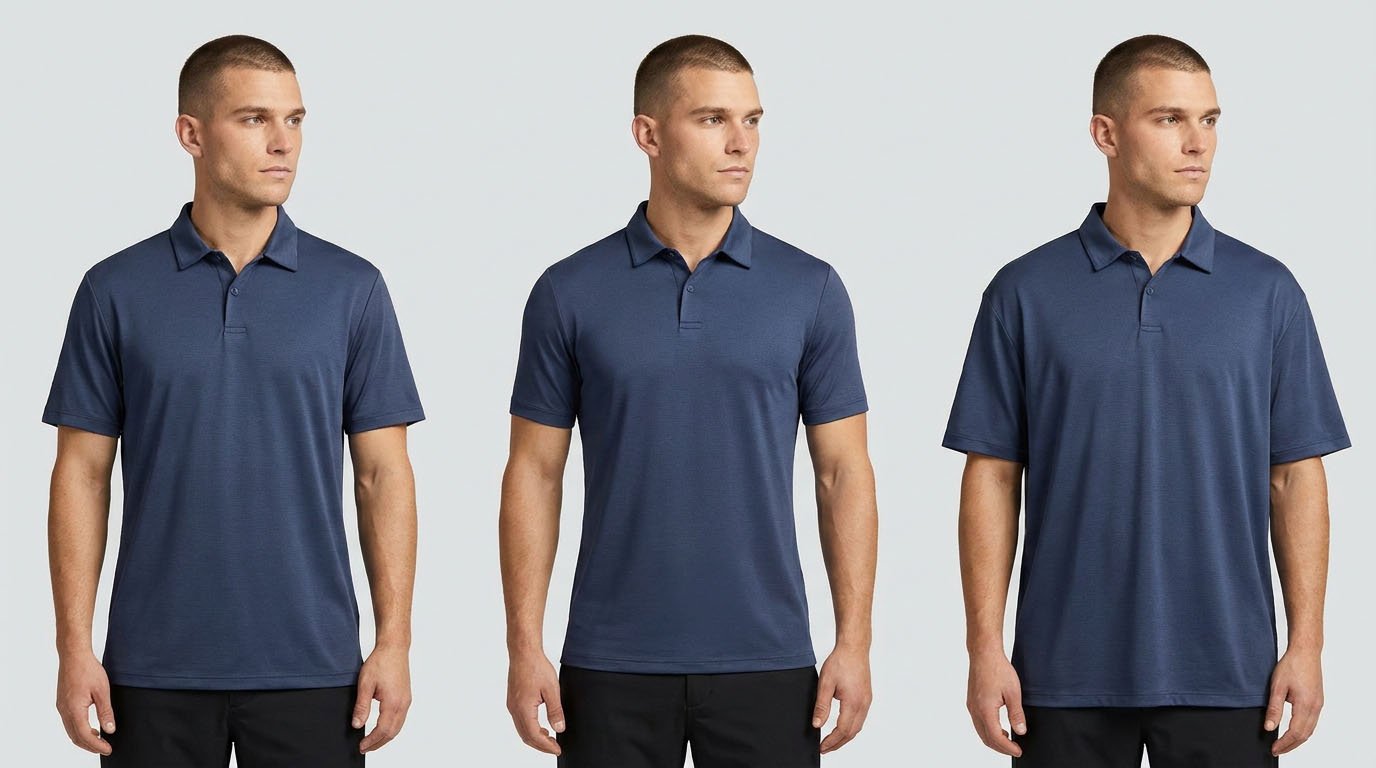
For brands developing custom golf polos, choosing the right foundation matters. Subsequent styles and sizes are typically developed from that starting pattern.
This guide explains how the three fit directions differ, when to adapt an existing block, and what real FUWAY Slim Fit and Relaxed Fit size specifications reveal about developing distinct garment proportions.
Key 1: What Is a Golf Polo Fit Block?
A fit block is a foundational garment pattern that serves as the starting point for developing a particular silhouette.
It establishes relationships between garment components, including:
- Chest and waist proportions
- Shoulder width and shape
- Armhole and sleeve construction
- Front and back body balance
- Body length and hem proportions
A block is not simply a collection of finished-garment measurements.
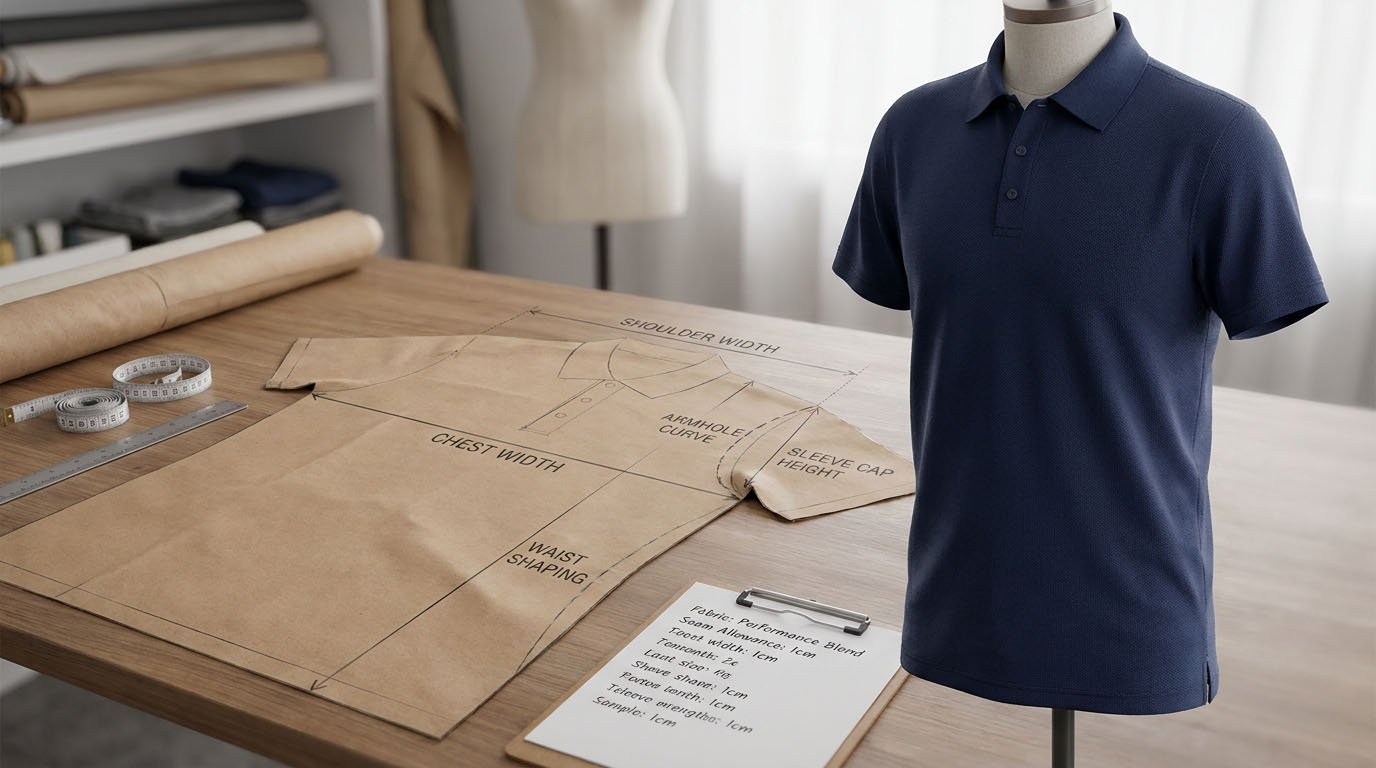
Fit Block vs Size Chart
| Feature | Fit Block | Size Chart |
|---|---|---|
| Purpose | Establishes pattern shape and proportions | Records target garment dimensions |
| Main Information | Pattern structure, shaping, balance | POM values and grading |
| Development Role | Foundation for creating a fit | Measurement reference for each size |
| Core Question | How is the garment constructed to achieve its silhouette? | What should the finished garment measure? |
For example, two polos can share the same half-chest measurement but differ in shoulder, waist, and sleeve proportions. Their overall appearance and wearing characteristics can therefore be completely different.
A fit block establishes the intended structure. The size chart records the dimensions required for individual sizes. Both matter, but they serve fundamentally different purposes.
Key 2: Regular vs Athletic vs Relaxed — What Actually Changes?
Regular, Athletic, and Relaxed Fit are useful design descriptions. They are not universal technical standards.
Their meanings depend entirely on the brand's intended silhouette and approved specifications.
Comparing the Three Fit Directions
| Pattern Characteristic | Regular Fit | Athletic Fit | Relaxed Fit |
|---|---|---|---|
| Overall silhouette | Balanced, straight or gently shaped | More contoured | Fuller, less body-defining |
| Chest-to-waist shaping | Limited to moderate | Often more pronounced | Usually less pronounced |
| Shoulder proportions | Balanced for intended wearer | Defined around upper-body shape | Coordinated with fuller body volume |
| Sleeve profile | Moderate volume | Often more fitted | Usually fuller |
| Body shape | Versatile | More tapered | Straighter or more voluminous |
| Development priority | Consistent balanced proportions | Controlled shaping | Intentional volume |
These are general design directions. No single measurement range defines every Regular, Athletic, or Relaxed golf polo.
Regular Fit: Calibrating Your Brand's Baseline
Regular Fit serves as the anchor for your entire golf polo collection. It defines the core wearing silhouette your brand will be known for.
It is not the mathematical midpoint between Athletic and Relaxed. It is an independent, balanced starting point.
A Regular block typically features:
- A straight or slightly tapered body
- A shoulder line appropriate to the intended wearer
- Moderate sleeve volume
- Proportioned body measurements that provide a reference for developing other fits
Athletic Fit: Shaping Without Simply Downsizing
Athletic Fit combines a defined torso with proportions designed to accommodate the upper body.
The goal is a more shaped silhouette — not an overall reduction in garment size.
Depending on the design, the pattern may require:
- Greater chest-to-waist shaping
- Specific shoulder and upper-back proportions
- Coordinated armhole and sleeve construction
- A controlled hem width
Athletic Fit should not automatically be treated as Slim Fit.
Slim Fit generally describes a closer overall silhouette. Athletic Fit often retains more upper-body room while narrowing the waist. The exact distinction is brand-specific and must be defined through your own approved specifications.
Actionable tip: If you're specifying Athletic Fit to a manufacturer, provide a reference garment or annotated sketch — don't rely on the label alone.
Relaxed Fit: Adding Deliberate Volume
Relaxed Fit provides more volume through the garment body. However, it should not be developed by simply grading a Regular Fit up one size.
Doing so changes multiple dimensions simultaneously — shoulder, neckline, sleeve, and body length — which may not produce the intended proportions.
A Relaxed block can use a conventional shoulder position or an intentionally extended shoulder line. The correct approach depends on your design, not a fixed industry rule.
For detailed diagnosis of shoulder, sleeve, and other construction problems, see FUWAY's Golf Polo Fit and Pattern Guide.
Key 3: How Should Brands Select a Starting Fit Block?
The first technical decision is not necessarily whether to choose Regular, Athletic, or Relaxed.
It is whether an existing pattern already provides a suitable foundation for the intended garment.
Step 1: Identify the Intended Silhouette
Start with the shape you want to achieve. Ask yourself:
- Should the torso appear straight or tapered?
- Should the sleeve look close-fitting or fuller?
- Where should the shoulder line sit?
- How much volume should the lower body have?
- Does an existing approved garment represent the intended appearance?
A physical reference garment or annotated design sketch clarifies these decisions more effectively than a fit label alone.
Step 2: Evaluate Existing Pattern Options
| Starting Situation | Recommended Approach |
|---|---|
| An approved block already matches the intended silhouette | Reuse it |
| An existing block is close but needs limited proportion changes | Evaluate an adapted version |
| The new silhouette differs substantially from available blocks | Develop a distinct base block |
| The brand has no approved pattern reference | Define a starting block using its fit brief and reference information |
The purpose is to select a technically appropriate starting point — not to create unnecessary new patterns.
Step 3: Identify the Proportions That Must Remain Consistent
Before pattern development begins, establish which features define your brand's intended fit.
One brand may want to preserve its existing shoulder appearance while changing the waist and hem proportions. Another may want a substantially different shoulder and sleeve silhouette.
These are different development requirements, even if both are described as changes to fit.
For a broader discussion of consumer-facing fit positioning, see Slim Fit vs Regular Fit Golf Polo.
Key 4: Real Factory Example — FUWAY Slim Fit vs Relaxed Fit Specifications
To illustrate how different fit specifications work in practice, we compared two actual men's short-sleeve golf polo styles from FUWAY.
Comparison parameters:
- Slim Fit: Style JN-01P1
- Relaxed Fit: A separate FUWAY men's short-sleeve polo style
- Fabric: Same fabric used for both styles
- Sizes: S–3XL
- Unit: Centimeters
These are real garment size specifications. They demonstrate differences between two actual styles — not universal measurements for Slim or Relaxed Fit.
The available records do not include the complete underlying pattern pieces.
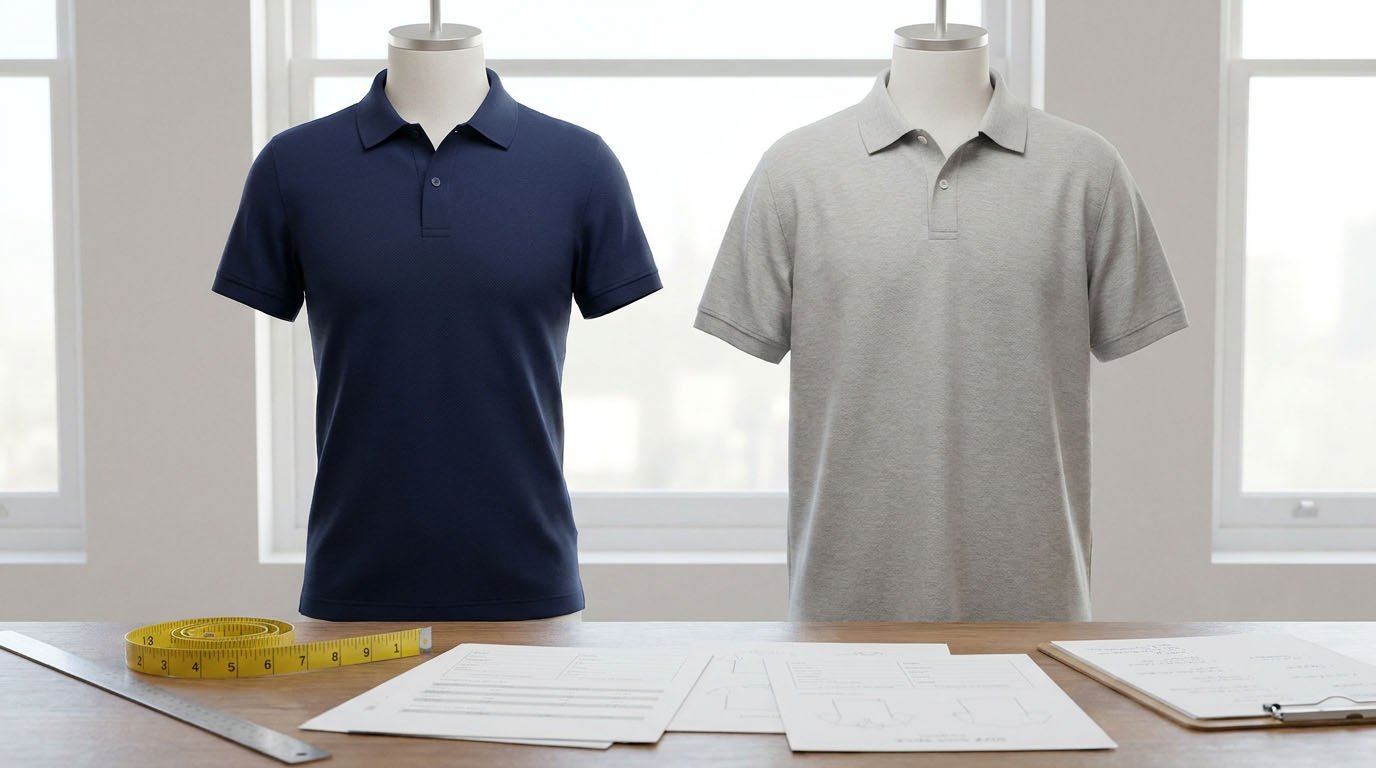
1. Half-Chest Width Comparison
| Size | Slim Fit (cm) | Relaxed Fit (cm) | Difference (cm) |
|---|---|---|---|
| S | 52 | 56 | +4 |
| M | 55 | 58.5 | +3.5 |
| L | 58 | 61 | +3 |
| XL | 61 | 63.5 | +2.5 |
| 2XL | 64 | 66 | +2 |
| 3XL | 67 | 68.5 | +1.5 |
Source: FUWAY's original garment size specifications. Differences are calculated as Relaxed Fit minus Slim Fit.
The Relaxed Fit specification has a larger half-chest measurement at every listed size. However, the difference is not constant.
At size S, the difference is 4 cm. At size L, it is 3 cm. At size 3XL, it is 1.5 cm.
This reveals a principle that many brands overlook: two fit specifications do not necessarily maintain the same dimensional difference throughout the size range.
2. Shoulder Width and Sleeve Length
The two styles also differ in shoulder width and sleeve length.
| Size | Slim Shoulder | Relaxed Shoulder | Slim Sleeve | Relaxed Sleeve |
|---|---|---|---|---|
| S | 45 | 47 | 22 | 23 |
| M | 47 | 49 | 23 | 24 |
| L | 49 | 51 | 24 | 25 |
| XL | 51 | 53 | 25 | 26 |
| 2XL | 53 | 55 | 26 | 27 |
| 3XL | 55 | 57 | 27 | 28 |
All measurements are in centimeters.
Across the listed sizes:
- Relaxed Fit shoulder width is consistently 2 cm greater.
- Relaxed Fit sleeve length is consistently 1 cm greater.
- Both styles increase shoulder width by 2 cm per size.
- Both styles increase sleeve length by 1 cm per size.
The comparison confirms that the styles differ across several garment measurements — not only chest width. However, these values alone cannot reveal how the armhole curve, sleeve cap, or other underlying pattern components differ.
3. Different Chest Grading Progressions
The half-chest measurements follow different grading increments. This is where the real structural difference lives.
| Measurement | Slim Fit | Relaxed Fit |
|---|---|---|
| Half-chest increase per size | 3 cm | 2.5 cm |
| Shoulder-width increase per size | 2 cm | 2 cm |
| Sleeve-length increase per size | 1 cm | 1 cm |
The difference in chest grading explains why the gap between the two styles narrows at larger sizes.
This reveals an advanced principle: Slim and Relaxed fits don't just start from different base measurements — they follow different growth logic across the size range. Each fit has its own grading DNA, which is what preserves its distinct silhouette from S through 3XL.
For brands, this means: if you're developing a second fit based on an existing one, don't just adjust the base size — define the grading rules from scratch. Otherwise, the fit identity will blur at larger sizes.
These particular increments should not be treated as universal grading rules for all golf polos.
4. Beyond the Measurable: Armhole and Sleeve Cap Geometry
Measurable dimensions like chest and shoulder width tell part of the story. The deeper difference between fit blocks often lies in structural details that don't appear on a size chart.
A Slim Fit block typically uses a deeper, more curved armhole matched with a higher, more shaped sleeve cap. This construction provides internal space for arm movement while maintaining a lean external appearance.
A Relaxed Fit block may use a straighter armhole curve and a shallower sleeve cap, delivering ease and volume more directly through the cut itself.
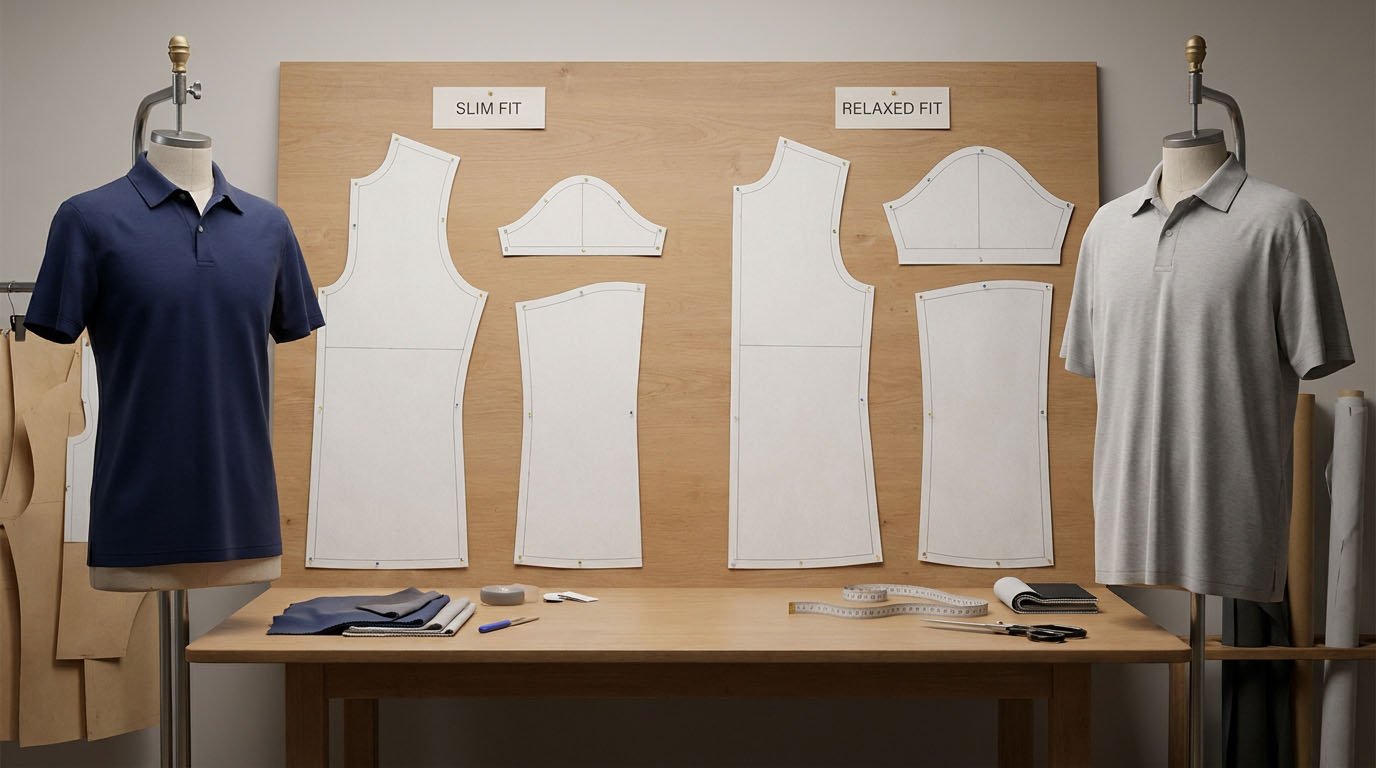
In short: same chest measurements, different armhole shapes → different mobility and drape.
This means two polos can share identical shoulder and sleeve length measurements yet wear completely differently — because the armhole and sleeve cap geometry defines how the garment moves and drapes on the body. This is what separates a true pattern from a simple set of measurements.
5. Why Measurement Definitions Must Be Consistent
The original FUWAY charts also reveal a measurement detail that buyers should not overlook.
The Slim Fit chart records garment length from the shoulder-top reference point. The Relaxed Fit chart records garment length from the center-back reference point.
Both charts contain length values from 72 cm to 82 cm across S–3XL, but the measurements cannot be directly compared because their starting points differ. The Slim Fit chart also does not provide numerical sleeve-opening measurements.
Before treating two size charts as directly comparable, confirm that the same POM definitions and measurement methods are used in both.
6. What This Example Actually Proves
FUWAY's two specifications demonstrate that:
- Two golf polo styles can use the same fabric while following different garment dimensions.
- The Relaxed Fit has greater chest and shoulder measurements than the Slim Fit at every listed size.
- Their chest grading increments differ — each fit follows its own growth logic.
- Comparing only one base size can overlook differences across the full size range.
- Complete pattern construction cannot be determined from a finished-garment size chart alone.
The example supports a practical development principle:
Define each intended fit through its own approved specifications, including its own grading rules. A fit label or one fixed measurement adjustment is not enough.
Key 5: How Can Brands Define Their Own Fit Block?
Once a suitable starting block has been selected, record the decisions that define your intended silhouette.
This does not require a complete Tech Pack at the initial decision stage. The immediate objective is to communicate which proportions and characteristics matter most.
A Practical Fit Block Decision Record
| Decision | What to Confirm |
|---|---|
| Intended Fit | Regular, Athletic, Relaxed, or brand-specific |
| Starting Reference | Existing approved block, reference garment, or new development |
| Base Size | Selected reference size |
| Key Silhouette Features | Straight, tapered, fuller, or other defined shape |
| Critical Proportions | Shoulder, chest-to-waist relationship, sleeve and hem |
| Non-negotiable Proportions | Which measurements cannot change even if others do? |
| Structural Geometry Note | Armhole curve depth, sleeve cap height — even if approximate |
| Fabric Reference | Intended fabric specification |
| Reuse or New Development | Whether the existing block can be retained or needs adjustment |
| Approval Status | Proposed, under development, or approved |
This short record helps the brand and manufacturer agree on the fit direction before detailed development work begins. It should not be confused with the final garment specification.
Example: Defining a Relaxed Version
Suppose a brand has an approved Slim Fit golf polo and wants to introduce a Relaxed Fit.
Instead of requesting "one size larger," the brand should clarify whether it wants:
- More chest and waist volume
- A straighter body silhouette
- Wider shoulders or the same shoulder position
- Fuller sleeves
- The same or a different body-length appearance
- A different armhole and sleeve cap construction
The manufacturer can then assess whether the desired silhouette can be developed from the existing pattern or requires a distinct foundation.
The final dimensions must come from the specific design and development work — not a universal Relaxed Fit formula.
Once these decisions are confirmed, detailed requirements can be documented in the Golf Polo Tech Pack.
Key 6: When Should a Brand Reuse, Adapt, or Develop a New Fit Block?
Not every new golf polo style requires a completely new base pattern. But reusing a block without checking whether it still matches the design can lead to inconsistent fit across a collection.
The decision depends on how significantly the intended silhouette differs from the existing foundation.
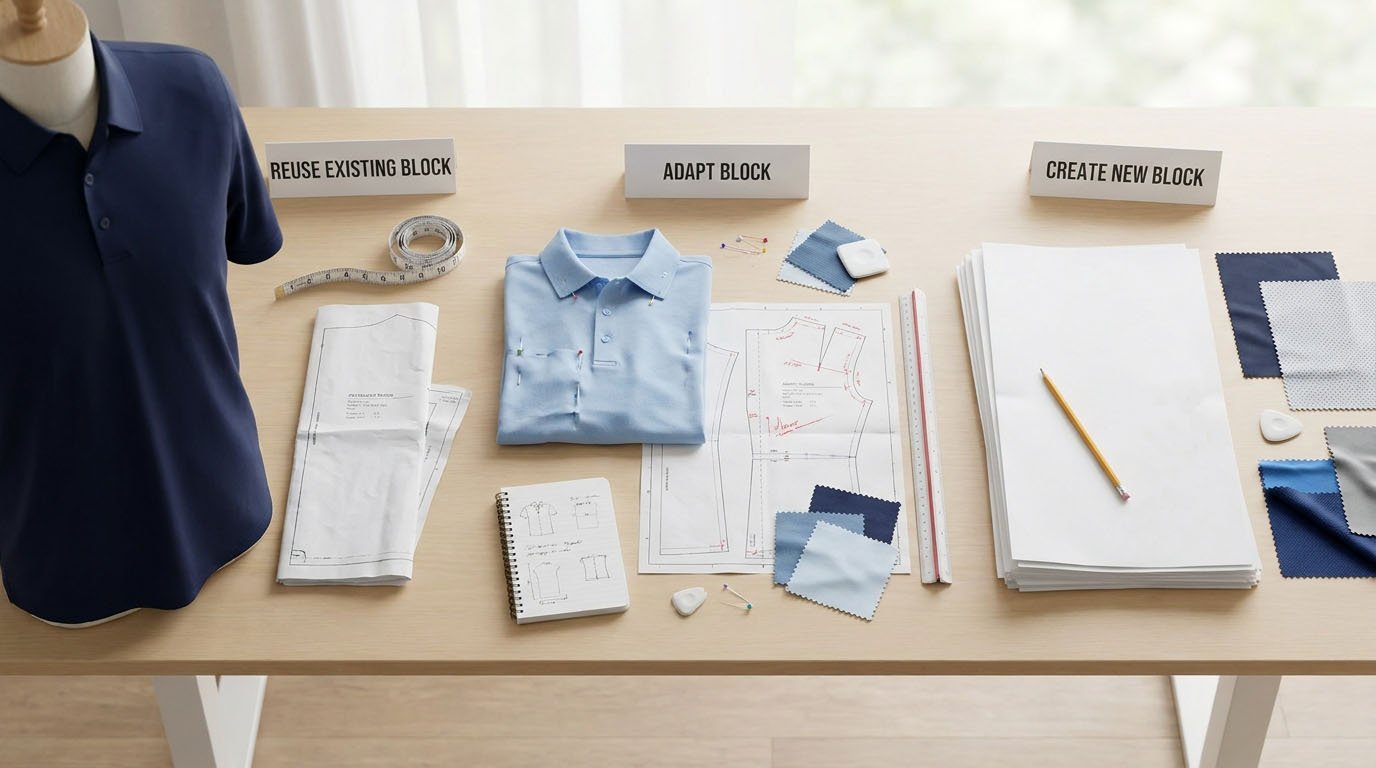
When Reusing a Block May Be Appropriate
Consider reusing an approved block when:
- The intended silhouette remains substantially unchanged.
- The customer profile and fit requirements remain consistent.
- Only styling elements such as color, logo, or compatible design details change.
- The selected fabric remains suitable for the approved fit.
Reusing an existing pattern can simplify development, but fabric or construction changes still require an assessment of their effects.
When Adapting an Existing Block May Be Appropriate
An adapted block may be suitable when the desired fit is close to an approved reference. For example:
- A slightly straighter torso is required.
- Sleeve volume needs to change.
- The hem proportion needs adjustment.
- A new fabric changes the way the garment drapes.
These changes should be evaluated together rather than treated as isolated measurements.
When a Separate Fit Block May Be Justified
A distinct block is appropriate when a new product requires a consistently different proportional structure.
For instance, a brand may want to offer both a close-fitting golf polo and a deliberately fuller silhouette as separate product options. If the required differences extend across body, shoulder, sleeve, and armhole relationships, maintaining separate approved pattern references makes future development clearer.
| Situation | Possible Decision |
|---|---|
| Same silhouette, minor styling updates | Reuse existing block |
| Limited proportion changes | Adapt existing block |
| Substantially different silhouette | Evaluate a new block |
| Different fabric behavior | Reassess existing block; modify if needed |
| New size range or customer body profile | Review whether the block and grading remain suitable |
These are decision guidelines, not automatic rules. The final choice should reflect your specific pattern and product requirements.
Once a block has been developed, sample fitting and size-set approval are separate activities. FUWAY covers those steps in its Garment Fit Approval Checklist.
Key 7: Frequently Asked Questions About Golf Polo Fit Blocks
Is Athletic Fit the Same as Slim Fit?
Not necessarily.
Slim Fit generally describes a closer overall garment silhouette. Athletic Fit often involves more defined waist shaping while retaining relatively more room through the upper body. The actual difference depends entirely on the brand's approved specifications.
If you're specifying Athletic Fit to a manufacturer, provide a reference garment or annotated sketch — don't rely on the label alone.
Is Regular Fit Always Between Athletic and Relaxed Fit?
No.
Regular Fit is not a universal midpoint calculated from two other patterns. A brand should develop its Regular Fit independently, using a silhouette that matches its own product requirements and serves as an intentional baseline.
Can Relaxed Fit Be Developed by Grading Up Regular Fit?
No.
Simply increasing every measurement by one size does not guarantee the intended Relaxed Fit. The resulting shoulder, neckline, sleeve, and body proportions may differ from the desired design. The full silhouette — including the underlying structural geometry — should be considered.
Can the Same Fabric Be Used for Different Fit Blocks?
Yes.
Different garment fits can be developed using the same fabric. FUWAY's Slim Fit and Relaxed Fit specifications provide a real example of two same-fabric polo styles with different target dimensions and grading progressions.
Does a Brand Need a New Fit Block for Every Collection?
No.
An existing approved block can serve as a solid foundation for subsequent collections when the intended silhouette remains suitable. A new block is justified when the brand introduces a meaningfully different fit direction.
Can a Size Chart Prove That Two Styles Use Different Base Patterns?
Not by itself.
Different size charts establish different target dimensions, but they do not reveal how the underlying pattern pieces were constructed — particularly the armhole curve, sleeve cap geometry, and other structural elements. Approved pattern records are needed to confirm specific construction differences.
Should a New Golf Brand Develop All Three Fits?
Not necessarily.
A new brand can start with one clearly defined fit and expand when another silhouette serves a demonstrated customer or product requirement. The priority is maintaining a consistent, intentional fit rather than offering multiple labels without distinct specifications behind them.
Conclusion: Build a Clear Fit Foundation Before Expanding Your Golf Polo Range
One core lesson: A fit label means nothing without a defined pattern and grading rules behind it.
Regular, Athletic, and Relaxed golf polo fits represent different design directions — not universally standardized measurements.
For brands, the important decision is whether an existing base pattern supports the intended silhouette or whether the design requires an adapted or separate foundation.
FUWAY's actual Slim Fit and Relaxed Fit specifications demonstrate how two golf polos using the same fabric can differ across chest measurements, shoulder width, sleeve length, and — critically — grading progression. Each fit follows its own structural logic across the size range.
The lesson is not to copy a particular set of dimensions. It is to define each fit through appropriate proportions, its own grading rules, and approved specifications that capture the full structural intent.
A clear fit block strategy helps brands develop more consistent products and provides a stronger starting point for every future style.
If your brand is developing a custom golf polo collection, FUWAY can support OEM/ODM development based on your intended fit, fabric, and product specifications.
Explore our Custom Golf Shirts Manufacturing services to discuss your golf polo development requirements.