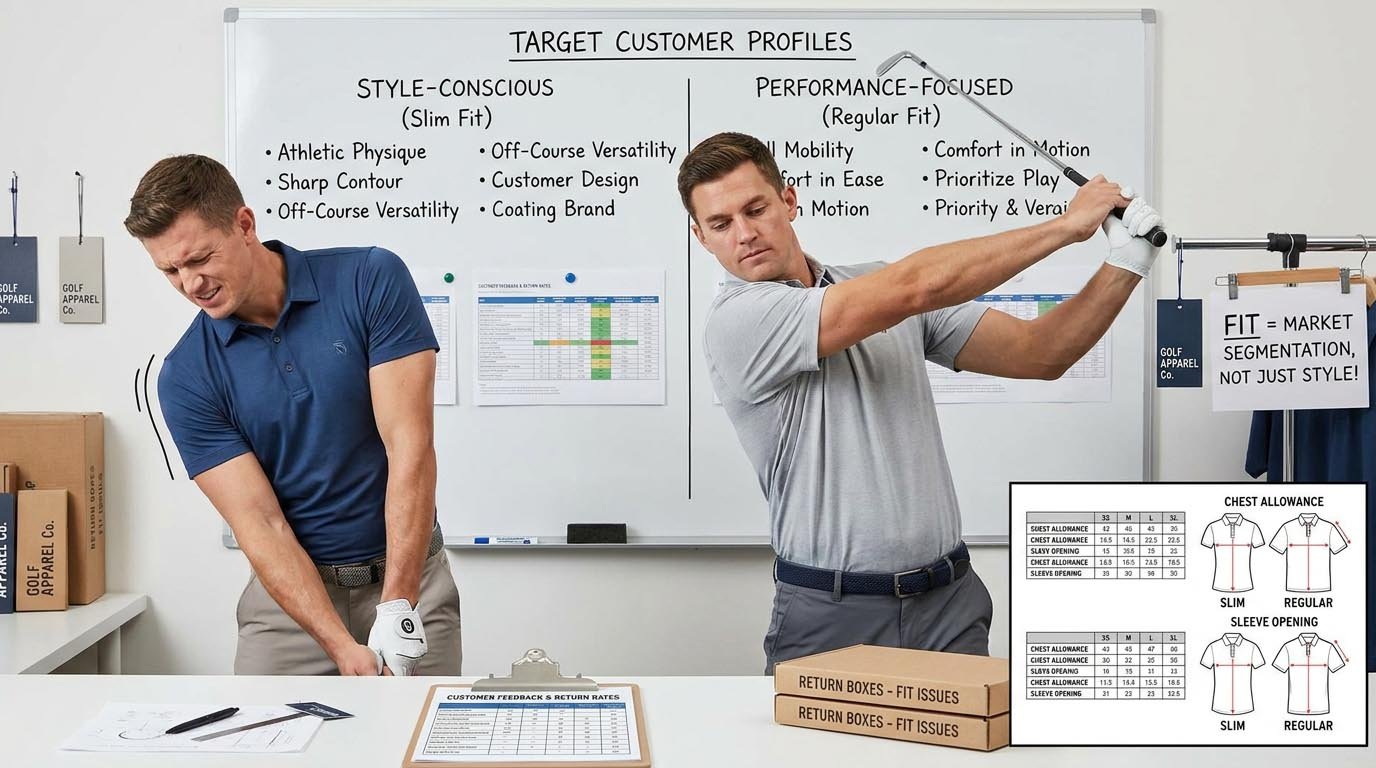
A client launched a "Slim Fit" golf polo line and got 22% return rate in three months. The samples looked great on fit models. The issue was not pattern quality—it was positioning. Customers who bought based on the visual styling discovered the cut restricted their swing motion, while customers seeking athletic contour found the fit not slim enough. The product sat between two segments serving neither well. Fit decisions are not aesthetic choices. They are market segmentation decisions with direct inventory and return-rate consequences.
Slim Fit vs Regular Fit is a market segmentation tool, not a style preference. The decision determines who your product fits comfortably during actual play, how customers interpret your sizing, and how much return risk you absorb. Choose based on your target buyer's play priority (mobility vs contour) and body proportion data—not competitor trends or aesthetic appeal alone.
I am Willfrom FUWAY. In OEM projects we have handled, fit positioning errors are among the top three causes of first-order regret—right after fabric selection mistakes and color matching issues. This guide translates "Slim vs Regular" from a vague style debate into concrete decisions you can apply to your product line, sizing communication, and return management.
Quick Answers: Slim Fit vs Regular Fit Golf Polo Decisions
What is the actual difference between Slim Fit and Regular Fit golf polo?
The real distinction is proportion control, not size reduction. Slim Fit features narrower chest-to-waist ratio, shallower armholes, shorter body length, and tighter sleeve circumference. Regular Fit maintains uniform chest-waist-hip width, deeper armholes for swing mobility, longer body coverage, and relaxed sleeve cut. "Size down one" is not Slim Fit—it is just a smaller Regular Fit, which creates pull and discomfort.
Should I launch with Slim Fit, Regular Fit, or both?
Single-fit launches reduce inventory complexity and clarify brand positioning. Choose based on your target buyer's primary play priority: contour-conscious players in youth/athletic segments → Slim Fit. Mobility-prioritizing players or markets with broader body proportions → Regular Fit. Dual-fit launches require clear verbal differentiation in product descriptions and 40-60% more SKU investment—justified only if customer data supports both segments.
Does Slim Fit actually restrict the golf swing?
Yes, if pattern proportions sacrifice armhole depth and shoulder mobility for body contour. A well-designed Slim Fit retains swing-functional armhole and back panel ease while reducing waist and sleeve circumference. The restriction issue arises when factories scale Slim Fit by reducing all measurements proportionally—armhole tightness restricts arm raise and rotation. Verify swing mobility through physical testing, not visual fit checks.
How does fit choice affect return rates?
In projects we have handled, mismatched fit descriptions drive 15-25% of size-related returns. Customers ordering "Slim Fit" expecting one cut and receiving another lose trust. Returns spike when fit language ("athletic," "modern," "tailored," "classic") does not match actual measurements. Specifying chest-waist-hip measurements per size (not just S/M/L) and including fit comparison guides reduces return rates by 30-50%.
Is Regular Fit "outdated" in 2026 golf apparel market?
No. Regular Fit serves real demand segments: mobility-priority players, broader body proportions common in 40+ demographic, function-first brand positioning, and markets where contour-focused styling has limited appeal. Dismissing Regular Fit based on social media trends ignores actual customer body data. Brand positioning matters more than fit trend—Function-first brands lose credibility selling fashion-forward Slim cuts.
How do I communicate fit clearly to avoid customer confusion?
Use three layers: (1) Named fit (Slim/Regular/Athletic) for quick filtering, (2) measurement table per size showing chest, length, sleeve, hem at body and waist points, (3) fit description explaining proportion philosophy ("trimmed through waist with full shoulder mobility" vs "uniform width with relaxed sleeve"). Photos on multiple body types reinforce expectations. Avoid mixing aesthetic terms ("modern," "classic") with measurement claims.
Does fit choice change my fabric selection requirements?
Yes. Slim Fit requires fabrics with mechanical stretch (4-way spandex blend, 8-15% elastane) and strong recovery to prevent bagging at body-hugging zones. Regular Fit tolerates lower-stretch fabrics (2-way stretch or no stretch) since ease comes from pattern, not fabric. Choosing low-stretch fabric for Slim Fit causes immediate discomfort and shape distortion after a few wears. Fabric and fit decisions must be specified together, not sequentially.
Define Your Target: Athlete, Avid Golfer and Lifestyle Customer
Fit choice anchors to your specific customer's play priority and body proportion—not generic "modern golfer" descriptions. Three customer archetypes drive different fit logic, and most brands serve a primary archetype with secondary tolerance, not all three equally.
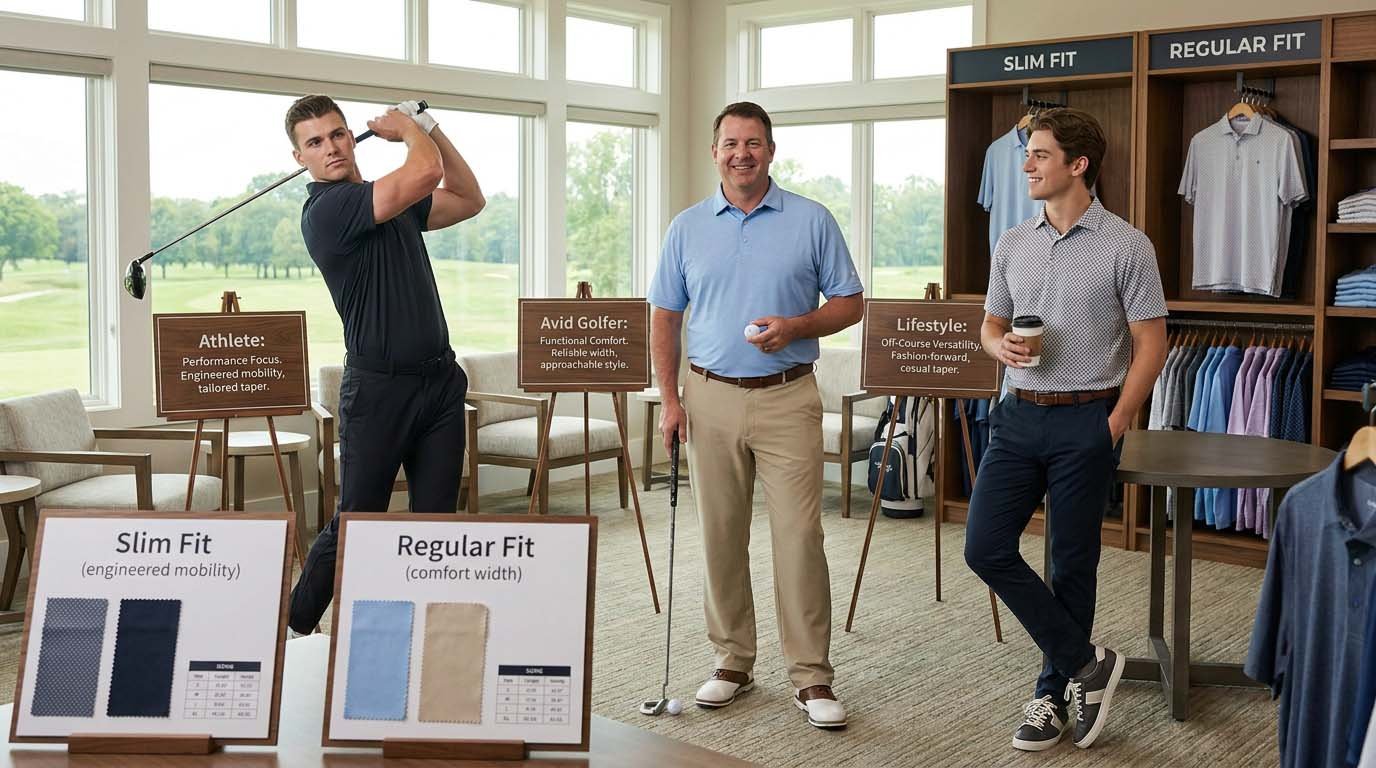
Athlete-Performance Customer
Profile characteristics:
- Plays 2+ rounds weekly with practice sessions
- Body proportions skew athletic (defined chest-shoulder, narrower waist)
- Values swing performance over aesthetic preference
- Tolerates body-hugging cuts only if mobility uncompromised
Fit logic:
Slim Fit can work, but only with engineered armhole depth and back panel ease. Pure aesthetic Slim Fit fails this segment because restricted swing mobility immediately disqualifies the product regardless of styling. Pattern must include athletic taper (chest-waist drop of 4-6 inches) without sacrificing rotation room.
Brand positioning fit:
Performance-focused brands competing with technical sportswear (Adidas, Nike Golf tier). Marketing emphasizes mobility, fabric tech, and on-course functionality.
Avid Golfer (Mid-Frequency)
Profile characteristics:
- Plays 1-3 rounds monthly
- Body proportions vary widely—often broader builds, less defined athletic taper
- Values comfort and presentability equally
- Frequently 35-55 age range, but exceptions common
Fit logic:
Regular Fit dominant choice. Body proportions and play priorities both favor uniform width with mobility ease. Slim Fit cuts often pull at chest and waist on this body type, creating discomfort and unflattering visual outcome. Forcing Slim Fit on this segment drives returns.
Brand positioning fit:
Country club brands, traditional golf labels, and lifestyle-leaning performance brands (Peter Millar, Footjoy tier). Marketing emphasizes craftsmanship, fabric quality, and course-to-clubhouse versatility.
Lifestyle Customer (Off-Course Wear)
Profile characteristics:
- Wears golf polos casually beyond the course
- Body proportions diverse—matches general population distribution
- Values aesthetic appeal and fabric comfort
- Frequently includes non-golfers attracted to polo styling
Fit logic:
Either fit works, but selection drives different positioning. Slim Fit aligns with fashion-forward casual styling. Regular Fit aligns with classic American casual or country club aesthetic. Critical: this segment is most sensitive to fit description accuracy because they cannot test "swing functionality" relevance.
Brand positioning fit:
Lifestyle brands, fashion-leaning labels, and DTC e-commerce brands serving broader casual market.
Mapping Your Customer to Fit
| Primary Archetype | Recommended Fit | Secondary Tolerance |
|---|---|---|
| Athlete-Performance | Slim Fit (engineered) | Regular Fit acceptable |
| Avid Golfer (broad-build) | Regular Fit | Slim Fit risky |
| Avid Golfer (athletic-build) | Either | Both viable |
| Lifestyle (fashion-leaning) | Slim Fit | Regular Fit niche |
| Lifestyle (classic) | Regular Fit | Slim Fit niche |
If you cannot identify your primary archetype with specificity, fit decisions become guesses. Customer data from existing orders, returns analysis, and persona research must precede fit specification.
Fit Fundamentals: Ease Allowance, Balance, Mobility and Proportion
Fit is technically defined by ease allowance (extra room beyond body measurement) at specific points: chest, waist, hem, armhole, sleeve, and shoulder. Slim Fit and Regular Fit differ in ease allowance distribution, not absolute size reduction.
Ease Allowance Reference Points
Ease = garment measurement minus body measurement at that point.
| Body Point | Slim Fit Ease | Regular Fit Ease |
|---|---|---|
| Chest | 2-4 inches | 5-7 inches |
| Waist | 1-3 inches (tapered) | 5-7 inches (straight) |
| Hem | 2-4 inches | 5-8 inches |
| Armhole depth | Higher cut (less drop) | Deeper drop for mobility |
| Sleeve circumference | 1-2 inches | 3-5 inches |
| Shoulder slope | Closer to body | More relaxed |
These ranges reflect typical pattern decisions in projects we have handled. Exact specifications vary by brand positioning and fabric stretch.
Balance: Where Slim Fit Goes Wrong
Common pattern error: reducing all ease measurements proportionally to create "Slim Fit." This creates restriction at functional points (armhole, shoulder rotation) while still feeling loose at aesthetic points (waist drop unclear). Result: garment feels tight and looks unflattering simultaneously.
Better approach: maintain functional ease (armhole depth, shoulder mobility) while reducing aesthetic ease (waist taper, sleeve circumference, hem narrowing). This creates Slim Fit visual outcome with preserved swing function.
Mobility Test for Golf-Specific Fit
Before approving any fit specification, test these motions on actual sample:
- Full backswing arm raise (does shoulder seam pull?)
- Cross-body follow-through (does chest seam restrict?)
- Squat-to-tee position (does hem ride up excessively?)
- Forward bend over putt (does collar gap or shirt billow?)
Visual fit on still mannequin or stationary model can pass while failing actual play motion. Mobility testing is the missing step in most first-time OEM fit approvals.
Proportion Logic for Different Body Types
Slim Fit pattern assumes V-shape proportion (chest > waist > hip with athletic taper). Applied to barrel-shape proportion (chest ≈ waist ≈ hip), Slim Fit creates pulling at the widest point and looseness elsewhere. Regular Fit pattern assumes uniform proportion, accommodating body shape variation through ease distribution.
This is why fit choice cannot be made independently of target customer body data. Fit-to-body-type mismatch causes returns regardless of pattern quality.
Pattern and Grading: Blocks, Shoulder/Sleeve, Hem Shape and Size Scales
Pattern grading must adjust ease ratios across size range, not scale measurements proportionally. Slim Fit and Regular Fit require different grading logic, and size scales must reflect target customer body distribution—not standard apparel grade tables.
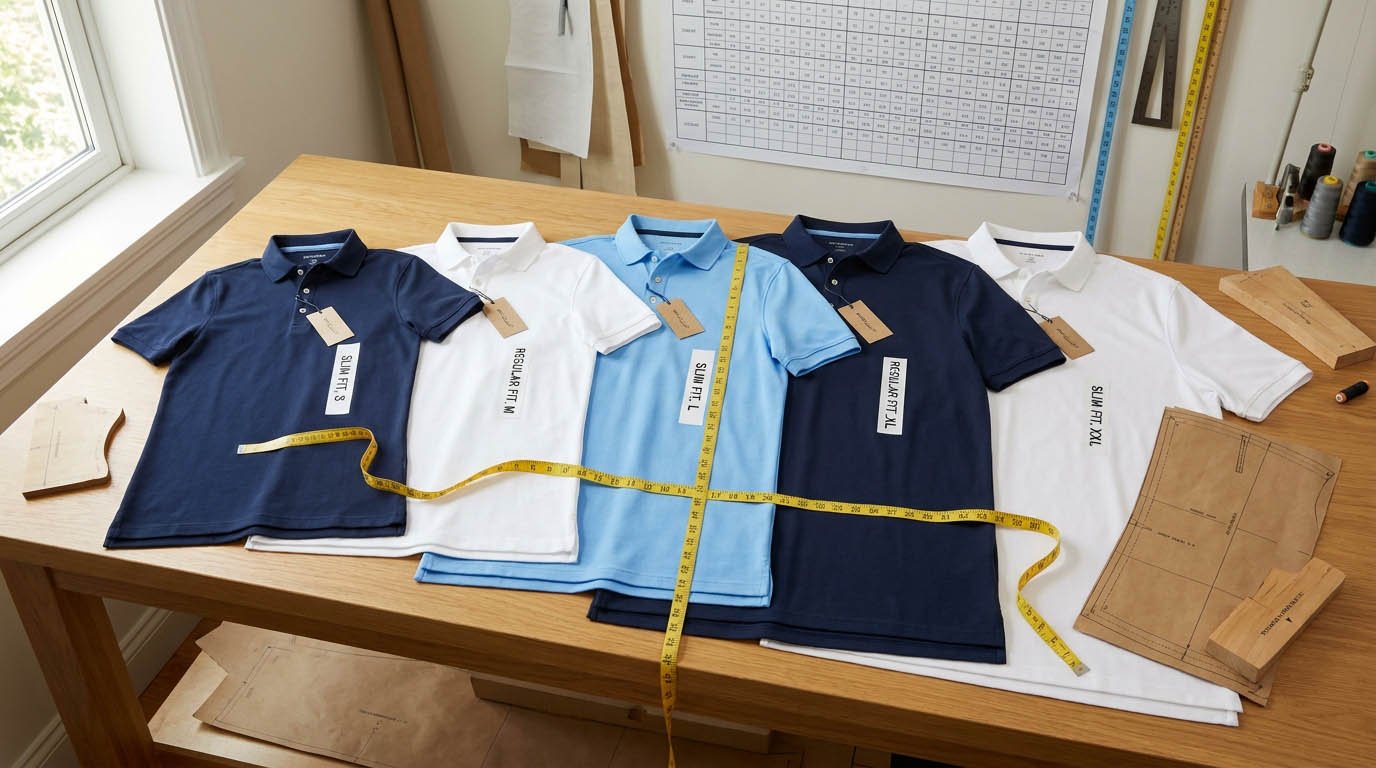
Grading Differences by Fit Type
Slim Fit grading considerations:
- Smaller sizes: maintain or increase chest-waist drop ratio (preserve athletic taper)
- Larger sizes: reduce chest-waist drop ratio (avoid pulling on broader builds buying Slim cuts)
- Armhole depth: scale slower than body width (preserve mobility on larger sizes)
- Sleeve circumference: scale faster than body (avoid arm tightness)
Regular Fit grading considerations:
- Uniform proportion preserved across size range
- Standard grade tables work well (less customization needed)
- Length grading more consistent across sizes
- Sleeve and body grade together more reliably
Size Scale Decisions
Standard scale (S, M, L, XL, XXL) covers 80-90% of typical body distribution but misses tall-narrow and short-broad customers. Extended scales add complexity but capture niche segments.
| Scale Type | Coverage | Inventory Impact |
|---|---|---|
| Standard 5-size (S-XXL) | Covers ~85% of buyers | Lowest SKU count, lowest customization |
| Extended 7-size (XS-XXXL) | Covers ~95% of buyers | 40% more SKUs, slow-moving extremes |
| Fit-tier scale (Slim S/M/L + Regular S/M/L) | Splits by fit preference | Doubles SKUs but clarifies fit positioning |
| Numerical sizing (38-50) | Precise, less ambiguous | Higher consumer education need |
Hem and Length Considerations
Slim Fit typically uses shorter body length with subtle curved hem (rises at sides). Regular Fit uses longer body length with straight or minimal curve hem. Length affects tucked-vs-untucked wearing decision.
In projects we have handled, mismatched hem length is a common return reason. Customers expecting tucked-only fit get longer hem and feel garment is too long; customers expecting tuckable receive Slim length and find it too short for tucked wear. Specify intended wearing mode in product description.
Shoulder and Sleeve Pattern Decisions
Set-in sleeve vs raglan vs drop-shoulder constructions interact with fit type:
- Slim Fit + set-in sleeve = clean athletic line, preserves shoulder definition
- Regular Fit + set-in sleeve = traditional polo construction, broad demographic appeal
- Slim/Regular + drop-shoulder = casual lifestyle styling, less athletic
- Raglan rare in golf polos (restricts swing angle definition)
Construction choice should match fit type and brand positioning, not be selected independently.
Fabric Choice: Stretch, Recovery, Weight and Drape Impact on Fit
Fabric stretch and recovery determine whether your specified fit holds up through wear cycles. Slim Fit requires fabrics engineered for body-hugging cuts; Regular Fit tolerates broader fabric range. Choosing fit and fabric separately causes shape failure after first laundry or extended wear.
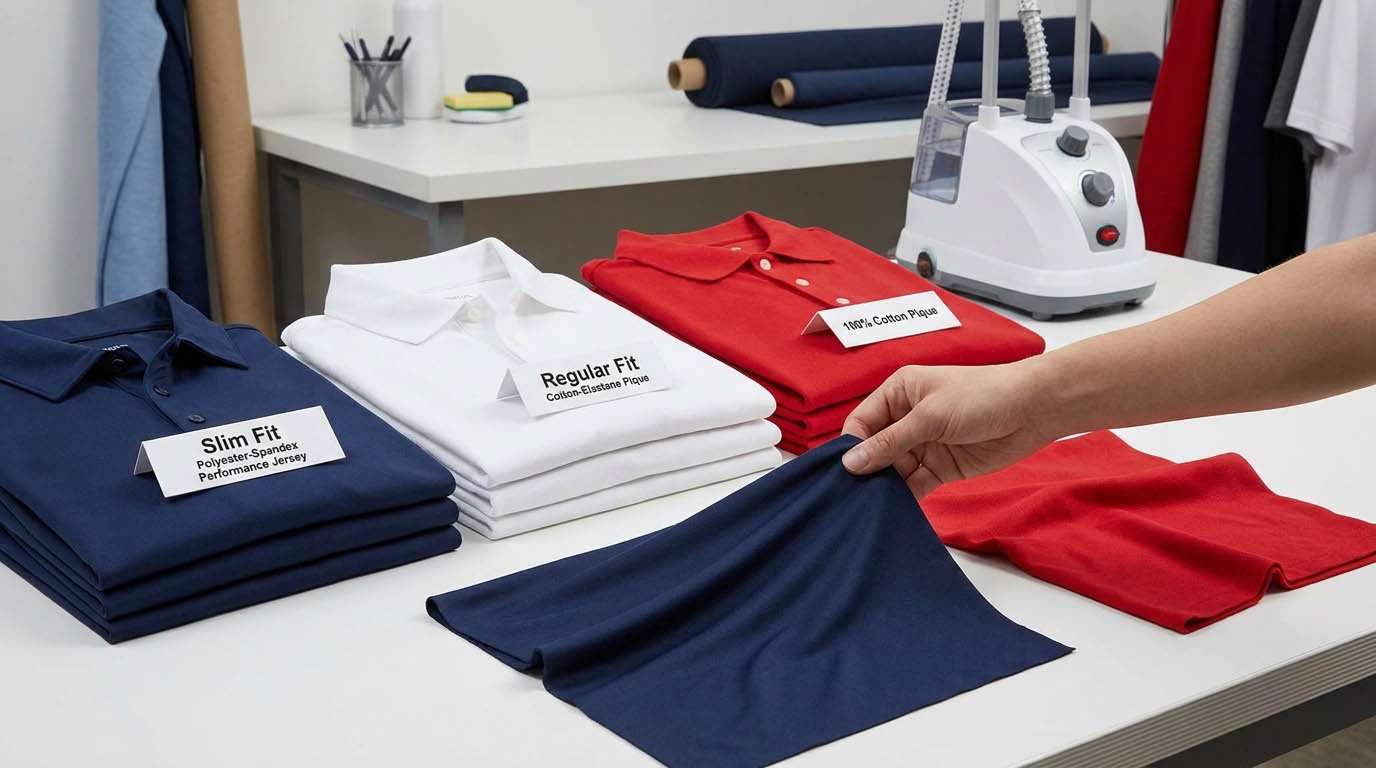
Stretch Requirements by Fit Type
| Fit Type | Stretch Requirement | Typical Fabric |
|---|---|---|
| Slim Fit (athletic) | 4-way stretch, 8-15% elastane | Polyester-spandex pique, performance jersey |
| Slim Fit (lifestyle) | 2-way stretch, 3-8% elastane | Cotton-elastane pique |
| Regular Fit (performance) | 2-way stretch optional, 0-5% elastane | Standard polyester pique, moisture-wicking |
| Regular Fit (classic) | No stretch acceptable | 100% cotton pique, traditional weaves |
Recovery: The Overlooked Variable
Stretch without recovery causes bagging. Recovery refers to fabric's ability to return to original shape after stretching. Slim Fit emphasizes recovery because body-hugging cuts magnify any sagging. Spandex/elastane content is most reliable recovery indicator—mechanical stretch from weave alone provides limited recovery.
Test recovery during sampling: stretch fabric to 25% extension, hold 10 seconds, release, observe return. Strong recovery returns to within 2% of original. Weak recovery shows visible sag.
Weight and Drape Considerations
Fabric weight (GSM) affects how fit reads visually:
- Lightweight fabrics (140-170 GSM) drape close to body, accentuating fit shape
- Mid-weight fabrics (180-220 GSM) balance drape and structure—most versatile for both fits
- Heavy fabrics (230+ GSM) hold shape independently, can mask fit pattern details
Slim Fit benefits from mid-to-heavy weight to maintain shape without clinging. Regular Fit works across weight range but very light fabrics in Regular cuts can look billowy.
Performance Treatments Affecting Fit Perception
Moisture-wicking treatments do not significantly change fit feel. Anti-odor treatments are neutral. UPF treatments may slightly stiffen fabric hand. Cooling tech fabrics often have higher stretch and softer hand—pair well with Slim Fit positioning.
Common Fabric-Fit Mismatch Errors
| Error | Consequence |
|---|---|
| Slim Fit + low-stretch fabric | Restriction during wear, bagging after laundry |
| Slim Fit + lightweight no-recovery | Garment loses shape within 5 wears |
| Regular Fit + high-stretch fabric | Fit reads "loose Slim Fit" instead of intentional Regular |
| Either fit + low-quality recovery | Returns within first month |
Specify fabric stretch and recovery requirements simultaneously with fit type. Treating them as separate decisions invites first-order regret.
Merchandising & Positioning: Size Curves, Pricing, Imagery and Returns
Fit positioning extends beyond pattern decisions into size curve allocation, pricing tiers, photography direction, and return policy alignment. Inconsistent merchandising signals cause customer confusion regardless of pattern quality.
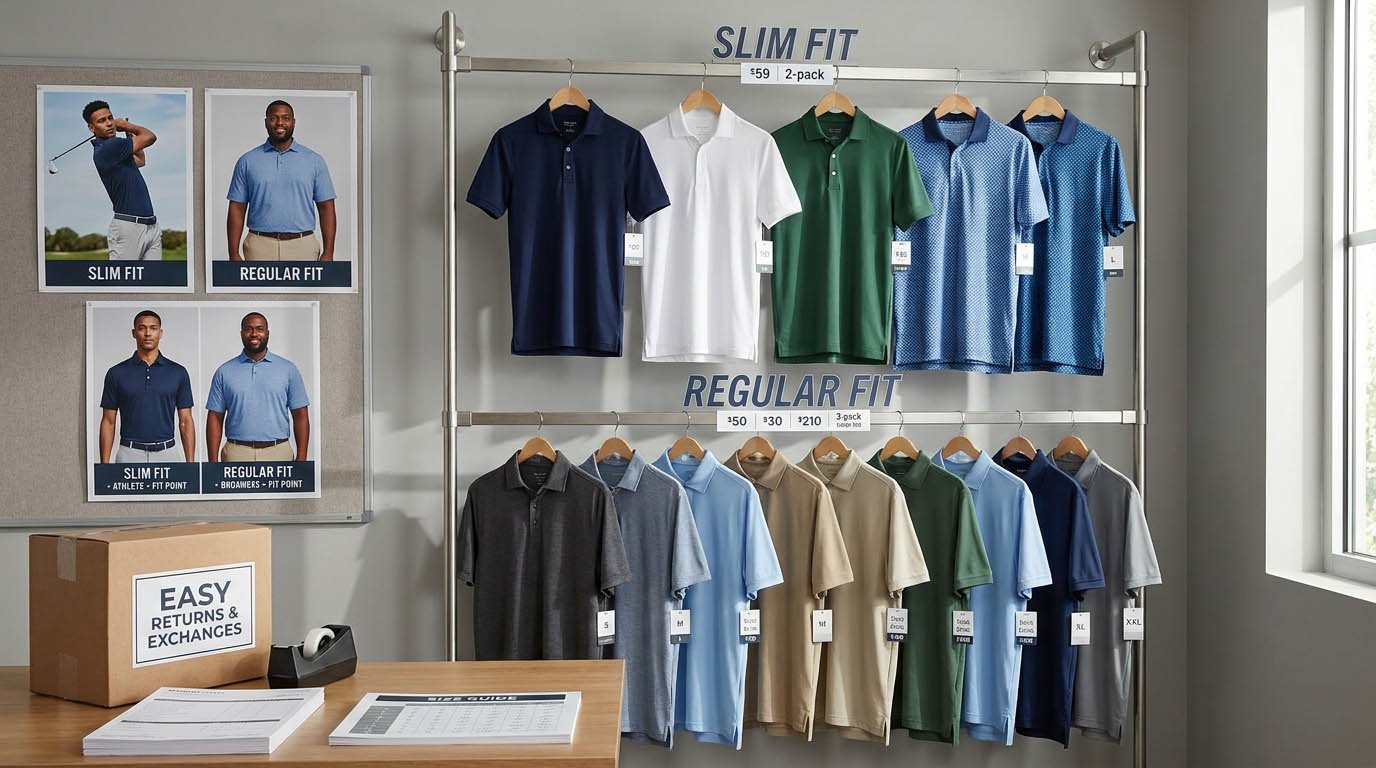
Size Curve Allocation by Fit Type
Slim Fit demand skews toward middle sizes (M-L) with smaller XS and XXL volumes. Regular Fit demand distributes more evenly across S-XXL with stronger XL-XXL representation.
| Size | Slim Fit Curve | Regular Fit Curve |
|---|---|---|
| S | 12% | 10% |
| M | 28% | 22% |
| L | 32% | 28% |
| XL | 20% | 25% |
| XXL | 8% | 15% |
Above ranges reflect typical patterns in projects we have handled. Your specific curve depends on customer body distribution. Order based on expected curve, not even split, to avoid overstock at extreme sizes.
Pricing Positioning
Slim Fit and Regular Fit can price equivalently (same fabric, similar construction cost) or differentiate based on positioning:
| Strategy | Logic |
|---|---|
| Equal pricing | Treats fits as preference choice within same product tier |
| Slim Fit premium ($5-15 above) | Positions Slim as performance/fashion-forward variant |
| Regular Fit premium | Positions Regular as heritage/craftsmanship variant (rare but possible for traditional brands) |
Pricing differentiation must reflect actual product positioning. Charging Slim Fit premium without distinct fabric or construction quality creates customer skepticism.
Photography and Visual Differentiation
Customers cannot interpret fit from text alone. Photography must show:
- Front, side, back views on same model body type
- Comparison shots with both fits side by side (separate images, but consistent styling)
- Action shot showing swing motion (mobility evidence)
- Detail shots highlighting fit signature points (waist taper for Slim, hem drape for Regular)
Using different model body types for Slim vs Regular implicitly communicates which body type each fit serves—useful for buyer self-selection.
Return Policy Alignment
High-fit-variability products (especially first-launch fit lines) benefit from clear return policies:
- Free first-exchange shipping (lowers fit-trial risk)
- Detailed measurement guides (reduces wrong-size orders)
- Customer fit questionnaire (recommends size based on body data)
Strict no-return policies on fit-sensitive products drive negative reviews and second-order avoidance. Building 5-8% return cost into pricing is more sustainable than fighting fit returns.
Marketing Language Consistency
Avoid ambiguous fit terms that mean different things to different customers:
| Avoid | Use Instead |
|---|---|
| "Modern fit" | "Slim Fit" with specifications |
| "Tailored fit" | "Slim Fit" or "Athletic Fit" with measurements |
| "Classic fit" | "Regular Fit" with measurements |
| "Comfortable fit" | Specific ease allowance description |
| "Athletic cut" | "Slim Fit" with mobility specifications |
Consistency across product page, size chart, marketing copy, and customer service responses prevents expectation misalignment.
FAQ: Slim Fit vs Regular Fit in Golf Polos
Should I copy the fit strategy of leading brands like Peter Millar or Travis Mathew?
Their fit strategy reflects their customer body data, not yours. In projects we have handled, brands attempting to mirror leading-brand fits without matching customer demographic see misaligned products. Use competitor fit as one reference point, but base final decisions on your actual customer order data, returns analysis, and persona research.
Can a single fit serve multiple customer archetypes?
Marginally. Regular Fit accommodates wider body type range than Slim Fit. Slim Fit performance-engineered (with mobility-preserving armhole) can serve athletic and lifestyle segments simultaneously. But trying to serve all three archetypes with single fit usually produces compromise that satisfies no segment fully.
How do I handle fit feedback from first orders?
Document return reasons systematically: too tight at chest, restrictive in shoulders, too long, too short, wrong proportion. Pattern adjustments in second order should target specific issues. Vague feedback ("doesn't fit right") is hard to action—push customer service to capture specific body points.
Is "Tailored Fit" a third category or marketing language?
"Tailored Fit" usually means Slim Fit with slightly relaxed ease at functional points—essentially a moderate Slim. Different brands use the term differently. If you launch a "Tailored Fit," specify exact ease measurements and differentiate clearly from Slim and Regular, or customers default to one of those interpretations.
Should I offer custom sizing or stick to standard sizes?
Custom sizing serves premium positioning ($150+ retail) with customer body measurement intake. For standard pricing tiers, custom sizing creates operational complexity exceeding margin benefit. Better approach: offer extended size scale (XS-XXXL) and detailed measurement guides for self-selection.
How does fit decision affect MOQ and inventory risk?
Single-fit launch: standard MOQ across size curve. Dual-fit launch: doubles SKU count, increases MOQ pressure or inflates per-fit volume risk. New brands should start single-fit, validate demand, then expand to second fit with data backing the investment.
When does fit positioning need refresh or expansion?
Trigger points: return rate above 12-15%, customer complaints about fit clarity, persistent feedback requesting alternative fit, expansion into new demographic segment, or competitive landscape shift in target market. Avoid changing fit positioning based on single quarter's data—fit decisions need 6-12 months of data to evaluate.
Conclusion
Slim Fit vs Regular Fit is a market segmentation decision determined by your target customer's play priority and body proportion data—not aesthetic preference or competitor trends. Specify ease allowances precisely, match fabric stretch to fit type, align size curves and merchandising to fit positioning, and use clear measurement language to prevent return-driving expectation gaps.