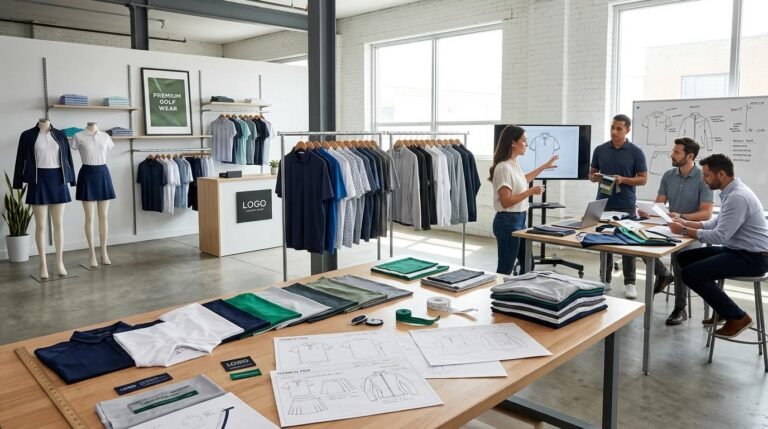
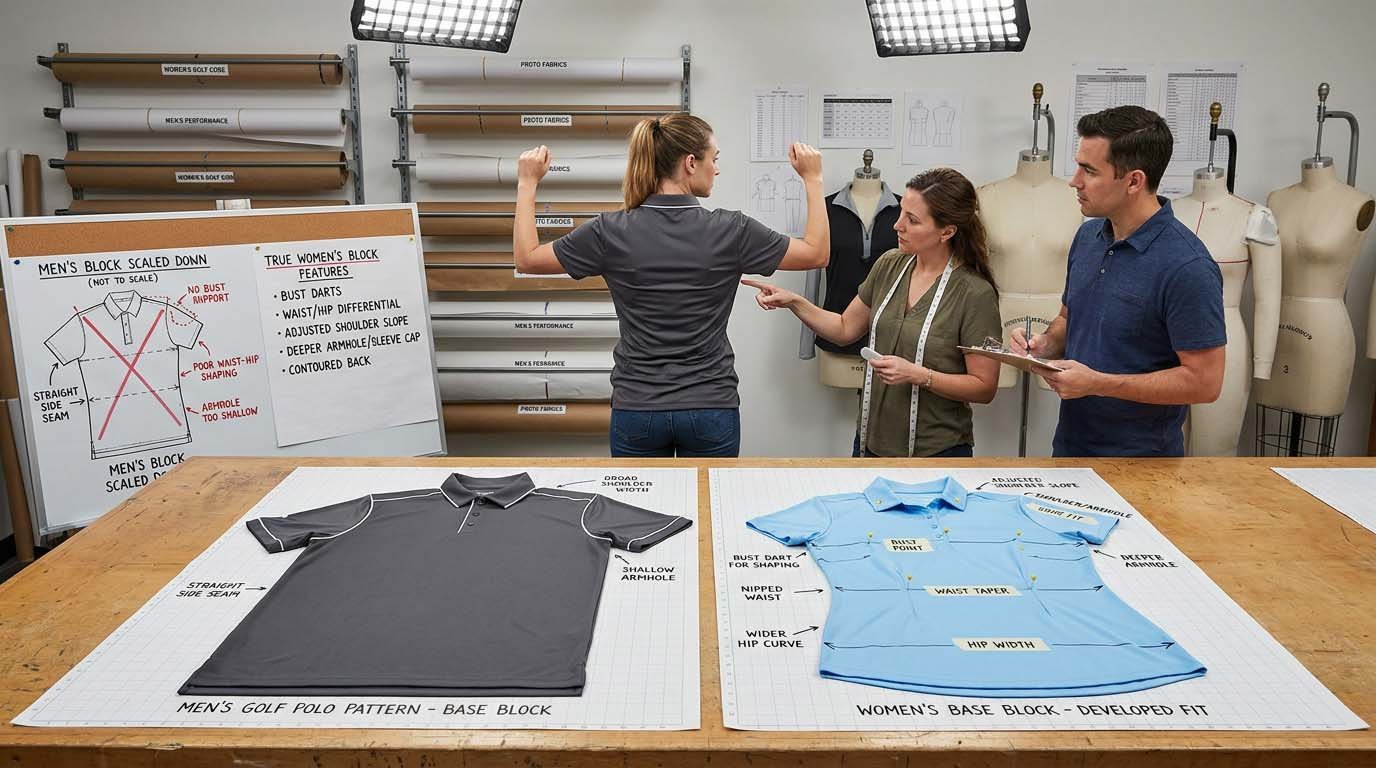
A brand sent us their bestselling men's golf polo tech pack and asked us to grade it down to women's sizing. We explained that women's S-XL sizing requires different pattern blocks, not scaled men's patterns. They insisted we try their approach first—just reduce chest and length measurements proportionally. We produced samples. The fit failed across all sizes: bust area pulled tight creating horizontal stress lines, waist hung loose with excess fabric, shoulders sat too wide causing sleeve slippage during arm raises, and hip area rode up during seated fitting. They asked what went wrong. We showed them: their men's block had no bust shaping, no waist-hip differential, wrong shoulder slope, and inadequate hip swing. Fixing these required rebuilding the pattern from base blocks designed for female body proportions, not adjusting men's measurements.
Women's golf polo patterns require dedicated base block development with bust dart placement, waist-to-hip ratio grading, shoulder slope adjustment, and armhole depth recalculation—not proportional downsizing of men's patterns—because female torso structure, shoulder angle, and movement requirements create fit and mobility failures when male pattern geometry is simply scaled smaller.
I am Will from FUWAY. In our pattern room, we handle 40-60 women's golf polo development projects annually, converting brand concepts into production-ready patterns. Most brands arrive with one of two starting points: successful men's styles they want in women's versions, or women's design sketches without understanding the pattern engineering required. Both groups encounter the same challenge—underestimating how much pattern work separates men's and women's golf polo construction. This guide explains the structural differences that determine whether your women's golf polo fits properly and performs during play, based on what we see succeed and fail in sampling and production.
Quick Answers: Women's Golf Polo Pattern Design
Q: Can you just scale down men’s golf polo patterns for women?
No. Proper women's fit needs bust shaping, a bigger waist-hip curve, adjusted shoulder slope, and shallower armholes—not just smaller sizing. Scaling men’s patterns leads to poor fit.
Q: What fit failures happen when using men’s patterns?
Bust pulling/gaping, excess waist fabric, shoulder slippage, and hem rising at hips—none can be fixed without women’s-specific pattern blocks.
Q: How much extra time and cost for women’s-specific patterns?
Budget about $1,600–2,400 and 2-3 extra weeks for initial development (pattern block, grading, and fit sampling). Future designs become much cheaper.
Q: Do different female golfer segments need different patterns?
Yes. Standard, athletic (straighter), and plus-size/curvy golfers each require specific adjustments.
Q: What impacts golf swing mobility most for women?
Sleeve cap shape, back shoulder width, ribcage ease, and hem length—always test with real golf swings, not just standing fit.
Who You're Designing For: Female Golfer Segments and Use Cases
Segment definition determines pattern proportions—athletic builds need less waist suppression and broader shoulders, standard recreational builds need full shaping features, and curvy builds need deeper darts and larger differentials—because attempting universal patterns results in mediocre fit across all segments rather than excellent fit for target customer.
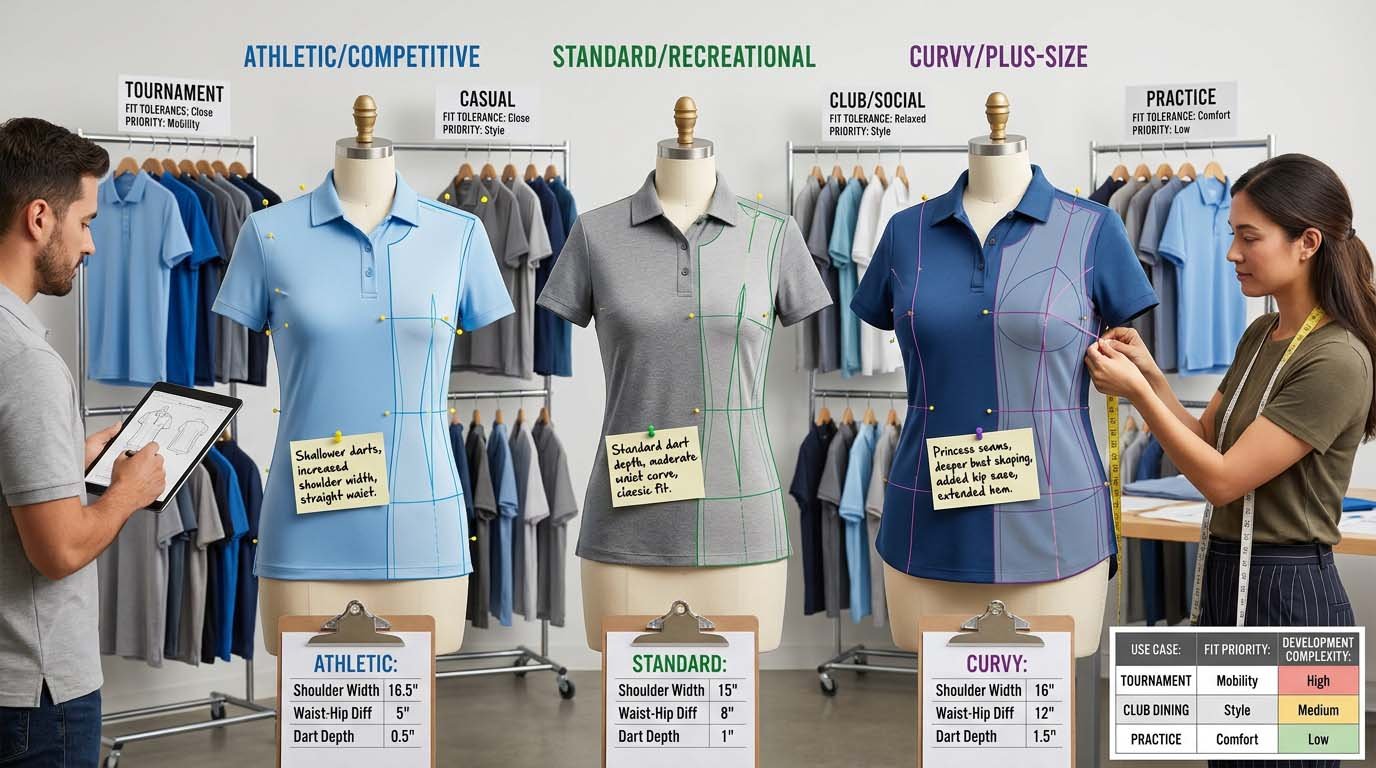
Athletic/Competitive Build Segment
Body proportion characteristics:
- Broader shoulders relative to bust measurement
- Less pronounced waist definition (4-6cm differential vs. 8-10cm standard)
- Lower bust point height (typically 16-18cm from shoulder vs. 15-17cm standard)
- Straighter torso silhouette with less hip curve
Pattern implications:
- Consider adapted men's athletic fit with women's length and neckline proportions instead of fully feminine block
- If using women's block, reduce waist suppression to 2-3cm per side seam (vs. 3-5cm standard)
- Increase back shoulder width by 1-2cm accommodating muscular development
- Use shallower bust darts (3-5cm depth) or eliminate darts in favor of slight ease
Use case priorities:
- Performance over fashion—prioritize mobility and durability
- Longer wear cycles—prefer 200+ GSM fabrics matching men's weight
- Less concern with feminine silhouette, more with professional appearance
Standard Recreational Build Segment
Body proportion characteristics:
- Typical 8-10cm waist-to-hip differential
- Standard bust point placement (15-17cm from shoulder, 8-10cm from CF)
- Average shoulder slope (5-6cm drop from neck to shoulder point)
- Balanced torso proportions
Pattern implications:
- Full women's pattern features required: bust darts, waist suppression, hip curve
- Standard dart depth 6-8cm distributed through front shaping
- Waist suppression 3-4cm per side seam creating defined but not extreme taper
- Hip curve allowing 2-3cm ease at fullest point
Use case priorities:
- Balance performance and appearance—want functional athletic wear that looks good
- Moderate wear frequency—prefer 160-180 GSM fabrics feeling lightweight
- Expect feminine fit without excessive tailoring
Plus-Size/Curvy Build Segment
Body proportion characteristics:
- Larger bust requiring deeper dart construction (8-12cm depth)
- Greater waist-hip differential (10-15cm or more)
- Fuller hip curve extending lower on torso
- Often need longer back length for adequate hip coverage
Pattern implications:
- Consider princess seam construction instead of darts for better bust shaping distribution
- Increase hip ease to 3-4cm minimum preventing binding
- Add back length by 2-3cm ensuring hem reaches intended point on fuller hip
- Adjust armhole depth and width accommodating fuller upper arm
Use case priorities:
- Fit and coverage paramount—reject styles riding up or pulling across bust/hip
- Comfort during movement—higher stretch requirement (12-15% spandex)
- Often underserved segment—will pay premium for proper fit in fashionable styles
Use Case Impact on Pattern Decisions
| Use Case | Pattern Priority | Fit Tolerance | Development Cost |
|---|---|---|---|
| Tournament play | Mobility > silhouette | Tight (no restriction) | Higher (extensive fit testing) |
| Casual rounds | Balanced fit | Moderate | Standard |
| Club social/dining | Appearance > performance | Looser (style over function) | Lower (less technical) |
| Practice/range | Durability, ease | Loose (comfort priority) | Lower |
Pattern Block Differences: Bust Shaping, Shoulder, Armhole and Grading
Bust shaping requires precise bust point coordinates, calculated dart depth from B-cup through DD-cup grading, and specified construction method (front darts, princess seams, or transferred shaping)—not generic "add darts" instructions—because improper placement or depth creates fit failures across size range that cannot be corrected post-production.
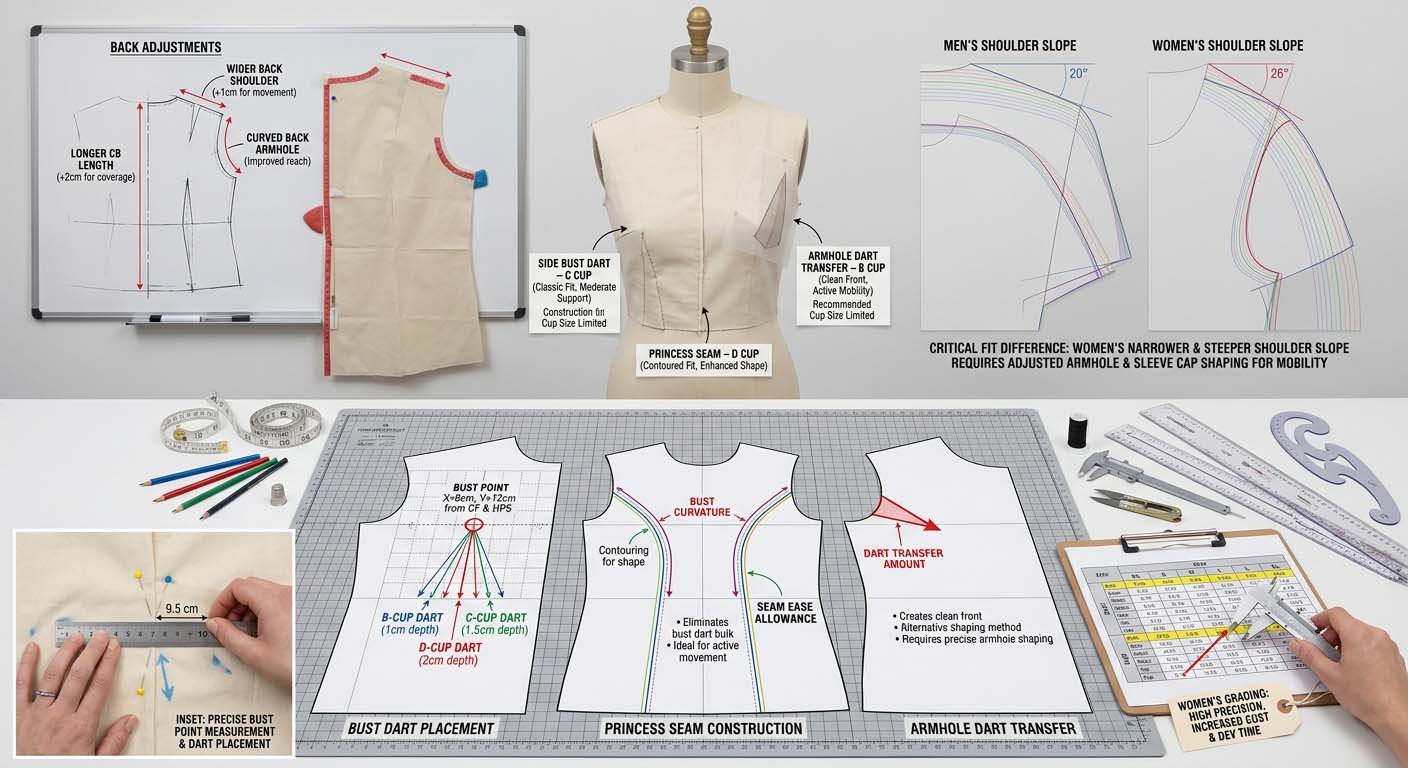
Bust Shaping Construction
Critical measurements required:
- Bust point horizontal position: typically 8-10cm from center front (varies by size)
- Bust point vertical position: typically 15-18cm below shoulder point (varies by size and segment)
- Dart depth: calculated as (bust circumference - underbust circumference) ÷ 4 per dart location
- B-cup: 5-6cm total (1.25-1.5cm per quarter)
- C-cup: 7-8cm total (1.75-2cm per quarter)
- D-cup: 9-10cm total (2.25-2.5cm per quarter)
Construction methods:
Front darts (most common for knit polos):
- Dart legs point toward bust point from waist or side seam
- Creates visible dart line but simplest construction
- Works best with opaque heavier fabrics (180+ GSM)
Princess seams:
- Vertical seams from shoulder or armhole to hem incorporating bust shaping
- No visible dart lines but higher construction cost
- Preferred for premium styles and plus-size ranges
Armhole dart transfer:
- Bust shaping built into armhole curve (invisible)
- Limited shaping depth possible (maximum 6-7cm) before distorting armhole
- Works only for B-C cup range; insufficient for larger cup sizes
Shoulder and Armhole Reconstruction
Shoulder slope adjustment:
Men's shoulder: typically 4-5cm drop from neckpoint to shoulder point over 13-15cm horizontal distance
Women's shoulder: requires 5-6cm drop over 11-13cm horizontal distance (steeper angle, narrower width)
Pattern change: Shoulder seam must be redrawn with increased slope and reduced width—not simply shortened, which maintains wrong angle.
Armhole depth and width:
Men's armhole: deeper placement (24-26cm from neckpoint) accommodating muscular chest and shoulder
Women's armhole: shallower placement (22-24cm from neckpoint) for proportional fit, narrower width (3-4cm less) at underarm
Why this matters: Wrong armhole depth creates loose, unflattering sleeve caps. Wrong armhole width restricts underarm movement or creates excess fabric pooling.
Grading Across Women's Size Range
Grading complexity versus men's:
Men's grading: relatively simple proportional scaling (each size larger adds consistent measurements across chest, waist, hip)
Women's grading: non-proportional changes required:
- Bust increases faster than underbust (cup size increases with size)
- Hip increases faster than waist (maintain feminine waist definition)
- Shoulder width increases minimally (2-3cm from XS to XXL vs. 5-6cm men's)
- Bust point location moves as size increases (requires dart repositioning per size)
Grade rule example (size M to L):
| Measurement Point | Men's Grade | Women's Grade |
|---|---|---|
| Chest/Bust | +2cm | +2cm |
| Waist | +2cm | +1.5cm |
| Hip | +2cm | +2.5cm |
| Shoulder width | +1cm | +0.5cm |
| Bust point horizontal | 0cm | +0.5cm |
| Bust point vertical | 0cm | +0.3cm |
Grading cost impact: Women's complex grading requires 40-60% more pattern engineering time than men's, reflected in $400-600 grading costs vs. $250-350 men's.
Back Pattern Adjustments Often Overlooked
Back length proportion:
Women's torso: longer back length relative to front (typical 2-3cm longer CB to waist than CF to waist)
Men's torso: more balanced front/back proportion
Pattern implication: Women's patterns need additional back length or hem rides up at back during sitting/bending while front maintains correct position.
Back shoulder width:
Must be wider than front shoulder width by 1-2cm allowing shoulder blade movement during backswing
Common error: equalizing front and back shoulder width restricts mobility
Back armhole shape:
Deeper curve at top of armhole (shoulder blade area) than men's patterns accommodate broader range of motion during overhead reach and rotation
Mobility & Swing Mechanics: Sleeves, Range of Motion and Ease
Swing mobility requires intentional ease additions beyond base fit measurements—sleeve cap ease, back width allowance, and torso side seam curve—creating slightly looser static fit that enables unrestricted movement during backswing rotation, weight transfer, and follow-through without fabric pulling or riding up.
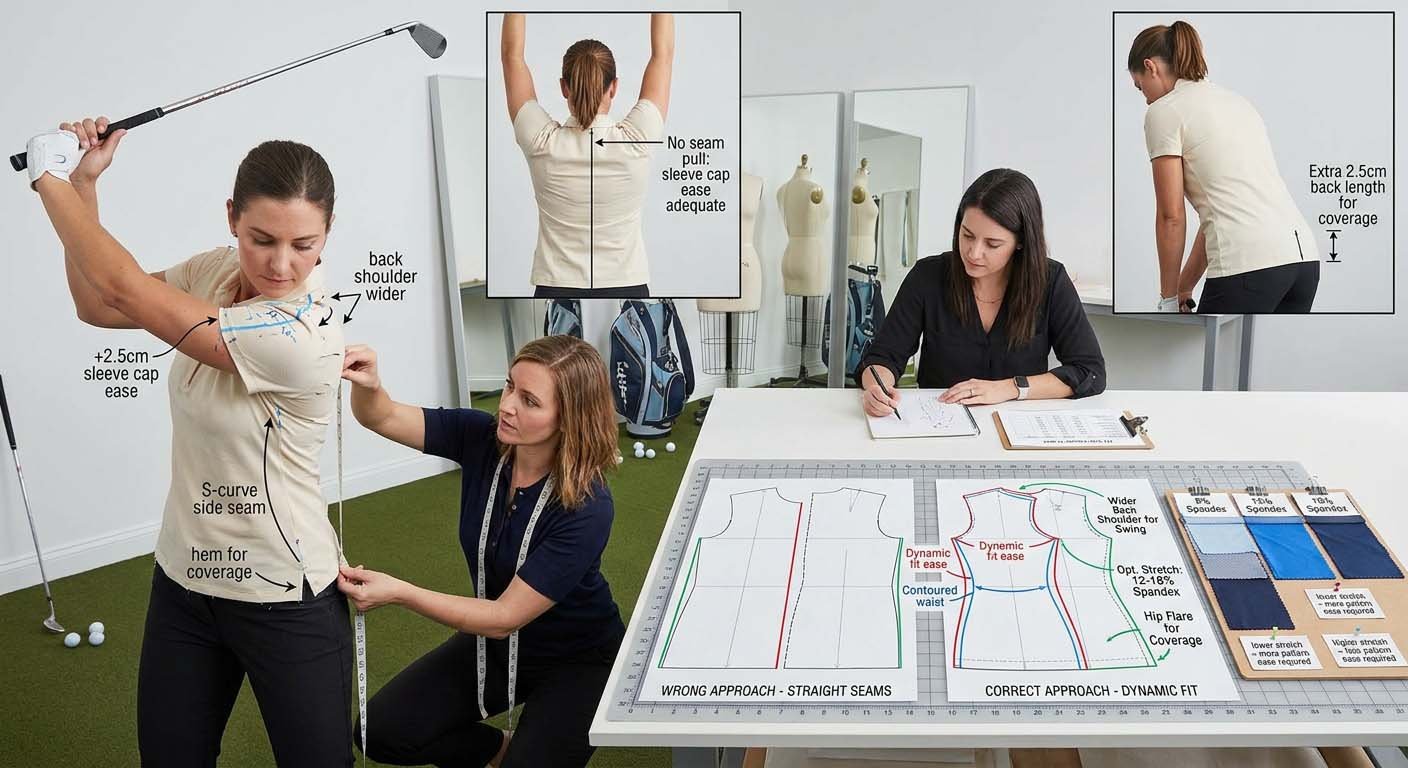
Sleeve Cap and Armhole Ease
Minimum ease requirements for mobility:
- Sleeve cap ease: 2-3cm total distributed around armhole (bicep area needs most, underarm least)
- Purpose: allows shoulder rotation during backswing without sleeve pulling polo body
- Trade-off: excess ease creates loose, unflattering sleeve cap; insufficient ease restricts movement
Testing method we use:
Fit model raises arm overhead (simulating backswing)—watch center back seam:
- If CB seam pulls up away from neck, insufficient sleeve cap ease
- If CB seam maintains position, ease adequate
Armhole depth impact:
Women's shallower armhole (22-24cm from neckpoint) compared to men's creates challenge: less vertical space to distribute ease without creating tight underarm
Solution: Carefully shape underarm curve allowing 3-4cm ease at deepest point while maintaining close fit at shoulder
Back Shoulder Width for Rotation
Why back must be wider than front:
During backswing, lead shoulder rotates back while trail shoulder rotates forward—shoulder blade movement requires fabric slack at back shoulder area
Typical proportion:
- Front shoulder width: 11-13cm
- Back shoulder width: 12-14cm (1-2cm wider)
Common error: Brands specify symmetric front/back shoulder width—restricts shoulder turn
Verification: Fit model rotates torso 90° (backswing simulation)—back shoulder seam should not pull tight across shoulder blade
Torso Side Seam Curve and Ease
Static vs. dynamic fit requirements:
- Static fit: minimize ease for streamlined appearance
- Dynamic fit: require 4-5cm ease through rib cage area allowing torso rotation and weight transfer without side seam pulling
Side seam curve construction:
Should curve inward at waist (2-4cm suppression) then outward toward hip creating S-curve accommodating movement
Straight side seams (men's pattern approach) bind at hip during rotation or create excess fabric at waist—cannot optimize both
Length Considerations for Coverage During Movement
Women's torso proportion challenge:
Longer torso relative to arm length means hip coverage requires 2-3cm additional length compared to equivalent men's size
Movement impact:
- Seated position: hip area compresses requiring length to maintain coverage
- Bent-over position (address): back length must not ride up exposing lower back
- Follow-through rotation: front hem should not rise uncomfortably
Length specification strategy:
Specify back length (CB neck to hem) as primary control measurement, allow front length to adjust based on back length plus pattern proportions
Typical women's polo: 62-66cm back length (vs. 68-72cm men's—but women's shorter torso requires higher hem placement relative to hip)
Stretch Fabric vs. Pattern Ease Tradeoff
Stretch reduces ease requirement but does not eliminate it:
- Low stretch (5-10% spandex): requires full ease allowances (2-3cm sleeve cap, 4-5cm torso)
- Medium stretch (10-15% spandex): can reduce ease by 20-30% while maintaining mobility
- High stretch (15-20% spandex): can reduce ease by 30-40% creating fitted appearance without mobility loss
Why stretch does not eliminate ease need:
Stretch helps accommodate movement but fabric recovery time matters—during full swing, multiple body areas stretch simultaneously. Pattern ease distributes stress across garment instead of concentrating it in high-stretch zones risking fabric failure.
Our pattern approach:
Develop base block with adequate ease for medium-stretch fabrics (10-15% spandex)—most common golf polo fabric range. Adjust ease up/down if brand specifies different stretch level.
Length, Silhouette & Finishes: Hem, Vents, Waist and Hip Balance
Length and finish proportions—hem placement relative to hip, side vent positioning, front/back hem balance, and waist curve integration—determine whether polo looks polished or awkward during movement, with small adjustments (1-3cm) creating significant fit perception changes that technical measurements alone do not capture.
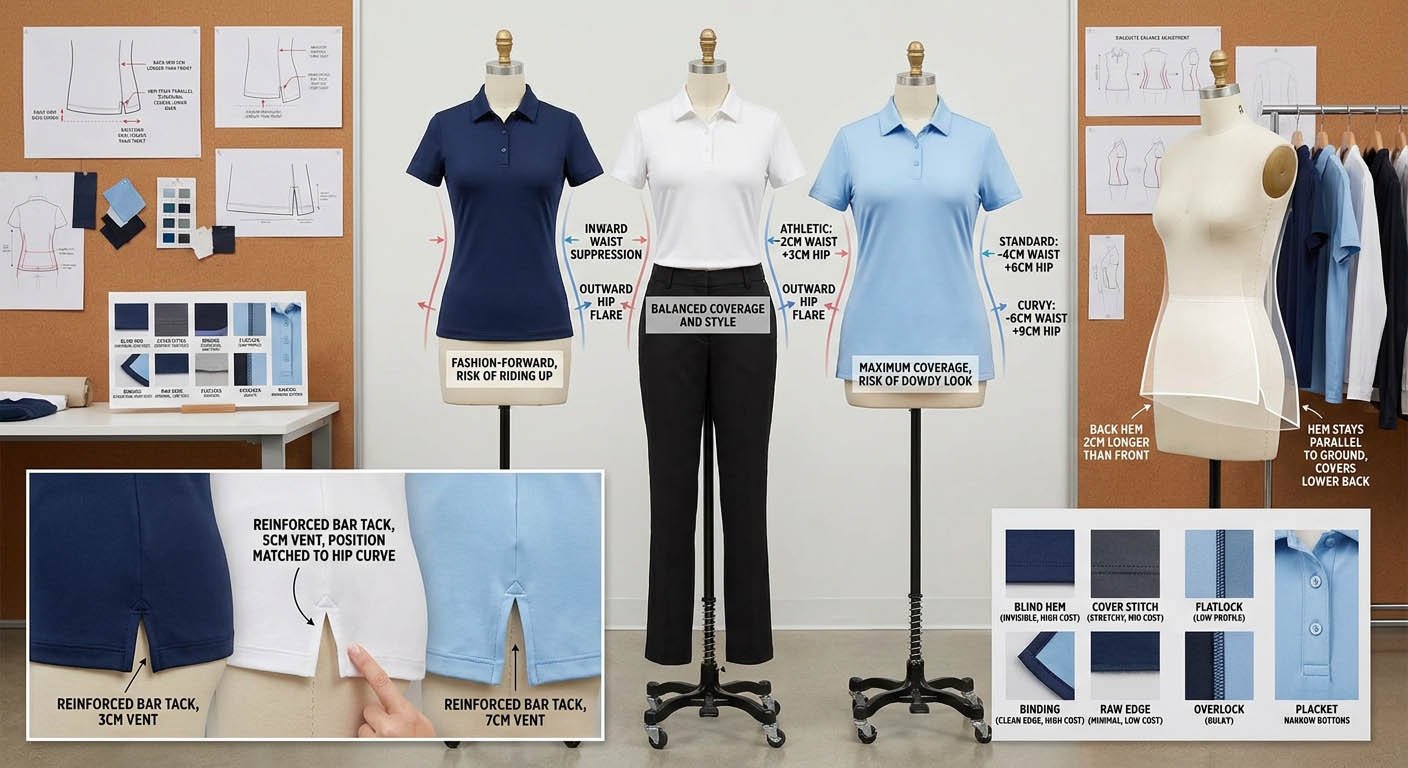
Hem Length and Placement Strategy
Three length strategies and use cases:
Hip-bone length (shortest):
- Hem sits at top of hip bone when standing
- Creates modern, fitted silhouette
- Risk: rides up during movement exposing midriff or waistband
- Best for: athletic builds, younger demographic, fashion-forward styling
Mid-hip length (standard):
- Hem sits at middle of hip covering waistband completely
- Most common commercial choice—balances coverage and style
- Adequate for most movement without excessive fabric
Below-hip length (longest):
- Hem sits below hip fullest point (typically 2-3cm below)
- Provides maximum coverage during bending and sitting
- Risk: can appear dowdy if not balanced with body-skimming fit through torso
- Best for: modest styling, plus-size range, conservative club dress codes
Measurement specification:
Always specify back length from CB neck to hem as control measurement (typically 62-66cm depending on length strategy)
Front length calculated from back length minus front/back proportion difference (typically 1-2cm shorter front)
Side Vent Construction and Positioning
Vent purposes:
- Enable hip movement without hem pulling up
- Allow polo to drape over hip curve without clinging
- Reduce fabric tension during sitting/bending
Vent specifications:
- Vent height: 4-6cm from hem (taller vents for longer polos, shorter for cropped styles)
- Vent positioning: must sit at or slightly above hip fullest point—too high creates gaping, too low fails to release tension
- Vent width: 2-3cm at hem opening (wider for looser fits, narrower for fitted styles)
Construction method:
- Reinforced with bar tack at top of vent preventing tear propagation
- Finished with binding or hemming matching main hem finish
- Often topstitched for durability and clean appearance
Common errors:
Vents positioned based on men's pattern placement (lower on body)—opens awkwardly on women's hip curve. Must reposition 2-3cm higher accounting for women's waist-hip proportion.
Front/Back Hem Balance
Why back longer than front:
- Women's gluteal curve requires back length to maintain hem parallelism to ground
- Without balance adjustment, front hem drops lower than back when viewed from side
- Typical balance: back hem 1-2cm longer than front at side seam
High-low hem styling (optional):
Some brands intentionally exaggerate front/back difference to 2-4cm creating fashionable high-low effect
Advantage: provides extra back coverage without adding bulk to front
Risk: too extreme difference looks costume-like rather than athletic
Curved hem vs. straight hem:
- Curved hem: follows body curves, preferred for fitted silhouettes
- Straight hem: simpler construction, preferred for relaxed fits
Most golf polos use slightly curved hem (1-2cm curve depth) balancing appearance and ease
Waist Shaping and Hip Curve Integration
Waist suppression execution:
Side seams must curve inward at waist (suppression zone) then outward toward hip (ease zone) creating smooth S-curve
Suppression amount:
- Athletic build: 2-3cm per side seam (4-6cm total waist reduction)
- Standard build: 3-4cm per side seam (6-8cm total)
- Curvy build: 4-5cm per side seam (8-10cm total)
Hip curve allowance:
After waist suppression, pattern must flare out toward hip allowing 2-3cm ease at hip fullest point
Without hip flare, polo binds during walking/sitting despite adequate hip circumference measurement
Common specification error:
Brands specify waist measurement wanting defined waist but do not specify hip measurement—leaving factory to guess appropriate flare amount
Result: samples either bind at hip (insufficient flare) or bag at hip (excessive flare)
Finish Details Affecting Perceived Quality
Hem finish options:
| Finish Type | Construction | Appearance | Cost |
|---|---|---|---|
| Blind hem | Invisible stitch from exterior | Clean, professional | Moderate |
| Cover stitch | Visible parallel stitching | Sporty, durable | Standard |
| Binding | Contrast or matching binding | Design element | Higher |
| Raw edge | Clean-cut with stretch fabric | Modern, minimal | Lower |
Side seam finish:
Should be flatlock or overlock creating flat seam without bulk—important for feminine silhouette
Avoid plain seam with serging visible from exterior (acceptable for men's but sloppy for women's)
Placket finish:
Women's plackets often use narrower width (2-3cm vs. 3-4cm men's) and more delicate buttons/snaps maintaining feminine proportion
Fabrics & Details: Stretch, UPF, Plackets, Collars and Aesthetics
Stretch percentage specification determines whether women's pattern shaping succeeds—low stretch (5-10%) requires generous ease defeating fitted aesthetic, high stretch (15-20%) risks pilling and sheerness, with optimal range (10-15%) balancing mobility, durability, and feminine silhouette for most golf polo applications.
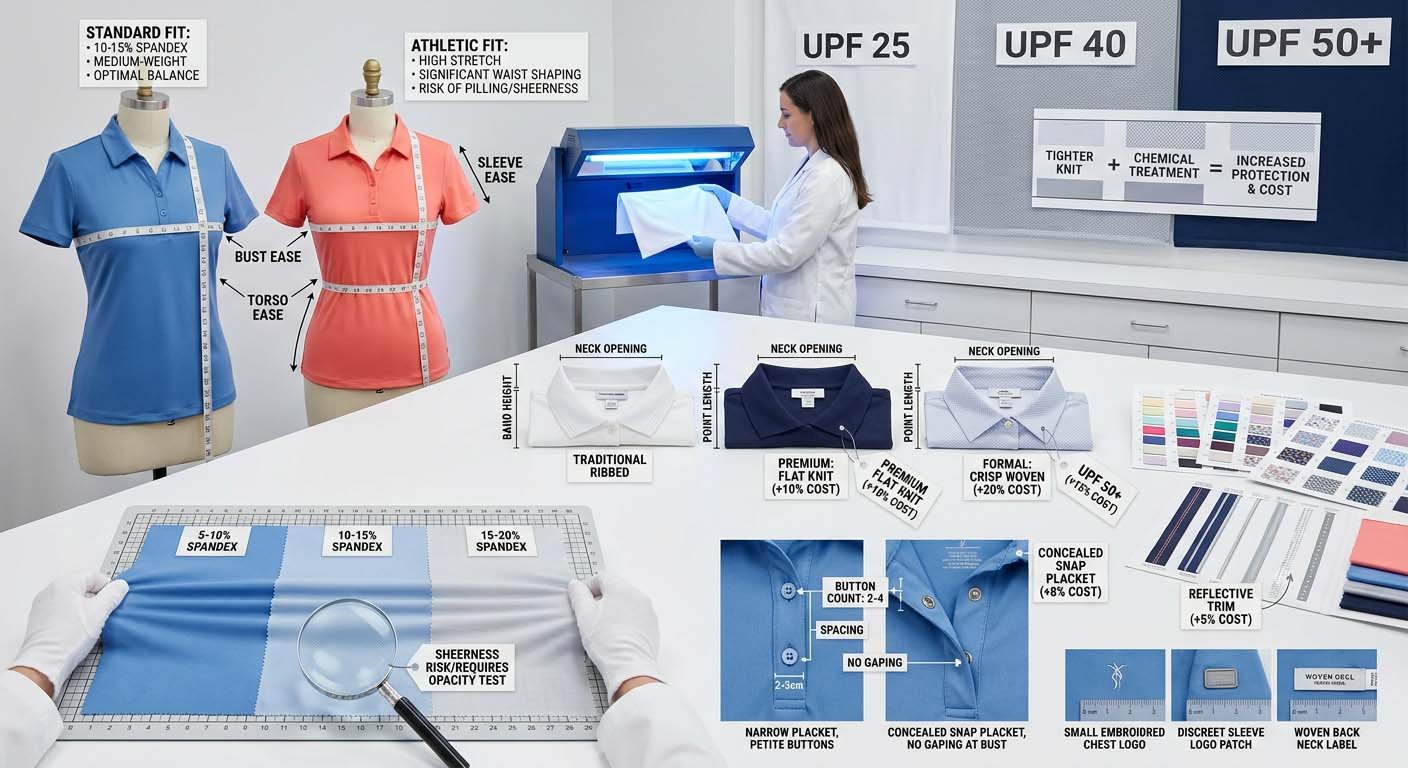
Stretch Fabric Specification
Stretch percentage targets by garment fit:
Relaxed fit (minimal waist shaping):
- 5-10% spandex adequate
- Pattern ease: 4-5cm torso, 2-3cm sleeve cap
- Fabric behavior: minimal recovery requirement, similar to men's polos
Standard fit (moderate waist shaping):
- 10-15% spandex optimal
- Pattern ease: 3-4cm torso, 2cm sleeve cap
- Fabric behavior: good shape retention, adequate recovery speed
Fitted/athletic fit (significant waist shaping):
- 15-20% spandex required
- Pattern ease: 2-3cm torso, 1-2cm sleeve cap
- Fabric behavior: high recovery needed, watch for pilling risk and sheerness at stretch
Fabric weight interaction:
- Lighter weight (140-160 GSM) + high stretch (15%+): sheerness risk requiring opacity testing
- Medium weight (160-180 GSM) + moderate stretch (10-15%): optimal balance for most golf polos
- Heavier weight (180-200 GSM) + low stretch (5-10%): durability prioritized over lightweight feel
UPF and Performance Features
UPF rating requirements:
- UPF 15-24: minimal protection, rarely marketed
- UPF 25-39: marketed as sun protection
- UPF 40-50+: "excellent" protection, premium positioning
Achieving UPF ratings:
- Fabric structure: tighter knit construction blocks more UV (but reduces breathability)
- Chemical treatments: UV-absorbing chemicals added during finishing (may degrade over washes)
- Fiber content: some fibers (polyester) naturally better UV blockers than others
Cost impact: UPF 40-50+ fabrics typically $0.80-1.50 per meter more than standard moisture-wicking
Women's specific consideration:
Lighter-weight fabrics preferred by female customers often have lower inherent UPF—must choose between lightweight feel and high UPF rating, or use chemical treatments maintaining both
Collar Design and Sizing
Women's collar proportion differences:
- Collar band height: 3-4cm (vs. 4-5cm men's)—lower collar suits shorter neck proportion
- Collar point length: 6-8cm (vs. 8-10cm men's)—shorter points maintain proportion
- Collar stand: often softer/lower stand creating more feminine appearance
- Neckline opening: can be slightly wider/more open than men's (personal preference by brand positioning)
Collar construction options:
Traditional ribbed collar:
- Knit rib fabric creates stretchy, casual appearance
- Most forgiving fit (accommodates neck size variance)
- Cost: standard
Flat knit collar:
- Engineered knit collar in same fabric as body
- More refined, tailored appearance
- Cost: 10-15% premium (requires separate collar knitting/attaching)
Woven collar:
- Woven fabric insert creating crisp, formal collar
- Elevated styling but reduces stretch comfort
- Cost: 20-30% premium (more complex construction)
Placket and Button Details
Placket width:
Women's: 2-3cm wide (narrower than 3-4cm men's)
Maintains feminine proportion and reduces visual bulk
Button count and spacing:
Standard: 3-4 buttons on women's polo (vs. 2-3 men's)
Closer spacing (6-8cm between buttons) reduces gaping risk across bust area
Button size:
Women's: 10-12mm diameter (vs. 12-15mm men's)—smaller buttons suit narrower placket and more delicate styling
Hidden placket option:
Snap closures concealed behind placket (no visible buttons)
Creates clean, minimal appearance—growing trend in women's golf fashion
Cost: 15-25% premium over standard button placket (more complex construction)
Aesthetic Details Differentiating Women's Styles
Color and pattern preferences:
- Solid colors: remain most commercial, but women's market accepts broader color range than men's (pastels, jewel tones beyond navy/black/white)
- Prints: subtle patterns acceptable in women's golf (small florals, geometric, color-blocking) vs. men's solid preference
- Contrast details: color-blocking, contrast collar/placket, piping more common in women's styles
Trim and finishing details:
- Contrast stitching: decorative topstitching in contrasting thread color
- Piping: thin contrast piping at seams or edges
- Reflective details: small reflective elements for visibility (emerging trend)
Branding placement:
Women's polos often use smaller, more discreet branding placement:
- Chest logo: 4-6cm width (vs. 6-8cm men's)
- Back neck label: preferred over large back graphics
- Sleeve logo: small detail placement popular
Cost impact of aesthetic complexity:
Each additional detail (contrast trim, piping, multiple logo placements) adds $0.30-0.80 per unit in construction costs—manageable for premium positioning but significant for value-priced programs
FAQ: Women's vs Men's Golf Polo Design
Can I modify existing men's pattern or must I start from scratch?
Starting from scratch almost always more efficient despite appearing more expensive initially. Here is why:
Modifying men's pattern typically requires:
- Rebuilding bust area (adding darts/shaping where none existed)
- Completely redrafting side seams (changing from straight to curved)
- Reconstructing shoulder (changing width AND slope requires new armhole)
- Adjusting armhole shape (not just size—actual curvature different)
- Recalculating all grading rules
Net result: You end up redrafting 70-80% of pattern. Time investment: 1-2 weeks plus 2-3 sampling rounds correcting incompatibilities between modified sections and leftover men's geometry.
Starting from scratch: Women's block drafted with correct proportional relationships from beginning. Time investment: 2-3 weeks plus 1-2 sampling rounds. Total timeline similar but fewer fit surprises.
When modification makes sense: If you have successful women's pattern in different style (e.g., women's crew neck tee) and adapting to polo construction—base women's proportions already solved.
Do I need different fit models for women's versus men's lines?
Yes, absolutely. Using same fit model (even female model wearing men's samples) creates misleading fit assessment because:
- Fit model for women's wear should have B/C cup bust (A cup or D+ cup both create fit anomalies)
- Proportions should match target customer segment (athletic build for performance line, average proportions for recreational line)
- Experienced women's fit model provides useful feedback on comfort, restriction, appearance that male or inexperienced model cannot
Cost consideration: Professional fit model $150-300 per fitting session. Seems expensive but prevents costly production errors. Brands trying to save money by skipping proper fit model typically spend more correcting problems later.
How do I determine if market wants women's specific patterns or unisex is sufficient?
Test questions to determine necessity:
- What percentage of customers are women? If under 20%, unisex may suffice. If over 30%, women's patterns likely necessary for retention.
- What price point are you targeting? Under $40 retail, unisex often acceptable. Over $50, women expect proper fit.
- What is competition offering? If major competitors have women's specific lines, you will lose sales with inferior fit.
- What are current fit complaints? If receiving returns/complaints about "doesn't fit right," "tight in chest," "loose at waist"—indicators women's patterns needed.
Market data: In golf apparel, women represent 20-25% of players but account for 30-35% of apparel purchases (more frequent buying behavior). Women's specific patterns capture larger share of this high-value segment.
What size range should I develop for women's line launch?
Minimum viable: S, M, L (covers approximately 60-70% of customer base)
Standard full range: XS, S, M, L, XL (covers approximately 85-90%)
Extended plus range: Add XXL (covers approximately 95%)
Development cost by range:
- 3 sizes (S/M/L): $500-800 pattern development + $300-500 sampling = $800-1,300
- 5 sizes (XS-XL): Same base cost + $150-250 for grade rule development and extreme size sampling = $950-1,550
- 6 sizes (XS-XXL): Add $200-300 for plus-size fit verification = $1,150-1,850
Recommendation for first launch: Start with S, M, L plus one size at each extreme (XS or XL based on target demographic skew). Test market acceptance before extending full range. Extending too wide initially creates inventory risk; extending too narrow loses sales.
Should women's patterns cost more per unit to manufacture than men's?
Pattern construction itself should not add cost if factory set up for women's apparel production (dart sewing, curved seams standard women's wear). However, several factors may affect cost:
Potential cost increases:
- Smaller sizes use similar setup time but less fabric—some factories charge slight premium on XS/S to offset (typical $0.20-0.40 per unit)
- More complex grading (non-proportional) takes additional pattern work—some factories charge grade rule premium (one-time $100-200, not per-unit)
- Sampling iterations if starting without existing women's patterns—more upfront sampling cost, not production cost
Cost should NOT increase for:
- Basic sewing operations (darts, curved seams are standard women's construction—not specialty)
- Fabric (same performance fabrics used across men's and women's lines)
- Trims (buttons, labels, etc. similar cost)
Reality check: Some factories quote higher prices on women's simply because they lack experience (true cost is their learning curve). Look for factories with established women's golf apparel production avoiding the "new to us" premium.
How do I protect my women's pattern investment if changing factories?
Critical steps:
- Specify pattern ownership in contract—state clearly you own patterns developed for your brand
- Request digital pattern files (.dxf or .plt format for automated cutting) after approval—enables taking to new factory
- Retain Golden Sample (approved fit sample) with detailed measurement sheet—new factory can draft from this if patterns lost
- Document fit standards in writing (bust dart position, waist-hip measurements, ease allocations)—provides reference for recreating if necessary
Reality: Most factories resist providing pattern files (they view patterns as proprietary work). Negotiate this before paying deposit—easier to get agreement upfront than after patterns developed.
Cost of recreating patterns with new factory: If you have Golden Sample and measurement specs, new factory can recreate pattern for $300-500 (less than initial development but not free). If starting from photos and descriptions only, closer to $500-800 (basically new development).
Conclusion
Women's golf polo pattern development requires dedicated base blocks with bust dart placement calculated from cup size differentials, waist-to-hip ratio grading maintaining feminine proportions across sizes, shoulder slope and armhole reconstruction accommodating anatomical differences, and stretch fabric specifications (typically 10-15% spandex) enabling shaped silhouette without mobility restriction—not scaled-down men's patterns—with first-style investment ($1,600-2,400 development, 2-3 weeks additional timeline) amortizing across future styles once base block established, making women-specific engineering economically justified for brands launching 3+ styles targeting female golfers who prioritize proper fit over adapted men's sizing.