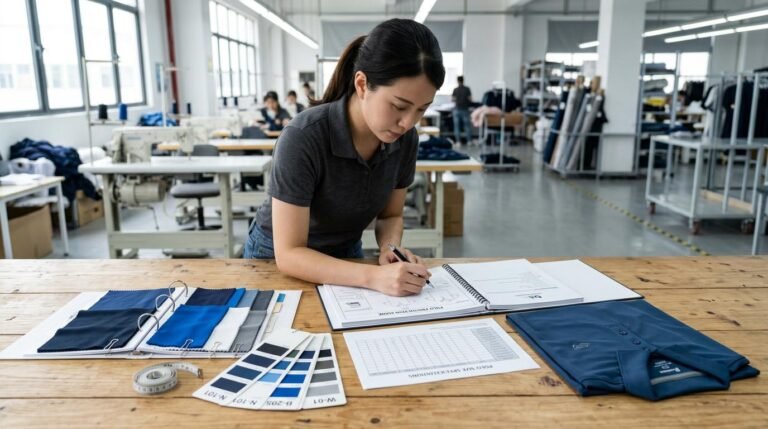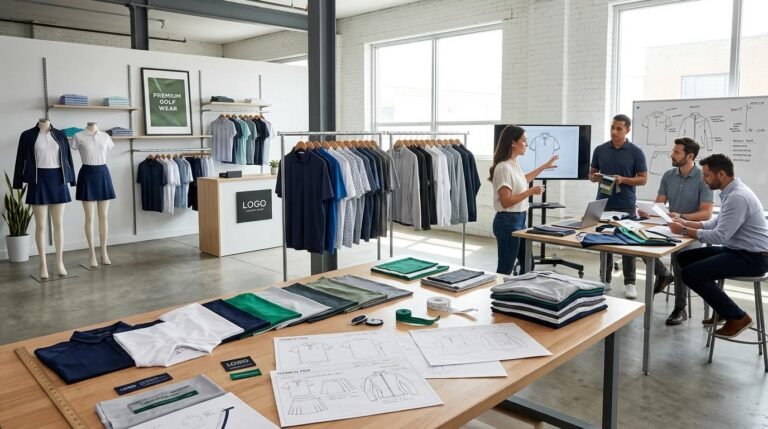
A client showed me a list of 12 "top golf polo manufacturers" from a Google search and asked which one to pick. I asked what their order volume was, whether they had tech packs, and what their budget per unit looked like. They had 400-piece orders, design sketches but no tech packs, and $14 per unit budget. Of their 12 "top" factories, 9 required 1,000+ piece MOQs or quoted above their budget. Their shortlist was built on reputation, not compatibility. The factories that would actually serve them well were not the most famous—they were the ones matching their specific business model.
A useful 2026 golf polo OEM shortlist is not a universal ranking but a filtered list of manufacturers matching your specific order volume, design readiness, budget, and quality verification needs—because golf brand buyers and e-commerce sellers evaluate factories on completely different criteria, and the "best" supplier depends on which type of buyer you are.
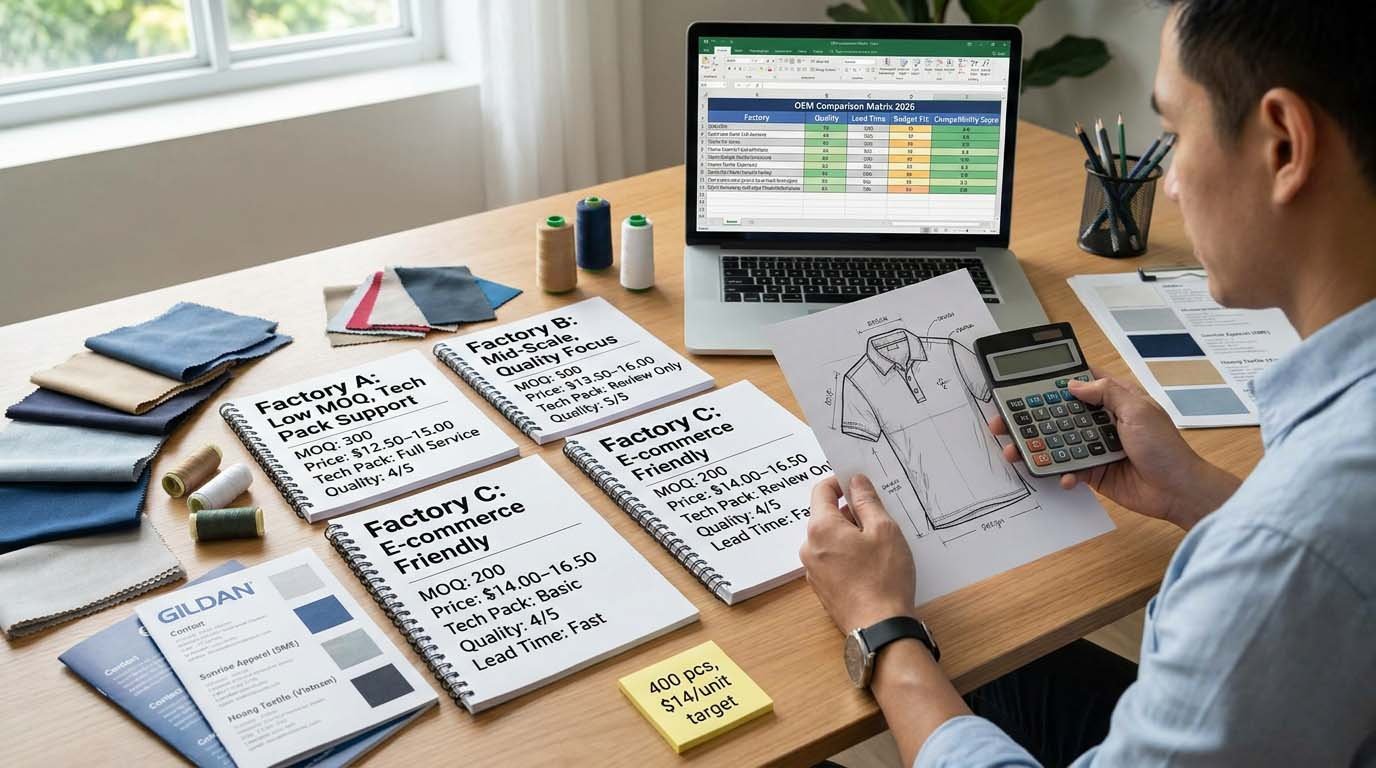
I am Will from FUWAY. Over the past 3 years, I have helped 120+ golf apparel brands and e-commerce sellers evaluate factories and execute first orders. Most buyers arrive with shortlists compiled from search rankings or trade show contacts, then discover their list does not match their actual business needs. This guide shows you a starting shortlist of three credible manufacturers, explains the vetting framework behind it, and helps you decide which type of supplier actually fits your situation.
Quick Summary: 2026 Golf Polo OEM Sourcing
- How many to shortlist: Keep it to 3-5 factories to ensure deep evaluation.
- Brand vs. E-com: Brands need R&D and stability (like FUWAY); E-com needs speed and low MOQs (like Tack Apparel).
- The MOQ Sweet Spot: 300-500 pieces balances cost efficiency with quality control. Avoid ultra-low MOQs (<100) which often hide stock-fabric compromises.
- Biggest Red Flag: Quotes 20-30% below market average usually mean fabric downgrades or hidden development fees.
(Read below for the complete shortlist of 3 vetted manufacturers, regional comparisons, and our deep-dive FAQ on protecting your production.)
Best Manufacturers & Private Label Suppliers: 2026 Shortlist
The three manufacturers below represent different buyer fits—not a ranking. Evaluate based on which profile matches your business model rather than choosing by reputation alone.
1. FUWAY (fuwaygolf.com)
Location: China
Best fit for:
Mid-volume golf brands and e-commerce sellers (100-2,000 piece orders) prioritizing fabric stability, construction consistency, and ODM design support specifically for golf polos.
What they offer:
- Golf-specialized ODM with established pattern library plus OEM custom development
- Moisture-wicking polyester, 4-way stretch, anti-odor, UPF-rated fabric options
- MOQ: 300 pieces per style across 2-3 colorways
- Lead time: 4-6 weeks production after pre-production sample approval
- OEKO-TEX certified materials with three-stage QC and batch traceability documentation
Where they fit your shortlist:
Golf-category specialist rather than general sportswear factory, suitable for buyers wanting category expertise without 1,000+ piece commitments. Less suitable for ultra-low-MOQ test orders (under 100 pieces) or rock-bottom-budget sourcing where fabric performance is not a priority.
2. Tack Apparel (tackapparel.com)
Location: United States (design and customization), manufacturing partnerships across regions
Best fit for:
US-based golf brands and small-to-mid e-commerce sellers wanting domestic communication, faster turnaround on private label programs, and customization through embroidery, screen printing, or sublimation without managing offshore factory relationships.
What they offer:
- Private label and custom golf apparel programs with US-based account management
- Established customization capabilities for logo application across decoration methods
- Lower entry barrier for buyers without offshore sourcing experience
- Faster communication cycle due to time zone alignment for US-based brands
Where they fit your shortlist:
Useful option for buyers prioritizing communication ease and reduced sourcing complexity over absolute lowest cost. Verify pricing structure carefully—US-based service typically carries premium over direct Asia sourcing, but eliminates offshore management overhead and shipping lead times that may offset cost difference for smaller orders.
3. Thygesen (thygesenapparel.com)
Location: Vietnam
Best fit for:
Larger golf brands and established e-commerce sellers (1,000+ piece orders) seeking vertically integrated performance apparel manufacturing with strong sustainability credentials, technical fabric capability, and supply chain diversification away from China concentration.
What they offer:
- Vertically integrated manufacturing from fabric development to finished garment
- Performance and technical apparel specialization including golf polo construction
- Strong ESG and sustainability certifications supporting major retail buyer requirements
- Vietnam manufacturing offering tariff advantages for US market and supply chain diversification
Where they fit your shortlist:
Better fit for brands at scale (1,000+ piece orders) where vertical integration and certification depth matter more than small-batch flexibility. Less suitable for emerging brands with 300-500 piece orders, as MOQ structure and minimum engagement scale favor larger commitments.
How to Choose Among the Three
| Decision Factor | FUWAY | Tack Apparel | Thygesen |
|---|---|---|---|
| Region | China | US-based service | Vietnam |
| Order volume fit | 300-2,000 pieces | Small to mid-volume | 1,000+ pieces |
| Custom fabric development | Strong (golf-specialized) | Moderate (partner-dependent) | Strong (vertically integrated) |
| MOQ flexibility | Moderate (300+ per style) | Higher flexibility | Lower (favors scale) |
| Communication ease | Asia time zone | US time zone | Asia time zone |
| Supply chain diversification | China-based | Multi-region | Non-China (Vietnam) |
| Sustainability/ESG depth | Standard certifications | Varies by partner | Strong ESG positioning |
| Best buyer profile | Mid-volume golf brand needing category specialist | US buyer prioritizing communication ease | Scale brand needing vertical integration and diversification |
Selection logic:
- If you are a 300-500 piece order golf brand wanting category expertise: FUWAY
- If you are a US buyer prioritizing communication and reduced offshore complexity: Tack Apparel
- If you are a 1,000+ piece scale brand needing vertical integration and China diversification: Thygesen
None of these three is universally "best"—each optimizes for a different buyer profile and tradeoff priority.
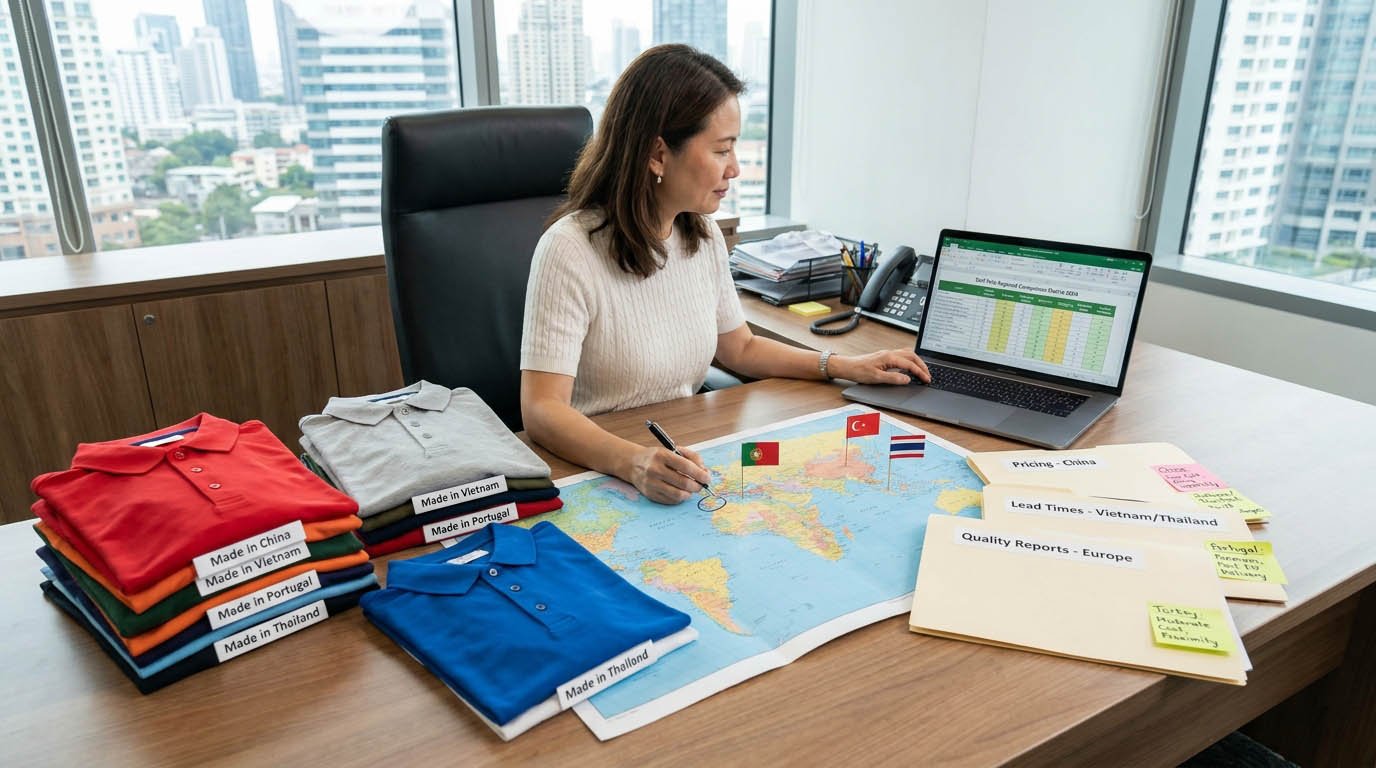
Regional Overview: China, Vietnam, Thailand, Portugal, Turkey
Regional manufacturing selection requires prioritizing your business model's critical constraint—cost ceiling, lead time requirement, quality positioning, or supply chain risk tolerance—because each region optimizes for different tradeoffs rather than offering universally superior quality.
China: Cost Efficiency with Broad Capability
Pricing range: $11-16 per unit for 500-piece moisture-wicking polo
Lead time: 6-8 weeks production + 4-6 weeks ocean shipping
Best for: Cost-prioritized brands, orders 500+ pieces justifying ocean freight, buyers comfortable with 10-14 week cycles
Watch for: Quality variance across factories requires thorough vetting; language and time zone complicate real-time communication
Vietnam and Thailand: China Alternative with Tariff Advantages
Pricing range: $12-17 per unit (5-10% higher than China)
Lead time: Similar to China
Best for: Buyers diversifying supply chain risk, brands optimizing US tariff exposure, companies wanting growing capability without China concentration
Watch for: Fabric sourcing often still relies on China/Korea adding lead time; technical depth less established than China
Portugal: Premium Positioning with EU Speed
Pricing range: $20-28 per unit (60-100% premium over Asia)
Lead time: 6-8 weeks production + 1-2 weeks shipping to EU, 2-3 weeks to US
Best for: Premium brands ($80-150 retail) where "Made in Portugal" justifies pricing, brands needing fast restocking, easier factory oversight
Watch for: Smaller factory scale (2,000-10,000 pieces monthly); higher MOQs (500-800 typical)
Turkey: EU Proximity at Moderate Cost
Pricing range: $18-25 per unit (50-80% premium over Asia)
Lead time: 6-8 weeks production + 1-2 weeks to EU, 2-3 weeks to US
Best for: EU-focused brands wanting cost between Asia and Portugal, buyers prioritizing EU proximity and trade agreements
Watch for: Currency and political volatility; verify factory English communication capability
Regional Decision Matrix
| Priority | Best Region | Tradeoff Accepted |
|---|---|---|
| Lowest cost | China | Long lead time, distance |
| Supply chain diversification | Vietnam/Thailand | Slight cost premium |
| Fast EU delivery | Portugal | Higher cost |
| EU proximity at moderate cost | Turkey | Currency risk |
| Premium positioning | Portugal | 60-100% price premium |
| Scale capacity | China | Communication complexity |
Capabilities Snapshot: Fabrics, Tech, MOQs, Lead Times, Certifications
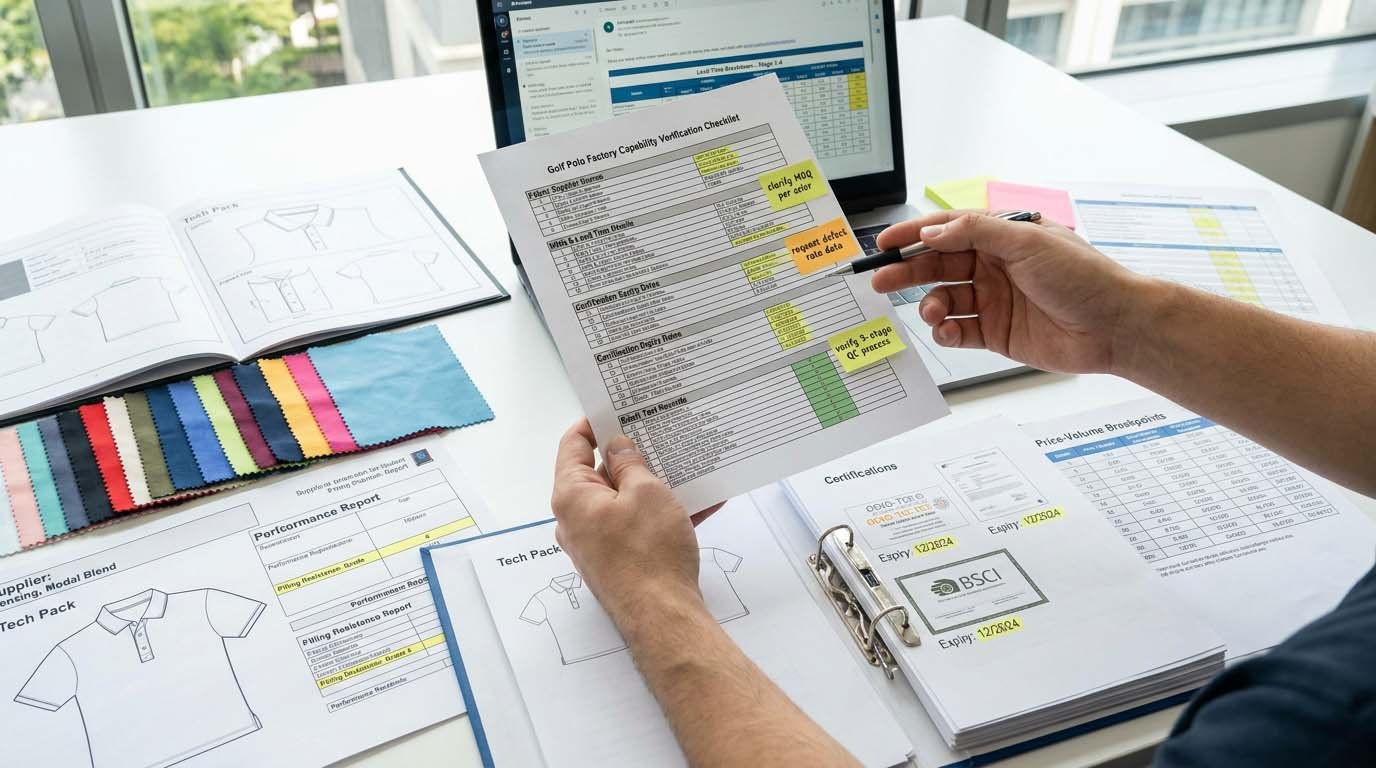
Capability evaluation requires specific operational verification—fabric supplier names and batch test records, certification scope and expiration dates, MOQ thresholds with cost impact, lead time component breakdown—because marketing capability claims are universal across factories but execution details separate credible suppliers from aspirational ones.
Fabric Capabilities
What to verify:
- Fabric supplier names and stability (do they source from same mills consistently?)
- Stock fabric versus custom dye lead times
- Performance testing protocols (every batch or supplier certificates only?)
- Custom fabric MOQ constraints (some performance fabrics require 1,000+ yard minimums)
Common gaps:
Factory claims "all performance fabrics" but stock options limited to 5-10 substrates; custom sourcing takes 3-4 weeks extending your lead time; certain features (4-way stretch, anti-odor) require specific mill relationships some factories lack.
Technical Manufacturing
What to verify:
- Pattern library scope (athletic fit, traditional fit, regional sizing variants)
- Construction capability (engineered mesh panels, hidden plackets, bonded seams)
- Sample iteration policy (how many rounds included before fees apply)
- Defect rate documentation
Common gaps:
Factory shows sample portfolio of impressive constructions but most are one-off showpieces; production capability does not consistently match showcase samples; complex constructions carry hidden cost premiums revealed only at quotation stage.
MOQ Reality Check
Stated versus actual MOQ:
Many factories state "300 pieces MOQ" meaning 300 pieces per color per style. Clarify: total order minimum versus per-color minimum. True flexibility means 300 total across 2-3 colors (100-150 each), not 300 per color requiring 600-900 piece commitment for color variety.
MOQ cost curve:
Orders at factory minimum MOQ carry 10-20% price premium versus optimal volume. Ask what volume achieves standard pricing—often 500-1,000 pieces. Understand: 300-piece order at $15/unit versus 1,000-piece at $13/unit represents different value calculations.
Lead Time Components
Request breakdown:
- Pattern development: ___ weeks (if OEM)
- Fabric sourcing: ___ weeks
- Sampling: ___ weeks
- Bulk production: ___ weeks
- Shipping: ___ weeks
Red flags:
Cannot break down timeline (suggests guessing); promises 4-week total for custom development (unrealistic); no contingency buffer mentioned for revisions.
Certifications: What They Actually Cover
OEKO-TEX Standard 100: Fabric chemical safety—does not prove every batch tested, factory uses only certified fabrics, or quality consistency
REACH: EU chemical compliance—does not prove ongoing compliance, accessories included, or testing frequency
BSCI/SEDEX: Social audit snapshot—does not prove daily conditions match audit, no violations between audits, or quality reliability
ISO 9001: Documented QMS exists—does not prove system consistently followed
Practical use:
Certifications eliminate non-compliant factories from shortlist. They do not predict execution quality. Verify execution through three-stage QC documentation, batch testing records, and pre-shipment inspection willingness.
Private Label Programs: Design Support, Branding, Packaging and Fulfillment
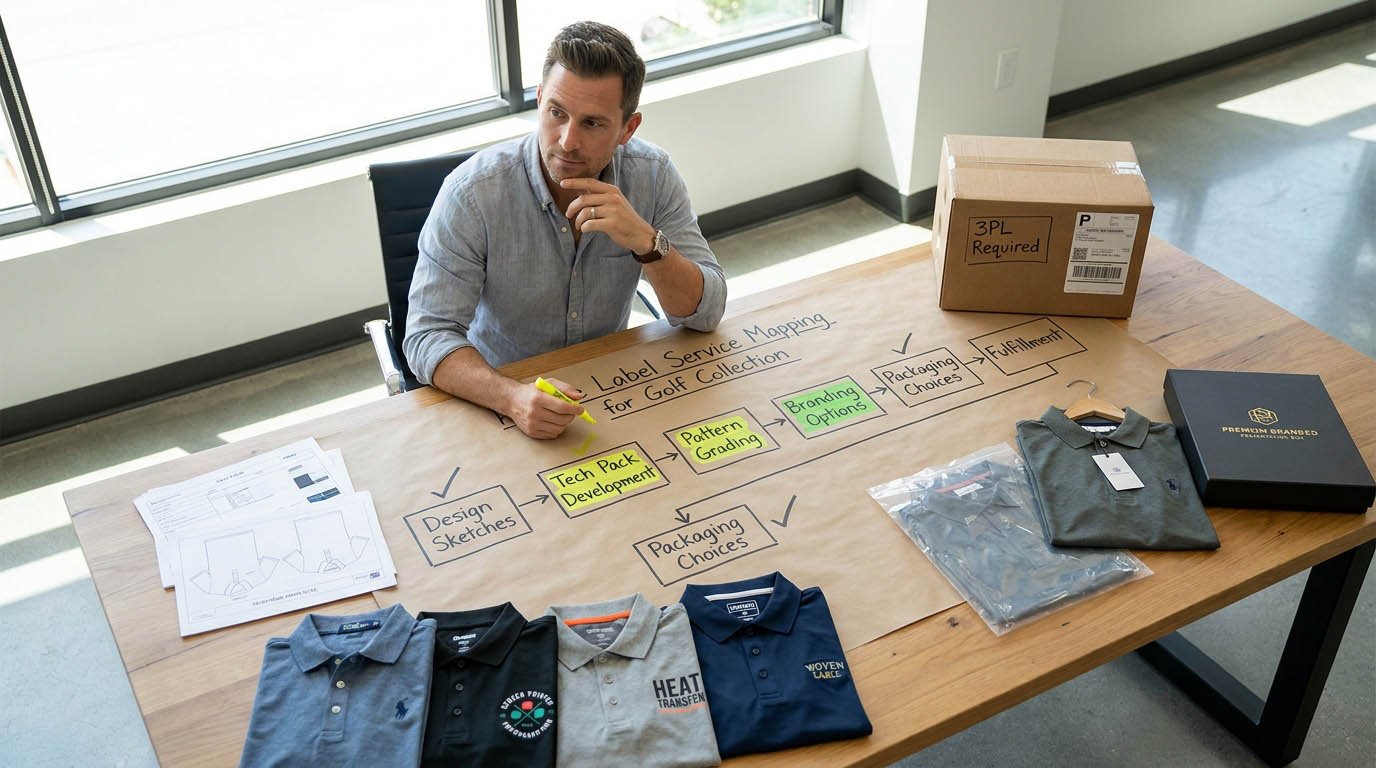
Private label service selection depends on mapping your specific capability gaps against complete product development cycle—identifying which services you actually need rather than buying "full service" packages including capabilities you already have or do not require.
Design and Development Services
Tech pack development: $150-400 per style. Needed if you have sketches but lack manufacturing-ready specifications.
Pattern making and grading: $300-800 OEM, often absorbed in ODM. Needed for custom fit; ODM uses existing patterns.
Sample iteration: $80-200 per sample × 2-4 rounds typical. Standard across all projects.
Concept design: $500-2,000 per style. Rarely needed—most buyers arrive with design direction.
Branding Integration
Logo application:
- Embroidery: $1.20-2.00 per placement, most durable
- Screen printing: $0.40-0.80 per placement, cost-effective
- Heat transfer: $0.80-1.40 per placement, complex designs
- Woven labels: $0.15-0.40 each, brand identity element
Setup fees: Typically $50-150 per logo setup, one-time but applies per new style.
Packaging
Basic: Individual poly bag + care label, minimal cost
Standard: Poly bag + hang tag + brand sticker, $0.20-0.40 per piece
Premium: Custom poly bag + hang tag + tissue + box, $1.20-2.80 per piece
MOQ consideration: Custom packaging often requires 500-1,000 piece minimums separate from garment order.
Fulfillment Reality
Most golf apparel factories do not offer individual order fulfillment. If you need e-commerce fulfillment, partner with 3PL—factories ship bulk to your warehouse or 3PL location. Do not expect dropshipping or pick-and-pack from manufacturing factories.
Costs, Terms and Compliance: Pricing, Incoterms, IP and ESG
Cost comparison requires normalizing quotes to identical Incoterms and inclusion scope—because FOB pricing excludes $4-8 per unit in shipping, duties, and fees that DDP pricing absorbs, making nominal price differences misleading without total landed cost calculation.

Pricing Bands by Tier (China, 500-piece reference)
Basic: $10-13 per unit—standard polyester, simple construction, no customization
Standard: $12-16 per unit—moisture-wicking, athletic fit, brand customization
Premium: $16-22 per unit—4-way stretch, anti-odor, UPF, engineered features
Payment Terms
Standard: 30-50% deposit, balance before shipping
Negotiable factors: Larger orders (1,000+) may achieve 30% deposit; established relationships (3+ successful orders) may extend terms
Protection options: Alibaba Trade Assurance for smaller orders; Letter of Credit for orders above $20,000
IP Considerations
Pattern ownership: Clarify in contract—OEM patterns you develop should be yours; ODM patterns typically remain factory property
NDA: Limited offshore enforceability but sets expectations
Best protection: Work with factories supplying established brands (reputation risk discourages copying); register designs/trademarks in key markets
ESG and Compliance
When required: Major retail buyers (Target, Dick's, etc.) require certified suppliers; EU market requires REACH compliance; sustainability marketing requires verified certifications (OEKO-TEX, GRS)
When optional: Pure e-commerce with own brand positioning may operate without extensive certification, though sustainability is increasingly market access requirement
FAQ: Golf Polo OEM and Private Label Sourcing 2026
How long does full development from concept to inventory take?
ODM with existing patterns: 6-8 weeks. OEM custom patterns: 10-14 weeks. Full development from concept: 12-16 weeks. Add 2-4 weeks buffer for revisions.
Can I get lower MOQs for first test orders?
Some factories offer 100-200 piece test orders at 15-30% price premium with limited color and size options. Better approach: order at standard MOQ (300-500) with strategic color allocation rather than chasing ultra-low test MOQs.
How do I protect designs from copying?
NDA with factory (limited offshore enforceability), retain pattern ownership for OEM work, choose factories with established brand clients (reputation incentive to protect relationships), register designs in key markets. Accept that some copying risk exists—focus on brand execution and speed advantages.
Should I use Alibaba or contact factories directly?
Start with Trade Assurance-protected first order establishing relationship, transition to direct contracts after successful execution. Hybrid approach balances payment protection with cost efficiency.
What deposit should I expect?
30-50% deposit upon order confirmation, balance before shipping. New factories rarely offer better terms. Use Trade Assurance, escrow, or L/C for deposit protection on first orders.
How do I verify if quoted lead time is realistic?
Request component breakdown (pattern, fabric, sampling, production, shipping). Compare to regional norms (6-8 weeks Asia minimum). Add 20-30% buffer for first orders accounting for learning curve and unforeseen issues.
What recourse if bulk production does not match sample?
Documentation critical: approved Golden Sample, detailed tech pack, pre-shipment inspection report. Payment leverage: balance should not release until quality approved. Prevention better than remedy—thorough specification and PSI minimize disputes.
Conclusion
A useful 2026 golf polo OEM shortlist matches your business model—volume, design readiness, budget, timeline, and quality verification capacity—rather than ranking factories on universal "best" criteria, with credible vetting requiring category specialization verification, execution consistency checks across multiple orders, three-stage QC documentation, and commercial transparency rather than reliance on certifications alone or marketing capability claims disconnected from operational execution evidence.