
Your sample polo looks great on the hanger, but on a real person, it pulls across the shoulders during a swing and the sleeves feel tight. The fit just isn't right, and you don't know what to tell your factory to fix it.
Mastering golf polo fit isn't about one magic number. It's about understanding the relationship between the shoulder seam, the sleeve cap, and the hem. By controlling these key areas and always measuring after washing, you can engineer a polo that moves with the golfer.
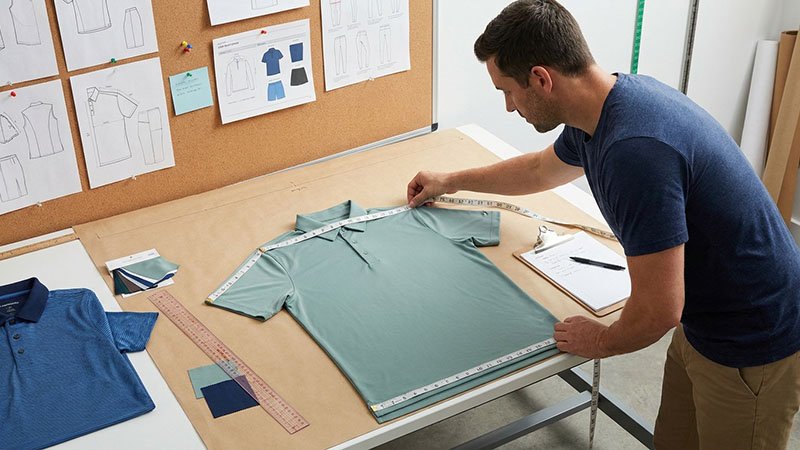
I've worked with countless brands, and the number one source of frustration is fit. Founders like Bobby will send me a competitor's polo they like and a list of measurements, but the sample still comes back wrong. Why? Because a flat garment's measurements don't tell the whole story. A polo has to fit a three-dimensional body that is bending, twisting, and swinging. The "correct" measurement for the chest or sleeve means nothing if the shoulder slope is wrong or the sleeve cap is too high. In this guide, I'll show you how these pieces work together and how to diagnose and fix the most common fit problems.
What Are the Quick Fixes for Common Golf Polo Fit Issues?
| Problem | Quick Fix Solution |
|---|---|
| Where should the shoulder seam sit? | It should sit about 5–10 mm forward of the natural shoulder point (the acromion bone) to match the golfer's address posture. |
| How high should the sleeve cap be? | For a knit polo in size M, 8–12 cm is typical. A lower cap provides more mobility for the swing. Keep the ease (the difference between the sleeve and armhole seam lengths) near zero (0-6mm). |
| How much bicep ease is needed? | For an athletic fit, aim for 3–5 cm of ease over the actual body bicep measurement. For Big & Tall sizes, you may need 5–7 cm for comfort. |
| What's the right drop tail length? | The back hem should be 2–4 cm longer than the front hem to keep the shirt tucked in during the swing. |
| What are the standard side vent specs? | A depth of 5–7 cm is standard, with a 7–10 mm bartack at the top for reinforcement. |
| Tight across front armhole on swing? | This is a classic mobility issue. The fix is to lower the sleeve cap height by 5–8 mm and add a little more room to the front armhole curve. |
| Back neck bubbles or collar lifts? | This is usually a balance issue. Increase the slope of the back shoulder by 3–5 mm and ensure the collar seam length perfectly matches the new neckline length. |
| Hem flips up or twists after washing? | This is often caused by fabric spirality (test with AATCC 179) or incorrect sewing machine settings. Reduce the differential feed on the coverstitch machine to prevent stretching. |
| Sleeves feel twisted on the arm? | The sleeve pitch is wrong. The entire sleeve pattern needs to be rotated forward by 5–10 degrees to match the natural hang of the arm. |
| Measure before or after wash? | For knits, you MUST specify measurements after one standard home wash and dry (AATCC 135/150). The factory will then add the expected shrinkage to the pattern. |
How Do You Establish the Basic Foundation for a Great Fit?
You want a "great fit," but what does that actually mean in technical terms? Without a clear definition and precise measurements, "great fit" is just an opinion your factory can't manufacture.
A great fit starts with a clear fit intent (e.g., "Athletic Fit"), a complete list of Points of Measure (POMs), and strict rules for how those POMs are measured, including tolerances and after-wash conditions. This is the non-negotiable foundation.
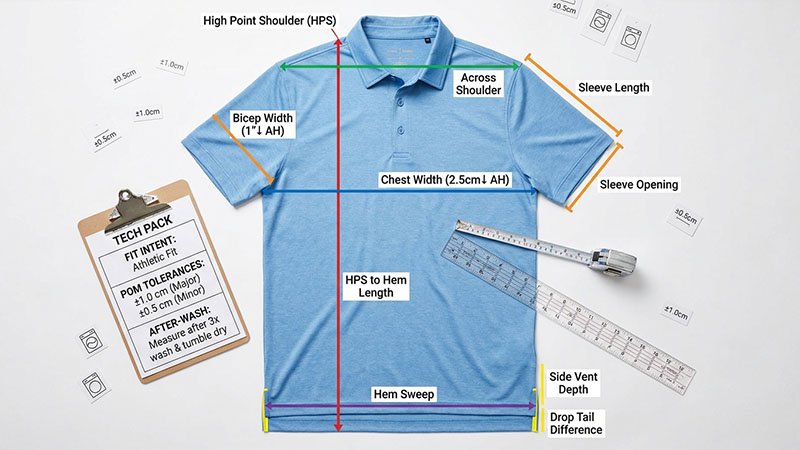
Before we even talk about pattern fixes, we have to build the baseline. This is the part of the tech pack that defines what you're trying to achieve. Without this foundation, any adjustments you make will be built on sand. It's about translating your subjective idea of a "good fit" into objective, repeatable instructions.
Define fit intent
First, declare your goal. Is this a "Regular Fit" for a classic, looser feel, or an "Athletic Fit" with a more tapered body and less ease? This intent will guide the target measurements for your key fit zones: the chest, waist, bicep, and bottom hem sweep. For an athletic fit, you might have 8-10 cm of ease at the chest, while a regular fit might have 12-14 cm.
Knit polo POMs
You must provide a complete list of your Points of Measure. These are the specific locations where the garment will be measured. Key POMs for a polo include: High Point Shoulder (HPS) to hem length, chest width (measured 2.5 cm below the armhole), across shoulder, bicep width (1" down from armhole), sleeve length, sleeve opening, hem sweep, side vent depth, and the drop tail difference between the front and back length.
Tolerances
No factory can produce thousands of garments to the exact millimeter. You must provide an acceptable tolerance for each POM. For larger measurements like the chest, ±1.0 cm is a common tolerance. For smaller, more critical measurements like the placket length or collar width, you need a tighter tolerance of ±0.3–0.5 cm.
After-wash measurement rules
This is the most critical rule for knit apparel. You must specify that all measurements are to be taken after one standard wash and dry cycle (per AATCC 135/150). The garment should be laid flat and allowed to relax before measuring. This accounts for fabric shrinkage and ensures the polo will fit the customer correctly after they wash it for the first time.
How Do You Control the Shoulders and Overall Balance of the Polo?
Your sample has ugly drag lines pulling from the neck to the armhole, or the fabric is pooling and bubbling at the back of the neck. What's causing this imbalance?
These are classic balance problems, usually caused by the shoulder slope not matching the wearer's body. The fix is to adjust the angle of the shoulder seam on the pattern and ensure the collar seam is "trued" to the new neckline shape.
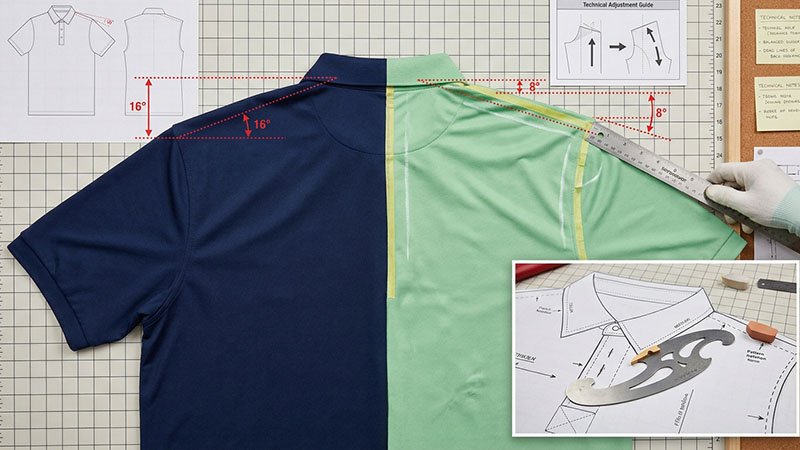
The shoulder is the hanger of the entire garment. If the shoulders aren't right, nothing else will hang correctly. I always start a fitting by looking at the shoulders because they tell me so much about the overall balance of the pattern. A simple 5 mm adjustment here can solve problems all the way down at the hem.
Shoulder slope and balance
Every person has a unique shoulder slope. Your pattern must try to match the average slope of your target customer. If your sample has drag lines pulling from the collar to the front armhole, the front shoulder slope is too high. If fabric pools at the back neck, the back shoulder slope is too low. The fix involves adding or subtracting 3-6 mm of height at the shoulder point of the pattern and blending it back to the neck.
Forward shoulder move
A golfer's posture is not perfectly straight; the shoulders are slightly rounded forward when addressing the ball. A sophisticated polo pattern accounts for this by moving the shoulder seam forward by 5-8 mm. This is done by adding to the front shoulder pattern piece and subtracting an equal amount from the back. This simple change dramatically improves comfort and mobility during the swing.
Shoulder width
The shoulder width should be specified from acromion bone to acromion bone, plus a small amount of ease. If the shoulders of the polo are too narrow, it will cause pulling and drag lines down the sleeve.
Collar integration
Anytime you adjust the shoulder slope or move the shoulder seam, you change the shape and length of the neckline. You must then "true" the neckline, which means re-drawing it as a smooth curve and re-measuring its length. The collar pattern must then be adjusted to match this new length perfectly. This is a critical step that is often missed.
Diagnostics
When you're fitting a sample, use tools to diagnose the problem. A photo grid background can help you see imbalances. Use chalk or masking tape to mark the direction of any drag lines. This visual evidence is invaluable for communicating the required fix to your pattern maker.
How Do You Engineer the Sleeve and Armhole for a Perfect Swing?
The sleeves on your sample feel tight at the bicep, or the whole shirt lifts up when you raise your arms. How do you create a sleeve that allows for total freedom of movement?
For maximum mobility, you need a lower sleeve cap height, the correct bicep ease, and a forward-pitched sleeve. A tight armhole can be fixed by "scooping" the underarm curve of the pattern, but the key is the sleeve cap height.
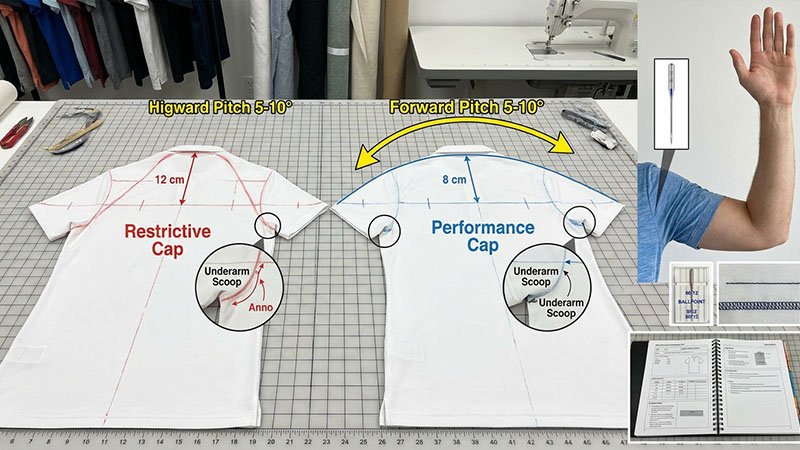
The armhole and sleeve are the engine of a performance polo. This is where a golf-specific fit truly separates itself from a standard fashion polo. The goal is to create a sleeve that feels like it's not even there, allowing for a completely unrestricted swing.
Cap height
The sleeve cap height is the distance from the bicep line to the top of the sleeve pattern. For a men's size M, this is typically 8–12 cm. A higher cap creates a very tailored, crisp shoulder line but restricts upward arm movement. A lower cap provides significantly more mobility, which is ideal for golf.
Ease and seaming
In woven shirts, the sleeve cap is often larger than the armhole, and the extra fabric is "eased" in. For performance knits, you want almost zero ease (0-6 mm max). Trying to ease in too much fabric on a knit will cause puckering and an ugly seam.
Sleeve pitch
Most people's arms hang slightly forward, not straight down at their sides. A sophisticated pattern accounts for this by rotating the entire sleeve pattern forward by 5–10 degrees. This "forward pitch" solves the common problem of sleeves feeling twisted on the arm.
Bicep and armhole
For an athletic fit, you need about 3-5 cm of ease at the bicep. If a fit model says the armhole feels tight or is "biting" at the underarm, the pattern maker can scoop out the bottom of the armhole curve by 3-5 mm to provide more room.
Pattern fixes
So, to fix a tight, restrictive sleeve, the pattern adjustments are: 1) Lower the sleeve cap height by 5-8 mm. 2) Add 3-5 mm of length to the front armhole curve to give the chest more room to expand. 3) Re-measure and "true" all the seam lengths to make sure they still match perfectly.
Sewing notes
To prevent the fabric from getting damaged during sewing, your tech pack should specify a ballpoint needle (size 70/10 or 80/12) and a stitch density of 9-12 stitches per inch.
What Are the Secrets to a Perfect Side Vent and Hem?
The side vents on your sample are flaring out, or the bottom hem is wavy and looks cheap. How do you get that clean, flat finish that screams quality?
A perfect side vent is clean, reinforced, and flat. It should be 5-7 cm deep and reinforced with a bartack. A wavy hem is usually caused by the sewing machine stretching the fabric; this is fixed by adjusting the machine's differential feed.
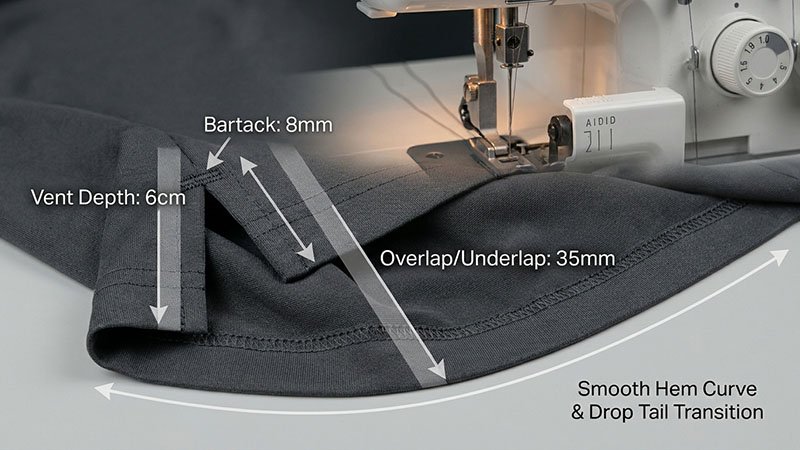
The hem and side vents are finishing details, but they are what a discerning customer will look at to judge the quality of your polo. A puckered hem or a flimsy side vent is a sign of poor craftsmanship. Getting these details right is crucial for creating a premium product.
Spec
Your tech pack needs to specify the exact dimensions. A side vent depth of 5-7 cm is standard. The underlap and overlap of the vent facing should be around 30-40 mm. For the bottom hem, you should have at least 6-10 cm of ease compared to your chest measurement to allow the polo to drape cleanly over the hips.
Build
The vent needs to be finished cleanly, either with a self-fabric facing or a woven tape. Most importantly, it must be reinforced at the top with a dense, 7-10 mm bartack stitch to prevent it from tearing. The hem is typically sewn with a two-needle 406 coverstitch machine. For knits, the machine's differential feed (DF) should be set between 0.95 and 1.05 to prevent stretching or puckering.
Step hem and curve
The side seam lengths of the front and back pieces must be perfectly matched to ensure the vent hangs straight. The curve of the hem should be a smooth, consistent radius that transitions cleanly into the drop tail.
Issues
If your side vents are flaring open, you can either reduce the width of the vent facing or slightly decrease the differential feed setting on the sewing machine. If your hem is "tunneling" (creating a ridge between the needles), the thread tension needs to be adjusted, or you can use a softer thread.
Label and tape placement
To reduce bulk, avoid placing any labels or taping directly over the top of the side vent area where multiple layers of fabric are already coming together.
How Do You Create a Balanced Drop Tail That Stays Tucked In?
You want a drop tail to keep the shirt from untucking, but on your sample, it looks exaggerated or pulls the front of the shirt up. How do you get the length and curve just right?
A functional drop tail should have a 2-4 cm difference in length between the back and the front. The key to balance is ensuring the curve of the hem is smooth and that the fabric has good recovery, preventing the hem from stretching out over time.
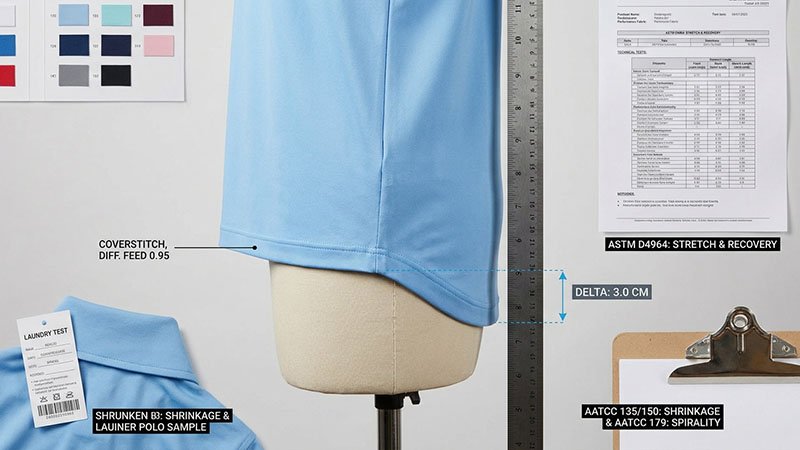
The drop tail, or stepped hem, is a classic performance detail. Its only job is to provide extra length in the back to prevent the shirt from coming untucked during the golf swing and when bending over. It's a simple feature, but getting the balance right requires attention to the pattern and the fabric properties.
Set the delta
The "delta" is the difference in length between the back and front hems. For a golf polo, a delta of 2–4 cm is the sweet spot. You can choose to keep this delta constant across all sizes, or you can scale it slightly, adding about 0.3 cm for each size up.
Hem curve and coverstitch
The curve of the hem at the side seams should be a smooth, gradual radius, not an abrupt angle. When sewing the hem with a coverstitch machine, the differential feed setting is critical. On a stretchy knit, setting it slightly below 1.0 (e.g., 0.95) will create a small amount of compression that helps prevent the hem from flaring or looking wavy.
Fabric recovery and growth
Low-quality knit fabrics can "grow" or stretch out over time, especially at the hem. Before selecting your fabric, you should request a test report for stretch and recovery (like ASTM D4964). Using a stabilizing thread in the coverstitch can also help prevent the hem from growing.
Post-wash behavior
After washing your sample, check two things: shrinkage (AATCC 135/150) and spirality (AATCC 179). Spirality, or torque, is when the side seams twist around the body. This is a fabric quality issue that can't be fixed in sewing and is a reason to reject a fabric. If the shrinkage is higher than expected, the shrinkage add-ons in your pattern must be adjusted.
How Do You Adapt Your Fit for Different Genders and Body Types?
Your men's medium fits great, but now you need to create a women's version and a Big & Tall line. Can you just scale the pattern up and down?
No. Different body types require different pattern blocks. A women's pattern needs more room at the bust and hips and a higher armhole. A Big & Tall pattern needs extra length and more ease at the bicep and neck, not just a wider body.
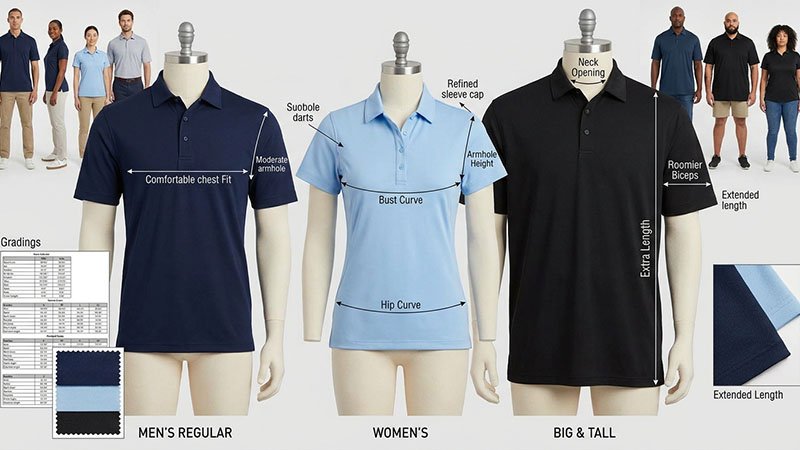
This is a mistake I see many new brands make. They try to save money by just "grading" their men's pattern up to a 4XL or down to a women's small. The result is a disaster. A woman is not a small man, and a Big & Tall customer has different proportions. Each requires its own unique fit block.
Core grading
For a standard men's size range, the grading rules are relatively simple. For each size you go up, you might add 2-2.5 cm to the chest, 1-1.5 cm to the length, 0.8-1 cm to the shoulder width, and 1 cm to the sleeve length.
Keep drop tail constant
When grading, it's often best to keep the drop tail delta and the side vent depth constant across all sizes. Scaling these can lead to an oddly proportioned look in the smallest and largest sizes.
Women’s block
A women's pattern is fundamentally different. It requires shaping to accommodate the bust and hips. This often means adding darts or using curved side seams. The armhole is typically higher and smaller, and the sleeve cap is often slightly higher to create a more shaped, less boxy shoulder line.
Big & Tall
A Big & Tall fit isn't just wider; it's also longer in the body and sleeves. You need to add significantly more ease at the bicep (an extra +2 cm over your standard grade) and a larger neck opening for comfort.
Fit set
The only way to validate your grading is to get a full "size set" of samples and have real people of all different sizes try them on. This is where you'll catch issues, like the sleeves on the XXL being too short, and can go back and adjust your grading rules before committing to bulk production.
What Is the Professional Workflow for Nailing the Fit?
You've got a sample and a list of potential fixes. What is the actual step-by-step process for a professional fitting and communicating the changes to your factory?
The workflow is a cycle: try-on the sample and document all issues, review the garment again after washing, create a clear list of pattern edits, and then update your tech pack with the changes. Never approve production until you have a perfect pre-production sample.
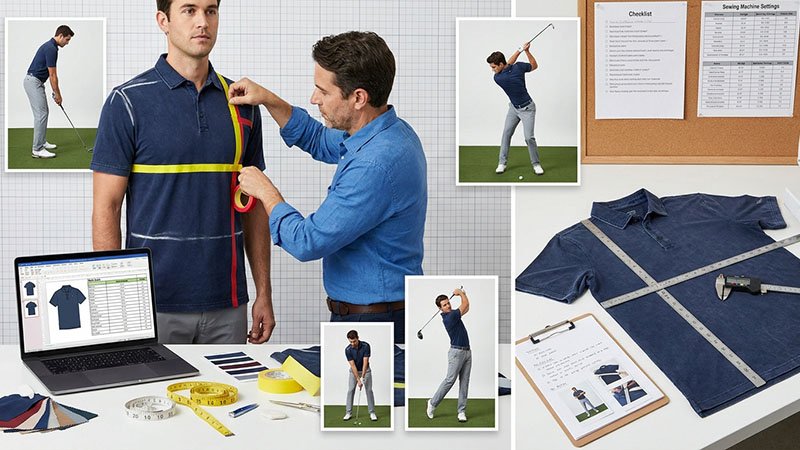
A disciplined workflow is what separates hope from certainty. It's a systematic process of testing, documenting, and refining until you have a perfect "golden sample." This process ensures that nothing is left to chance.
Try-on protocol
When your sample arrives, have your fit model try it on. Take clear photos against a grid background: front, side, and back. Also, take photos of the model in an address posture and at the top of their backswing. Use masking tape to mark the key POMs and use chalk to draw over any visible drag lines. This documentation is your evidence.
After-wash review
Pattern edits
Bundle all your photos and measurement logs and send them to your pattern maker. Use the terminology from this guide. Don't say "the shoulder is weird"; say "the garment shows back neck bubbling, please increase the back shoulder slope by 5 mm and re-true the collar."
Sewing settings
Once you have a sample with a good fit, document the sewing settings that were used to make it. Note the needle type, SPI, differential feed, and thread tensions. This information should be passed to the bulk production team to ensure consistency.
Change log
Every time you make a change, update your tech pack's version number and change log. If the change affects the construction or fit, you must get a new Pre-Production Sample (PPS) and repeat the approval process. You cannot risk going to bulk with an unverified change.
Conclusion
Mastering a polo's fit is not about finding one set of perfect numbers. It is about understanding how the pattern pieces work together as a system to fit a body in motion. This knowledge is what turns a simple shirt into a piece of performance equipment.