I've watched too many new golf brands fail not because their products were bad, but because they priced them wrong from day one. They treated factory quotes as final costs, copied competitor prices without understanding costs, and wondered why profits disappeared after the first shipment.
Pricing golf apparel starts with calculating your true landed cost—not just factory FOB price—then matching your markup to your positioning and sales channel. DTC brands typically need 3-4x landed cost, while wholesale requires 5-6x to cover both margins. Your price tier must match your fabric quality, MOQ commitment, and target customer willingness to pay.
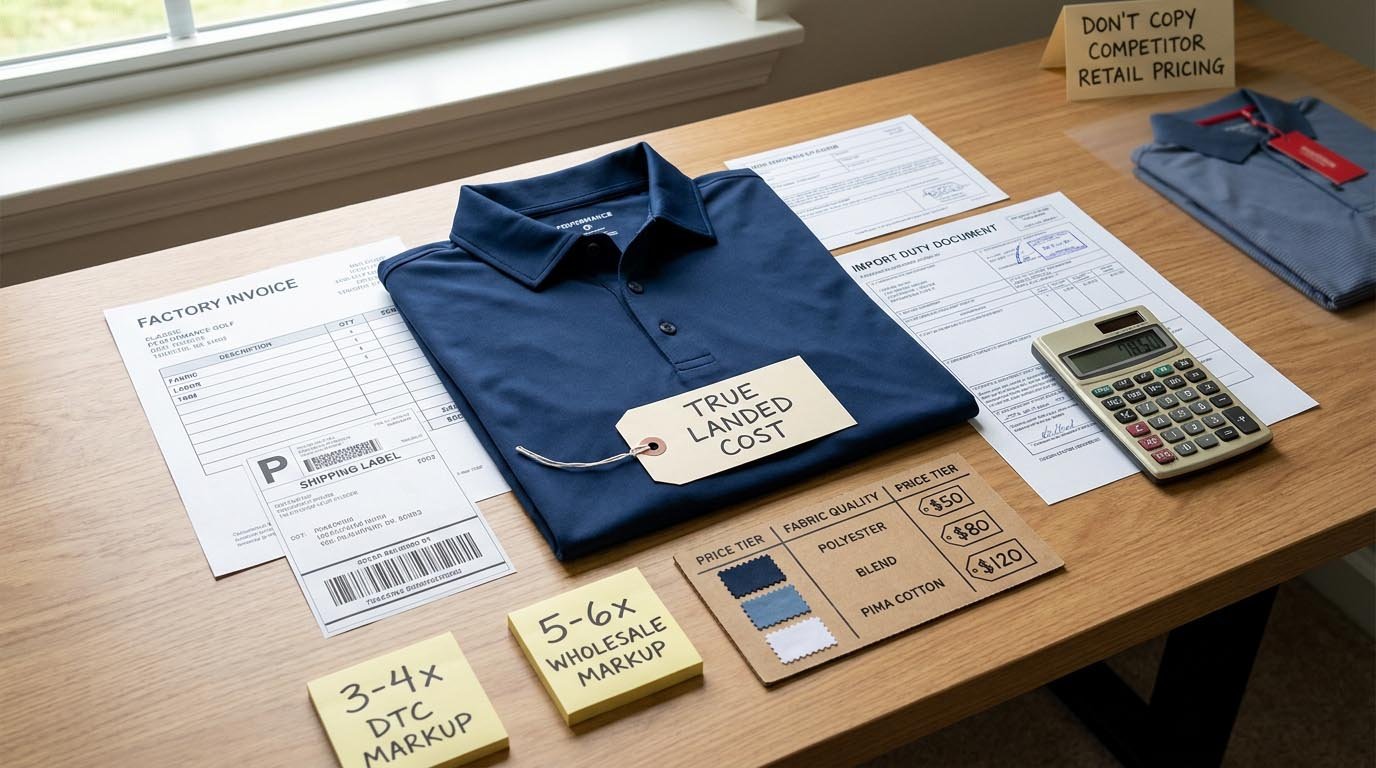
Most small brands approach me with a competitor's polo in hand and ask: "Can you make this for $8 so I can sell it for $50?" That's backwards. Your pricing strategy should start with understanding your real costs, your positioning, and your customer—not someone else's retail price.
If you are still shaping your first collection, review how to start a golf apparel line before locking in price assumptions.
Quick Answers: Golf Apparel Pricing Essentials
Q: What's the difference between FOB and landed cost?
FOB is the factory price. Landed cost includes shipping, tariffs, quality inspection, and warehousing—typically 30-50% higher than FOB for small orders.
Q: What markup should I use for golf polos?
No universal rule exists. DTC brands need 3-4x landed cost, wholesale needs 5-6x to cover distributor margins. Your channel structure determines your markup.
Q: How does MOQ affect my unit price?
Dramatically. A 500-piece order might cost $18 per unit, while 2,000 pieces drops to $12—same quality, different scale. Higher MOQ unlocks better fabrics and construction.
Q: Can I price premium without premium costs?
No. Premium positioning requires premium inputs. If your landed cost is $10 but competitors at your price point use $15+ fabrics, customers will notice the quality gap.
Q: What's the biggest pricing mistake new brands make?
Treating factory FOB as final cost. They calculate margins based on $12 FOB, then discover their real cost is $17 landed, killing profitability before launch.
Understanding Golf Apparel Price Tiers?
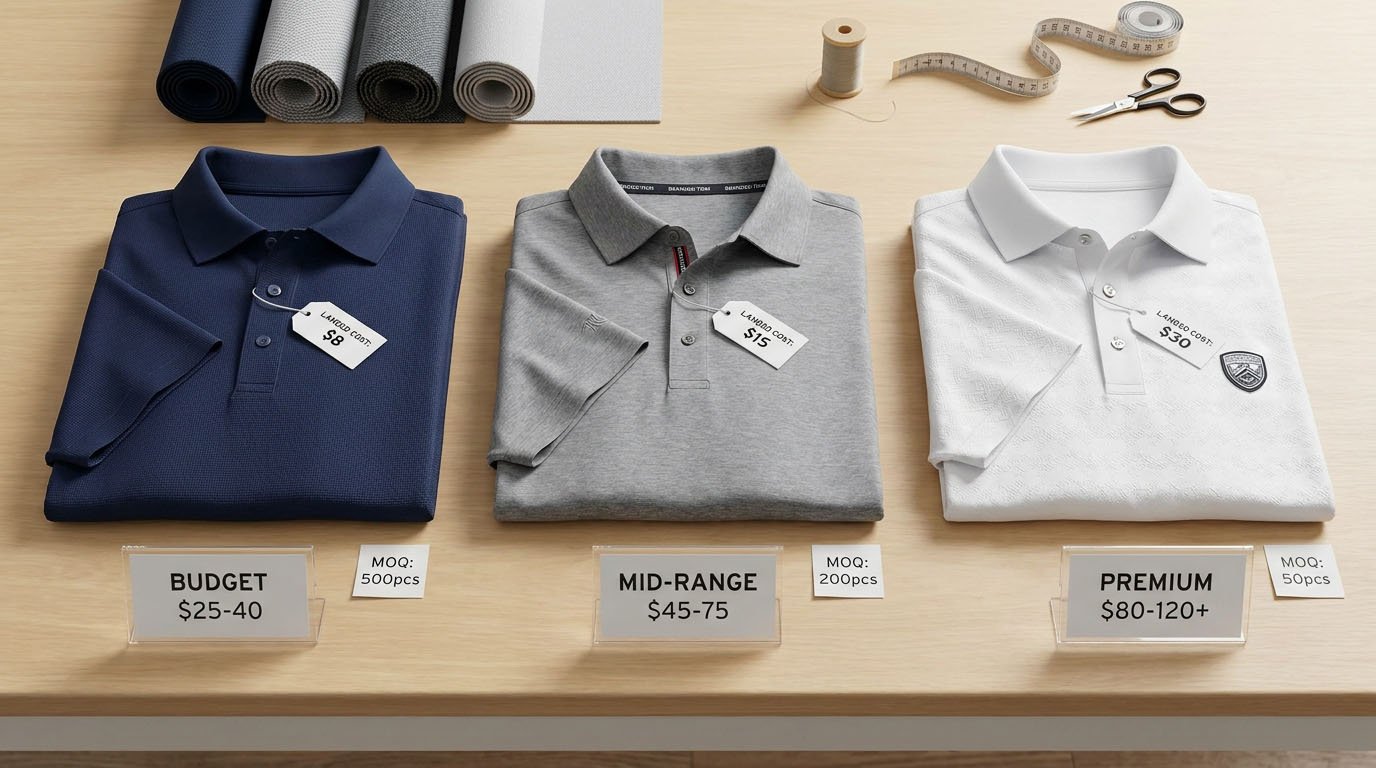
Price tiers in golf apparel aren't arbitrary—they reflect distinct cost structures, fabric quality, and manufacturing complexity. When I receive inquiries, the first question I ask isn't about design—it's about budget and target price point, because those determine everything else.
Here's what I've observed across hundreds of golf brands:
The Three Core Price Tiers
| Price Tier | Retail Range | Typical Landed Cost | Fabric & Construction | MOQ Reality |
|---|---|---|---|---|
| Budget | $25-$40 | $6-$10 | Basic polyester blends, simple construction, standard trims | 500-1,000 pieces |
| Mid-Range | $45-$75 | $12-$20 | Performance fabrics (moisture-wicking, UV), better fit, branded trims | 1,000-2,000 pieces |
| Premium | $80-$120+ | $22-$35+ | Technical fabrics, advanced features, premium construction details | 1,500+ pieces |
A client once told me he wanted to compete with TravisMathew (mid-range positioning) but only wanted to spend $8 landed cost. The math doesn't work. TravisMathew's fabric quality alone requires $12-15 landed cost minimum. You can't fake a price tier—customers feel the difference.
The tier you choose must match three things: your target customer's budget, your competitor's quality level, and your ability to commit to the required MOQ. Miss one, and your pricing strategy collapses.
What Landed Cost Includes?
This is where most new brands bleed money without realizing it. Factory gives you a $14 FOB quote, you calculate a $42 retail price (3x), and you think you've got healthy margins. Then reality hits.
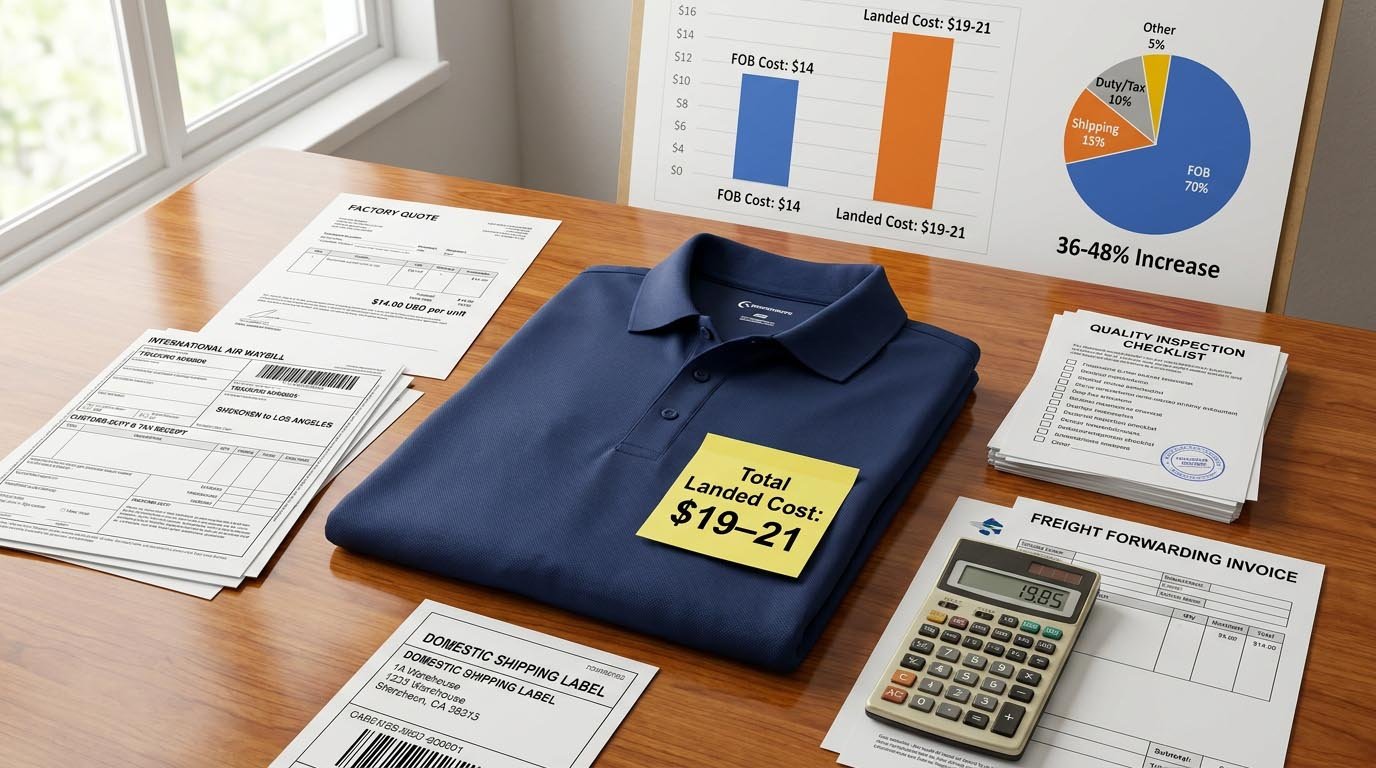
Landed cost is every expense required to get your product from factory floor to your warehouse, ready to sell. Here's what actually happens to that $14 FOB:
- Factory FOB: $14.00
- International shipping (ocean freight, typical): +$1.50-2.00
- Customs duties (US averages 16-17% on apparel): +$2.24-2.38
- Quality inspection (third-party, spread across order): +$0.40-0.80
- Freight forwarding & customs clearance: +$0.30-0.50
- Domestic shipping to warehouse: +$0.40-0.60
- Quality control & potential rework (1-3% defect rate): +$0.20-0.40
Your real landed cost: $19.04-20.68
That's 36-48% higher than FOB. Small orders face even worse ratios because fixed costs spread across fewer units.
Last month, a DTC brand owner called me frustrated—his "profitable" $50 polo was losing money. He'd calculated margins on $15 FOB but never tracked landed cost. His actual cost was $21.80. At $50 retail with 3x markup, he thought he had room. Reality: barely breaking even after returns and marketing.
For small brands (under 1,500 pieces), always add 40-50% to FOB when calculating landed cost. Larger orders can negotiate better shipping rates and reduce per-unit inspection costs, bringing the premium down to 30-35%.
DTC vs Wholesale Pricing?
Your sales channel determines your margin structure, and your margin structure determines your pricing formula. A $60 retail price means completely different profitability for a DTC brand versus a wholesale brand.
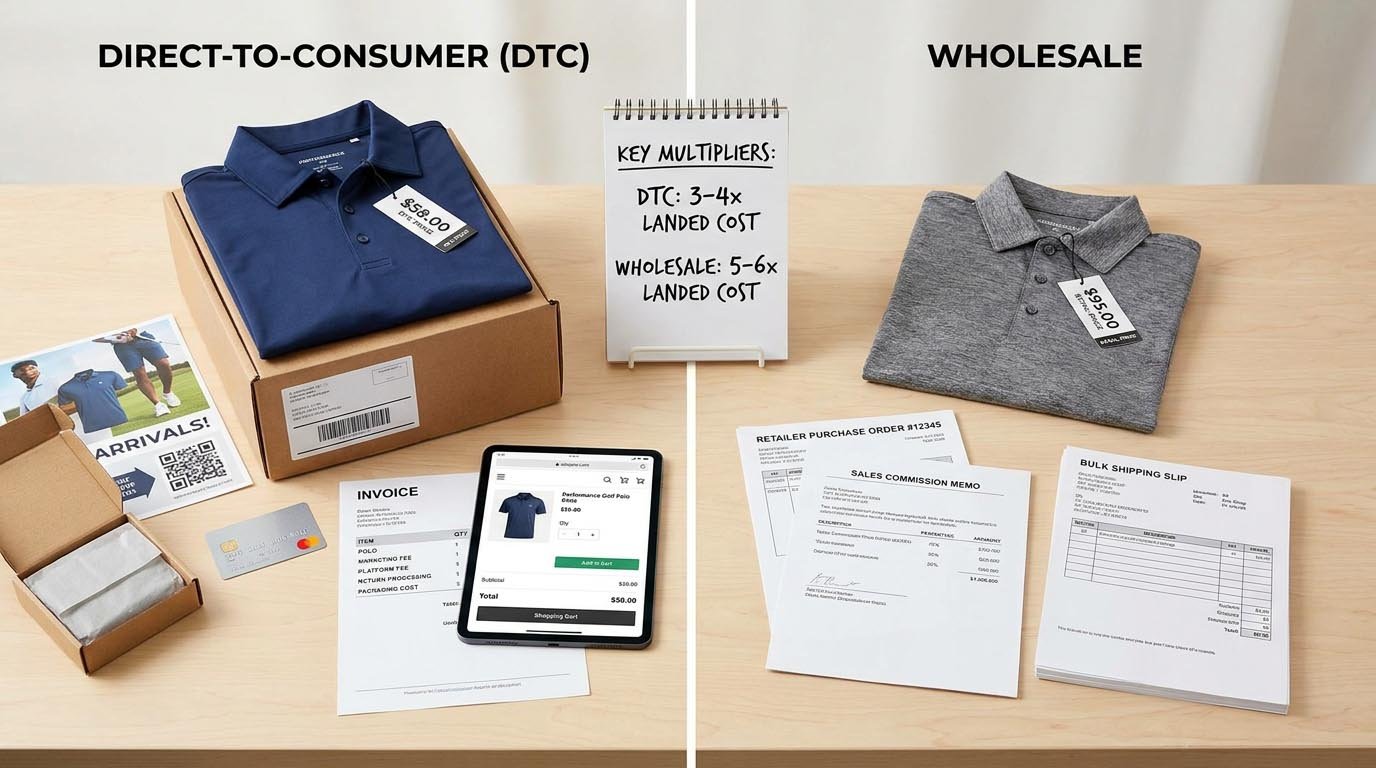
I worked with two brands last year with nearly identical products—both mid-range golf polos, similar quality, same landed cost of $18. Brand A sold DTC at $58. Brand B sold wholesale at $95 retail. Both were profitable, but their models were totally different.
Direct-to-Consumer (DTC) Model
With DTC, you capture the full retail price but carry all operational costs:
- Landed cost: $18
- Marketing & customer acquisition: $12-15 (typical 20-25% of retail)
- Platform fees (Shopify, payment processing): $2-3 (4-5%)
- Returns & exchanges: $2-3 (3-5%)
- Fulfillment & packaging: $3-4
- Net margin target: $15-18 (25-30%)
Required retail price: $52-60
You need 3-4x landed cost for DTC to work. Lower than 3x, and you don't have room for customer acquisition. Higher than 4x without premium positioning, and conversion suffers.
Wholesale Model
Wholesale means lower operational costs but giving up 50% of retail price to your distribution partner:
- Landed cost: $18
- Your wholesale price (50% of retail): $47.50
- Marketing (mostly B2B, lower per-unit): $3-4
- Sales commissions: $2-3
- Fulfillment to retailers: $1.50
- Net margin target: $18-23 (38-48% of wholesale price)
Required retail price: $90-95
Wholesale requires 5-6x landed cost to maintain healthy margins after retailer markup. You make less per unit than DTC but scale faster through distribution partners.
The mistake I see constantly: Brands design pricing for DTC, then try wholesale without raising price. You can't sell $58 DTC for $29 wholesale and survive—the math breaks.
Margin Benchmarks for Golf Brands?
There's no "standard" golf apparel margin because every brand operates differently. But after 15 years of cost negotiations, I can tell you what actually works for brands that survive past year two.
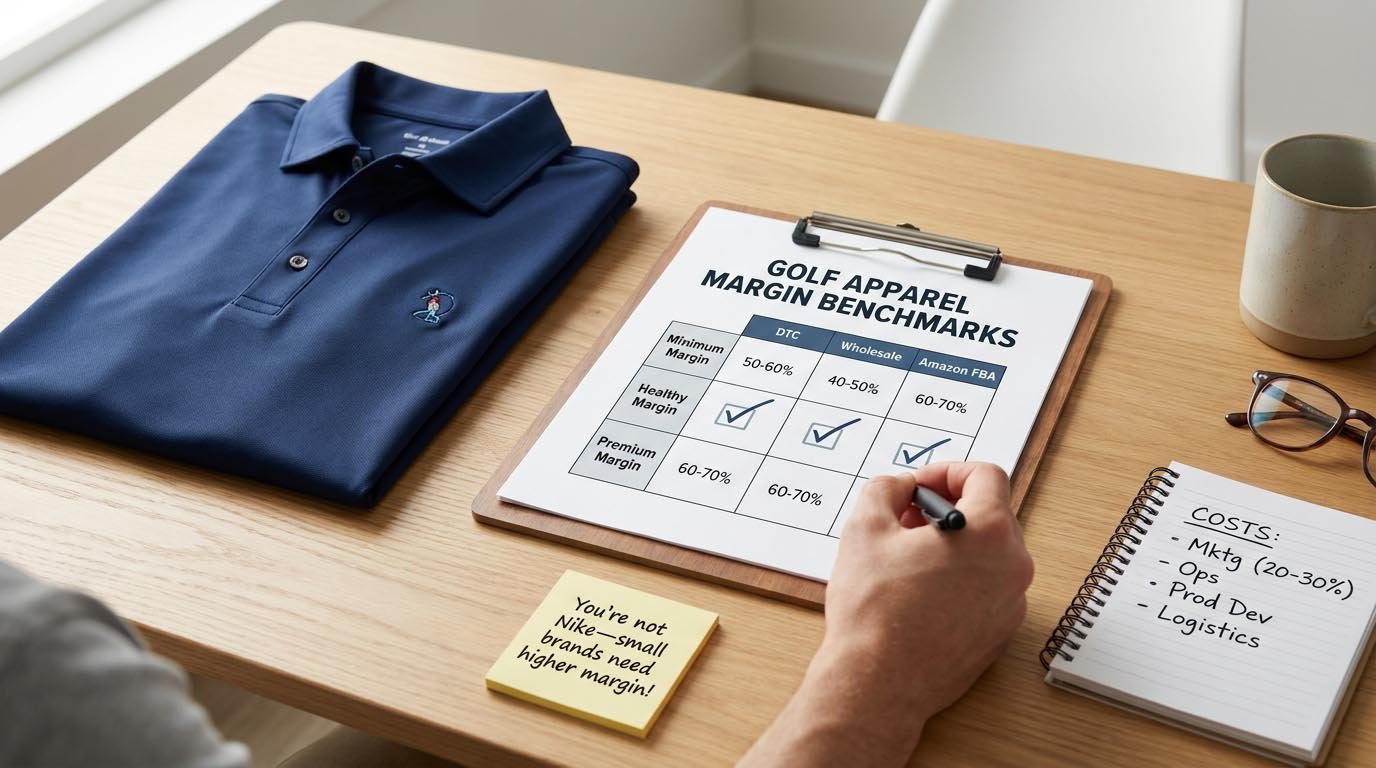
Gross margin (revenue minus COGS including landed cost) should hit these minimums:
| Sales Channel | Minimum Gross Margin | Healthy Target | Premium Brands |
|---|---|---|---|
| DTC | 65-70% | 72-75% | 78-82% |
| Wholesale | 48-52% | 55-60% | 62-68% |
| Amazon FBA | 60-65% | 68-72% | 75-80% |
These aren't arbitrary. They're reverse-engineered from operating expense reality.
A DTC golf brand needs:
- 20-30% for customer acquisition (ads, influencer partnerships, content)
- 8-12% for operations (platform, customer service, returns)
- 5-8% for product development and photography
- 10-15% net profit minimum to reinvest in inventory
If your gross margin is 68% but acquisition costs run 32%, you're losing money on every sale while growing. I've watched this happen.
Small brands face margin compression that large brands don't. You can't negotiate the same fabric prices, your MOQs force higher per-unit costs, and your shipping rates are worse. That's why small DTC brands often need to price higher relative to cost—you're operating at structural disadvantage until you scale.
One founder told me: "But Nike's margin is only 45%!" Yes, because Nike operates at massive scale with wholesale-heavy model and billion-dollar infrastructure. You're not Nike. Your costs are higher, your volume is lower, and you need more margin cushion to survive mistakes.
Matching Price to Product and Positioning?
This is where strategy meets reality. You can't decide to be premium and expect customers to pay premium prices unless your product delivers premium experience. The market doesn't care about your aspirations—it compares your product to alternatives.
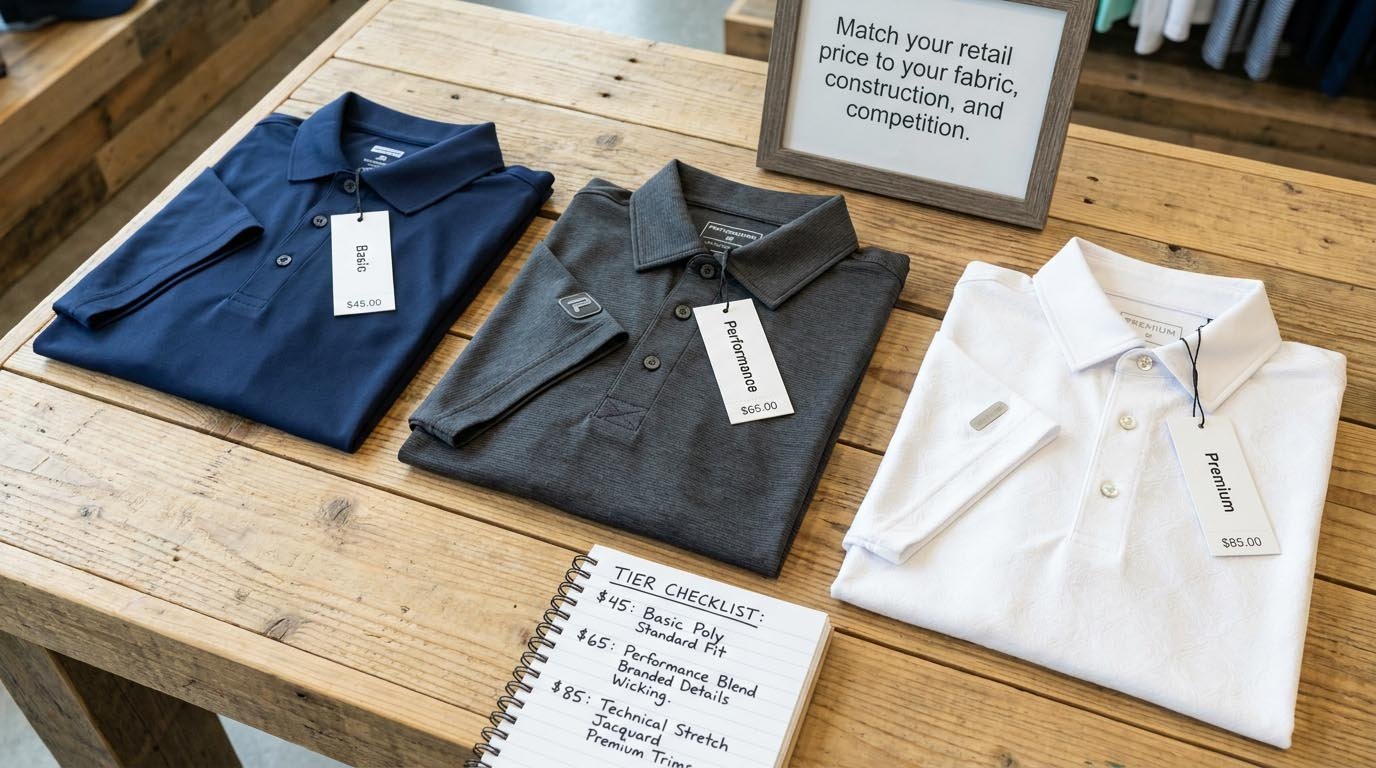
I use a simple framework when brands ask me about positioning: Start with competitor analysis, not self-image.
The Positioning Audit
Last quarter, a new brand wanted to price their performance polo at $75. I asked four questions:
1. Who is your target customer, and what do they currently buy?
His answer: Weekend golfers, currently buying $45-60 polos from Greg Norman or PUMA.
2. What fabric and construction are your competitors using at that price point?
He didn't know. We ordered samples. They were using 180-200 GSM polyester-spandex blends with mesh panels and sublimated patterns.
3. What's your landed cost to match or exceed that quality?
We calculated $19-21 landed to match fabric quality and construction details.
4. What justifies your price premium over current options?
He said "better fit and designs." That's not enough for 25% premium—customers need clear functional or status benefit.
We repositioned him at $65 with $18 landed cost using similar fabric quality, giving him room for better patterns and customer service. At $75, he would've struggled because the quality gap versus competitors wasn't obvious enough.
Quality Gates by Price Tier
The market has invisible quality thresholds. Cross below them at a given price, and conversion dies:
$30-45 retail requires:
- Basic moisture-wicking polyester
- Standard collar construction
- Clean stitching but simple details
- Acceptable after 15-20 washes
$50-70 retail requires:
- Performance fabric blends (poly-spandex, UV protection)
- Reinforced placket and shoulder seams
- Branded trims and labels
- Maintains shape after 30+ washes
$75-100+ retail requires:
- Premium technical fabrics with advanced features
- Precise pattern engineering and fit grades
- Distinctive design details that photograph well
- Durability and color retention through 50+ washes
You can't skip tiers. A $15 landed cost product trying to sell at $85 will fail against competitors using $22+ landed cost—customers recognize the difference.
Common Pricing Mistakes?
I've watched the same mistakes kill golf brands for 15 years. The patterns are predictable, and almost always fixable if caught early.
Mistake 1: Reverse-Engineering From Competitor Retail
A brand owner finds a $70 polo from a competitor, assumes 5x markup, concludes factory cost is $14, and asks for quotes at $12 FOB. This logic is backwards and wrong.
You don't know their margin structure, their MOQ, their landed cost calculations, or their channel strategy. They might be doing $15 FOB at 3,000-piece MOQ with 3.5x markup because they're DTC-only. Or they're doing $18 FOB wholesale with 4x markup. Or they're losing money to gain market share.
Start with your costs and positioning, not their prices.
Mistake 2: Ignoring Channel Cost Structure
Brands design DTC pricing ($55 retail, $16 landed, looks good), then a retailer asks for wholesale terms. They offer $27.50 (50% of retail), leaving $11.50 margin before any B2B operational costs. That's break-even or negative after sales commissions and fulfillment.
If you want wholesale optionality, design pricing from the beginning assuming 50% trade margin. That $16 landed cost product needs $85-95 retail, not $55.
Mistake 3: Underestimating Landed Cost
Last month, three different brands told me their margins were "fine" based on FOB. None had calculated actual landed cost. When we ran numbers:
- Brand 1: Thought margin was 68%, actually 59%
- Brand 2: Thought margin was 71%, actually 61%
- Brand 3: Thought margin was 65%, actually 54%
All three were underwater when operational costs hit. Track every penny from factory to warehouse.
Mistake 4: Pricing for Aspiration, Not Reality
"I want to be the luxury brand of golf" is not a pricing strategy. Luxury positioning requires luxury costs—premium fabrics, exclusive factories, sophisticated branding, and high-touch customer experience.
If your landed cost is $17 and you price at $120 claiming luxury, customers will compare you to $120 alternatives (Peter Millar, TravisMathew premium lines) and reject the quality gap instantly. You don't get luxury pricing without luxury investment.
Mistake 5: Static Pricing Across Styles
Not every piece in your line should have the same markup. A basic polo with $15 landed might retail at $48 (3.2x), while a technical jacket with $42 landed retails at $110 (2.6x). Complex styles face higher development costs and slower turns—you can't sustain the same margin.
I worked with one brand that insisted on 4x markup across all styles. Their technical pieces sat in inventory because they were overpriced relative to alternatives, while basic polos were underpriced and sold out instantly. Flex your markup by style complexity and competitive set.
Pricing only works when it matches the product, fabric, MOQ, and budget structure outlined in how to start a golf apparel line.
Conclusion
Pricing golf apparel isn't about picking a magic number—it's about understanding your true costs, matching your price to your positioning reality, and structuring margins that sustain your business model. Start with landed cost, not FOB. Design for your channel, not someone else's retail price. And remember: the market decides if your positioning matches your price, not your brand deck.