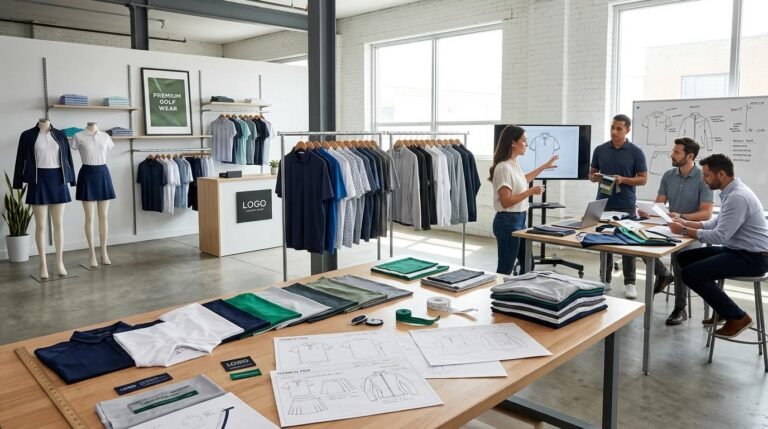
You want to launch multiple golf apparel styles to look professional. But spreading your budget too thin causes bigger problems than you think. Let me show you why.
Most new golf brands should start with 2-3 core styles, not 5-6. Why? Because MOQ requirements force you to choose between inventory depth per style and total style count—and depth wins for first launches.
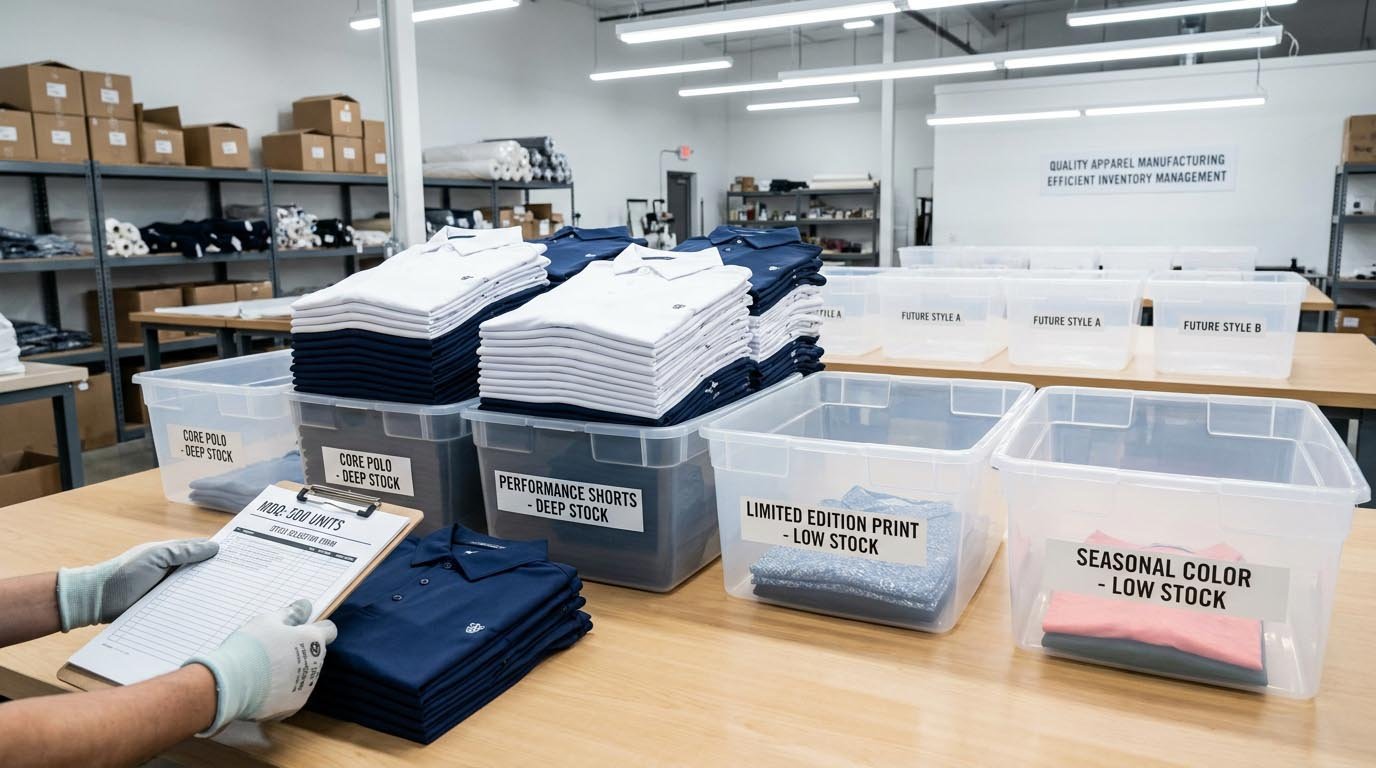
I've handled hundreds of first-launch orders at FUWAY. The most common mistake? New brand owners think more styles equal more market coverage. But when I review their order details six months later, I see something different: best-selling styles sold out in weeks while slow movers still sit in their warehouse.
MOQ is one of the biggest constraints in apparel development, but it only makes sense in the context of a full launch plan. Start with how to start a golf apparel line if you need the bigger picture.
Quick Answers: What You Need to Know About Golf Apparel MOQ
What's the typical MOQ for custom golf apparel?
300-500 pieces per style is standard for quality manufacturers. Some offer lower MOQs at $2-3 higher per unit.
How many styles should I launch with?
2-3 styles maximum if your budget is under $15,000 and you have no retail distribution requirements.
Should I offer multiple colors per style?
Start with 1-2 colors per style. Each color is a separate SKU that divides your inventory depth.
What happens if I launch with too many styles?
Your per-style order quantity drops, leading to stockouts on winners and dead inventory on losers.
Can I reorder quickly if a style sells out?
Standard reorders take 45-60 days. Low initial inventory means you lose sales during this gap.
How does MOQ work in golf apparel manufacturing?
MOQ (Minimum Order Quantity) is the smallest production batch a manufacturer will accept per style. For golf apparel, this typically ranges from 300 to 500 pieces per style, depending on fabric complexity and customization level.
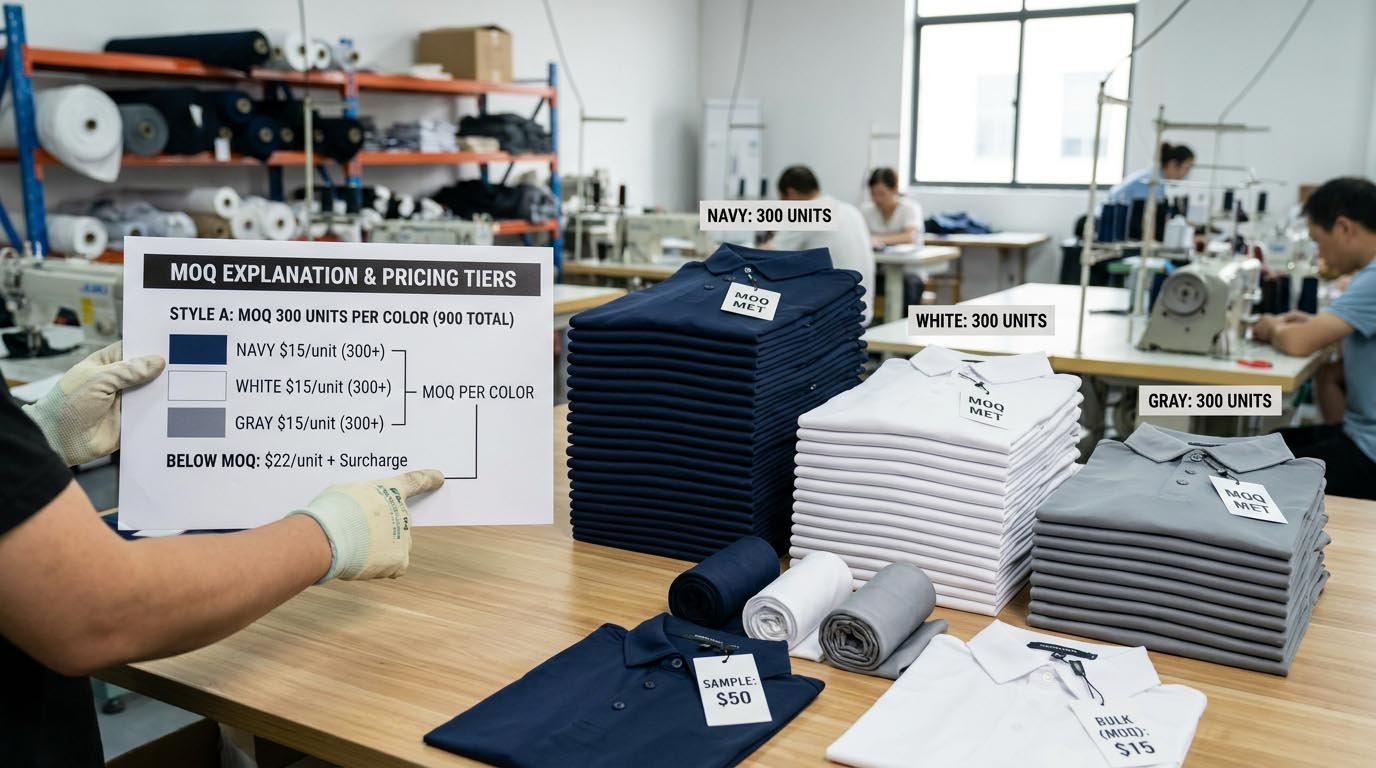
When a client asks me "Can you do 100 pieces?", I usually ask back: "What's your total budget and how many styles are you planning?" Because the real question isn't whether I can lower the MOQ—it's whether that makes financial sense for their launch.
Why manufacturers set MOQ requirements
Here's what happens on our production floor:
- Fabric sourcing: Mills require minimum yardage (usually 500-1000 yards per color)
- Pattern setup: Each style needs pattern making, grading, and sample approval
- Production line setup: Switching between styles costs 2-4 hours of downtime
- Quality control: Small batches make defect rates harder to control
| Cost Component | Small Batch (100pcs) | Standard MOQ (500pcs) |
|---|---|---|
| Per-unit fabric cost | $12-14 | $8-10 |
| Setup cost allocation | $3-5/pc | $0.60-1/pc |
| Total cost impact | +$5-7 per unit | Baseline |
Can I produce 100 pieces? Yes. But you'll pay $16-18 per polo instead of $11-13. That's not markup—it's production math.
How colors multiply your MOQ challenge
Most new brands don't realize this: each color is a separate production run. When you say "I want this polo in navy, white, and gray," you're actually requesting three MOQs, not one.
If my MOQ is 300 pieces per color:
- 1 style × 3 colors = 900 total pieces
- Your inventory is now split into 3 color SKUs of 300 each
- If navy sells well but white doesn't, you can't shift inventory between them
Why do too many styles hurt first-launch economics?
Launching with 5-6 styles forces you to reduce per-style quantities to meet your budget. This creates shallow inventory depth, meaning your best sellers stock out before you can reorder, while slow movers tie up cash.
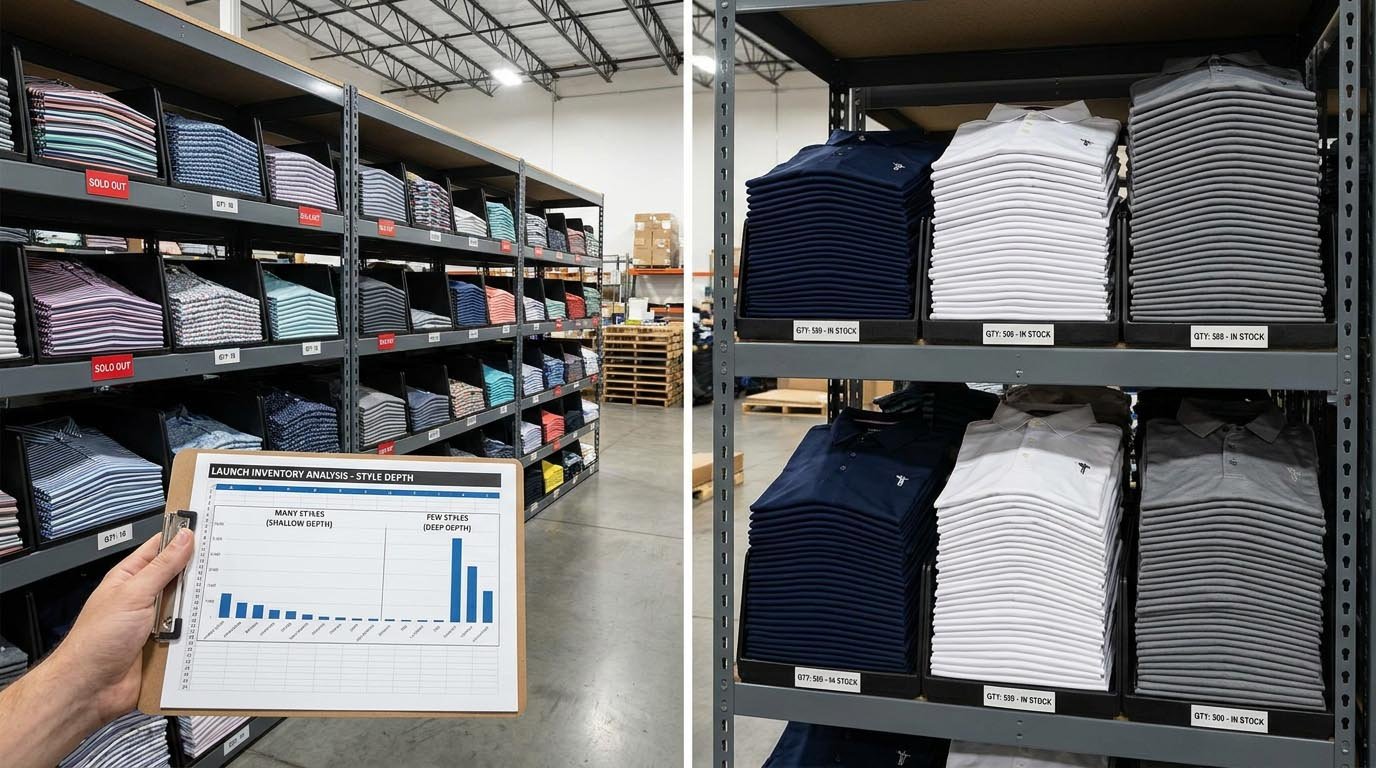
I see this pattern repeatedly when reviewing client order details. They split a $15,000 budget across six styles to "test the market." Six months later, when they come back for reorders, I look at their sales data and see the problem clearly.
The inventory depth trap
Let me walk through what actually happens:
Scenario A: 6 styles, thin inventory
- Total budget: $15,000
- Cost per unit: $12
- Total units: 1,250 pieces
- Per style: ~200 pieces (below MOQ, so cost rises to $14)
- Actual total units: 1,070 pieces
- Per style inventory: 178 pieces
Now add colors. If you do 2 colors per style:
- Per style per color: 89 pieces
What happens when your best-selling polo in navy sells 15 units per week? You're out of stock in 6 weeks. Reorder takes 60 days. You just lost 8-10 weeks of sales on your winner.
Scenario B: 3 styles, deep inventory
- Same $15,000 budget
- 3 styles at 400 pieces each (meets MOQ)
- Cost per unit: $12.50
- Per style inventory: 400 pieces
- 2 colors per style: 200 pieces per color
Your navy polo now has 200 units. At 15 per week, that's 13 weeks of inventory. You can reorder at week 8 and maintain stock.
Why "market coverage" is a false goal for new brands
Some clients tell me: "But I need variety to compete with established brands."
I usually respond: "When was your last stockout on a best seller?"
If you haven't launched yet, you don't have best sellers. You have guesses. And spreading inventory across guesses is how brands create cash flow problems.
Here's what I see in actual order reviews:
| Launch Approach | Typical Outcome (6 months) |
|---|---|
| 6 styles, 180 pcs each | 1-2 styles sold out (lost sales), 2-3 styles at 60-70% inventory remaining |
| 3 styles, 400 pcs each | 1 style sold out (but had time to reorder), 1 style at 40% remaining, 1 style slow but not critical |
The second approach loses less money because you had fewer slow movers eating warehouse space and tying up capital.
What does a sample SKU math breakdown look like?
Let's break down a real launch structure with actual numbers. A $15,000 budget with standard MOQs gives you very specific choices—and those choices determine your inventory depth and reorder flexibility.
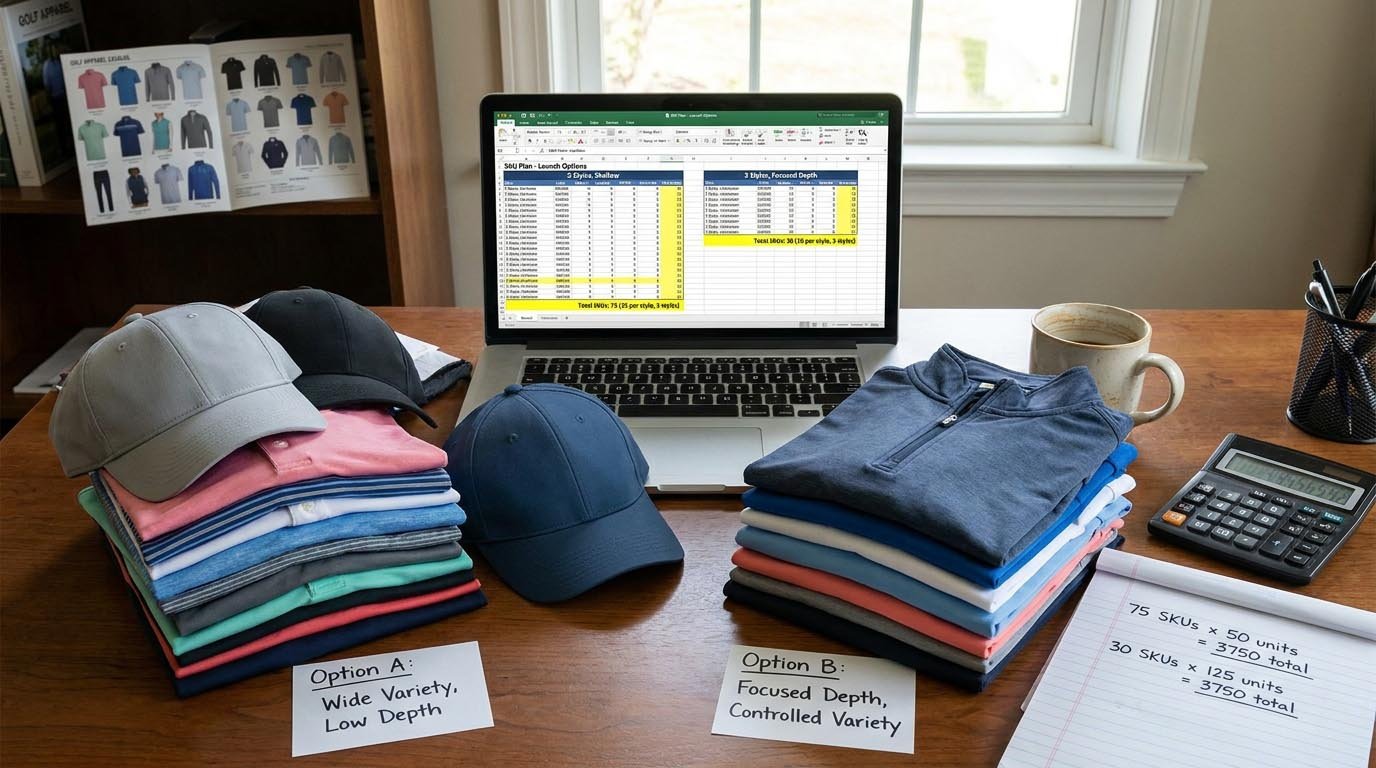
I'll use numbers I see in typical new brand orders. These aren't hypothetical—they're based on order structures I process regularly.
Option 1: Wide variety, shallow inventory
Launch plan:
- 5 styles (polo, quarter-zip, vest, shorts, cap)
- 3 colors per style
- Total SKUs: 15
Budget allocation:
- $15,000 total budget
- Target cost: $13 per unit (because quantities are below optimal MOQ)
- Total units: ~1,150 pieces
Per-style breakdown:
- 1,150 ÷ 5 styles = 230 pieces per style
- 230 ÷ 3 colors = 77 pieces per SKU
What this means:
- You have 77 units of "Navy Polo" in inventory
- If it sells 12 units/week, you're out in 6.4 weeks
- Reorder timeline: 60 days = 8.5 weeks
- Gap period: 2+ weeks of lost sales
Financial impact when navy polo is a winner:
- Potential lost sales during gap: 24-30 units
- Lost revenue: $1,440-1,800 (at $60 retail)
Option 2: Focused depth, controlled variety
Launch plan:
- 3 styles (polo, quarter-zip, shorts)
- 2 colors per style
- Total SKUs: 6
Budget allocation:
- $15,000 total budget
- Unit cost: $12 (meets MOQ efficiency)
- Total units: 1,250 pieces
Per-style breakdown:
- 1,250 ÷ 3 styles = 417 pieces per style
- 417 ÷ 2 colors = 208 pieces per SKU
What this means:
- You have 208 units of "Navy Polo"
- At 12 units/week: 17.3 weeks of inventory
- You can reorder at week 9 and maintain stock
- No gap period
Cost comparison table:
| Factor | Wide Variety (5 styles) | Focused Depth (3 styles) |
|---|---|---|
| Per-unit cost | $13 | $12 |
| Per-SKU inventory | 77 pcs | 208 pcs |
| Stockout risk (best seller) | High (6-7 weeks) | Low (17+ weeks) |
| Reorder flexibility | Must rush (higher cost) | Standard timeline |
| Capital tied in slow movers | 3-4 styles likely | 1-2 styles likely |
The hidden cost of variety
When I review orders six months after launch, here's the pattern:
Inventory turnover rates typically show:
- 20% of SKUs: sold out or near-sold out (winners)
- 30% of SKUs: 50-70% inventory remaining (moderate performers)
- 50% of SKUs: 70%+ inventory remaining (slow movers)
In the 5-style scenario:
- 3 SKUs (20%) sold out, lost sales = lost revenue
- 8 SKUs (50%+) still in warehouse = tied capital
- Average inventory turn: 120+ days
In the 3-style scenario:
- 1-2 SKUs sold out but had time to reorder = maintained sales
- 2-3 SKUs in warehouse but smaller total quantity = less tied capital
- Average inventory turn: 60-90 days
What's the best launch structure for small golf brands?
For brands with under $20,000 launch budget and no retail distribution needs: 2-3 core styles, 1-2 colors per style, and 400+ pieces per style. This structure maintains inventory depth, enables timely reorders, and limits slow-moving SKU risk.
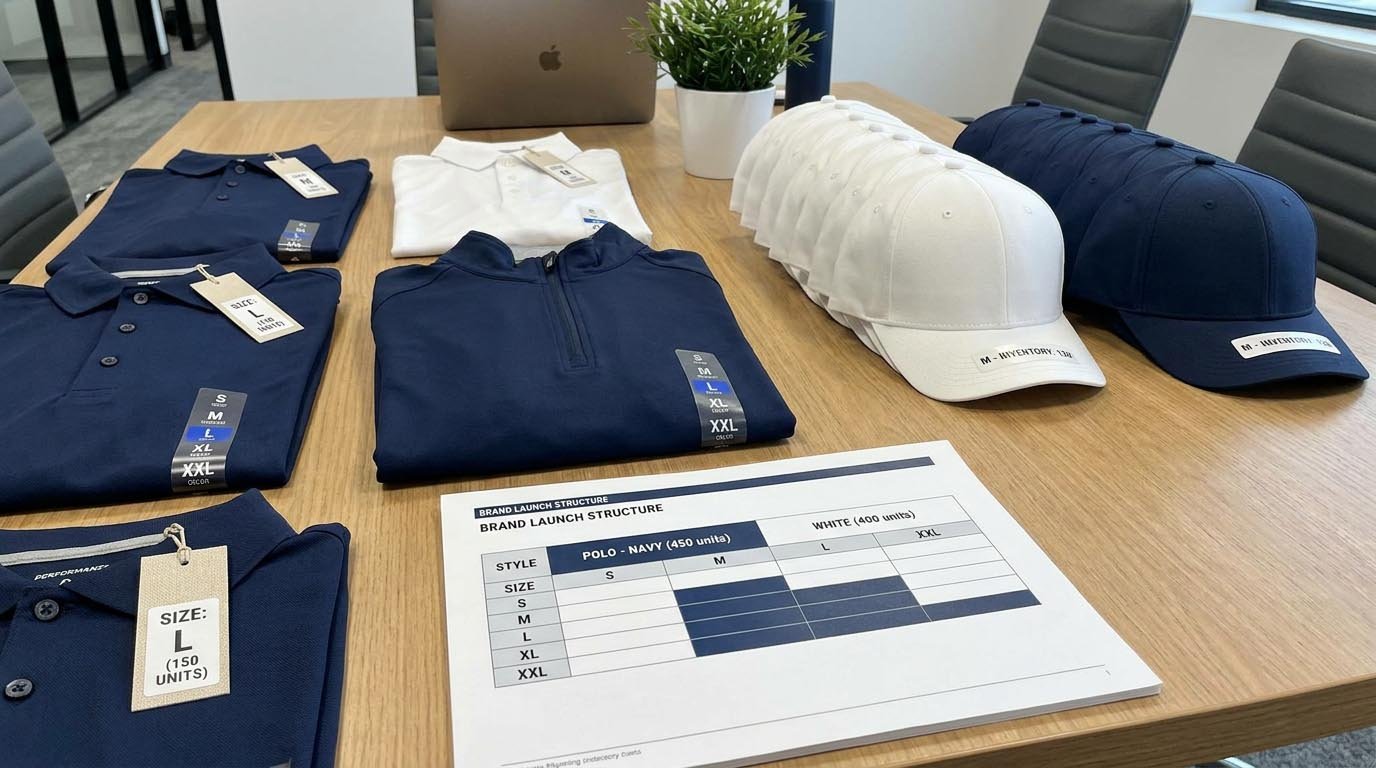
I need to be clear here: this isn't a universal rule. If you have $50,000 and signed retail accounts requiring variety, your structure changes completely. I'm talking specifically about direct-to-consumer brands testing their first market fit.
Core style selection logic
When clients ask "which 2-3 styles should I choose?", I redirect them: "What's your core customer scenario?"
Here's how I see successful launches structured:
Scenario 1: Performance-focused brand
- Style 1: Performance polo (moisture-wicking, stretch) - 500 pieces
- Style 2: Performance shorts (same fabric family) - 400 pieces
- Colors: 2 per style (navy + one accent color)
- Total SKUs: 4
- Total pieces: 900
Why this works:
- Fabric consistency across styles (better MOQ pricing)
- Coordinated look (customers buy both)
- Deep inventory in your hero product (polo)
Scenario 2: Lifestyle-meets-performance brand
- Style 1: Classic fit polo - 450 pieces
- Style 2: Quarter-zip pullover - 400 pieces
- Style 3: Performance cap - 300 pieces
- Colors: 2 for polos/pullovers, 3 for caps (lower cost item)
- Total SKUs: 7
- Total pieces: 1,150
Why this works:
- Covers on-course and off-course wear
- Cap is lower-risk (lower unit cost, faster turn)
- Two main styles maintain depth
Color strategy: depth beats variety
This is where most new brands get it wrong. They think offering 4 colors per style looks professional. But here's what I see in order reviews:
4 colors per style example:
- Style: Performance polo
- Colors: Navy, white, gray, light blue
- Total pieces: 400
- Per color: 100 pieces
- Best color (navy) sells 15/week: out in 6-7 weeks
- Worst color (light blue) sells 2/week: 50 weeks to clear
2 colors per style example:
- Same polo
- Colors: Navy, white
- Total pieces: 400
- Per color: 200 pieces
- Navy sells 15/week: 13 weeks inventory
- White sells 8/week: 25 weeks inventory (slower but acceptable)
The math is simple:
- Fewer colors = deeper inventory per color
- Deeper inventory = time to reorder winners
- Less color variety = less dead stock risk
Size distribution considerations
Don't forget sizes multiply your SKUs too:
- 2 colors × 5 sizes (S, M, L, XL, XXL) = 10 SKUs per style
Standard size distribution I recommend:
- S: 15%
- M: 30%
- L: 30%
- XL: 20%
- XXL: 5%
If you have 200 pieces in "Navy Polo":
- M and L: 60 pieces each
- XL: 40 pieces
- S: 30 pieces
- XXL: 10 pieces
Even with 200 total pieces, your M and L (the common sizes) only have 60 units each. At 6 sales/week per size, that's 10 weeks. Still tight.
This is why I push for 300-400 pieces per style per color—it's not arbitrary. It's the minimum depth to maintain stock in common sizes through a reorder cycle.
How can I reduce MOQ and inventory risk?
You can't eliminate MOQ requirements without paying more per unit. But you can reduce inventory risk through strategic color choices, fabric consistency across styles, pre-launch validation, and phased rollout approaches.
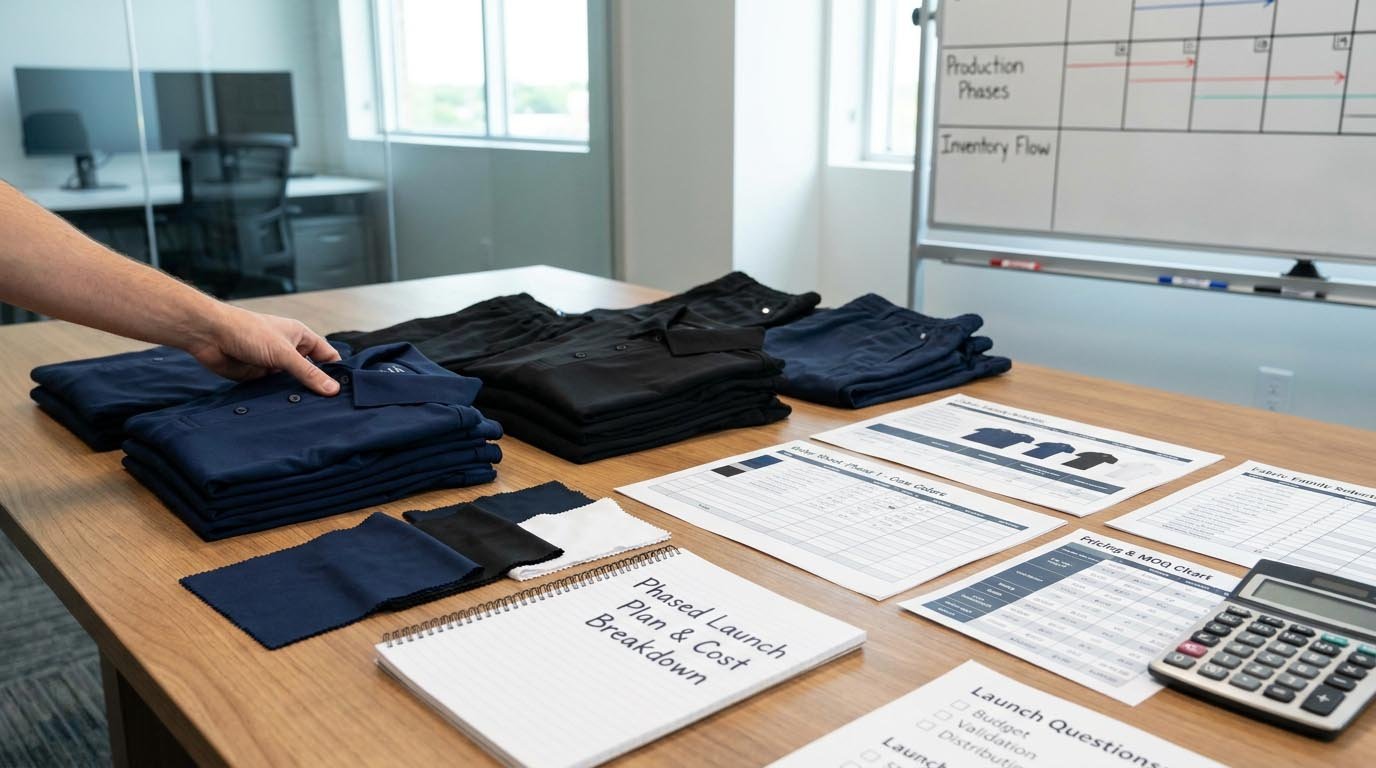
Let me be direct: when clients ask "Can you do 200 pieces instead of 500?", the answer is always "Yes, but..." Because lowering MOQ isn't free—it shifts cost somewhere else.
Strategy 1: Start with one color per style
The fastest way to meet MOQ efficiently:
- 3 styles × 1 color each = 3 SKUs
- All pieces concentrated in proven colors (navy, black, white)
- 400-500 pieces per SKU = deep inventory
Trade-off:
- Less visual variety on your website
- But much lower stockout risk
- And lower capital tied in slow colors
I see this working when brands test their first market. Once you know which style sells, you add colors in reorder 2.
Strategy 2: Use fabric families
This is something I suggest during order consultations:
Instead of:
- Polo A: Pique cotton
- Polo B: Performance polyester
- Shorts: Stretch woven
- Each requires separate fabric MOQ
Try:
- Polo A: Performance blend (same base fabric)
- Polo B: Same fabric, different design details
- Shorts: Same fabric family, different construction
Benefits:
- Combined fabric order reaches mill MOQ faster
- Lower per-yard cost
- Can potentially lower per-unit price by $1-2
Strategy 3: Pre-launch validation (carefully)
Some brands try to pre-sell before production. This works but has limits:
What works:
- Pre-orders with 30-50% deposit
- Limited "founder edition" with clear 8-10 week delivery
- 50-100 validated sales before full production
What doesn't work:
- Trying to crowdfund full MOQ (slow conversion kills momentum)
- Long pre-order periods (customers forget/cancel)
- Using pre-order data to pick 6 styles (you're back to the variety trap)
I've had clients successfully pre-sell 100-150 units, then use that to confidently order 400 pieces (knowing 100 are already sold). It lowers risk but doesn't eliminate MOQ.
Strategy 4: Phased inventory approach
Instead of ordering all SKUs at once:
Phase 1 (first production):
- 2 styles, 1 color each
- 500 pieces per style
- Total: 1,000 pieces, 2 SKUs
Phase 2 (60 days later, after initial sales data):
- Reorder winning style in original color (500 pieces)
- Add 1 new color to winning style (400 pieces)
- Add 1 new style based on customer requests (400 pieces)
This approach:
- Limits first-order risk
- Uses real data to guide phase 2
- Maintains continuous inventory flow
Trade-off: you need working capital for phase 2 while phase 1 is still selling.
What "lower MOQ" really costs
When I quote "flexible MOQ" options, here's the real pricing:
| MOQ Level | [Typical Cost | Cost Increase](https://fuwaygolf.com/understanding-moq-for-custom-golf-polo-shirts/) |
|---|---|---|
| 500+ pcs | $11-12/unit | Baseline |
| 300-499 pcs | $13-14/unit | +$2/unit |
| 200-299 pcs | $15-16/unit | +$4/unit |
| 100-199 pcs | $17-18/unit | +$6/unit |
So "Can you do 200 pieces?" equals:
- 200 pcs × $16 = $3,200
- vs. 500 pcs × $12 = $6,000
You save $2,800 upfront but pay $4/unit more. If those 200 pieces sell well and you reorder 300 more:
- Second order: 300 × $14 = $4,200
- Total: $7,400 for 500 pieces
- vs. ordering 500 upfront: $6,000
The small MOQ costs you $1,400 more in total. It only makes sense if you're truly uncertain about demand.
My usual consultation framework
When new brands contact me about MOQ, I ask:
- What's your total launch budget? (Not per style—total)
- Do you have retail distribution requirements? (Changes everything)
- What's your pre-launch validation? (Email list size, pre-orders, social following)
- How fast do you need to launch? (Affects inventory strategy)
Based on answers, I map out:
- Realistic style count for their budget
- Color strategy that balances depth and variety
- Whether phased approach makes sense
- Where they can (and can't) compromise on MOQ
Most importantly: I show them the order details and ask "If 40% of this inventory sits for 6 months, can you handle that?" If the answer is no, we reduce SKU count.
Once you understand MOQ, the next step is aligning it with product choice, budget, and launch timing in how to start a golf apparel line.
Conclusion
The right style and color count for your golf apparel launch isn't about market coverage—it's about inventory depth, reorder timing, and capital efficiency. Start focused, validate with real sales, then expand strategically.