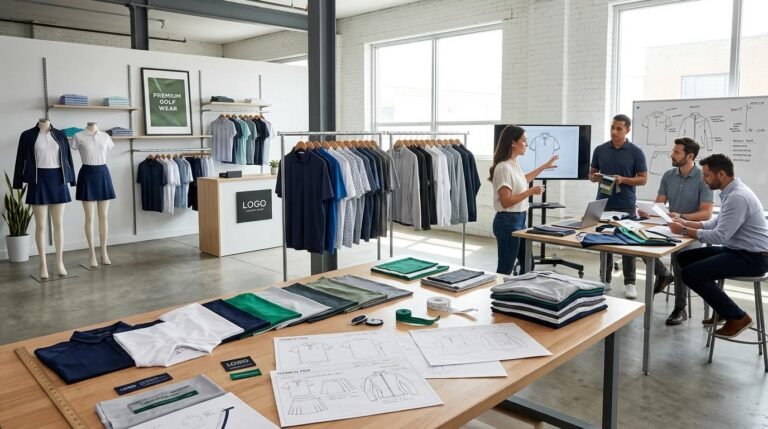
Starting a golf clothing brand requires matching your available capital, design differentiation goals, and marketing timeline to supplier MOQ structures and production constraints before you commit to product development—not finding "the right steps" in sequence.
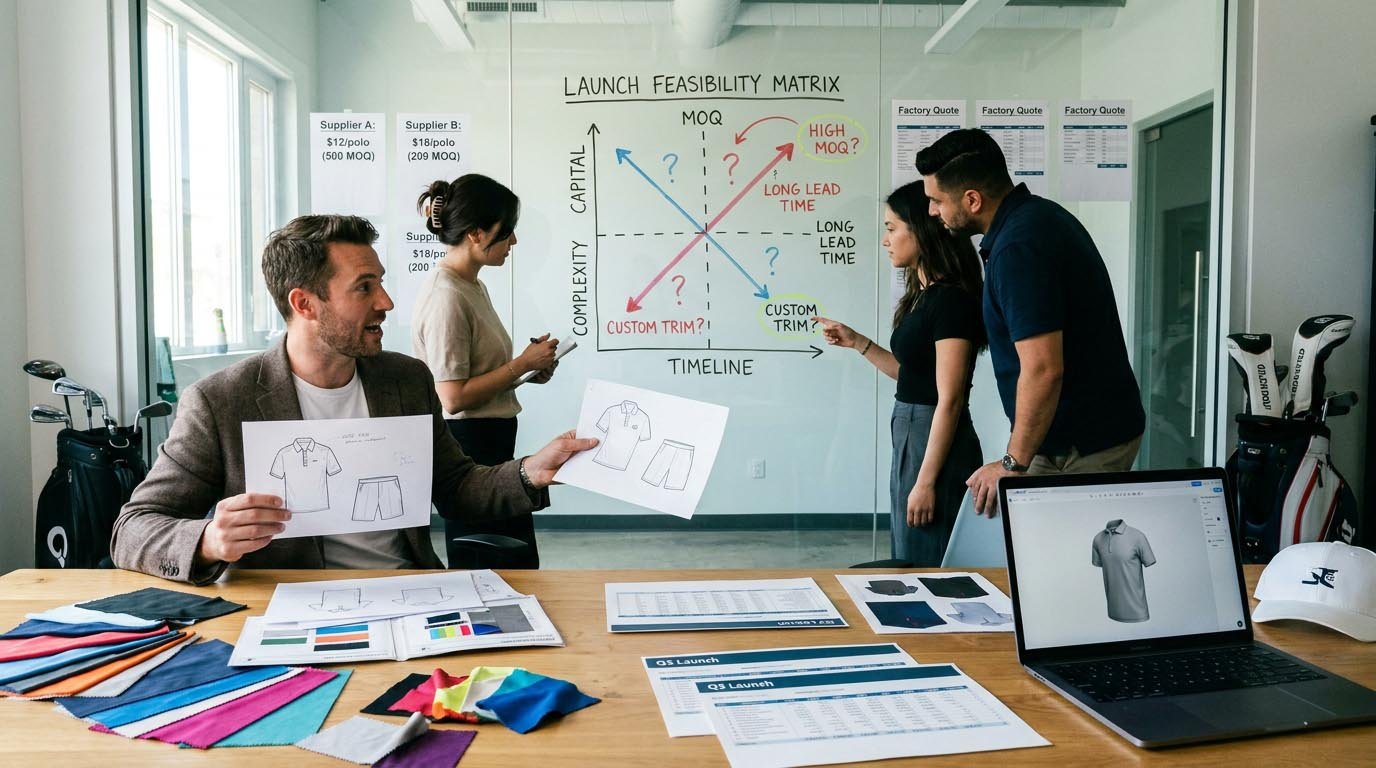
I am Will from FUWAY. I receive inquiries from 50-80 people monthly who want to start golf clothing brands. About 30% have never spoken to a manufacturer before contacting me. They have designed products without knowing if their designs are producible at their budget level. Another 40% have contacted 5-10 factories but received confusing or contradictory quotes. They cannot figure out why one factory quotes $12 per polo while another quotes $18 for "the same product." The remaining 30% have realistic plans but need help navigating quality control, timeline management, or scaling decisions. This guide focuses on the decision variables that determine whether your brand launch is feasible before you spend money on sampling or production.
Quick Answers: Starting a Golf Clothing Brand
How much capital do I need to start a golf clothing brand?
$8,000-$15,000 for a minimal test launch (200-300 pieces, 1-2 styles, simplified customization, DTC-only sales). $20,000-$40,000 for a proper launch (500-800 pieces, 2-3 styles, moderate customization, wholesale-ready inventory). $50,000+ for differentiated positioning with custom fabrics, complex construction, and multi-channel distribution.
Should I design products before contacting suppliers?
No. Contact 3-5 suppliers first to understand MOQ requirements, stock fabric options, and customization capabilities at your budget level. Then design within those constraints. Designing without knowing supplier limitations wastes time and often forces complete redesign.
What is the biggest mistake new golf clothing brands make?
Designing products that require 1,000+ piece MOQs when they only have capital for 300-500 pieces. They either pay premium pricing that destroys margins, sacrifice key design elements that differentiate their brand, or abandon the project after investing in design development.
Can I start with one style or do I need a full collection?
You can start with one style (typically a performance polo) if your positioning allows it. Many successful golf brands launched with a single signature polo, proved demand, then expanded. Full collections (4-6 styles) require 3-5x more capital and inventory management complexity.
How long does it take from starting design to receiving inventory?
4-6 months for first production: 2-4 weeks supplier sourcing and initial communication, 3-4 weeks sampling and revisions, 4-6 weeks bulk production, 2-4 weeks shipping and customs. Faster timelines are possible but cost 20-30% more and limit customization options.
What are realistic profit margins for a golf clothing brand?
Wholesale: 2.0-2.5x markup over manufacturing cost (if your polo costs $12 to produce, you sell to retailers at $24-30). Retail DTC: 3.0-4.0x markup over manufacturing cost (same $12 polo sells at $36-48 on your website). Premium positioning: 4.0-6.0x markup if you have strong brand differentiation and customer loyalty.
Do I need certifications or compliance documentation?
For DTC sales in North America: fabric performance test reports are more important than formal certifications initially. For wholesale to major retailers: OEKO-TEX, REACH (EU), and social compliance audits (WRAP/BSCI) are often required. For international expansion: research target market requirements before production.
Have You Identified What You Can Actually Afford to Differentiate?
Your available capital determines which differentiation strategies are feasible. Custom fabric development, complex construction details, and premium trims all increase MOQ requirements and per-unit costs. Most new brands must choose 2-3 differentiation elements, not everything.
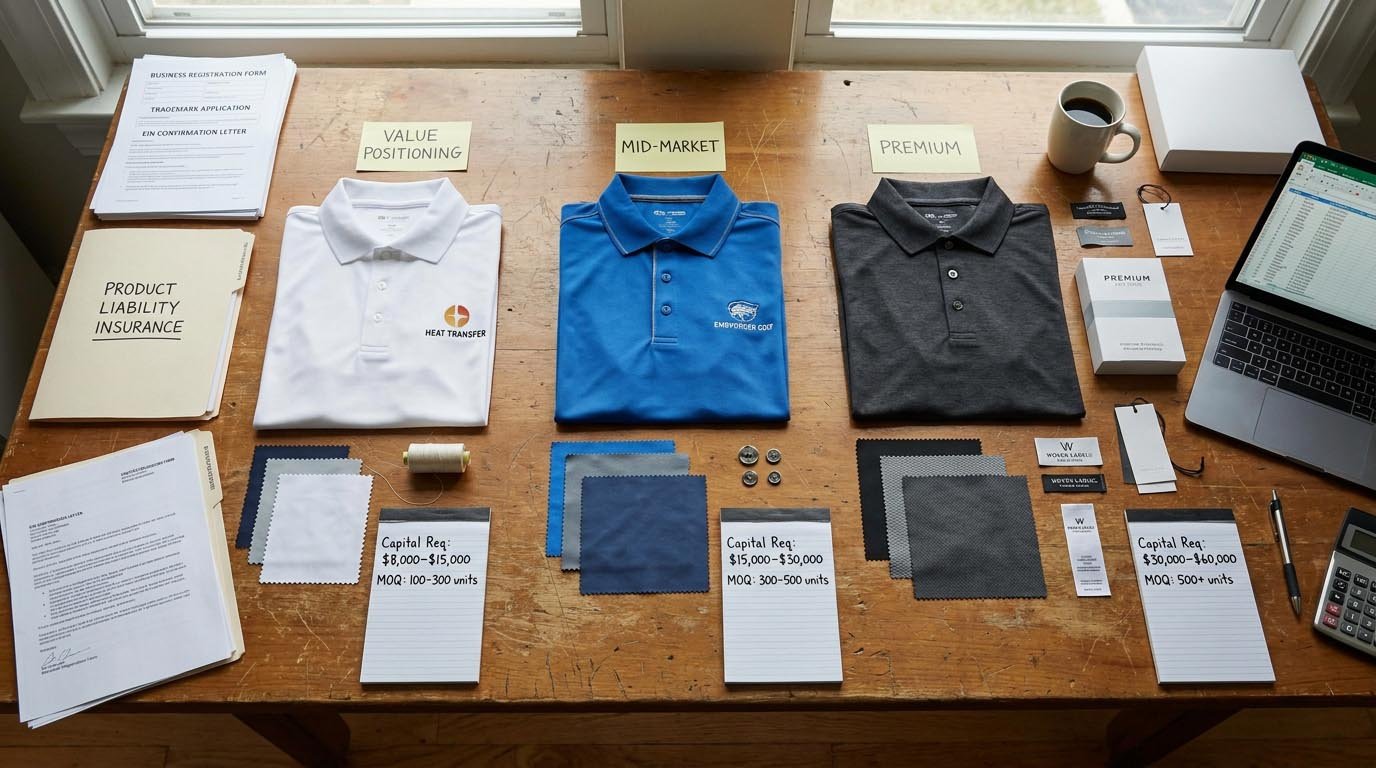
Defining Your Positioning Within Capital Constraints
Value positioning ($35-50 retail polos):
Requires manufacturing cost under $10-12 per unit to maintain healthy margins. This forces you into stock fabrics, basic logo methods (heat-transfer or simple embroidery), standard construction, and MOQs of 500+ pieces to achieve pricing. Differentiation comes from branding, marketing, and customer experience—not product innovation.
Capital required: $8,000-$15,000 for initial 500-800 piece production run.
Mid-market positioning ($50-80 retail polos):
Allows manufacturing cost of $12-18 per unit. You can afford performance fabrics from factory stock options, embroidered logos, some contrast details, and moderate customization. MOQ typically 500-800 pieces. Differentiation comes from fabric performance claims, fit optimization, and targeted design details.
Capital required: $15,000-$30,000 for initial 500-1,000 piece production run across 1-2 styles.
Premium positioning ($80-120+ retail polos):
Requires manufacturing cost budget of $18-30 per unit. Enables custom fabric development, complex construction, premium trims, and meaningful product innovation. MOQ increases to 800-1,500 pieces. Differentiation comes from proprietary fabrics, unique fit systems, and construction quality.
Capital required: $30,000-$60,000 for initial 1,000-1,500 piece production run across 2-3 styles.
Compliance and Legal Foundation
Before designing products, establish basic legal structure and understand compliance requirements.
Business registration:
LLC or corporation formation costs $100-500 depending on jurisdiction. Protects personal assets from business liabilities. Required for opening business bank accounts and signing supplier contracts.
Trademark protection:
Register your brand name and logo as trademarks. U.S. trademark costs $250-350 per class through USPTO. Prevents others from using your brand identity. Start this early—trademark approval takes 6-12 months.
Import compliance:
If importing from overseas manufacturers, you need an EIN (Employer Identification Number) for customs clearance. Understand tariff codes and duty rates for your products. Golf apparel typically falls under HTS codes 6105-6115 with 15-30% duty rates depending on fabric content.
Product liability insurance:
Covers claims if your products cause injury. Costs $500-2,000 annually for small brands. Some retailers require minimum coverage amounts ($1-2 million) to carry your products.
Labeling requirements:
U.S. requires fiber content disclosure, country of origin, and care instructions on permanent labels. FTC enforces these rules. Non-compliance risks fines and retailer rejection.
I see many aspiring brand owners skip these steps, focusing only on product design. They contact me ready to order, but cannot sign a contract because they have no business entity. They cannot import because they have no EIN. They cannot sell wholesale because they have no insurance. These issues delay launch by 2-3 months if not addressed early.
Can Your Design Vision Work Within Supplier Constraints?
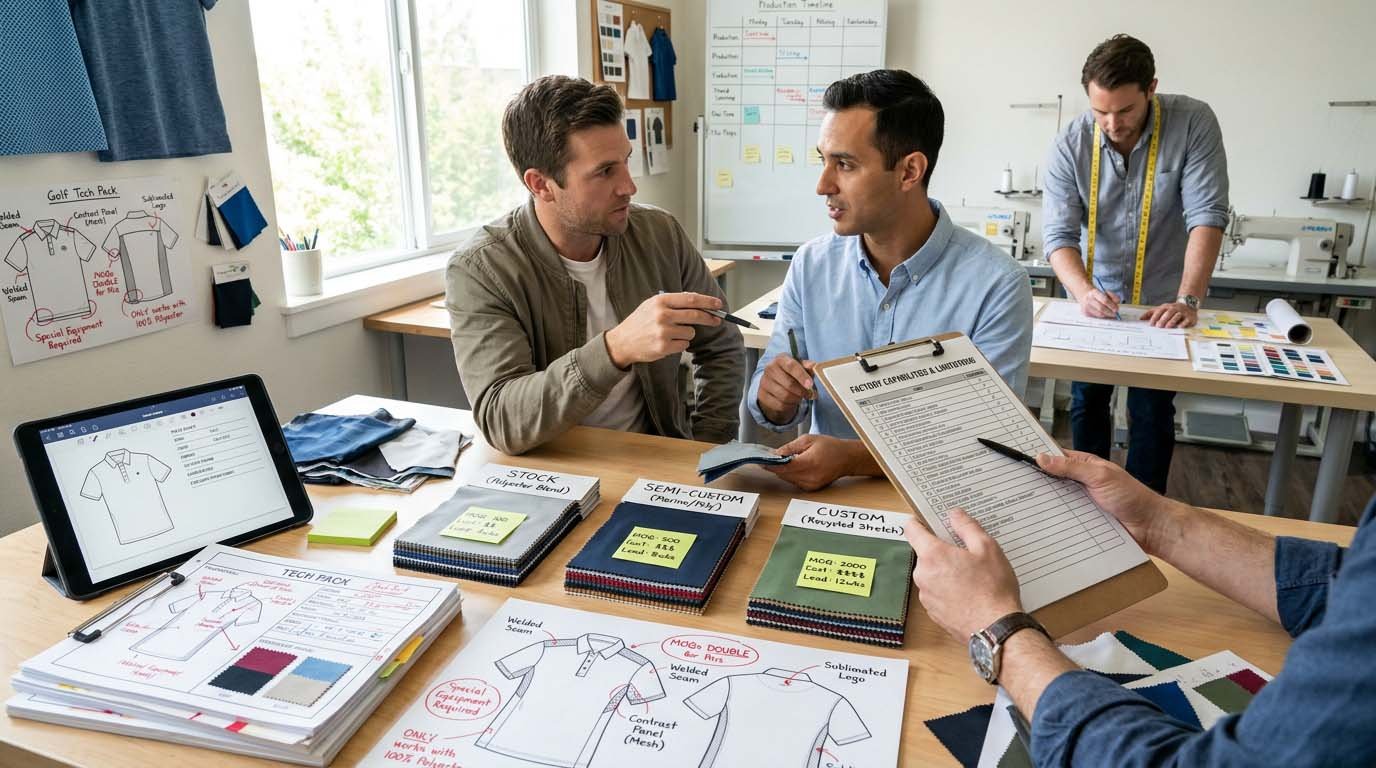
A client sent me detailed tech packs for golf polos with 4-way stretch fabric, contrast shoulder panels, welded seams, and sublimated logos. I asked if they had confirmed these elements were within their budget and MOQ targets. They said no—they had designed what they wanted, assuming factories could execute it. I explained welded seams require specialized equipment most golf apparel factories do not have. Sublimation only works on 100% polyester. Contrast panels require sourcing two fabrics, doubling MOQ requirements. Their design was technically feasible but would require 1,500 pieces and $25,000+ capital.
Product design must start with understanding what your target suppliers can execute at your MOQ and budget level. Otherwise you design products you cannot produce or must compromise every differentiation element to fit production reality.
Fabric Selection and Performance Features
Stock performance fabrics:
Most factories maintain inventory of 20-40 performance fabrics—pique, jersey, and interlock knits in common weights (140-180 GSM) with moisture-wicking treatment. Using these options keeps MOQ around 300-500 pieces and cuts lead time by 10-15 days. Fabric cost is $5-7 per unit.
Semi-custom fabric selection:
Factories with direct mill relationships can source from 200-500 fabric options the mills stock. You get broader selection than factory stock but avoid custom development. MOQ increases to 500-800 pieces. Fabric cost is $6-9 per unit.
Custom fabric development:
Developing proprietary blends or unique finishes requires 1,200-2,000 meters minimum from mills—translating to 800-1,500 pieces in production. This enables true differentiation but requires capital for larger production runs. Fabric cost is $7-12+ per unit depending on complexity.
Performance features and testing:
Moisture-wicking, UV protection (UPF 50+), anti-microbial treatment, and 4-way stretch all require specific fabric constructions and treatments. Verify your supplier conducts performance testing or provides mill test reports. Without documentation, your performance claims are unsubstantiated.
Tech Pack Development
Tech packs translate design vision into production specifications.
What tech packs must include:
Flat sketches showing front, back, and detail views. Measurement specifications for each size. Fabric specifications (composition, weight, finish). Construction details (seam types, stitching methods). Logo placement with measurements. Colorways with Pantone references. Trim specifications (buttons, labels, packaging).
Common tech pack mistakes:
Specifying measurements without tolerance ranges—factories need to know if 110cm chest means 108-112cm or exactly 110cm. Providing Pantone colors without understanding fabric dye limitations. Showing design details without specifying construction methods. Including elements that require equipment the factory does not have.
Who creates tech packs:
You can create basic tech packs using templates ($0 cost but requires learning). Hire freelance technical designers ($200-800 per style). Use design agencies ($1,000-3,000 per style including sampling). Or work with suppliers that offer design support—some factories help develop tech packs as part of sampling process.
At FUWAY, we receive tech packs ranging from professional CAD drawings with complete specifications to hand-drawn sketches with basic notes. We can work with both, but detailed tech packs reduce sampling rounds and revision costs. When clients do not have tech packs, we charge $150-250 to develop them based on verbal descriptions and reference images—this takes 3-5 days and delays the sampling timeline.
How Do You Evaluate Suppliers Before Committing Capital?
Supplier selection should happen early in planning, before finalizing designs, because factory capabilities determine what products you can successfully produce. Comparing price quotes without verifying specialization, quality systems, and batch flexibility leads to costly production failures.
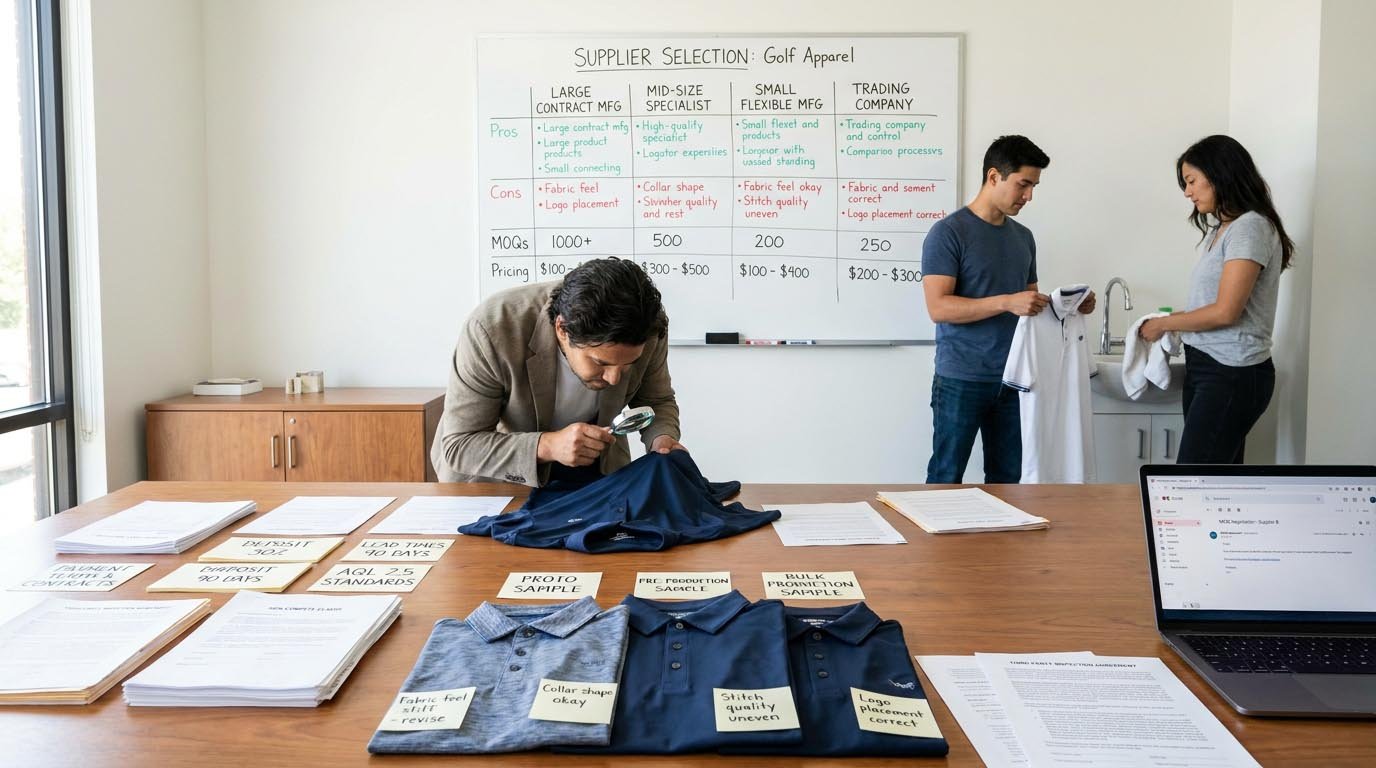
Factory Types and Capabilities
Large contract manufacturers (10,000+ units monthly):
Serve major brands with high-volume orders. Offer best pricing at scale but often have minimum order values ($30,000-50,000) that exclude startups. Unlikely to provide design support or accommodate small batch flexibility. Best for brands already scaled beyond startup phase.
Mid-size golf specialists (2,000-10,000 units monthly):
Focus on golf and performance apparel with proven expertise. Typical MOQs of 500-1,500 pieces. Offer reasonable pricing, documented quality systems, and moderate customization support. Can handle both polos and some complexity in fit or features. Best fit for most new golf brands.
Small flexible manufacturers (under 2,000 units monthly):
Accept lower MOQs (200-500 pieces) and offer more hand-holding through the process. Pricing is 20-35% higher than mid-size specialists. Quality and consistency vary widely. Limited production capacity can cause delays during peak season. Suitable for true test launches under $10,000 capital.
Trading companies:
Aggregate orders from multiple small brands to place consolidated factory orders. Offer very low MOQs (100-300 pieces) but add 20-30% markup over direct factory pricing. Useful for initial market testing when capital is extremely limited, but long-term unit economics require transitioning to direct manufacturing.
Sampling Process and Evaluation
Initial sample (proto sample):
Factory produces one or two samples based on your tech pack to validate design feasibility and get initial feedback. Costs $40-80 per sample. Takes 10-15 days. This is not production-quality—it proves concept and identifies issues.
Pre-production sample:
After you approve proto sample with revisions, factory produces samples using actual bulk production methods and materials. This validates that production processes match your expectations. Costs $30-60 per sample. Takes 7-12 days.
Bulk production sample:
Some factories provide samples made during actual bulk production startup—using final fabrics, trims, and logos. This is your last verification before mass production continues. Not all factories offer this.
What to evaluate in samples:
Fabric hand feel, weight, and stretch recovery. Collar stiffness and symmetry. Logo placement accuracy and stitching quality. Seam quality and finishing. Sizing accuracy against your measurements. Colorfastness after washing test sample yourself.
MOQ Negotiation Reality
I address this extensively in other content, but key points for brand planning:
500-800 pieces is standard MOQ for meaningful customization with embroidered logos and semi-custom fabric selection. 200-300 pieces is possible with in-stock fabrics and simplified logos, but per-unit cost increases 25-40%. Below 200 pieces, you are working with trading companies or paying extreme premiums (50-80% higher) that destroy margin sustainability.
Structure your first order around 2-3 core SKUs (colors/styles) to concentrate volume. Do not split 500 pieces across five colors (100 per color). Order 500 pieces across two colors (250 per color) for production efficiency.
Contract Terms and Risk Management
Payment terms:
Standard is 30% deposit, 40-50% after pre-production sample approval, 20-30% balance before shipment. Avoid factories demanding 70%+ upfront. Use trade assurance platforms (Alibaba, Global Sources) for first orders to protect payment.
Production timeline:
Document sampling timeline, bulk production timeline, and shipping method in contract. Include penalty clauses for delays beyond 10-14 days. Understand that rush fees (15-25% surcharge) apply if you need faster turnaround.
Quality standards:
Specify AQL (Acceptable Quality Limit) levels in contract—typically AQL 2.5 for major defects. Reserve right to third-party inspection before final payment. Document what constitutes acceptable versus rejectable quality.
IP protection:
Include non-compete clauses preventing factory from producing your designs for competitors. Understand enforceability is limited, especially with overseas manufacturers, but documented agreements provide some legal recourse.
What Are Your Real Costs and How Do You Price for Sustainability?
A client ordered 500 polos at $12.80 per unit. They planned to retail at $65. I asked if they had calculated their total landed cost per unit. They looked confused. I explained manufacturing cost is only one component. They needed to add sampling costs, shipping, duties, payment processing, photography, packaging, and returns. Their actual cost per unit was $21.40 before marketing. Their 5x markup assumption was actually 3x markup, barely sustainable after factoring marketing costs.
Most new brands underestimate total costs by 40-60% because they only calculate manufacturing unit price without accounting for every cost between factory and customer. This forces pricing too low to sustain operations or requires mid-launch price increases that damage credibility.
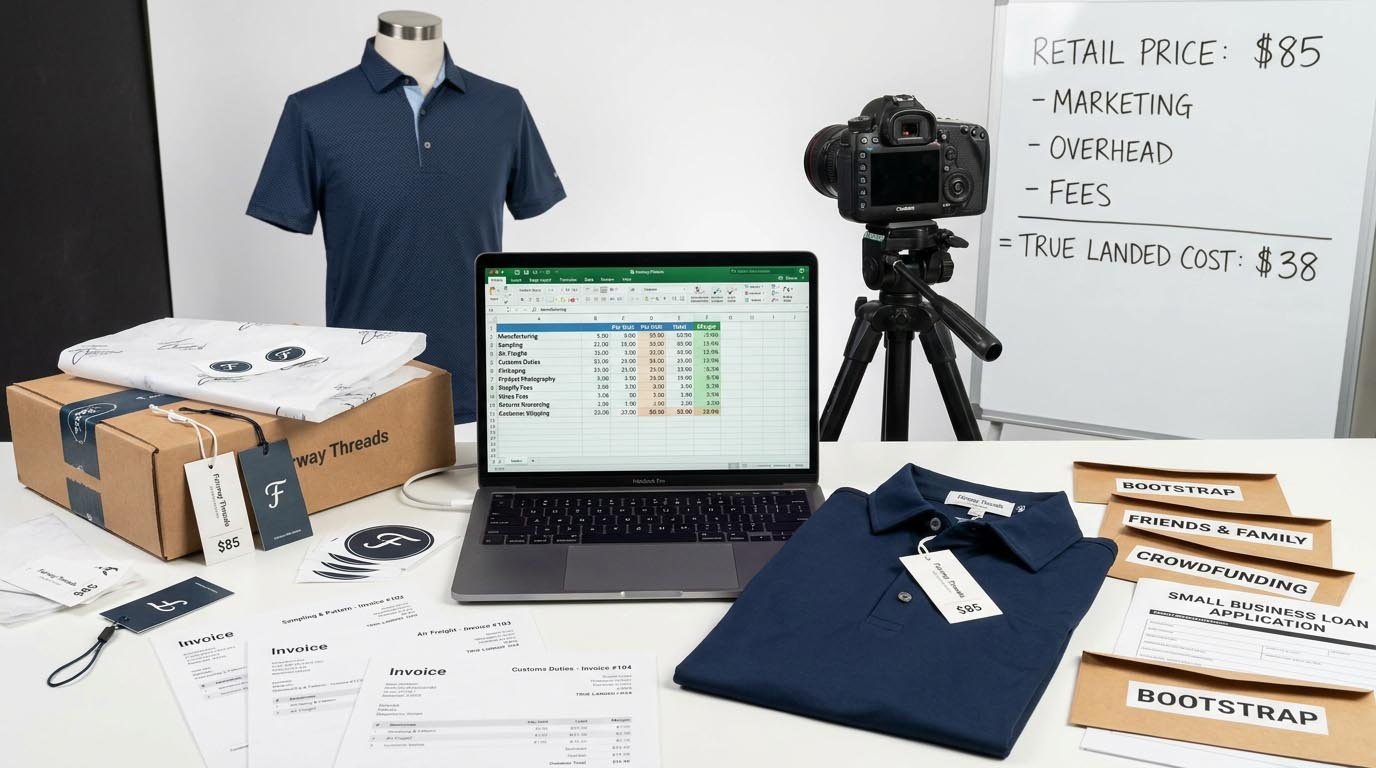
Complete Cost Structure
Manufacturing (COGS):
Polo shirts: $10-20 per unit depending on fabric, customization, and order volume
Shorts/pants: $14-26 per unit
Outerwear: $20-45 per unit
This represents 25-35% of your retail price in healthy business models.
Sampling and development:
$200-600 per style across multiple sampling rounds
Pattern making and grading: $150-300
Logo digitizing: $80-150
Total: $400-1,200 per style
Shipping and logistics:
Air freight: $3-6 per unit, 7-10 day transit
Sea freight: $1.50-2.50 per unit, 25-35 day transit
Customs duties: 15-30% of manufacturing cost depending on fabric content
Customs broker fees: $150-400 per shipment
Packaging and presentation:
Polybags: $0.15-0.30 per unit
Hang tags: $0.20-0.60 per unit
Custom packaging boxes: $1.50-4.00 per unit
Tissue paper and stickers: $0.30-0.80 per unit
Photography and content:
Product photography: $100-300 per style for basic shots
Lifestyle photography: $500-2,000 per shoot
Content creation: $300-1,000 monthly for social media
E-commerce fees:
Shopify or similar platform: $29-299 monthly
Payment processing: 2.9% + $0.30 per transaction
Shipping to customers: $4-8 per order
Returns and exchanges: 10-25% of orders, $6-12 per return
Pricing Strategy and Margin Calculation
Work backward from market positioning:
Research competitors at your target position. If similar brands retail polos at $58-68, your target retail is around $65. Work backward to determine sustainable manufacturing cost.
$65 retail price
- 30% for marketing and customer acquisition = $19.50
- 15% for operational overhead = $9.75
- 10% for returns and discounts = $6.50
- 5% for payment processing and platform fees = $3.25
= $26.00 available for COGS and fulfillment
$26.00 available
- $5.00 shipping and handling per order
= $21.00 maximum landed cost per unit
$21.00 landed cost
- $2.50 duties and freight
- $1.50 packaging
= $17.00 maximum manufacturing cost
If your manufacturing cost is $17 and you planned to retail at $65, your margin is too thin. Either reduce manufacturing cost through design simplification, increase retail price to $75-80, or improve efficiency elsewhere.
Funding and Cash Flow Planning
Bootstrap funding ($10,000-20,000):
Launch with minimal viable product—one style, two colors, 500 pieces. Sell through first inventory before ordering more. Growth is slow but risk is contained.
Friends and family funding ($20,000-50,000):
Enables proper launch with 2-3 styles, better inventory depth, and marketing budget. Typical structure is convertible note or revenue share agreement. Ensure legal documentation.
Crowdfunding (Kickstarter, Indiegogo):
Validate demand and fund initial production simultaneously. Successful campaigns raise $20,000-100,000 but require 60-90 days preparation and strong pre-launch audience. 30-40% of campaigns fail to reach funding goals.
Small business loans:
SBA microloans offer $5,000-50,000 for startups. Require business plan, collateral, and personal credit above 650. Interest rates 8-13%. Repayment begins immediately, creating cash flow pressure.
How Do You Manage Production Without Losing Control?
Production management is about milestone visibility and proactive problem reporting, not just waiting for delivery. Factories that communicate delays early give you options to adjust. Factories that stay silent until problems become crises force you into damage control with customers.
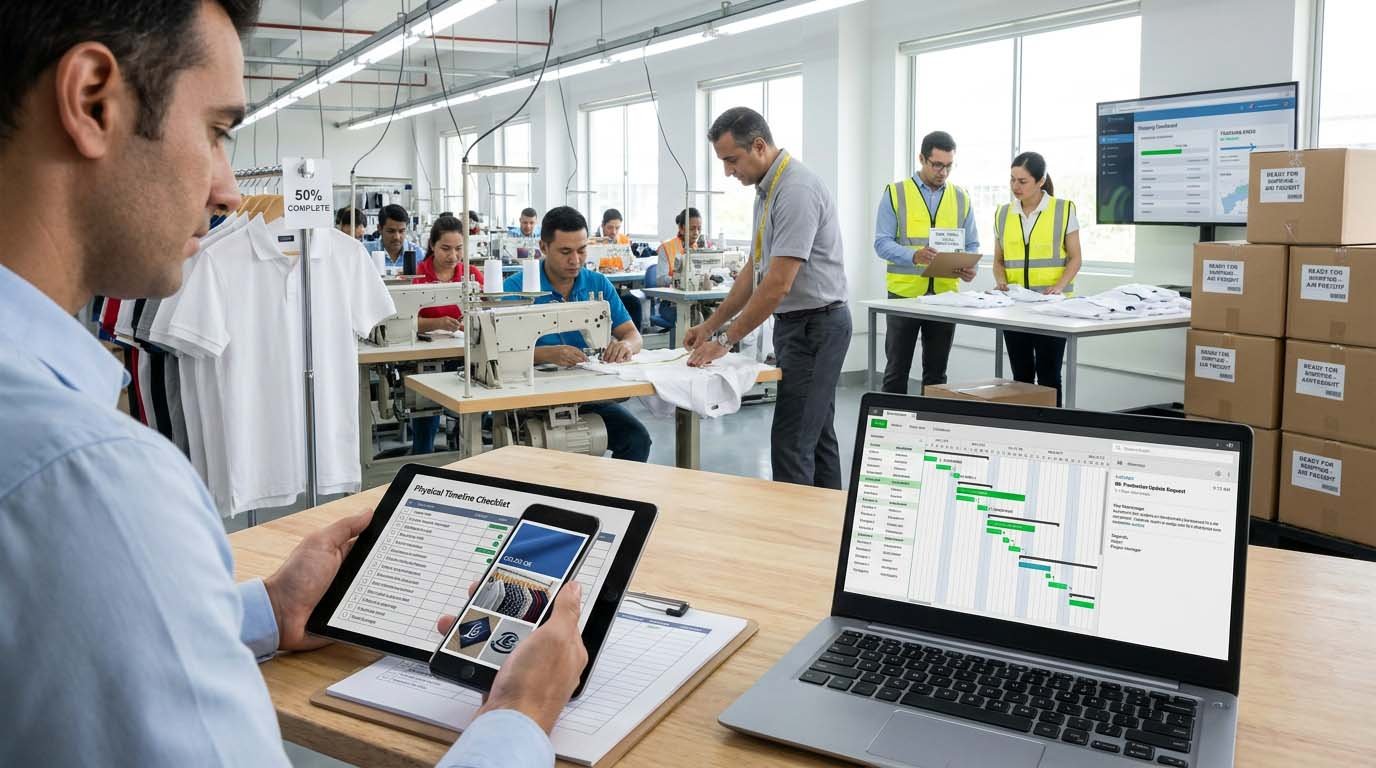
Production Timeline Milestones
Week 1-2: Fabric procurement and pre-production prep
Factory orders bulk fabric from mill or pulls from stock. Confirm fabric color against approved sample. Prepare cutting patterns and production line setup.
Your checkpoint: Request photo of bulk fabric swatch before cutting begins. Verify color matches your approved sample.
Week 3-4: Cutting and logo preparation
Fabric cut according to patterns across all sizes. Logo digitizing finalized and tested on scrap fabric. Pre-production quality check on cutting accuracy.
Your checkpoint: Request confirmation of cutting completion and first logo test shots. Identify any issues before sewing starts.
Week 4-6: Bulk sewing and assembly
Production lines sew pieces. Collars attached, logos applied, finishing and pressing completed. In-line quality checks at 25%, 50%, and 75% completion.
Your checkpoint: Request production progress photos at 50% completion. Verify consistency across sizes and colorways.
Week 6-7: Final inspection and packing
Random sampling inspection (AQL 2.5 standard). Pieces folded, tagged, and packed per your specifications. Carton labeling for shipping.
Your checkpoint: Hire third-party inspection or request detailed photo report before shipment authorization. This is your last quality gate.
Week 7-10: Shipping and customs clearance
Air freight (7-10 days) or sea freight (25-35 days) depending on your urgency and budget. Customs clearance typically 2-4 days. Final delivery to your warehouse or fulfillment center.
Your checkpoint: Track shipment daily during transit. Prepare for customs issues that could add 3-7 days delay.
Quality Control Requirements
Three-checkpoint system:
Pre-production fabric approval before cutting. In-line inspection at 50% production. Final pre-shipment inspection before payment release. Without these checkpoints, you discover quality issues after receiving inventory—too late to fix.
Third-party inspection services:
Companies like SGS, Intertek, or Bureau Veritas conduct independent inspections. Costs $200-400 per inspection. Provides documented evidence of quality and protects you in dispute scenarios.
What inspectors check:
Measurement accuracy across sizes. Collar and seam quality. Logo placement and stitching. Fabric defects (pilling, snags, color variation). Packaging quality and compliance with specifications.
I recommend third-party inspection for first 2-3 orders with any new factory. Once you establish trust and verify their quality systems work, you can reduce inspection frequency. But initial orders require verification—your capital is at risk.
How Do You Launch and Sell Without Inventory Sitting Idle?
Launch execution requires marketing momentum running parallel to production—not starting after inventory arrives. Your production timeline determines how aggressive your pre-launch marketing must be to create day-one demand.
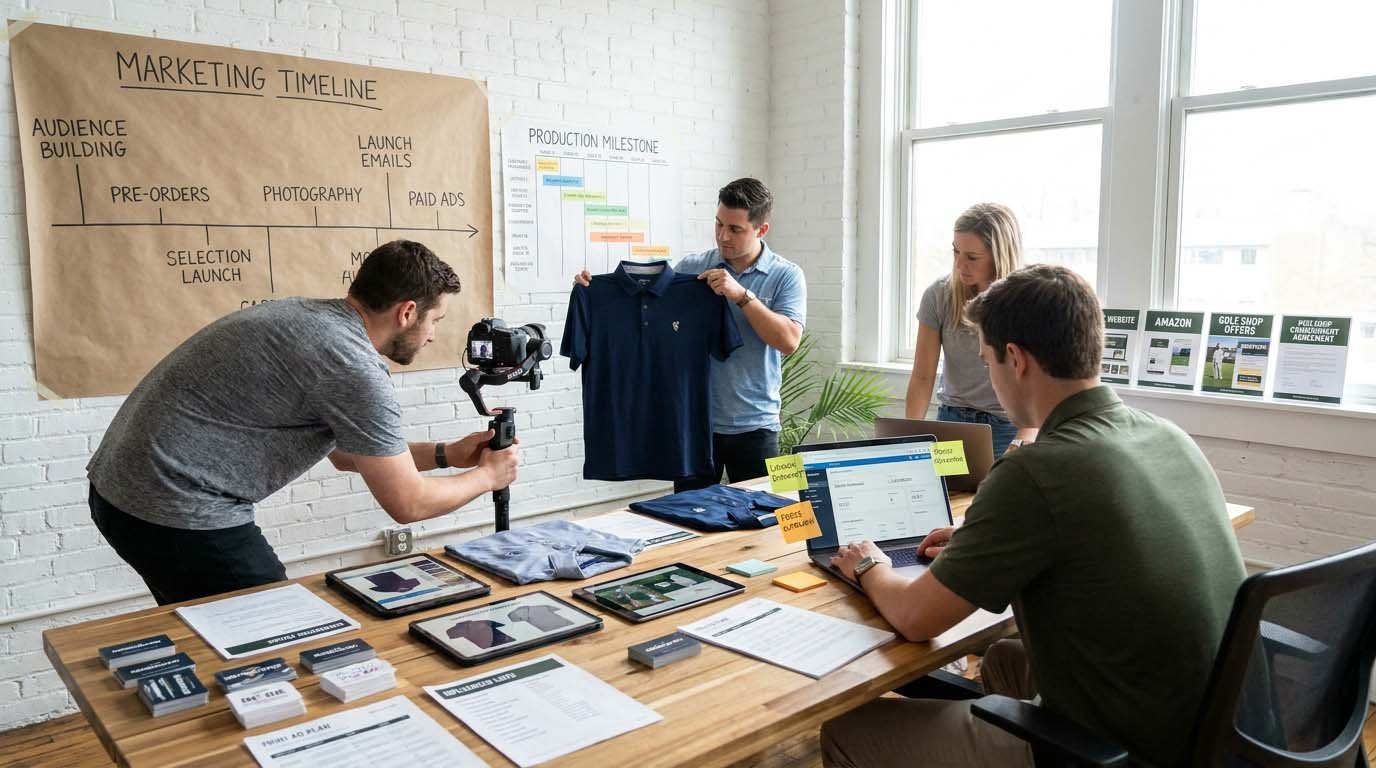
Sales Channel Strategy
Direct-to-consumer (DTC) via your website:
Highest margin (3-4x markup over COGS). Full brand control. Requires driving your own traffic through paid ads, content, and social media. Customer acquisition cost typically $25-60 per customer for new brands.
Amazon and online marketplaces:
Access to existing traffic but 15-20% platform fees. High competition and price pressure. Useful for volume once you prove demand through DTC.
Wholesale to golf shops and resorts:
2-2.5x markup over COGS (you sell at $26, they retail at $65). Requires larger inventory, net 30-60 payment terms, and return policies. Builds brand credibility but requires more capital.
Golf course pro shops:
Similar to wholesale but often consignment-based. You place inventory, they pay for what sells. Low risk for them, high inventory risk for you.
Pre-Launch Marketing Activities
Build audience before inventory arrives (90 days before launch):
Launch social media accounts with regular content. Create email signup landing page offering launch discount. Share behind-the-scenes production content. Run small paid ad campaigns ($300-500) testing messaging.
Generate pre-orders or waitlist (30-60 days before launch):
Offer early-bird pricing or limited edition first run. Collect email addresses with launch date commitment. This validates demand and generates cash flow before inventory investment.
Prepare launch assets (30 days before launch):
Professional product photography. Lifestyle content showing products in use. Size guide and fit information. Email sequences for launch week. Social media content calendar.
Launch week execution:
Email your full list. Run concentrated paid ad campaign ($1,000-2,000 for week one). Reach out to golf media and influencers with product samples. Offer limited-time launch discount (10-20% off).
Realistic First-Year Expectations
Most new golf brands sell 300-800 units in year one. Brands with strong pre-launch audiences or funded marketing budgets can reach 1,500-3,000 units. Exceptional brands with viral marketing or strong founder platforms sell 5,000+ units year one, but this is rare.
Plan for 60-75% sell-through of first inventory within 6-9 months. Remaining 25-40% will require discounting or extended timeline. This is normal—perfect inventory planning is impossible for first launches.
Conclusion
Starting a golf clothing brand requires matching capital to realistic MOQ structures ($10,000+ for simplified test launch, $25,000+ for differentiated positioning), designing within supplier capabilities verified through early factory contact, calculating complete landed costs before pricing, managing production through documented milestone checkpoints, and building marketing momentum parallel to manufacturing timelines—not sequentially after inventory arrives.