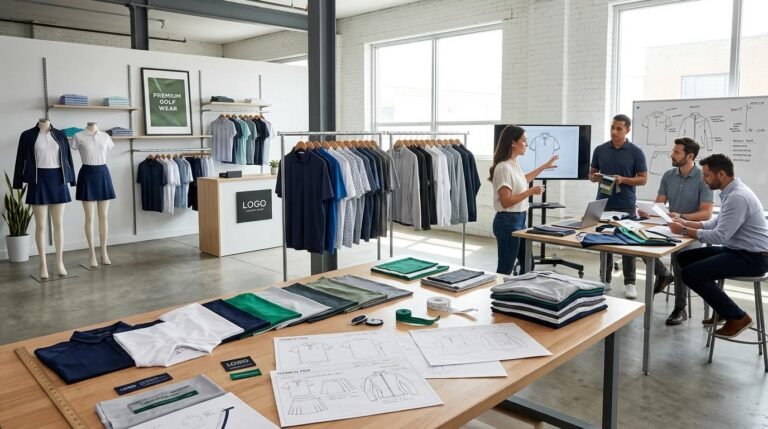
You're about to place your first manufacturing order, but you're stuck choosing between polo shirts, shorts, outerwear, or launching everything at once. Pick wrong, and you'll burn capital on inventory that never moves.
Start with one or two polo shirts using proven mid-tier performance fabrics. This isolated approach lets you test actual customer demand without scattering inventory risk across multiple product categories—something I've seen kill more new brands than bad designs ever did.
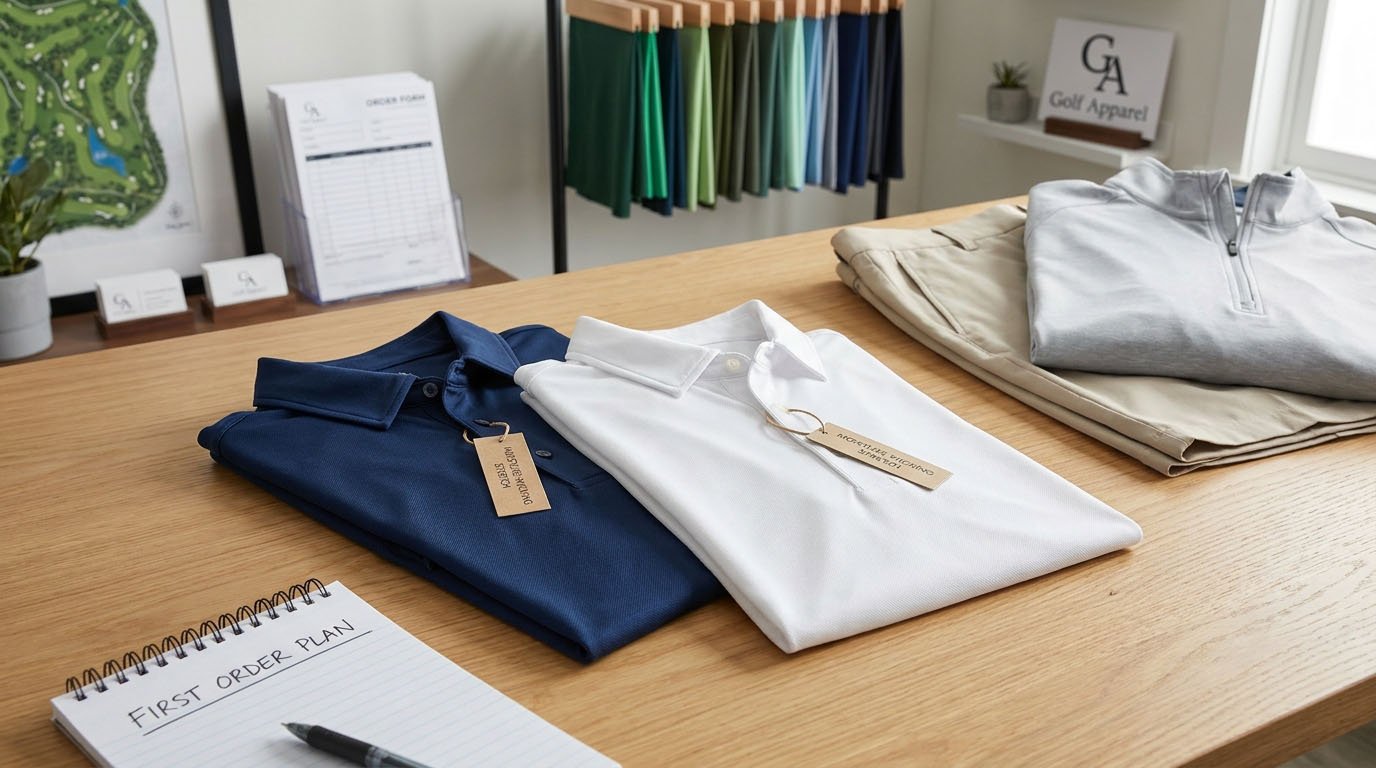
I've worked with over 300 new golf brands in the past 15 years at FUWAY. The ones that came back for second orders had one thing in common: they started narrow. The ones that disappeared? They ordered 6+ SKUs in their first batch and couldn't figure out what worked.
If you need the full roadmap beyond category choice, start with how to start a golf apparel line.
Quick Answers: First Product Selection for Golf Brands
What's the safest first product for a new golf brand?
A single polo shirt style in 2-3 colorways using proven moisture-wicking polyester blends (not basic cotton, not premium tech fabrics). This tests market fit without overcommitting capital.
How many SKUs should I launch with?
2-3 maximum—typically one polo style in multiple colors, or one polo plus one performance short. More SKUs at launch scatter inventory and make it impossible to diagnose what's working.
Should I target casual golfers or serious players first?
Pick one. Casual-focused brands need everyday wearability and cost efficiency. Frequent-player brands need moisture-wicking, UV protection, and stretch. Trying to serve both at launch creates a product that satisfies neither.
What fabric grade should I use for my first order?
Mid-tier performance fabrics—proven polyester-spandex blends with breathability and shape retention. Basic fabrics lose reorders due to poor wear experience. Premium fabrics add cost customers might not value yet.
When should I expand to jackets, pants, or accessories?
Only after your first 2-3 products generate reorders without promotional discounting. This confirms you've validated fit, fabric, and customer expectations before adding complexity.
Why New Golf Brands Should Start Narrow?
I get the same question during almost every first consultation: "Can we launch polos, shorts, and a vest together?" The answer is always no, but let me explain why from what I see on the production floor.
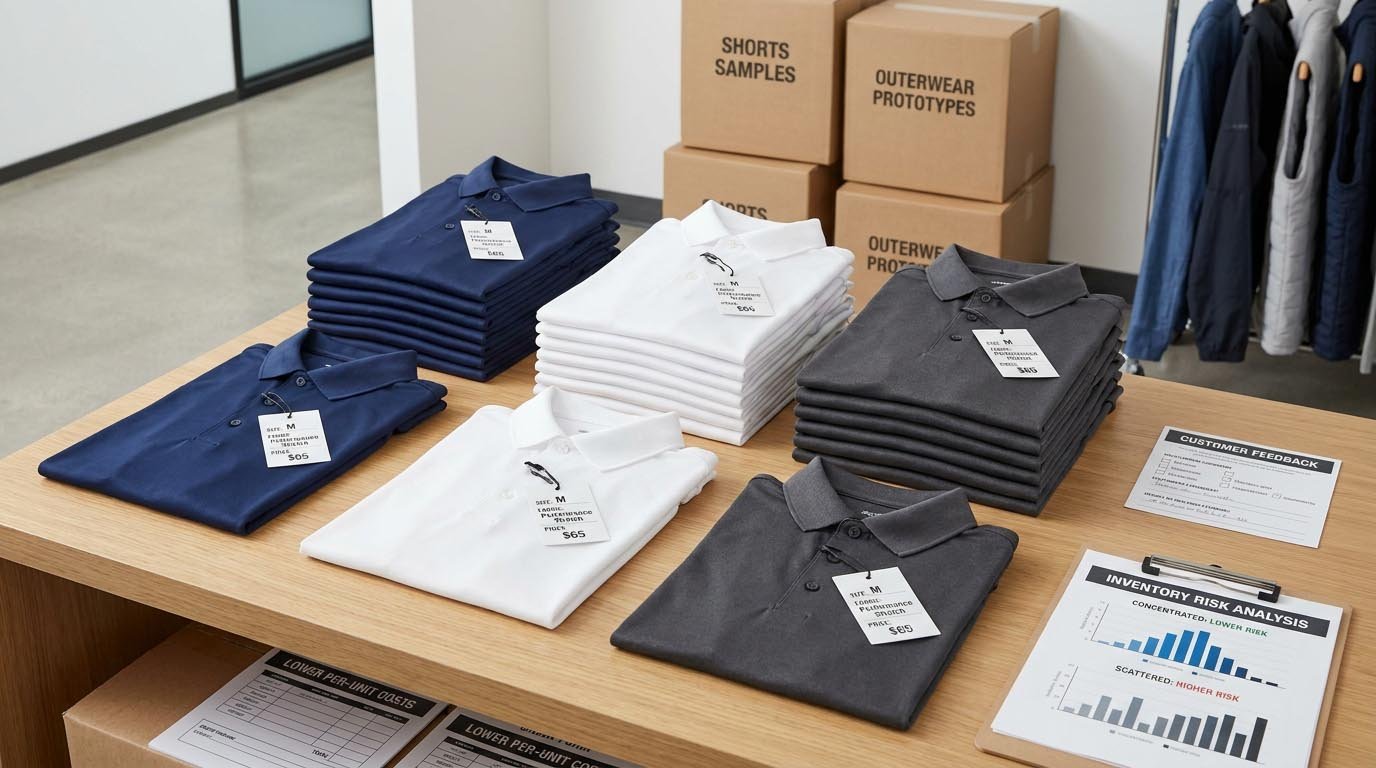
When a brand orders 5-6 SKUs in their first batch, here's what happens. They split their budget across multiple products. Each SKU gets lower quantities, which means higher per-unit costs and scattered inventory risk. Then when sales come in, they can't tell if customers prefer the polo over the shorts, or if the vest just didn't fit right, or if the entire color palette was wrong.
I worked with a brand in 2022 that launched with:
- 3 polo styles
- 2 short styles
- 1 windbreaker
- 1 pullover
Total investment: $28,000 for first order. Six months later, 70% of inventory was still sitting in their warehouse. They came back asking which product to reorder, but they had no idea—because nothing sold through cleanly enough to isolate demand.
What Narrow Focus Actually Tests
Starting with one polo shirt in 2-3 colors tests three things that matter:
Fabric performance in real use
Customers will wear it, wash it, and either reorder or complain. You'll learn if your fabric choice causes pilling, shrinkage, or poor breathability—issues that kill reorders but only surface after first wash.
Fit consistency across sizes
One style means you can dial in sizing based on direct feedback. Multiple styles mean you're chasing fit issues across different cuts simultaneously.
Price-to-quality perception
When customers compare your polo to competitors, you'll know if your price point matches perceived value. If you launch 6 products, pricing feedback gets muddied across categories.
The Math That Proves Narrow Focus
Here's the manufacturing side reality:
| Launch Approach | Per-Unit Cost | Inventory Risk | Learning Speed |
|---|---|---|---|
| 1 polo, 3 colors, 1,000 units | $12-14 | Concentrated but manageable | Fast—clear signal on demand |
| 6 SKUs, 150-200 units each | $16-18 | Scattered across categories | Slow—mixed signals |
The narrow approach costs 15-25% less per unit because higher quantities per SKU unlock better fabric pricing and production efficiency. More importantly, when that single polo sells through in 90 days, you know exactly what to reorder.
4 Criteria for Choosing First Products?
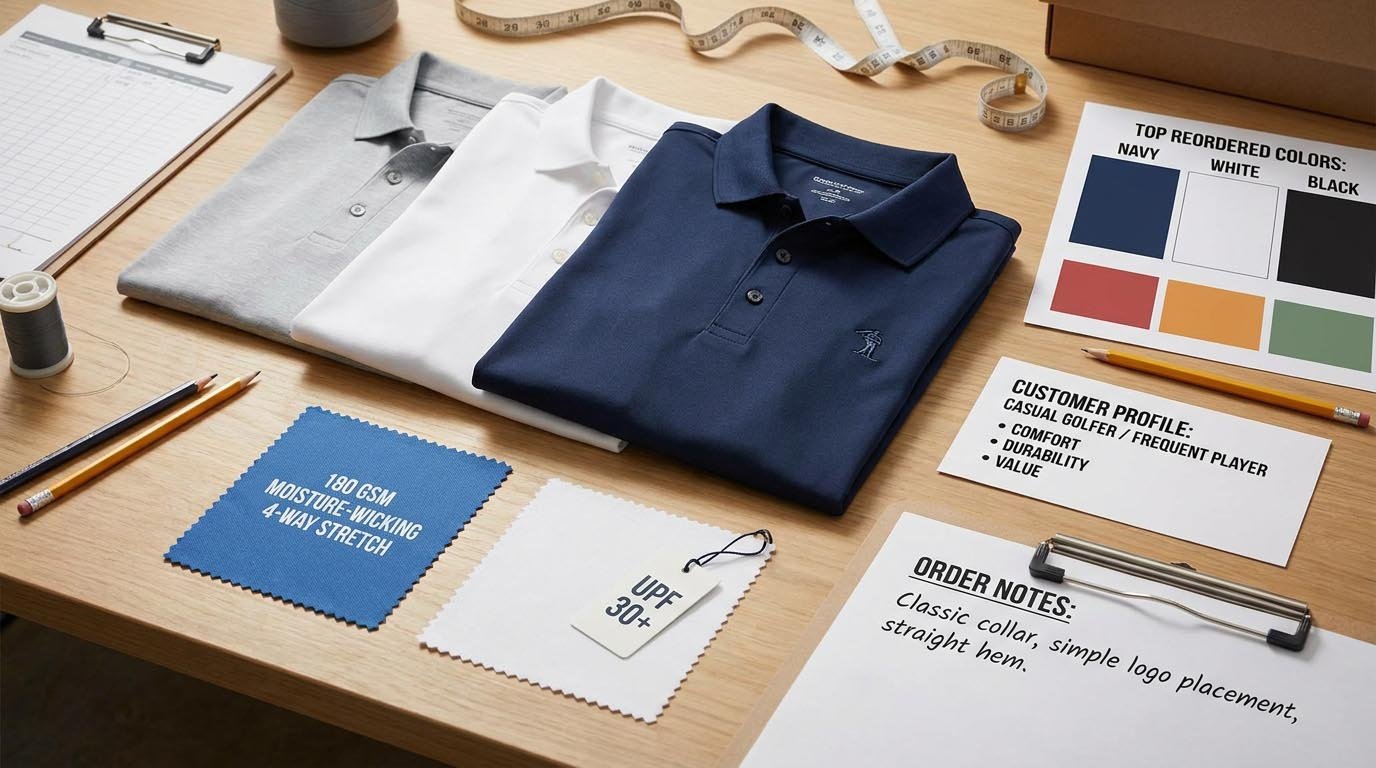
I don't tell new brands what to make—I tell them what survives first-batch mistakes. These four criteria come from watching which products generate reorders and which become clearance inventory.
Criterion 1: Proven Fabric Category
Use fabrics that already work for established brands in your price range. This isn't about copying—it's about not experimenting with untested materials when you're also testing design, fit, and market positioning.
What works for first orders:
- Polyester-spandex blends (92/8 or 88/12 ratio)
- Moisture-wicking treatments already standard in the industry
- Weight range: 180-220 GSM for polos, 150-180 GSM for shorts
What fails:
- Basic cotton-poly (deforms after washing, no stretch recovery)
- Experimental cooling yarns or graphene-infused fabrics (cost premium customers might not value)
- Overly lightweight fabrics that feel cheap or show sweat marks
I had a client insist on a 120 GSM ultra-light fabric for their first polo order. It felt great in samples. After customers wore it once, reviews complained it was "see-through" and "felt like pajamas." The brand never recovered from that first impression.
Criterion 2: Single Target Customer Profile
Pick either casual golfers who want everyday wearability, or frequent players who need performance features. Don't try to split the difference.
Casual-focused brands prioritize:
- Softer hand feel over technical performance
- Versatility (can wear to lunch, not just the course)
- Cost efficiency to keep retail price under $45-55
Frequent-player focused brands prioritize:
- Moisture-wicking and quick-dry (tested in heat)
- UV protection UPF 30+
- 4-way stretch for swing mechanics
The brands that fail are the ones who say "we want to appeal to everyone." That turns into a polo that's too technical for casual wear but not technical enough for serious players.
Criterion 3: Style Simplicity
Your first product should be the most universally accepted silhouette in golf apparel: a classic fit polo shirt. Not a fashion-forward slim cut. Not an oversized streetwear interpretation. Classic.
Why? Because you need to isolate variables. If your first polo has an unusual collar design or asymmetric hem, and it doesn't sell, you won't know if customers rejected the style innovation or just didn't find your brand yet.
Safe first-product features:
- Traditional polo collar (not band collar, not button-down)
- Chest pocket or logo placement only
- Hem length that covers waistband (not cropped, not tunic length)
Criterion 4: Color Validation Through Others' Success
I tell new brands to look at what established competitors are selling in their first 3-5 colorways. Not to copy exactly, but to understand proven color demand.
High-reorder colors from our production data:
- Navy, white, black (foundational, always needed)
- Light gray, sky blue (versatile second-tier colors)
- Bold accent colors (red, orange, lime) work only if your brand identity supports them
What doesn't work: launching with 5 fashion-forward colors because they photograph well. Customers buy navy and white first. You need those selling to fund experimentation later.
Best 2-3 Style Launch Combinations?
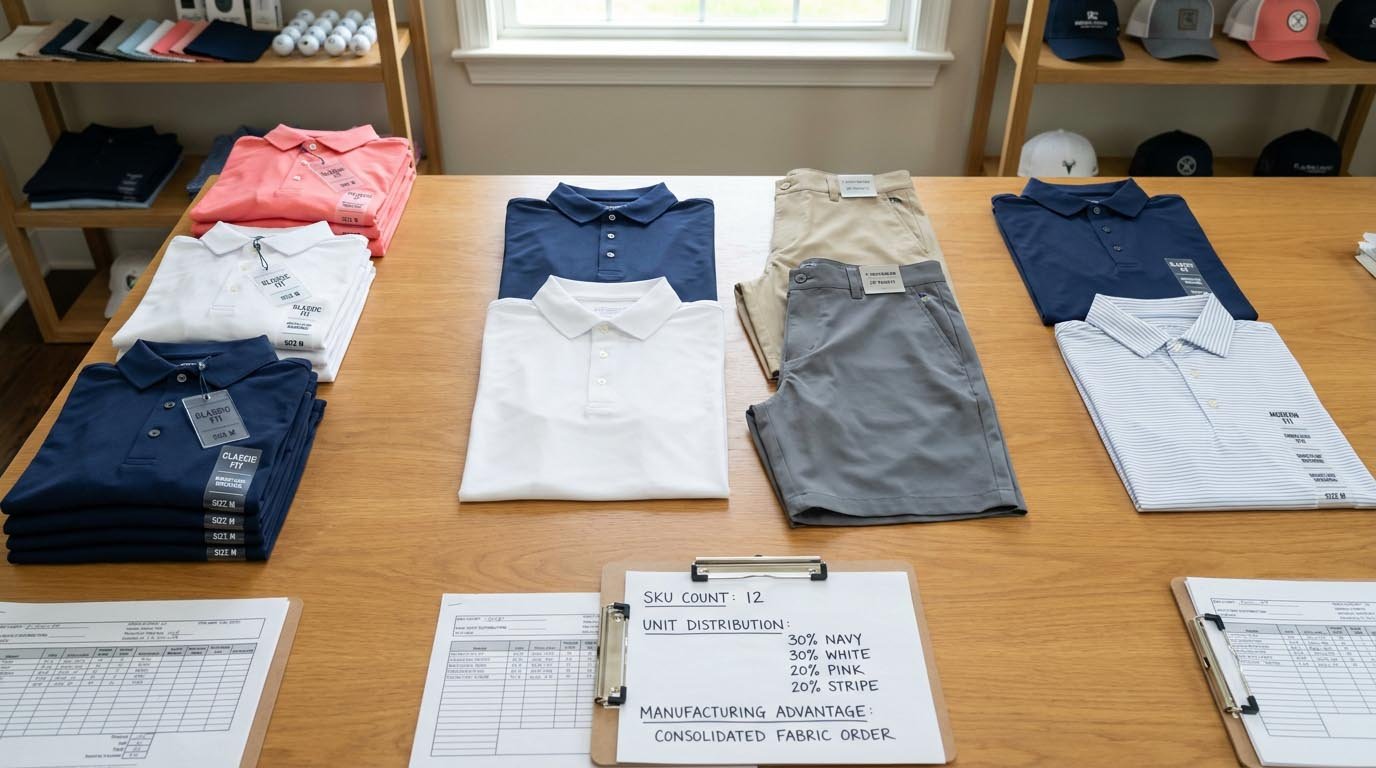
After 15 years of first orders, I've seen three launch combinations that consistently lead to second orders. All three keep SKU count low while testing customer preferences.
Combination 1: Single Polo, Three Colorways
What to order:
- 1 classic-fit polo style
- 3 colors (one neutral, one versatile, one brand accent)
- 800-1,000 total units split across colors
Why this works:
You're testing color preference and fabric performance without design variables. If the navy polo sells out but gray sits, you know customer preference for your next order.
Manufacturing advantage:
Higher quantity per style means better per-unit pricing ($12-14 vs $16-18 for scattered small batches) and consistent quality across the run.
Real example:
A brand launched with navy, white, and coral pink polos in 1,000 units total. Navy sold through in 60 days. White sold through in 90 days. Pink moved slowly but taught them their audience skews conservative. Second order: 1,500 units, mostly navy and white with forest green replacing pink. They're still operating three years later.
Combination 2: One Polo + One Performance Short
What to order:
- 1 classic polo (2 colorways, 600 units)
- 1 performance short (2 colorways, 400 units)
Why this works:
Polo and shorts are companion purchases. Customers who buy both tell you they're committed to your brand. Customers who only buy one tell you which category to double down on.
Color coordination matters:
Make sure polo and short colorways can mix-match. Don't launch navy/white polos with orange/purple shorts.
| Product | Colorways | Units Per Color | Price Point |
|---|---|---|---|
| Polo | Navy, White | 300 each | $48-55 |
| Short | Khaki, Gray | 200 each | $58-68 |
When this fails:
When brands order shorts with complicated features (too many pockets, unusual inseam length, non-standard waist sizing). Keep shorts simple in first order—elastic waistband or standard button closure, 9-inch inseam, zip pockets only.
Combination 3: Two Polo Styles Targeting Different Occasions
What to order:
- 1 classic-fit polo for traditional golf (solid colors)
- 1 modern-fit polo with subtle pattern (stripes, micro-texture)
Why this works (sometimes):
If your brand identity is about offering variety, this tests whether customers want options or consistency. But only try this if you have enough budget to order 600+ units per style.
Warning from production floor:
This is the riskiest of the three because you're introducing design variables. If one style outperforms the other by 3:1, you've tied up capital in the slower seller. I only recommend this to brands with $20,000+ first-order budgets who can absorb the learning cost.
What to Add in Phase 2?
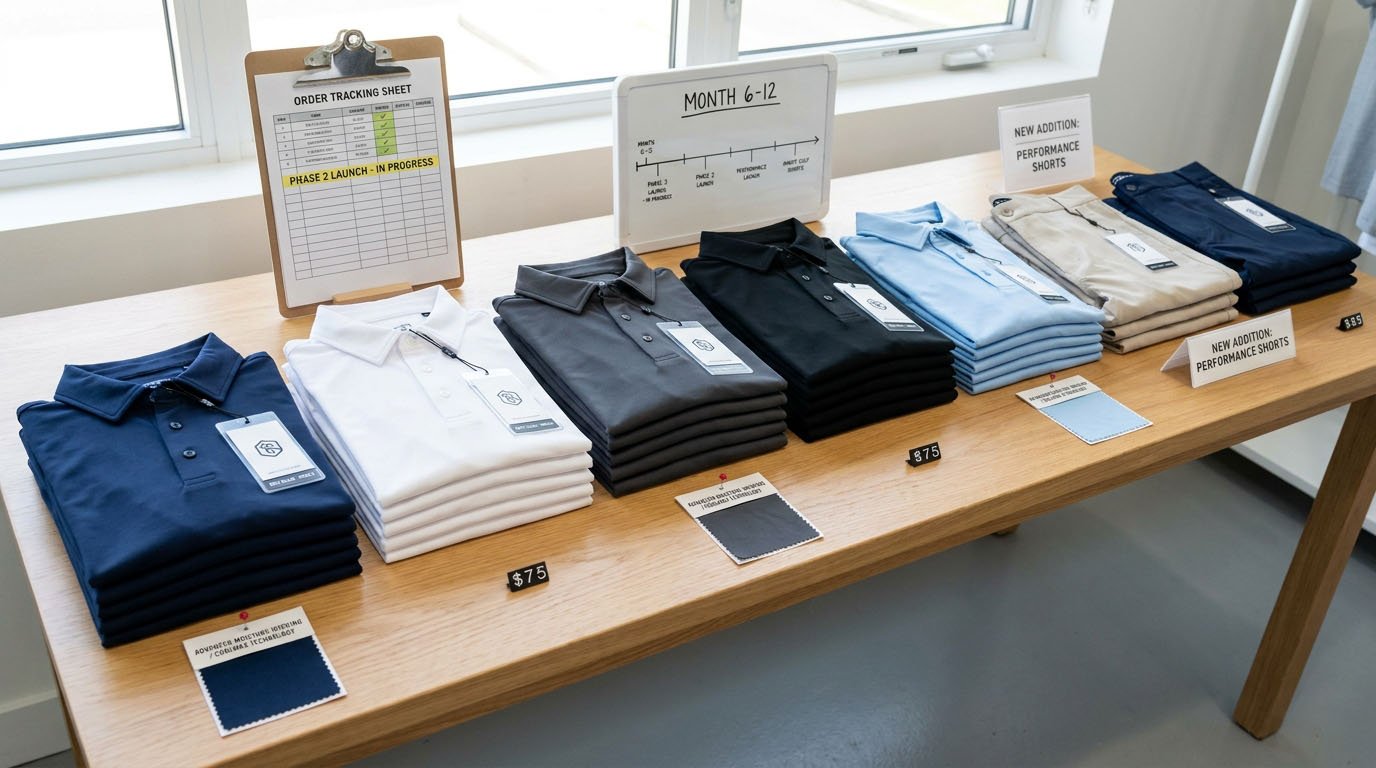
Phase 2 starts when you've reordered your first products at least once without needing promotional discounting to move inventory. Not before. Here's what our repeat clients add and in what order.
Timeline: 6-12 Months After Launch
Don't rush phase 2. I've seen brands hit reorder milestones in 4 months, then immediately expand to 10 SKUs and lose focus. Give your first products time to generate natural reorders and customer feedback.
Phase 2 Priority #1: Expand Core Winners
If your navy polo outsold everything 2:1, don't add jackets yet. Add more colors in that same winning polo style.
Typical phase 2 expansion:
- Original: Navy, white, gray (1,000 units)
- Phase 2: Add black, light blue, keep bestsellers (1,500 units across 5 colors)
This is less exciting than designing new categories, but it's how brands build reliable revenue.
Phase 2 Priority #2: Add One Complementary Category
After expanding colors, add one new category that pairs naturally with what's already selling.
If polos are your winner:
Add performance shorts or pants
If polo + shorts are both selling:
Add a lightweight layer (vest or quarter-zip)
Never add in phase 2:
- Outerwear with complex features (too much development risk)
- Accessories (hats, gloves, belts) unless you're already selling physical retail
- Winter-specific products if you launched in spring (seasonal cash flow trap)
Phase 2 Fabric Upgrade Decision
This is where mid-tier fabric strategy pays off. If customers reordered based on your first-batch fabric, you now have data proving they value performance. You can upgrade to higher-end fabrics and test if they'll pay $10-15 more per piece.
Upgrade path:
- Phase 1: Standard moisture-wicking polyester blend
- Phase 2: Branded fabric technology (Coolmax, similar performance grades)
- Test retail price increase from $48 to $58-62
If customers don't respond to the upgrade, you learned they're price-sensitive. Scale production of phase 1 fabrics instead of chasing premium.
What We See in Successful Phase 2 Orders
| Brand Type | Phase 1 Products | Phase 2 Addition | Timeline |
|---|---|---|---|
| Casual-focused | 1 polo, 3 colors | +2 colors, +1 short | 8 months |
| Performance-focused | 2 polos (solid/pattern) | +1 pant, upgrade polo fabric | 10 months |
| Retail-channel brand | 1 polo + 1 short | +1 vest, +hat line | 12 months |
The common factor: they all added 3-4 SKUs maximum in phase 2, not 10+.
Mistakes to Avoid in Your First Collection?
These aren't hypothetical mistakes—I'm listing the exact errors that led to brands never placing a second order with us.
Mistake 1: Ordering Below Minimum Viable Quantities
New brands hear "start small" and think that means 200-300 total units. That's not small—that's too small to learn anything or achieve reasonable unit costs.
What happens:
- Per-unit cost runs $18-22 due to low volume
- You're forced to retail at $65-75 to maintain margins
- Price point puts you in competition with established premium brands
- Inventory sells slowly because price doesn't match brand recognition
Better approach:
Order 800-1,000 units minimum across your first 2-3 SKUs. Yes, it's more capital risk upfront, but per-unit cost drops to $12-14, letting you retail competitively at $45-55 where new brands can actually win customers.
Mistake 2: Launching With Fabric You Haven't Worn Yourself
I can't count how many brands approve samples based on how fabric looks and feels in-hand, then get customer complaints after first wash about shrinkage, pilling, or loss of shape.
The test I tell everyone:
Order sample garments in your chosen fabric. Wear them for 2 weeks. Wash them 5 times. If you wouldn't reorder for yourself, your customers won't either.
Common fabric failures:
- Cotton-poly blends that shrink 1-2 sizes after first hot wash
- Polyester that pills after 3-4 wears (cheap yarn quality)
- Performance fabrics that lose moisture-wicking after detergent buildup
Mistake 3: Ignoring Size Run Data
New brands order even quantities across all sizes (S, M, L, XL, 2XL = 20% each). This never matches actual demand.
Standard size demand in golf apparel (our data from 100+ brands:
- Small: 10%
- Medium: 25%
- Large: 35%
- XL: 20%
- 2XL: 10%
You'll always sell out of Large and Medium first. If you order evenly, you end up with Small and 2XL inventory that needs discounting to clear.
Mistake 4: Adding "Signature Features" Too Early
A brand wanted their first polos to have contrast tipping on collar and cuffs, custom interior collar prints, and side vents with branded labels. Total cost premium: $4 per unit.
None of those features drove sales. Customers bought (or didn't buy) based on fit, fabric, and price. The brand paid extra for details that didn't move the needle.
Save design flourishes for phase 2 when you know customers are already reordering your basic product. At launch, fabric and fit matter 10 times more than style details.
Mistake 5: Not Planning for Reorder Lead Time
This one kills momentum. Brand launches, product sells faster than expected, they place reorder in month 3. But they didn't account for 60-90 day production and shipping lead time. They run out of stock for 8-10 weeks and lose all sales momentum.
How to avoid this:
When your first order is 50% sold through (not when it's 90% gone), place your reorder. This keeps inventory flowing without gaps.
Once you know your first products, the next step is connecting them to fabrics, fit, MOQ, and launch timing in how to start a golf apparel line.
Conclusion
Start with one proven polo in proven fabric, validate demand through reorders, then expand. This isn't cautious—it's the fastest way to learn what actually drives your customers to come back without burning capital on unvalidated complexity.