You found a great sample.
The fabric feels right. The collar looks clean. The logo is exactly where you wanted it.
Then bulk production arrives—and something has changed.
The collars curl. The plackets are uneven. The fabric feels lighter. The color is slightly different. Size measurements vary from piece to piece.
Sound familiar?
Sourcing golf apparel in China usually does not fail because there are too few factories. It fails because buyers choose a supplier before proving that the factory can reproduce the approved product consistently.
To find a reliable golf clothing manufacturer in China, first build a shortlist of golf-specific factories, send each supplier the same sourcing brief or tech pack, verify its actual production capabilities, compare MOQ and pricing using identical specifications, approve physical samples, and understand how the factory controls quality from sample to bulk production.
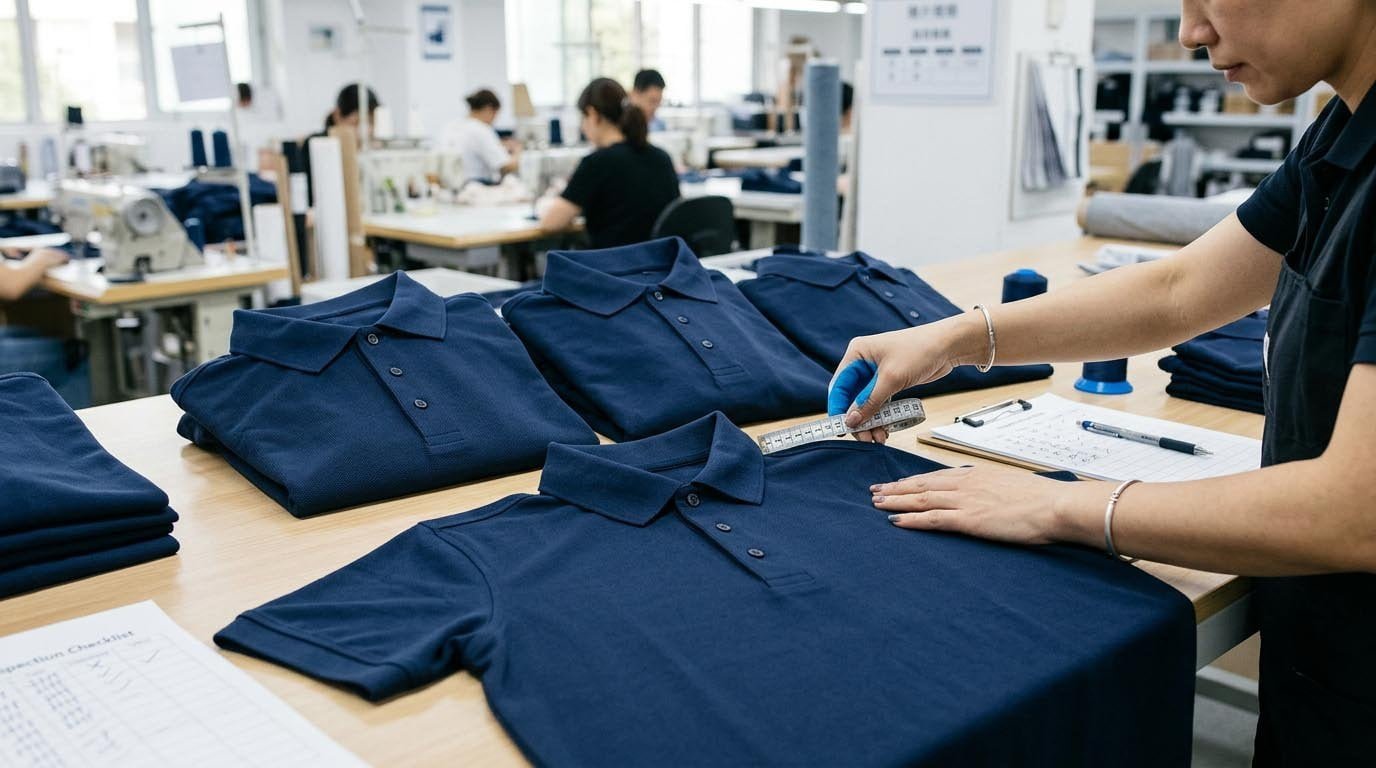
At FUWAY, we work with golf apparel manufacturing projects for startup brands, established labels, importers and wholesalers.
One lesson comes up repeatedly:
Do not choose the factory that can make one good sample. Choose the factory that can repeat that sample consistently at scale.
This guide explains how to find, shortlist, verify and compare golf clothing manufacturers in China before placing your bulk order.
Quick Answer: How Do You Find a Reliable Golf Clothing Manufacturer in China?
Use this process:
Define Product Requirements
→ Find Potential Manufacturers
→ Screen for Golf Experience
→ Send the Same Brief
→ Verify the Factory
→ Compare Quotes
→ Develop Samples
→ Check QC System
→ Approve Final Sample
→ Start a Controlled Bulk Order
| Step | What to Check | Why It Matters |
|---|---|---|
| 1. Define requirements | Product, fabric, quantity, customization | Prevents vague quotes |
| 2. Build shortlist | Golf-specific manufacturers | Filters generic factories |
| 3. Send same brief | Identical specifications | Makes quotes comparable |
| 4. Verify supplier | Factory, team, products, processes | Reduces sourcing risk |
| 5. Compare MOQ & price | Same specifications | Prevents false price comparisons |
| 6. Make samples | Fit, fabric, workmanship | Tests actual capability |
| 7. Check QC | Sample-to-bulk controls | Tests repeatability |
| 8. Approve standard | Final specifications | Creates production reference |
| 9. Start production | Controlled first order | Tests real execution |
The biggest mistake is jumping directly from:
Google / Alibaba → Quote → Deposit
There should be several verification steps in between.
Why Do Golf Brands Source Clothing From China?
China is often associated with lower manufacturing costs.
Cost matters, but focusing only on cost misses a bigger advantage:
Supply-chain depth.
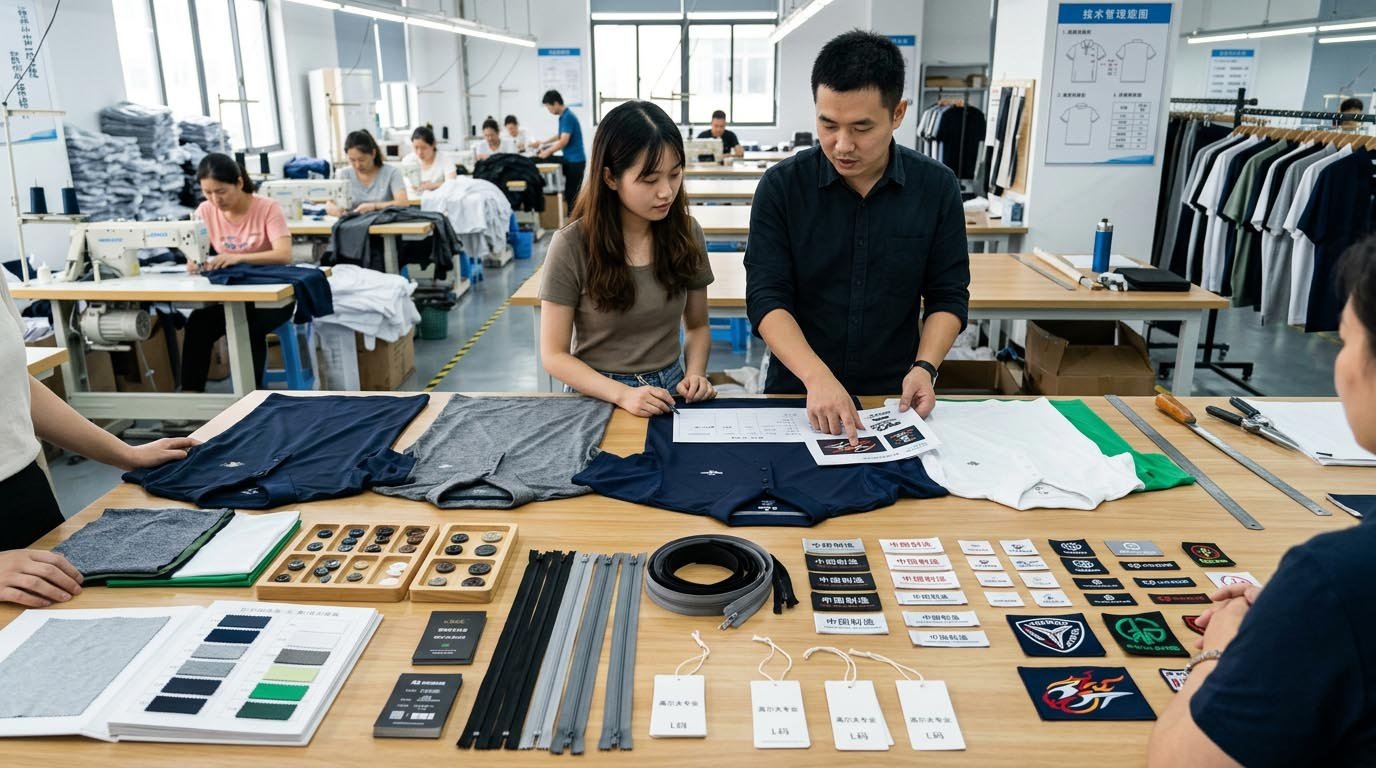
Golf apparel requires more than sewing machines.
A custom golf collection may involve:
- Moisture-wicking fabrics
- Polyester-spandex blends
- Nylon-spandex blends
- Lightweight performance knits
- Custom dyeing
- Sublimation printing
- Embroidery
- Heat-transfer logos
- Custom collars
- Buttons
- Zippers
- Woven labels
- Care labels
- Hangtags
- Packaging
When fabric mills, trim suppliers, printing facilities, embroidery suppliers and garment factories operate within an established apparel supply chain, product development can become easier to coordinate.
For brands developing technical materials rather than simply selecting a ready-made garment, the manufacturer's fabric sourcing capabilities are especially important because fabric choice can affect performance, MOQ, sampling time and final cost.
The Real Advantage Is Not Simply "Cheap"
When I evaluate a manufacturing project, I think about four things:
Can we source the right material?
Can we execute the design?
Can we reproduce it consistently?
Can we deliver it within the required timeline?
A cheap factory that fails any of those tests is not actually cheap.
But supply-chain depth does not mean every Chinese clothing factory is suitable for golf apparel.
A factory producing basic promotional T-shirts is not automatically the right factory for a performance golf polo.
That is why your next step is specialization.
Where Can You Find Golf Clothing Manufacturers in China?
There is no single best sourcing channel.
A better strategy is to build an initial shortlist from several sources and then verify the suppliers individually.

Google Search
Google is useful when you want to find manufacturers that have invested in their own websites and international marketing.
Try searches such as:
- golf clothing manufacturer China
- golf apparel manufacturer China
- golf polo manufacturer China
- custom golf shirts manufacturer
- private label golf apparel manufacturer
- OEM golf clothing manufacturer
Do not judge a supplier only by its Google position.
Use the website to investigate:
- Product specialization
- Factory information
- Customization capabilities
- Manufacturing processes
- Fabric options
- Quality control
- Test reports
- Case studies
- Contact information
A polished website is useful information.
It is not proof of manufacturing capability.
B2B Sourcing Platforms
Platforms such as Alibaba, Made-in-China and Global Sources can help you create a larger initial supplier list.
The advantage is speed.
You can compare:
- Product categories
- Claimed MOQ
- Customization options
- Export markets
- Company information
- Basic product photos
The disadvantage is that listings can make many suppliers look similar.
So treat directories as:
Discovery tools—not final verification tools.
Trade Shows
Trade shows can be useful if you want to:
- Touch fabrics
- Inspect garments
- Compare workmanship
- Meet supplier representatives
- Discuss customization
- Collect samples
But the same rule applies.
Meeting someone at a trade show does not automatically prove that the company owns or directly operates the production facility.
Verify after the show.
Industry Referrals
Fabric suppliers, trim suppliers, sourcing professionals and other apparel brands can sometimes introduce specialized manufacturers.
Referrals can reduce search time.
But do your own verification anyway.
A factory that works well for another company may not fit your:
- Product
- Quantity
- Quality level
- Communication style
- Timeline
Should You Choose a Factory or Trading Company?
This question comes up constantly when sourcing from China.
The simple answer is:
Do not assume "factory = good" and "trading company = bad."
They serve different functions.
| Factor | Direct Factory | Trading / Sourcing Company |
|---|---|---|
| Production | Usually direct | Usually outsourced |
| Technical communication | Potentially more direct | May pass through another team |
| Product range | Often narrower | Can be broader |
| Multiple categories | More limited | Often easier to coordinate |
| Production visibility | Potentially higher | Depends on transparency |
| Sourcing flexibility | Depends on factory network | Often broader |
For a highly customized golf apparel project, I care less about the label on the business card and more about these questions:
Who develops my pattern?
Who makes my sample?
Where will bulk production happen?
Who buys the fabric?
Who controls QC?
Can I verify those people and processes?
If the answers are clear, you can evaluate the supplier properly.
If the answers keep changing, investigate further.
How Do You Shortlist a Golf-Specific Manufacturer?
Generic garment factories often say:
"We can make anything."
That answer does not tell you much.
Instead, test whether they understand golf-specific construction and performance requirements.
For example, if golf polos are one of your core products, look beyond a catalog photo and investigate whether the supplier can actually handle custom golf polo manufacturing, including fabric selection, fit, collars, plackets, branding and sampling.
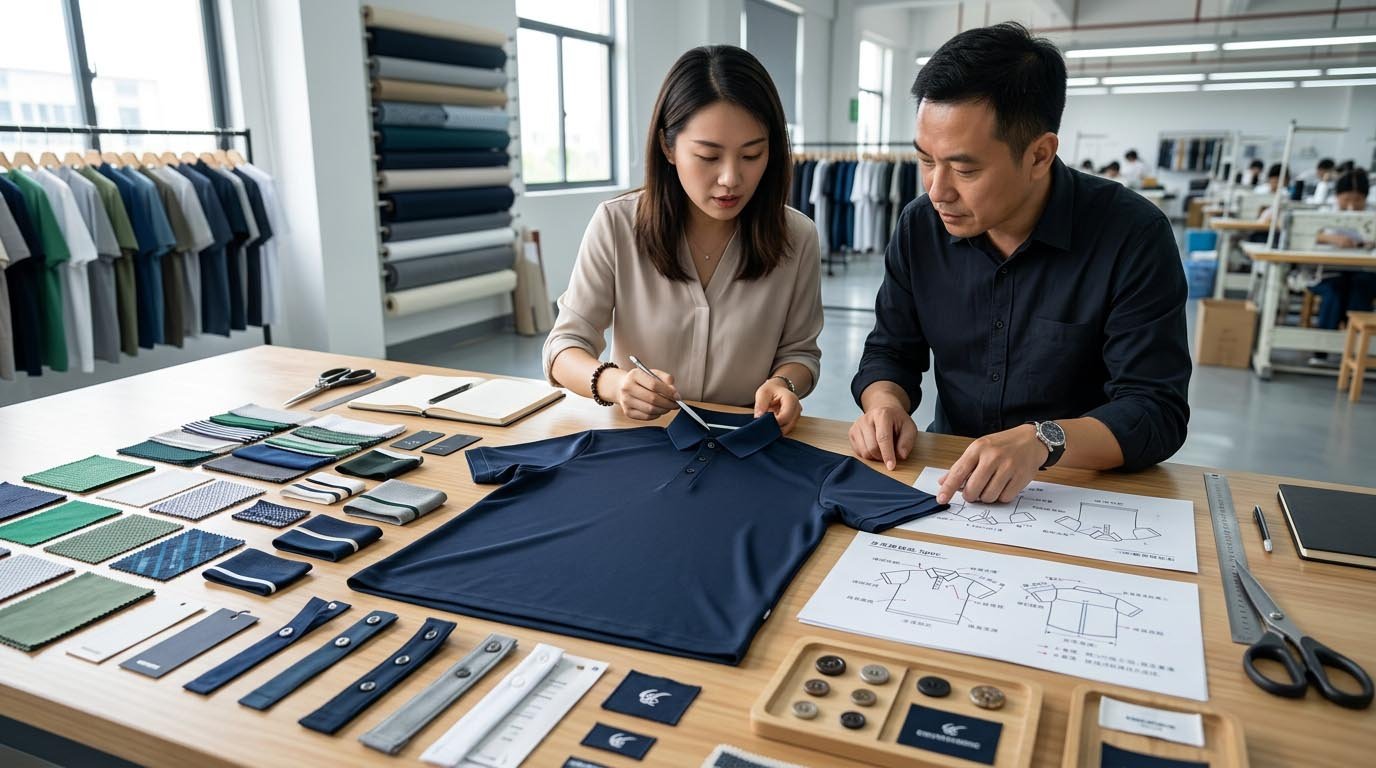
Ask Questions a Generic Factory Cannot Answer Easily
"How would you choose a moisture-wicking fabric for this polo?"
A useful answer should start with questions about:
- Target market
- Climate
- Product positioning
- Stretch
- Weight
- Hand feel
- Budget
Not simply:
"We have polyester."
"How do you keep the collar structured but comfortable?"
Listen for explanations about:
- Collar type
- Fabric
- Rib or self-fabric construction
- Interlining where appropriate
- Shrinkage
- Fit
"How do you keep the placket clean and even?"
A manufacturer should be able to explain its construction and sewing process rather than simply saying:
"Our quality is very good."
"How do you build a golf polo for movement?"
Golf is not static.
The wearer rotates, bends, reaches and swings.
The manufacturer should understand how fabric stretch, pattern, sleeve construction and fit influence movement.
Compare Golf Specialist vs Generic Garment Supplier
| Area | Generic Answer | More Useful Golf-Specific Answer |
|---|---|---|
| Fabric | "Polyester" | Composition, weight, stretch, knit, performance |
| Collar | "Polo collar" | Collar construction and shape retention |
| Fit | "Regular fit" | Chest, shoulder, sleeve and movement |
| "We can print" | Method matched to fabric and artwork | |
| QC | "We inspect everything" | Specific checkpoints from material to packing |
You are not testing whether the salesperson knows impressive vocabulary.
You are testing whether the team understands your product.
Send Every Manufacturer the Same Sourcing Brief
This is one of the simplest ways to improve your sourcing process.
A common mistake is sending:
"Hi, I need 500 custom golf polos. Please quote."
to ten factories.
Each supplier then makes different assumptions.
One assumes basic polyester.
Another assumes poly-spandex.
One includes embroidery.
Another does not.
One quotes standard packaging.
Another includes custom labels.
You receive ten prices—but you are comparing ten different products.
Build One Standardized Brief
At minimum, include:
| Brief Item | What to Specify |
|---|---|
| Product | Polo, pants, skort, quarter-zip, etc. |
| Fabric | Composition/performance if known |
| Fit | Regular, athletic, relaxed |
| Colors | Number of colorways |
| Branding | Embroidery, print, labels |
| Quantity | Per style/color |
| Sizes | Required size range |
| Packaging | Standard/custom |
| Timeline | Required delivery date |
| Destination | Country/region |
Send the same document to every shortlisted supplier.
Now the answers become much easier to compare.
Should You Send a Tech Pack Before Requesting a Quote?
If your product is already developed, yes.
A proper tech pack reduces assumptions.
For more complex projects, it can also reveal whether the supplier actually understands technical product development.
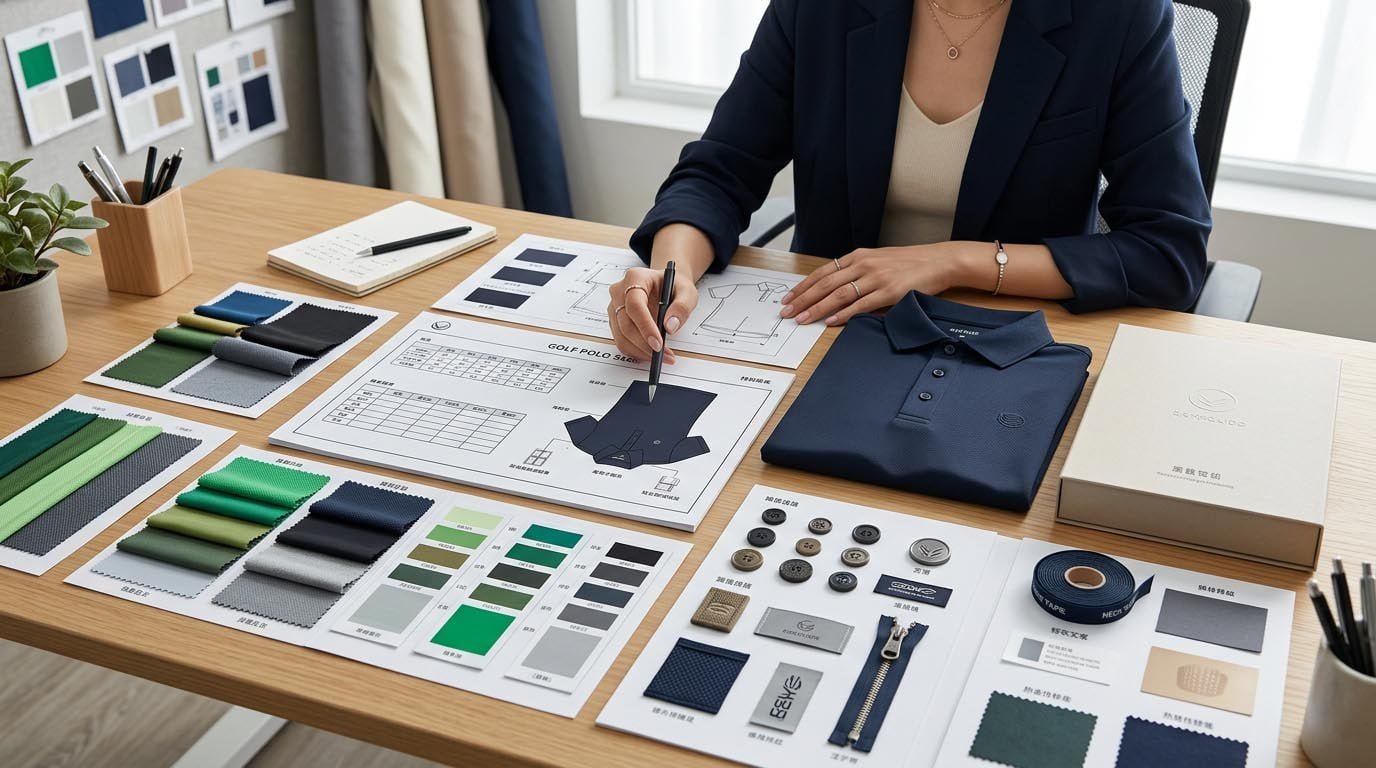
A Useful Golf Apparel Tech Pack Can Include
1. CAD / Technical Drawings
Front, back and relevant construction details.
2. Measurement Chart
Include your Points of Measure and size grading.
3. Fabric Specification
For example:
- Fiber composition
- Target GSM
- Knit construction
- Stretch/performance requirements
If you have not finalized these details yet, discuss performance fabric sourcing with the manufacturer before locking the tech pack.
4. Color Information
Provide Pantone or other appropriate color references where necessary.
5. Bill of Materials
List relevant:
- Buttons
- Zippers
- Threads
- Labels
- Interlinings
- Trims
6. Branding
Specify:
- Logo size
- Position
- Embroidery
- Heat transfer
- Sublimation
- Screen printing
7. Packaging
Specify:
- Hangtags
- Polybags
- Barcodes
- Carton requirements
For brands that need custom neck labels, care labels, hangtags and branded packaging as part of the order, it is also worth checking whether the supplier offers a complete private label golf apparel service rather than only garment sewing.
The goal is not to make your tech pack unnecessarily complicated.
The goal is to remove ambiguity.
How Do You Verify a Golf Clothing Factory in China?
Never verify a manufacturer using only one source.
Use multiple pieces of evidence.
10 Things to Verify Before Paying a Deposit
1. Company Information
Confirm the legal company information used for quotation, contract and payment.
2. Factory Location
Ask where sampling and bulk production actually happen.
3. Live Factory Video
If you cannot visit, ask for a live video call.
A live walkthrough can be more useful than a collection of polished photos.
4. Golf Products
Ask to see golf garments currently being sampled or produced where possible.
5. Sample Room
Understand who develops patterns and samples.
6. Fabric Sourcing
Ask how they source performance fabrics and what happens when you need a custom material.
7. Printing and Embroidery
Ask which processes are handled internally and which are handled by partner facilities.
If embroidery is important to your collection, investigate the supplier's golf polo embroidery capabilities rather than simply accepting "embroidery available" on a quotation.
Likewise, for printed designs, the production method matters. A supplier should be able to explain when screen printing is appropriate and when sublimation printing makes more sense for the fabric and artwork.
8. Quality Control
Ask what is checked:
before cutting → during sewing → before packing.
Where available, supporting documents such as fabric and garment test reports can provide another layer of evidence when evaluating material and product quality.
9. Export Experience
Ask about:
- Packing
- Documentation
- Shipping coordination
- Your target market
10. Third-Party Inspection
Ask whether independent inspection can be arranged before shipment if required.
One individual answer does not prove a factory is reliable.
You are looking for consistency across all ten.
How Should You Compare MOQ, Price and Lead Time?
Do not evaluate these three separately.
They are connected.
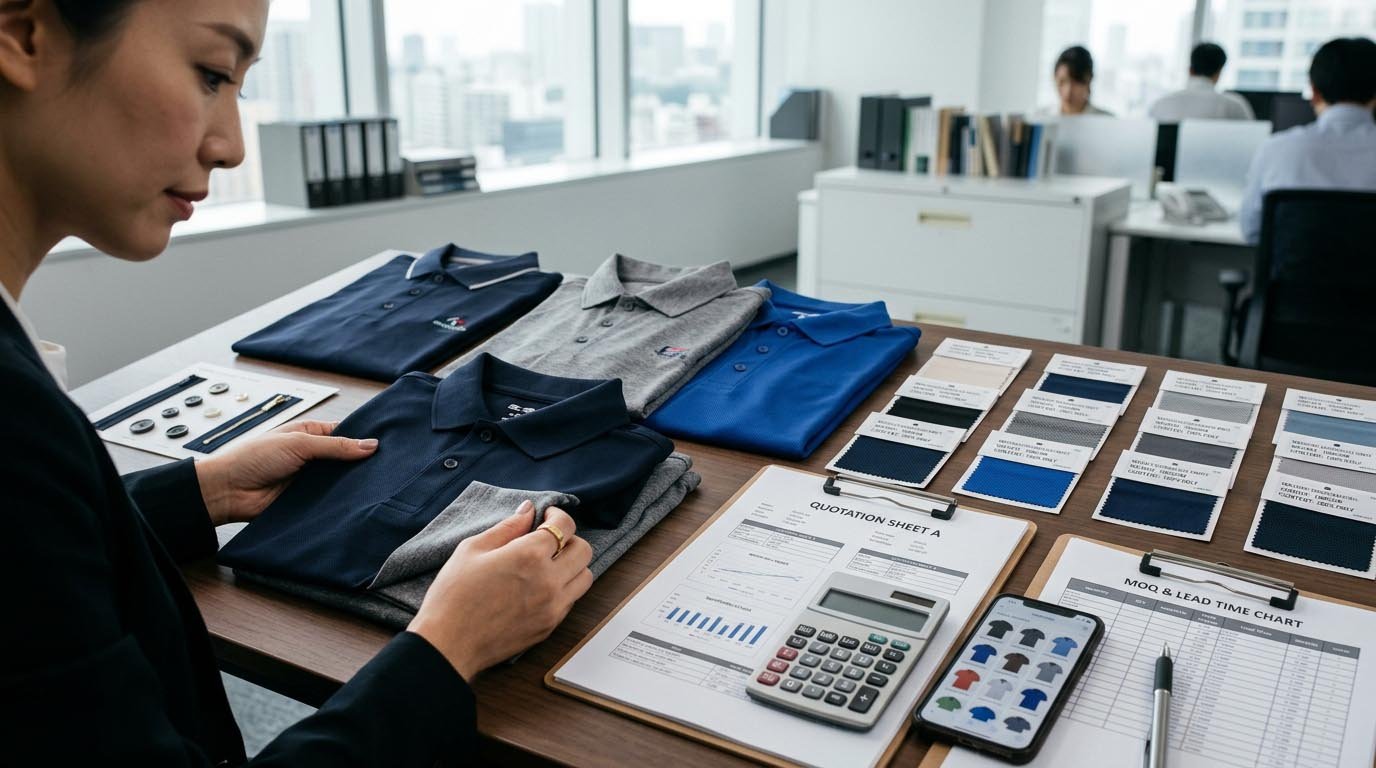
MOQ Depends on More Than Sewing
At FUWAY, 100 pieces per style is a common MOQ, while some projects using available fabrics and relatively standard trims may be workable around 50–100 pieces per style.
But this does not mean every custom product can be made at the same MOQ.
A factory may be able to sew 50 polos.
The fabric mill may not be willing to custom-dye fabric for 50 polos.
That is the difference.
Stock Fabric vs Custom Fabric
Stock Fabric
Can often support:
- Lower MOQ
- Faster sourcing
- Faster sampling
- Lower development risk
But you may have fewer choices in:
- Exact color
- Composition
- Texture
- Finish
Custom Fabric
Gives you more control over the product.
But custom:
- Dyeing
- Knitting
- Finishes
- Textures
- Compositions
can create higher raw-material minimums and longer lead times.
Why a Low Quote Can Cost More
A buyer once showed me a quotation that was significantly lower than ours.
Instead of immediately matching the price, I asked:
What fabric is included?
The other quotation used a lighter, cheaper knit than the original requirement.
The price was not really lower.
The product was different.
This is why every quote should be checked against:
- Same fabric?
- Same GSM?
- Same construction?
- Same logo method?
- Same trims?
- Same packaging?
- Same quantity?
- Same quality expectations?
Only then are you comparing price.
How Do You Compare Several Chinese Golf Apparel Suppliers Fairly?
Create a comparison sheet.
Do not allow price to become the only column.
| Evaluation Area | Supplier A | Supplier B | Supplier C |
|---|---|---|---|
| Golf apparel experience | |||
| Fabric sourcing | |||
| Tech pack understanding | |||
| Sample quality | |||
| MOQ suitability | |||
| Quote clarity | |||
| Communication | |||
| QC process | |||
| Factory verification | |||
| Bulk capability | |||
| Export experience |
You do not need a complicated mathematical score.
The purpose is to force yourself to compare the suppliers across the same criteria.
A slightly higher quotation may make sense if another supplier clearly performs better in areas that matter to your brand.
Equally, a higher price does not automatically mean better quality.
Verify the reason behind the difference.
Why Should You Never Approve a Manufacturer Based on One Good Sample?
This is one of the biggest sourcing traps.
A beautiful sample proves:
The supplier can make one beautiful sample.
It does not automatically prove:
The supplier can make 500, 1,000 or 5,000 pieces consistently.
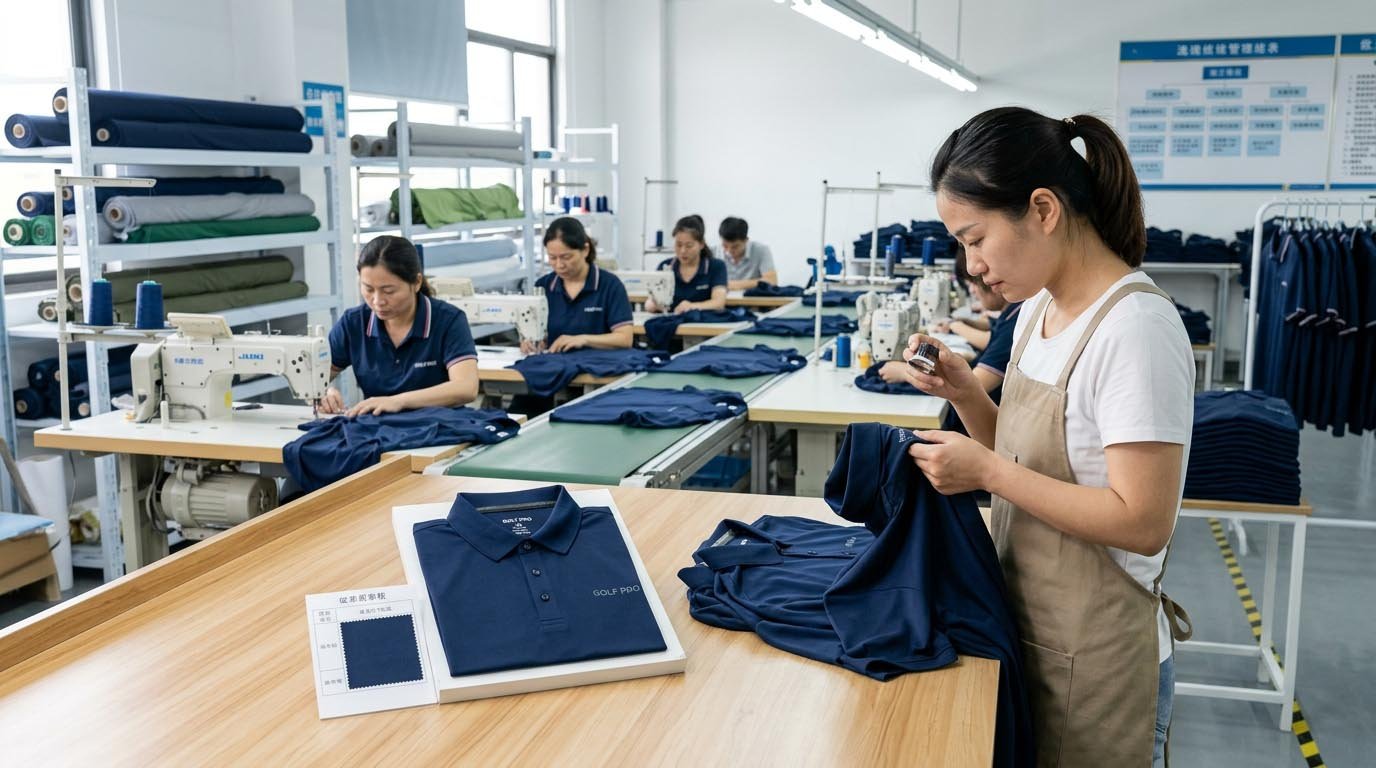
Bulk production introduces new variables:
- Larger fabric lots
- More cutting
- Multiple sewing operators
- Larger print runs
- More embroidery
- More sizes
- More QC checkpoints
- Packing at scale
So ask:
How Is the Approved Fabric Locked?
Will bulk use the same approved material specification?
Is the Approved Sample Kept as a Reference?
The factory should have a clear production standard.
What Happens During Production?
Does QC happen only when garments are finished?
Or are problems identified while production is still running?
This is why sample approval should be treated as the beginning of production control, not the end of supplier verification.
What Is a Pre-Production Sample and Why Does It Matter?
For more customized projects, a Pre-Production or PP sample can provide a final reference before bulk manufacturing.
Ideally, the final approved sample reflects the intended:
- Fabric
- Color
- Measurements
- Fit
- Collar
- Placket
- Logo
- Embroidery
- Labels
- Trims
- Packaging details
Once these specifications are approved, unnecessary changes should be avoided.
Why?
Because a late change can affect:
- Fabric purchasing
- Artwork
- Patterns
- Cutting
- Printing
- Sewing
- Production schedule
The closer you are to bulk production, the more expensive changes become.
How Should a Golf Clothing Manufacturer Control Bulk Quality?
A useful QC system does not begin after production is finished.
It follows the product through manufacturing.
A practical workflow can include:
| Stage | What to Check |
|---|---|
| Incoming material | Fabric, color, trims |
| Pre-production | Approved sample/specifications |
| Cutting | Pattern and size accuracy |
| Printing / embroidery | Color, position, appearance |
| Sewing | Construction and workmanship |
| In-line inspection | Consistency during production |
| Final inspection | Measurements, workmanship, appearance |
| Packing | Labels, quantity, packaging |
For a golf polo, specific checks can include:
- Collar shape
- Placket alignment
- Chest measurement
- Body length
- Sleeve measurement
- Stitching
- Logo position
- Print appearance
- Color consistency
- Buttons
- Labels
- Loose threads
- Packaging
Ask potential suppliers to explain their process in their own words.
A detailed answer tells you much more than:
"We have strict QC."
If quality verification is important to your sourcing decision, ask the manufacturer to provide relevant documentation where applicable rather than relying only on verbal claims. You can also review FUWAY's available test reports as part of evaluating our manufacturing and material quality documentation.
What Red Flags Should You Watch for When Sourcing Golf Apparel in China?
No single warning sign proves a supplier is unreliable.
But several warning signs together should make you investigate further.
Red Flag 1: "Yes" to Everything
You ask for:
- Low MOQ
- Custom fabric
- Custom color
- Complex trims
- Very low price
- Very fast delivery
and the answer to everything is immediately:
"No problem."
A strong supplier should also tell you what is difficult.
Red Flag 2: They Cannot Explain the Quote
Ask:
Why is this fabric more expensive?
Why does this color increase MOQ?
Why does this design need more sampling time?
If the answers remain vague, investigate.
Red Flag 3: They Avoid Showing Production
Not every factory can reveal customer products.
That is reasonable.
But persistent avoidance of:
- Factory information
- Production processes
- Live video
- Sample room
- QC procedures
deserves further checking.
Red Flag 4: The Sample and Bulk Process Are Unclear
Ask:
What happens after I approve the sample?
If nobody can clearly explain the next steps, that is a problem.
Red Flag 5: Price Keeps Changing Without Specification Changes
A price can legitimately change when:
- Quantity changes
- Fabric changes
- Artwork changes
- Trims change
- Packaging changes
But unexplained changes should be questioned.
What Common Mistakes Do Brands Make When Finding a Manufacturer in China?
Most sourcing problems come from a few repeated habits.
Mistake 1: Choosing the Cheapest Quote
Compare specifications first.
Mistake 2: Sending Vague Inquiries
Vague input creates vague quotations.
Mistake 3: Using Different Specifications With Every Supplier
You cannot compare quotations fairly.
Mistake 4: Trusting One Perfect Sample
Test sample-to-bulk controls.
Mistake 5: Trusting Certificates or Photos Alone
Documents and photos are useful evidence.
They are not the whole verification process.
Mistake 6: Ignoring Golf-Specific Experience
A general garment factory may be capable of making a polo, but that does not mean it is the right partner for your product.
Mistake 7: Focusing on MOQ Without Understanding Materials
The garment factory is only one part of the MOQ equation.
Mistake 8: Paying Before Understanding the Production Process
Know what happens after the deposit.
What Should You Send a Golf Clothing Manufacturer Before Requesting a Quote?
You do not need to have everything perfect.
But better input produces better quotations.
Basic RFQ Checklist
Send:
- Product type
- Reference photos or technical drawings
- Tech pack if available
- Fabric preference
- Target composition
- Target GSM if known
- Colors
- Logo / artwork
- Branding method
- Quantity per style
- Quantity per color
- Size range
- Labels
- Packaging requirements
- Target delivery date
- Destination country
Then ask the supplier to confirm:
- MOQ
- Sample process
- Sample lead time
- Fabric options
- Customization limitations
- Bulk lead time
- Payment terms
- Shipping terms
This gives you a much stronger starting point than simply asking:
"How much for 500 polos?"
If you already have a tech pack, reference sample or sourcing brief and want FUWAY to evaluate the project, you can contact our team and send the basic specifications for review.
Final Supplier Verification Checklist
Before committing to bulk production, ask yourself:
| Question | Yes / No |
|---|---|
| Have I confirmed the supplier understands golf apparel? | |
| Did every shortlisted supplier receive the same brief? | |
| Am I comparing the same fabric and construction? | |
| Do I understand the MOQ? | |
| Do I know who makes the sample? | |
| Do I know where bulk production happens? | |
| Have I verified the factory or production partner? | |
| Have I reviewed a physical sample? | |
| Do I understand the QC process? | |
| Is there an approved production reference? | |
| Do I understand the bulk lead time? | |
| Do I understand packaging and shipping responsibilities? |
If several answers are still "No," you probably need more information before paying the bulk-production deposit.
FAQ: Finding a Golf Clothing Manufacturer in China
What is the MOQ for a golf clothing manufacturer in China?
There is no universal MOQ. It depends on fabric, colors, trims, customization and supplier. At FUWAY, 100 pieces per style is a common MOQ, while some projects using available fabrics and relatively standard components may be workable around 50–100 pieces per style. More customized materials can require higher quantities.
How long does golf apparel sampling take in China?
It depends on design complexity and material availability. At FUWAY, sample development is typically around 7–10 business days once the key product details and materials are confirmed.
How long does bulk golf clothing production take?
FUWAY's typical bulk production time is around 3–4 weeks after final approval, depending on the order, material availability and customization.
Should I choose a factory instead of a trading company?
Not automatically. A direct factory can provide greater production visibility, while a sourcing or trading company may offer broader product coordination. Verify who actually develops, manufactures and inspects your products rather than relying only on the company label.
How can I verify a Chinese golf clothing manufacturer without visiting China?
Ask for company information, a live factory video, sample-room information, examples of relevant production, explanations of the QC process and details about where your order will be made. Independent inspection can also be considered before shipment.
Should I use Alibaba to find a golf apparel manufacturer?
B2B platforms can be useful for discovering potential suppliers. However, a marketplace listing should be the beginning of your verification process rather than the end.
How do I compare quotes from different golf apparel manufacturers?
Send every supplier the same brief or tech pack. Then compare the same fabric, GSM, construction, branding, trims, packaging, quantity and delivery requirements. Otherwise, the lowest quote may simply represent a different product.
How do I know whether a manufacturer can handle bulk production?
Ask how the supplier controls materials and workmanship from approved sample through cutting, sewing, branding, final inspection and packing. A strong sample is useful, but repeatability during bulk production matters more.
Final Takeaway: Don't Find the Cheapest Factory—Find the Right Manufacturing Fit
Finding a golf clothing manufacturer in China is not about collecting the largest possible supplier list.
And it is not about finding the lowest number on a quotation.
The process should look like this:
Find
→ Shortlist
→ Standardize
→ Verify
→ Compare
→ Sample
→ Approve
→ Control Bulk Quality
The right supplier for your brand should understand your product, explain the manufacturing process clearly, identify potential problems before production, and show how an approved sample will be reproduced consistently at scale.
At FUWAY, we work with golf brands, importers, wholesalers and growing e-commerce businesses on OEM/ODM golf apparel manufacturing.
Our services include:
- Custom golf polo manufacturing
- Fabric sourcing
- Pattern development
- Sampling
- Sublimation printing
- Embroidery
- Screen printing
- Heat transfer
- Private label manufacturing
- Custom packaging
- Bulk production
- Quality control
If you are currently comparing golf clothing manufacturers in China, send us your tech pack, reference product, artwork or sourcing brief.
We can review the project and help you clarify:
- Suitable fabric options
- MOQ
- Customization
- Sampling
- Production requirements
- Lead time