Most first-time importers focus on one number: the per-kilogram freight rate.
That's a mistake. The rate won't matter if your shipment sits in customs for two weeks—or arrives with $800 in unexpected fees.
Here's what actually determines your total shipping cost, timeline, and risk.
The best way to ship golf apparel from China to the USA is to compare express courier, air freight, and ocean freight using your actual shipment weight, carton volume, delivery deadline, and total landed cost. Small, urgent shipments often suit express services, while larger planned orders may benefit from air or ocean freight.
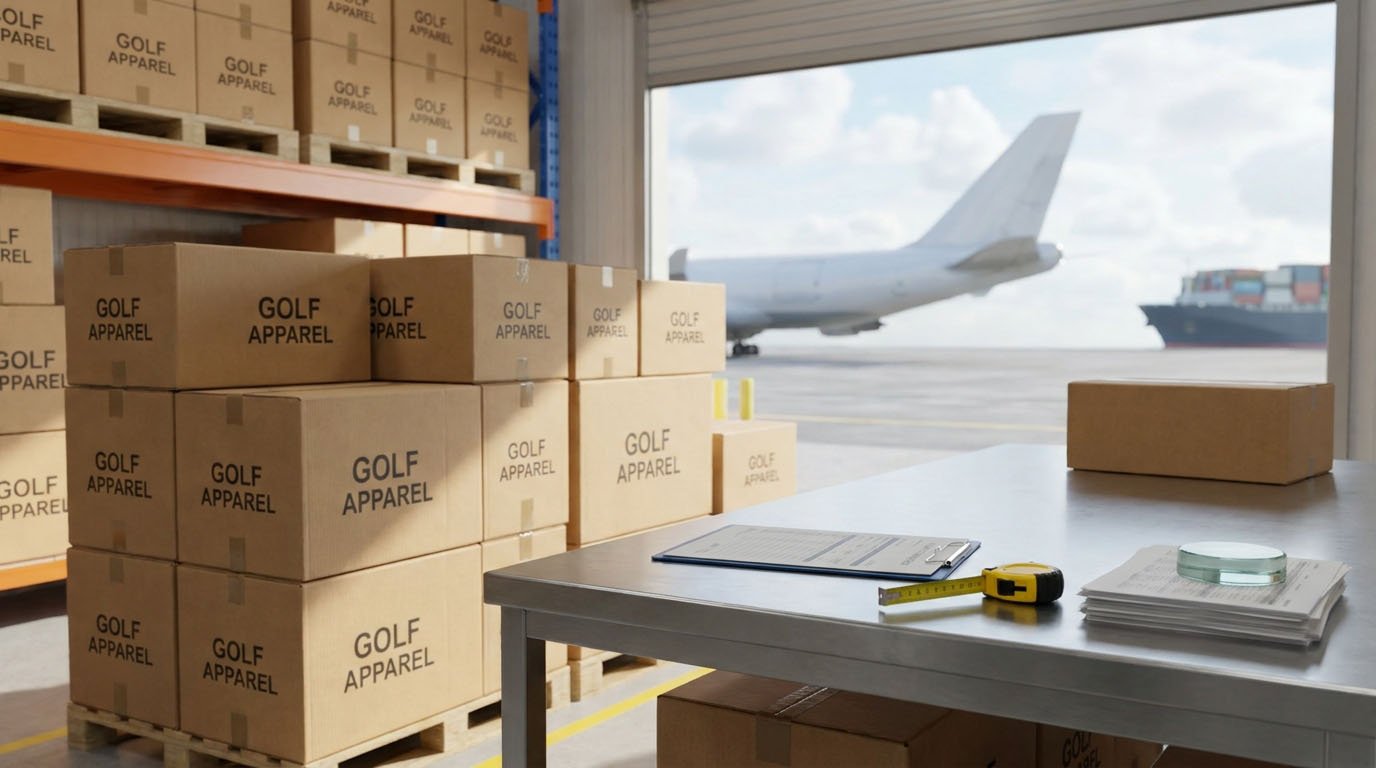
For golf clothing brands, pro shops, and apparel wholesalers, the goal is to receive the correct products on time without unexpected logistics costs.
At FUWAY, we manufacture custom golf polos, pants, shorts, and outerwear for international brands. This guide explains the factory-to-warehouse shipping process, including the information buyers should prepare before booking freight.
Quick Answer: What Is the Best Shipping Method for Golf Apparel?
The right shipping method depends on your shipment size, required delivery date, and cost tolerance. No single option is the cheapest or most suitable for every order.
| Shipping Method | Best For | Key Advantage | Watch Out For |
|---|---|---|---|
| Express Courier | Samples, size sets, urgent small orders | Fastest door-to-door with simple tracking | Gets expensive fast above roughly 50 units |
| Air Freight | Time-sensitive commercial orders | Faster international transit than ocean freight | Higher freight cost than ocean; confirm if door-to-door or airport-to-airport |
| Ocean LCL | Bulk orders that do not fill a container | Shared container capacity; pay only for your volume | Consolidation, handling fees, and longer timelines |
| Ocean FCL | Larger shipments with sufficient container volume | Dedicated container; potentially efficient unit cost | Requires adequate volume and advance planning |
Before choosing a method, obtain the final packed weight, carton dimensions, destination ZIP code, and a clear quote showing the services included.
For most buyers, the lowest freight quotation is not necessarily the lowest delivered cost.
Step 1: Prepare Your Golf Apparel Shipment Details
A freight forwarder cannot prepare a reliable quotation using garment quantity alone.
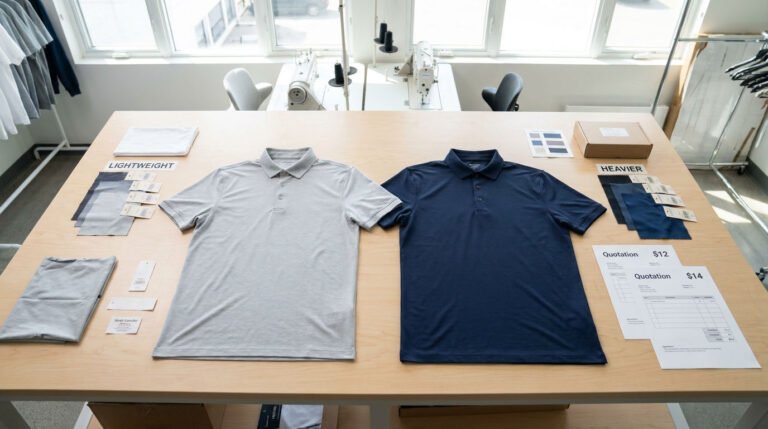
For example, 500 lightweight golf polos may occupy considerably less carton space than 500 fleece-lined golf hoodies. Even when both shipments contain the same number of garments, their transportation charges may differ.
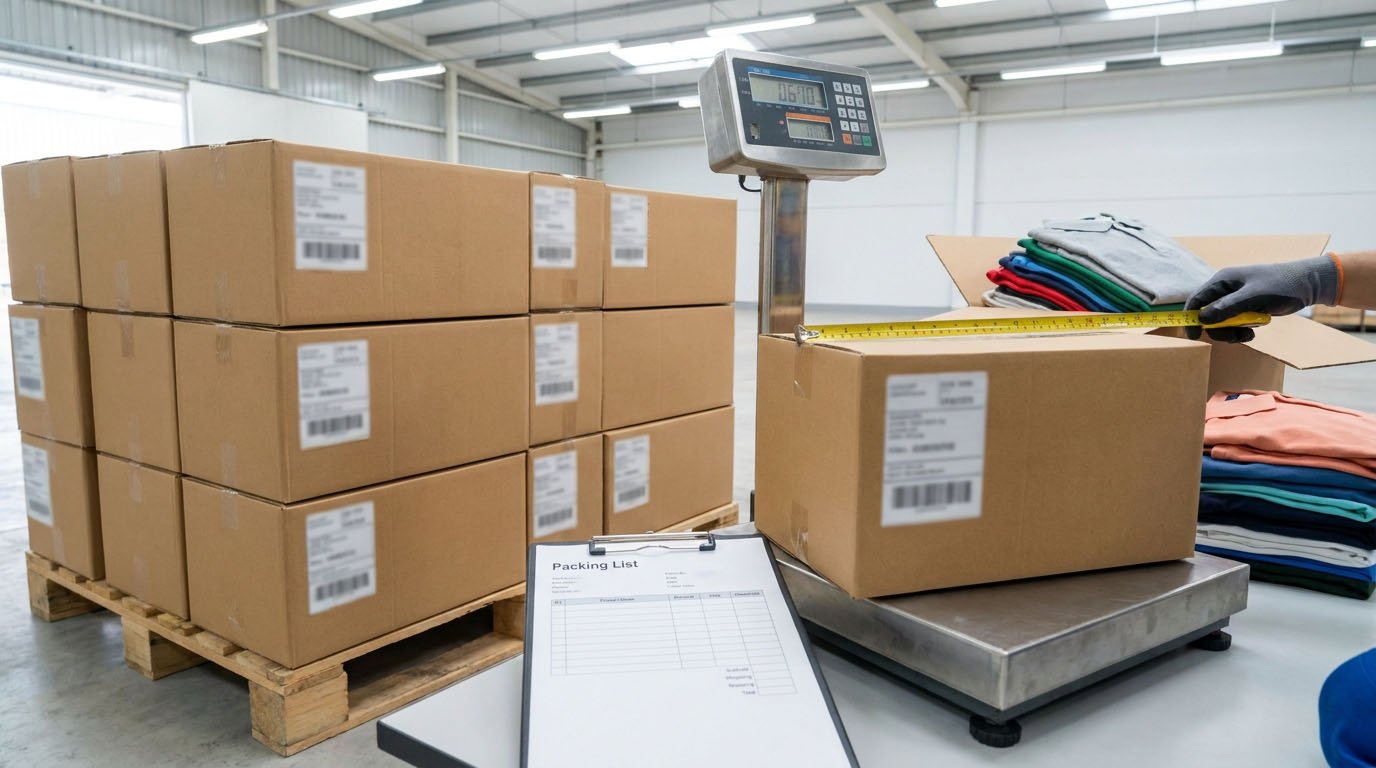
What Information Does a Freight Forwarder Need?
Prepare the following information before requesting a quotation:
| Shipment Information | Why It Matters | Common Mistake |
|---|---|---|
| Product description | Identifies the garments being shipped | Using vague terms like "clothing" instead of "men's knitted golf polo" |
| Total quantity | Confirms the order size and packing requirements | Counting units without confirming carton capacity |
| Number of cartons | Helps plan handling and transportation | Assuming carton count without checking actual packed count |
| Carton dimensions | Determines shipment volume and dimensional weight | Using estimates instead of actual packed measurements |
| Total gross weight | Used for freight calculations | Rounding down to save cost—can trigger inspection |
| Fabric composition | Supports customs classification | Writing "polyester" instead of exact blend percentages |
| Delivery address and ZIP code | Determines destination transportation requirements | Providing only city/state without ZIP code |
| Required delivery date | Helps select the appropriate shipping service | Stating "ASAP" without a calendar date |
| Incoterms and service scope | Clarifies responsibilities and quotation coverage | Requesting quotes without specifying who handles which steps |
For mixed orders containing golf polos, shorts, and jackets, prepare a packing list that identifies quantities by style, SKU, color, and size.
Why Carton Dimensions Matter
Air and express carriers commonly use chargeable weight rather than garment weight alone.
Chargeable weight is generally the greater of actual gross weight and calculated volumetric weight.
A common volumetric calculation is:
Volumetric Weight (kg) = Length × Width × Height (cm) ÷ Divisor
The divisor depends on the carrier and service. Common examples include 5,000 and 6,000, but buyers must confirm the applicable formula with their logistics provider.
Example: A carton measuring 50 × 40 × 30 cm with actual weight of 8 kg.
- Volumetric weight (÷5000): 50 × 40 × 30 ÷ 5000 = 12 kg
- → Chargeable weight = 12 kg (higher than actual)
That's a 50% increase. Now multiply that across 15 cartons—suddenly you're paying freight on 180 kg, not 120 kg.
For ocean LCL shipments, freight pricing commonly considers cargo volume in cubic meters (CBM), with weight-related minimums or pricing rules depending on the quotation.
This is why reducing unnecessary empty space in export cartons can sometimes lower transportation costs.
However, packaging must still protect collars, embroidery, printed logos, and other garment details.
What Should the Factory Check Before Dispatch?
Before handing over the cargo, confirm that:
- Actual packed quantities match the approved order.
- Carton counts and weights match the packing list.
- Each carton has the required shipment identification.
- Garments are packed according to approved customer requirements.
- The freight forwarder has received the shipment details.
For direct-to-warehouse shipments, also confirm whether the destination requires delivery appointments, pallet specifications, or other receiving instructions.
Step 2: Compare Express, Air Freight, and Ocean Freight
The fastest shipping method is not always the most economical. The most suitable option depends on shipment volume, urgency, and the consequences of receiving inventory late.
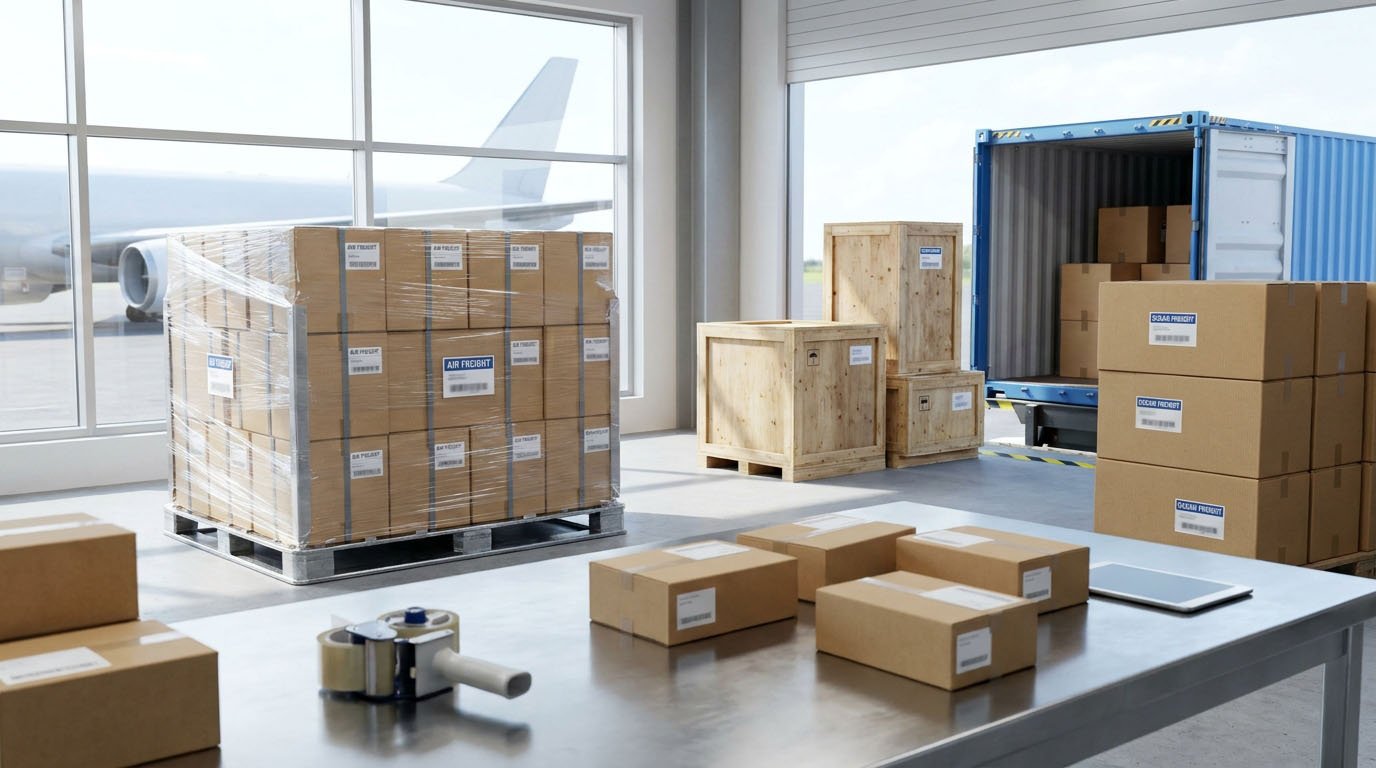
Express Courier: Best for Samples and Urgent Small Orders
International express providers such as DHL, FedEx, and UPS are commonly used for smaller shipments.
Express services are useful when:
- Sending development or approval samples.
- Delivering size sets to a buyer.
- Shipping a small urgent replenishment order.
- Providing products for time-sensitive evaluation.
These services usually offer integrated transportation and tracking, although import clearance, duties, and additional charges still depend on the shipment and service agreement.
Should you ship samples and bulk production together? Generally, no. Samples often ship via express courier while bulk production moves by air or ocean. Shipping them together means paying express rates for bulk volume—or waiting for ocean timelines for urgently needed samples. Plan sample shipments separately and budget for express costs as part of your development timeline.
For larger commercial orders, express shipping can become expensive because of chargeable weight.
Air Freight: Best for Time-Sensitive Bulk Orders
Air freight is worth considering when a brand has a fixed launch date or needs inventory sooner than ocean freight can reasonably deliver.
Examples include:
- Seasonal golf collections.
- Tournament apparel with confirmed event dates.
- Urgent replenishment of popular sizes.
- Initial retail orders with tight delivery windows.
Air cargo may be quoted airport-to-airport or with additional door-to-door services.
Buyers should confirm whether pickup, customs clearance, destination handling, and final delivery are included.
Ocean Freight: Best for Planned Bulk Inventory
Ocean freight is commonly used for shipments with sufficient lead time.
There are two primary options:
LCL (Less than Container Load)
Your cartons share container space with shipments from other exporters. This can be suitable when your goods do not justify an entire container.
However, LCL may involve consolidation, deconsolidation, and destination handling fees.
FCL (Full Container Load)
Your shipment uses a dedicated container. FCL can be cost-effective for larger shipments, depending on the volume, route, equipment availability, and all-in freight quotation.
FCL is not automatically cheaper simply because the order contains thousands of garments.
The actual shipment volume and complete freight charges determine the better option.
How Should Brands Choose?
Use these questions:
- When must the garments arrive at the destination warehouse?
- How many cartons and how much volume will the order occupy?
- What is the total delivered cost for each available method?
- How much delay can the business tolerate?
- Would shipping part of the order earlier reduce stockout risk?
A split shipment—sending urgent inventory by air and the remaining inventory by ocean—may be appropriate in some situations.
However, it should be chosen only after comparing the additional handling and transportation costs. It is not automatically the most economical strategy.
Step 3: Understand Incoterms and Shipping Responsibilities
One important decision when importing golf apparel is determining who arranges transportation, who pays particular charges, and when transportation risk transfers.
These responsibilities should be agreed upon before the shipment is dispatched.
FOB, FCA, DAP, and DDP Explained
Incoterms define delivery obligations, cost allocation, and risk transfer between sellers and buyers. They do not, by themselves, determine ownership transfer or every contractual payment obligation.
| Incoterm | Seller's Main Responsibility | Buyer's Main Responsibility |
|---|---|---|
| FCA – Free Carrier | Deliver goods to the carrier at the named place, with export clearance where applicable | Arrange subsequent transportation and import clearance |
| FOB – Free on Board | Deliver goods on board the vessel at the named port of shipment | Arrange and pay for main carriage, import clearance, and subsequent delivery |
| DAP – Delivered at Place | Arrange transportation to the named destination, ready for unloading | Handle import clearance, duties, and applicable taxes |
| DDP – Delivered Duty Paid | Arrange delivery and handle import formalities and applicable duties under the agreed terms | Receive the goods at the named destination |
Under Incoterms 2020, FOB is intended for sea and inland waterway transport, not ordinary air freight.
FCA is available for multiple transport modes and is often worth considering for containerized shipments handed over to a carrier before vessel loading.
DDP requires particular care because the seller must be able to fulfill the applicable import obligations legally.
Do not assume every overseas apparel factory offers DDP.
Which Incoterm Should a First-Time Importer Choose?
If you're new to importing, FOB (for ocean) or FCA (for air/express) often provides a clearer starting point. You control the international freight and customs broker, which means you see the actual costs and build relationships with your own logistics providers.
⚠️ DDP Warning for First-Time Importers:
DDP means the factory acts as the U.S. importer of record. This requires a legal U.S. entity or registered agent. If a factory quotes "DDP" but uses your company as importer of record, the terms are inconsistent—and you may be assuming legal risks you didn't agree to.
Before accepting DDP, ask: "Who is listed as the importer of record on the customs entry?"
What Should Buyers Confirm with FUWAY?
Before confirming the shipment, agree on:
- The named delivery place or port.
- The applicable Incoterms rule and version.
- Whether FUWAY or the buyer arranges international freight.
- Which party pays freight and related service charges.
- Who acts as the U.S. importer of record.
- Who arranges customs entry and pays import duties.
- Who coordinates final delivery to the U.S. warehouse.
FUWAY can discuss available transportation arrangements during order planning.
When FUWAY arranges shipping, the shipping charge is separate from the apparel production charge. The exact included services should be confirmed in writing.
A clear responsibility agreement helps avoid misunderstandings after production finishes.
Step 4: Calculate the Total Landed Cost
A freight quotation shows only part of the cost of importing golf apparel.
Total landed cost is the amount required to move the purchased goods to the defined destination, including the applicable product, freight, import, and handling expenses.
The calculation must avoid double-counting charges already included under the agreed trade terms.

Which Costs Should Buyers Include?
| Cost Component | What to Check |
|---|---|
| Garment purchase cost | Agreed product price and trade terms |
| Origin transportation and handling | Whether pickup and export-related services are included |
| International freight | Air, express, or ocean transportation |
| Cargo insurance | Coverage, exclusions, and insurance charge if purchased |
| U.S. import duties | Product-specific classification and applicable rates |
| Customs entry and brokerage | Entry service charges and applicable fees |
| Destination handling | Terminal, warehouse, or deconsolidation charges when applicable |
| Final-mile transportation | Delivery from the arrival point to the warehouse |
For ocean imports, buyers may also need to account for applicable customs bonds, Importer Security Filing service charges, Merchandise Processing Fee, Harbor Maintenance Fee, and other shipment-specific charges.
Not every fee applies to every shipment.
The buyer should request an itemized quotation rather than assuming a low freight rate includes all destination expenses.
Quick Landed Cost Worksheet
Use this framework to compare your actual costs across different shipping methods. Fill in the numbers for each method you're evaluating.
A. Garment Purchase Cost:       $________
B. Origin Handling & Pickup:    $________
C. International Freight:       $________
D. Cargo Insurance:             $________
E. U.S. Customs Duties:         $________
F. Customs Brokerage Fees:      $________
G. Destination Handling:        $________
H. Final Delivery to Warehouse: $________
-------------------------------------------
TOTAL LANDED COST:              $________
COST PER UNIT (Total ÷ Qty):    $________
Example for 300 polos via air freight (hypothetical):
A. Garment Purchase Cost:       $3,900
B. Origin Handling & Pickup:    $120
C. International Freight:       $1,300
D. Cargo Insurance:             $45
E. U.S. Customs Duties:         $780 (estimated 20%)
F. Customs Brokerage Fees:      $175
G. Destination Handling:        $85
H. Final Delivery to Warehouse: $210
-------------------------------------------
TOTAL LANDED COST:              $6,615
COST PER UNIT (÷300):           $22.05
Garment unit price: $13. Landed unit cost: $22.05. That's a 70% increase. Is your margin still viable?
These are hypothetical figures to demonstrate the calculation method. Your actual costs will differ based on your specific carton specs, freight method, duty classification, and destination.
For broader retail and wholesale pricing decisions, see FUWAY's How to Price Golf Apparel guide.
Real FUWAY Order Example: 300 Golf Polos Shipped to Arkansas
The following example uses actual order and transportation figures provided from a FUWAY customer project.
| Order Detail | Recorded Information |
|---|---|
| Product | Custom golf polo shirts |
| Total order | 300 pieces |
| Designs | 3 designs, 100 pieces per design |
| Garment unit price | USD $13 |
| Total garment value | USD $3,900 |
| Recorded shipment weight | 137 kg |
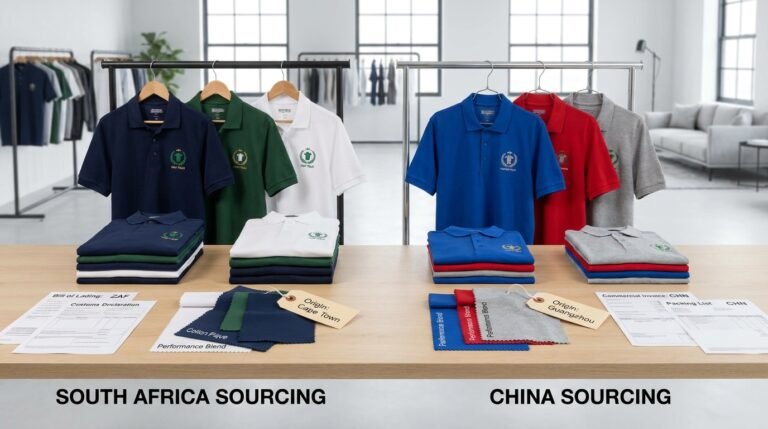
| Shipping origin | Guangzhou, China |
| Destination | Arkansas, USA, ZIP 72211 |
| Recorded shipping charge | RMB ¥9,320 |
What this tells us: For this specific 300-polo, 137 kg shipment to Arkansas, the international freight component alone was approximately RMB ¥9,320. This gives you a rough order-of-magnitude reference—but your own costs will depend on your exact carton specs, chosen method, and destination.
What this doesn't tell us: Total landed cost, including U.S. duties, brokerage, and final delivery. The recorded information does not establish the precise transportation mode, shipping service inclusions, U.S. import duties, or final landed cost. Therefore, the RMB ¥9,320 shipping charge should not be presented as a current freight rate or a complete delivered-duty-paid quotation.
Actual costs for another order may differ significantly because of its carton volume, weight, route, transportation service, and import requirements.
How to Compare Two Freight Quotations
Ask each logistics provider to quote the same:
- Origin and destination.
- Cargo quantity, dimensions, and gross weight.
- Shipping method and service scope.
- Applicable customs and destination services.
- Cargo insurance requirement.
- Expected transportation schedule.
- Exclusions and possible additional charges.
For example, an airport-to-airport air freight quotation cannot be compared directly with a door-to-door quotation without adding the missing services.
Compare complete transportation proposals, not isolated per-kilogram rates.
Step 5: Prepare Export Documents and U.S. Customs Information
Complete, consistent shipment documents help freight forwarders and importers prepare customs filings and reduce avoidable corrections.
The required documents depend on the shipping method, product, and entry circumstances.
Three Customs Documentation Mistakes That Cause Delays
Before diving into the document checklist, watch out for these common errors that can hold your shipment at the border:
-
Inconsistent descriptions. The commercial invoice says "golf polo shirt" but the packing list says "men's knitted top." Customs may flag this for review. Use identical product descriptions across all documents.
-
Rounded-down weights. Declaring 100 kg when the actual weight is 137 kg can lead to examination, penalties, or shipment holds. Use verified weights from the factory, not estimates.
-
Missing fiber composition. U.S. customs classification of apparel depends heavily on fiber content. "Polyester shirt" is insufficient—provide exact percentages (e.g., "88% polyester / 12% spandex").
Real-world example: A brand ordered 500 polos for a tournament. Production finished on time, but the commercial invoice listed "shirts" while the packing list said "knit tops." Customs held the shipment for document review—adding 5 days. The goods arrived after the event.
Cost of the delay: Unsold tournament inventory. All from one inconsistent document.
Essential Shipping Documents
| Document | Main Purpose | Typical Responsible Party |
|---|---|---|
| Commercial Invoice | Identifies the products, parties, transaction value, and relevant trade details | Seller/exporter |
| Packing List | Records carton quantities, contents, weights, and dimensions | Factory/exporter |
| Bill of Lading or Air Waybill | Documents the transportation arrangement | Carrier or freight forwarder |
| Product Specifications | Provides fabric composition and garment details for classification | Factory/exporter |
| Additional Origin or Compliance Evidence | Supports specific customs or regulatory requirements when requested | Relevant supplier or responsible party |
Descriptions, quantities, weights, and commercial values should be consistent across the applicable documents.
A separate certificate of origin is not automatically required for every U.S. apparel shipment. Confirm whether additional documents are necessary for the specific entry.
U.S. Import Duties and HTS Classification
Golf polos, woven trousers, shorts, and outerwear may fall under different U.S. tariff classifications.
Classification can depend on factors such as:
- Fiber composition.
- Knit versus woven construction.
- Garment type and design.
- Applicable men's, women's, or other classification criteria.
- Country of origin.
Buyers should check the relevant classification and current duties through the official U.S. Harmonized Tariff Schedule.
The applicable import charges may include additional tariffs or other trade measures in effect on the entry date.
Because U.S. tariff policy can change, FUWAY does not publish a universal duty percentage for all golf apparel.
A qualified customs professional should review product-specific classifications and current tariff treatment before shipment.
Who Is Responsible for U.S. Customs Clearance?
The importer of record is responsible for complying with applicable entry requirements and paying duties, taxes, and fees.
An eligible importer may make its own customs entry or engage a licensed U.S. customs broker.
A broker is generally recommended when the importer does not have the necessary customs expertise, but hiring one does not automatically transfer all importer responsibilities.
FUWAY's factory-side role is to provide accurate product and shipment information, rather than independently determining U.S. tariff classifications or guaranteeing customs release.
When Is an ISF Required?
For covered ocean shipments entering the United States, an Importer Security Filing (ISF) is generally required.
Key ISF information must normally be submitted no later than 24 hours before the cargo is loaded aboard the vessel at the foreign port, subject to the specific filing rules.
It is not simply a deadline measured from the vessel's departure from China.
The ISF importer or authorized filing agent must coordinate the required information.
See the official U.S. Customs and Border Protection ISF guidance.
This requirement does not apply in the same way to goods arriving solely by air.
Check U.S. Apparel Labeling Before Shipment
For most covered textile apparel sold in the United States, relevant labeling requirements include:
- Fiber content.
- Country of origin.
- Identification of the responsible manufacturer or business, using an accepted identification method.
- Appropriate care instructions.
Care information and other disclosures must follow the applicable labeling rules.
Buyers should consult the official FTC Apparel Labeling Guidance.
For detailed label development, placement, and packaging decisions, refer to FUWAY's Golf Apparel Labeling Guide.
These checks should be completed during product development and verified before dispatch—not left until the goods arrive in the United States.
Step 6: Plan the Factory-to-Warehouse Delivery Timeline
A common planning mistake is treating the factory's production completion date as the warehouse arrival date.
These are different milestones.
Your delivery schedule must account for final inspection, packing, cargo handover, export procedures, international transportation, U.S. import release, and final-mile delivery.

Typical Timeline: Ocean Freight from China to a U.S. Warehouse
The timeline below illustrates the major stages for a representative ocean freight shipment. Actual durations depend on the specific port pair, carrier schedule, customs workload, and destination distance.
Week 1         Week 2         Week 3         Week 4         Week 5         Week 6         Week 7
[QC + PACK] → [ORIGIN] → [------- OCEAN TRANSIT -------] → [CUSTOMS] → [DELIVERY]
This is illustrative. Express and air freight follow compressed timelines. Use this to set realistic expectations—not as a guaranteed schedule.
The Main Shipping Milestones
| Stage | Main Activity | Potential Delay |
|---|---|---|
| 1. Final QC | Inspect finished garments against approved specifications | Corrective work or approval delays |
| 2. Packing | Complete carton packing, labeling, and weight verification | Packaging or packing-list changes |
| 3. Cargo Handover | Transfer shipment to the designated logistics provider | Missed pickup or cargo cutoff |
| 4. Export Processing | Complete applicable China export procedures | Missing or inconsistent documentation |
| 5. International Transport | Move goods by air, express, or ocean | Capacity, routing, or weather disruption |
| 6. U.S. Customs | Complete applicable entry and release procedures | Document review or examination |
| 7. Final Delivery | Deliver released cargo to the destination warehouse | Trucking capacity or receiving appointments |
How Much Time Should Brands Allow?
There is no reliable universal door-to-door transit time for every China-to-USA shipment.
A quoted ocean transit time may refer only to vessel movement between ports. An air freight quotation may refer to airport-to-airport movement rather than the complete delivery process.
Buyers should request separate estimates for:
- Final inspection and packing.
- Origin pickup and export handling.
- International transportation.
- U.S. customs procedures.
- Destination handling and final delivery.
At FUWAY, custom golf apparel sampling typically takes around 7–10 business days, while bulk production commonly takes approximately 3–4 weeks after the necessary approvals, depending on the project.
These are manufacturing estimates, not guaranteed warehouse delivery dates.
Final packing, transportation, customs procedures, and destination delivery require additional planning.
Work Backward from Your Required Delivery Date
Suppose a golf brand needs inventory before a tournament or retail launch.
Instead of asking only when production can finish, identify the required warehouse receiving date and work backward through the transportation milestones.
Confirm:
- When the warehouse must receive the garments.
- When transportation needs to begin.
- When final packing must be completed.
- When production must finish.
- When all material, logo, and sample approvals must be finalized.
Leave a reasonable contingency buffer based on the route, service provider, and commercial consequences of a delay.
No freight method eliminates all customs or transportation risks.
Step 7: Complete the Pre-Shipment Checklist
Before cargo leaves the factory, the buyer, manufacturer, freight forwarder, and customs representative should verify the details relevant to their responsibilities.
The following checklist can be used for a commercial golf apparel order.
Factory and Buyer Checklist
- [ ] Final quantities match the approved purchase order.
- [ ] Carton count, dimensions, and gross weight are confirmed.
- [ ] Product descriptions and fabric compositions are accurate.
- [ ] Required apparel labels have been reviewed.
- [ ] Commercial invoice and packing list are consistent.
- [ ] Product descriptions match across all documents (invoice, packing list, and any certificates).
- [ ] The agreed Incoterm includes a clearly named place or port.
- [ ] The transportation service and delivery destination are confirmed.
- [ ] Shipping charges and exclusions are documented.
- [ ] The importer of record and customs filing responsibilities are identified.
- [ ] Required advance filings, including applicable ocean ISF, are arranged.
- [ ] Warehouse receiving requirements have been communicated.
- [ ] Tracking details and shipping documents will be shared after dispatch.
Documents to Keep for Future Reorders
Brands should also retain a basic logistics record for each approved order:
| Record | Why Keep It? |
|---|---|
| Final commercial invoice | Helps reconcile order value and shipment records |
| Approved packing list | Provides a reference for future carton planning |
| Carton specifications | Supports comparison of future freight quotations |
| Freight quotation and final invoice | Helps track actual transportation expenses |
| Shipping and delivery documents | Supports shipment traceability |
| Customs entry and duty records | Supports applicable import recordkeeping obligations |
| Receiving discrepancy report, if any | Helps prevent recurring delivery or packing problems |
A documented shipment history makes it easier to compare repeat orders, identify unexpected cost changes, and improve delivery planning.
For brands still developing their products, FUWAY's Custom Golf Shirts page explains the available OEM/ODM manufacturing and customization options.
Frequently Asked Questions
How Long Does It Take to Ship Golf Apparel from China to the USA?
Express courier is generally the fastest option for small shipments, followed by air freight and ocean freight.
However, actual door-to-door delivery time depends on the service, route, shipment readiness, customs processing, and U.S. destination.
Always confirm whether a quoted duration includes customs clearance and final-mile delivery.
Is Air Freight or Ocean Freight Cheaper for 300 Golf Polos?
There is no universal answer based on garment quantity alone.
The decision depends on final carton dimensions, chargeable weight, shipping route, service scope, and delivery deadline.
For an order of 300 polos, compare complete express, air, and ocean LCL quotations before choosing.
Can FUWAY Arrange Shipping to the United States?
FUWAY can discuss and coordinate available shipping arrangements for custom golf apparel orders.
If FUWAY arranges transportation, the applicable shipping cost is charged separately from garment production.
The agreed service scope, destination, and responsibility for U.S. import formalities should be confirmed before shipment.
Do I Need a Customs Broker to Import Golf Apparel?
Not every eligible importer is legally required to hire a customs broker, but using a licensed broker is often practical for commercial apparel imports.
The importer of record remains responsible for meeting applicable entry and duty obligations.
A broker can assist with classification, filings, and clearance procedures.
Are Small Golf Apparel Samples Automatically Duty-Free?
No. Buyers should not assume that low-value shipments qualify for duty-free entry.
U.S. duty-free de minimis treatment was suspended for affected low-value imports beginning August 29, 2025, and subsequent policy developments must also be considered.
Check current CBP requirements and the applicable entry procedure before shipping samples.
How Do I Protect My Budget from Freight Rate Fluctuations?
Freight rates can change between quotation and shipment. To manage this risk:
- Request a quotation with a defined validity period.
- Ask whether the rate is subject to peak season surcharges or General Rate Increases.
- For large orders, consider requesting forward-dated rates or discussing rate-lock options with your forwarder.
- Build a small buffer into your logistics budget for unexpected adjustments.
What Information Should I Send to Request a Shipping Estimate?
Provide the product type, garment quantity, estimated or actual carton dimensions, gross weight, U.S. destination ZIP code, requested delivery date, and desired shipping service.
For quotations prepared before final packing, clearly identify which weights and dimensions are estimates.
Conclusion
Shipping golf apparel from China to the USA requires coordinated planning between the manufacturer, freight provider, and importer.
The most important steps are to prepare accurate packing data, select a suitable transportation method, clarify shipping responsibilities, verify applicable import requirements, and calculate the complete delivered cost.
For golf brands and wholesalers, good logistics planning begins before the finished garments leave the factory.
With over 15 years of experience in golf apparel manufacturing, FUWAY supports OEM/ODM projects covering custom polos, pants, shorts, and outerwear, including production planning and factory-side shipping coordination.
Don't guess at freight costs. Send FUWAY three things, and we'll give you real numbers:
- Your product specs and order quantity
- Your destination ZIP code
- Your target delivery date
We'll come back with packing estimates and available shipping options—so you can compare real numbers, not guesswork.