Plan golf apparel replenishment by tracking demand at the style, color, and size level, calculating when replacement stock must become sellable, and confirming materials and production capacity before placing the reorder. Your plan should connect inventory data with a factory-confirmed schedule—not rely on the lead time from your first order.
This guide is for golf apparel brands managing repeat production of polos, bottoms, skorts, and layers. The goal is to replenish proven products while controlling cash commitments, seasonal leftovers, and differences between production batches.

Step 1: Decide Which Products Deserve Replenishment
A successful launch does not mean every product needs another production run. Review each style-color-size combination before deciding what to repeat.
| Product Situation | Replenishment Approach | Check Before Committing |
|---|---|---|
| Proven core product | Review regularly and maintain a replenishment trigger | Ongoing demand, margins, returns, and supply continuity |
| Seasonal product | Reorder only if stock can arrive within a useful selling window | Expected demand after arrival and markdown exposure |
| Tournament or team order | Plan against confirmed requirements and delivery dates | Final quantities, sizing, branding, and event deadline |
| Product with recurring fit or quality complaints | Resolve the issue before repeating production | Revised specification and approval requirements |
| Slow-selling SKU | Reduce, pause, or discontinue | Whether weak sales reflect demand, limited exposure, or availability |
Define core products through sales evidence. Navy is not automatically a winner, and a bright seasonal color is not automatically a poor replenishment candidate.
Check stock availability alongside sales history. A size that sold out early may show low recent sales because customers could no longer buy it. Returns and cancellations also need context: strong initial orders can hide a fit problem that should be corrected before the next batch.
Step 2: Calculate a Reorder Trigger for Each SKU
A style-level total can hide shortages. You may have plenty of polos overall while the navy medium and large sizes are unavailable.
Start with this planning relationship:
Reorder point = Forecast demand during the full replenishment lead time + Safety stock
Oracle’s reorder point planning guidance uses this basic relationship. For a golf apparel brand, the lead time should extend to usable inventory at the destination, including the relevant preparation, production, delivery, and receiving stages.
Compare the Trigger With Inventory Position
For a simple planning view:
Inventory position = Sellable stock on hand + Confirmed incoming stock − Unfulfilled committed demand
Use consistent definitions. Exclude damaged or quarantined stock, and do not subtract customer reservations twice if your available-stock figure already removes them.
Incoming stock also needs an arrival date. A purchase order due after the shortage cannot prevent that shortage, even if it appears in your total inventory position.
Worked Example: Navy Polo, Size M
The following figures are illustrative, not FUWAY delivery commitments.
| Planning Input | Example |
|---|---|
| Forecast weekly demand | 12 units |
| Full replenishment lead time | 8 weeks |
| Safety stock selected for this example | 24 units |
| Reorder point | 12 × 8 + 24 = 120 units |
| Sellable stock on hand | 85 units |
| Confirmed incoming stock | 20 units |
| Unfulfilled committed orders | 10 units |
| Inventory position | 85 + 20 − 10 = 95 units |
The inventory position is below the 120-unit trigger, so this SKU needs a reorder review. Check whether the 20 incoming units arrive before the projected shortage, then confirm factory feasibility and cash availability.
The trigger is not the quantity to order.
Calculate the Proposed Order Quantity Separately
A simple periodic-review approach is:
Target stock position = Forecast demand over replenishment lead time and the next review interval + Safety stock
Proposed reorder quantity = Target stock position − Current inventory position
Using the same example, with a two-week review interval:
- Target stock position: 12 × (8 + 2) + 24 = 144 units
- Proposed reorder quantity: 144 − 95 = 49 units
That is a planning proposal for one SKU. Combine it with the other sizes, then check style and color minimums, fabric requirements, cash, and the remaining selling season.
For changing seasonal demand, use a week-by-week forecast rather than multiplying one historical average. Check whether the projected inventory balance falls below your buffer before the new order arrives.
Safety stock should reflect demand uncertainty, delivery reliability, and the consequences of a shortage. A fixed percentage is not suitable for every SKU.
Step 3: Confirm the Full Replenishment Timeline

Work backward from the date stock must be available for sale.
Ask the factory and logistics provider to identify what is included in each quoted duration.
| Timeline Component | What to Confirm |
|---|---|
| Buyer review and order release | Who approves the quantities, specifications, and payment? |
| Material preparation | Are fabrics and trims available, reserved, or still to be produced? |
| Repeat-order approvals | What requires renewed shade, fit, artwork, or sample approval? |
| Production | When can the order actually enter the schedule? |
| Inspection and packing | Are these included in the production window? |
| Freight and destination handling | Does the estimate include clearance and local delivery? |
| Warehouse receiving | When will goods be checked, entered into stock, and sellable? |
| Contingency | Which uncertainties could affect the required date? |
At FUWAY, bulk production for suitable projects is generally around 3–4 weeks, subject to approved specifications, material readiness, and confirmed capacity. This is a production reference, not a complete reorder-to-warehouse timeline.
For the detailed stages, see our golf polo production timeline guide.
Keep calendar days and working days consistent. Ask whether final inspection is already included so you do not count it twice.
For core products, compare your stock cover with the complete replenishment cycle. For seasonal products, also ask whether enough profitable selling time will remain after arrival.
Step 4: Check Material and Product Continuity
“Repeat the previous order” is a reference, not a complete production instruction.
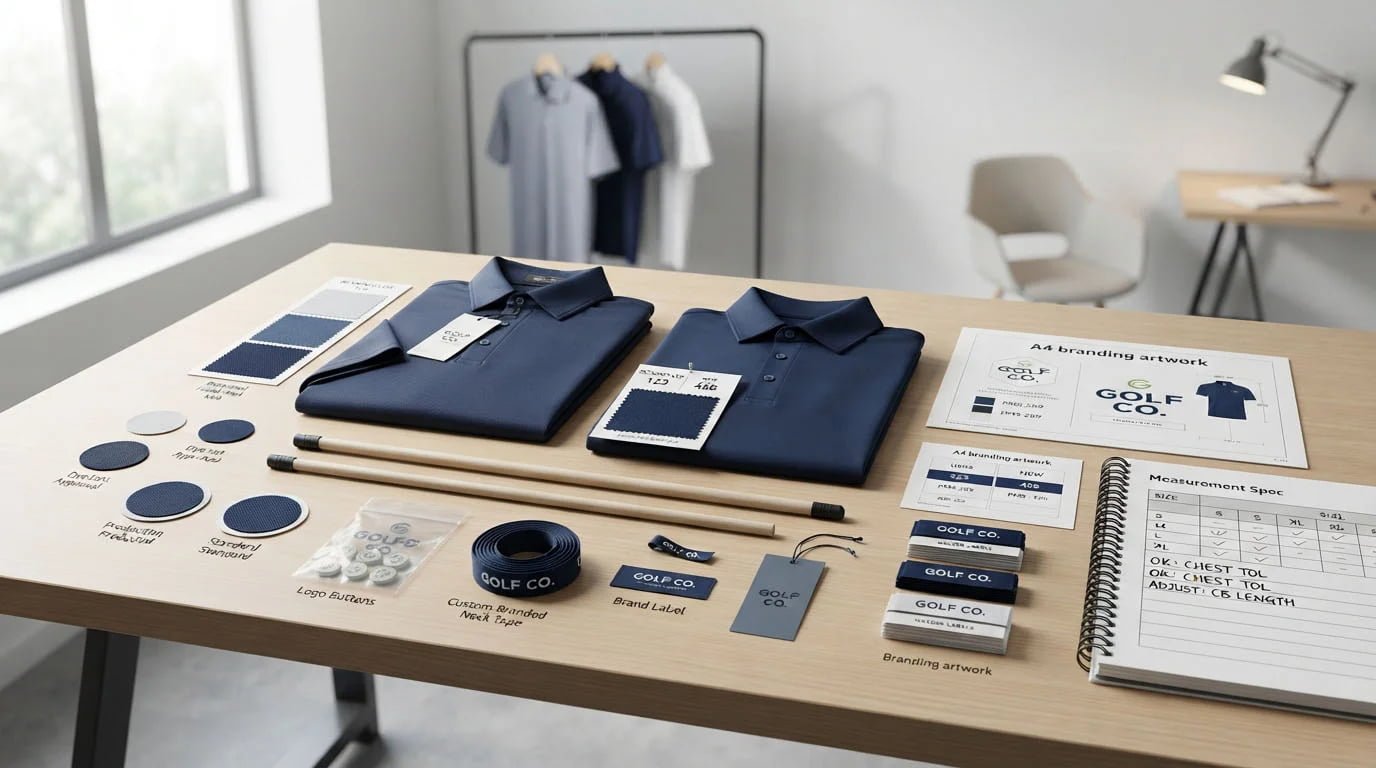
The previous purchase order should connect to a current, approved specification. Check whether customer feedback led to changes after the first run.
| Continuity Area | Reference to Retain | What to Recheck |
|---|---|---|
| Fabric | Approved composition, construction, weight, finish, and swatch | Availability, lot changes, and relevant performance requirements |
| Color | Physical master standard and agreed acceptance criteria | New bulk shade and matching components |
| Fit and measurements | Approved pattern and versioned size specification | Any changes made after the previous order |
| Branding | Approved artwork, dimensions, placement, and decoration sample | File version, thread or ink references, and application |
| Trims | Confirmed component specification | Supplier, appearance, function, and availability |
| Labels and packing | Approved label files, SKU codes, and packing instructions | Size allocation, barcodes, carton marks, and destination requirements |
Separate Shade Matching From Colorfastness
A new fabric batch may resist washing and rubbing but still look different from the previous batch.
- Shade matching checks appearance against the approved color reference.
- Colorfastness testing checks color change or transfer under specified conditions.
A colorfastness result does not prove that two production batches match visually. Compare the new material with the physical standard under agreed viewing conditions, and approve any departure before cutting.
Keep relevant testing requirements in the reorder specification. Our golf apparel quality control guide explains the broader inspection and approval process.
Distinguish Greige Fabric From Finished Fabric
A fabric reservation can shorten some stages, but its benefit depends on what is being held.
- Greige fabric still requires the applicable preparation, dyeing or printing, finishing, and approval steps.
- Finished fabric may remove more upstream work, but still needs quantity, condition, specification, and shade verification.
Before paying for a fabric reserve, agree on its specification, ownership, storage responsibility, usable quantity, release conditions, and treatment of unused material.
Step 5: Turn SKU Demand Into a Factory-Feasible Order
Your sales data identifies what you need. The factory must confirm whether that mix can be produced economically and within the required window.
Send proposed quantities by style, color, and size. Avoid instructions such as “repeat the same size ratio” unless current demand supports that decision.
Ask the factory to check:
- Minimums per style, color, fabric, decoration, or configuration.
- Available fabric quantity and whether it is allocated to your order.
- Whether selected sizes can be replenished without repeating the full original size mix.
- Trim and packaging minimums.
- Current pricing and production availability.
FUWAY’s typical starting reference is approximately 100 pieces per style for suitable projects. This does not establish a universal minimum per color or guarantee that every small top-up is feasible.
For the trade-offs behind minimums, see how to negotiate MOQ with a golf apparel manufacturer.
If your proposed reorder falls below a material minimum, evaluate available approved fabric, consolidation with a later order, or a smaller production option where feasible. Do not automatically add slow-selling sizes just to reach a minimum.
Compare the total commitment—including likely leftovers—with the value of avoiding the shortage.
A rolling forecast gives the factory advance visibility. It does not automatically reserve materials or production capacity.

Choose a forecast horizon that reaches beyond your actual replenishment cycle. Review fast-moving SKUs more frequently, and update the factory when demand or required dates change materially.
Use clear commitment stages:
| Stage | Information Shared | Written Agreement Needed |
|---|---|---|
| Forecast visibility | Likely products, quantity ranges, and required windows | Identify assumptions and what remains provisional |
| Material or capacity reservation | Specific material quantities or production windows | Cost, authorization, ownership, release conditions, and change exposure |
| Firm reorder | Final quantities and approved specifications | Accepted PO, payment terms, production milestones, and delivery scope |
Forecast visibility helps a supplier investigate availability and flag constraints. A reservation requires separate confirmation.
Do not treat a general forecast email as evidence that fabric has been purchased or a sewing line has been booked.
Use One Shared Reorder Sheet
A practical worksheet should include:
| Information Group | Required Fields |
|---|---|
| Product identity | Style code, color, size, previous PO, specification version |
| Demand | Recent sales, stockout periods, returns, upcoming promotions or events |
| Inventory | Sellable stock, commitments, confirmed incoming quantities and dates |
| Proposed reorder | Units by SKU, priority sizes, latest useful sellable date |
| Factory response | MOQ, material status, approval requirements, quoted dates |
| Commitments | Reservation status, accepted PO, agreed changes, responsible person |
The buyer owns demand and inventory accuracy. The factory confirms manufacturing feasibility and production status. Logistics and warehouse teams confirm the destination delivery and receiving plan.
What to Do When Stock Will Run Out Before Replenishment Arrives
Identify the constraint before choosing a remedy. Faster freight cannot recover time lost to unavailable fabric or unresolved approvals.
| Problem | Option to Evaluate | Main Trade-Off |
|---|---|---|
| Only a few sizes will run out | Prioritize those sizes where production permits | Minimums, material yield, and scheduling |
| Production is feasible but sea delivery is too late | Ship an urgent portion by a faster service | Additional freight and handling costs |
| Materials are unavailable | Evaluate an alternative with renewed approval | Appearance, performance, and product consistency |
| Seasonal stock would arrive too late | Reduce or cancel the proposed replenishment before commitment | Lost sales versus leftover inventory |
| Quality concerns affect the repeat order | Correct the issue and reassess the date | Additional approval time |
| An existing inbound order may be delayed | Confirm the revised arrival and recalculate the gap | Avoiding unnecessary duplicate production |
A split shipment changes delivery timing; it does not reduce the total inventory purchased.
Before increasing the order, check expected margin after freight, production payments, and remaining operating cash. For wider funding decisions, see our golf apparel startup budget and reorder planning guide.
Frequently Asked Questions
Do We Need a New Sample for Every Repeat Order?
Not necessarily. An unchanged product with retained approved references may need less development work. Material substitutions, fit changes, new decoration, or unresolved quality issues can require renewed sampling or approval. Agree on the evidence needed before scheduling production.
Can We Reorder Only Medium and Large Sizes?
It may be feasible, depending on material availability, cutting arrangements, production minimums, and decoration requirements. Provide the exact size quantities and request confirmation rather than assuming that the first order’s minimums apply unchanged.
Does a Reorder Keep the Same Unit Price?
Not automatically. Quantity, size mix, materials, trims, decoration, and delivery arrangements can change the quotation. Confirm the current price and what it includes before accepting the order.
Who Should Own Leftover Fabric?
Record this in the agreement. Define who paid for it, who owns it, where it is stored, how usable stock is tracked, and what happens if the fabric is no longer needed.
What If the Factory Cannot Meet Our Required Date?
Ask for the earliest feasible schedule and the reason for the gap. Then evaluate quantity priorities, approved material alternatives, shipment options, or a revised selling plan. Keep changes to specifications, costs, and dates in writing.
Conclusion
Reliable golf apparel replenishment connects SKU demand with a confirmed manufacturing plan. Track what is selling, distinguish the reorder trigger from the order quantity, check incoming delivery dates, and verify that materials and specifications can be repeated.
Before releasing the next order, agree on the exact quantities, approval requirements, commitments, and date the stock must become sellable.
For an existing or proposed FUWAY program, send your previous PO or product specifications, quantities by style-color-size, destination, and required warehouse date. Contact FUWAY to review the production requirements, or explore our custom golf shirts service for polo development and repeat production.