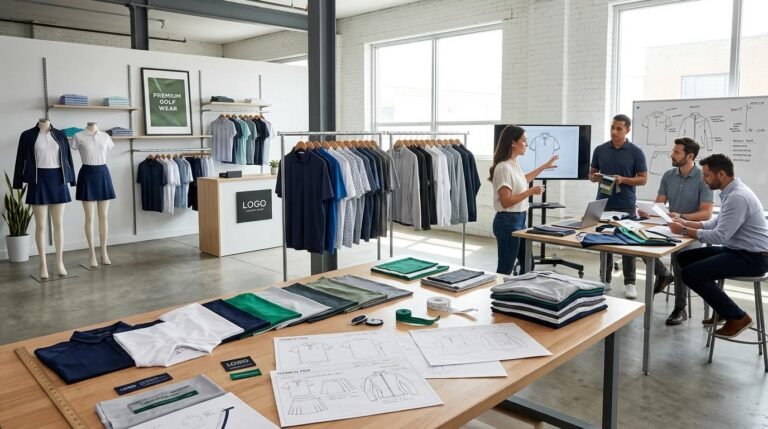
Launching a golf apparel brand is not only about how much money you have.
A more important question is:
How should you divide that money between product development, inventory, SKUs, fabrics, packaging, logistics, and launch activities?
A startup with a larger budget can still run into problems if it launches too many styles, colors, or categories at once.
Meanwhile, a more focused brand can often learn much more from its first collection by concentrating capital on fewer products with better inventory depth.
This guide focuses specifically on budget allocation and first-collection planning.
It covers:
- how to allocate a golf apparel startup budget
- how many SKUs to launch
- how MOQ affects your collection structure
- how much inventory depth each style needs
- stock fabrics vs custom fabrics
- where startups commonly overspend
- DTC vs wholesale launch strategy
- how to plan your second order
If your main question is “How much money do I need to start a golf apparel brand?”, read our separate guide:
How Much Does It Cost to Start a Golf Apparel Brand?
This article answers a different question:
Once you have a working launch budget, how should you use it?
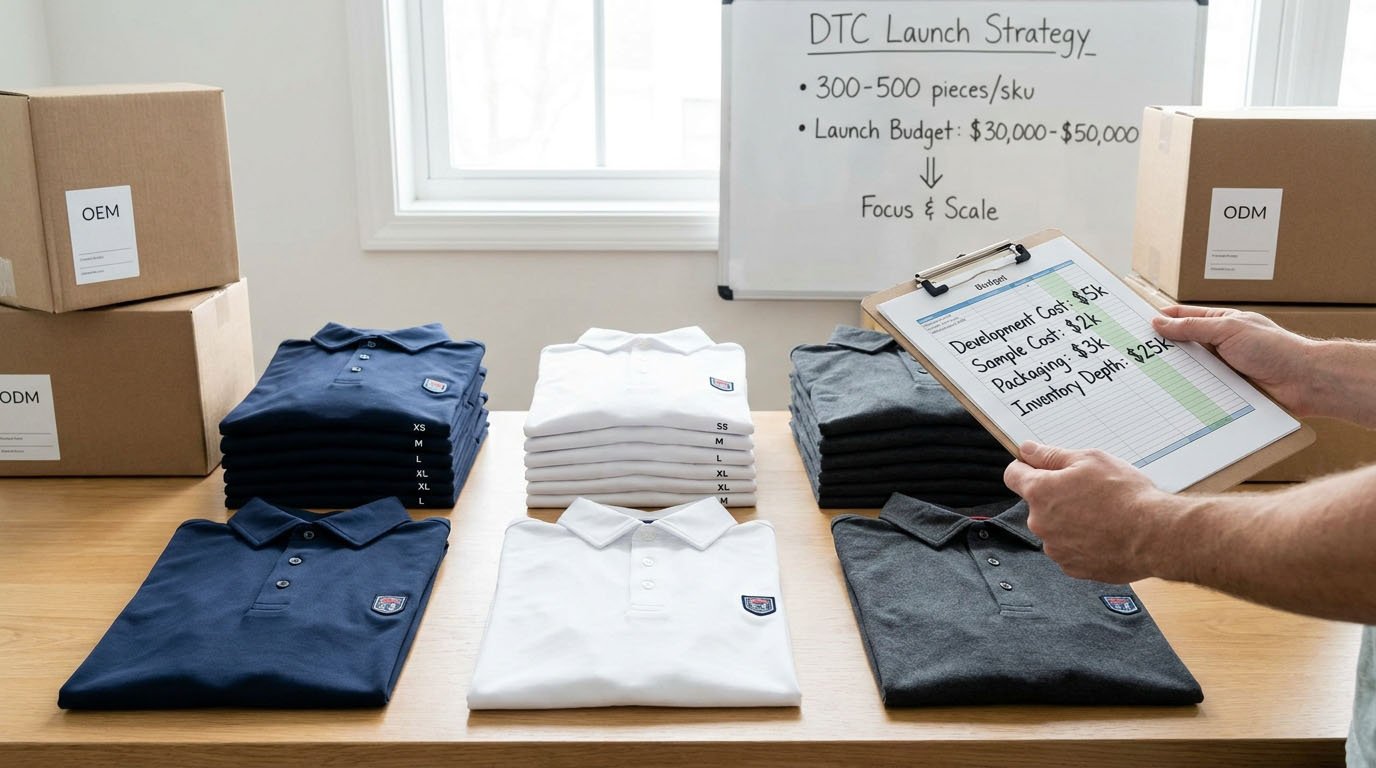
Quick Answer: How Should a Golf Apparel Startup Plan Its First Collection?
For many new golf brands, a lower-risk first collection looks something like this:
- 2–4 core styles
- 2–3 colors per style
- polos as the main category
- one bottom or layering product if the budget allows
- stock or readily available performance fabrics
- simple private-label packaging
- enough inventory depth to identify real winners
- DTC as the primary validation channel
- reserved cash for freight, revisions, marketing, and reorders
The main principle is simple:
Do not use all your money to create more products. Use part of it to learn which products deserve more money.
That changes the way you should think about SKUs, MOQs, fabrics, and inventory.
How Should You Allocate a Golf Apparel Startup Budget?
Your budget should not be treated as one large production fund.
A first collection normally requires money across several different areas.
A useful planning framework is:
| Budget Area | Main Purpose |
|---|---|
| Product development | Samples, fit revisions, tech packs |
| Bulk inventory | First production order |
| Branding & packaging | Labels, hangtags, packaging |
| Freight & import costs | Shipping, duties, delivery |
| Content & launch | Photography, website, marketing |
| Contingency | Unexpected revisions or costs |
| Reorder reserve | Funding winning styles after launch |
The exact percentages depend on your business model.
The important point is that bulk production should not consume every available dollar.
A brand that puts nearly all its cash into inventory may have attractive products but no flexibility left for:
- sample corrections
- freight increases
- photography
- customer acquisition
- packaging adjustments
- fast reorders
- unexpected production issues
Think in allocation, not just total budget
Suppose two brands have the same launch capital.
Brand A launches:
- 8 styles
- 4 colors each
- several fabric stories
- custom packaging
- multiple sales channels
Brand B launches:
- 3 core styles
- 2–3 colors
- mostly stock fabrics
- simple packaging
- DTC first
- cash reserved for reorders
Brand A may look more complete on launch day.
Brand B usually has a cleaner test.
Your first collection should not simply prove that you can manufacture clothing.
It should help answer:
- Which style sells?
- Which fit works?
- Which color gets reordered?
- Which price point converts?
- Which SKU deserves deeper inventory?
How Many SKUs Should a Golf Apparel Startup Launch?
For most first collections, fewer SKUs are easier to manage than a large assortment.
A practical starting point is often around:
Option A — Very Focused Launch
- 2 polo styles
- 2–3 colors each
Option B — Balanced Golf Collection
- 2–3 polo styles
- 1 shorts or trousers style
Option C — Slightly Broader Collection
- 2–3 polos
- 1 bottom
- 1 lightweight layering piece
You usually do not need polos, shorts, trousers, hoodies, quarter-zips, jackets, vests, skorts, and accessories in the first release.
Every additional style creates more than another product page.
It also creates another:
- sample
- fit approval
- pattern
- color decision
- size run
- production setup
- QC requirement
- photography requirement
- inventory forecast
- reorder decision
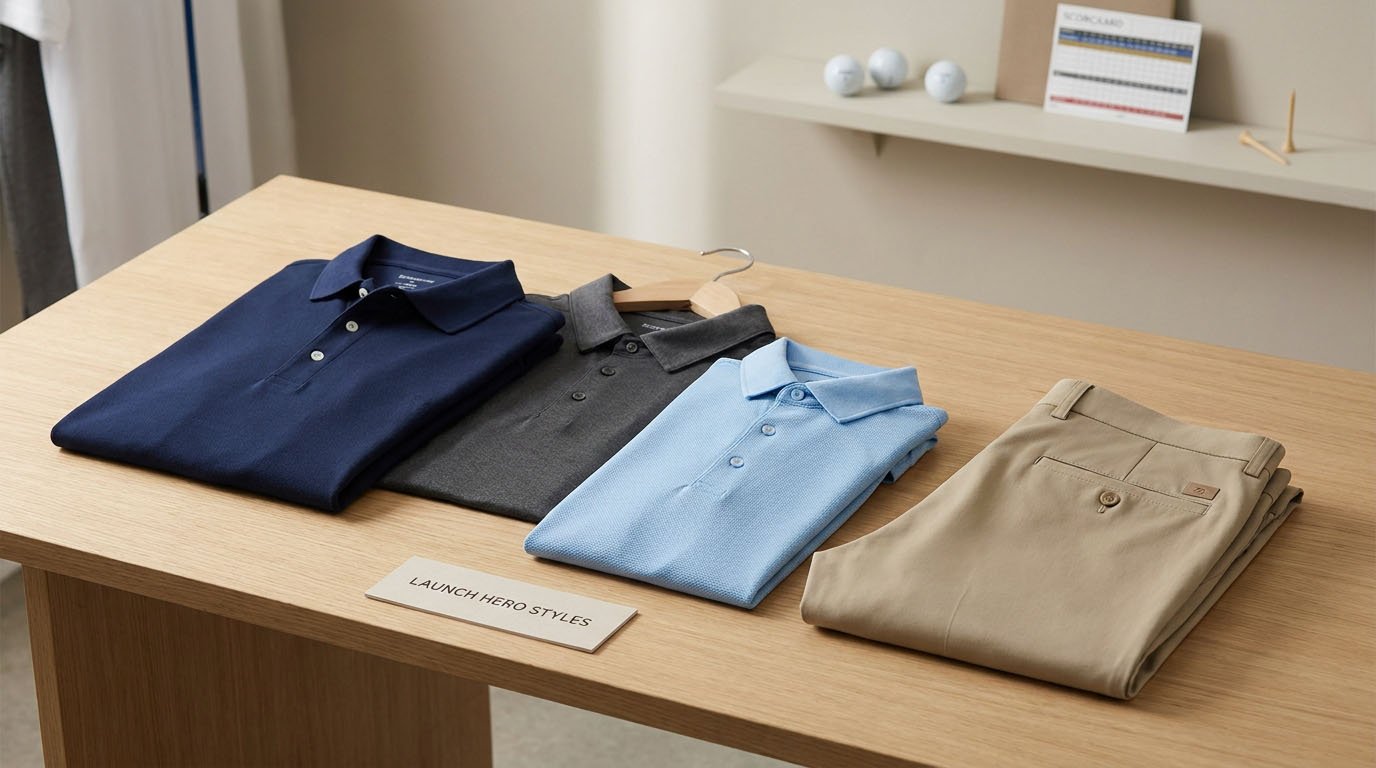
SKU count multiplies faster than many founders expect
Imagine one polo offered in:
- 3 colors
- 5 sizes
That already creates 15 sellable SKU combinations.
Four styles with similar color and size structures may quickly create dozens of inventory combinations.
If inventory is spread too thinly, a brand can sell out of common sizes while still holding large amounts of slow-moving inventory elsewhere.
That is why first-collection planning should focus on inventory depth, not just style count.
How Should You Divide Inventory Across Your First Collection?
Equal allocation is not always the smartest allocation.
If you have three products, you do not necessarily need to order exactly one-third of your inventory in each.
Instead, divide products into different roles.
Hero products
These are the products most likely to represent the brand and generate most sales.
For a golf apparel startup, this might be:
- core performance polo
- modern-fit polo
- signature printed or textured polo
Supporting products
These products help complete the range or increase average order value.
For example:
- golf shorts
- trousers
- quarter-zip
A practical inventory structure might look like this:
| Product | Role | Inventory Priority |
|---|---|---|
| Core Golf Polo | Hero | High |
| Signature Polo | Hero | High |
| Golf Shorts | Supporting | Medium |
| Experimental Layer | Test | Low |
The exact percentages should depend on supplier MOQ and expected demand.
The principle matters more than the number:
Do not allocate equal capital to products with unequal importance.
How Does MOQ Affect Your Launch Budget?
MOQ should be considered during collection planning—not after the collection has already been designed.
A factory MOQ can affect:
- number of styles
- number of colors
- fabric choices
- decoration methods
- packaging
- per-piece cost
FUWAY works with startup and growing brands on flexible development structures, although actual MOQ depends on the product, fabric, decoration, and production requirements.
You can explore our Custom Golf Shirts page for more information.
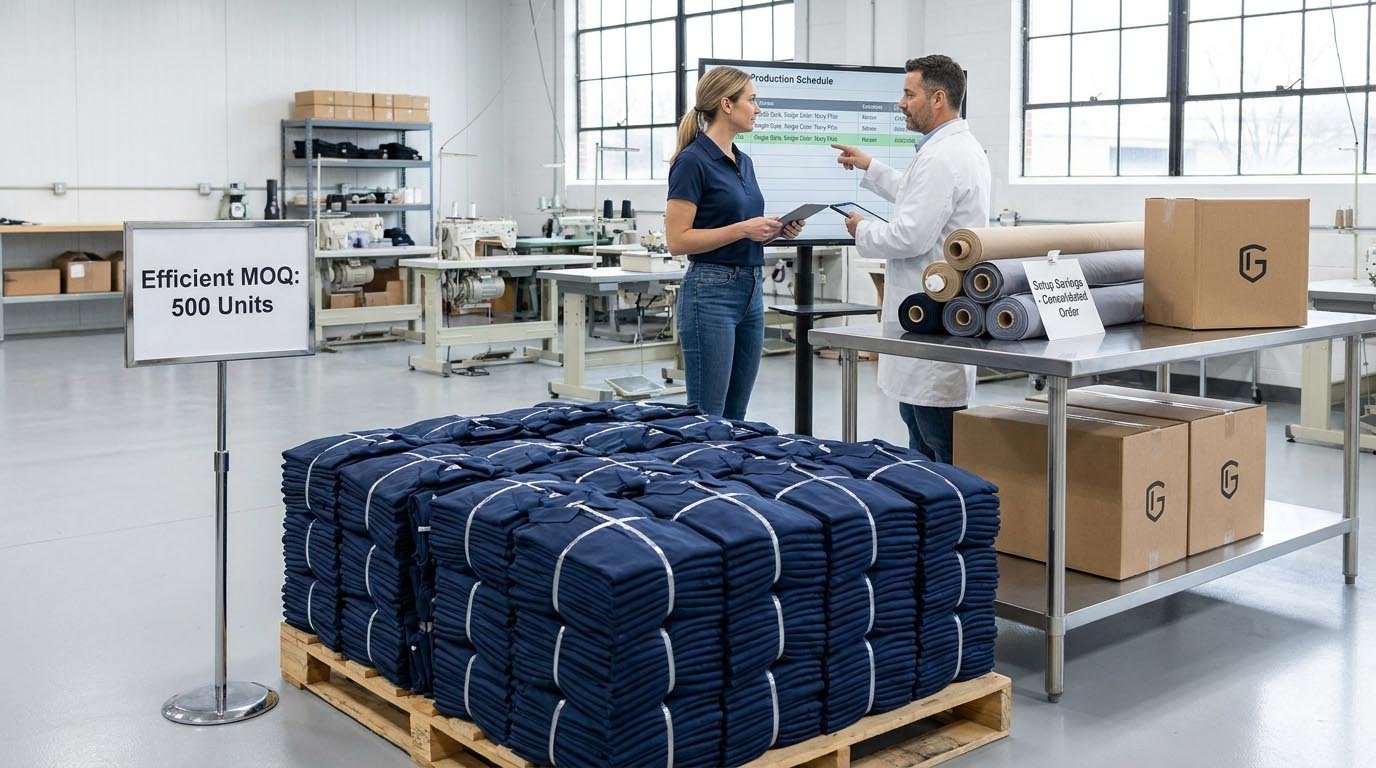
MOQ per style matters more than total quantity
Consider two collections.
Collection A
- 8 styles
- very small quantity per style
Collection B
- 3 styles
- deeper quantity per style
Even if the total garment quantity is similar, Collection B can often be easier to manufacture and easier to manage after launch.
Production efficiency tends to improve when there is more volume behind fewer constructions.
How to work with MOQ instead of fighting it
If supplier MOQ pushes your budget too far, consider:
- reducing styles
- reducing colors
- using the same fabric across several products
- using existing fabric colors
- simplifying trims
- using one decoration method
- concentrating inventory into hero products
The wrong response is often:
“Can the factory simply lower every MOQ?”
A better question is:
“How can I restructure the collection so the MOQ works economically?”
MOQ strategy is really collection strategy.
Should You Use Stock Fabrics or Custom Fabrics?
For many first collections, stock fabrics are the more capital-efficient option.
That does not mean the product needs to look generic.
You can still customize:
- fit
- collar
- placket
- logo
- embroidery
- trims
- labels
- packaging
- color combinations
FUWAY can also help brands with Fabric Sourcing when more specific performance, composition, weight, or hand-feel requirements are needed.
Why stock fabrics help startups
Stock or readily available fabrics can reduce:
- fabric development cost
- custom dye MOQ
- sampling delays
- color matching risk
- unused fabric liability
- launch lead time
This makes them useful when your first objective is market validation.
When custom fabric makes sense
Custom fabric becomes more attractive when:
- a product is already selling
- you have repeat orders
- signature hand feel matters
- a proprietary color is important
- performance specifications are central to your positioning
- volume can justify development
A logical progression might be:
First order:
Proven performance fabric + custom branding
Second order:
Refined fit + best-selling colors
Later collection:
Custom color or proprietary fabric development
That sequence puts differentiation behind proven demand.
[IMAGE PLACEHOLDER – NEW IMAGE]
Suggested image: Stock fabric vs custom fabric decision diagram
Suggested content:
Stock Fabric → Lower Development Risk → Faster Sampling → First Collection
Custom Fabric → Higher Development Investment → More Differentiation → Proven Hero Products
Suggested alt text:
Stock fabric vs custom fabric for a first golf apparel collection
How Many Colors Should You Launch?
Color can quietly create the same problem as too many styles.
Suppose you have:
- 4 styles
- 5 colors
- 5 sizes
You now have up to 100 style-color-size combinations to manage.
For many startups, 2–3 colors per core product provide enough choice without excessive fragmentation.
A typical first collection might include:
- one safe neutral
- one core brand color
- one stronger statement color
You do not need every style in every color.
For example:
| Product | Suggested Color Strategy |
|---|---|
| Core Polo | 3 colors |
| Signature Polo | 2 colors |
| Shorts | 2 neutral colors |
| Experimental Style | 1–2 colors |
Color architecture should support inventory efficiency.
Match Your Budget to Your Price Positioning
Your target retail price influences how much you can realistically spend on fabric, trims, construction, packaging, and customer acquisition.
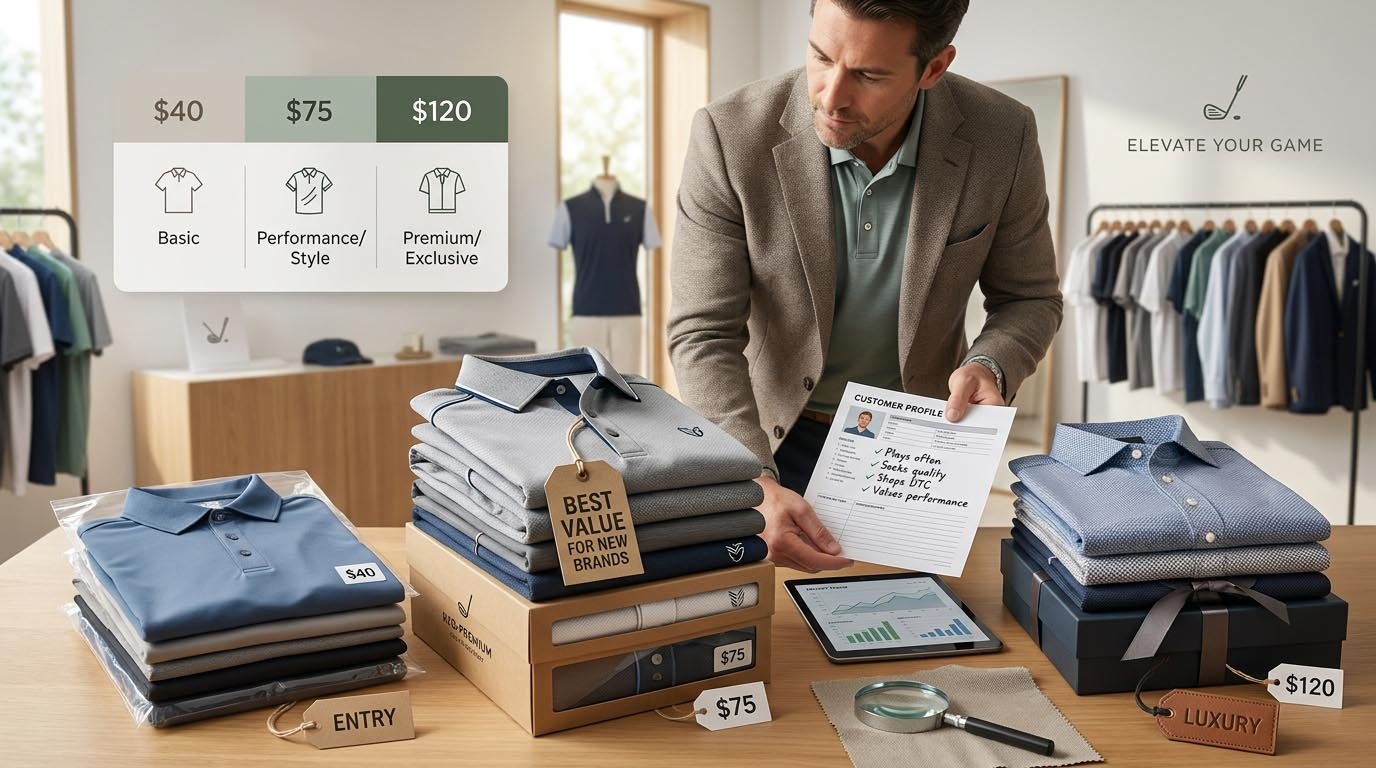
An entry-level product normally requires tighter cost control.
A mid-premium product may support:
- better fabric
- more refined fit
- stronger trims
- more detailed finishing
A premium positioning may require even more investment in product, storytelling, packaging, and customer experience.
The mistake is trying to combine:
- premium product expectations
- very low manufacturing cost
- very small order quantity
- high marketing spend
- aggressive margins
All of these goals compete for the same budget.
Your product quality, target retail price, and channel economics need to support each other.
Where Should a Startup Spend More Money?
Not every part of the collection deserves equal cost cutting.
Some areas usually justify stronger investment.
1. Fit
Poor fit can ruin an otherwise attractive product.
Spend enough time on:
- sample fitting
- size grading
- sleeve length
- body length
- collar proportions
- movement comfort
2. Fabric Quality
Customers interact with the fabric immediately.
For golf apparel, important considerations can include:
- hand feel
- moisture management
- stretch
- recovery
- opacity
- pilling resistance
- shrinkage
- colorfastness
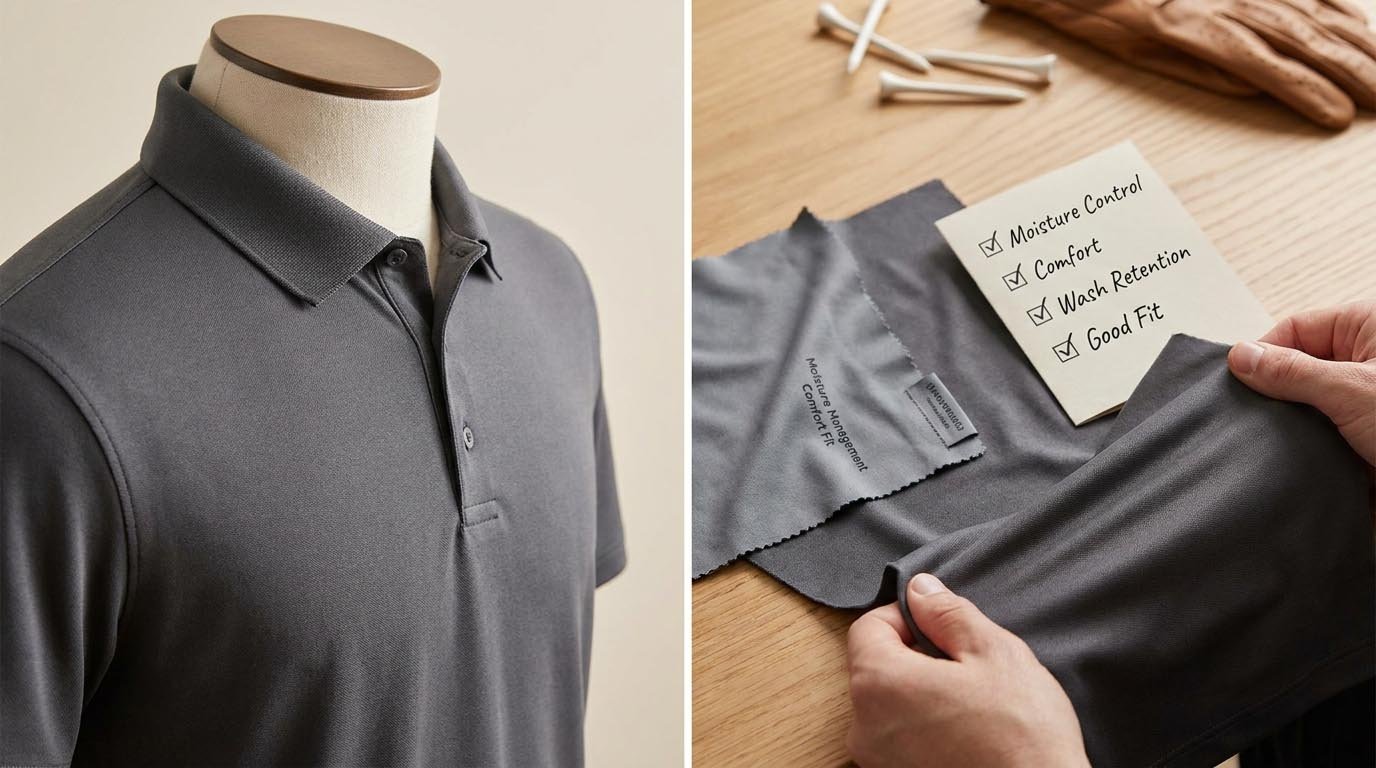
When performance claims matter, appropriate testing should also be considered.
FUWAY publishes relevant Test Reports to help buyers understand available fabric and garment verification.
3. Hero Products
Your highest-potential product deserves more attention than a speculative fifth or sixth style.
Spend money on making the product that represents the brand better rather than simply increasing assortment size.
Where Can a Startup Keep Costs Simpler?
Some parts of the first collection can stay intentionally simple.
Packaging
You probably do not need elaborate packaging for every polo.
A practical private-label package may include:
- branded polybag
- hangtag
- woven label
- size label
- care label
- simple shipping packaging
Number of trims
Too many custom trims create:
- more MOQ requirements
- sourcing delays
- more approvals
- more potential inconsistencies
Decoration methods
Instead of using multiple decoration technologies across one small collection, choose the techniques that best support your brand concept.
You can compare FUWAY's:
Use complexity where customers will notice it.
OEM, ODM or Hybrid: Which Model Uses Startup Capital More Efficiently?
The manufacturing model also affects your development budget.
ODM
ODM usually starts from an existing factory-developed base product.
You may customize:
- branding
- colors
- fabrics
- labels
- trims
- selected construction details
This can reduce development work.
OEM
OEM is more appropriate when you already have:
- detailed designs
- technical specifications
- unique fit requirements
- proprietary construction details
It gives you more control, but normally requires more development.
Hybrid Development
For many startup brands, the most practical first step sits between full ODM and full OEM.
For example:
- choose a proven base construction
- modify fit or selected details
- choose the fabric
- add custom branding
- launch and gather feedback
- create more proprietary versions later
FUWAY supports both Private Label Golf Apparel and more customized OEM/ODM programs.
The right model depends on how differentiated the product needs to be before demand has been validated.
Should Your First Golf Apparel Launch Be DTC or Wholesale?
Your sales channel affects how you should allocate inventory.
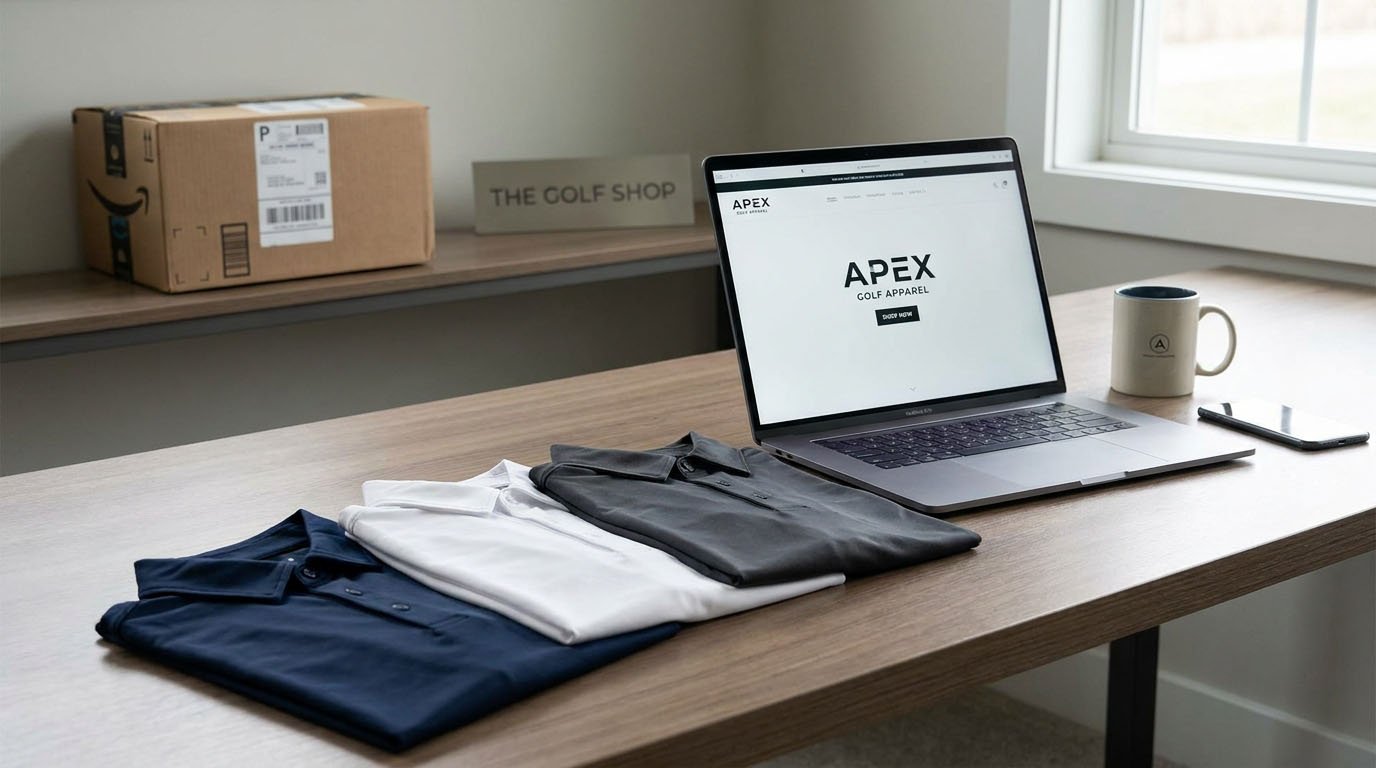
For many new brands, DTC provides the clearest initial feedback.
Through your own store, you can observe:
- conversion
- size demand
- return reasons
- customer reviews
- color preference
- repeat purchases
- discount sensitivity
That makes the first collection a learning system.
What about wholesale?
Wholesale can be valuable, especially once you have:
- proven products
- reliable production
- stable margins
- stronger inventory depth
- established wholesale pricing
But wholesale also changes your economics.
You must leave enough margin for the retailer while still covering:
- product cost
- freight
- duties
- packaging
- operating expenses
For some businesses, wholesale makes sense from day one because they already have retailer relationships.
The key is that channel strategy should be decided before product pricing and inventory planning—not afterward.
What about Amazon?
Amazon can become another growth channel, but adding it immediately creates another inventory pool and another pricing environment.
A cleaner sequence for many startups is:
DTC → identify winners → reorder → expand channels
Not every brand needs to follow that exact sequence, but your first channel should ideally help you learn.
How Should You Plan Your First Reorder?
One of the most overlooked parts of startup budgeting is the second purchase order.
Many founders plan only for launch.
A healthier strategy asks:
What happens if one product sells much faster than expected?
If all available capital has been spent on the first collection, a successful launch can ironically create a cash-flow problem.
Consider keeping some financial flexibility for:
- replenishing hero styles
- increasing winning colors
- correcting fit issues
- replacing weak SKUs
- funding seasonal follow-ups
What should you learn before the second order?
Track:
- sell-through by style
- sell-through by color
- sell-through by size
- returns
- fit complaints
- repeat purchase behavior
- customer reviews
- gross margin
- marketing efficiency
Your second order should usually be less speculative than your first.
The goal is to move capital toward proven demand.
A Simple First-Collection Planning Framework
Before sending an RFQ to a manufacturer, work through these seven steps.
Step 1 — Define Your Customer
Who are you designing for?
For example:
- traditional club golfer
- younger lifestyle golfer
- resort customer
- premium country-club buyer
- modern athletic golfer
Step 2 — Define Your Retail Position
Decide whether you are targeting:
- value
- mid-market
- mid-premium
- premium
Step 3 — Choose Your Hero Category
For many golf apparel startups, that will be polos.
Step 4 — Limit Initial Styles
Choose approximately 2–4 products that communicate the brand clearly.
Step 5 — Keep Colors Controlled
Avoid multiplying inventory before demand exists.
Step 6 — Check MOQ Before Finalizing the Collection
Ask suppliers about:
- MOQ per style
- MOQ per color
- fabric MOQ
- decoration MOQ
- packaging MOQ
Step 7 — Keep Launch and Reorder Capital Outside the First PO
Your first purchase order should not consume the entire business budget.
[IMAGE PLACEHOLDER – NEW IMAGE]
Suggested image: Golf apparel first collection planning flowchart
Suggested flowchart content:
Budget
↓
Target Customer
↓
Price Position
↓
Hero Products
↓
SKU & Color Count
↓
MOQ
↓
Fabric
↓
Sampling
↓
Bulk Production
↓
Launch
↓
Sales Data
↓
Reorder Winners
Suggested alt text:
Golf apparel startup first collection planning process
First Collection Checklist
Before placing your bulk order, confirm:
- [ ] Who is the target customer?
- [ ] What is the retail price range?
- [ ] Which products are hero SKUs?
- [ ] How many styles are really necessary?
- [ ] How many colors does each style need?
- [ ] Are stock fabrics sufficient?
- [ ] What is the MOQ per style and color?
- [ ] Which decoration method will be used?
- [ ] How much budget remains after production?
- [ ] Has freight been included?
- [ ] Is there cash reserved for reorders?
- [ ] Which sales channel launches first?
- [ ] What sales data will determine the second order?
If several of these questions still have no answer, it may be too early to finalize production quantities.
FAQ: Golf Apparel Startup Budget and Collection Planning
How should I allocate my golf apparel startup budget?
Separate your budget into product development, bulk inventory, branding and packaging, freight, launch activities, contingency, and reorder capital.
Avoid putting all available cash into the first production order.
How many golf apparel SKUs should I launch?
Many startup brands are easier to manage with approximately 2–4 core styles rather than a broad collection.
The right number depends on MOQ, available capital, product category, and sales strategy.
Should my first golf collection include only polos?
Not necessarily.
A focused range might combine two or three polo styles with one bottom category such as golf shorts or trousers.
Should I launch more styles or more inventory per style?
For early validation, deeper inventory in a smaller number of carefully selected products can produce clearer sales information than shallow inventory spread across many styles.
How does MOQ affect first-collection planning?
MOQ determines how much capital must be committed to each style, color, fabric, or decoration method.
If MOQ creates too much inventory, reducing styles or colors may be more effective than trying to reduce every production minimum.
Should startups use custom golf apparel fabrics?
Custom fabrics can provide differentiation, but stock or readily available fabrics generally reduce early development complexity.
Custom development often makes more sense after demand becomes clearer.
Should a new golf brand launch DTC or wholesale first?
It depends on the company's existing sales network.
DTC often provides more direct customer feedback, while wholesale may make sense for brands that already have retailer relationships.
What should I reserve money for after launch?
Common post-launch needs include:
- reorders
- fit corrections
- new samples
- freight
- marketing
- replacing weak products with stronger performers
When should I reorder my first collection?
Use actual sell-through, size demand, return data, customer feedback, and margin performance to decide which styles and colors deserve additional inventory.
Final Takeaway
A successful first golf apparel collection is not necessarily the one with the most products.
It is the one that uses capital deliberately.
For most startup brands, that means:
- fewer, clearer hero products
- controlled colors
- realistic MOQ planning
- sensible fabric choices
- sufficient inventory depth
- simple packaging
- enough money left for launch
- enough flexibility to reorder winners
Your first collection does not need to prove that your brand can make everything.
It needs to identify what your brand should make more of.
If your main question is how much total startup capital may be required, read:
How Much Does It Cost to Start a Golf Apparel Brand?
If you already know your approximate budget and need to determine products, quantities, fabrics, and manufacturing structure, collection planning is the next step.
Planning Your First Golf Apparel Collection?
At FUWAY, we work with startup and growing golf apparel brands on OEM, ODM, and private-label programs.
We can help evaluate:
- first-collection product structure
- MOQ by style and color
- golf polo development
- fabric options
- sample development
- embroidery and printing
- labels and packaging
- production planning
- reorder-friendly collection structures
Explore our:
Or contact FUWAY with your target products, approximate quantities, retail positioning, and launch schedule.
We can help you evaluate a production structure that fits your first collection more realistically.