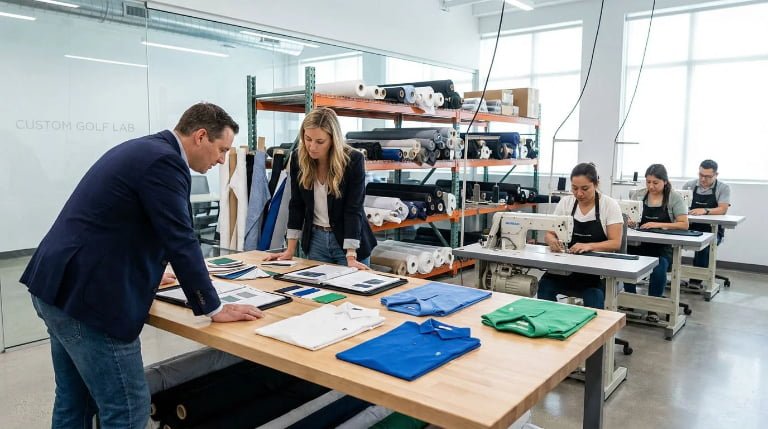
Your golf apparel manufacturer quotes a minimum order quantity (MOQ) of 300 pieces, but your brand only needs 100 for its first launch. Should you negotiate, accept the higher quantity, or find another supplier?
The best way to negotiate MOQ is to make your order easier to manufacture—not simply ask the factory to lower its minimum.
By simplifying fabrics, reducing unnecessary customization, and offering reasonable trade-offs, you may secure a smaller production run without compromising quality.
This guide explains seven practical MOQ negotiation steps, including quotation comparisons, an email template, and a pre-order checklist.
Quick Answer: How Can You Negotiate a Lower MOQ?
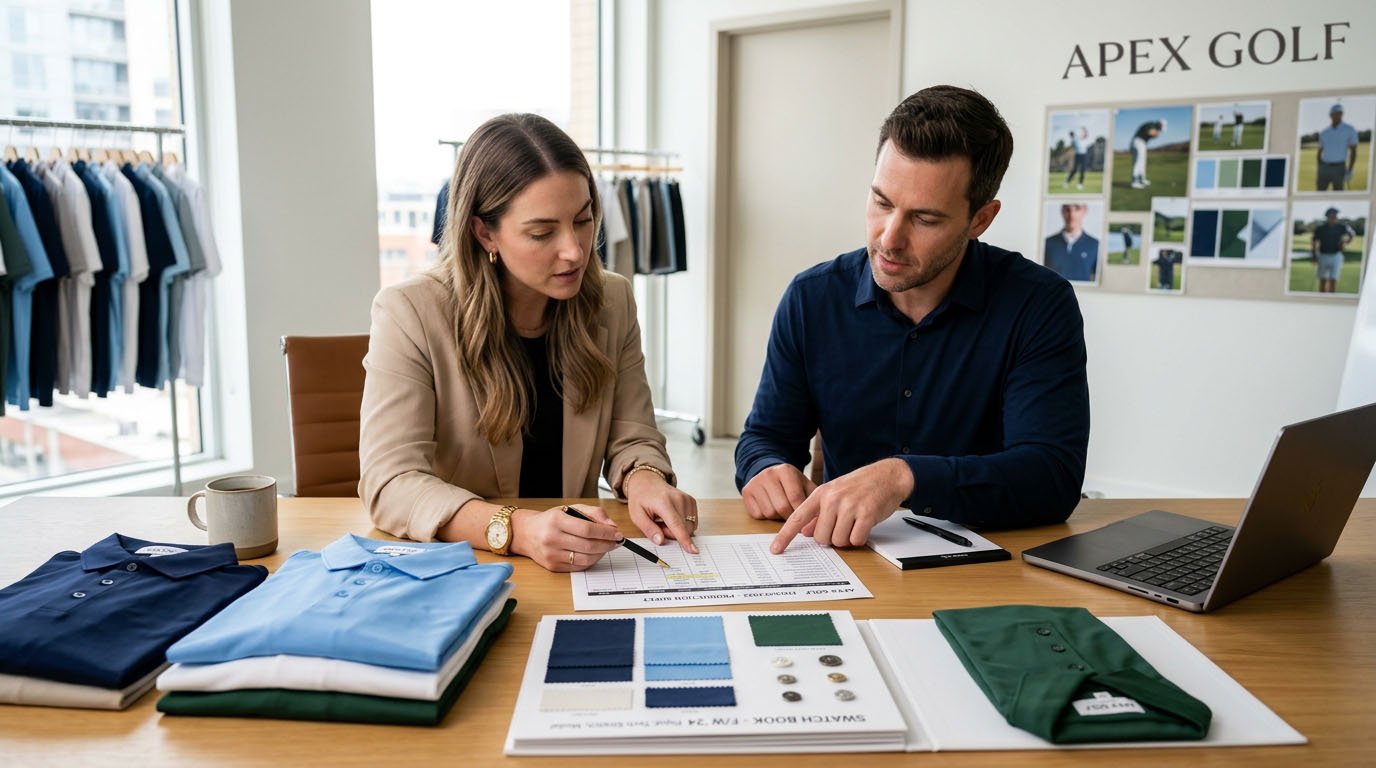
First, identify what makes your order difficult to produce. Then propose changes that reduce the manufacturer's setup or sourcing costs.
| Negotiation Strategy | How It Helps |
|---|---|
| Reduce styles and colors | Concentrates production into fewer batches |
| Use available performance fabrics | Avoids custom fabric production minimums |
| Simplify logos and trims | Reduces component sourcing requirements |
| Accept reasonable unit-price adjustments | Helps cover fixed costs on smaller runs |
| Compare alternative quantities | Identifies the most practical order size |
| Discuss repeat-order potential | Supports future planning without guaranteeing flexibility |
At FUWAY, MOQ generally starts at approximately 100 pieces per style for suitable projects. Requirements depend on fabric availability, colorways, construction, and customization.
For the fundamentals, see our MOQ guide for custom golf polo shirts.
The following steps focus on negotiating after receiving a quotation.
Step 1: Clarify the MOQ Before Negotiating
A factory's MOQ may not apply to your entire order.
It can be calculated per style, colorway, or specific material. Custom components may have separate minimums.
For example, a factory might accept 100 golf polos in one color but require different conditions for the same quantity split across three colors.
Ask These Five Questions
- Is the MOQ calculated per style or per color?
- Can different sizes be included in the same run?
- Is the minimum driven by fabric purchasing or garment production?
- Do labels, logos, or packaging have separate minimums?
- What changes would make my target quantity feasible?
Negotiation tip: Ask which specific requirement prevents the factory from accepting your proposed quantity.
That gives you a practical starting point instead of repeatedly requesting a lower number.
Step 2: Identify What Is Driving the High MOQ
Golf apparel manufacturers coordinate fabric sourcing, cutting, sewing, decoration, and accessory suppliers.
The limiting factor may come from just one part of this process.
| MOQ Bottleneck | Why It Matters | Possible Solution |
|---|---|---|
| Custom-dyed fabric | Fabric mill minimums | Use available colors |
| Multiple colorways | Separate material and production batches | Reduce initial colors |
| Complex construction | Additional setup and labor | Simplify nonessential details |
| Custom trims | Independent supplier minimums | Select standard components |
| Specialized logos | Artwork or tooling requirements | Compare alternative methods |
Golf polos may face additional sourcing requirements for custom collars. Golf skorts require both skirt and liner materials, while quarter-zips may involve specialty zippers.
Understanding these requirements helps you negotiate without removing important product features.
A complete golf apparel tech pack allows the factory to evaluate the exact construction, materials, and customization requirements.
Step 3: Simplify Your Order Without Sacrificing Quality
The most effective MOQ negotiation often begins with your product specifications.
Small design adjustments can make lower-volume manufacturing more practical.
Choose Available Performance Fabrics
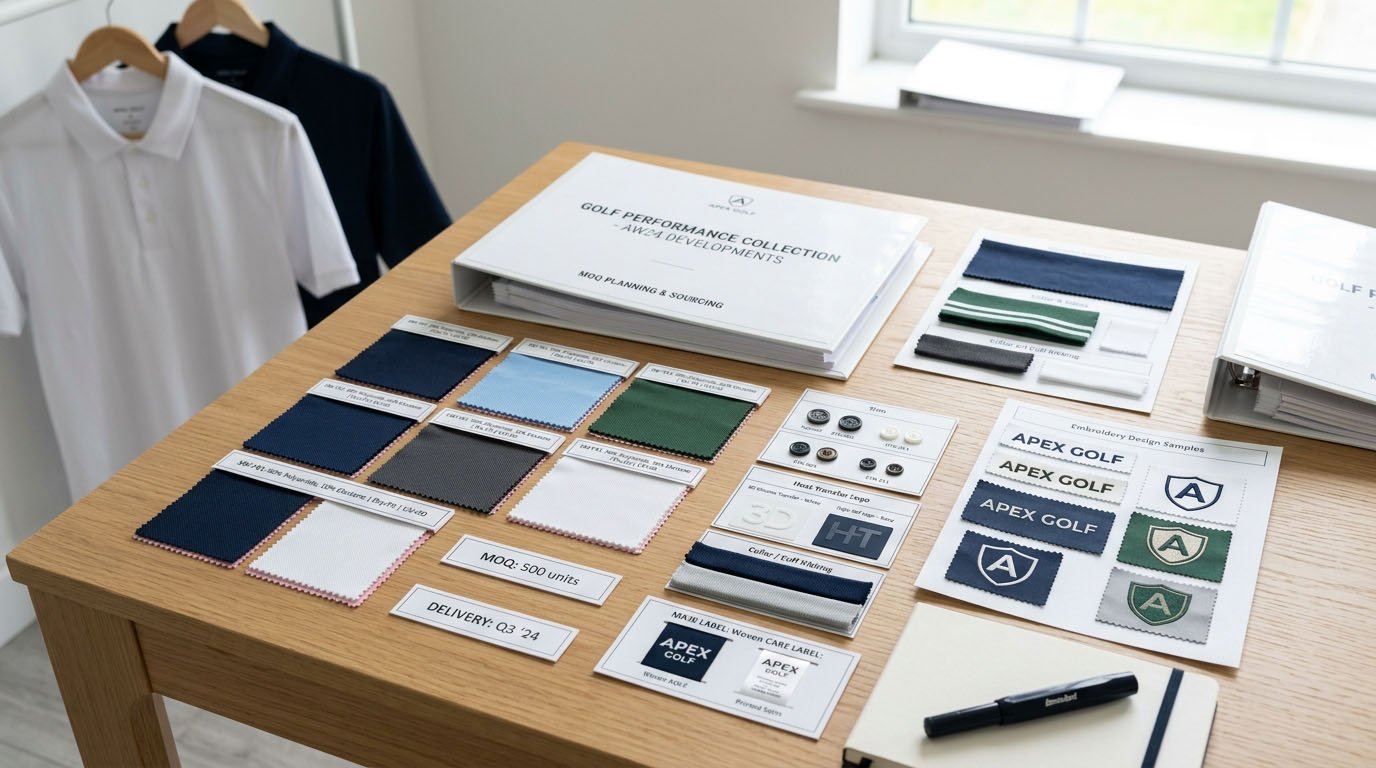
Custom fabric development may require separate knitting, dyeing, or finishing minimums.
Existing performance fabrics can reduce these barriers.
For golf apparel, evaluate available options based on:
- Moisture-wicking performance
- Stretch and recovery
- Breathability
- Weight and hand feel
- Required durability and colorfastness
FUWAY's fabric sourcing service can help identify suitable options.
However, an available fabric must still meet the approved product specifications and testing requirements.
Share Fabrics Across Compatible Styles
A short-sleeve polo and long-sleeve polo may use the same approved performance knit.
This can help consolidate fabric purchasing, but different styles may still require separate cutting and sewing setups.
Avoid forcing unsuitable materials across products merely to lower MOQ. Golf trousers, for example, may need different stretch, structure, and durability characteristics from polos.
Simplify Nonessential Branding
Compare decoration options based on their actual setup requirements.
| Branding Method | MOQ Consideration |
|---|---|
| Standard embroidery | Digitizing and machine setup |
| Heat transfer | Transfer production minimums |
| Screen printing | Screens and color setup |
| Custom silicone badge | Potential tooling and component minimums |
| Jacquard label | Independent supplier minimum |
For smaller orders, standard embroidery or an available heat-transfer option may be more practical than a custom molded component.
Choose the method based on artwork, fabric compatibility, durability, and supplier quotations.
Step 4: Offer Trade-Offs Instead of Demanding a Lower MOQ
A factory may not accept a smaller order at the original unit price. However, it may offer flexibility when production conditions change.
Trade-Off 1: Accept a Reasonable Unit-Price Adjustment
Smaller runs spread fixed setup costs across fewer garments.
Ask:
"What would the unit price be at our target quantity if we keep the approved specifications unchanged?"
Then compare the price increase against the inventory risk of ordering more units than you need.
Trade-Off 2: Use Standard Components
Replacing custom buttons, zipper pulls, or specialty packaging with suitable standard options may eliminate separate sourcing requirements.
Keep essential performance and appearance requirements unchanged.
Trade-Off 3: Offer Flexible Production Scheduling
A manufacturer may have opportunities to accommodate smaller runs when production capacity is available.
A flexible delivery window can help, although it does not guarantee a lower MOQ.
Trade-Off 4: Separate Component Purchasing
If a supplier requires more labels or packaging than your initial garment quantity, ask whether the unused components can be retained for future orders.
Confirm ownership, storage conditions, costs, and future availability in writing.
Important: Do not promise large future purchases or accept unfavorable payment terms simply to obtain a lower MOQ.
Step 5: Request Alternative MOQ and Pricing Quotes
Rather than negotiating only one number, request quotations at several realistic quantities.
This helps you compare total investment, production conditions, and inventory exposure.

Example: Comparing 100, 200, and 300 Golf Polos
Assume your initial order uses one golf polo style, one approved performance fabric, one color, and one chest logo.
Request the following quotations:
| Quotation Item | Option A | Option B | Option C |
|---|---|---|---|
| Quantity | 100 pcs | 200 pcs | 300 pcs |
| Garment style | Same | Same | Same |
| Fabric specification | Same | Same | Same |
| Logo method | Same | Same | Same |
| Unit price | To quote | To quote | To quote |
| Additional fees | Confirm | Confirm | Confirm |
| Lead time | Confirm | Confirm | Confirm |
These are illustrative quotation quantities, not guaranteed production minimums.
Compare Total Cost, Not Just Unit Price
A larger order may reduce unit cost while increasing your total inventory investment.
Calculate:
Total production commitment = Quantity × Unit Price + Applicable Setup and Development Charges
Also consider shipping, import costs, and the cash tied up in unsold stock.
The lowest unit price is not necessarily the best first-order choice.
Ask for the Lowest Workable Quantity
A useful negotiation question is:
"What is the lowest practical quantity for this specification, and what would need to change to reduce it further?"
This encourages the factory to suggest solutions rather than simply reject your request.
Step 6: Send a Clear MOQ Negotiation Proposal
Once you understand the factory's constraints, send a structured request.
Avoid vague messages such as:
"Your MOQ is too high. Can you make 50 pieces?"
Instead, show that you understand how the order can be simplified.
MOQ Negotiation Email Template
Subject: MOQ Discussion – Custom Golf Polo Initial Order
Dear [Manufacturer Name],
Thank you for your quotation.
We are preparing our first custom golf polo collection and would like to discuss a smaller initial production quantity.
Our proposed order is:
- Product: Men's performance golf polo
- Quantity: 100 pieces, one style
- Color: One available fabric color
- Sizes: According to our confirmed size breakdown
- Fabric: Approved stock performance knit
- Branding: One left-chest logo
- Packaging: Standard packaging where suitable
Could you please confirm whether this arrangement is feasible?
If 100 pieces is below your workable minimum, please advise:
- Your lowest feasible production quantity
- Unit prices at 100, 200, and 300 pieces, where available
- Changes that could reduce the MOQ
- Additional development or component charges
- Estimated sampling and production lead times
We are open to reasonable adjustments that maintain the approved garment quality.
Thank you. We look forward to your recommendations.
Best regards,
[Your Name]
[Brand Name]
What If the Manufacturer Refuses?
Ask why the proposed quantity is not workable.
| Factory Response | Recommended Action |
|---|---|
| Fabric MOQ is too high | Request suitable available fabrics |
| Too many colors | Consolidate the color selection |
| Custom trims require more units | Compare standard trims or separate purchasing |
| Production run is too small | Request the lowest workable quantity and price |
| Specifications cannot be met | Consider an alternative design or qualified factory |
Not every MOQ can be reduced.
A manufacturer that clearly explains its limitations may be a better partner than one that accepts any quantity without explaining how quality will be maintained.
Step 7: Confirm MOQ, Quality Standards, and Reorder Terms
Before paying a production deposit, document the final negotiated conditions.
A lower MOQ should not introduce uncertainty about specifications, pricing, or delivery.
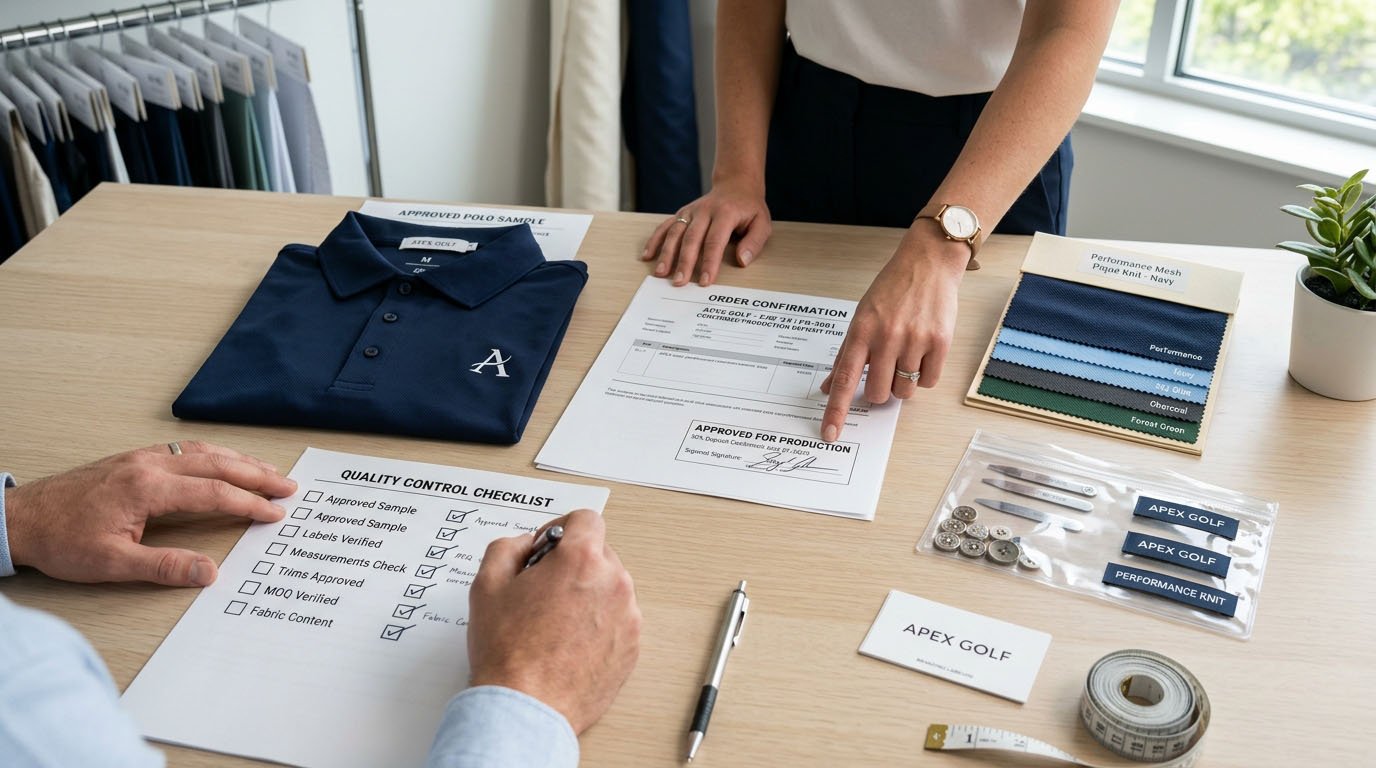
MOQ Negotiation Confirmation Checklist
| Item | What to Confirm |
|---|---|
| Order quantity | Units per style and color |
| Size breakdown | Quantity for each size |
| Fabric | Composition, weight, color, and approved source |
| Decoration | Method, artwork, and placement |
| Components | Labels, buttons, zippers, and packaging |
| Pricing | Unit price, additional charges, and payment terms |
| Sampling | Required samples and approval process |
| Lead time | Production schedule and delivery conditions |
| Quality control | Approved specifications and inspection requirements |
| Reorders | Future MOQ, materials, and pricing conditions |
Never Exchange Product Quality for Lower MOQ
Reducing order quantity should not mean accepting unapproved fabric substitutions, inaccurate measurements, poor decoration quality, or inconsistent colors.
At FUWAY, finished garment measurements at specified measurement points must remain within ±1.0 cm of approved target dimensions, with tighter tolerances where agreed in the Tech Pack.
Any proposed material or construction change must be approved before production.
Our Golf Apparel Quality Control Guide explains how specifications are controlled through production and inspection checkpoints.
Confirm Future Reorder Conditions
Before finalizing the agreement, ask whether subsequent orders will require new fabric minimums, setup charges, or sampling.
If the manufacturer retains unused labels or materials, document their ownership and storage conditions.
Remember that a negotiated first-order MOQ does not automatically apply to future orders.
FAQ: Negotiating MOQ With Golf Apparel Manufacturers
Can I Order 100 Pieces From a Golf Apparel Manufacturer?
Yes. Some manufacturers support orders around 100 pieces per style.
At FUWAY, approximately 100 pieces per style is a common starting point for suitable projects. Final requirements depend on fabric, construction, colorways, and customization.
Can I Reduce MOQ by Paying a Higher Unit Price?
Sometimes. A higher unit price can help cover fixed production costs, but it does not automatically remove fabric mill or component supplier minimums.
Ask which specific cost or sourcing requirement prevents the smaller order.
Can Different Golf Apparel Styles Be Combined to Meet MOQ?
They may share fabric purchasing volume when using the same approved material.
However, each style may still require separate patterns, cutting, and sewing setups. Confirm material MOQ and garment production MOQ independently.
Will Removing Custom Labels or Packaging Reduce MOQ?
It may help when custom components have separate supplier minimums.
Standard alternatives can reduce complexity, provided all applicable labeling and product requirements are maintained.
What If the Factory Will Not Lower Its MOQ?
Ask for the specific constraint and request alternative specifications or quantities.
If the order remains impractical, compare other qualified manufacturers rather than accepting unnecessary inventory or compromising quality.
Conclusion: Negotiate MOQ Through Smarter Order Planning
Negotiating MOQ with a golf apparel manufacturer is not simply about requesting fewer pieces.
The most effective approach is to simplify production requirements, offer reasonable trade-offs, compare alternative quantities, and document the final agreement.
The goal is not always the lowest possible MOQ—it is an order quantity that balances quality, production feasibility, cost, and inventory risk.
Planning your first golf apparel collection?
FUWAY supports OEM/ODM development, fabric sourcing, customization, sampling, and bulk production.
Contact FUWAY with your design specifications and target quantity to discuss a practical manufacturing arrangement.