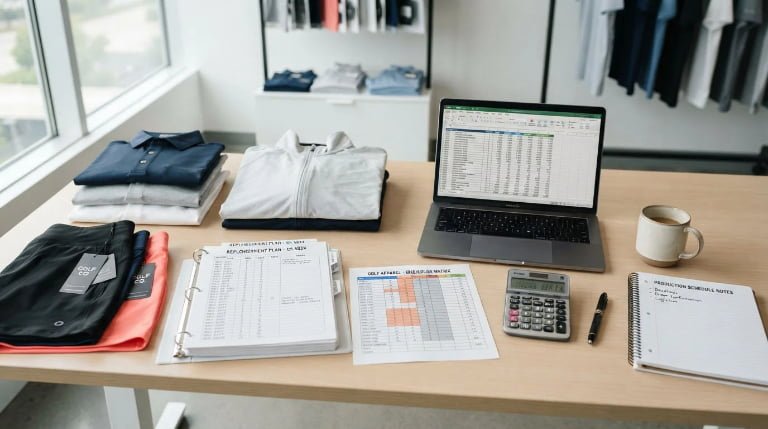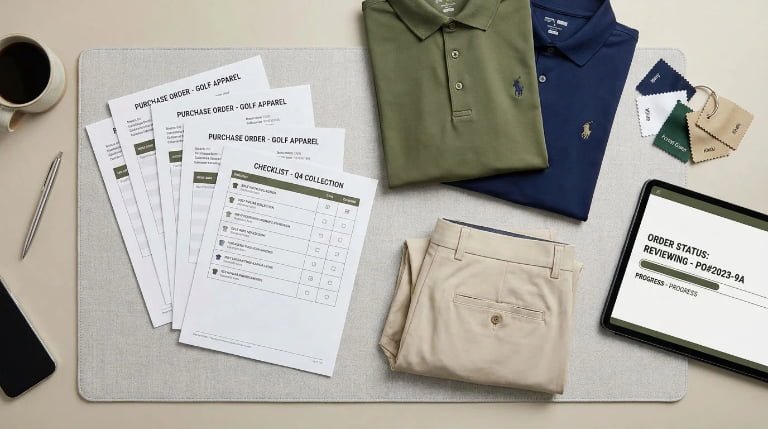
Before placing your first order with an overseas golf apparel manufacturer, you may want to verify more than product photos, samples, and factory certificates.
A live factory video audit allows you to observe production areas, ask questions, and compare a supplier's claims with what it can demonstrate.
To prepare for your first golf apparel factory video audit, define your verification objectives, request relevant documents, arrange a live camera route, prepare product-specific questions, and record evidence gaps before making a sourcing decision.
The goal is not to replace a complete factory inspection. It is to identify potential risks and decide whether the manufacturer deserves further evaluation, sampling, or an on-site audit.
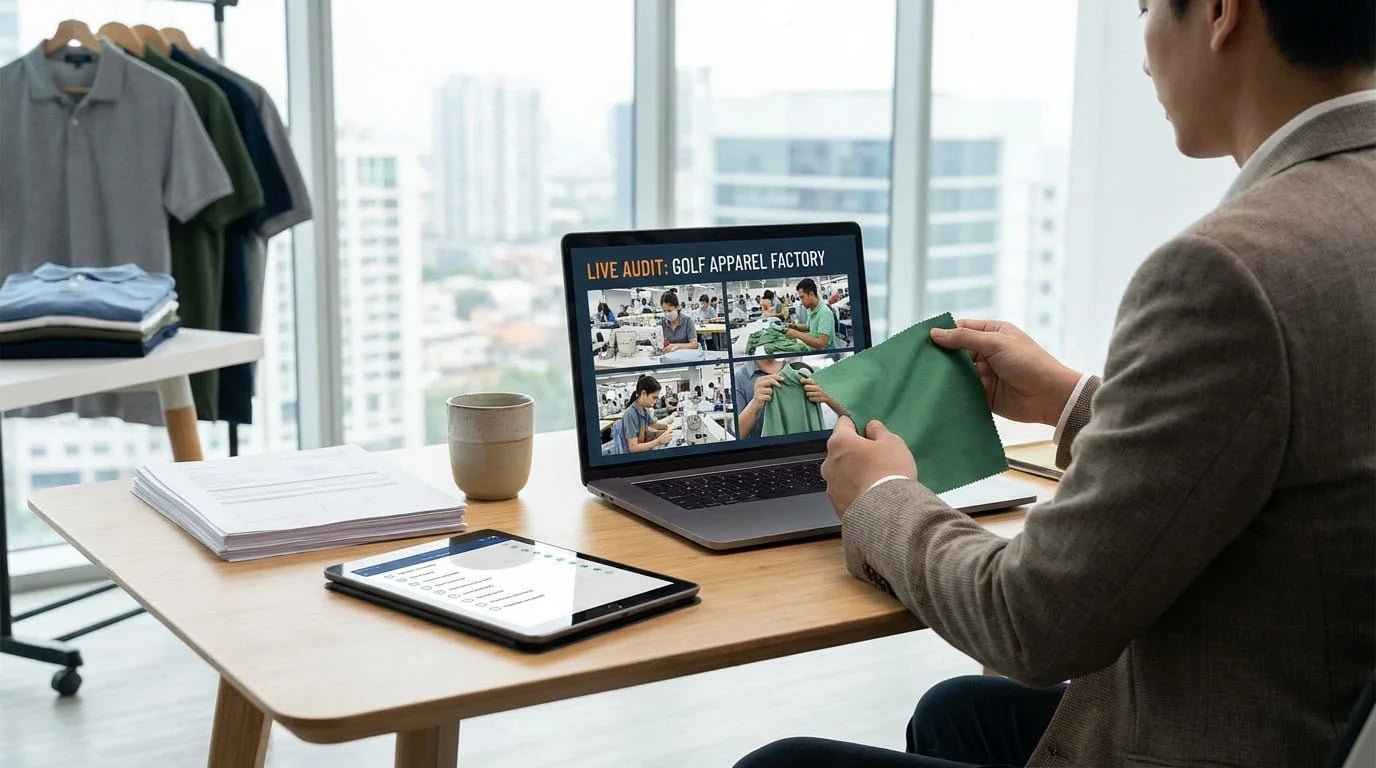
Quick Answer: What Should You Prepare Before a Factory Video Audit?
A successful video audit requires six preparations:
- Audit objectives: Identify the factory capabilities and processes you need to verify.
- Documents: Request relevant production and QC records.
- Camera route: Agree on the areas to review during the live walkthrough.
- Technical questions: Prepare questions about your intended golf apparel products.
- Evidence tracker: Record what was demonstrated and what remains unverified.
- Follow-up plan: Determine what additional evidence or sampling is required.
A video audit should be an interactive verification session, not simply a prerecorded factory presentation.
Step 1: Define What You Need to Verify Before the Call
Your first factory video audit should focus on a few important questions rather than attempt to evaluate every aspect of a manufacturing business.
For golf apparel brands, three objectives are particularly useful.
Confirm the Manufacturing Operation
Can the supplier demonstrate relevant production activities and explain where your products would be manufactured?
Ask which operations are performed internally and which, if any, are outsourced.
Verify Golf Apparel Production Experience
Can the factory demonstrate suitable sewing processes and construction knowledge for golf polos, shorts, skorts, or other products in your collection?
Relevant experience matters more than simply having sewing machines.
Observe Basic Quality-Control Practices
Can the supplier show where inspections occur, how measurements are recorded, and what happens when defects are identified?
Before the call: Send a short audit brief identifying your products, required demonstrations, questions, preferred meeting platform, and expected duration.
For a broader evaluation of factory capabilities, management systems, and supplier risks, refer to our 10-point golf apparel factory audit checklist.
This guide focuses specifically on conducting the live video review.
Step 2: Request Documents and Prepare Your Questions
Documents are most useful when they can be connected to actual factory operations.
Before the audit, request a small set of relevant records, such as:
- Factory profile and production overview
- Examples of comparable golf apparel products
- Production workflow or order records
- QC inspection and measurement records
- Relevant fabric specifications or test reports
The manufacturer may need to anonymize records to protect other customers' information.
Prepare Questions That Require Demonstration
Avoid relying entirely on questions such as "Do you have quality control?"
Instead, ask:
- Can you show where incoming fabric is inspected?
- How are fabric lots identified and separated?
- Could you demonstrate a typical garment measurement check?
- How do operators access approved specifications?
- What happens when a sewing defect is discovered?
- Which processes would be outsourced for our order?
These questions encourage the supplier to demonstrate real procedures rather than provide general assurances.
Confirm Who Will Participate
Ask the factory to assign appropriate staff:
- Account representative: Coordinates the call and questions.
- Production supervisor: Explains equipment and manufacturing processes.
- QC representative: Demonstrates inspection and defect-handling procedures.
One person may cover multiple roles in a smaller factory.
Step 3: Plan a Live Camera Route Through the Factory
One of the most valuable parts of a video audit is observing the actual production environment.
A useful camera route follows the material flow from fabric receiving through cutting, sewing, inspection, and packing.
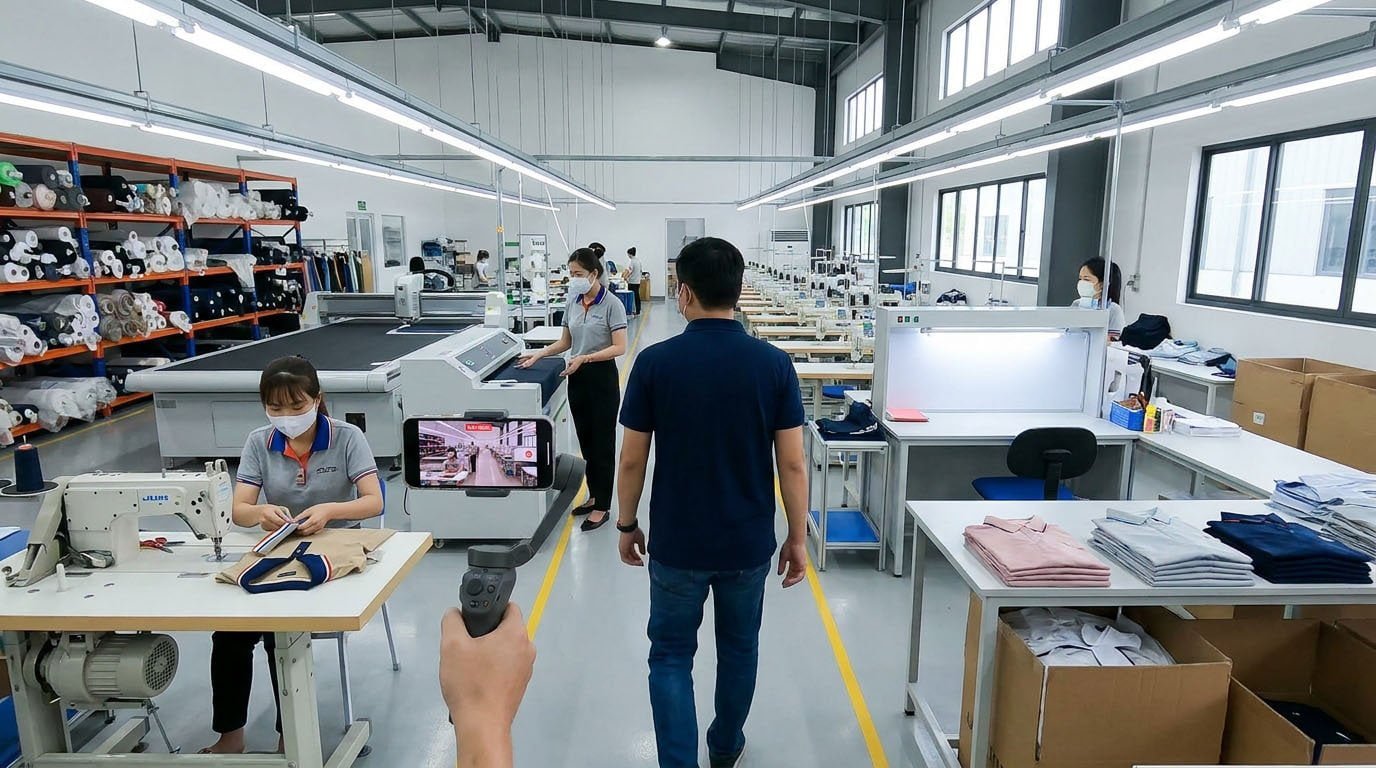
Suggested Factory Video Audit Route
| Camera Stop | What to Observe | Example Buyer Request |
|---|---|---|
| Fabric storage | Material identification and organization | Show how fabric lots are labeled |
| Fabric inspection | Incoming material checks | Demonstrate how defects are recorded |
| Cutting area | Pattern and panel preparation | Explain how sizes are separated |
| Sewing lines | Relevant garment construction | Show a collar or waistband sewing operation |
| QC station | Measurement and defect checks | Demonstrate an inspection record |
| Packing area | Labeling and order identification | Explain how finished goods are checked |
The route should reflect the factory's actual facilities and current production schedule.
Request Limited Unscripted Verification
A planned tour is useful, but buyers should also be able to request reasonable additional views.
For example:
"Could you show the inspection station beside this sewing line?"
Or:
"Can we see how the operator identifies the approved garment size?"
These requests help distinguish genuine operational practices from a purely promotional presentation.
However, respect factory safety rules and the confidentiality of other customers' designs.
Test the Connection Beforehand
Ask the supplier to check video quality, lighting, and audio along the planned route.
Workshop noise and weak wireless coverage can make demonstrations difficult to evaluate. A backup device or connection may help.
If a relevant production line is inactive, request an explanation and arrange another demonstration if necessary.
Step 4: Ask Golf Apparel-Specific Production Questions
A general garment factory tour may show cutting tables and sewing machines, but that does not automatically demonstrate expertise in performance golf apparel.
Different golf products require different construction methods and quality controls.
What Should You Ask to See?
| Product | Construction Focus | Example Video Audit Question |
|---|---|---|
| Golf Polo | Collar and placket construction | How do you check collar alignment and placket symmetry? |
| Golf Shorts | Waistband, pockets, and stretch seams | How do you maintain waistband consistency? |
| Golf Skort | Inner shorts and skirt attachment | How are the liner and outer skirt assembled? |
| Quarter-Zip | Zipper and neckline finishing | How do you prevent zipper misalignment? |
Choose questions relevant to your actual product designs rather than attempting to inspect every garment category.
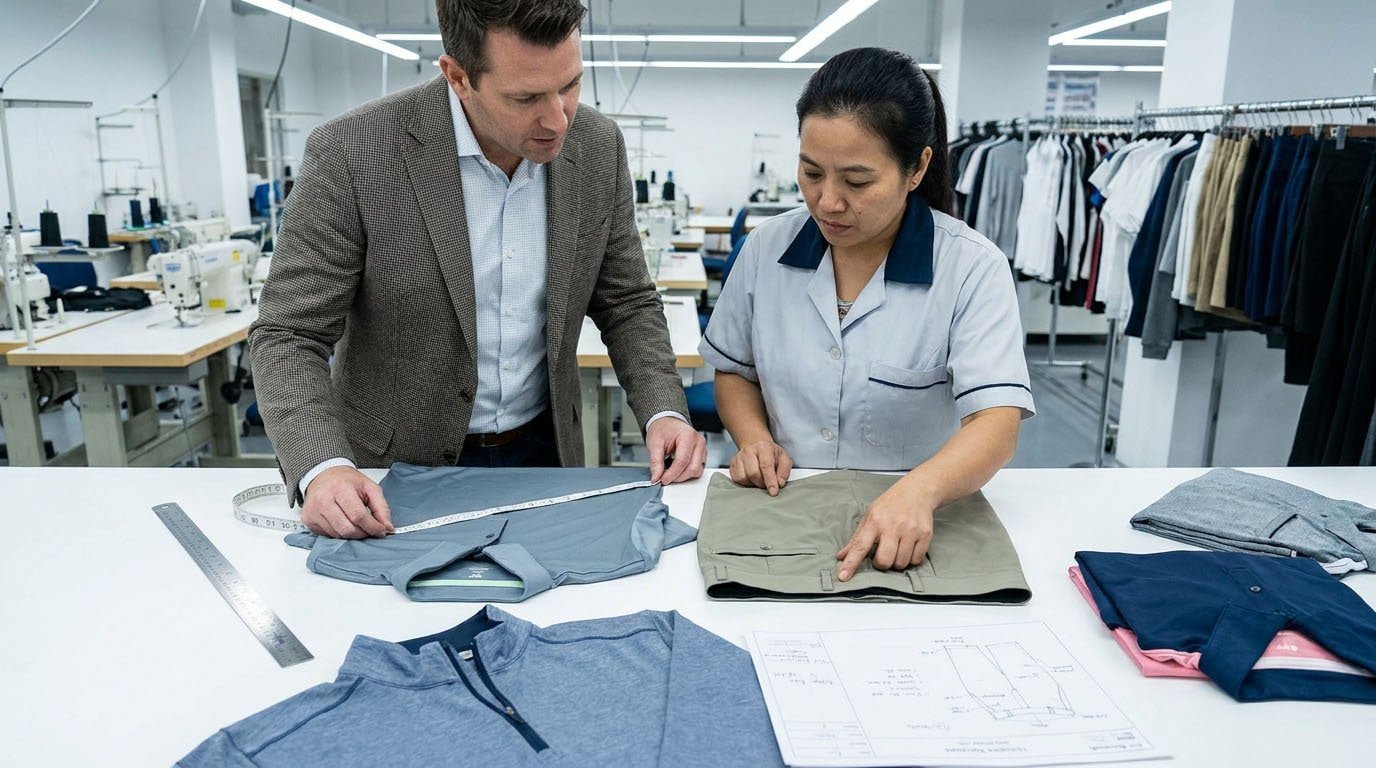
Example: Evaluating Golf Polo Production
Suppose your brand plans to develop a lightweight performance golf polo.
During the video audit, ask the manufacturer to demonstrate:
- How the approved collar reference is communicated to operators.
- How placket alignment is checked during sewing.
- Where finished garment measurements are recorded.
- How logo placement is verified.
- How recurring sewing defects are corrected.
These demonstrations provide more useful information than a general claim of extensive manufacturing experience.
If you are developing a private-label polo collection, review FUWAY's custom golf shirts capabilities for fabric, construction, and customization options.
Look for Relevant Experience, Not Just Equipment
A factory may possess suitable machinery without having substantial experience with your intended product.
Ask for comparable construction examples, approved samples, or production references where available.
Anonymized examples are acceptable when customer confidentiality prevents disclosure.
Step 5: Cross-Check Live Operations With Factory Records
Seeing an active production line does not automatically confirm that quality requirements are consistently followed.
A stronger video audit connects three elements:
What the camera shows → What the factory explains → What the records support
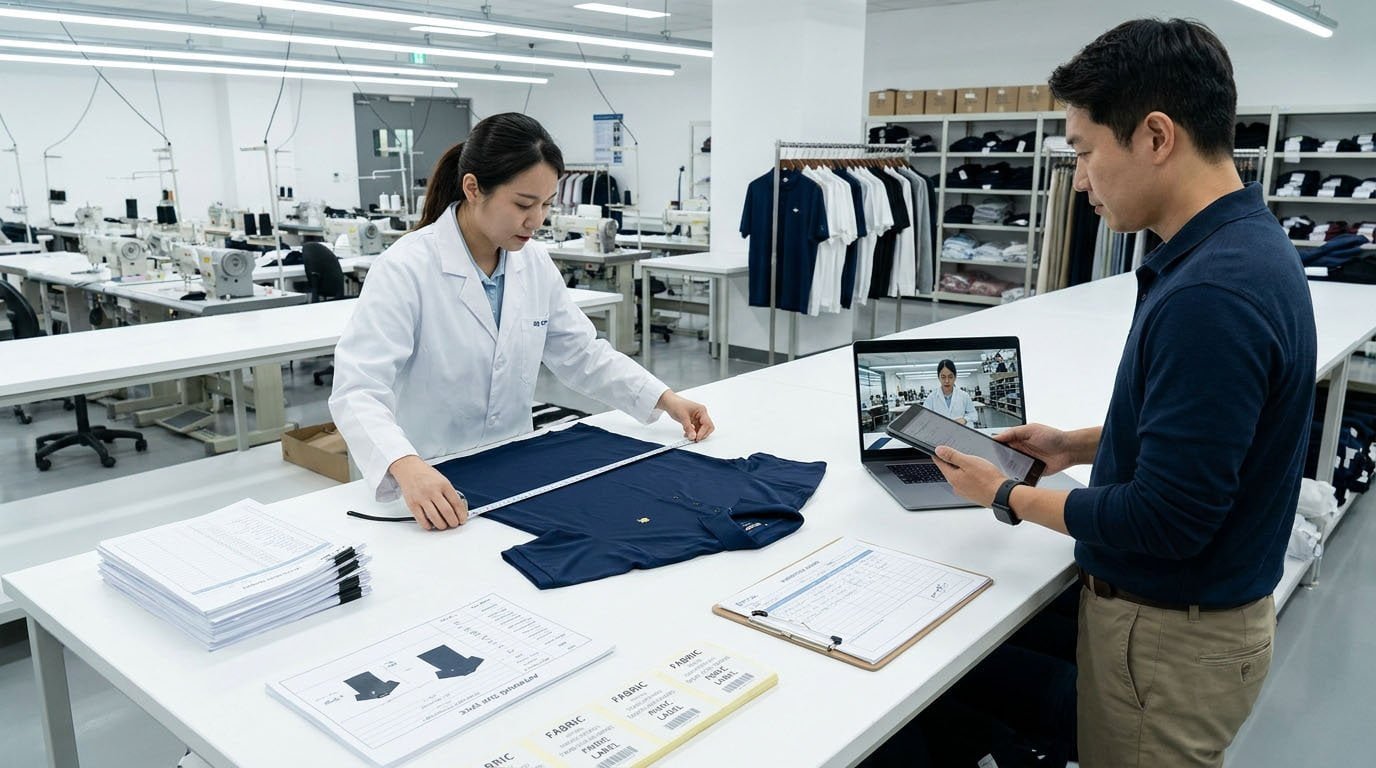
Example: Verifying Measurement Control
Ask the factory to demonstrate a garment measurement at its QC station.
Observe whether the inspector:
- Uses an approved measurement specification.
- Measures the correct points of measure.
- Records actual results.
- Explains how out-of-tolerance garments are handled.
For FUWAY projects, specified garment measurements are controlled within ±1.0 cm of approved target measurements, or tighter tolerances where agreed in the tech pack.
The important question is whether the factory follows its approved specifications consistently.
Check That Records Match the Demonstration
For example:
- A fabric roll identifier should correspond to an appropriate material record.
- A garment being measured should have a relevant size specification.
- An identified defect should follow a defined correction process.
Not every factory uses the same documentation system. What matters is whether the operation can be supported by credible, relevant evidence.
If documents and live observations do not match, request an explanation and supporting evidence.
For detailed inspection procedures, see our Golf Apparel QC Checklist.
A first video audit evaluates whether credible controls exist; it does not replace a full production or pre-shipment inspection.
Step 6: Record Findings and Follow Up After the Call
A video audit is only useful when observations and unanswered questions are documented.
Without written records, buyers may confuse verbal claims with capabilities that were actually demonstrated.
Use a Simple Video Audit Evidence Log
| Audit Area | Evidence Observed | Outstanding Question | Next Action |
|---|---|---|---|
| Production | Relevant sewing operations shown | Can the factory handle our construction? | Review sample |
| Materials | Fabric identification demonstrated | Are required fabric records available? | Request evidence |
| QC | Measurement process observed | How are failed measurements handled? | Review QC record |
| Outsourcing | Production scope explained | Which processes apply to our order? | Confirm in writing |
Classify each finding as:
- Demonstrated: The requested activity or evidence was shown during the call.
- Further evidence required: Additional documentation or verification is necessary.
- Not demonstrated: The factory could not show the requested process or evidence.
Even a demonstrated activity may require independent verification before a high-risk sourcing decision.
Send a Written Follow-Up
After the audit, summarize the evidence reviewed, remaining questions, requested documents, and agreed next steps.
Set realistic deadlines based on the documents or demonstrations required.
This creates a clear record for both the buyer and manufacturer.
Step 7: Decide Whether to Proceed With Sampling or Further Verification
A factory video audit should support your sourcing decision, not replace every supplier qualification step.
After reviewing your findings, determine whether the available evidence supports moving forward.
When Can You Proceed to Sampling?
Sampling may be appropriate when:
- Relevant manufacturing activities have been demonstrated.
- The factory understands your product requirements.
- Basic QC procedures appear credible.
- Major unanswered questions have been addressed.
- The supplier can explain its development and production scope.
Sampling then allows you to evaluate actual fabric, fit, construction, and customization.
A successful video audit does not guarantee consistent bulk production quality.
When Is Further Verification Necessary?
Consider additional checks if:
- Important production claims remain unsupported.
- Outsourced processes are unclear.
- Relevant golf apparel experience cannot be demonstrated.
- Documents contain unexplained inconsistencies.
- The order carries significant commercial or quality risks.
Depending on the project, further verification may include additional video demonstrations, sample testing, third-party inspections, or an on-site audit.
Before making a substantial production payment, review our guide on how to verify a golf apparel factory in China before paying a deposit.
That article addresses wider supplier verification and transaction risks beyond the live video audit itself.
Common Mistakes During Your First Factory Video Audit
1. Accepting a Promotional Video Instead of a Live Review
A prerecorded factory tour may be useful for introductions, but it does not provide the same opportunity for buyer-directed verification.
Request live interaction whenever practical.
2. Asking Only General Questions
Questions such as "Can you produce high-quality golf shirts?" provide limited evidence.
Ask the manufacturer to demonstrate a relevant construction or QC process instead.
3. Trying to Verify Everything in One Call
A first video audit cannot establish every aspect of factory capability, compliance, or long-term consistency.
Prioritize critical risks and arrange additional checks when necessary.
4. Ignoring Unresolved Questions
Do not treat missing evidence as confirmation.
Record outstanding issues, request appropriate follow-up, and consider their importance before proceeding.
Frequently Asked Questions
How Long Should a First Factory Video Audit Take?
A focused initial review may take approximately 45–75 minutes, depending on the facility, products, and audit scope.
More complex evaluations may require additional sessions.
Can a Video Audit Replace an On-Site Factory Audit?
Not completely.
Video audits are useful for initial screening and targeted observations, but high-risk projects may still require physical inspections, independent testing, or third-party verification.
What if the Factory Is Not Producing Golf Apparel During the Call?
Ask for relevant equipment demonstrations, previous production examples, and a follow-up walkthrough when suitable products are being manufactured.
Avoid treating unrelated production as sufficient proof of golf apparel expertise.
Should Buyers Record Their Factory Video Audit?
Recording can help with later technical reviews, but obtain permission and follow agreed confidentiality requirements.
Written notes and authorized screenshots can also support your evaluation.
Conclusion: Make Your First Factory Video Audit Evidence-Based
Your first golf apparel factory video audit should be a structured verification process rather than a polished factory presentation.
Prepare your questions, request relevant production demonstrations, compare live operations with supporting records, and document any remaining risks.
The most important outcome is understanding what the factory can demonstrate, what still needs verification, and whether you should proceed to sampling or further evaluation.
At FUWAY, we support brands developing custom golf polos, shorts, skorts, and other OEM/ODM golf apparel.
If you are evaluating manufacturing options or planning your first custom golf apparel collection, contact FUWAY to discuss your product requirements and next steps.