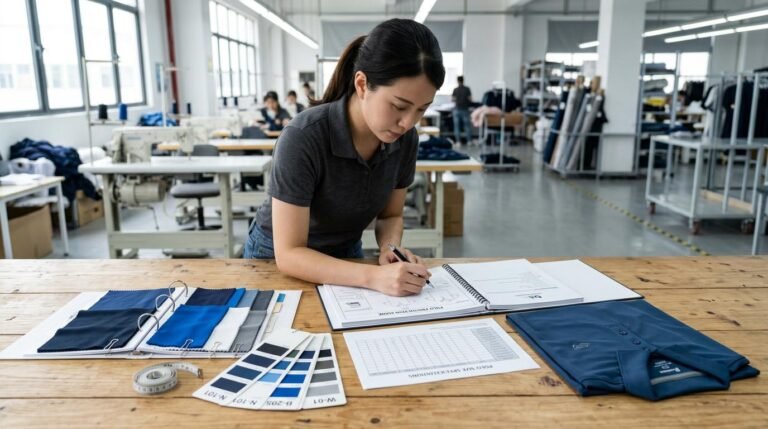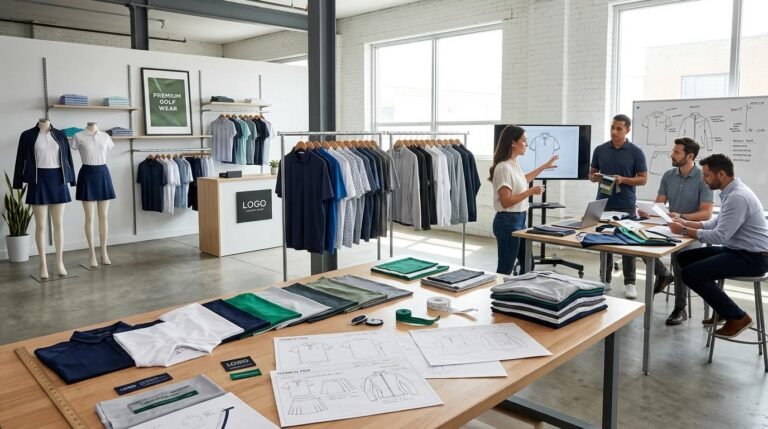
A client wanted to test five color options with 100 pieces each. They asked if we could do 20 pieces per color instead. I explained that would require five separate fabric orders, five logo setups, and five production runs. The per-unit cost would jump from $14 to $28. They were shocked. They thought smaller quantity meant slightly higher cost, not double.
MOQ (minimum order quantity) is not an arbitrary barrier—it is a cost-driven constraint rooted in fabric roll minimums, logo setup fees, and production line efficiency. Understanding these drivers helps you structure orders that respect MOQ economics while testing your market.
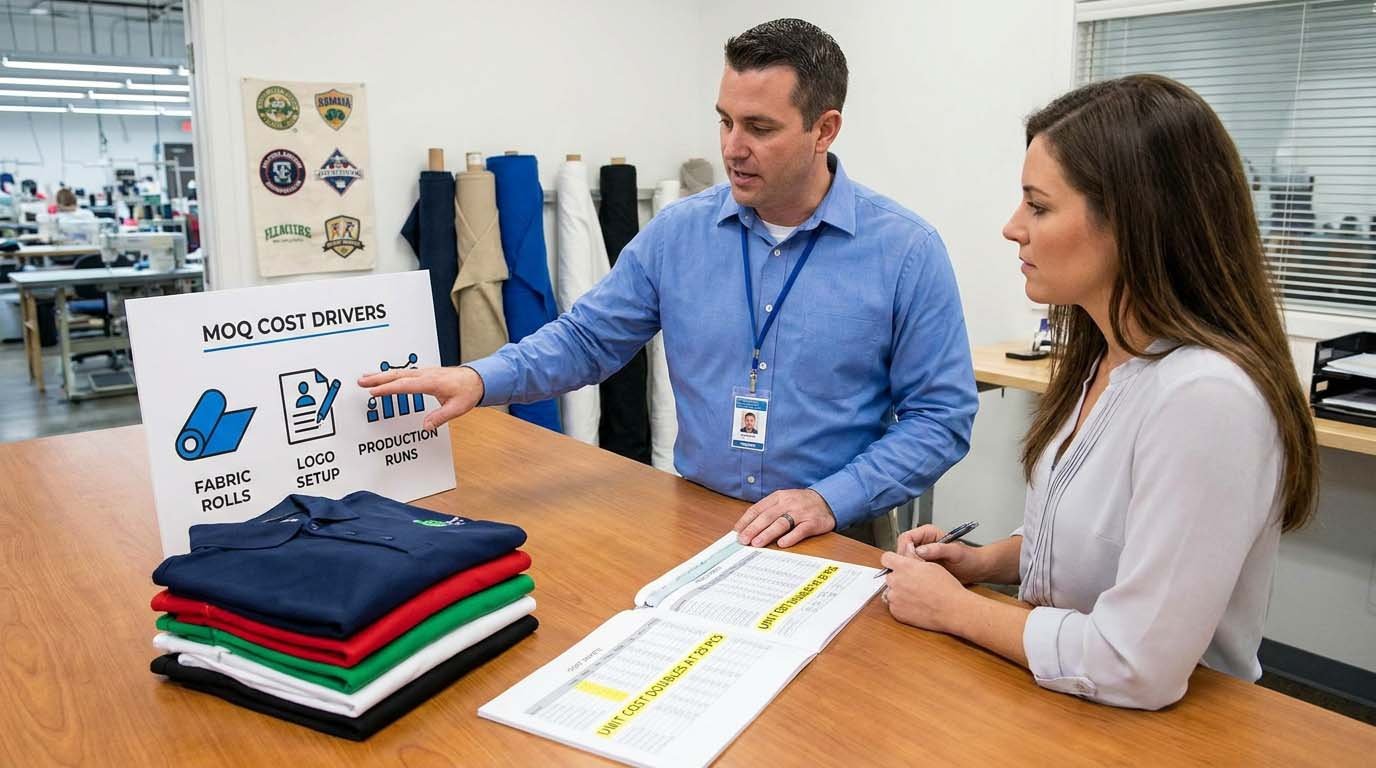
I am Will from FUWAY. I handle MOQ negotiations daily with brands launching their first custom polo orders. My job is translating factory cost structures into decisions that help clients balance inventory risk against unit economics. Most MOQ conversations start with "Can you go lower?" I explain what that lower MOQ costs and why. Some clients find creative ways to work within MOQ constraints. Others chase 100-piece quotes from factories that cut corners on fabric quality or logo execution. This guide shows you how MOQ works from the factory side so you can plan smarter first orders.
Quick Answers: MOQ for Custom Golf Polos
What is MOQ and why does it exist?
MOQ is the minimum order quantity a factory requires to cover fixed costs like fabric roll minimums (typically 500-1,500 meters), logo setup fees ($150-400 per design), and production line efficiency losses. Below MOQ, per-unit costs rise 40-80% because fixed costs concentrate across fewer pieces.
What is the typical MOQ for custom golf polos with embroidered logos?
500-1,000 pieces for fully custom designs with custom fabric colors and embroidered logos. 200-300 pieces if you accept in-stock fabric colors and heat-transfer logos. 100-200 pieces from trading companies that aggregate orders, but expect 25-40% higher unit costs.
Can I negotiate lower MOQ without increasing unit price?
Rarely. You can lower MOQ by accepting constraints: use fabrics the factory already stocks (eliminates fabric roll minimum), choose simpler logo methods (reduces setup costs), or consolidate into fewer colors (improves cutting efficiency). But truly lower MOQ without trade-offs means higher per-unit pricing.
How does splitting my order across multiple colors affect MOQ?
Each color requires separate fabric procurement, cutting, and production setup. If your MOQ is 500 pieces and you want five colors, you effectively need 500 pieces per color (2,500 total) to maintain efficiency. Splitting 500 pieces across five colors (100 per color) increases per-unit cost by 30-50%.
What is the difference between MOQ for stock service vs fully custom?
Stock service (factory's pre-designed styles in their existing colors): 50-100 pieces per color. Made-to-order (your design using in-stock fabrics): 200-500 pieces. Fully custom (your design, custom fabric, custom details): 500-1,000 pieces.
Does higher MOQ always mean better unit pricing?
Up to a point. Price drops significantly from 200 to 500 pieces as fixed costs spread out. Smaller decreases from 500 to 1,000 pieces. Beyond 1,000 pieces, pricing plateaus unless you increase total value enough to justify bulk fabric discounts or dedicated production lines.
How far in advance should I plan if I want to meet MOQ without overstocking?
Calculate your realistic 3-6 month sales projection. If you expect to sell 300 polos across three colors in six months, order 500 pieces in two core colors that represent 70% of projected demand. Use the extra volume buffer for testing secondary channels or replacing sold-out sizes.
What Is MOQ and Why Does Every Factory Have One?
MOQ exists because manufacturing has fixed costs that do not scale linearly with order quantity. Fabric comes in minimum roll lengths, logo setups cost the same whether you produce 100 or 1,000 pieces, and production lines lose efficiency when switching between small batches.
Fixed Costs That Drive MOQ
Fabric roll minimums:
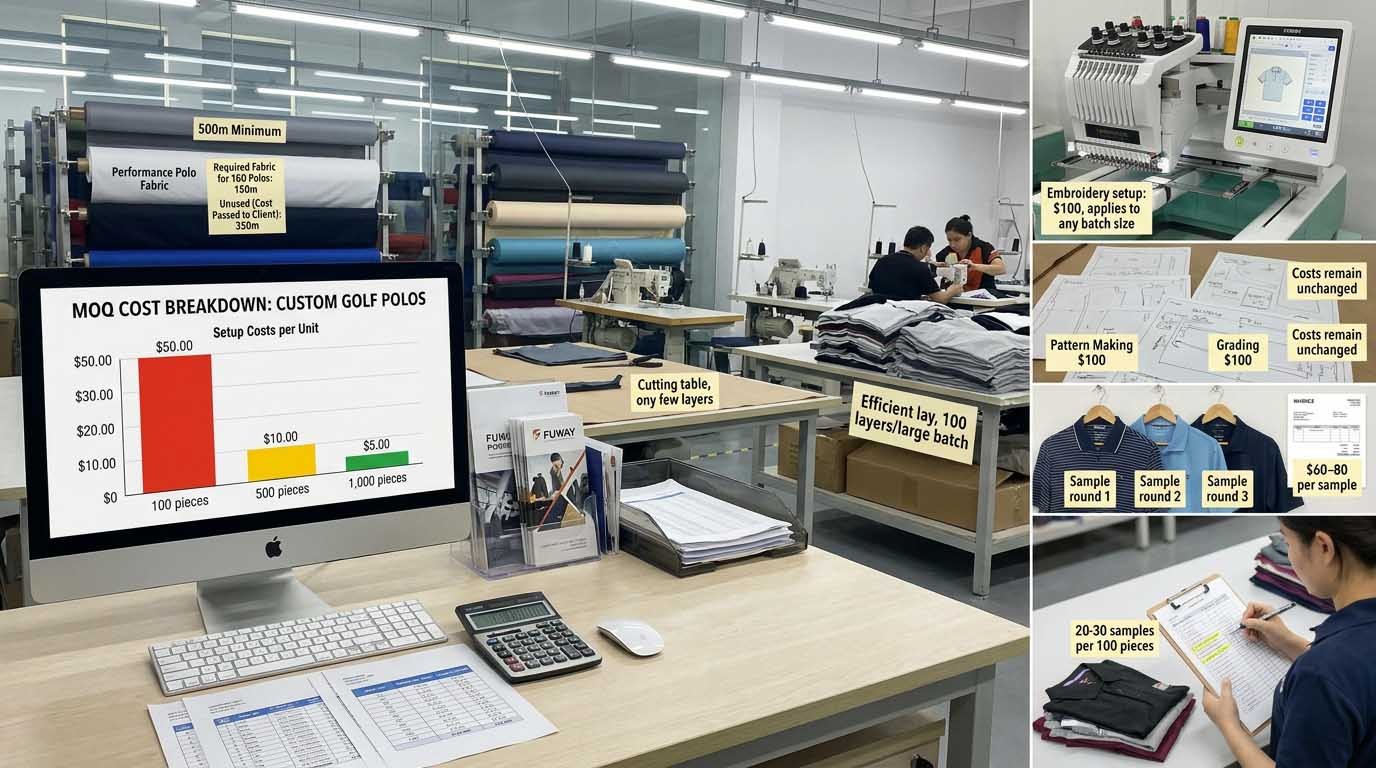
Textile mills sell fabric in rolls of 500-1,500 meters depending on the knit type and finish. A golf polo uses 1.2-1.4 meters of fabric per piece. For 500 polos, you need 600-700 meters—close to one full roll. For 100 polos, you need 120-140 meters, but the mill still sells you a 500-meter minimum. The factory either absorbs the waste, carries inventory risk for the leftover 360 meters, or passes the cost to you.
Logo setup and digitizing:
Embroidery requires converting your artwork into a stitch file (digitizing). This costs $80-150 per logo design. Embroidery machines need setup time—loading the design, adjusting tension, testing on scrap fabric. Setup takes 2-3 hours regardless of whether you embroider 100 logos or 1,000. At 100 pieces, setup cost is $0.80-1.50 per unit. At 1,000 pieces, setup cost drops to $0.08-0.15 per unit.
Pattern making and grading:
Your design needs to be translated into cut patterns for each size. Pattern making costs $100-200. Grading (scaling the pattern across sizes S through XXL) adds another $80-120. These costs are identical for 100 pieces or 1,000 pieces.
Sampling and revisions:
Before bulk production, you approve 2-3 sample rounds. Samples cost $40-80 each. Three rounds across two samples per round = $240-480. At 100 pieces, sampling cost per unit is $2.40-4.80. At 500 pieces, it drops to $0.48-0.96.
Total fixed costs:
$560-950 for a typical custom polo project. Divide this across order quantity to see per-unit impact.
100 pieces: $5.60-9.50 per unit in fixed costs
500 pieces: $1.12-1.90 per unit in fixed costs
1,000 pieces: $0.56-0.95 per unit in fixed costs
This is before adding fabric, labor, or logo execution costs.
Production Efficiency and Line Setup
Beyond cost structures, small orders wreck production efficiency.
Cutting efficiency:
Cutting tables work in lays—stacking 50-100 fabric layers and cutting them simultaneously. For 500 polos across five sizes (100 per size), we stack two lays per size. For 100 polos across five sizes (20 per size), we cannot even fill one efficient lay per size. Cutting waste increases and labor time per piece doubles.
Sewing line balance:
Production lines run most efficiently when batch sizes exceed 200 pieces. Below that, operators spend more time adjusting machine settings, switching thread colors, and handling smaller bundles. Line speed drops 30-40%.
Quality control overhead:
QC inspects samples throughout production. For 1,000 pieces, we inspect 50-80 samples total. For 100 pieces, we still need to inspect 20-30 samples to maintain quality standards. QC cost per unit is much higher on small orders.
I tell clients MOQ is not about factory greed. It is about covering real costs that do not disappear just because you order fewer pieces. When clients ask for lower MOQ, I show them the math. They usually choose to either accept MOQ, pay premium pricing for smaller quantity, or consolidate their order into fewer SKUs to reach minimum efficiently.
What Actually Drives MOQ Up or Down?
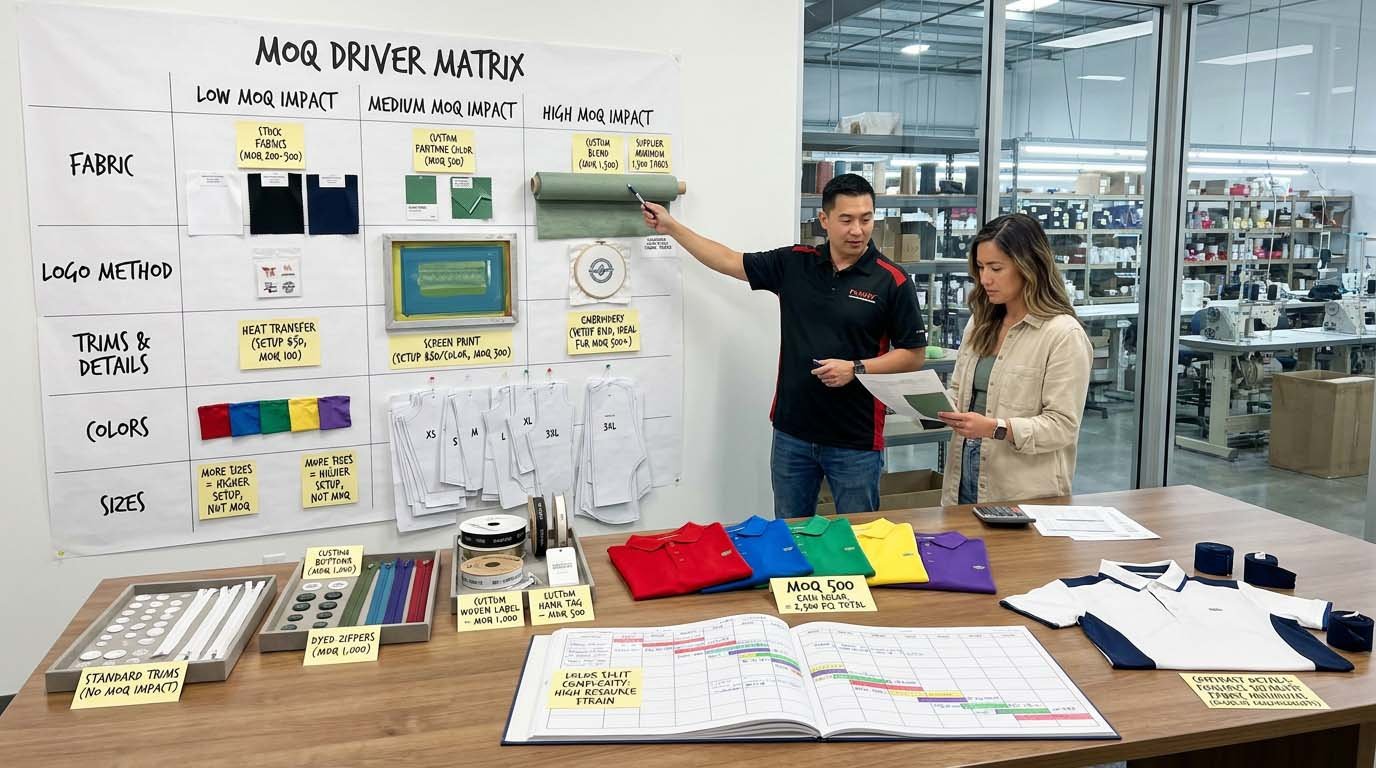
MOQ increases with each layer of customization—fabric specification, logo complexity, trim customization, and color variety—because each addition creates separate supply chain minimums and production setup requirements. The simplest way to reduce MOQ is eliminating custom elements, not negotiating harder.
Fabric Choices and MOQ Impact
In-stock standard fabrics:
Most factories maintain inventory of 20-40 popular fabrics—standard pique, jersey, and performance blends in common weights (140-180 GSM) and neutral colors (white, black, navy, gray). Using these fabrics eliminates fabric roll minimums and cuts 10-15 days from lead time. This often allows MOQ to drop from 500 to 200-300 pieces.
Custom fabric colors:
If you want a specific Pantone color not in the factory's stock, the mill needs to dye fabric specially. Dyeing minimums are typically 500-1,000 meters depending on the mill and color complexity. This adds fabric minimum on top of production minimum.
Custom fabric blends:
Developing a proprietary blend (say 65% polyester / 30% cotton / 5% spandex instead of standard ratios) requires mill development work and 1,500+ meter minimums. Only brands ordering 1,000+ pieces benefit from custom blends.
Performance treatments:
Adding moisture-wicking finish, anti-microbial treatment, or UV protection to base fabric increases minimum because mills batch-treat fabric. Treatment minimums are 800-1,200 meters.
Logo Methods and Setup Costs
Heat-transfer logos:
Setup cost: $50-100 for printing the transfer sheets. Works well for complex multi-color logos and orders under 500 pieces. No per-piece minimum beyond overall order quantity.
Screen printing:
Setup cost: $80-150 per color (each color needs a separate screen). Efficient for simple 1-2 color logos on orders over 300 pieces. Below 300 pieces, setup cost makes heat-transfer more economical.
Embroidery:
Setup cost: $100-200 for digitizing plus machine setup. Most durable and premium-looking option. Efficient at 500+ pieces. Below 300 pieces, consider simpler logo methods unless brand positioning requires embroidery.
Sublimation:
Only works on polyester fabrics. Allows all-over patterns and photo-quality graphics. Setup cost similar to screen printing but enables complex designs without per-color charges. Common for full-custom fashion golf apparel but less common for performance brands.
Trim and Detail Complexity
Buttons:
Standard resin or plastic buttons: no MOQ impact (factories stock these). Custom buttons with your logo molded in: 1,000 pieces minimum from button suppliers. Custom buttons alone can force higher MOQ.
Zippers:
Standard zippers in common colors: no MOQ impact. Custom zipper tape color or custom zipper pulls: 500-1,000 piece minimum from zipper suppliers.
Labels and hang tags:
Woven labels: 1,000 pieces minimum from most suppliers (some offer 500). Printed labels on satin ribbon: 300-500 pieces minimum. Heat-transfer labels: no minimum beyond your order quantity. Hang tags: 500-1,000 pieces minimum for custom printing.
Collar tipping and contrast details:
Any contrast fabric detail (striped collar edge, contrast side panels) requires procuring that second fabric, which carries its own roll minimum. Two-fabric designs effectively double fabric MOQ requirements.
Color and Size Variety
This is where most small brands create their own inventory problems.
Color proliferation:
If your MOQ is 500 pieces and you design five color options, you do not get 100 pieces per color. You get 500 pieces MOQ per color—2,500 total pieces. Each color requires separate fabric cutting, potentially separate fabric procurement (if not all colors are in stock), and separate production setups.
At FUWAY, I see clients design beautiful six-color collections, then get shocked when we quote 3,000 pieces minimum. I explain we can do 500 pieces in one color, or 1,500 pieces across three colors (500 each), but splitting 500 pieces six ways (83 per color) creates production chaos.
Size range complexity:
Offering S-XXL (five sizes) versus XS-3XL (seven sizes) increases cutting complexity and inventory risk. Each size needs separate pattern grading and cutting. The difference between five and seven sizes does not affect MOQ much, but brands should forecast which sizes actually sell before expanding the range.
How Do MOQ Requirements Vary by Product Type?
MOQ ranges from 50 pieces for stock service (factory's pre-made designs) to 300-500 for made-to-order (your design using in-stock materials) to 800-1,500 for fully custom development (unique fabric, trims, and construction). The customization level determines MOQ.
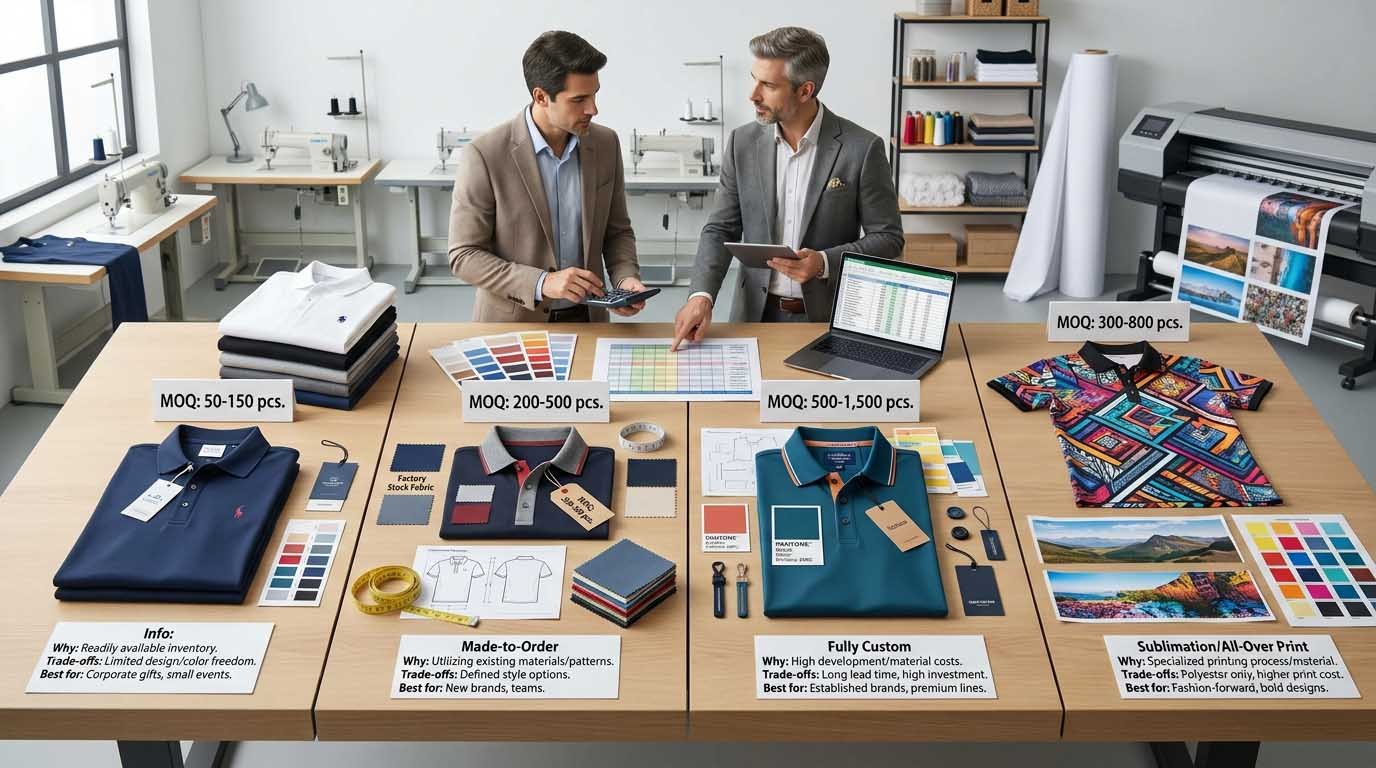
Stock Service: 50-150 Pieces
What it means:
The factory has 10-30 existing polo designs in their catalog. You select one design, choose from their available colors (usually 8-12 options), and specify simple customization like screen-printed or embroidered logo placement. Everything else—collar style, fit, fabric—is predetermined.
Why MOQ is low:
No pattern making, no fabric procurement (they maintain inventory), no construction development. Your only custom element is the logo. Setup cost is $80-200 for logo work spread across 50+ pieces.
Trade-offs:
Zero design differentiation. Your polo looks identical to other brands using the same factory catalog. Fabric and construction quality is whatever the factory chose, not optimized for your positioning.
Who this suits:
Corporate orders, tournament events, team uniforms where branding matters more than unique design. Small resellers testing golf apparel category before committing to custom design.
Made-to-Order: 200-500 Pieces
What it means:
You provide your design (collar style, placket type, fit specifications). The factory uses their in-stock fabric options and standard trims. Logo and label are customized. This is partial customization—your design, their materials.
Why MOQ is moderate:
Pattern development required ($150-300 in fixed costs). Sampling needed (2-3 rounds). But fabric is from stock inventory (no roll minimum), and trims are standard (no custom procurement). Fixed costs of $500-800 spread over 200-500 pieces.
Trade-offs:
Limited fabric selection—you choose from 20-40 fabrics the factory stocks. Limited color selection within each fabric type. Cannot specify proprietary blends or unique finishes.
Who this suits:
Small brands launching first collections with 6-12 month runway before needing reorders. DTC brands testing market fit before scaling to larger custom orders.
Fully Custom: 500-1,500 Pieces
What it means:
Complete control: your design, your fabric specifications (blend, weight, finish), your trim selections (custom buttons, labels, hang tags), your logo methods and placements. Factory executes your complete vision.
Why MOQ is high:
Fabric roll minimums (500-1,500 meters). Custom trim minimums (500-1,000 pieces for buttons, labels, hang tags). Pattern development and sampling. Fixed costs of $800-1,500 require 500-1,000 pieces to keep per-unit impact under $2.
Trade-offs:
Higher capital commitment. Longer lead time (60-90 days vs 30-45 for made-to-order). Inventory risk if your design does not resonate with market.
Who this suits:
Established brands with proven demand executing seasonal collections. Brands with strong design identity where fabric and fit differentiation are core to positioning. Orders where 500-1,000 pieces represent 3-6 months of realistic inventory.
Sublimation and All-Over Print: 300-800 Pieces
What it means:
Full-surface printing (not just logo areas) using dye sublimation. Enables complex patterns, gradients, and photographic prints. Only works on 100% polyester fabrics.
Why MOQ varies:
Sublimation printers work in minimum panel sizes. Small orders (under 300 pieces) create panel waste similar to fabric roll minimums. Above 300 pieces, waste percentage drops and unit cost improves.
Trade-offs:
Limited to polyester fabrics (no cotton blends). Color vibrancy depends on polyester quality. Not suitable for brands positioning around natural fibers or traditional golf aesthetics.
Who this suits:
Fashion-forward golf brands, resort wear brands, or brands targeting younger demographics who prefer bold graphic patterns over classic solid colors.
How Can You Lower MOQ Without Destroying Unit Economics?
A client wanted 200 pieces across four colors. I said our MOQ was 500. They asked how to make it work. I explained three options: consolidate to two colors (100 per color is still inefficient but more feasible than 50 per color), accept our in-stock fabric colors instead of custom Pantone matching, or pay $3-4 more per unit to compensate for the efficiency loss. They chose to consolidate colors and hit 250 pieces in two colors at standard pricing.
The only ways to lower MOQ without wrecking unit economics are: eliminate custom fabric procurement by using stock fabrics, consolidate SKUs to concentrate volume, simplify logo execution, or pay premium pricing to cover fixed cost concentration.
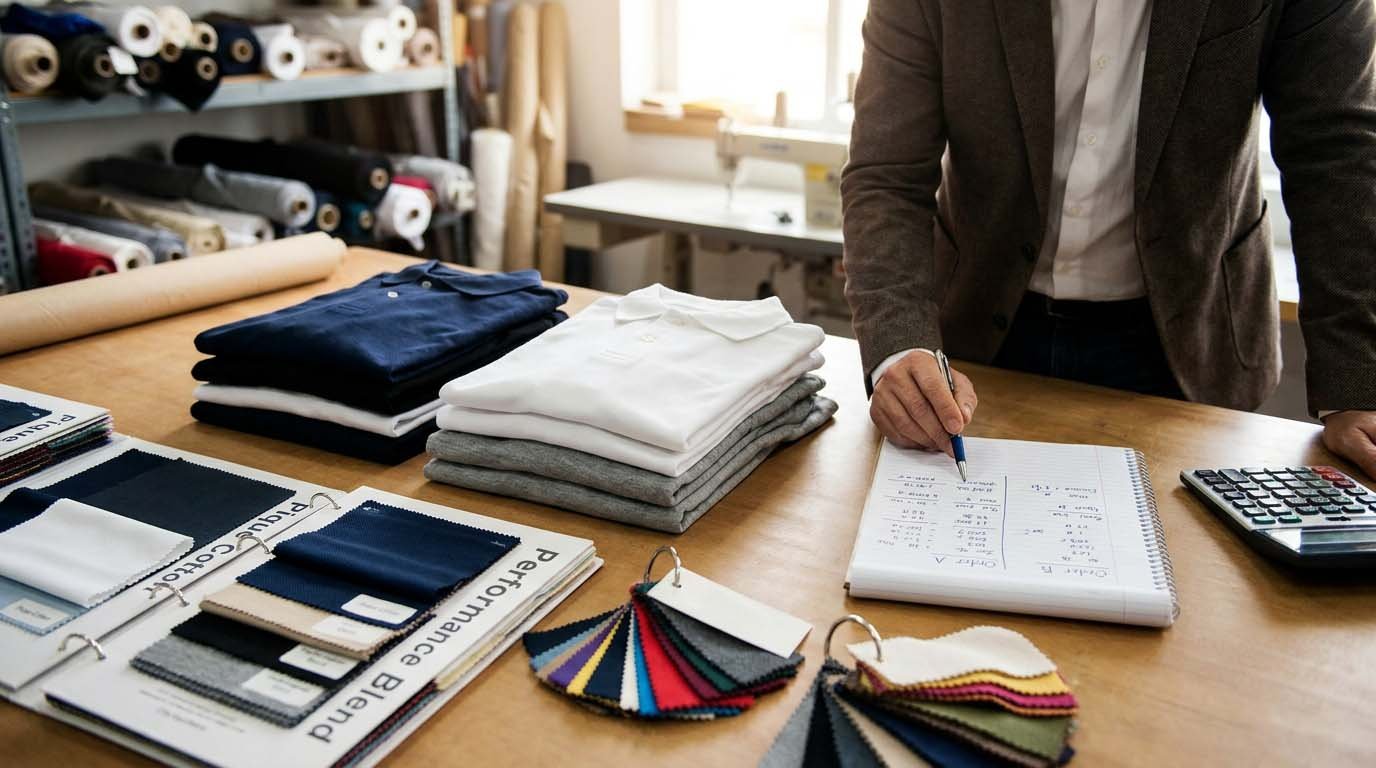
Strategy 1: Use Stock Fabrics and Colors
What this means:
Ask the factory what fabrics they currently stock. Most maintain 1,000-3,000 meters of 20-40 popular fabrics. If you can design your polo using their stock options, you eliminate the 500-1,500 meter fabric roll minimum.
How much this helps:
Often allows MOQ to drop from 500 to 200-300 pieces. Cuts 10-15 days from lead time. Reduces per-unit cost by $1-2 by eliminating fabric procurement overhead.
Trade-offs:
Limited color selection—usually 6-12 colors per fabric type. You might not get your exact Pantone match. Fabric blend and weight options are predetermined.
Implementation:
Before finalizing your design, request the factory's stock fabric catalog with available colors, weights, and performance specs. Design around what exists rather than specifying custom requirements.
Strategy 2: Consolidate Colors and SKUs
What this means:
Instead of 500 pieces across five colors (100 per color), order 500 pieces across two colors (250 per color). Instead of offering six size options, offer four core sizes.
How much this helps:
Dramatically improves cutting efficiency and reduces fabric waste. Factory can run larger production batches per color/size combination, improving quality consistency.
Trade-offs:
Less variety for testing market preferences. Risk of overstock if you bet on wrong color. Cannot accommodate wide range of body types with limited size range.
Implementation:
Analyze your target market data or competitor reviews to identify 2-3 colors that represent 70-80% of golf apparel demand (typically navy, black, white, or gray). Concentrate your first order on proven colors. Expand palette after confirming baseline demand.
Strategy 3: Simplify Logo Execution
What this means:
Use heat-transfer or screen-print logos instead of embroidery. Place logo in one position instead of multiple positions. Simplify logo design to 1-2 colors instead of 4-5 colors.
How much this helps:
Reduces logo setup cost from $200-350 (multi-position embroidery) to $50-120 (single-position heat-transfer). Makes 200-300 piece orders more economical.
Trade-offs:
Heat-transfer and screen-print are less durable than embroidery. Heat-transfer can peel or crack after 20-30 washes. Screen-print fades faster than embroidery stitching.
Implementation:
For test orders under 500 pieces, use heat-transfer logos to minimize setup costs. Once you prove demand and scale to 800-1,000+ pieces, upgrade to embroidery for better durability and premium perception.
Strategy 4: Accept Higher Per-Unit Pricing
What this means:
Order your desired quantity and customization level, but pay a premium to compensate factory for fixed cost concentration and efficiency loss.
How much this costs:
200 pieces might cost 25-40% more per unit than 500 pieces. 100 pieces might cost 50-80% more per unit. The premium covers fabric waste, setup cost concentration, and production inefficiency.
When this makes sense:
When market testing value exceeds per-unit cost optimization. If learning which design resonates is worth paying $16 per unit instead of $12, do it. Failed inventory from wrong design at $12 per unit costs more than successful test at $16 per unit.
Implementation:
Ask factories for tiered pricing: What does 200 pieces cost versus 500 pieces versus 1,000 pieces? Calculate your break-even and sell-through requirements at each tier. Choose the quantity where reasonable sell-through (60-80%) covers your investment.
Strategy 5: Commit to Reorder Volume
What this means:
Some factories will run your first 200-300 pieces at 500-piece pricing if you commit to 500 total pieces across two orders within 4-6 months.
How this works:
Factory spreads fixed costs (pattern making, logo setup, fabric minimum) across your total commitment. They carry some inventory risk on leftover fabric from your first order, confident your reorder will use it.
Requirements:
You must provide a written commitment or deposit covering the future order. Factory will hold your patterns, logo files, and potentially fabric inventory.
When this works:
When you have reasonable confidence in 3-6 month demand but want to stage inventory risk across two shipments. Common for seasonal launches where you order initial stock in January and reorder in April based on sell-through.
What Are the Real Cost Trade-Offs Between Order Sizes?
A client asked why 300 pieces cost $15.50 per unit but 600 pieces only cost $12.80 per unit—a $2.70 difference. They assumed doubling quantity should reduce cost by maybe 10-15%, not 18%. I showed them the cost breakdown. Fixed costs per unit dropped from $2.30 to $1.15 (saving $1.15). Fabric cost per unit dropped from $6.20 to $5.40 because we could negotiate better mill pricing for larger roll (saving $0.80). Labor efficiency improved, saving another $0.75 per unit. This is why unit economics change dramatically between 300 and 600 pieces.
Cost does not scale linearly with quantity because fixed costs concentrate differently and variable costs benefit from bulk procurement and production efficiency. The biggest per-unit cost drop happens from 200 to 500 pieces. Beyond 1,000 pieces, cost reduction slows significantly.

Cost Breakdown Across Order Sizes
Here is a realistic cost structure for a custom golf polo with embroidered logo:
200 pieces:
Fixed costs per unit: $3.20 (pattern, sampling, logo setup)
Fabric per unit: $6.50 (buying 280 meters, high waste)
Labor and overhead per unit: $3.80 (low efficiency)
Logo execution per unit: $2.20 (embroidery)
Trims and packaging per unit: $1.10
Total: $16.80 per unit
500 pieces:
Fixed costs per unit: $1.30 (same fixed costs, more pieces)
Fabric per unit: $5.80 (buying 700 meters, better mill pricing)
Labor and overhead per unit: $3.00 (improved efficiency)
Logo execution per unit: $1.80 (embroidery amortization)
Trims and packaging per unit: $0.90 (bulk trim pricing)
Total: $12.80 per unit
1,000 pieces:
Fixed costs per unit: $0.65 (well-amortized)
Fabric per unit: $5.20 (full roll pricing, minimal waste)
Labor and overhead per unit: $2.60 (high efficiency)
Logo execution per unit: $1.50 (full amortization)
Trims and packaging per unit: $0.80 (bulk discounts)
Total: $10.75 per unit
2,000 pieces:
Fixed costs per unit: $0.35
Fabric per unit: $4.90 (multi-roll discount)
Labor and overhead per unit: $2.40 (peak efficiency)
Logo execution per unit: $1.40
Trims and packaging per unit: $0.75
Total: $9.80 per unit
The cost curve shows:
- Largest drop: 200 to 500 pieces (24% cost reduction)
- Moderate drop: 500 to 1,000 pieces (16% cost reduction)
- Smaller drop: 1,000 to 2,000 pieces (9% cost reduction)
Calculating Your Break-Even Volume
Simple break-even formula:
Break-even units = Total order cost / (Retail price - Variable costs)
Example: You order 500 pieces at $12.80 per unit = $6,400 total cost.
Your retail price is $65. Your variable costs (shipping to customers, payment processing, marketing) are $20 per unit.
Break-even = $6,400 / ($65 - $20) = 142 units
You need to sell 142 pieces (28% of inventory) to cover your manufacturing investment. Anything beyond 142 units is gross profit.
Risk-adjusted planning:
If you expect 60% sell-through in 6 months (reasonable for new brands), you will sell 300 of 500 pieces.
Revenue: 300 × $65 = $19,500
Costs: 500 × $12.80 = $6,400 (manufacturing) + 300 × $20 = $6,000 (variable) = $12,400 total
Profit: $19,500 - $12,400 = $7,100
If you ordered 200 pieces at $16.80 per unit instead:
Manufacturing: 200 × $16.80 = $3,360
At 60% sell-through: 120 units sold
Revenue: 120 × $65 = $7,800
Costs: $3,360 + (120 × $20) = $5,760
Profit: $7,800 - $5,760 = $2,040
The 500-piece order at lower unit cost generates $5,000 more profit despite higher capital commitment, assuming same sell-through percentage.
When Smaller Orders Make Sense
Lower MOQ makes sense in specific scenarios:
Unproven demand:
If you have no market validation—no pre-orders, no email list, no competitor analysis—smaller quantity limits downside risk. Paying $16 per unit for 200 pieces risks $3,200. Paying $12 per unit for 500 pieces risks $6,000. If your product fails, you lose less.
Rapid iteration testing:
If you are testing multiple design variations (three different collar styles, two fit options) to determine which resonates, smaller batches per variation make sense. Better to test 150 pieces each across three designs than commit 500 pieces to one untested design.
Cash flow constraints:
If your total available capital is $5,000, ordering 500 pieces at $12 per unit ($6,000) is not feasible. Order 200 pieces at $16 per unit ($3,200), sell those, and use revenue to fund larger second order.
Short season window:
If you are launching for a specific 8-week tournament season, overstock risk is high. Order conservatively for known demand rather than optimizing unit cost.
How Should You Negotiate MOQ and Plan Your First Order?
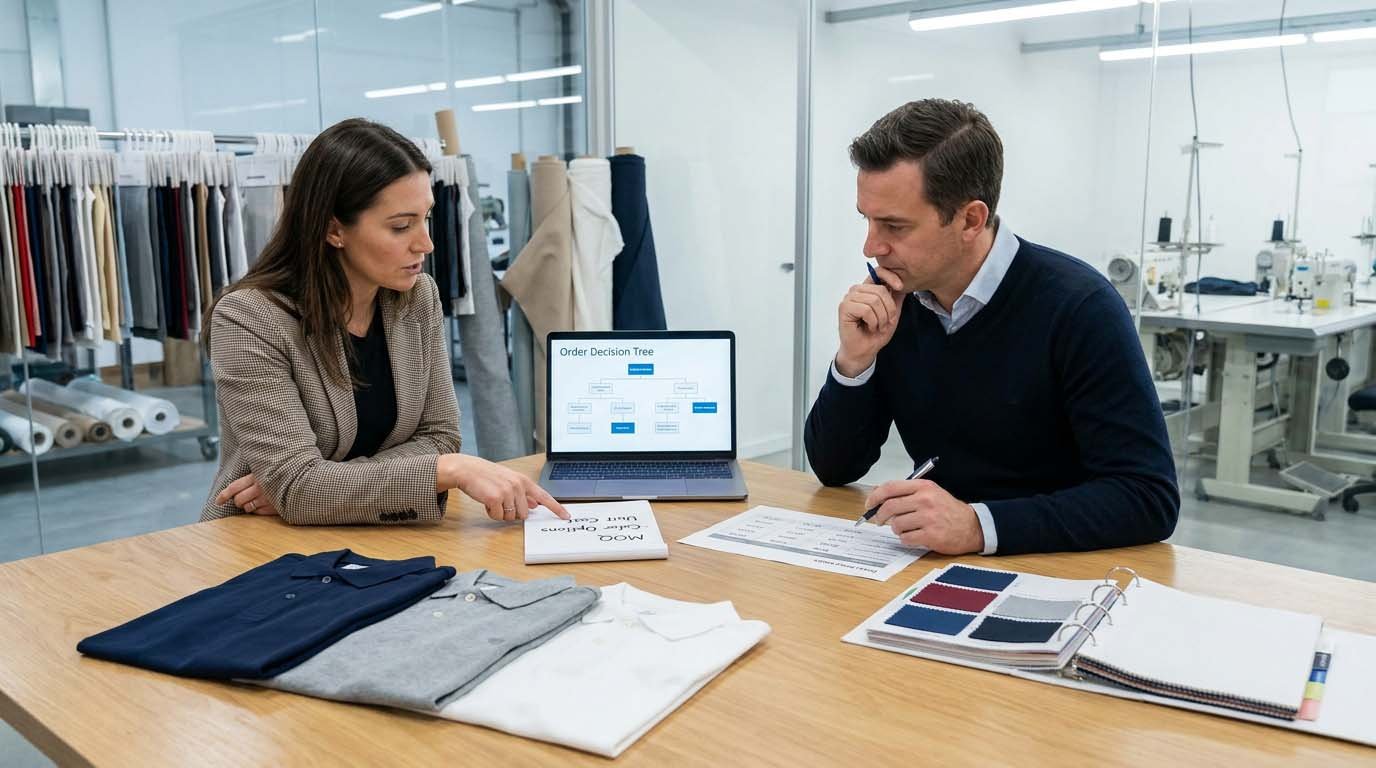
MOQ negotiation is not about getting factories to "go lower"—it is about understanding which constraints you can accept (limited color options, higher per-unit cost, longer lead times) in exchange for lower volume. Effective negotiation requires knowing what you can compromise and what matters most to your launch.
Questions to Ask Before Negotiating
What is the MOQ breakdown per color/SKU?
If the factory quotes 500-piece MOQ, does that mean 500 total pieces across all colors, or 500 pieces per color? This changes the conversation dramatically.
At FUWAY, our 500-piece MOQ is total across all colors if you keep it to 2-3 colors. But if you want five colors, we need 400-500 pieces per color because each color requires separate fabric procurement and production setup.
What elements drive your MOQ and which are flexible?
Ask the factory to separate MOQ drivers: fabric minimum, logo setup efficiency, production batch size. This reveals negotiation levers. Maybe fabric is flexible (they have stock) but logo setup requires 300+ pieces for economic embroidery.
What does accepting in-stock options save?
Ask: "If I choose from your stock fabric colors, how much does MOQ drop?" Often this cuts MOQ by 30-40% because fabric roll minimum disappears.
What is the cost penalty for lower MOQ?
Request tiered pricing. "Quote me 200, 300, 500, and 1,000 pieces." See where the cost curve flattens. If 300 pieces is only $1 more per unit than 500 pieces, that might be acceptable. If it is $4 more per unit, the economics change.
Can we stage orders with commitment?
Ask: "If I commit to 500 pieces over two orders (250 now, 250 in three months), can you run the first batch at 500-piece pricing?" Some factories will negotiate this if you provide a deposit or written commitment.
Common Negotiation Mistakes
Mistake 1: Comparing only headline MOQ numbers
Factory A says 300-piece MOQ. Factory B says 500-piece MOQ. You assume Factory A is better. But Factory A uses stock service with no customization. Factory B offers full customization. You are comparing different products.
Mistake 2: Focusing only on per-unit cost
Factory C quotes $11 per unit at 500 pieces. Factory D quotes $13 per unit at 500 pieces. You choose Factory C. But Factory C skips pre-production sampling and final inspection. You receive bulk with 8% defect rate, costing you $3 per unit in returns and lost sales. Factory D includes full QC and has 2% defect rate. True cost is lower at Factory D.
Mistake 3: Splitting small quantities across too many SKUs
You negotiate 300-piece MOQ, then design six colors. Factory explains that is 50 pieces per color, which is below efficient batch size. They agree to do it but charge 40% more per unit to cover waste and setup. You would have been better off ordering 500 pieces in three colors at standard pricing.
Mistake 4: Chasing lowest MOQ without checking factory capability
You find a factory offering 100-piece MOQ. You assume that is better than 500-piece MOQ factories. You order. Quality is inconsistent. Logo placement varies by 3-4cm across pieces. The factory has no documented QC procedures. You cannot sell 40% of inventory. Low MOQ meant nothing without quality execution.
How to Structure Your First Order Intelligently
Step 1: Forecast realistic 3-6 month demand
Review competitor pricing, Amazon Best Sellers Rank for similar products, or use your email list size to estimate. If you have 2,000 email subscribers with typical 2-3% conversion, expect 40-60 initial sales. Plan inventory for 3-5x initial sales to account for repeat customers and growth. This suggests 200-300 pieces.
Step 2: Identify your 2-3 core SKUs
Do not launch with six color options and seven sizes. Launch with two colors that represent 60-70% of golf apparel market (navy, black, white, or gray) and four core sizes (M, L, XL, XXL). Concentrate volume in fewer SKUs.
Step 3: Map your constraints
List your priorities:
- Maximum capital available: $ X
- Launch deadline: X weeks
- Must-have customization (logo method, fabric feel)
- Nice-to-have customization (custom buttons, multiple logo positions)
Step 4: Request tiered quotes
Ask factories for pricing at 200, 300, 500, and 1,000 pieces with your exact specs. Then ask for pricing at 300 pieces with simplified specs (in-stock fabric, heat-transfer logo). Compare total cost and per-unit economics across options.
Step 5: Choose the structure that balances risk and reward
If you have strong demand signals (pre-orders, proven audience), order at higher MOQ for better unit economics. If you are testing unproven concepts, accept higher per-unit cost for lower volume to limit downside.
At FUWAY, I walk clients through this framework instead of simply saying "our MOQ is 500, take it or leave it." About 40% of clients optimize into 500 pieces across two colors at standard pricing. Another 40% choose 300 pieces at premium pricing to test market fit. The remaining 20% realize they need to build more demand before manufacturing and delay their order—which is better than placing an order they cannot sell.
Conclusion
MOQ for custom golf polos ranges from 200-1,000 pieces depending on customization level—driven by fabric roll minimums, logo setup costs, and production efficiency. Reduce MOQ by using in-stock fabrics, consolidating colors, simplifying logos, or accepting higher per-unit pricing. Structure your first order around realistic 3-6 month demand concentrated in 2-3 core SKUs.