Finding a low MOQ golf apparel manufacturer can be challenging for a small or emerging golf clothing brand. You may have a clear product idea and a limited launch budget, but many factories require more pieces than you are ready to purchase.
The solution is not simply finding the manufacturer advertising the lowest minimum order quantity.
A suitable low MOQ golf apparel manufacturer should support your target quantity while maintaining reliable fabric sourcing, custom development, consistent quality, and the ability to handle future reorders.
This guide explains how small brands can compare manufacturers, understand customization limits, and prepare a practical first order without committing to unnecessary inventory.
Quick Answer: What Should Small Brands Know About Low MOQ Golf Apparel Manufacturers?
Low MOQ golf apparel manufacturers allow brands to produce smaller quantities than conventional large-volume apparel programs.
For suitable projects, an initial order of around 100 pieces per style may be possible. Some manufacturers offer smaller quantities, but the actual minimum depends on fabric availability, colors, construction, and branding requirements.
At FUWAY, custom golf apparel production typically starts at approximately 100 pieces per style, subject to project specifications.
| Key Question | What Small Brands Should Know |
|---|---|
| What is a low MOQ? | A relatively small production minimum, often around 50–100 pieces for suitable programs |
| Is 100 pieces enough? | Potentially, depending on the style, colors, and materials |
| Can products be fully customized? | Yes, but custom fabrics and components may require larger quantities |
| Is the lowest MOQ the best choice? | Not necessarily; quality, total costs, and reorder reliability matter |
| What should brands prioritize? | A feasible first order with approved specifications and manageable inventory risk |
The best manufacturer is not always the one offering the smallest advertised quantity. It is the one that can explain how your specific order will be manufactured.
Step 1: Understand How Low MOQ Golf Apparel Manufacturing Works
MOQ stands for Minimum Order Quantity. It represents the smallest production quantity a manufacturer can accept under particular manufacturing conditions.
However, the number alone does not explain what you can order.
MOQ Per Style, Color, or Total Order
Manufacturers may calculate MOQ in different ways.
| MOQ Structure | Example | Why It Matters |
|---|---|---|
| Per total order | 100 pieces across approved items | Offers greater flexibility |
| Per style | 100 pieces of one polo design | Different styles may need separate production runs |
| Per color | 100 pieces per colorway | Additional colors may increase total order quantity |
| Per material | Separate minimum for custom fabric | Fabric purchasing may exceed garment requirements |
Suppose a supplier advertises a 100-piece MOQ.
You want 100 golf polos in two colors and five sizes.
Before assuming the order is acceptable, confirm whether the manufacturer permits 50 pieces per color and how the size quantities can be distributed.
A factory's advertised minimum is only useful when you understand the product configuration it applies to.
Why Do Some Factories Have Higher MOQs?
Common reasons include:
- Minimum purchasing quantities from fabric suppliers
- Patternmaking and cutting setup
- Sewing line changeovers
- Custom collars, zippers, and other components
- Logo decoration and packaging requirements
For a detailed explanation of these production constraints, see our MOQ guide for custom golf polo shirts.
The important point for small brands is to identify which requirement limits their proposed order.
Step 2: Compare Low MOQ Options by Golf Apparel Type
Not every golf apparel category has the same manufacturing requirements.
A factory that accepts small orders for standard golf polos may have different conditions for tailored golf pants or skorts.
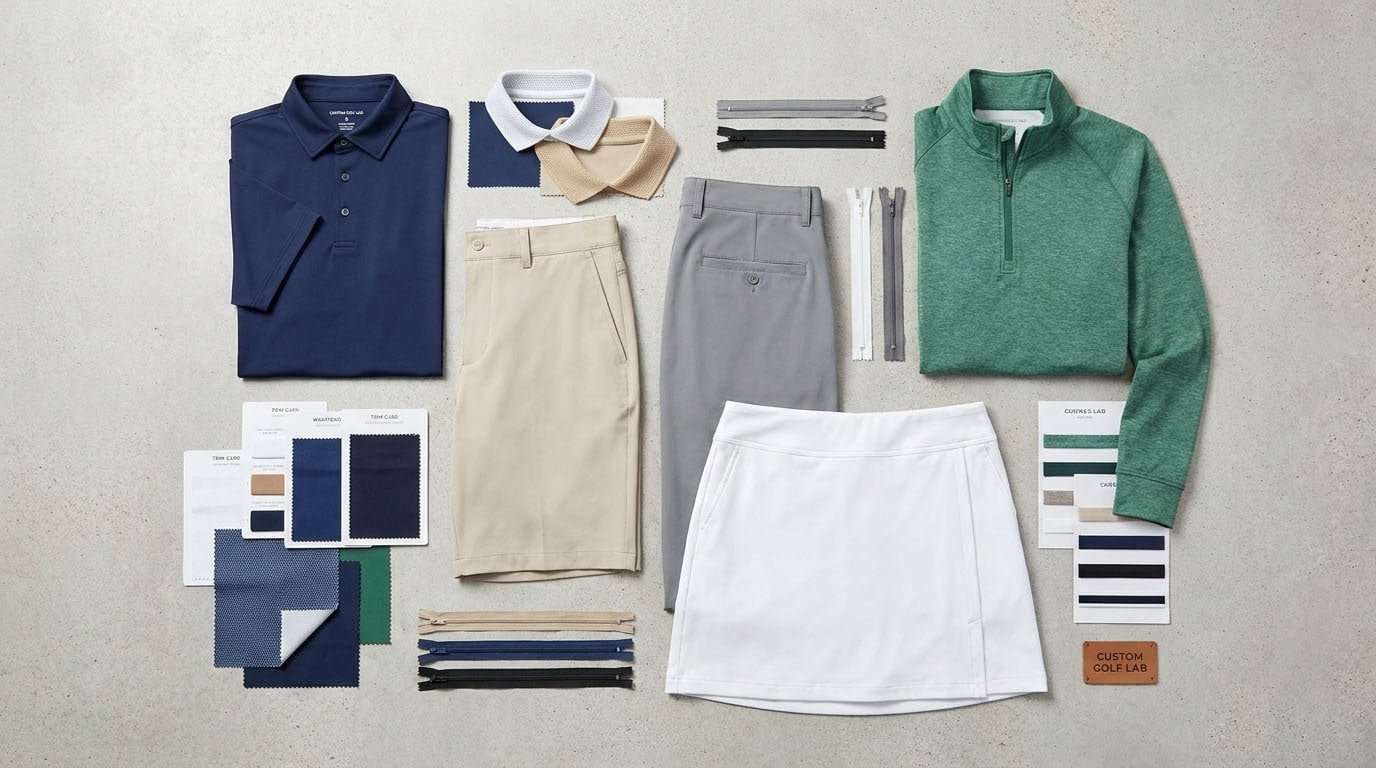
How Product Type Affects Production Flexibility
| Golf Apparel Product | Main MOQ Considerations | What Small Brands Should Check |
|---|---|---|
| Golf polo shirts | Performance knit, collars, plackets, logo methods | Available fabrics, collar options, color minimums |
| Golf shorts | Stretch woven fabric, waistbands, pockets | Fabric availability and waistband construction |
| Golf pants | Pattern grading, fit, waist construction, trims | Approved size range and available materials |
| Golf skorts | Outer skirt fabric, inner shorts, elastic | Compatibility and availability of both fabrics |
| Quarter-zips | Knit fabric, zippers, collars, finishing | Zipper sourcing and construction requirements |
These are manufacturing considerations, not fixed MOQ ranges. Actual minimums must be confirmed for each project.
Golf Polos May Offer a Practical Starting Point
A classic performance polo can be a practical first product when the manufacturer already has suitable fabric, collar, and trim options.
For example, a small brand may develop one signature polo with:
- An available moisture-wicking fabric
- A standard collar construction
- A custom fit and size specification
- One embroidered chest logo
- Branded neck labeling
This approach can preserve the brand's identity without requiring every component to be developed from scratch.
Explore FUWAY's custom golf shirts manufacturing options for examples of available development and customization capabilities.
Golf Bottoms and Skorts Need Separate Evaluation
Golf shorts, pants, and skorts can involve additional construction and sourcing requirements.
A skort, for example, may require separate materials for its outer skirt and inner compression shorts.
Even if both materials are available, the factory must confirm their compatibility, production quantity, and performance requirements.
Do not assume that a manufacturer offering 100 golf polos will automatically accept 100 pieces of every other golf apparel category under identical conditions.
Step 3: Evaluate Manufacturers Beyond Their Advertised MOQ
Once you have identified several potential suppliers, compare their ability to manufacture your specific product rather than relying on the advertised MOQ alone.
A reliable manufacturer should explain production requirements clearly and provide evidence of its capabilities.
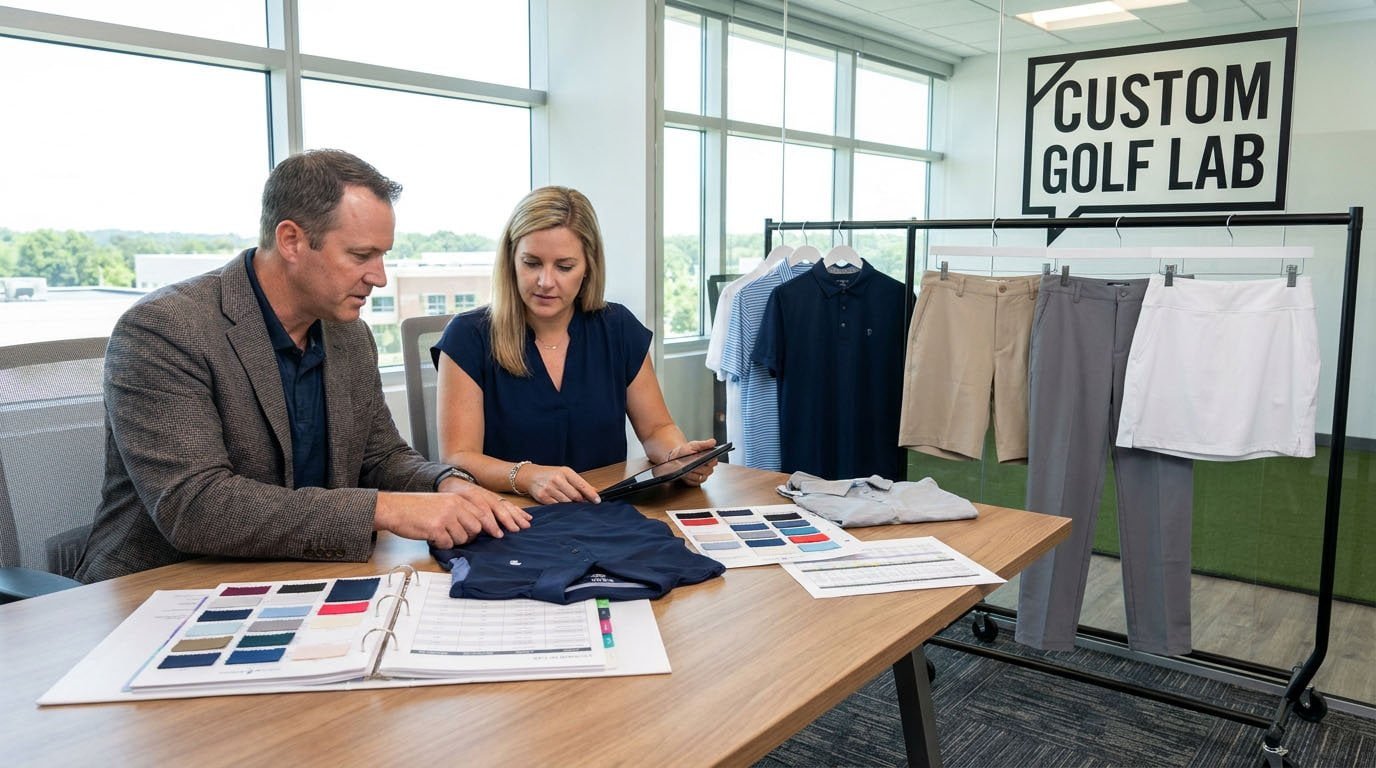
Low MOQ Golf Apparel Manufacturer Evaluation Matrix
| Evaluation Area | What to Ask | Warning Sign |
|---|---|---|
| MOQ flexibility | Is MOQ per style, color, or order? | Minimums change without explanation |
| Golf apparel experience | Can you show relevant polos, shorts, pants, or skorts? | Only unrelated garments are shown |
| Fabric sourcing | Which suitable fabrics are available at my quantity? | Promises any custom fabric at any quantity |
| Customization | Which logo, label, and trim options work for small runs? | No clear explanation of limitations |
| Sampling | How are samples reviewed and approved? | Bulk production starts without approval |
| Quality control | How are measurements, materials, and workmanship checked? | No documented inspection requirements |
| Repeat orders | Can approved specifications and materials be reused? | No records of approved materials or patterns |
| Quotation | Are unit prices and additional charges clearly identified? | Unexplained fees appear after confirmation |
Look for Evidence, Not Just Promises
A manufacturer should be able to demonstrate relevant product experience and explain how the proposed order will move through sampling and production.
Useful evidence may include:
- Photos or videos of relevant manufacturing operations
- Golf apparel samples and construction examples
- Fabric swatches with specifications
- Sample approval records
- Measurement and inspection documentation
For a more comprehensive supplier assessment, use our 10-point golf apparel manufacturer audit checklist.
Can the Manufacturer Support Future Growth?
An initial order may be small, but your production requirements can change if the product sells successfully.
Ask how the factory manages approved patterns, fabric references, branding files, and repeat-order specifications.
A partner that supports consistent reorders may offer greater long-term value than one that only accepts an unusually small first order.
Step 4: Understand Low MOQ Costs and Customization Limits
Low MOQ production reduces the number of garments you must purchase, but it does not automatically reduce every manufacturing expense.
Small production runs still require development, materials, setup, sewing, inspection, and packaging.
Compare Total Project Costs
When comparing quotations, consider:
Total initial commitment = Garment production cost + Applicable development and setup charges + Packaging + Shipping and import costs
A lower order quantity usually reduces the initial inventory commitment, but fixed development and setup costs are distributed across fewer garments.
Ask each manufacturer to separate one-time development charges from recurring production costs.
Which Customization Choices Affect MOQ?
| Customization Choice | Potential MOQ Impact | Practical Alternative |
|---|---|---|
| Custom-dyed fabric | May require a separate mill minimum | Use an approved available color |
| Exclusive fabric development | May require larger fabric orders | Select a suitable existing fabric |
| Custom-molded trims | Independent component minimums | Use approved standard trims |
| Multiple colorways | Additional material and setup requirements | Begin with fewer colors |
| Complex logo decoration | Specialized setup or minimums | Compare suitable embroidery or transfer methods |
| Fully custom packaging | Separate packaging supplier minimums | Use simpler branded packaging |
For lower-volume orders, available fabrics can often improve sourcing flexibility.
FUWAY's fabric sourcing service helps brands evaluate materials according to composition, weight, stretch, hand feel, performance, and production requirements.
However, selecting available materials should not mean accepting fabric that fails to meet your product specifications.
Should You Negotiate for an Even Lower MOQ?
Sometimes a smaller quantity becomes workable after reducing colors, changing nonessential components, or adjusting the order structure.
But a manufacturer cannot always reduce its minimum without changing production costs or sourcing conditions.
Once you receive an actual quotation, our guide on how to negotiate MOQ with a golf apparel manufacturer explains the practical negotiation process.
For this stage, your priority should be identifying the lowest workable quantity—not simply demanding the smallest possible number.
Step 5: Review Small-Batch Golf Apparel Production Scenarios
A practical way to compare low MOQ manufacturers is to send the same proposed order to each supplier and ask whether it can be produced without changing the approved product requirements.
Consider the following illustrative scenarios.
Scenario A: One Custom Golf Polo Style
A startup wants to test a signature performance polo.
| Order Detail | Proposed Requirement |
|---|---|
| Product | Men's performance golf polo |
| Quantity | 120 pieces |
| Styles | 1 |
| Colors | 1 available fabric color |
| Sizes | S–XXL, based on proposed demand |
| Fabric | Approved available performance knit |
| Branding | One chest logo |
Feasibility: Potentially suitable for low MOQ production, subject to fabric, component availability, and manufacturer approval.
Because the order uses one style and one color, the factory can evaluate a relatively focused production setup.
Scenario B: Multiple Products and Colors
Another startup wants the same 120 pieces divided across:
- Two different golf apparel styles
- Three colors per style
- Several sizes in each color
If quantities are split evenly, this creates only 20 pieces per style-color combination before dividing the order into sizes.
Feasibility: More difficult, because each product may require separate patterns, materials, cutting, and production arrangements.
The manufacturer may recommend consolidating styles or colors.
Scenario C: One Custom Golf Skort
A women's golf brand requests 100 skorts using an outer stretch fabric, matching inner shorts, and a branded waistband.
Feasibility: Depends on the availability of both approved fabrics, waistband components, and the required construction.
Even though this order has fewer style variations, its material requirements may make it more complex than Scenario A.
What These Scenarios Show
The most important comparison is not 100 versus 120 pieces.
It is whether the proposed style, materials, colors, size breakdown, and customization can be produced together.
These examples illustrate production planning, not guaranteed acceptance quantities or quotations from FUWAY.
Step 6: Prepare an RFQ Before Contacting a Low MOQ Manufacturer
RFQ means Request for Quotation.
A clear RFQ helps manufacturers evaluate whether your proposed quantity is feasible and provide a quotation based on consistent specifications.
You do not need every technical detail finalized before making an initial inquiry. However, you should provide enough information for the factory to understand your intended product.
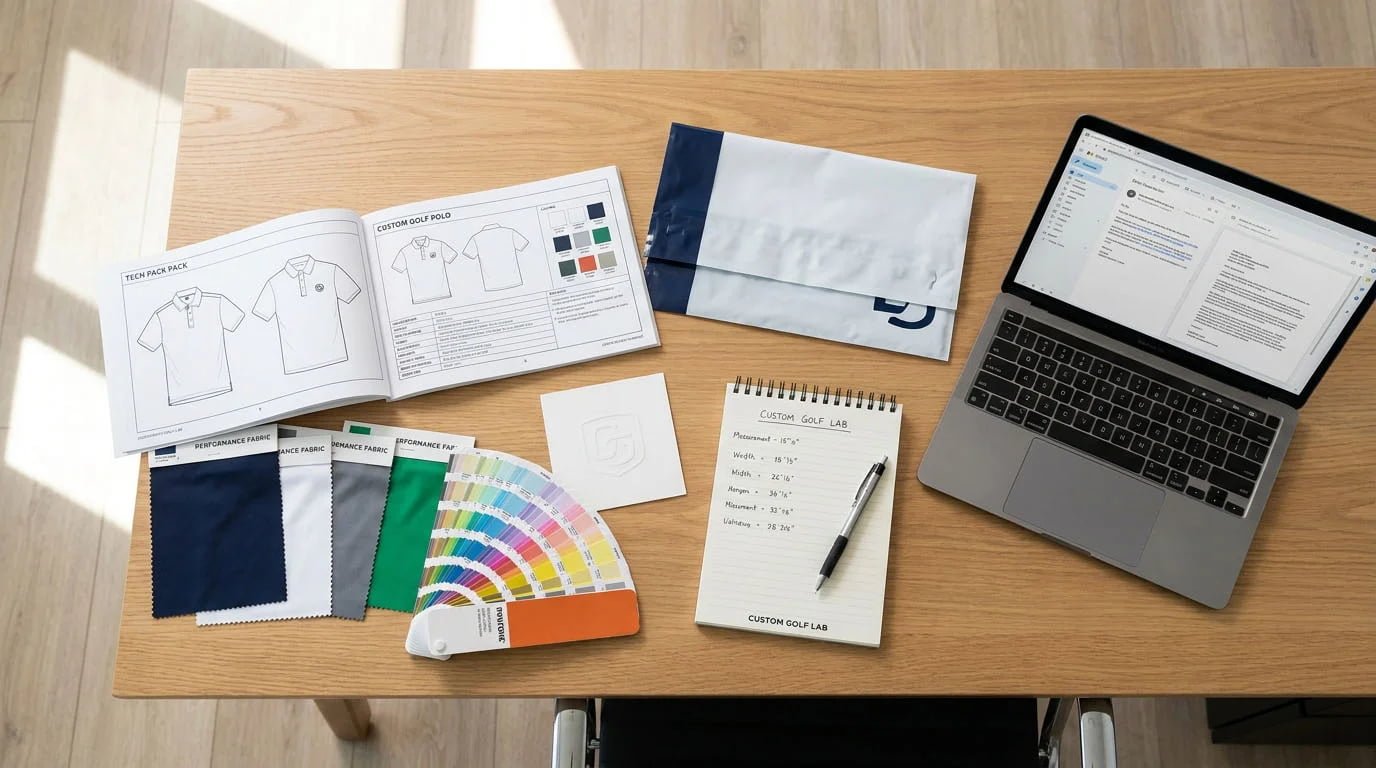
Low MOQ Golf Apparel RFQ Checklist
| Information | What to Provide |
|---|---|
| Product category | Polo, shorts, pants, skort, or outerwear |
| Target quantity | Proposed pieces per style |
| Colorways | Number of colors and available references |
| Size range | Required sizes and estimated distribution |
| Fabric | Preferred composition, weight, and performance |
| Design | Sketch, reference sample, or tech pack |
| Branding | Logo artwork, labels, and decoration method |
| Packaging | Standard or custom packaging requirements |
| Target market | USA, Europe, Australia, or another destination |
| Timeline | Expected sample approval and delivery dates |
If you already have technical specifications, attach them.
For guidance on preparing the required design and production information, see our golf apparel tech pack checklist.
Five Questions to Include in Your RFQ
Ask prospective manufacturers:
- Can you produce this design at our proposed quantity?
- Which specific materials or components determine your minimum?
- What is included in the unit price, and which charges are separate?
- What samples and approvals are required before bulk production?
- Can you support reorders using the same approved specifications?
Request quotations against the same product requirements whenever possible.
Otherwise, a lower price may simply reflect different fabrics, construction, or branding.
Step 7: Choose a Manufacturer That Can Support Quality and Repeat Orders
Low MOQ manufacturing should help small brands enter the market without giving up control over product quality.
Before selecting a supplier, confirm how approved specifications will be maintained during bulk production.
Sampling and Production Approval
For custom golf apparel, sampling should confirm:
- Fabric hand feel and performance requirements
- Garment fit and measurements
- Construction and workmanship
- Logo appearance and placement
- Labels, trims, and packaging
- Any required corrections before bulk production
A pre-production sample may also be required to confirm that final materials and construction match the approved specifications.
At FUWAY, sampling typically takes approximately 7–10 working days, while bulk production commonly takes around 3–4 weeks after the necessary approvals and material arrangements. Actual timing depends on product complexity, quantity, and material availability; shipping time is additional.
Maintain the Same Quality Standard for Small Orders
Smaller quantities should still follow the agreed product specifications.
For FUWAY projects, finished garment measurements at specified measurement points are controlled within ±1.0 cm of the approved target dimensions, with tighter tolerances where agreed in the tech pack.
Brands should also confirm how the factory checks:
- Fabric and color consistency
- Sewing workmanship
- Collar and waistband construction
- Logo placement and appearance
- Finished measurements
- Final packaging
The goal is not to create a different quality standard for low MOQ orders. It is to apply the approved requirements to the actual production run.
Confirm Reorder Conditions Before Your First Deposit
A small first order may sell well, but subsequent production is not always identical to the original run.
Before confirming your supplier, ask:
- Can the same approved fabric be sourced again?
- Will the factory retain the approved pattern and size specifications?
- Can logo and branding files be reused?
- Will future orders have different minimum quantities?
- Will additional development or setup charges apply?
If a fabric or trim becomes unavailable, the manufacturer should propose an alternative for approval rather than substituting it without authorization.
For emerging golf brands, repeat-order consistency is an important part of choosing the right manufacturing partner.
FAQ: Low MOQ Golf Apparel Manufacturers
1. Can I Start a Golf Apparel Brand With 100 Pieces?
Yes. Some manufacturers can support an initial production quantity of approximately 100 pieces per style.
At FUWAY, this is a typical starting point for suitable custom golf apparel projects. Final feasibility depends on materials, construction, colorways, and customization.
2. Can I Find a Golf Apparel Manufacturer With a 50-Piece MOQ?
Some suppliers advertise 50-piece minimums, particularly for simpler customization using available products or materials.
However, 50 pieces is not a universal minimum for full OEM development. Confirm whether the offer covers a custom-manufactured garment or an existing product with added branding.
3. Can I Combine Golf Polos, Shorts, and Skorts to Meet MOQ?
A manufacturer may allow an overall order to contain different products, but each style can still have separate production requirements.
Shared approved materials may help with fabric purchasing, although they do not automatically eliminate individual garment minimums.
4. Are Low MOQ Manufacturers Suitable for Premium Golf Apparel?
Yes, provided the manufacturer can meet the required fabric, fit, construction, performance, and quality standards.
Premium positioning depends on product execution and consistency, not simply the production quantity.
5. Is Private Label Manufacturing Easier Than Full OEM for Small Brands?
It can be.
Adding branding to an existing approved product generally involves fewer development steps than creating a completely new garment pattern and fabric specification.
However, private label options may provide less flexibility over fit, construction, and material selection.
6. Should I Choose the Manufacturer Offering the Lowest MOQ?
Not automatically.
Compare the approved product specifications, total project cost, quality controls, delivery requirements, and reorder capability before making your decision.
A slightly higher but reliable production minimum may be more suitable than a lower offer with unclear manufacturing conditions.
Conclusion: Find the Right Low MOQ Golf Apparel Manufacturing Partner
Low MOQ golf apparel manufacturing can help emerging brands launch without committing to unnecessarily large inventories.
However, the right manufacturer should offer more than a small minimum order number.
Look for a partner that understands golf apparel construction, explains material and customization limitations, provides transparent quotations, and maintains consistent production standards.
At FUWAY, we support custom golf apparel OEM/ODM development for brands producing performance polos, shorts, pants, skorts, and other golf clothing.
Our team can review your design, target quantity, fabric requirements, and branding details to determine a practical manufacturing approach.
Planning your first custom golf apparel collection?
Contact FUWAY to discuss your product specifications, estimated order quantities, sampling requirements, and manufacturing options.