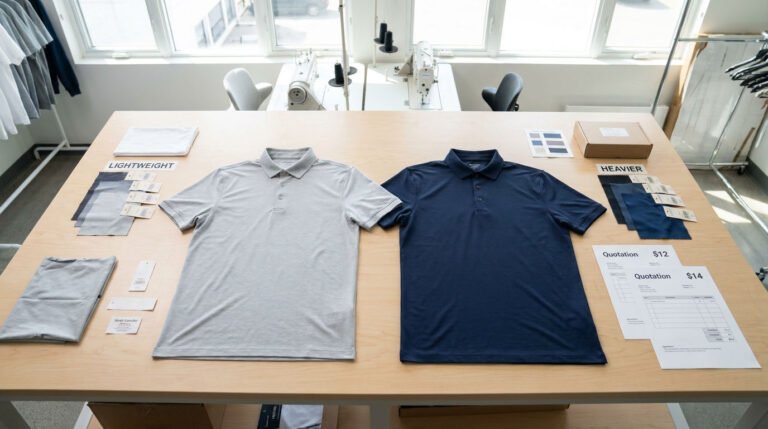
Should your South African golf brand work with a local manufacturer or source custom golf polos from China? The answer depends on what you are buying, how quickly you need it, and what it will cost to reach your warehouse—not simply where the supplier is located.
Quick answer: Local suppliers can be a strong choice for urgent uniforms, smaller branded runs and hands-on coordination. A Chinese OEM/ODM partner may suit brands developing their own fit, fabric and private-label collection. Neither option automatically wins on price, speed or quality. Compare the same garment specifications and the full cost before deciding.
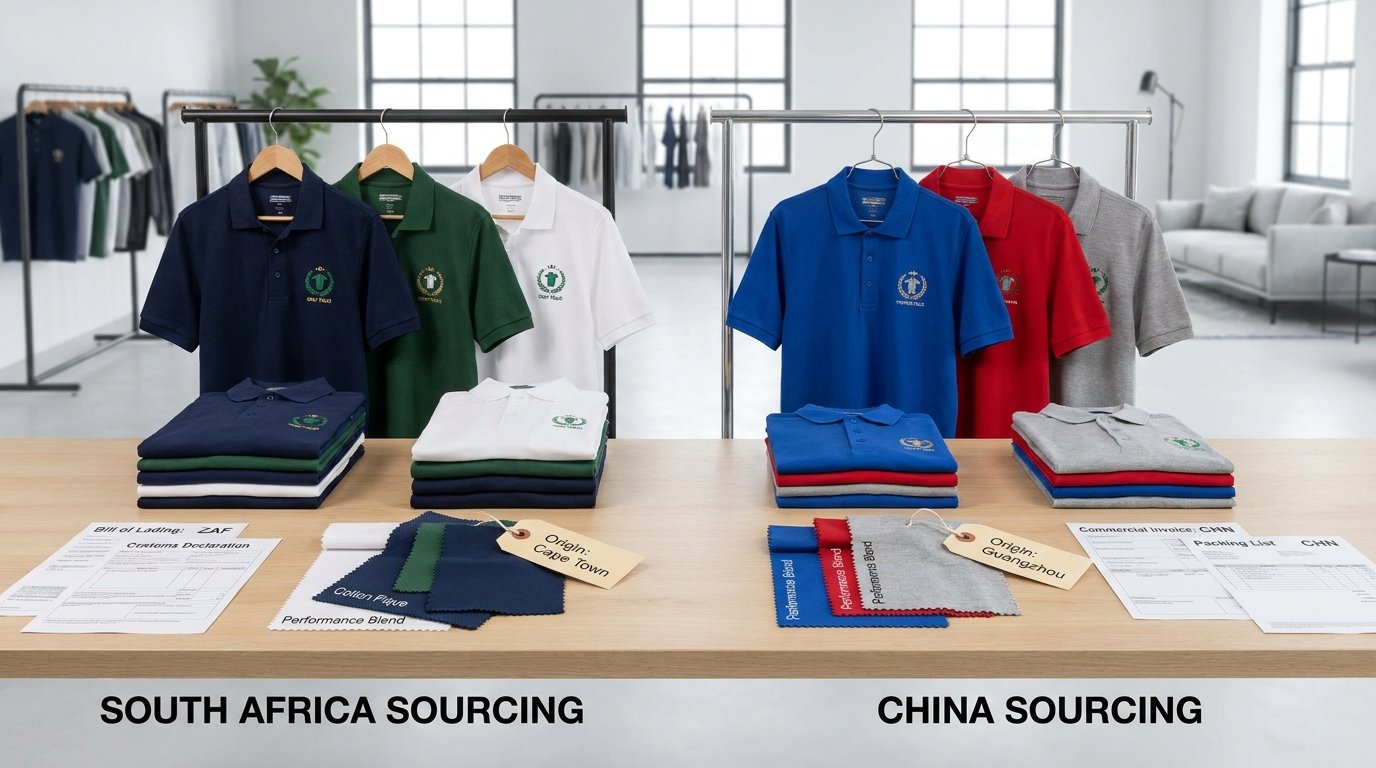
Quick Comparison: Local South African Sourcing vs China OEM/ODM
| Buying Question | South African Supplier | Chinese OEM/ODM Supplier |
|---|---|---|
| What can I order? | Stock polos with branding, locally sewn styles, and some full custom programs | Stock-fabric development and made-to-spec private-label polos |
| How fast is delivery? | No international shipment of the finished shirt, but fabric and capacity still matter | Requires production plus international freight and customs clearance |
| Is the MOQ lower? | Sometimes; verify by supplier, fabric and process | Sometimes; verify by supplier, fabric and process |
| Which costs should I compare? | Delivered quote and any additional services | Quoted trade term plus freight, import charges and delivery |
| Who controls quality? | The individual supplier and agreed specifications | The individual supplier and agreed specifications |
Step 1. Understand the Three Golf Shirt Sourcing Options in South Africa
Before requesting quotes, distinguish these business models:
- Stock polo with local branding. A supplier adds embroidery, printing or other decoration to an existing garment. This often works for corporate golf days, club uniforms and short deadlines, but the base fabric and fit may be fixed.
- Local cut-and-sew manufacturing. A South African workshop makes garments from fabric, potentially with custom patterns, colors and full-surface sublimation. This is not the same as decorating ready-made shirts.
- Overseas OEM/ODM development. A factory develops or produces a polo to an agreed specification, including fabric, fit, collar, branding and private labels, then exports the finished garments.
Local manufacturing is a real option—not merely a branding service. For example, Johannesburg-based CCS Apparel publicly describes cutting and sewing sublimated golf shirts locally, advertising a minimum of 10 pieces per style and a 15-day production reference for 500 units after approval.
Those are supplier-published conditions for its own product, not independently audited results or a direct equivalent to FUWAY's stock-fabric polo.
Decision point: If you need 40 shirts for an upcoming event, start by checking local stock and production availability. If you want a proprietary golf-polo range to reorder over time, compare actual development capabilities on both sides.
Step 2. Compare Real Factory Quotes With South African Landed Cost
The most common mistake is comparing a Chinese factory quote with a delivered price in South Africa. They are not the same cost basis.
FUWAY Example: One Specified Stock-Fabric Golf Polo
FUWAY provided the following quantity quotations for a representative men's golf polo using in-stock 88% polyester / 12% spandex fabric at 180 GSM:
| Order Quantity | Quoted Unit Price | Quoted Garment Value | Trade Term |
|---|---|---|---|
| 100 pieces | US$16 | US$1,600 | FOB Guangzhou |
| 300 pieces | US$14 | US$4,200 | FOB Guangzhou |
| 500 pieces | US$12 | US$6,000 | FOB Guangzhou |
These are FUWAY quotations for the stated product scenario, not universal prices for every custom polo. Final inclusions, decoration details, size assortment, quotation validity and the exact named shipment port must be confirmed in writing. The 300-piece quotation must not be confused with the separate South African customer order discussed below.
What Does a Buyer in South Africa Still Need to Add?
For a relevant delivered-cost comparison, obtain written figures for:
- International freight and any transport insurance.
- Import customs duty based on the correct product classification and origin.
- Import VAT and customs clearance or brokerage charges.
- Destination terminal charges, local transport and any other costs not covered by the supplier's trade term.
- Any separately purchased third-party services, if applicable.
South Africa's SARS guidance on duties and taxes for importers currently identifies a 15% import VAT rate, with VAT calculated on a prescribed import tax value rather than simply 15% of the invoice price.
The customs duty rate depends on the correct classification, origin and applicable rules. Check the SARS tariff guidance and confirm the classification with a South African customs specialist before budgeting.
For VAT-registered businesses, whether import VAT can be recovered depends on their circumstances and tax compliance. It can affect cash flow even when ultimately deductible.
Important shipping-term note: FUWAY's quoted term is FOB Guangzhou, which is intended for an agreed named port and vessel shipment. Confirm the specific port, cost inclusions and appropriate Incoterms rule before booking. For courier or air freight, request a suitable quotation term rather than assuming the sea-freight FOB terms apply unchanged.
Without comparable South African quotations and a verified China-to-South-Africa freight quote, there is no defensible percentage by which China is “cheaper.”
Step 3. Check MOQ, Sample Approval and the Real Production Timeline
A low unit price offers little value if the required minimum ties up cash in unsold colors or sizes.
For the quoted FUWAY stock-fabric scenario, the confirmed starting point is 100 pieces per style, with eligible orders split into 50 pieces per color.
That allows a brand to test two colorways under the applicable order conditions; custom-dyed fabrics or specialty components may have different minimums.
More details are available on FUWAY's custom golf shirts manufacturing page.

Keep Each Part of the Timeline Separate
| Stage | What the Buyer Must Confirm |
|---|---|
| Product specifications | Fabric, measurements, logo method and print colors |
| Sampling | FUWAY's usual reference is about 7–10 working days once specifications are confirmed; revisions and shipping add time |
| Bulk production | FUWAY's general reference is about 3–4 weeks depending on confirmed specifications, materials and order requirements |
| International shipment | Obtain an actual freight quotation; no South Africa transit time is assumed here |
| Customs and delivery | Depends on clearance, documents, destination and transport arrangements |
Real FUWAY Order: 300 Men's Golf Polos for South Africa
FUWAY has confirmed an actual customer order with these details:
- Market: South Africa.
- Product: Men's golf polo.
- Quantity: 300 pieces.
- Bulk production time: 25 days.
The 25 days describe bulk production only. They do not include sampling, international shipping, customs clearance or delivery to the customer's premises.
The order's actual selling price, freight cost and full door-to-door timeline have not been provided, so none is claimed here.
This case demonstrates that FUWAY has handled a 300-piece South African golf polo production order. It does not establish a standard 25-day lead time for all products or prove a faster delivery than a local factory.
Step 4. Compare Fabric and Quality by Specification, Not Country
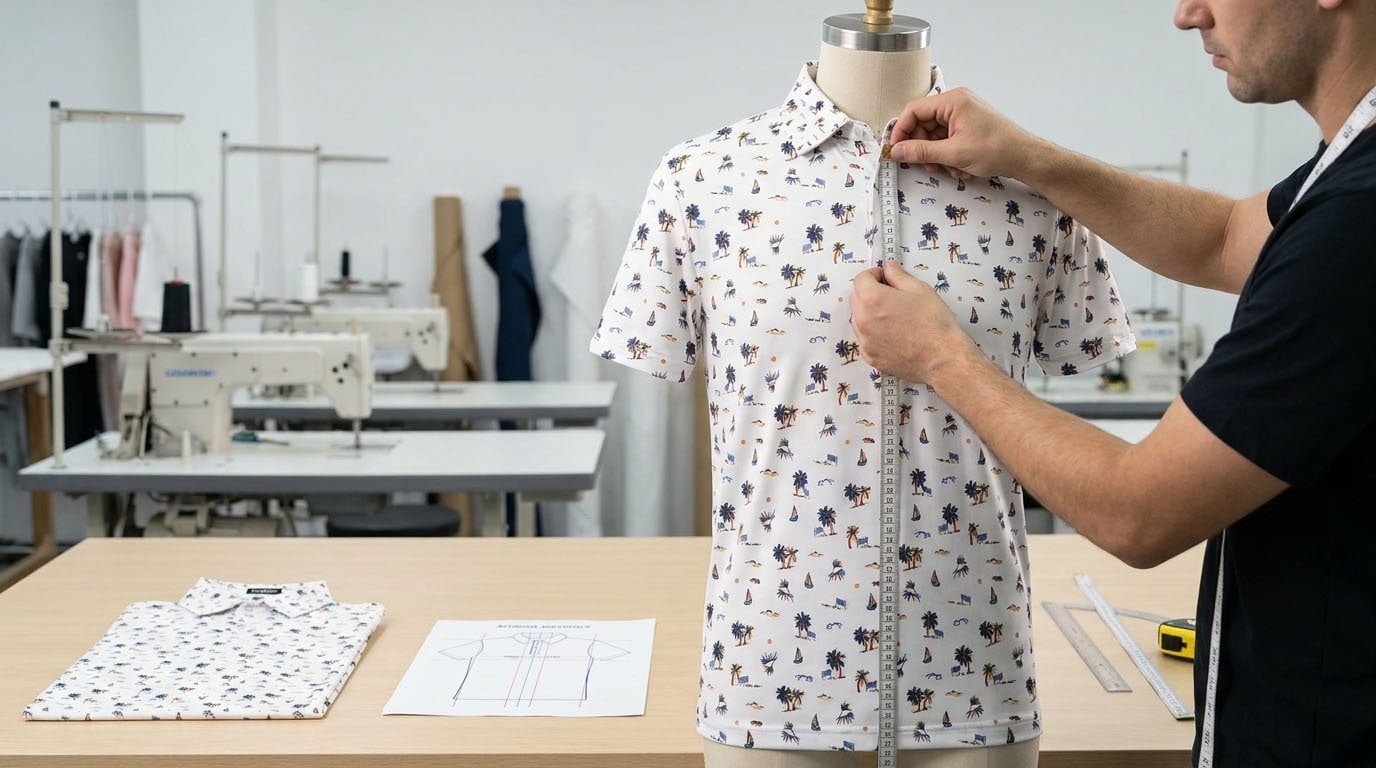
A premium golf polo can be manufactured locally or overseas. Ask each supplier whether it can reproduce the same specific garment, rather than assuming quality from country of origin.
For warm-weather golf apparel, practical checks include:
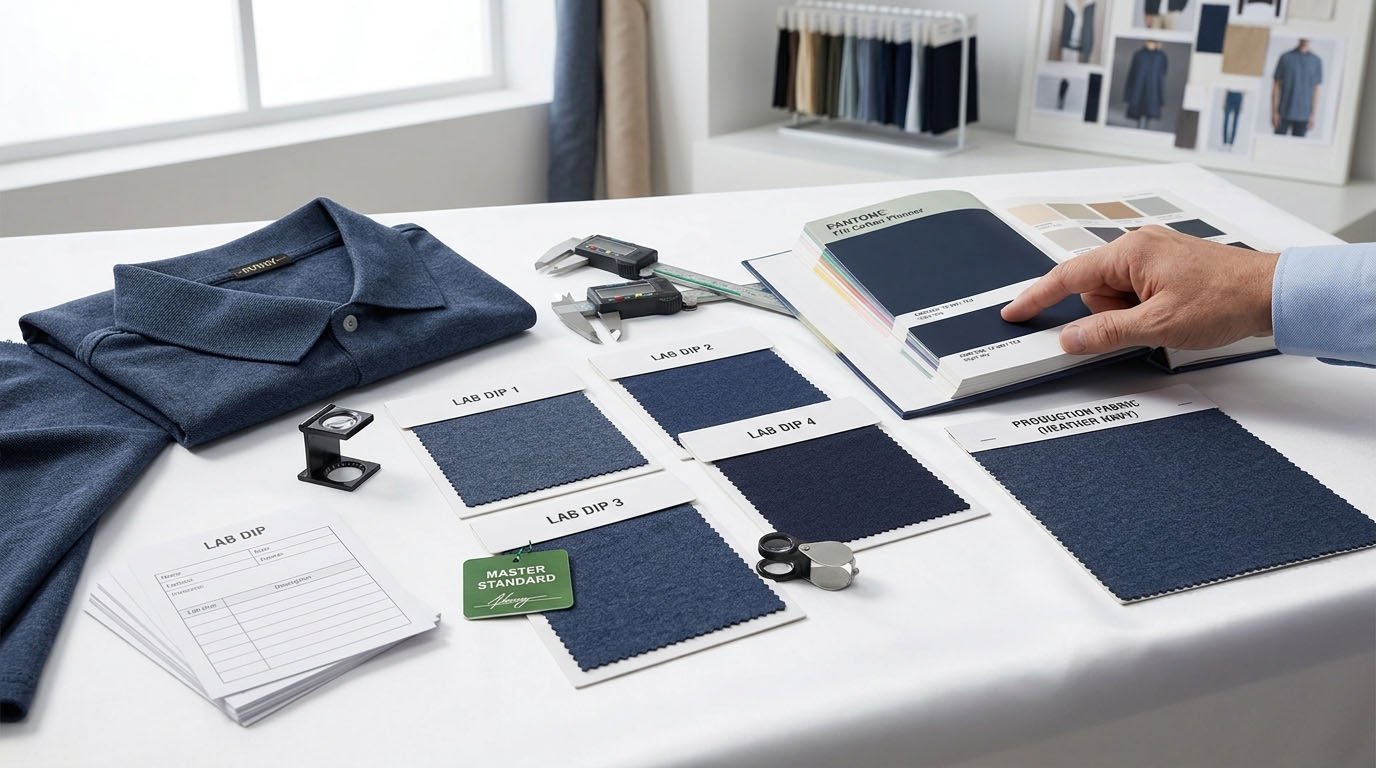
- Fabric: Confirm fiber composition, GSM, knit structure, hand feel and stretch recovery.
- Fit: Compare an approved measurement chart across the intended size range.
- Construction: Inspect the collar, placket, seams, stitching and logo placement.
- Performance: Request relevant test results for shrinkage, colorfastness or any claimed moisture management and UV protection.
- Repeatability: Agree on the approved bulk standard and how discrepancies will be documented.
At FUWAY, the default finished-garment point-of-measurement (POM) tolerance is ±1.0 cm, unless a tighter tolerance is specified in the approved tech pack.
A label stating 88% polyester / 12% spandex, 180 GSM identifies composition and weight; it does not, by itself, prove UPF 50+, anti-odor treatment or a particular moisture-wicking test result.
Ask for product-specific evidence where performance claims matter.
FUWAY makes available a selection of fabric and product test reports, but buyers should check that any report applies to their selected material or finished garment.
Step 5. Plan Shipping, Customs and Reorders for South Africa
Local delivery can reduce exposure to international transport for the finished garment. It does not automatically remove lead-time risk if a local workshop must first source fabric or wait for production capacity.
For China sourcing, plan a calendar that separates production completion, freight departure, arrival, customs clearance and final delivery.
FUWAY has not provided a current freight quotation for South Africa, so this article intentionally does not invent a courier, air or sea rate or transit duration.
Documents and Decisions to Confirm Before Shipment
- Commercial invoice with the agreed transaction terms, product description, quantity and value.
- Packing list with cartons, sizes, quantities and shipment weights.
- Accurate garment composition and details needed for customs classification.
- Applicable origin documentation and import requirements, as advised by the clearing agent.
- Importer registration responsibilities, carrier arrangements and the party handling clearance.
Keep a Practical Reorder Document Checklist
For repeat orders, preserve the following records:
- Approved physical sample and latest tech pack.
- Size specifications, color references and fabric details.
- Final logo artwork, dimensions and placement.
- Approved trims, labels and packaging instructions.
- Previous purchase order and any agreed production revisions.
- Quality inspection records and corrections from earlier batches.
This reduces the chance of an unintentional change between orders, especially when replenishing a successful golf-polo style.
Step 6. Choose Local, China or a Hybrid Sourcing Model
| Your Situation | More Practical Starting Point | What to Verify |
|---|---|---|
| Urgent local golf-day shirts | Local stock-and-branding supplier | Stock sizes, logo method, confirmed delivery deadline |
| Locally made sublimated team polos | South African cut-and-sew supplier | Fabric, sample, actual MOQ and production slot |
| First private-label range of around 100 pieces | Compare eligible local custom and China OEM offers | Same fit, fabric, branding, total delivered cost |
| A 300–500-piece signature golf-polo program | Compare full-specification quotes from both locations | Sample consistency, pricing terms, landed cost and reorder plan |
| Seasonal range plus emergency event replenishment | Consider a hybrid arrangement | Whether the two sources can maintain acceptable fit and color consistency |
Do not use nationality as a proxy for quality.
A local supplier with a proven custom program may be the right choice; a Chinese supplier with good fabric access and a suitable MOQ may be the right choice.
The final decision is order-specific.
Step 7. Send a Comparable Quote Request to Every Supplier
To avoid misleading comparisons, send local and Chinese factories one consistent sourcing brief:
- Garment: Men's or women's golf polo, reference photos and intended use.
- Material: Requested composition, GSM, texture, color and any tested performance requirements.
- Construction: Fit, measurements, collar, placket and required size breakdown.
- Branding: Logo artwork, size, placement, application method, labels and packaging.
- Order plan: Pieces per style, color and size; expected reorder quantities.
- Timing: Sample approval deadline, target bulk completion and required arrival date.
- Commercial comparison: Pricing term, exact included services, sample and production timeline, quality acceptance and delivery destination.
Request an approved physical sample where appropriate, then compare two suppliers against the same specification sheet.
For a more detailed review of the China production workflow, see FUWAY's guide to sourcing golf apparel from China.
Frequently Asked Questions
Are Golf Shirts Actually Manufactured in South Africa?
Yes. South Africa has suppliers that manufacture golf shirts locally, including some that print, cut and sew full-sublimation garments. Others focus on branding stock polos. Check each supplier's actual production model before requesting a quote.
Is Ordering Custom Golf Polos From China Always Cheaper?
No. Compare identical product specifications and final landed cost. FUWAY's quoted prices in this article are FOB Guangzhou and exclude unquoted South African import and delivery expenses.
Can a South African Startup Order Only 100 Custom Polos From FUWAY?
For the specified stock-fabric scenario, FUWAY supports 100 pieces per style with eligible orders split into two colors of 50 pieces each. Different fabrics or custom components may change the MOQ.
Does the 25-Day South African Order Include Shipping?
No. The documented 25 days cover bulk production of 300 men's golf polos only. Sampling, freight, import clearance and final delivery are separate.
What Import Duty Applies to Golf Polo Shirts in South Africa?
The applicable duty cannot be established solely from the words “golf polo.” The correct customs classification, actual garment details and relevant origin rules must be checked against current SARS schedules, preferably with a customs broker. Import VAT and other charges must also be considered.
When Should a Brand Use Both Local and Overseas Suppliers?
A hybrid model can make sense when one supplier develops a planned seasonal collection and another handles urgent local event orders. It adds coordination and possible fit or shade differences, so use approved specifications and samples for each source.
Conclusion
For South African golf brands, the better sourcing partner is the one that meets your exact product brief at an acceptable total cost and arrival date.
Local suppliers can be effective for fast branding and locally manufactured programs. Chinese OEM/ODM production can be practical for private-label development when fabric, fit, MOQ and replenishment requirements align.
FUWAY has confirmed a stock-fabric golf-polo quotation from 100 pieces per style and an actual 300-piece South African men's polo order completed in 25 days of bulk production. Neither fact replaces a project-specific landed-cost quote.
If you are comparing sourcing options, share your design, fabric, quantities by color and size, logo requirements and destination city in South Africa.
Contact FUWAY to request a specification-based manufacturing quotation and discuss what still needs to be verified before ordering.