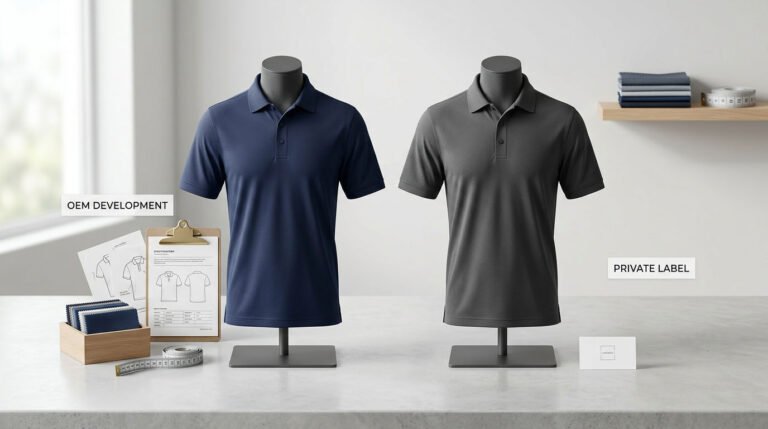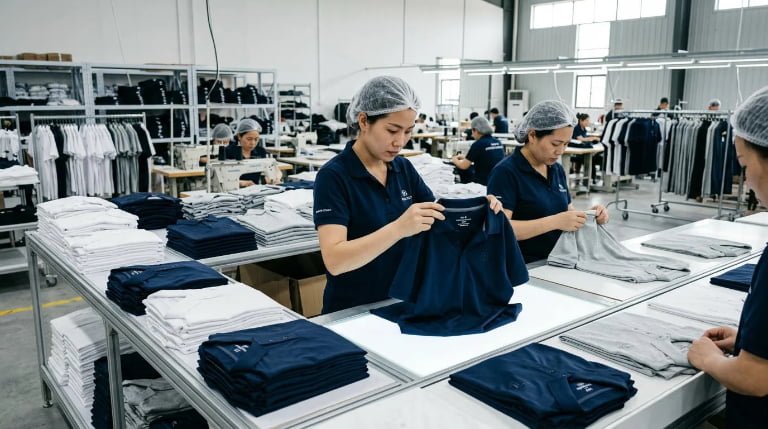
Sourcing golf apparel from China can look simple until your approved sample and bulk production turn out differently. Wrong fabric, off colors, inconsistent sizing, delayed production, or poor stitching can quickly turn a low factory quote into an expensive problem.
To source golf apparel from China successfully, define your product before requesting prices, choose suppliers based on golf apparel capability rather than price alone, approve clear production specifications, and control fabric, sampling, bulk production, and final inspection as one connected process.
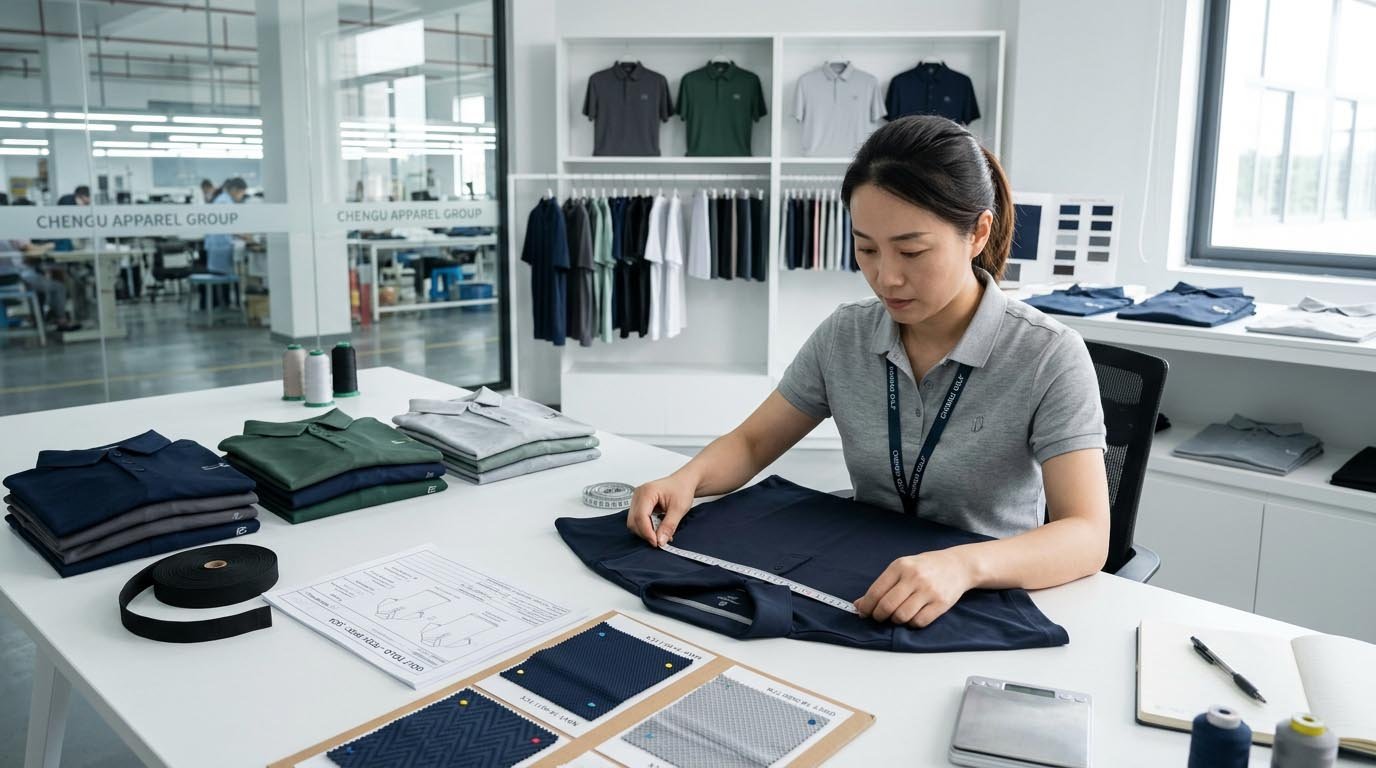
From the factory side, one of the biggest mistakes I see is treating sourcing as a simple process of finding a supplier, getting a sample, and placing an order.
A good sample is important, but it does not guarantee a good bulk order.
The real goal is to build a process that allows the factory to reproduce your fabric, fit, color, workmanship, branding, and packaging consistently across hundreds or thousands of pieces.
This guide explains how to do that.
Quick Answers: How Do You Source Golf Apparel From China?
If you are evaluating Chinese golf apparel manufacturers, these are the main points to remember:
- Define the product first. Prepare clear information about fabric, fit, colors, sizing, logos, trims, and packaging before requesting quotes.
- Choose by capability, not only price. A general clothing factory may not have the same experience with stretch fabrics, golf collars, plackets, or performance finishes.
- Test the supplier through sampling. Samples help you evaluate communication, technical understanding, workmanship, and problem-solving ability.
- Do not treat one approved sample as enough. The bulk production standard should also be documented in writing.
- Control fabric before cutting. Fabric weight, color, shrinkage, stretch, and hand feel can all affect the finished garment.
- Use in-process and final inspection. Quality control should happen during production, not only after everything is packed.
- Compare total sourcing cost. Unit price is only one part of the real cost. Sampling, packaging, freight, duties, inspection, delays, and rework also matter.
Why Source Golf Apparel From China?
China remains attractive for golf apparel because many parts of the apparel supply chain are available within the same manufacturing ecosystem.
A golf brand can typically source:
- Performance fabrics
- Stretch knits
- Woven fabrics
- Labels and hangtags
- Buttons and zippers
- Embroidery
- Screen printing
- Sublimation printing
- Heat transfers
- Packaging
- Pattern development
- Sampling
- Bulk production
This can make product development easier, especially for brands that want more customization than simply buying ready-made garments.
For example, brands developing custom golf shirts may need to coordinate fabric selection, fit, collar construction, decoration, labels, and packaging rather than simply choosing a stock polo.
However, golf apparel is not the same as basic promotional clothing.
A good golf polo, quarter-zip, pant, skort, or jacket may need to balance:
- Stretch
- Breathability
- Moisture management
- Shape retention
- Soft hand feel
- Collar stability
- Clean logo application
- Consistent sizing
- Comfort during movement
That is why finding the right golf apparel manufacturer matters more than simply finding any apparel factory.
What Golf Apparel Can You Source From China?
Most major golf apparel categories can be developed in China.
| Product | Important Sourcing Considerations |
|---|---|
| Golf polos | Stretch, moisture management, collar shape, placket construction |
| Quarter-zips | Warmth, stretch, zipper quality, layering fit |
| Golf hoodies | Fabric hand feel, recovery, hood construction |
| Golf shorts | Stretch, waistband comfort, pocket construction |
| Golf pants | Mobility, wrinkle resistance, waistband fit |
| Golf skorts | Inner shorts, stretch, skirt drape, waistband |
| Outerwear | Wind resistance, water resistance, layering |
| Tournament apparel | Logo consistency, delivery timing, size range |
| Private-label collections | Labels, packaging, trims, color consistency |
Your target customer and market should influence the product specification.
For example, a golf polo designed for hot and humid conditions may prioritize breathability and quick drying.
A quarter-zip designed for cooler markets may need more warmth, structure, and wind protection.
Do not begin with:
“How much is a golf polo?”
Begin with:
“What kind of golf polo are we trying to make?”
That one change usually leads to much more accurate quotations.
Step 1: Define Your Golf Apparel Before Contacting Factories
One of the biggest causes of inaccurate quotations is sending a factory only a reference photo.
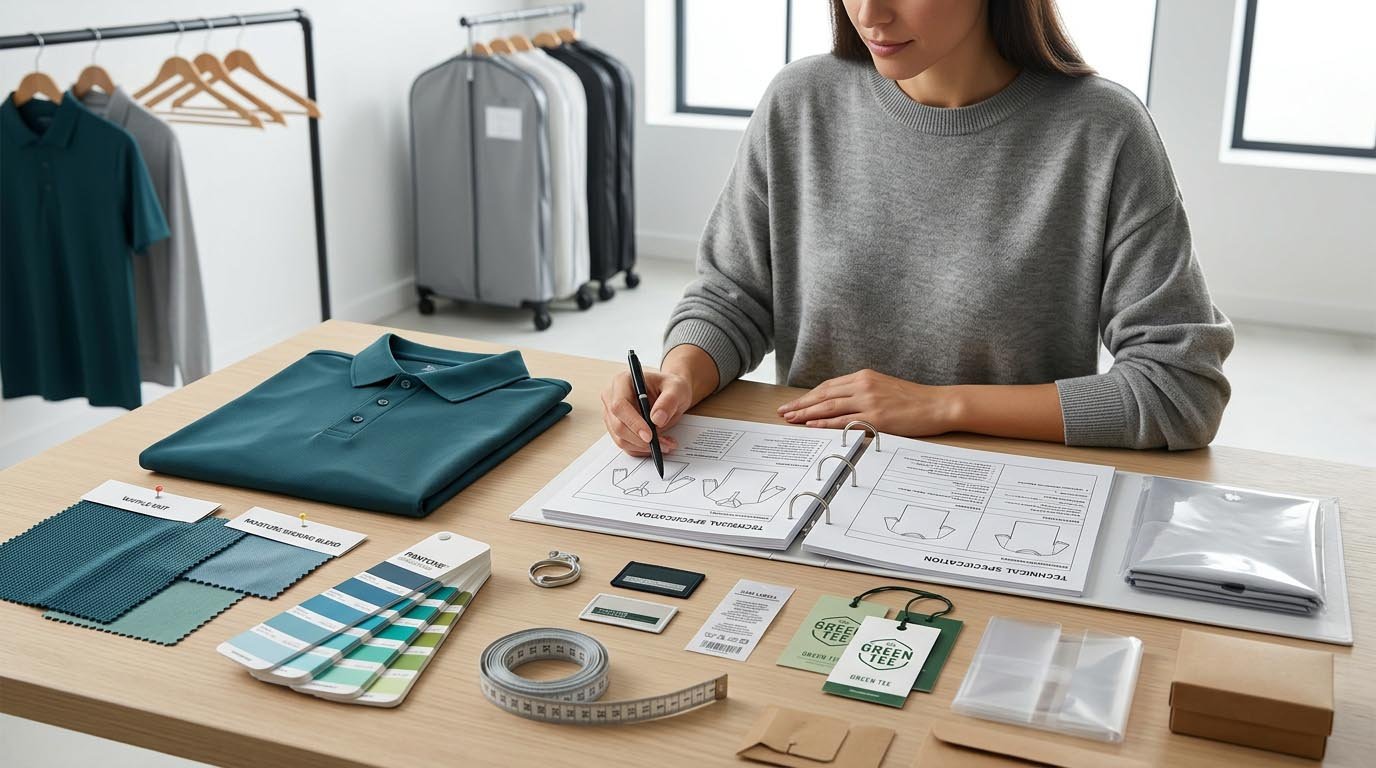
A photograph can show style direction, but it usually does not tell the factory:
- Fabric composition
- Fabric weight
- Stretch level
- Hand feel
- Measurements
- Fit
- Seam construction
- Logo size
- Logo technique
- Label details
- Packaging
If these details are missing, the supplier has to make assumptions.
Different factories may then quote completely different products even though they are responding to the same photo.
Build a Practical Tech Pack
You do not always need an extremely complicated tech pack for the first conversation.
But you should provide enough measurable information that the factory understands what you are trying to develop.
A practical golf apparel tech pack may include:
Product Information
- Product type
- Men's, women's, or unisex
- Intended market
- Target retail or quality level
- Intended climate
- Reference photos
Fabric
Specify as much as you currently know:
- Fiber composition
- Knit or woven
- Approximate GSM
- 2-way or 4-way stretch
- Texture
- Hand feel
- Moisture-wicking requirement
- UV protection requirement
- Recycled material requirement
- Special finish requirements
You do not have to know every technical answer in advance.
A good manufacturer should also be able to recommend suitable fabrics based on your target product.
If fabric selection is one of your biggest sourcing challenges, working with a manufacturer that offers dedicated fabric sourcing support can make development much easier. Instead of choosing only by composition, you can compare fabric weight, stretch, texture, performance, and cost before confirming the bulk material.
Measurements
Include:
- Chest
- Body length
- Shoulder
- Sleeve
- Waist
- Hip
- Inseam
- Collar
- Any style-specific measurements
Also define acceptable measurement tolerances.
Colors
Whenever possible, use:
- Pantone references
- Approved lab dips
- Physical swatches
Avoid relying only on:
“dark navy”
or
“similar green to this picture.”
Color descriptions can be interpreted differently.
Branding
Specify:
- Embroidery
- Screen printing
- Sublimation
- Heat transfer
- Woven patch
- Silicone transfer
- Custom buttons
- Neck labels
- Care labels
- Hangtags
For more detailed logo planning, you can compare different decoration options such as golf polo embroidery, screen printing, and sublimation printing.
The best method depends on your fabric, artwork, order quantity, hand feel, durability requirements, and target price.
Packaging
Clarify:
- Individual polybags
- Size stickers
- Barcode labels
- Hangtags
- Folding method
- Carton requirements
If you are building your own golf brand rather than buying generic garments, these details should also form part of your private-label apparel program.
The clearer these details are before quotation, the easier it becomes to compare factories fairly.
Step 2: How Do You Find Reliable Golf Apparel Manufacturers in China?
Finding apparel suppliers online is easy.
Finding one that fits your project is harder.
The lowest-priced supplier is not automatically the best supplier.
The largest factory is not automatically the best supplier either.
The better question is:
Can this manufacturer consistently make the type of golf apparel my brand needs?
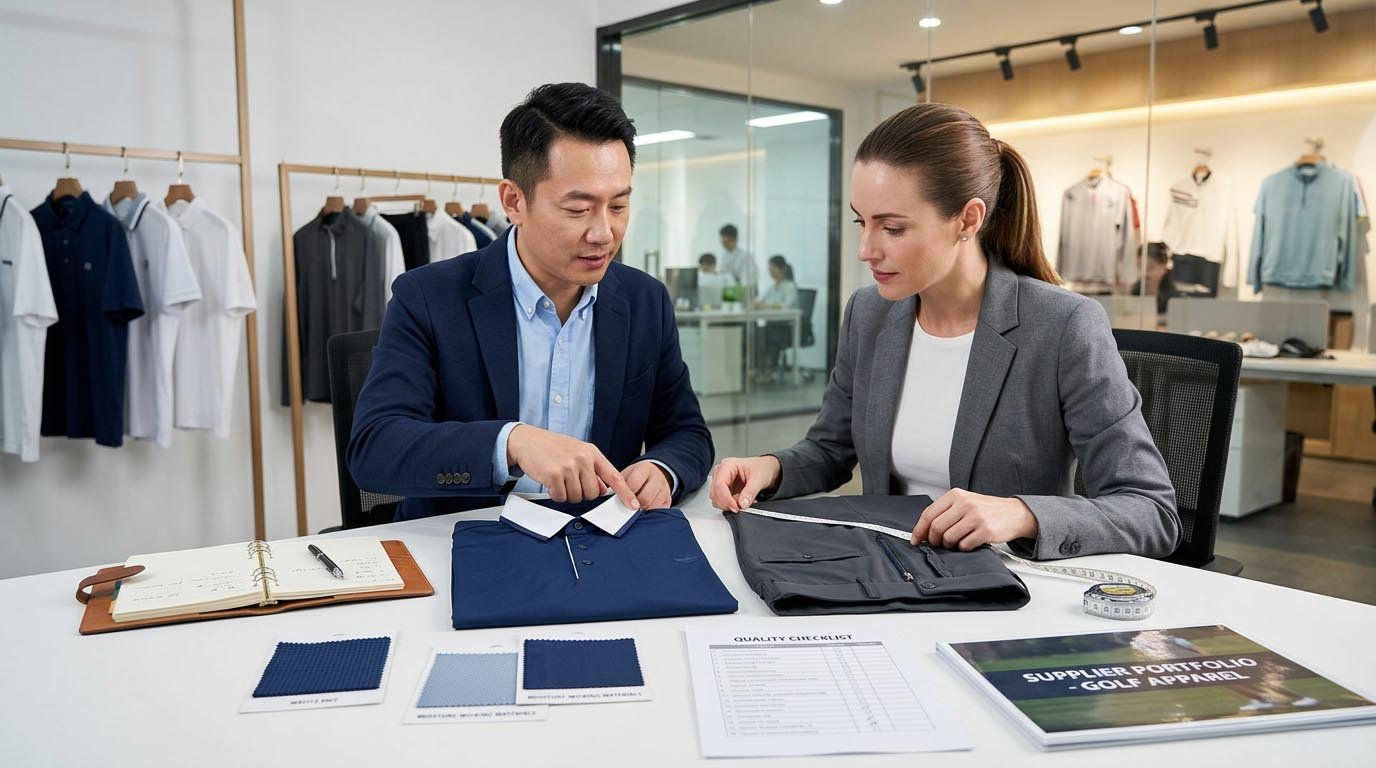
Check Golf-Specific Experience
Ask to see examples of products similar to yours.
For example, if you are developing golf polos, look closely at:
- Collar shape
- Placket symmetry
- Stitching
- Logo finish
- Fabric quality
- Hem construction
- Sleeve shape
- Button placement
If you are developing golf pants, the important areas may be:
- Waistband construction
- Pocket shape
- Zipper quality
- Stretch recovery
- Seam strength
- Fit
A supplier that performs well on basic T-shirts may not necessarily perform well on technical golf apparel.
Evaluate How the Supplier Thinks
Strong suppliers usually ask questions before giving a final quotation.
For example:
- What market are you selling into?
- What fabric feel do you want?
- Is the garment for hot or cool weather?
- What retail price level are you targeting?
- Do you need custom fabric?
- How many colors?
- What logo technique?
- What quantity per color?
- Do you already have a tech pack?
These questions are a good sign.
They show that the supplier is trying to understand the product rather than simply giving you the lowest possible number.
Step 3: Factory vs Trading Company — Which Should You Choose?
When sourcing from China, you may work with either a direct manufacturer or a trading company.
Neither model is automatically good or bad.
They serve different sourcing needs.
| Direct Manufacturer | Trading Company |
|---|---|
| Closer connection to production | Can coordinate multiple factories |
| Easier technical communication | Useful for broad product categories |
| More direct quality feedback | May offer wider sourcing options |
| Better visibility into production | Can simplify multi-category purchasing |
| Often stronger for repeat specialized products | May suit buyers who value sourcing convenience |
If your brand mainly focuses on golf apparel and expects to develop products repeatedly, working directly with a specialized manufacturer may give you more visibility into sampling and production.
If you need many unrelated product categories from different factories, a trading company may sometimes make coordination easier.
The key question is not simply:
“Are you a factory?”
The more useful question is:
“Who is actually responsible for fabric sourcing, sampling, production, quality control, and solving problems when something goes wrong?”
Step 4: How Do You Qualify a Golf Apparel Supplier?
Before placing a meaningful bulk order, evaluate the supplier in several areas.
1. Product Experience
Ask:
- What golf apparel do you make most often?
- Do you manufacture polos, bottoms, outerwear, or all of them?
- Can you show recent examples?
- Which fabrics do you work with frequently?
2. Fabric Sourcing Capability
Fabric is one of the most important parts of golf apparel.
Ask where the supplier sources:
- Polyester/spandex
- Nylon/spandex
- Pique
- Jersey
- Jacquard
- Woven stretch fabrics
- Brushed fabrics
- Recycled fabrics
Also ask whether they can provide:
- Existing fabric options
- Custom dyeing
- Lab dips
- Fabric test reports
- Shrinkage testing
- Colorfastness testing
This is one reason fabric sourcing should be evaluated as a separate capability rather than treated as a small part of the quotation. You can see more about FUWAY's fabric sourcing process here.
3. Sampling Capability
Sampling tells you much more than whether a factory can sew one garment.
It also shows:
- Communication quality
- Pattern ability
- Fabric matching
- Problem-solving
- Attention to detail
- Response speed
Pay attention to how the factory handles revisions.
A supplier that understands why a sample failed is usually much easier to work with than one that simply remakes the garment without understanding the cause.
4. Quality Control
Ask the supplier:
- When is fabric inspected?
- When are measurements checked?
- How are color differences controlled?
- How are defects recorded?
- Is there in-line inspection?
- Is final inspection performed?
- Can third-party inspection be arranged?
You are not looking for a perfect answer.
You are trying to understand whether quality control is built into production or only checked at the end.
5. Communication
Communication problems often become production problems.
Evaluate:
- Response time
- Clarity
- Technical understanding
- Willingness to point out risks
- Ability to summarize decisions
- Photo/video updates
- Problem-solving approach
A supplier that agrees to everything immediately is not always the best supplier.
Sometimes a good factory should tell you:
“This design is possible, but this fabric may not work well with this construction.”
That kind of feedback can save money later.
6. Certifications and Test Reports
Certificates can help you understand a supplier's compliance background, but they should not be treated as proof that your individual order will be perfect.
Check:
- Certificate company name
- Validity period
- Scope
- Relevant fabric or garment test reports
- Customer-specific compliance requirements
Where available, ask to review relevant fabric and garment test reports rather than relying only on marketing statements.
Your own order specifications and inspections are still important.
Step 5: Order Samples Before Bulk Production
Sampling is not only about approving appearance.
It is part of risk control.
Depending on your product and development process, you may use several types of samples.
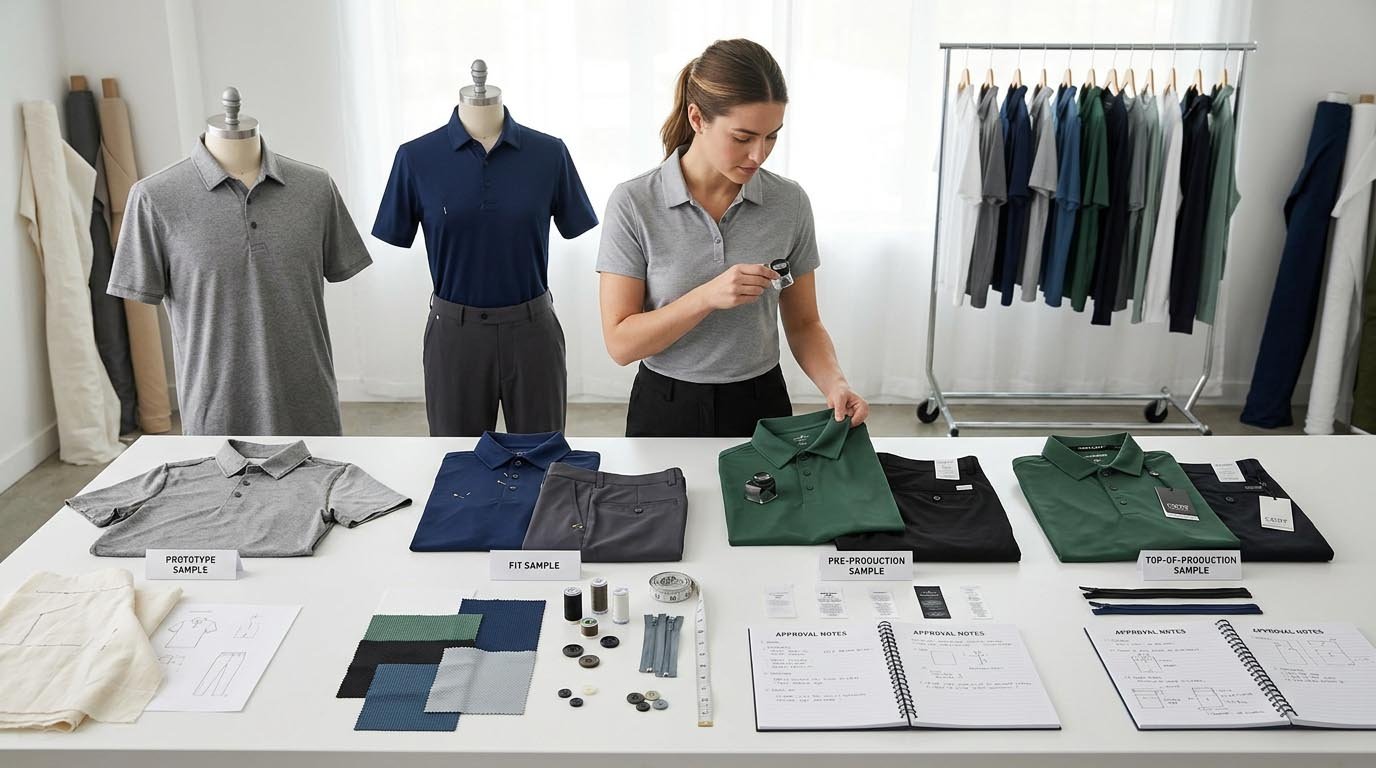
Development or Prototype Sample
This first sample is mainly used to test:
- General style
- Construction
- Fit direction
- Pattern
- Design feasibility
The exact final fabric may not always be available at this stage.
Fit Sample
The main purpose is sizing and shape.
Check:
- Chest
- Length
- Shoulder
- Sleeve
- Waist
- Hip
- Rise
- Overall silhouette
Do not focus only on whether the garment looks attractive on a hanger.
It needs to fit the intended customer.
Pre-Production Sample
The PP sample becomes much more important because it should represent the intended bulk product as closely as practical.
It should confirm:
- Fabric
- Color
- Logos
- Labels
- Trims
- Measurements
- Construction
- Packaging details
The PP sample should be connected to the written specifications.
Top of Production Sample
For more controlled programs, a TOP sample can be taken from the beginning of actual bulk production.
This helps confirm that the sewing line is reproducing the approved construction rather than only relying on the sample room.
This step is particularly useful for larger orders or products with more technical requirements.
Step 6: Avoid the “Golden Sample” Problem
One of the most common sourcing mistakes is assuming:
“The sample is good, so the bulk will automatically be good.”
That is not always true.
A sample proves the supplier can make one approved garment.
Bulk production requires the factory to reproduce that standard repeatedly.
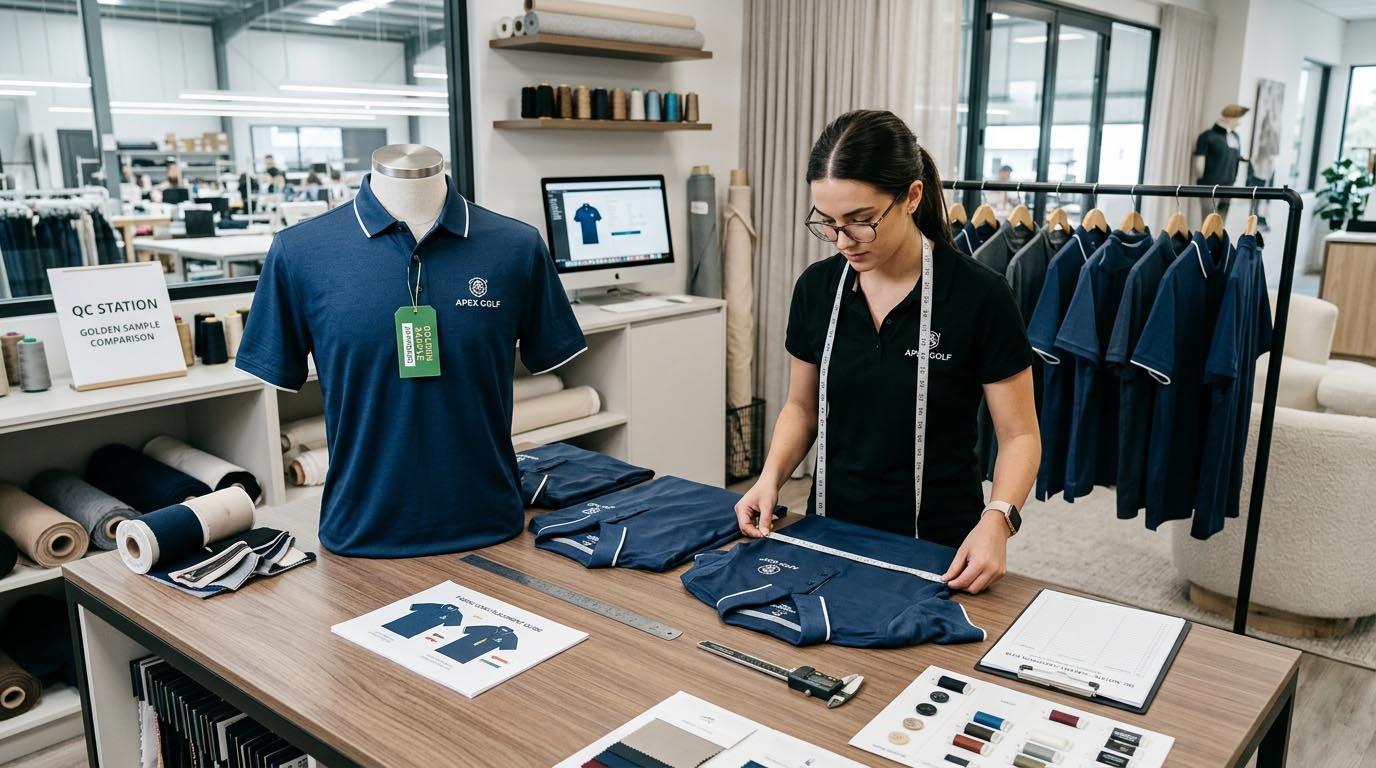
A bulk order may involve:
- Different fabric rolls
- More sewing operators
- Larger dye lots
- Faster production
- Multiple sizes
- Thousands of logo applications
- Different cutting batches
This introduces variation.
The solution is not simply asking:
“Please make bulk exactly like sample.”
Instead, convert the approved sample into measurable production standards.
Build a Production Specification
Your final production specification should cover:
Fabric
- Composition
- GSM
- Color
- Hand feel
- Stretch
- Shrinkage
- Finish
Measurements
- Full size chart
- Measurement points
- Tolerances
Branding
- Logo method
- Placement
- Dimensions
- Color
Trims
- Buttons
- Zippers
- Labels
- Drawcords
- Elastic
- Packaging
Workmanship
- Seam type
- Stitching quality
- Collar construction
- Placket construction
- Accepted defect level
This is much safer than relying only on visual memory.
Step 7: How Should You Control Bulk Quality?
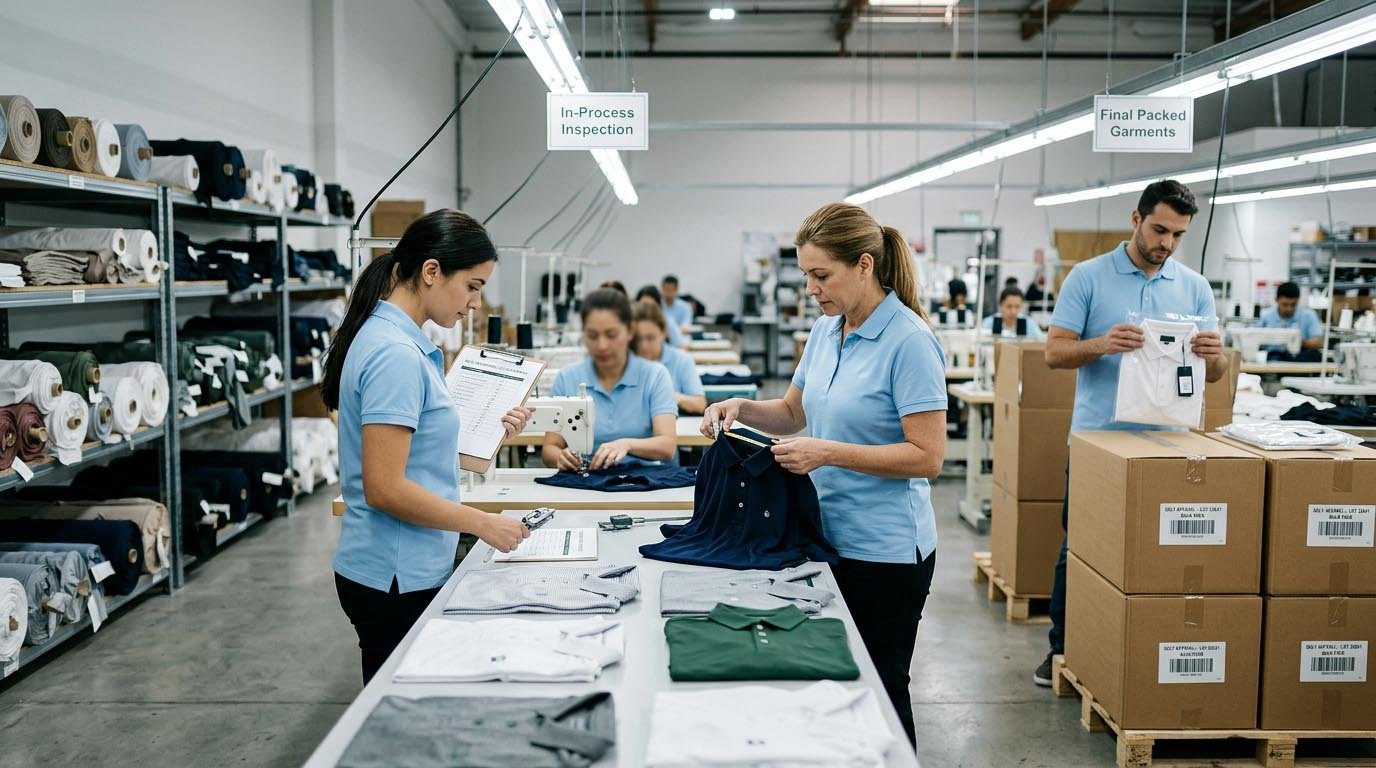
Quality control works best when it happens at several stages.
Not only at the end.
Stage 1: Fabric Inspection
Before bulk cutting, check:
- Color
- Fabric weight
- Hand feel
- Shrinkage
- Stretch
- Visible defects
If the fabric is wrong, sewing will not fix the problem.
Stage 2: In-Process Inspection
During production, check:
- Measurements
- Stitching
- Collar shape
- Placket alignment
- Logo placement
- Color consistency
- Workmanship
Finding a problem early is much cheaper than finding it after the entire order is completed.
Stage 3: Final Inspection
Before shipping, check:
- Finished measurements
- Workmanship
- Colors
- Logos
- Labels
- Packaging
- Quantity
- Carton information
A third-party inspection may also be useful, especially for larger first orders or when the buyer cannot visit the factory.
Step 8: What MOQ Should You Expect When Sourcing Golf Apparel From China?
There is no single standard MOQ for all golf apparel factories.
MOQ depends heavily on:
- Product type
- Fabric availability
- Custom colors
- Custom fabric
- Number of sizes
- Number of colors
- Logo method
- Packaging
- Factory production setup
For example, using an available fabric generally makes lower quantities easier.
Creating a custom fabric or special dye lot may increase the required minimum because the fabric mill also has its own production requirements.
Some manufacturers working with smaller or growing golf brands may offer lower starting quantities for suitable projects, while highly customized fabric programs may require substantially larger volumes.
When discussing MOQ, ask:
“What is driving this MOQ?”
That question often gives you much more useful information than simply asking:
“Can you reduce it?”
Step 9: How Much Does Golf Apparel Cost in China?
There is no reliable universal price for a custom golf polo, golf pant, or quarter-zip.
The price depends on several variables.
Fabric
Fabric can make up a large part of garment cost.
Price changes with:
- Fiber type
- Weight
- Stretch
- Finish
- Custom dyeing
- Recycled content
- Performance treatme
Construction
More complex products generally require more labor.
For example:
- Bonded seams
- Complicated collars
- Multiple panels
- Hidden pockets
- Special zippers
- Laser cutting
- Custom trims
can all influence cost.
Branding
Different decoration methods have different cost structures.
For example:
- Embroidery can work well for classic logos and premium golf branding.
- Screen printing can suit certain graphic designs and larger print areas.
- Sublimation printing is particularly useful when the design requires all-over patterns or highly detailed color graphics on suitable polyester fabrics.
- Heat transfer may suit small, lightweight performance logos.
The right method should be chosen according to the fabric, design, required hand feel, durability, quantity, and target cost.
Quantity
Larger quantities can improve production efficiency and spread some setup costs across more units.
But price should never be evaluated without considering specification differences.
A $7 polo and a $12 polo may not be the same product.
Step 10: Calculate Total Landed Cost — Not Just Unit Price
One of the most useful changes a buyer can make is to stop comparing factories only by FOB unit price.
The true cost of sourcing includes more than the garment.

A simple landed-cost model might include:
| Cost | Example |
|---|---|
| Garment | Factory production price |
| Sampling | Development and courier cost |
| Custom trims | Labels, buttons, packaging |
| Inspection | Internal or third-party QC |
| Freight | Express, air, or sea |
| Duties | Depends on destination and classification |
| Rework | Cost of correcting defective goods |
| Delay | Lost launch time or missed selling season |
Imagine Supplier A is slightly cheaper than Supplier B.
But Supplier A:
- misses the launch date,
- delivers inconsistent sizing,
- or requires rework.
The cheapest unit price may become the most expensive total order.
For a growing brand, reliability often matters as much as small differences in garment price.
Step 11: How Should You Ship Golf Apparel From China?
The best shipping method depends on:
- Order size
- Weight
- Deadline
- Destination
- Budget
Express Courier
Useful for:
- Samples
- Small orders
- Urgent deliveries
Usually fast, but expensive for large volumes.
Air Freight
Useful when:
- You need the goods faster than sea freight
- The order is too large for normal courier shipping
- Launch timing matters
Sea Freight
Usually more suitable for:
- Larger orders
- Less urgent shipments
- Buyers focused on lower freight cost per unit
Shipping should be discussed before production finishes.
Waiting until the order is packed to start planning freight can create unnecessary delays.
Common Mistakes When Sourcing Golf Apparel From China
1. Choosing the Lowest Quote
Low price does not automatically mean good value.
Always compare:
- Fabric
- Construction
- QC
- Communication
- Lead time
- Risk
2. Sending Only Reference Photos
Factories need measurable specifications.
Photos are useful for design direction, but they are not complete production instructions.
3. Approving Only One Sample and Assuming Bulk Will Match
Connect the approved sample with:
- Written specs
- Measurement tolerances
- Material standards
- Inspection
4. Changing Details After Production Starts
Late changes to:
- Fabric
- Colors
- Labels
- Logos
- Packaging
can create delays and mistakes.
Lock important details before bulk production begins.
5. Ignoring Fabric Risk
Many finished-garment problems actually begin with fabric.
Check the material before cutting.
6. Comparing Suppliers Only by MOQ
A lower MOQ may be attractive, but also consider:
- Fabric choices
- Quality
- Production consistency
- Communication
- Long-term scalability
7. Ignoring Total Landed Cost
The cheapest factory quotation may not create the lowest final cost.
Buyer Checklist Before Paying a Deposit
Before confirming a bulk order, make sure you know:
- [ ] Final product specification
- [ ] Fabric composition
- [ ] Fabric weight
- [ ] Approved color
- [ ] Size chart
- [ ] Measurement tolerance
- [ ] Logo technique
- [ ] Logo placement
- [ ] Labels
- [ ] Packaging
- [ ] MOQ
- [ ] Unit price
- [ ] Sample approval status
- [ ] Production lead time
- [ ] QC process
- [ ] Shipping terms
- [ ] Payment terms
- [ ] Final inspection plan
If several of these items are still unclear, the order is probably not ready for bulk production.
FAQ: Sourcing Golf Apparel From China
Is China a Good Place to Source Golf Apparel?
China can be a strong sourcing option for brands that need performance fabrics, customization, private labeling, and access to a broad apparel supply chain.
The result depends heavily on choosing a supplier that matches your specific product.
How Do I Find a Reliable Golf Apparel Manufacturer in China?
Look beyond the supplier's website and price quote.
Evaluate:
- Similar golf apparel experience
- Fabric knowledge
- Sample quality
- Communication
- Quality control
- Production capability
- Test reports
- Willingness to discuss risks
A good supplier should understand both your design and how to manufacture it consistently.
Do I Need a Tech Pack?
A tech pack is highly recommended for custom products.
It reduces assumptions by documenting important information such as:
- Measurements
- Fabric
- Colors
- Construction
- Branding
- Packaging
For early development, the document can start simple and become more detailed as the sample develops.
What Is a PP Sample?
A Pre-Production sample is a sample used to confirm the intended bulk production standard before mass production proceeds.
It should represent the final:
- Fabric
- Color
- Measurements
- Logos
- Trims
- Labels
- Construction
as closely as possible.
Why Can Bulk Production Differ From the Approved Sample?
Possible reasons include:
- Different fabric batches
- Different sewing operators
- Unclear tolerances
- Color variation
- Changed trims
- Production shortcuts
- Poor in-line quality control
The best protection is to combine a physical approved sample with written specifications and production inspections.
What MOQ Should I Expect?
MOQ varies by factory and product.
Available fabrics and simpler customization usually make smaller quantities easier.
Custom fabrics, special dyeing, complex trims, or many color combinations may require higher minimums.
How Long Does Golf Apparel Production Take?
Lead time depends on:
- Sample revisions
- Fabric availability
- Custom dyeing
- Trim development
- Order quantity
- Product complexity
- Factory schedule
Ask the manufacturer to separate:
- Sampling time
- Material preparation
- Bulk production
- Inspection
- Shipping
This gives you a much clearer delivery plan.
Should I Use a Factory or Trading Company?
Both can work.
A direct manufacturer may be better when you want closer technical control over a specialized golf apparel program.
A trading company may make sense when you need many different product categories sourced from different factories.
Choose based on your sourcing model rather than the label alone.
Conclusion
Sourcing golf apparel from China should not be treated as a search for the cheapest factory.
It is a process of reducing uncertainty.
First define the product.
Then find a supplier that understands golf apparel.
Build clear specifications.
Use sampling to test both the product and the manufacturer.
Approve the correct materials and production details.
Finally, control bulk production through fabric inspection, in-process checks, and final inspection.
When these steps connect properly, the approved sample becomes more than a good-looking prototype. It becomes a repeatable production standard.
That is what turns China sourcing from a one-time purchase into a reliable supply chain.
At FUWAY, we work with golf brands on OEM/ODM development covering custom golf apparel, fabric sourcing, sampling, private labeling, decoration, quality control, and bulk production.
If you are developing golf polos, bottoms, quarter-zips, skorts, or another golf apparel collection, you can contact FUWAY with your tech pack, reference sample, design file, or even an early product concept to discuss your project.