
I watched a client's 500-piece polo order get held at customs for 18 days because the care label showed a polyester percentage that didn't match the lab test. The fix cost them $2,400 in re-labeling fees and two angry retailers who canceled their orders.
Hangtags, care labels, and packaging are not design extras—they are compliance gates. Most new golf apparel brands finalize artwork without checking fiber content against lab reports, wash symbols against fabric behavior, or market formats against US FTC or EU REACH rules. These three mistakes delay shipments, trigger costly revisions, and create customer complaints that could have been caught during pre-production.
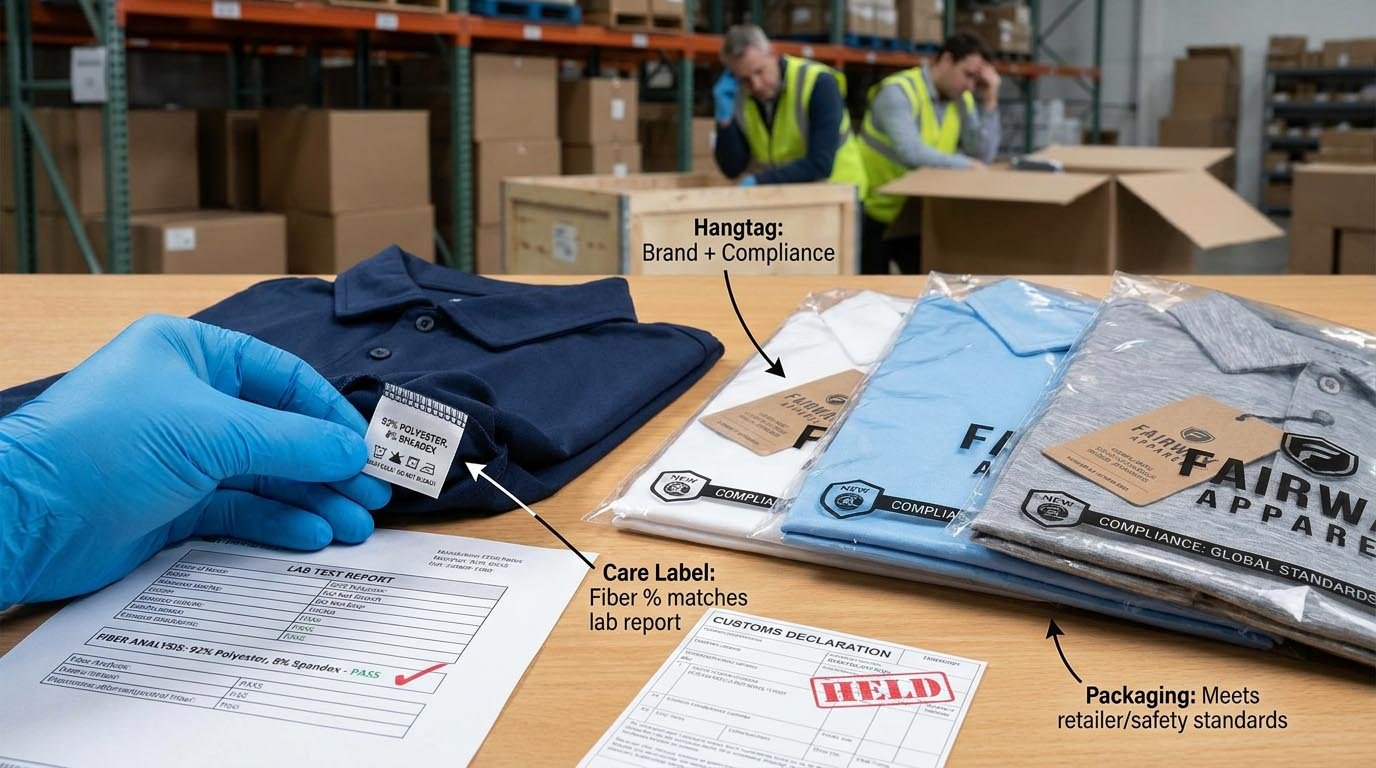
You probably think hangtags and labels are the last step, something you design after perfecting your polo's fit and colorways. I used to see clients treat them that way—until I started counting how many production runs got paused because a care symbol didn't match the fabric's actual shrinkage rate, or a fiber blend percentage was wrong by 12%.
What is the most common hangtag compliance mistake?
New brands print only their brand name on hangtags, not knowing US FTC requires either an RN number or full company address. This triggers delays when shipments reach US customs.
Why do fiber content percentages cause delays?
Suppliers sometimes mix fabric batches mid-production, creating 10%+ gaps between your approved sample and bulk-run lab tests. Always verify fabric test reports before printing care labels.
Can I use "machine washable" symbols for all golf polos?
No. If your fabric shrinks or fades under heat, the "machine washable" symbol creates liability. Request supplier wash-test data, or use cold-water-only symbols as a safer compliance option.
What packaging mistakes hurt pro-shop sales?
Brands use thin polybags that arrive wrinkled, forcing shops to steam every piece before display. Use rigid cardboard inserts or fold-and-clip methods to maintain retail-ready presentation.
How early should I finalize hangtag and label artwork?
Lock artwork at least 30 days before bulk production starts, so you have time to correct fiber content claims, wash symbols, or RN number formats without delaying manufacturing.
Why Labels and Packaging Matter: Brand Experience and Compliance?
Labels and packaging are the first physical touchpoint your customer holds. If a hangtag feels flimsy or a care label shows contradictory wash instructions, you lose trust before the polo is even tried on. Beyond brand experience, these elements also determine whether your shipment clears customs or gets flagged for compliance review.
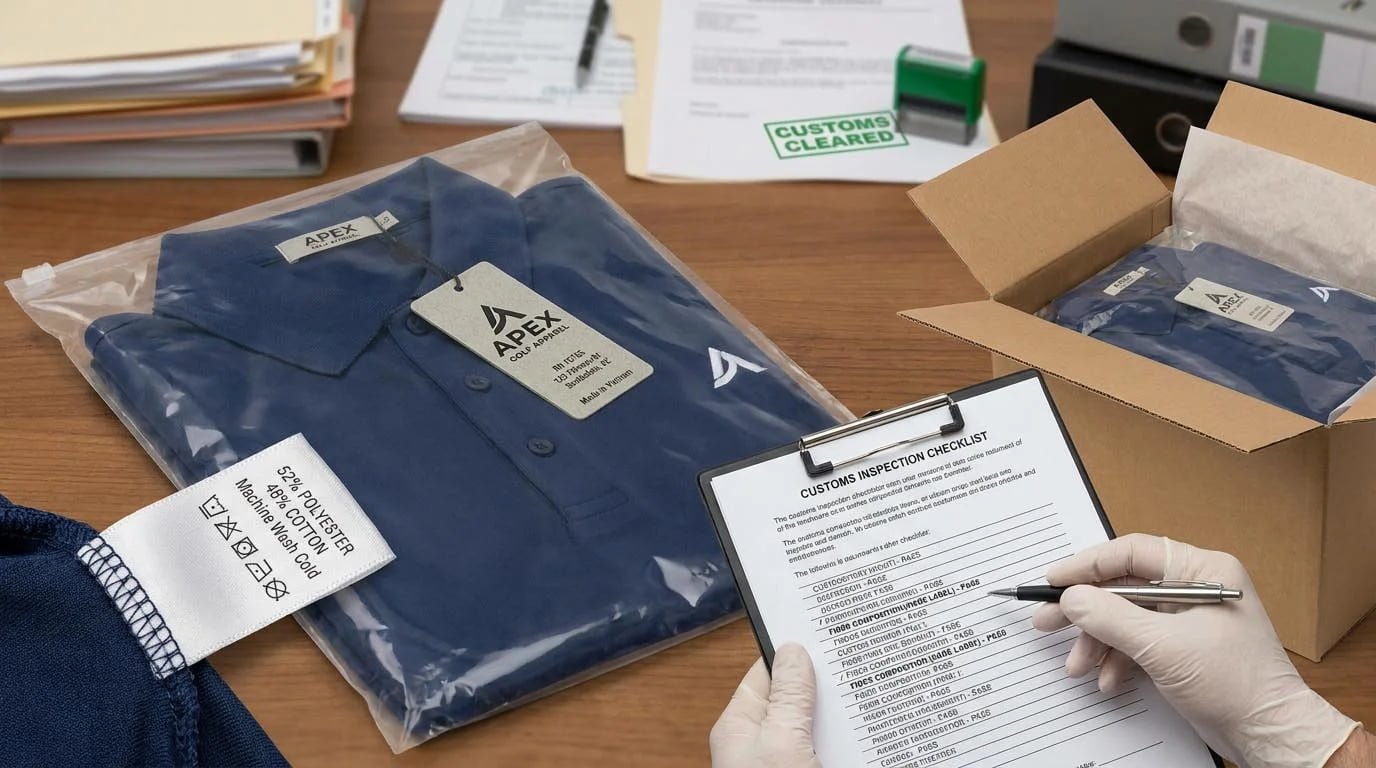
I started managing hangtag and label projects after a client asked me why their 1,200-piece shipment sat in a customs warehouse for three weeks. The answer was simple: their care label listed "95% polyester, 5% spandex," but the lab test showed 88% polyester, 12% spandex. Customs flagged it as a fiber content discrepancy, and the only fix was to re-label every piece in the warehouse.
Most new brands don't realize that labels and packaging are not just branding tools—they are legal documents. Here is what I tell every client during our first pre-production meeting:
- Care labels must match fabric test results, not supplier verbal promises
- Hangtags must include either an RN number or full company address for US compliance
- Packaging must protect garments during transit and maintain retail-ready presentation at destination
When clients skip these checkpoints, I see three outcomes: customs delays, retailer rejections, or customer complaints about garments that don't perform as the label claims.
A functional hangtag tells your brand story, displays sponsor logos clearly, includes pricing/barcode for retail scanning, and uses a string attachment that won't damage fabric. The common mistake is overloading hangtags with design elements while missing the compliance data required by your target market.
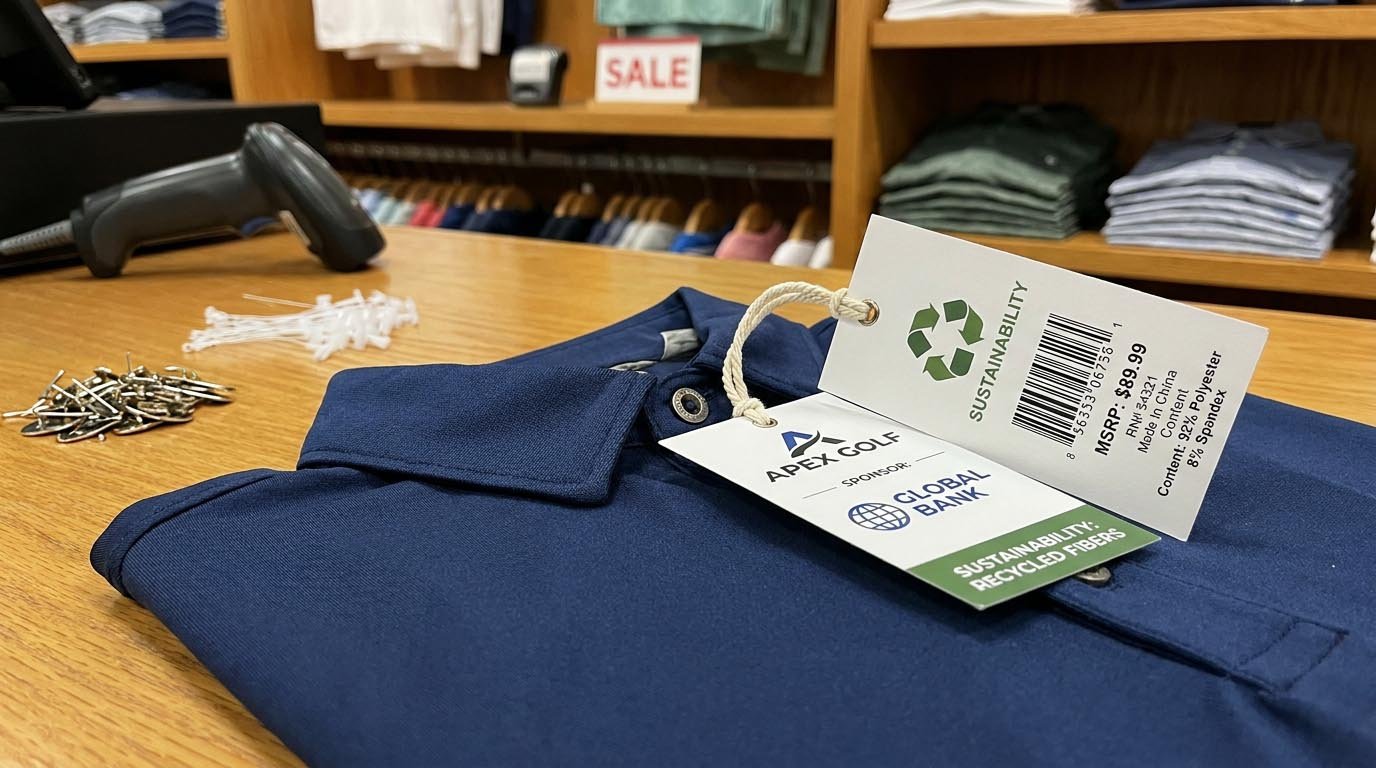
I worked with a brand that designed a beautiful 3-panel folded hangtag featuring their logo, a sustainability message, and sponsor logos. The problem appeared when they tried to enter US retail channels—the hangtag had no RN number, no country of origin statement, and no fiber content disclosure. The retailer rejected the shipment, and we had to print 1,000+ replacement hangtags at an extra cost of $0.45 per piece.
Here is what I check before approving any hangtag artwork:
| Hangtag Element | Why It Matters | Common Mistake |
|---|---|---|
| RN Number or Address | US FTC requires identification of manufacturer or importer | Brands print only logo, no legal entity info |
| Country of Origin | Required for US customs clearance | Missing "Made in China" or similar statement |
| Fiber Content | Must match care label data exactly | Brands copy competitor hangtags without verifying |
| Barcode/SKU | Enables retail POS scanning | Barcode too small or printed in color that won't scan |
The hangtag string attachment also matters more than most brands think. I have seen metal pins create small holes in moisture-wicking fabrics, and plastic loops that yellow over time. My standard recommendation: use cotton or nylon loop strings that tie through a reinforced eyelet punched at the top corner of the hangtag.
Care Labels and Legal Basics: Fiber, Origin, RN/CA, Care Symbols and Claims?
Care labels must disclose fiber content, country of origin, manufacturer identification (RN/CA number or address), and wash/dry instructions using standardized symbols. The three highest-risk errors are mismatched fiber percentages, wash symbols that don't align with fabric behavior, and missing RN/CA compliance for North American markets.
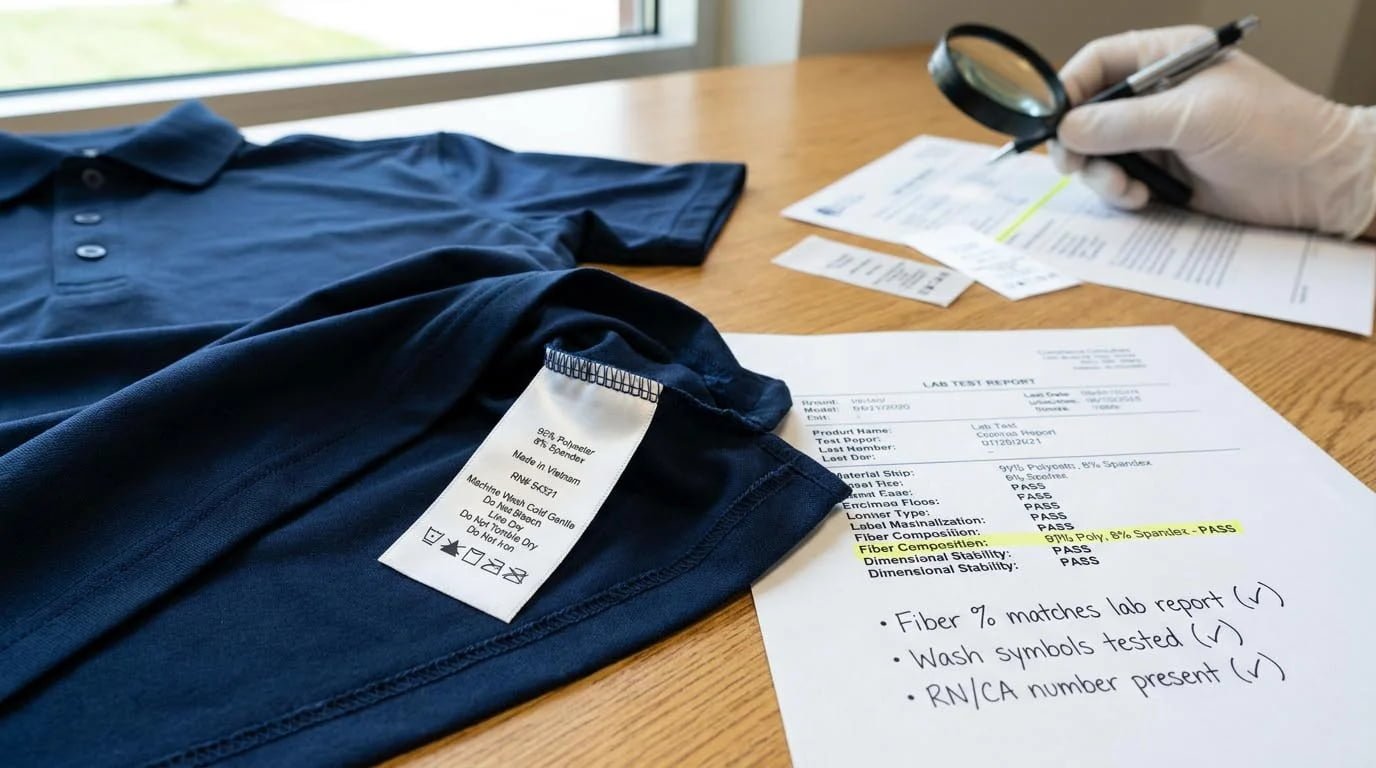
I catch fiber content errors at least once per month. The typical scenario: a client approves a sample labeled "100% polyester," then bulk production uses a slightly different fabric batch that tests at 92% polyester, 8% spandex. The supplier doesn't notify anyone, and we discover the gap only when reviewing the pre-shipment lab report.
Here is the correction process I follow:
- Request written fabric test reports from the supplier before finalizing care label artwork—never accept verbal fiber content claims
- Compare approved sample test data against bulk production test data to catch batch mixing
- Update care label content immediately if fiber percentages shift by more than 3%
The wash symbol contradiction is the second error I see repeatedly. A client will request standard "machine washable" symbols because they assume all moisture-wicking polos can handle normal wash cycles. Then the fabric shrinks 4-6% in length after a hot-water wash, and customers start returning the polos.
My solution: I ask suppliers to provide wash-test data showing shrinkage rates and colorfastness ratings. If the fabric fails hot-water tests, I recommend using cold-water-only symbols with a "do not tumble dry" icon. This protects the brand from liability, even if it limits the garment's convenience.
For North American markets, the RN number blind spot causes the most delays. New brands see competitors printing only brand names on care labels, so they assume that format is compliant. It isn't. US FTC requires either:
- A registered RN number (obtained through FTC online application)
- Full company name and address printed directly on the care label
EU brands selling into North America face the same gap, plus REACH disclosure requirements for certain fabric treatments. I coordinate these checks with third-party compliance consultants, since market-specific regulations change frequently.
Packaging and Kitting: Protection, Unboxing, Sustainability and Pro‑Shop Readiness?
Packaging must prevent wrinkles during transit, create a positive unboxing experience, align with sustainability claims if you make them, and deliver garments in retail-ready condition for pro-shop buyers. The mistake I see most often is using thin polybags that save $0.08 per unit but create $2-3 in steaming labor at destination.
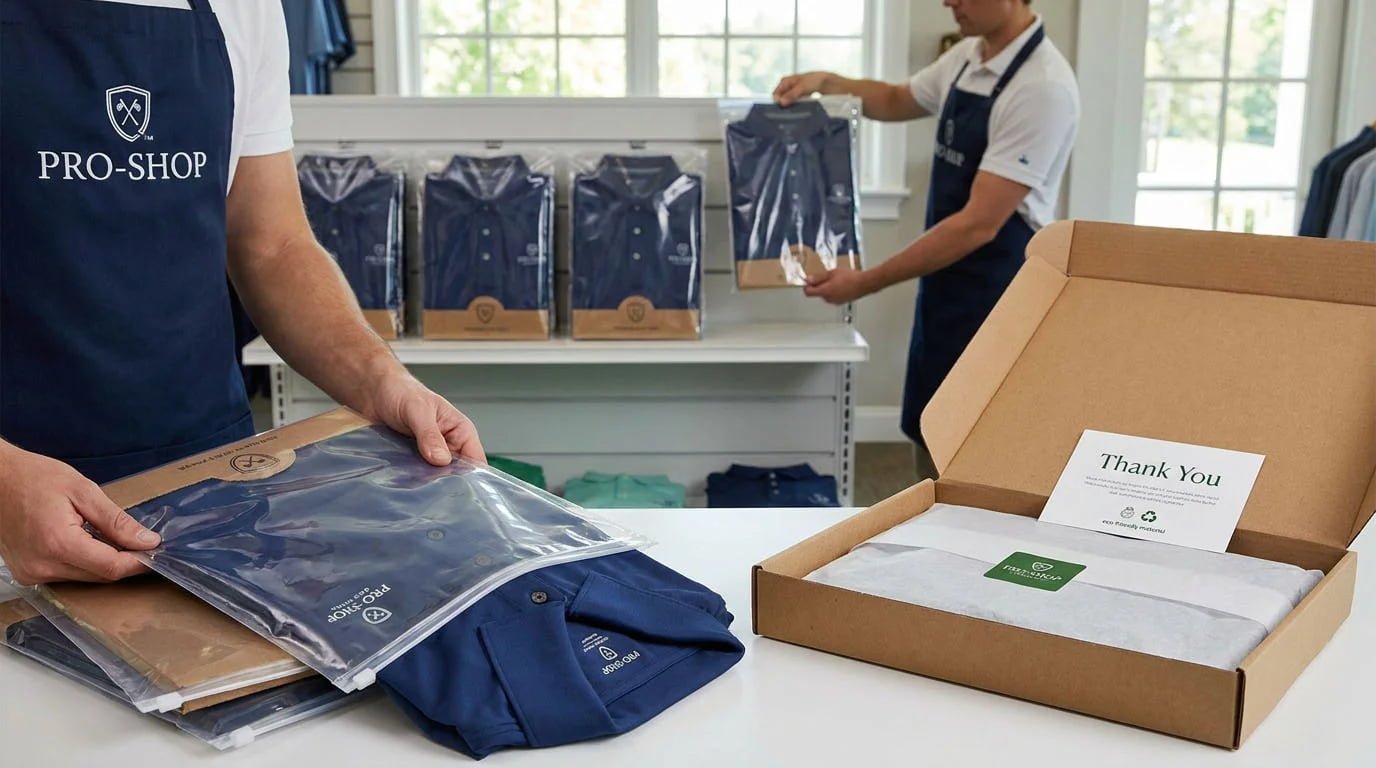
I worked with a client who sold to six pro shops across California. Their first shipment arrived in standard 9x12-inch polybags, and every shop called to complain that the polos looked wrinkled and unprofessional. The shops refused to display the garments without steaming them first, which added $2.50 per piece in labor costs that ate into the client's already thin margins.
We fixed it by switching to a fold-and-clip method with rigid cardboard inserts. The new packaging added $0.22 per unit, but the polos arrived display-ready, and the shops placed repeat orders without complaint.
Here is the packaging checklist I use for retail-focused clients:
- Rigid cardboard insert or fold board to maintain polo shape and prevent deep creases
- Clear or semi-opaque polybag that lets shop staff verify garment condition without opening
- Clip or rubber band to secure folded shape during transit
- Sustainability messaging if applicable—but only if the material choice backs up the claim
For e-commerce brands, the unboxing experience matters in a different way. Customers expect branded packaging that feels premium, especially if they paid $65-85 for a custom golf polo. I recommend:
- Custom-printed mailer boxes for orders above $100 total value
- Tissue paper wrapping with logo sticker as a low-cost premium touch
- Thank-you card with care instructions and social media handle
The sustainability question comes up in almost every project now. Clients ask for "eco-friendly packaging," then choose the cheapest polybag option because sustainable alternatives add $0.30-0.50 per unit. I tell them the same thing: if you claim sustainability on your website or hangtags, your packaging material must match that claim. Otherwise, you create a credibility gap that customers notice immediately.
Specs, Proofs and Testing: Art, Placement, Durability and Vendor Compliance?
Locking artwork specs, reviewing physical proofs, and testing label durability before bulk production starts prevents the three most expensive mistakes: incorrect fiber content on printed labels, wash symbols that fade after five launderings, and hangtag attachment methods that damage fabric. I verify supplier documentation aligns with target market standards rather than conducting lab analysis myself.
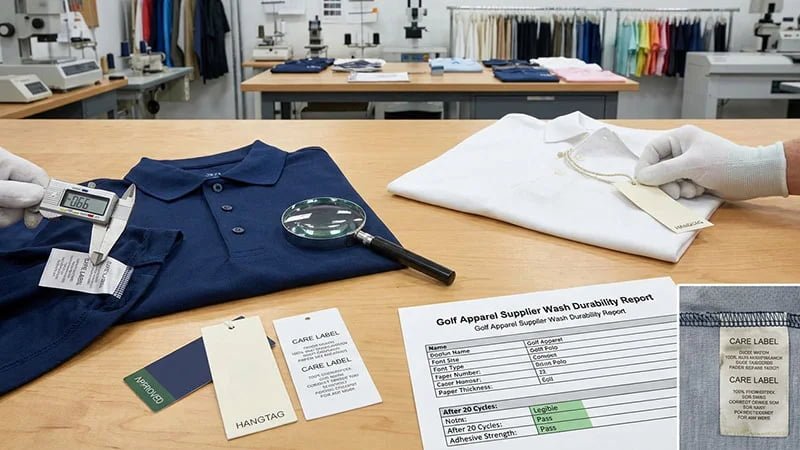
The spec phase is where most errors get locked in permanently. I learned this after a client approved care label artwork on a PDF proof, then discovered the printed labels used a font size 25% smaller than the approved proof. The labels were technically readable, but they looked cheap, and we had already printed 2,000 pieces.
Now I require physical printed samples for every label and hangtag before approving bulk orders. Here is what I check:
| Element | Spec to Verify | Testing Method |
|---|---|---|
| Font Size | Minimum 6pt for legal text | Measure with digital caliper |
| Color Match | PMS code accuracy | Visual comparison against approved sample |
| Label Adhesive | Survives 10+ wash cycles | Supplier wash-test report or request sample testing |
| Hangtag Paper Weight | 300gsm minimum for premium feel | Physical sample comparison |
The wash durability test is critical for care labels. I request supplier data showing the label's print and adhesive quality after 10, 20, and 30 launderings. If the supplier can't provide this data, I ask for 10-20 sample labels that I can send to a third-party lab for accelerated wash testing.
Placement matters as much as durability. I once saw a client place care labels at the back neck seam of a golf polo, exactly where the collar would rub during movement. After five rounds of golf, the label was curled and the print was partially faded. We moved the label to the side seam at hip level, and complaints stopped.
For hangtag attachment, I test two things:
- String strength: Pull test to verify the string won't break during normal handling
- Fabric damage: Examine the attachment point after removing the hangtag to check for holes or pulls
I don't run these tests in-house—I coordinate with accredited labs or rely on supplier documentation. My role is interpreting the data and flagging discrepancies before they reach bulk production.
Do I need an RN number for every market?
No. RN numbers are a US FTC requirement. For EU markets, you need compliance with REACH regulations and CE marking if applicable. Canada requires a CA number or full company address.
Can I print care labels in multiple languages?
Yes, but check market-specific requirements. US labels need English, Canadian labels need English and French, and EU labels often require the language of the destination country.
What happens if my fiber content is off by 5%?
US FTC allows a 3% tolerance for fiber content disclosure. If your label says 95% polyester and tests show 92%, you are within tolerance. Beyond 3%, you risk compliance flags and potential re-labeling.
How much does re-labeling cost if I make a mistake?
Re-labeling costs vary by volume, but expect $0.50-1.20 per piece for labor, plus $0.15-0.40 per new label. For a 1,000-piece order, total re-labeling runs $650-1,600.
Should I use woven or printed care labels?
Woven labels feel more premium and survive more launderings, but cost $0.18-0.35 per piece. Printed labels cost $0.08-0.15 per piece but fade faster. For retail golf apparel, I recommend woven labels.
Can I copy a competitor's hangtag format?
You can use similar layouts, but never copy fiber content, wash symbols, or compliance data without verifying your own fabric properties. Copying creates liability when your garment performance doesn't match the label claims.
Conclusion
Hangtags, care labels, and packaging are compliance gates that protect your brand and your budget. Lock artwork specs early, verify fiber content against lab reports, and test label durability before bulk production starts—these three steps prevent the costly mistakes I see every month.