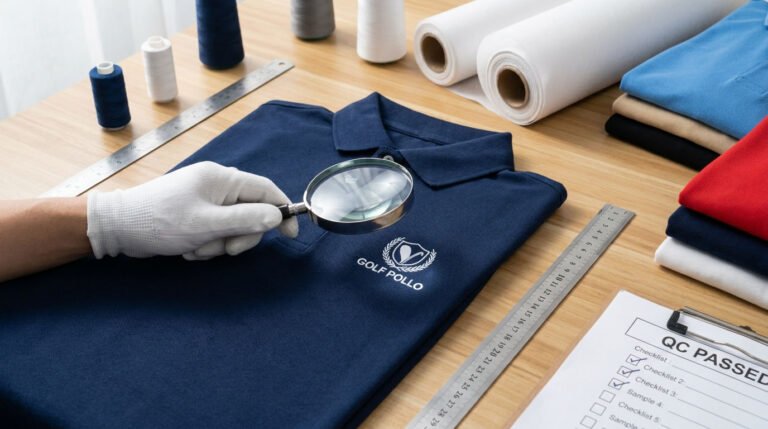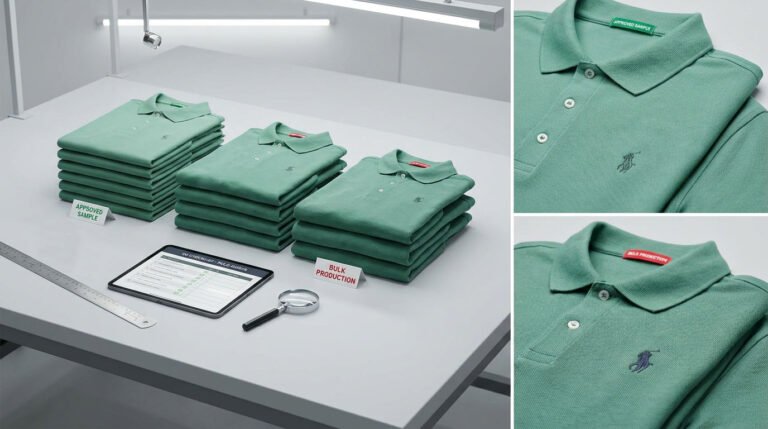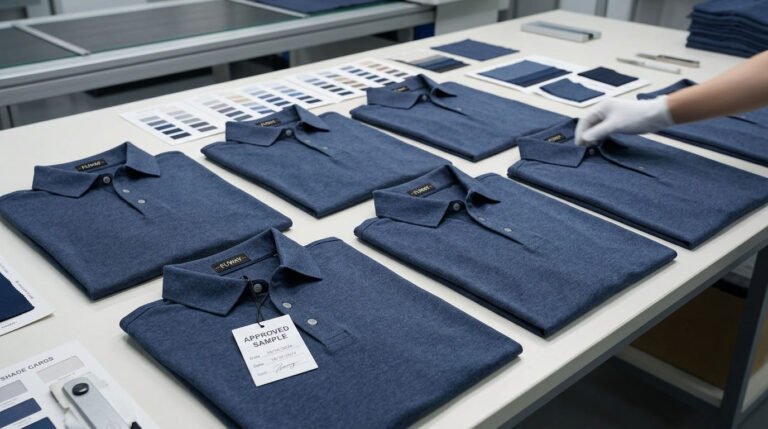
A golf polo can look perfect in a sample photo but still fail during a swing. A Medium sample may fit correctly while smaller and larger sizes have problems with shoulders, sleeves, or body length.
Once bulk cutting begins, correcting these issues becomes more difficult and expensive.
Before mass production, golf apparel brands should approve the size chart, grading, garment measurements, golf-specific movement, fabric stability, and final pre-production (PP) sample. At FUWAY, finished-garment measurement deviations must remain within ±1.0 cm of the approved specifications, with tighter limits where required.
This checklist explains what to inspect, which samples to approve, and when to request corrections before releasing bulk production.
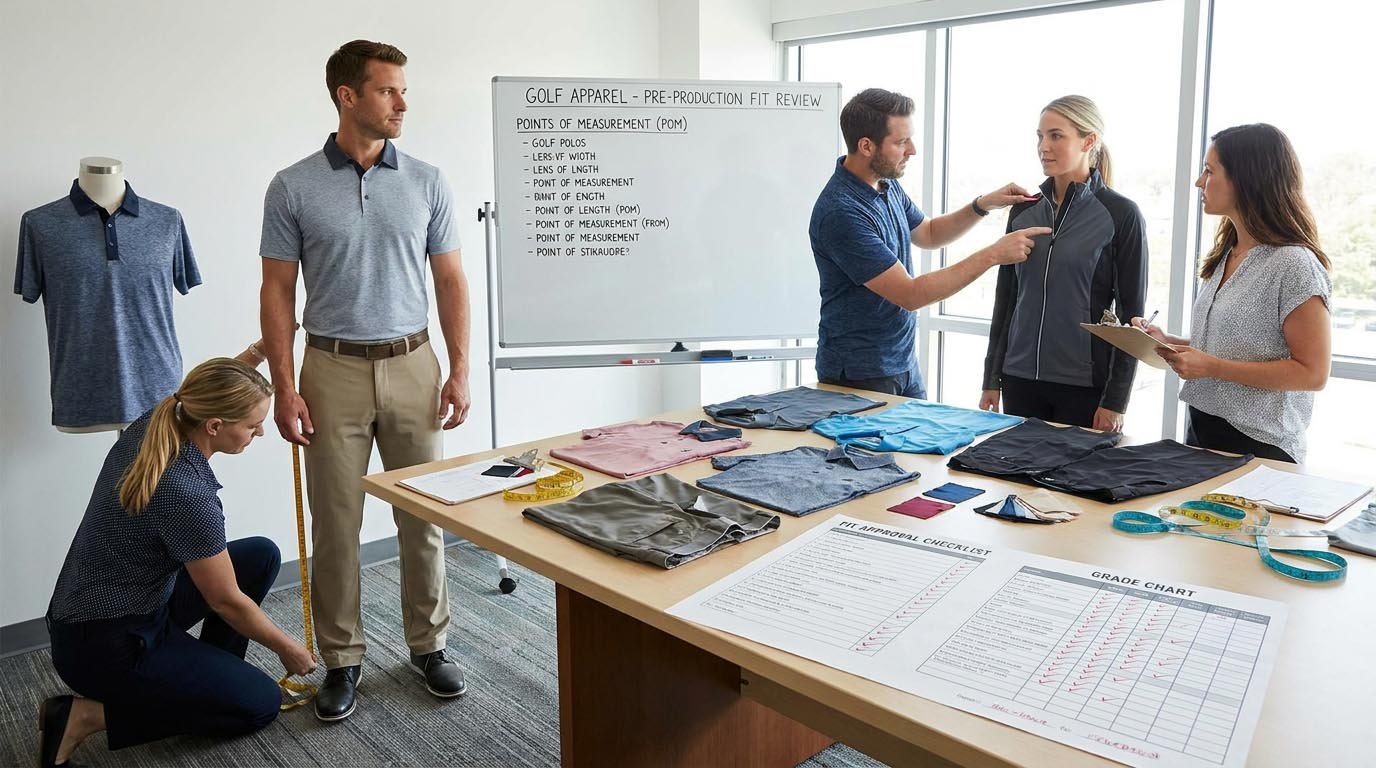
Quick Answer: How Do You Approve Garment Fit Before Mass Production?
A reliable fit approval process covers eight checkpoints:
| Step | Approval Checkpoint | What Must Be Confirmed |
|---|---|---|
| 1 | Fit goals | Target customer, fit block, and intended ease |
| 2 | Size chart and size set | Grading and proportions across sizes |
| 3 | Sample stages | Each required sample passes its intended review |
| 4 | POMs and tolerances | Clear measuring methods and approved limits within ±1.0 cm |
| 5 | Golf movement | Comfort during swinging, bending, and layering |
| 6 | Fabric stability | Shrinkage, stretch recovery, and construction stability |
| 7 | PP and TOP samples | Final production readiness and early-line consistency |
| 8 | Final approval | Written sign-off with no unresolved critical fit issues |
The key rule: Do not approve bulk cutting solely because one sample looks good or meets its measurement chart.
A garment must also perform as intended during actual golf movements.
Pre-Production Fit Approval Checklist at a Glance
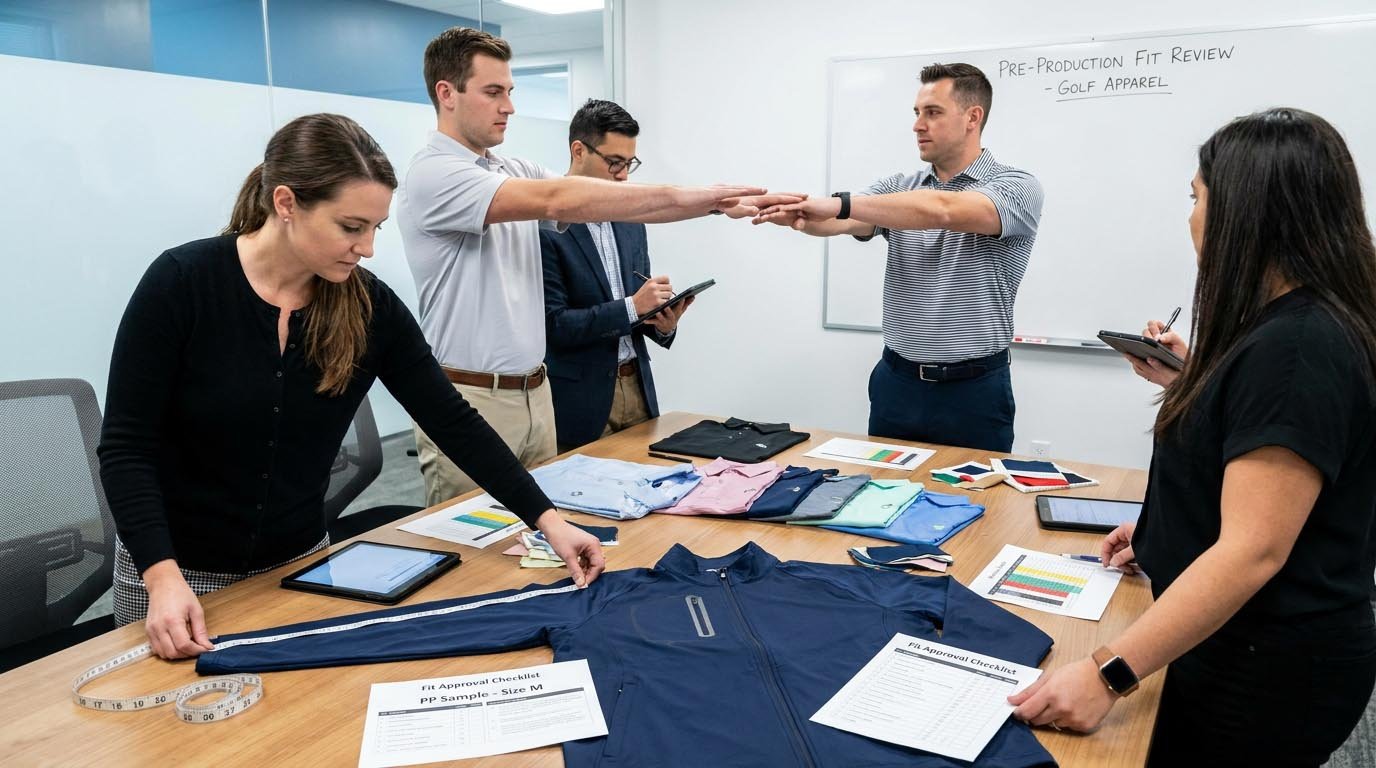
Before releasing production, verify that:
- [ ] The intended fit and target customer are defined.
- [ ] The base size chart and grading rules are approved.
- [ ] Representative sizes have been tested.
- [ ] All relevant POMs and measurement methods are documented.
- [ ] Tolerances comply with FUWAY's ±1.0 cm maximum.
- [ ] Golf-specific movement tests have passed.
- [ ] Fabric shrinkage and recovery meet agreed requirements.
- [ ] The final PP sample matches approved production specifications.
- [ ] The approval record contains no unresolved issues that block production.
The following eight steps explain how to complete these checks.
Step 1: Define Fit Goals, Ease, and Target Customer
Before sampling, brands must decide what a correct fit means for their product.
Terms such as athletic fit, regular fit, or relaxed fit describe general styling, but they are not precise enough for manufacturing.
Define Your Fit Requirements
| Fit Element | What to Confirm |
|---|---|
| Target market | Intended regional sizing and customer profile |
| Fit block | Athletic, regular, relaxed, or brand-specific |
| Chest and shoulder ease | Room required for rotation |
| Waist and hip ease | Comfort during movement |
| Garment length | Coverage when standing, bending, or swinging |
| Layering | Whether the garment will be worn over another layer |
For example, a fitted performance polo may need a cleaner silhouette, while a golf quarter-zip requires sufficient room over a base layer.
Fit approval should start with an agreed design target, not subjective comments such as "make it slightly looser."
For a deeper explanation of ease, patterns, and movement, see our Golf Apparel Fit Guide.
Step 2: Validate the Size Chart and Size Set
One approved Medium sample does not prove that every size will fit correctly.
Size grading determines how measurements change between adjacent sizes. Incorrect grading can create disproportionate sleeves, narrow shoulders, or inconsistent waist and hip measurements.
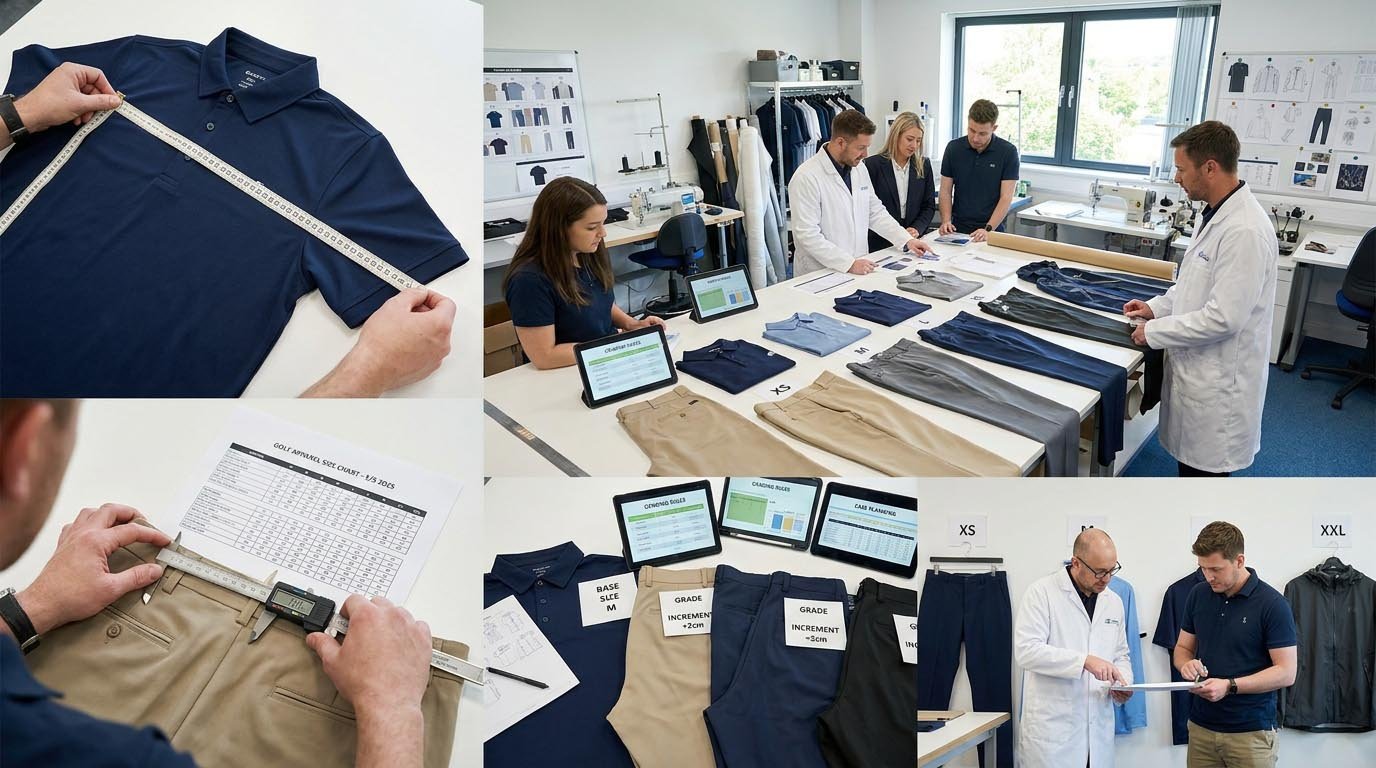
What Should Brands Check?
Review the following:
- Base size measurements
- Chest, waist, hip, and shoulder grading increments
- Sleeve and body length progression
- Armhole and leg opening proportions
- Intended ease across the size range
How Many Sizes Should Be Tested?
For a typical size range, reviewing at least three representative sizes is a useful starting point.
For example:
- S / M / L
- M / L / XL
- Lower / middle / upper sizes within the actual range
For broad size ranges or complex fits, additional size-set samples may be necessary.
When Should Grading Be Rejected?
Consider a golf polo where:
- Medium fits correctly.
- Small restricts shoulder movement.
- XL sleeves become disproportionately long.
Even if each sample meets its own measurement tolerances, the grading or pattern may still need correction.
Passing the measurement chart does not automatically mean the fit is approved.
Step 3: Review Each Sample Stage for Its Intended Purpose
Different sample stages answer different development questions.
Brands should not use an early design sample as the final production reference unless it has been specifically developed and approved for that purpose.
Sample Approval Comparison
| Sample Stage | Main Purpose | Approval Focus |
|---|---|---|
| Proto sample | Validate design concept | Silhouette, layout, and construction feasibility |
| Fit / development sample | Evaluate intended fit | Measurements, comfort, and revisions |
| SMS, if used | Showroom or sales review | Appearance and presentation; not automatically final fit approval |
| Size set | Validate grading | Proportions across representative sizes |
| PP sample | Confirm production readiness | Final fabric, trims, construction, and measurements |
| TOP sample | Check initial production output | Consistency with approved PP requirements |
Not every project requires every sample type. The stages depend on design complexity, development risk, and buyer requirements.
Which Stage Matters Most Before Bulk Cutting?
The pre-production (PP) sample is the key release checkpoint.
It should represent the final approved product using the intended production materials and construction methods.
A TOP sample is reviewed after production starts, so it supports early-production verification rather than replacing PP approval before cutting.
For the broader development workflow, see our Golf Apparel Sampling Process Guide.
Step 4: Confirm POMs and FUWAY's ±1.0 cm Measurement Standard
Points of Measurement (POMs) define exactly where and how finished-garment dimensions are measured.
Without clear POM instructions, the buyer and factory may obtain different results from the same garment.
Common POMs by Garment Type
| Garment | Key Measurement Points |
|---|---|
| Golf polo | Chest, shoulder, sleeve, body length, collar |
| Golf trousers | Waist, hip, rise, thigh, inseam |
| Golf shorts | Waist, hip, rise, leg opening |
| Golf skort | Waist, hip, outer-skirt length, liner dimensions |
| Quarter-zip | Chest, shoulder, sleeve, hem, neck opening |
Measurement diagrams should define exact starting points, ending points, and garment positioning.
What Measurement Tolerance Does FUWAY Accept?
FUWAY controls finished-garment measurement deviations within ±1.0 cm of the approved target.
Fit-sensitive points may require stricter tolerances specified in the approved tech pack.
The following is an illustrative specification example:
| Point of Measurement | Target | Example Tolerance | Acceptable Range |
|---|---|---|---|
| Polo 1/2 chest width | 58.0 cm | ±1.0 cm | 57.0–59.0 cm |
| Polo body length | 72.0 cm | ±1.0 cm | 71.0–73.0 cm |
| Polo sleeve length | 24.0 cm | ±0.5 cm | 23.5–24.5 cm |
| Trouser 1/2 waist | 40.0 cm | ±1.0 cm | 39.0–41.0 cm |
These are examples rather than fixed tolerance assignments for all FUWAY products.
For a detailed explanation of acceptable dimensional
deviations, measurement methods, and bulk inspection
decisions, see our
Golf Apparel Measurement Tolerance Guide.
Three Rules Before Approval
- Confirm measuring methods. Measure garments flat, relaxed, or in another specified condition according to the approved POM instructions.
- Apply the approved limits. No specified FUWAY finished-garment dimensional tolerance should exceed ±1.0 cm.
- Do not automatically widen tolerances for stretch fabrics. Fabric behavior must be controlled through appropriate development and production procedures.
If a chest measurement is specified as 58.0 ±1.0 cm, an actual result of 59.3 cm is outside tolerance and must be addressed.
Also remember that a garment within measurement tolerance may still fail fit approval because of poor proportions or restricted movement.
For guidance on documenting measurement charts, grading, and construction requirements, see our Golf Apparel Tech Pack Checklist.
Step 5: Test Golf-Specific Movement, Not Just Static Fit
Golf apparel must perform during movement, not only while the wearer stands in front of a mirror.
Fit testing should reflect how the product will actually be worn.
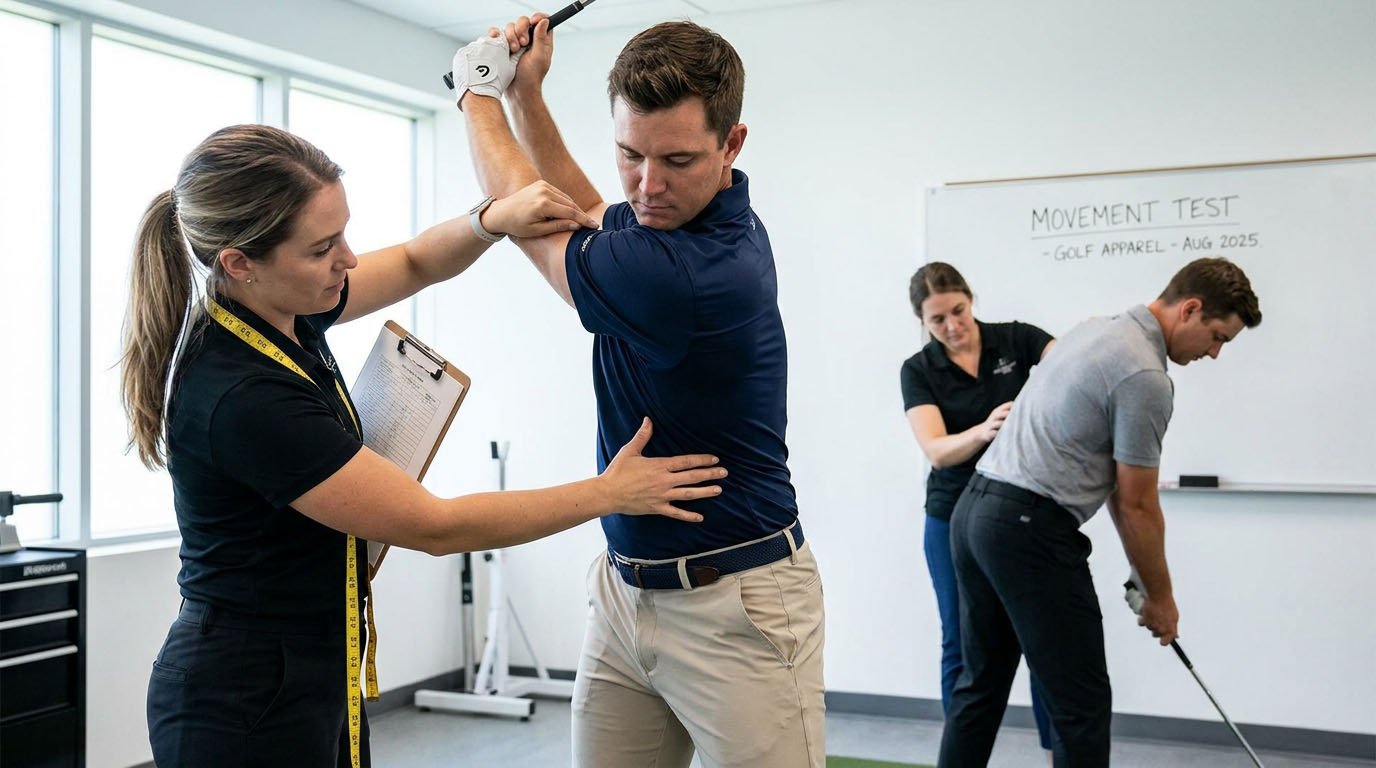
Golf Polos and Performance Tops
Test:
- Full backswing and follow-through
- Torso rotation
- Forward bend in address posture
- Arms raised overhead
Watch for shoulder pulling, armhole restriction, back-panel tension, and excessive hem lifting.
Golf Trousers, Shorts, and Skorts
Test:
- Squatting
- Bending to pick up a ball
- Walking and taking a wide stance
- Sitting and knee bending
For skorts, check whether the outer skirt maintains coverage and whether the inner liner restricts movement or rides up.
Quarter-Zips and Outerwear
Wear the garment over its intended base layer.
Confirm:
- Adequate shoulder rotation
- Comfortable chest and upper-back fit
- No excessive sleeve drag
- No zipper stress during movement
What If Measurements Pass but Movement Fails?
Do not approve the fit solely because the measurements fall within tolerance.
The pattern, ease, armhole shape, or garment construction may require revision.
Functional fit and dimensional compliance are two separate approval requirements.
Step 6: Validate Fabric Shrinkage, Stretch, and Recovery
A sample may fit correctly before washing but change dimensions after laundering or repeated wear.
This can affect the final approved fit even when initial measurements meet specifications.
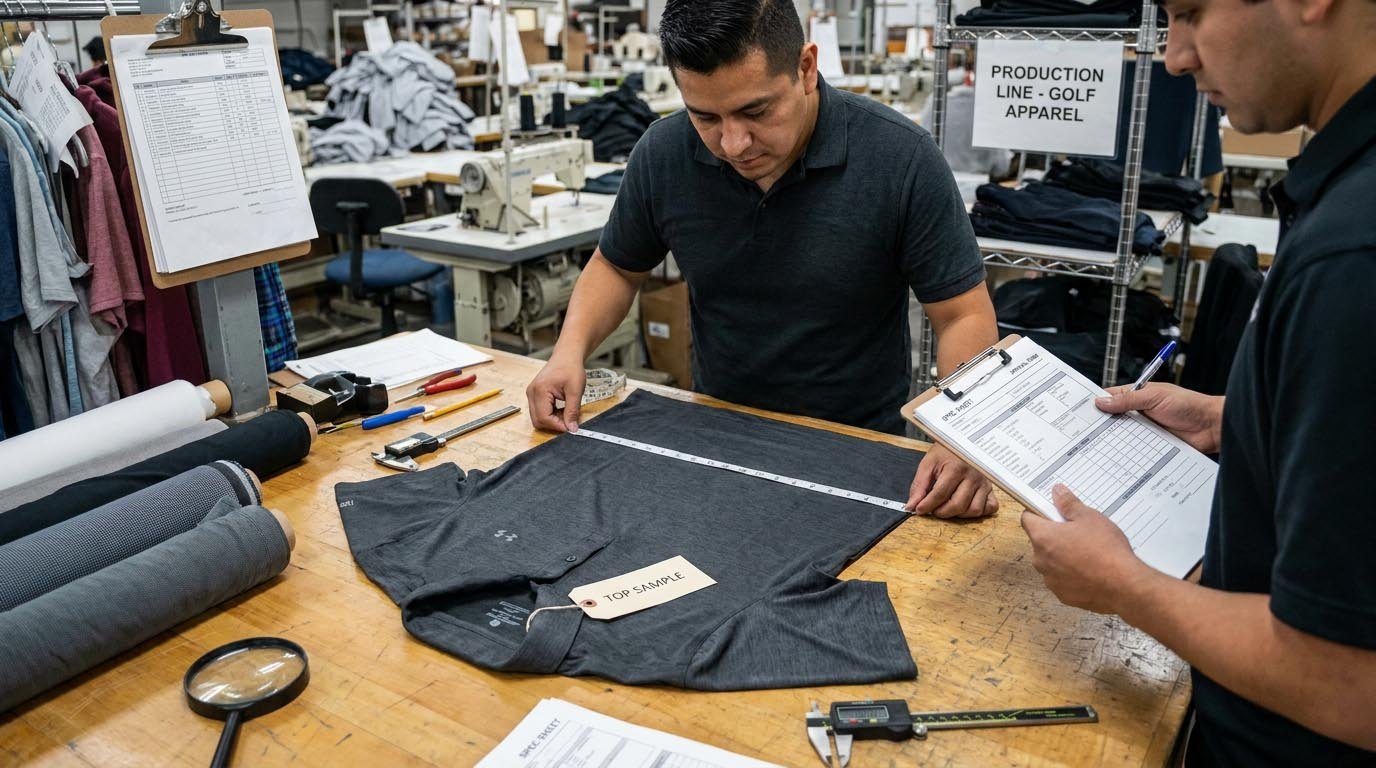
Essential Fabric Stability Checks
| Check | What to Evaluate | Potential Problem |
|---|---|---|
| Wash shrinkage | Lengthwise and widthwise dimensional change | Garment becomes shorter or narrower |
| Stretch recovery | Return after extension | Bagging at knees, elbows, or seat |
| Collar stability | Shape after washing | Curling, twisting, or distortion |
| Seam stability | Performance after washing and wear | Puckering or seam distortion |
| Finishing stability | Response to heat and pressing | Localized dimensional changes |
Testing conditions should follow the intended care instructions and agreed buyer requirements.
Is ±1.0 cm Also the Shrinkage Limit?
Not automatically.
FUWAY's ±1.0 cm standard applies to approved finished-garment measurement tolerances.
Fabric shrinkage is evaluated separately using defined laundering conditions, test methods, and acceptance criteria.
Before PP approval, brands should confirm that dimensional changes are understood and that the garment can maintain its intended fit under the agreed care conditions.
For detailed testing procedures, refer to our Golf Apparel Fabric Shrinkage Testing Guide.
Step 7: Approve the PP Sample and Review TOP When Needed
The PP sample should be the final approved reference before bulk cutting.
It must reflect the actual production specifications rather than an approximate development version.
PP Sample Approval Checklist
Before signing off, confirm:
- [ ] Final production fabric and color are approved.
- [ ] All relevant POMs meet their approved tolerances within ±1.0 cm.
- [ ] Grading and intended fit are confirmed.
- [ ] Movement testing has passed.
- [ ] Shrinkage and recovery results meet agreed requirements.
- [ ] Collars, seams, plackets, and hems are acceptable.
- [ ] Final trims, labels, and decoration details match specifications.
- [ ] The approved tech pack and sample revisions are recorded.
Keep an identified approved sample as the physical production reference, together with its measurement records and supporting specifications.
When Should Brands Request a TOP Sample?
A top-of-production sample is particularly useful when:
- Working with a new manufacturing partner
- Producing a new or complex garment style
- Using unfamiliar stretch fabrics
- Managing tight fit requirements
- Starting a high-risk production program
TOP review helps identify differences between the approved PP sample and actual early-line garments.
It should not be used to justify starting bulk production with unresolved PP approval issues.
Step 8: Record the Final Fit Approval Decision
A verbal "looks good" is not a reliable production authorization.
The final decision should clearly establish whether the garment is ready for bulk cutting or requires additional action.
Fit Approval Decision Matrix
| Decision | When to Use | Required Action |
|---|---|---|
| Approve | Measurements, grading, movement, and required tests pass | Authorize the next production stage |
| Revise | Correctable fit or dimensional issues remain | Amend specifications or sample and recheck |
| Hold | Required test results or approvals are incomplete | Stop release until outstanding issues are resolved |
| Reject | Major fit or construction failures require redevelopment | Correct pattern or construction and resample |
For example, if a polo meets all dimensional requirements but restricts shoulder rotation, the brand should request a fit revision rather than approve production.
If shrinkage results are still pending, production release should remain on hold when those tests are required for approval.
Sample Fit Approval Record
A simple approval record can prevent misunderstandings between the brand and manufacturer.
| Approval Field | Record |
|---|---|
| Style Number | __ |
| Sample ID / Size | __ |
| Tech Pack Revision | __ |
| POM Measurements | Pass / Revise |
| Size Set and Grading | Pass / Revise |
| Movement Testing | Pass / Revise |
| Fabric Stability | Pass / Hold |
| PP Sample Decision | Approve / Revise / Hold / Reject |
| Outstanding Issues | __ |
| Approved By / Date | __ |
| Bulk Cutting Authorization | Released / On Hold |
All required approvals should be documented against the same specification revision.
If changes are made after approval, confirm whether a revised sample or additional review is necessary.
The most important output of the entire process is an unambiguous production decision supported by records.
Final Printable Garment Fit Approval Checklist
Use this checklist before authorizing mass production.
Fit and Sizing
- [ ] Target customer and intended fit confirmed
- [ ] Base size chart and grade rules approved
- [ ] Representative size set reviewed
- [ ] Golf-specific movement tests passed
Measurements and Fabric
- [ ] POM definitions and measurement methods documented
- [ ] Approved dimensional tolerances comply with FUWAY's ±1.0 cm maximum
- [ ] Fit-sensitive points meet any stricter agreed limits
- [ ] Required wash and shrinkage tests passed
- [ ] Stretch recovery and construction stability confirmed
Final Production Approval
- [ ] PP sample matches final production specifications
- [ ] Final tech pack revision confirmed
- [ ] Outstanding fit issues resolved
- [ ] Approval record completed and signed
- [ ] Bulk cutting formally authorized
- [ ] TOP review arranged if required
FAQ: Garment Fit Approval Before Mass Production
Can a brand approve garment fit using only one sample size?
A single size may not reveal grading problems across the full range.
Reviewing lower, middle, and upper sizes is recommended for many programs, with additional sizes where the fit or size range requires them.
What is the difference between a fit sample and a PP sample?
A fit sample focuses on measurements, proportions, comfort, and pattern adjustments.
A PP sample confirms the final product using approved production materials, trims, construction methods, and specifications before bulk cutting.
What measurement tolerance does FUWAY use?
FUWAY controls finished-garment measurement deviations within ±1.0 cm of the approved target.
Certain POMs may require tighter limits when specified in the approved tech pack.
Can a sample pass measurement inspection but fail fit approval?
Yes.
A garment can meet its measurement specifications but still restrict shoulder rotation, ride up during movement, or have incorrect proportions.
Both dimensional compliance and functional fit must be approved.
Is a TOP sample required for every order?
Not necessarily.
TOP review is particularly useful for first-time production, sensitive fabrics, complex styles, or higher-risk orders. It does not replace PP approval.
What should a brand do if a PP sample fails?
Document the failed requirement, request correction, and verify the revised result.
Depending on the issue, this may require a measurement adjustment, pattern revision, construction change, additional testing, or another sample.
Do not release bulk cutting while required fit approvals remain unresolved.
Conclusion: Approve the Fit Before Releasing Bulk Production
A reliable garment fit approval process protects golf apparel brands from sizing inconsistency, customer complaints, and avoidable production rework.
Before mass production, confirm:
- The intended fit and size grading
- Approved POMs and measurement tolerances
- Golf-specific movement performance
- Fabric dimensional stability
- Final PP sample compliance
- Written production authorization
At FUWAY, finished-garment measurements must stay within ±1.0 cm of approved specifications, while critical points may require tighter limits.
More importantly, passing a measurement check is only part of fit approval. The garment must also deliver the comfort, proportions, and movement required by its design.
FUWAY supports golf apparel brands with product development, sampling, fit evaluation, and OEM/ODM manufacturing.
If you are preparing golf polos, shorts, trousers, skorts, or performance outerwear for production, contact FUWAY to review your fit requirements and pre-production specifications.