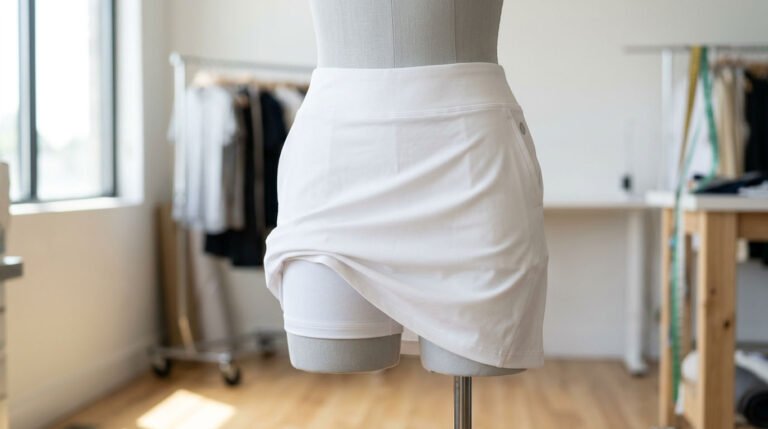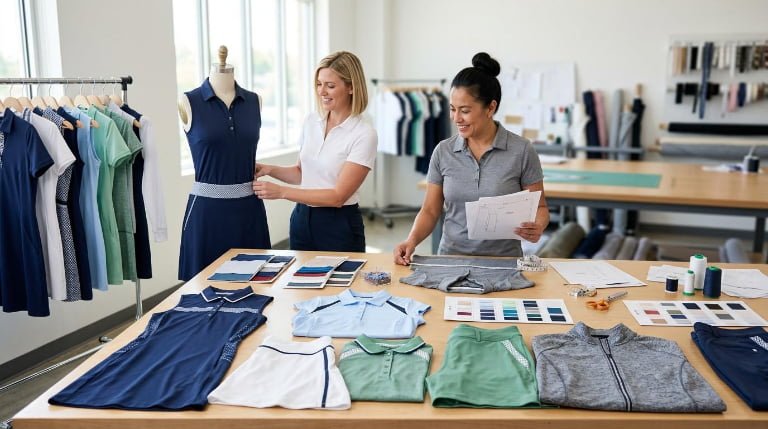
Choosing the right golf skort length involves more than copying a competitor's size chart. A skort that looks balanced on one golfer may feel too short or restrictive on another.
There is no single best golf skort length. For apparel brands, the right choice depends on customer height, waistband position, skirt silhouette, liner construction, and intended use.
This guide explains how to select, measure, and develop golf skort lengths that balance coverage, movement, and consistent sizing.

Quick Answer: What Is the Best Golf Skort Length?
Golf skorts come in different lengths, from shorter athletic designs to longer traditional styles. Many retail collections offer options around 14–20 inches, although the full market extends beyond this range.
| Development Question | Recommendation |
|---|---|
| What length should a brand choose? | Match the target customer's height, coverage preferences, and intended use. |
| Is there a standard length? | No universal measurement applies to every brand. |
| What affects finished length? | Waistband rise, measurement points, silhouette, and grading. |
| Does a longer skirt guarantee coverage? | No. Liner construction and movement also matter. |
| How should brands confirm length? | Define specifications and validate physical samples. |
Key principle: Treat golf skort length as a product-development specification rather than a fixed fashion measurement.
What Are the Most Common Golf Skort Lengths?
Retail length options provide useful references, but brands should not treat them as mandatory production standards.
For example, TAIL Activewear offers several skort lengths, including 16, 17, 18, and 19.5 inches, illustrating how different styles serve different coverage preferences.
Golf Skort Length Comparison
| Illustrative Length | Design Direction | Development Consideration |
|---|---|---|
| 14–16 inches | Shorter, athletic styling | Check coverage during movement and course suitability. |
| 16–18 inches | Balanced sport and lifestyle design | Validate fit across customer heights. |
| 18–20+ inches | Longer-coverage styling | Check movement, fabric volume, and proportions. |
These are approximate style categories, not universal sizing standards. Comparisons assume consistent measurement methods.
A 16-inch skort may appear longer on a petite golfer than on a taller wearer. Waistband placement and pattern construction can also change the finished appearance.
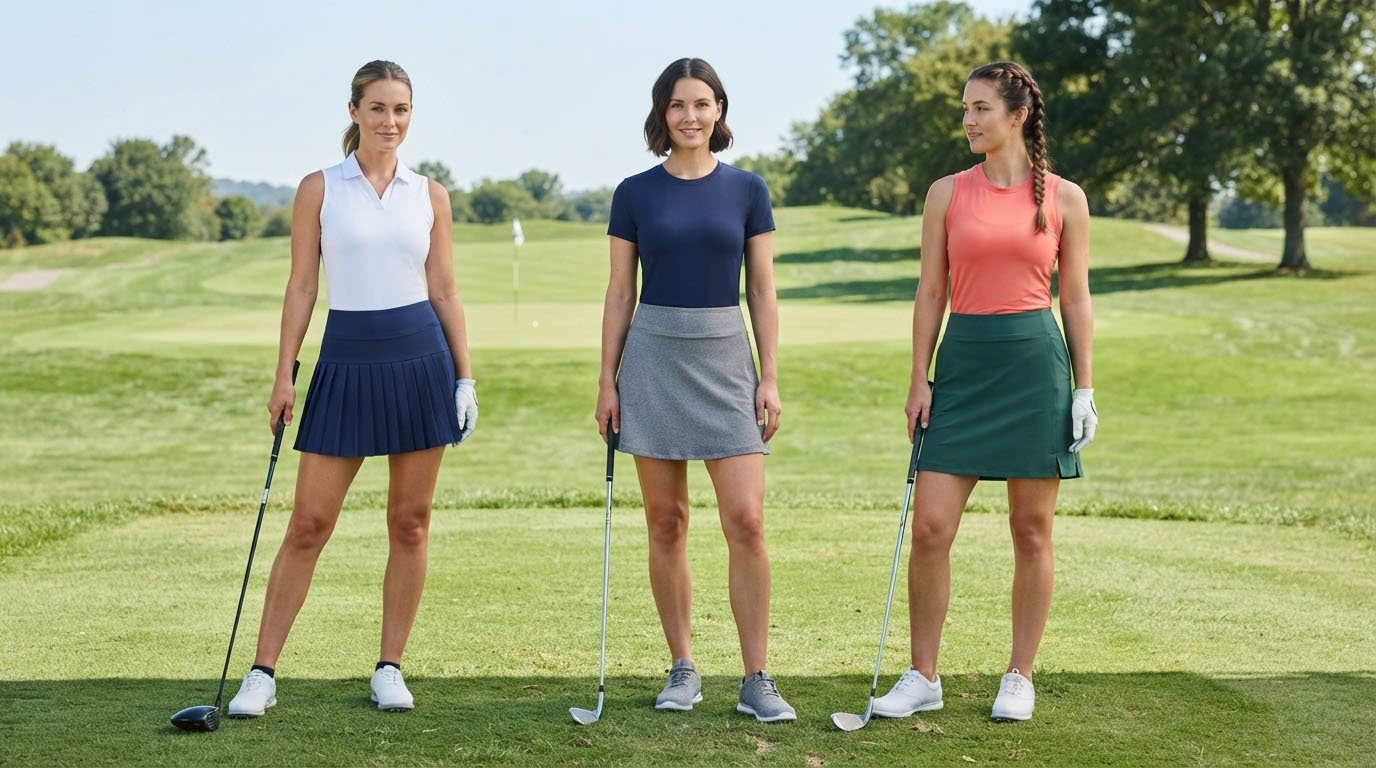
How Should Brands Choose a Starting Length?
Define three requirements before creating the base pattern:
- Target customer: Height range, size distribution, and preferred coverage.
- Brand positioning: Athletic, traditional, or lifestyle golfwear.
- Playing environment: Private clubs, public courses, resorts, or practice facilities.
Use these factors to select an initial length, then validate it through sampling.
How Should Golf Skort Length Be Measured?
A common development mistake is requesting a "16-inch golf skort" without defining the measurement method.
The same stated length can produce different results depending on whether measurements include the waistband or follow the center front or side seam.
Four Important Measurement Points
| Measurement | Definition | Purpose |
|---|---|---|
| Center Front — Including Waistband | Top center of waistband to front hem | Defines total front length. |
| Center Front — Excluding Waistband | Lower waistband seam to front hem | Separates waistband and skirt-panel measurements. |
| Side Outseam | Top of waistband to side hem along the specified measurement path | Establishes side length. |
| Center Back | Top center of waistband to back hem | Helps assess rear coverage. |
Measurements may differ on pleated, asymmetric, or curved-hem designs.
Every tech pack should identify the exact starting point, endpoint, and measurement path.
What Should the Tech Pack Include?
- Front and back technical sketches.
- Clearly marked points of measurement (POM).
- Measurement methods and units.
- Base-size specifications and grading rules.
- Agreed tolerances.
- Construction notes for pleats or asymmetric panels.
Also specify whether measurements are taken with the garment relaxed and laid flat.
For a complete production specification, see our Golf Apparel Tech Pack Checklist to learn how to document measurement points, grading rules, and construction details before sampling.
How Do Waistband Rise and Skirt Silhouette Affect Length?
Finished length depends on how the garment sits and drapes on the body.
Waistband Rise
High-rise and mid-rise skorts position the waistband differently.
A skort worn higher on the waist may have a different visible hem position from one worn lower, even when both share the same stated length.
Brands should therefore develop waistband rise and finished length together.
Skirt Silhouette
| Style | Length Development Consideration |
|---|---|
| Straight | Check hip ease and upward movement during activity. |
| A-line | Evaluate flare, drape, and side-hem balance. |
| Pleated | Check how pleats open during walking and swinging. |
| Wrap / Overlap | Confirm coverage when panels move. |
Two skorts with identical center-front lengths may provide different coverage during movement.
Front-to-Back Balance
Body curvature and garment fit influence the rear hem position.
Some patterns need additional back length or shaping to maintain the intended appearance. However, no fixed front-to-back difference works for every design.
Validate rear coverage during standing, bending, and golf movements.
How Should Golf Skort Length Change Across Sizes?
A successful size range maintains intended proportions across different body types.
Using an identical length across XS–XXL without fit validation can create inconsistent results.
Length Development by Customer Profile
| Customer Profile | Development Direction |
|---|---|
| Petite | Adjust length and waistband placement for balanced proportions. |
| Regular | Establish the primary fit using the target customer profile. |
| Tall | Evaluate additional length to maintain intended coverage. |
| Extended Sizes | Consider hip and seat measurements when checking hem position. |
Should Length Increase With Every Size?
Not necessarily.
Some brands maintain the same length across selected sizes. Others apply length grading or develop separate petite and tall options.
A practical development process is to:
- Approve the base-size fit.
- Define the intended hem position.
- Establish length grading alongside waist and hip grading.
- Test representative sizes.
- Adjust the pattern where proportions or coverage change.
Avoid applying one fixed grading increment to every design.
Why Must the Outer Skirt and Inner Liner Be Developed Together?
A golf skort combines an outer skirt with built-in shorts. Both components determine comfort, coverage, and freedom of movement.
Extending the outer skirt alone will not correct a liner that rides up or feels restrictive.
Important Liner Construction Details
| Component | What Brands Should Check |
|---|---|
| Liner inseam | Coverage, comfort, and friction during walking. |
| Leg opening | Comfortable tension without digging in or excessive ride-up. |
| Fabric stretch | Mobility and recovery after stretching. |
| Liner attachment | Smooth integration with the waistband and outer skirt. |
| Hem relationship | Appropriate liner concealment during normal wear. |
There is no universal liner-to-skirt length difference. The correct dimensions depend on silhouette, fit, and intended coverage.
Fabric Selection
Outer skirts and inner shorts may require different fabric properties.
- Outer skirt: Suitable drape, durability, stretch, and shape retention.
- Inner liner: Comfortable stretch, moisture management, recovery, and skin contact.
A woven stretch fabric may suit a structured outer skirt, while a softer stretch knit may provide better liner conformity.
Both materials should be evaluated for dimensional stability and laundering compatibility.
For material development support, explore FUWAY's golf apparel fabric sourcing capabilities.
What Golf Course Dress Codes Should Brands Consider?
Golf course dress codes influence customer expectations, particularly in traditional club environments.
However, no universal minimum golf skort length applies to every course. Requirements vary by club and location.
Brands should research dress expectations in their primary markets and avoid describing a particular length as universally compliant.
Offering two length options can help a collection serve customers with different coverage preferences.
How Can Brands Build a Golf Skort Length Specification Matrix?
A specification matrix helps align designers, patternmakers, and manufacturers before sampling.
Example Development Matrix
| Specification | What to Define | Validation |
|---|---|---|
| Base Size | Primary fit-model size | Match target customer measurements. |
| Center Front Length | Defined waistband-to-hem measurement | Check front hem position. |
| Side Outseam | Specified side measurement path | Check hem balance. |
| Center Back Length | Back measurement reference | Assess rear coverage. |
| Waistband Height | Finished waistband dimension | Confirm wearing position. |
| Liner Inseam | Crotch seam to liner hem | Check comfort and ride-up. |
| Liner Leg Opening | Defined opening circumference | Evaluate stretch and pressure. |
| Size Grading | Approved changes between sizes | Validate proportions across sizes. |
This is a development checklist, not a universal measurement standard.
Example: Developing a 17-Inch Golf Skort
Before sending a 17-inch requirement to a manufacturer, clarify:
- Is the measurement center front or side outseam?
- Does it include the waistband?
- Where should the waistband sit?
- What is the intended skirt silhouette?
- What liner coverage is required?
- How should length change across sizes?
These details allow the manufacturer to translate a general design idea into measurable specifications.
How Should Brands Test Golf Skort Length Before Bulk Production?
Measurements establish the initial design, but fit testing confirms whether the skort performs as intended.
Step 1: Confirm the Tech Pack
Review measurement points, materials, construction, and target silhouette.
Step 2: Produce the Initial Sample
Use representative production fabrics and construction methods.
Step 3: Conduct Dynamic Fit Testing
Ask a fit model to walk, swing, bend, squat, and sit. Check hem position, liner movement, and overall comfort.
Step 4: Review Additional Sizes
Test representative sizes for waistband fit, hem balance, rear coverage, and liner performance.
Step 5: Approve Production Specifications
Document final measurements, grading, tolerances, and construction details. Include laundering checks where necessary.
For the full approval workflow, see our Golf Apparel Sampling Process guide, covering prototype development, size-set fitting, and pre-production sample approval.
Frequently Asked Questions
What Is the Most Popular Golf Skort Length?
There is no universally established most popular length. Brands should evaluate customer preferences, competitor products, and intended playing environments before selecting a base length.
Is a 15-Inch Golf Skort Too Short?
Not necessarily. Its appearance depends on customer height, waistband placement, silhouette, and intended use. Fit testing is more reliable than evaluating the number alone.
How Do You Measure Golf Skort Length?
Define the starting point, endpoint, and measurement path. Specify whether the waistband is included and whether the length follows the center front, side, or center back.
Should Inner Shorts Be Shorter Than the Outer Skirt?
The liner is generally designed to provide coverage while remaining appropriately concealed during normal wear. The correct dimensions depend on the complete pattern and fit.
Conclusion: Choose Golf Skort Length Through Product Development
The best golf skort length is the one that matches your target customer, desired silhouette, and performance requirements.
For apparel brands, successful development depends on clear measurement specifications, coordinated skirt and liner construction, appropriate grading, and physical fit testing.
FUWAY supports private label golf apparel development, from product specifications and sampling to manufacturing.
Contact FUWAY to discuss your golf skort design and production requirements.