
White golf skorts are popular for their clean, classic appearance, but they present a manufacturing challenge: fabric that looks opaque on a cutting table may become see-through when stretched, exposed to sunlight, or worn during a golf swing.
For golf apparel brands, poor opacity and liner construction can lead to customer complaints, returns, and costly production revisions.
The solution is to develop the outer skirt, built-in shorts, and garment fit as one system—and test them under realistic wearing conditions before bulk production.
This guide focuses specifically on preventing transparency and liner defects in white golf skorts. For broader product development decisions, see our Women's Golf Skort Development Checklist.

Quick Answer: What Makes White Golf Skorts Opaque?
White golf skort opacity depends on fabric construction, stretch behavior, liner color, garment fit, and production consistency—not fabric weight alone.
A good production specification should address five factors:
| Factor | What Brands Should Check |
|---|---|
| Outer Fabric | Knit density, stretch recovery, and opacity under tension |
| Built-in Liner | Color contrast, coverage, fit, and seam visibility |
| Garment Construction | Pocket bags, seams, and high-stretch areas |
| Wear Testing | Bending, squatting, swinging, lighting, and moisture |
| Production QC | Approved samples, fabric-lot consistency, and finished-garment checks |
There is no universal GSM, elastane percentage, or liner color that guarantees opacity for every white golf skort.
The final fabric and construction must pass testing under the intended wearing conditions.
Why Do White Golf Skorts Become See-Through?
White golf skorts often appear acceptable during initial sampling but reveal transparency problems when worn.
The most common causes are:
- Fabric stretch: Knitted loops open under tension, particularly across the hips and seat.
- Bright or backlighting: Light can reveal skin, underwear, liner edges, or pocket bags through the outer fabric.
- Poor liner matching: A contrasting inner short creates visible shadows beneath the white skirt.
- Excessive garment tension: Tight patterns stretch the shell beyond its intended working range.
- Moisture: Some fabrics become more transparent or cling to the body when wet.
These problems can appear separately or together.
For example, a dense white fabric may look opaque when relaxed but become noticeably sheer when the wearer bends forward. Adding a liner may improve coverage, but poorly positioned liner seams can create another visible defect.
That is why opacity must be evaluated on the finished garment, not only on a fabric swatch.
Step 1: Choose Fabric That Maintains Opacity Under Stretch
Fabric weight is useful for comparing materials, but it cannot independently predict transparency.
A heavier fabric with an open knit may perform worse than a lighter fabric with a compact construction.
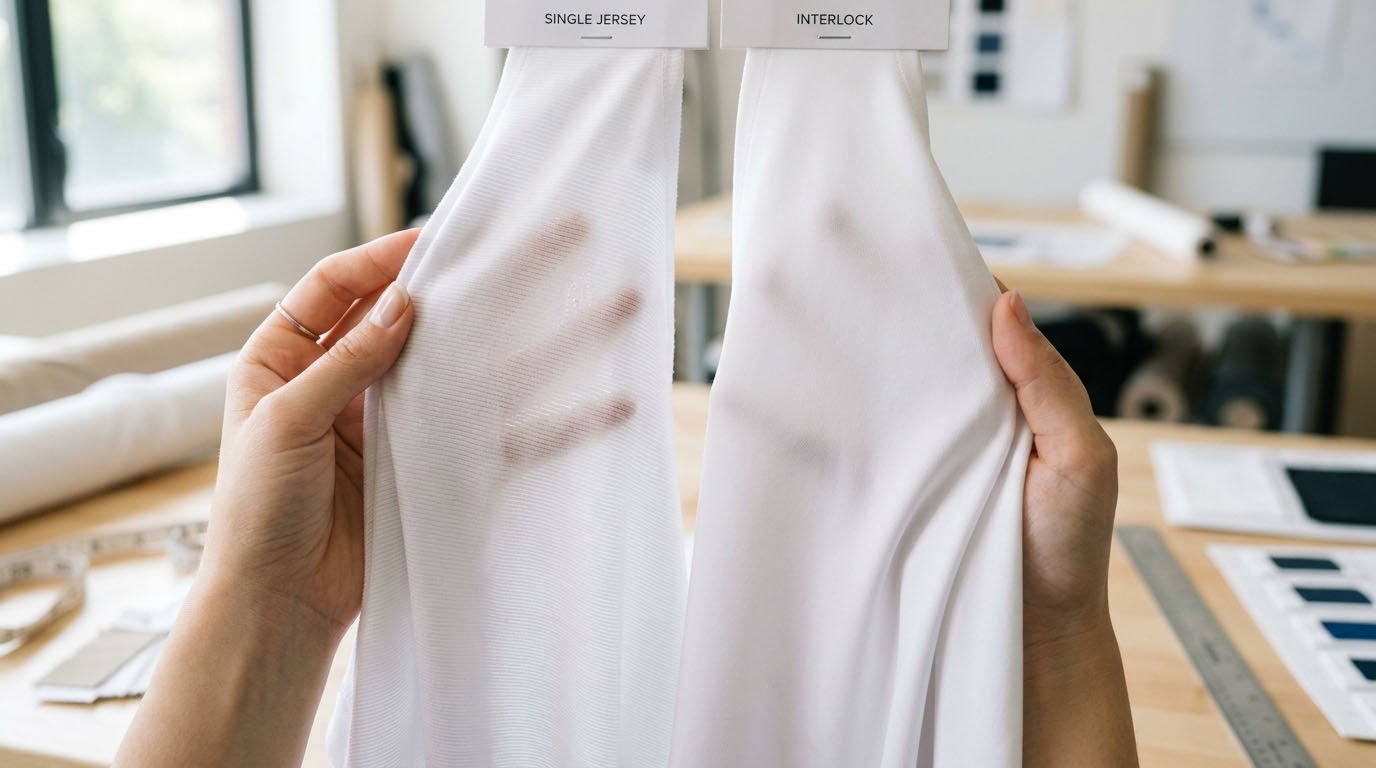
Single Jersey vs. Interlock Fabrics
| Fabric Construction | Opacity Considerations | Development Recommendation |
|---|---|---|
| Single Jersey | Can open visibly under tension, depending on density and yarn | Test carefully at high-stretch areas |
| Interlock | Double-knit structure can provide more coverage | Good candidate for white skort development |
| Compact Double-Knit | Often provides stable surface coverage | Evaluate stretch, recovery, and comfort |
| Stretch Woven | Depends on yarn coverage, weave, and mechanical stretch | Check drape, movement, and tension |
Interlock and compact double-knit fabrics are useful starting points, but they are not automatically opaque.
Yarn characteristics, fabric finishing, stretch direction, and pattern ease also influence the result.
What Should Brands Evaluate Beyond GSM?
When comparing white shell fabrics, request samples and evaluate:
- Knit density: Does the fabric maintain coverage when extended?
- Stretch and recovery: Does it return to shape after movement?
- Surface appearance: Does the material create visible shadows or excessive shine?
- Breathability: Is the fabric comfortable for warm-weather golf?
- Wash stability: Does washing change the appearance, fit, or stretch behavior?
Test candidate fabrics under similar lighting and stretch conditions rather than relying on supplier descriptions alone.
FUWAY's Fabric Sourcing service can support material selection based on the design, performance, and production requirements of a specific golf apparel project.
Step 2: Design the Built-in Liner for Coverage and Comfort
The built-in shorts are an essential part of white golf skort construction.
A liner should provide coverage during movement without creating visible seams, excessive heat, or uncomfortable pressure.
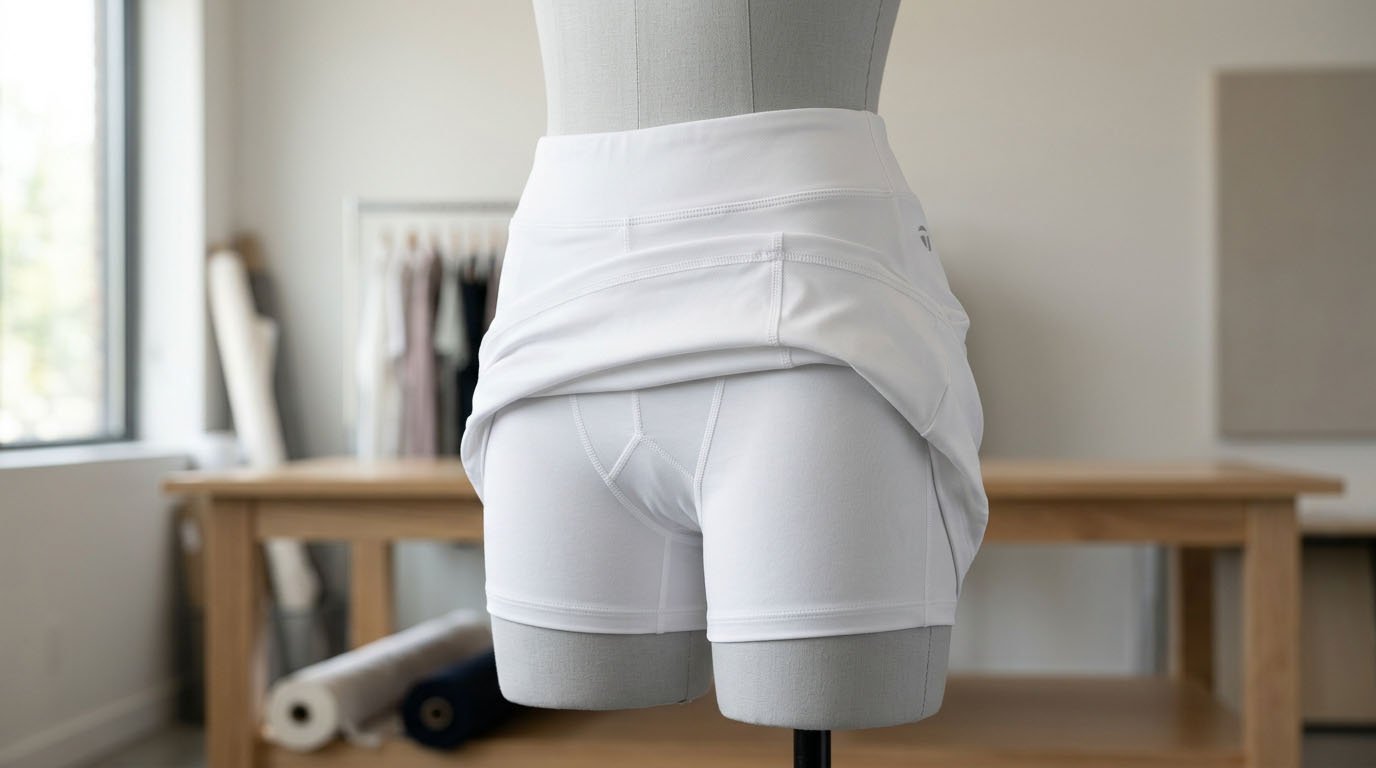
Choose the Right Liner Color
Matching the liner exactly to the white outer skirt does not always produce the least visible result.
An optical-white liner may create noticeable contrast against skin beneath a semi-transparent shell.
Depending on the outer fabric, alternatives worth testing include:
- Light nude or beige
- Sand or taupe
- Neutral gray
- Other low-contrast tones suited to the intended wearer
There is no single nude or neutral color that works equally well across all skin tones.
Evaluate liner swatches beneath the actual white shell and against representative skin tones before approving the color.
Prevent Liner Ride-Up and Visible Seam Lines
A good liner must remain stable while the golfer walks, bends, and rotates.
Important construction details include:
| Liner Detail | Quality Requirement |
|---|---|
| Leg Opening | Holds position without excessive tightness |
| Inseam Length | Provides coverage without unwanted bunching |
| Seam Construction | Minimizes bulk and visible ridges |
| Gusset | Supports movement and comfort |
| Waistband Attachment | Keeps the liner secure without pulling the skirt out of position |
| Stretch Recovery | Maintains fit after repeated movement |
Flat seams, bonded hems, or other low-profile finishes may improve appearance, but the correct solution depends on fabric behavior, durability, and production feasibility.
Avoid specifying a universal liner inseam length or seam type for every design. Different silhouettes and target customers require different solutions.
Does Adding a Second Liner Solve Transparency?
Not necessarily.
Additional layers may improve coverage but can also increase weight, heat retention, and production cost.
Before adding another layer, determine whether the actual problem is insufficient shell opacity, poor liner color matching, or excessive garment tension.
Correcting the source of the problem is often better than simply adding fabric.
Step 3: Prevent Pocket, Seam, and Liner Show-Through
Even when the outer shell and liner perform well individually, the assembled skort can develop visible defects.
White fabric may reveal pocket bags, seam allowances, reinforcement areas, or the outline of the inner shorts.
These details should be checked during sampling rather than after the production run.
Common White Golf Skort Defects and Corrections
| Production Defect | Likely Cause | Recommended Correction |
|---|---|---|
| Seat becomes see-through | Excessive tension or insufficient fabric coverage | Revise fabric construction or pattern ease |
| Liner shadow visible | High contrast between shell, liner, and skin | Test alternative liner colors |
| Pocket outline visible | Pocket bag color or thickness | Adjust pocketing material and construction |
| Liner rides up | Incorrect fit or poor leg-opening recovery | Revise liner pattern and hem |
| Seams show through | Bulky seam allowances or construction | Test a lower-profile seam solution |
| Waistband pulls or twists | Incorrect shell-liner balance | Adjust attachment and pattern fit |
| Bulk fabric looks more transparent | Material or finishing variation | Compare bulk lots with the approved reference |
Pay Special Attention to Pocket Bags
Pocket show-through is frequently overlooked.
A pocket bag that is too dark, thick, or visibly folded can create a shadow beneath the white shell.
During development:
- Compare pocketing materials beneath the approved shell.
- Inspect pocket outlines while standing and moving.
- Check that loaded pockets do not distort the outer skirt.
- Confirm both appearance and practical golf use.
Pockets should also be tested with the items the intended customer is likely to carry.
A clean appearance on an empty sample does not guarantee acceptable performance during play.
Step 4: Test Opacity During Real Golf Movements
Inspecting a white golf skort while it lies flat is not enough.
Transparency, liner movement, and seam visibility should be evaluated on a wearer during representative golf movements.
A Practical Dynamic Wear-Test Checklist
| Test | How to Evaluate | What to Look For |
|---|---|---|
| Standing Fit | Inspect under consistent lighting | Liner, pocket, and underwear outlines |
| Forward Bend | Bend into a golf address position | Seat transparency and waistband movement |
| Squat Test | Squat within the intended movement range | Shell thinning and liner coverage |
| Golf Swing | Rotate through a full swing | Liner twisting, riding up, or exposure |
| Lighting Test | Compare front-lit and backlit conditions | Visible shadows and transparency |
| Moisture Check | Evaluate the agreed damp or wet condition | Clinging and changes in coverage |
| After-Wash Check | Recheck after the agreed wash procedure | Shrinkage, recovery, and appearance |
Wear tests should include representative sizes and body shapes, particularly where pattern grading changes the stretch experienced by the fabric.

How Should Brands Define a Pass or Fail?
Avoid subjective instructions such as:
"The white fabric should not be too transparent."
Instead, agree on a repeatable inspection procedure.
For example:
Sample Opacity Acceptance Instruction
- Test the approved finished skort in its intended size and fit.
- Use documented lighting, viewing distance, and movement conditions.
- Inspect seat, hip, pocket, and liner-edge areas.
- Compare the garment against an agreed visual reference or contrast-card method.
- Record unacceptable visibility, liner exposure, or movement defects.
- Repeat relevant checks after washing or moisture exposure.
The acceptable level of show-through should be illustrated with approved reference images where practical.
A contrast card can support repeatable comparisons, but it is not automatically a universal certified opacity test. The method and acceptance limit must be agreed upon for the project.
These are practical garment-development checks, not substitutes for formal laboratory testing where a specific test method or performance claim is required.
Step 5: Approve Samples and Control Bulk Production Quality
A white skort sample can pass opacity testing while the bulk order performs differently.
Changes in fabric lots, finishing, cutting, pattern measurements, or liner components can affect the finished appearance.
The objective is to maintain consistency from approved sample to bulk production and future reorders.
Approve the Pre-Production Sample
Before production, the buyer and factory should confirm the finished PP sample against the agreed specifications.
| Approval Item | What Must Be Confirmed |
|---|---|
| Shell Fabric | Approved material, construction, color, and opacity |
| Liner | Approved material, color, coverage, and fit |
| Pocket Bags | Material and acceptable visibility |
| Measurements | Approved POM chart and tolerances |
| Construction | Seam types, hems, waistband, and attachment |
| Dynamic Performance | Movement and opacity test results |
| Reference Records | Approved sample photos, revisions, and test conditions |
For FUWAY projects, designated garment measurement points must remain within ±1.0 cm of the approved target measurements. Individual points may require tighter tolerances when specified in the confirmed Tech Pack.
Importantly, a garment meeting dimensional tolerances must still pass its separately defined opacity and liner-performance requirements.
These requirements should be documented in the Golf Apparel Tech Pack Checklist before final sample approval.
Inspect Bulk Fabric Before Cutting
Bulk material should be checked against the approved shell and liner references.
Important controls include:
- Confirm fabric and liner material identification.
- Check incoming shade and lot consistency.
- Compare opacity under agreed conditions.
- Verify stretch and recovery where specified.
- Identify material differences before cutting begins.
When different material lots are used, retain traceability so an opacity issue can be linked to the affected production.
Maintain Consistency During Sewing and Final Inspection
In-process checks should focus on defects that can change white skort appearance.
Check liner alignment, pocket bag placement, seam bulk, waistband attachment, and finished measurements.
A top-of-production (TOP) sample can confirm that the approved construction is reproduced using actual bulk materials and manufacturing processes.
Final inspection should also verify the agreed opacity and liner requirements instead of relying only on general workmanship checks.
For the wider inspection process, see FUWAY's Golf Apparel Quality Control Guide.
The key principle is simple: approve the performance standard before bulk, verify incoming materials, and inspect the finished product against the same approved requirements.
FAQ: White Golf Skort Opacity and Liner Quality
What Is the Best GSM for White Golf Skorts?
There is no universally correct GSM.
A dense, appropriately constructed fabric can offer better opacity than a heavier, loosely knitted material. Fabric selection should consider stretch, coverage, comfort, and the intended garment fit.
Always evaluate the physical sample under tension.
Should a White Golf Skort Have a White or Nude Liner?
Neither is automatically best.
White liners can create visible contrast, while nude or neutral liners may reduce shadowing. The best choice depends on the shell fabric, intended customer, and liner construction.
Compare actual material combinations before approval.
How Can Manufacturers Prevent Liner Ride-Up?
Liner ride-up can be reduced through appropriate pattern fit, leg-opening construction, fabric recovery, and secure waistband attachment.
Test the finished skort during walking, squatting, and golf swings rather than evaluating the liner separately.
Can Moisture Make White Golf Skorts See-Through?
Yes, some white fabrics become more transparent or cling more closely to the body when damp.
Moisture response depends on the material and garment construction. Test the finished skort under the intended wearing conditions and recheck appearance after drying.
Why Does a White Golf Skort Sample Pass but Bulk Production Fail?
Possible causes include fabric-lot variation, changes in material finishing, inconsistent liner components, pattern deviations, or sewing differences.
Comparing incoming materials and early bulk garments against the approved PP sample helps identify these issues before they affect the entire order.
Conclusion
Producing opaque white golf skorts requires more than choosing a thick fabric or adding an inner short.
Brands need to control the complete system:
Shell fabric → Liner color and fit → Pocket and seam construction → Dynamic testing → PP approval → Bulk quality control.
The most reliable development approach is to identify transparency risks during sampling, agree on practical acceptance criteria, and verify that bulk production matches the approved standard.
At FUWAY, we support OEM/ODM golf apparel development with fabric sourcing, sampling, construction adjustments, and production quality control.
If you are developing white golf skorts for your collection, contact FUWAY to discuss fabric options, liner specifications, and sample development before placing a bulk order.