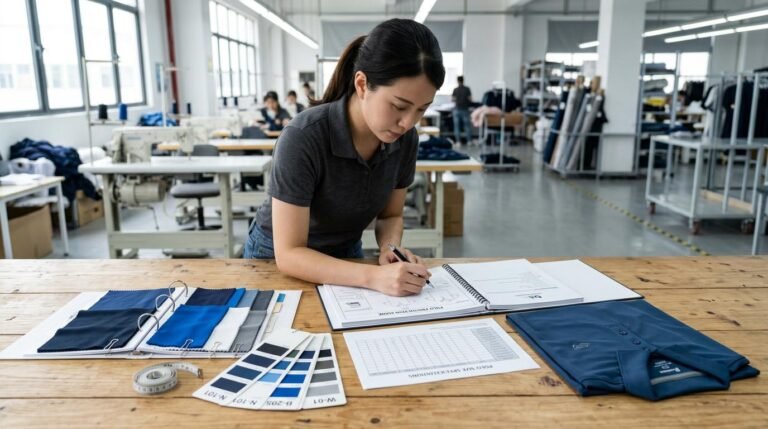
A beautiful skort that turns see-through in the sun or rides up after the first swing is a disaster. It disappoints your customers and wastes your development budget.
Develop a perfect skort using a risk-first checklist. Focus on controlling risks like fabric opacity, inner short ride-up, and pocket function from the start. Define specs and tests for these issues upfront to guarantee quality from the first sample to final shipment.
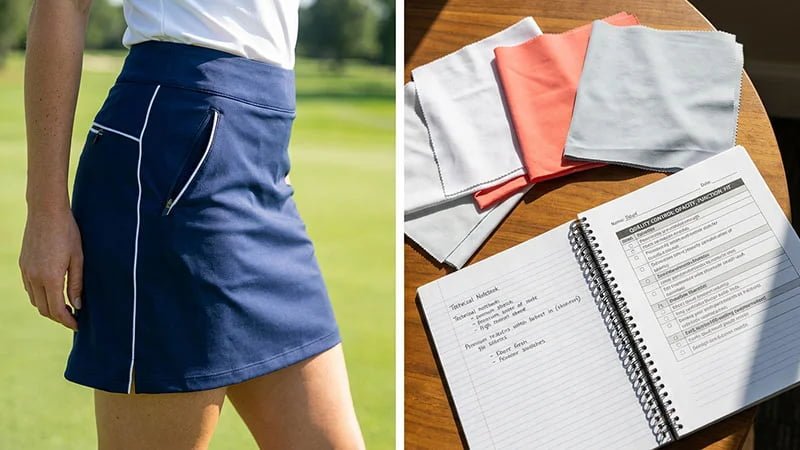
I've managed the end-to-end development for countless golf skorts, for both major international brands and new private-label sellers. The most successful projects are the ones where we identify what could go wrong first. The entire process I run is built around turning those potential failures into a series of controlled checkpoints. Let's walk through that exact checklist.
How Do You Define the Project Scope & Milestones?
An idea for a skort is not a plan. Without clear goals and a schedule, you are guaranteed to face delays and budget overruns. First, we need to make your vision a concrete project.
Start by defining your target customer, price tier, and launch window. From there, we build a development timeline with critical review "gates" to keep the project on schedule and on budget.

Before we look at fabric, we have to establish this framework. Your price point determines our material options and construction complexity. The launch season dictates the color palette and fabric weight. Here's a simplified timeline we use to map out every project.
| Phase | Key Activities | Duration (Approx.) |
|---|---|---|
| 1. Briefing & Planning | Define scope, price, target user, and features. | 1 week |
| 2. Sourcing & Development | Select fabrics and trims; create first proto sample. | 4-6 weeks |
| 3. Fit & Sales Samples | Refine fit; produce samples for marketing (SMS). | 2-3 weeks |
| 4. Pre-Production (PP) | Approve the final "golden" sample before bulk order. | 2 weeks |
| 5. Bulk Production & QC | Manufacturing, Quality Control, and Packing. | 6-8 weeks |
What Are the Market & Use Cases for a Golf Skort?
You cannot design a great golf skort by copying a tennis skirt. The movements, rules, and gear of a golfer are completely unique and must be the foundation of every design choice.
You must research club dress codes for length and design for multiple scenarios: practice, tournament play, and casual wear. Then, analyze competitor skorts to find their functional flaws and create a product that solves those specific problems.

A common mistake is trying to adapt a tennis pattern for golf—it never works. The functional differences are too great.
| Feature | Tennis Skort | Golf Skort |
|---|---|---|
| Pockets | Often just a place to tuck a ball under the hem. | Needs dedicated pockets for a phone, scorecard, tees, and a ball marker. |
| Movement | Designed for quick, lateral sprints. | Designed for a powerful, rotational swing and frequent bending. |
| Length | Can be shorter and more athletic. | Must often comply with club dress codes, requiring a more modest length. |
| Aesthetics | Tends to be more athletic and trend-driven. | Often requires a more classic, versatile style that works on and off the course. |
What Are Your Silhouette & Design Options?
The silhouette, or overall shape, is the primary driver of your skort's style. Your choice here should align with your brand's aesthetic and your target customer.
Choose a core silhouette like A-line or pleated and consider a multi-length strategy (e.g., 16" and 18") to appeal to a wider range of players. Use design elements like panels and action pleats to build in mobility for the golf swing.
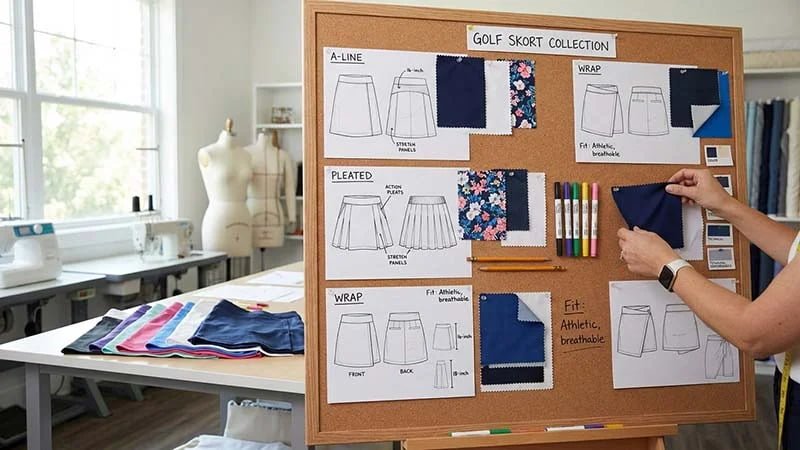
The best designs use style lines not just for looks, but for function. An A-line is a classic, universally flattering fit. Strategic "action pleats" on the sides can provide extra room for movement without making the entire skort flared. Offering a "Regular" and "Long" version of your most popular style is a proven strategy to make your brand more inclusive and compliant with stricter club dress codes.
What Is the Right Fabric & Performance Combination?
The fabric and inner short are the performance core of the skort. This is where the biggest technical risks lie, especially ensuring opacity in light colors.
Pair the right outer fabric with the right inner short. For the outer, choose a dense knit (Nylon/Spandex for feel; Poly/Spandex for durability) and verify its performance for opacity, stretch recovery, sun protection, and durability.
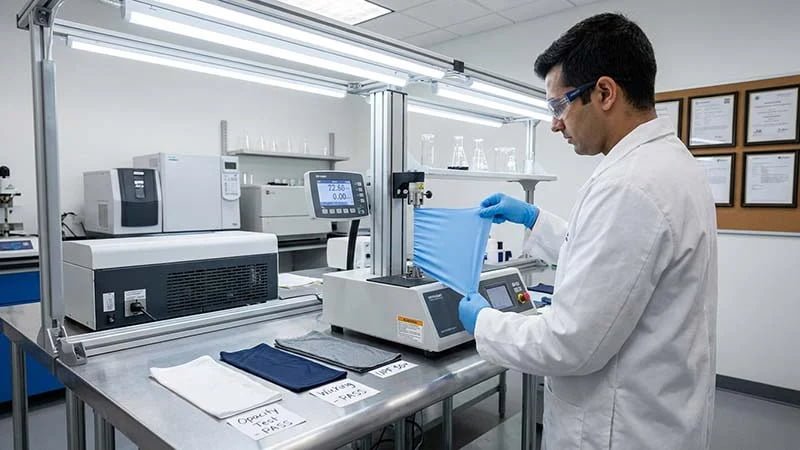
Simply putting "4-way stretch" on a tech pack is not enough. Here are the performance criteria we build into the spec:
- Main Fabric: We choose between Nylon/Spandex blends, which offer a softer hand-feel, and Polyester/Spandex blends, which provide excellent durability and color retention. Spandex content should be between 12-20%.
- Opacity & Anti-Cling: Light-colored fabric must be dense enough to not be see-through. My factory has a mandatory "squat test" under strong lights to verify this. An anti-static finish is also key to prevent unsightly clinging.
- Wicking, UPF, & Snag Resistance: The fabric must pull moisture away from the skin (wicking), offer a lab-certified UPF 50+ rating for sun protection, and have a high resistance to snagging.
- DWR & Chemical Compliance: A PFAS-free DWR (Durable Water Repellent) finish is the modern standard for shedding light moisture. All materials must also be certified to meet global chemical safety regulations (RSL).
How Do You Design the Perfect Built-in Inner Short?
An inner short that rides up is the single most common and frustrating complaint about skorts. A great inner short should feel like it's not even there.
Design the inner short with a breathable, 4-way stretch fabric and a crotch gusset for comfort. The secret to preventing ride-up is the perfect combination of inseam length and a reliable silicone gripper at the leg opening.
I treat the inner short as a separate, critical product. Here are the key components:
- Gusset & Crotch Curve: We use a diamond-shaped "gusset" in the crotch to eliminate uncomfortable seams and improve mobility.
- Inseam & Gripper Elastic: The inseam must be long enough to prevent chafing but not so long that it peeks out. A 1-2 cm wide silicone gripper inside the hem is the single most important feature to stop it from rolling up.
- Breathable Mesh: The inner short should be made from a lighter, more breathable fabric than the outer skirt, such as a power mesh, to prevent overheating.
What Are the Key Waistband & Structural Details?
The waistband is the anchor of the skort. It needs to provide support and comfort without digging in, rolling over, or creating a bulky look.
For golf, a contoured, mid-to-high-rise waistband offers the best comfort and coverage during the swing. Use a wide, flat elastic or an internal power mesh lining to provide gentle, smooth support and prevent rolling.
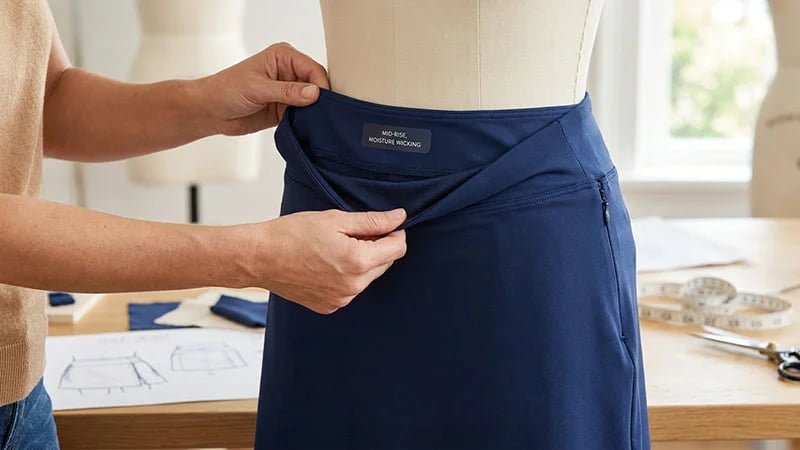
A "contoured" waistband uses a curved pattern piece that follows the natural shape of a woman's hips, which prevents gaping at the back. We also prefer to use flexible heat transfer care labels instead of scratchy woven tags inside the waistband for maximum comfort. For closures, a hidden side zipper provides a cleaner look and is more comfortable than a back zip when sitting in a golf cart.
How Do You Integrate Smart Pockets & On-Course Utility?
Pockets are a core feature, not an afterthought. They must be designed for the specific items a golfer carries and not interfere with their game.
Design dedicated pockets for a phone, scorecard, and tees. The most effective phone pocket is a patch pocket on the thigh of the inner short. A welt pocket on the back hip is ideal for a scorecard or glove.
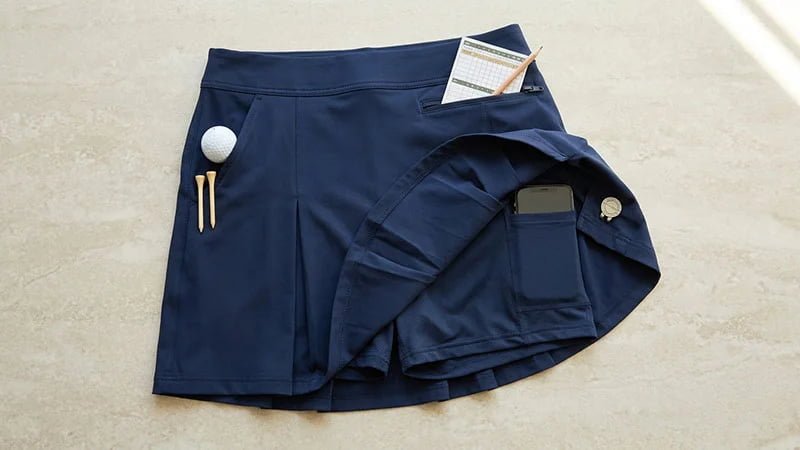
The placement and construction of pockets are critical to prevent them from bulging or getting in the way.
| Pocket Type | Best Placement | Use Case & Design Notes |
|---|---|---|
| Phone Pocket | Side of thigh on the inner short. | Securely holds a phone without bouncing. The top edge is often bonded for a clean finish. |
| Scorecard Pocket | Back right side, below the waistband. | Easy access for a right-handed player. A hidden zip or welt design keeps it sleek. |
| Ball/Tee Pocket | Front hip pockets (if silhouette allows). | Must be made with lightweight pocket bags to prevent bulging. |
| Premium Features | Hem or pocket flap with a hidden magnet. | A great spot to hold a metal ball marker for easy access on the green. |
How Do You Create a Final Risk Checklist?
Success comes from anticipating problems. This checklist summarizes the most common failures I have seen and the factory-floor strategies we use to prevent them. It is the heart of our entire development process.
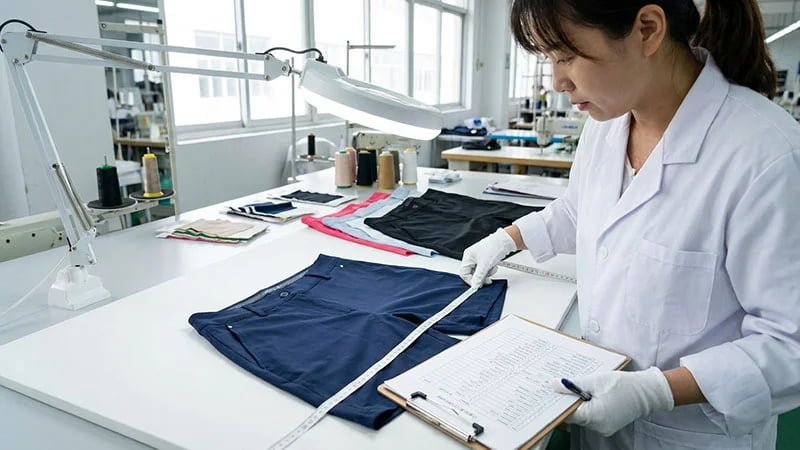
The biggest risks are a sheer white fabric, inner shorts that ride up, and bulky pockets. Each of these can be solved with the right specs, construction techniques, and mandatory wear-testing before production.
| Risk | Common Cause | My Prevention Strategy |
|---|---|---|
| White Sheerness / Static Cling | Fabric is too thin; wrong fiber choice. | Specify fabric minimum GSM. Perform a mandatory "squat test" under strong lights. Pair with an opaque inner short and use an anti-static finish. |
| Inner Short Rides Up | Inseam is too short; weak or no gripper elastic. | Specify minimum 4-inch inseam. Use a 1-2 cm wide silicone gripper. Verify with a walk/squat/swing wear-test protocol. |
| Pocket Bulge / Gaping | Poor pocket placement; heavy pocket bag fabric. | Use lightweight mesh for pocket bags. Place pockets on flatter planes of the body. Test with a phone and golf balls during every fit session. |
| Waistband Rolling | Elastic is too narrow or waistband is not contoured. | Use a wide (at least 1.5 inch) flat elastic. Mandate a curved pattern piece for the waistband to follow the body's natural shape. |
| Seam Waviness ("Lettucing") | Incorrect sewing machine tension for stretch fabric. | Specify the correct stitch type and require the use of differential feed during sewing. This simple machine setting ensures seams on stretch fabrics lay perfectly flat. |
Frequently Asked Questions?
After helping hundreds of brands launch apparel, I hear the same practical questions. Here are the answers to the most common ones about developing a golf skort.
These are the real-world business and product questions that come up during development. Getting these right will help you build a better product and a stronger, more profitable brand.
How can I reduce the cost of my first skort without making it look cheap?
Focus on simplifying the construction and using stock materials. The perceived quality comes from the fit and the fabric feel, not necessarily from having dozens of features.
The easiest way to lower the price is to reduce the number of seams and panels, as this directly reduces sewing time (the "CM" cost). Choose a classic A-line silhouette instead of complex pleats. Opt for two well-placed pockets instead of four. Most importantly, use a high-quality fabric that your supplier holds in stock—this dramatically lowers both cost and minimum order quantity (MOQ).
What is a realistic MOQ, and how can I start with a smaller order?
A typical MOQ for a fully custom skort is between 500 to 1,000 units per color. However, there are ways to start smaller.
The best strategy for new brands is to choose a fabric and color that your factory partner keeps in stock. Because we buy these materials in huge quantities, we can often offer you a much lower MOQ, sometimes as low as 200-300 units per color. You might pay a small surcharge for the smaller run, but it's the best way to test the market without a huge upfront investment.
You mentioned white skorts are risky. Are they even worth the trouble?
Yes, absolutely. A classic white skort is a timeless bestseller. The risk is not a reason to avoid it; it's a reason to plan for it properly.
The "trouble" only happens when a brand doesn't follow the checklist. If you specify a dense knit fabric, pair it with an opaque inner short, and conduct a mandatory opacity "squat test" before production, you eliminate the risk. A well-made white skort that provides total confidence is a huge competitive advantage.
How long does the whole process take, from my initial idea to having skorts ready to ship?
You should budget for approximately 3 to 4 months for the entire process. This can vary, but it's a safe estimate for planning.
This timeframe breaks down into two main phases. The first is Development and Sampling, which takes about 4-6 weeks. This includes fabric sourcing, creating the first prototype, and refining the fit until you approve the final Pre-Production (PP) sample. The second phase is Bulk Production, which takes about 8-10 weeks after you've signed off on that PP sample.
What's the best way to ensure my sizing is right and reduce fit-related returns?
The single best thing you can do is wear-test your samples on real people who match your target customer—not just on a professional fit model.
Have a few different women in your target size range wear the skort for a day, or even play a round of golf in it. Get their feedback on the waistband, the inner short, and the pocket placement. Once you have a great fit, create a detailed size chart for your website that includes not just waist and hip, but also the skort's outseam length so customers know exactly what they are buying.
Conclusion
Developing a great women's golf skort is about process and prevention. By using a risk-first checklist, you can turn potential problems into a clear, actionable plan for creating a high-quality product.